
Life, 1894-03-08 · page 13 of 14
Life — March 8, 1894 — page 13: what you’re looking at
What you’re looking at
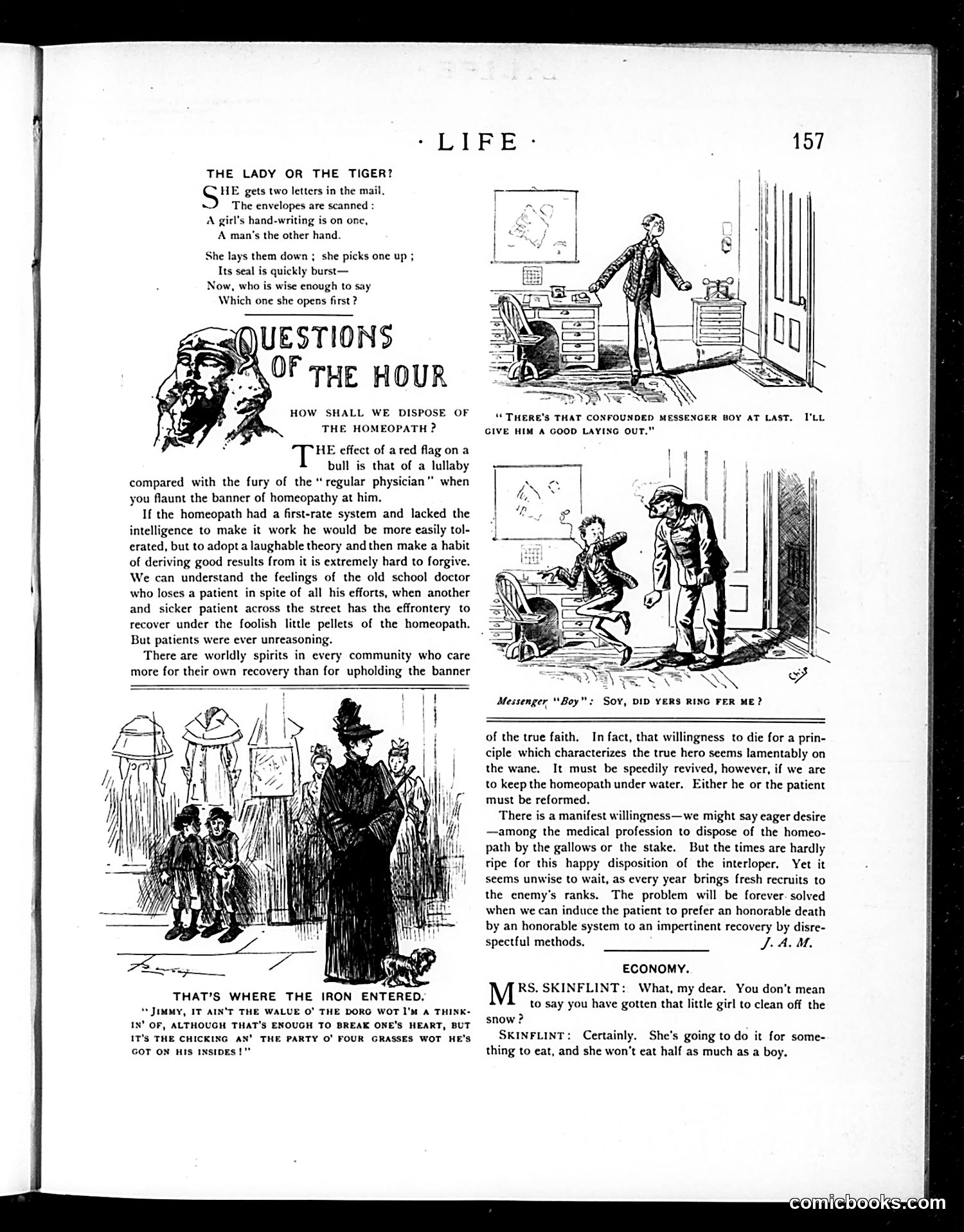
This page contains three distinct satirical pieces targeting professional and social hypocrisy: **"The Lady or the Tiger?"** — A humorous poem about a woman receiving two letters (one from a woman, one from a man) and which she opens first, playing on romantic uncertainty. **"How Shall We Dispose of the Homeopath?"** — The main satire mocks conventional medical doctors' fury at homeopathy's success. The piece ironically suggests that regular physicians resent homeopaths because patients *recover* under alternative medicine—contradicting their theoretical objections. The savage rhetoric ("gallows or the stake") satirizes doctors' professional jealousy masquerading as scientific principle. A messenger boy illustration accompanies this. **"Economy"** — A brief dialogue satirizing miserly exploitation: a woman (Mrs. Skinflint) has hired a poor girl to shovel snow for food scraps, deliberately choosing a child over a boy because she'll consume less. This exposes class cruelty disguised as frugality. The page's humor relies on exposing gap between stated principles and actual motives—whether romantic indecision, professional gatekeeping, or exploitation of poverty.
📄 Transcribed text from this page (OCR, searchable)
Machine-transcribed from the original scan — historical spelling and the odd misread are preserved.
THE LADY OR THE TIGER? HE gets two letters in the mail. The envelopes are scanned : A girl's hand-writing is on one, A man's the other hand. She lays them down ; she picks one up ; Its seal is quickly burst— Now, who is wise enough to say Which one she opens first ? HOW SHALL WE DISPOSE OF THE HOMEOPATH ? HE effect of ared flag on a bull is that of a lullaby compared with the fury of the “regular physician" when you flaunt the banner of homeopathy at him. If the homeopath had a first-rate system and lacked the intelligence to make it work he would be more easily tol- erated, but to adopt a laughable theory and then make a habit of deriving good results from it is extremely hard to forgive. We can understand the feelings of the old school doctor who loses a patient in spite of all his efforts, when another and sicker patient across the street has the effrontery to recover under the foolish little pellets of the homeopath. But patients were ever unreasoning. There are worldly spirits in every community who care more for their own recovery than for upholding the banner THAT’S WHERE THE IRON ENTERED. JimMy, 17 AIN'T THE WALUE 0' THE DORG WOT I'M A THINK: IN’ OF, ALTHOUGH THAT'S ENOUGH TO BREAK ONE'S HEART, BUT IT'S THE CHICKING AN’ THE PARTY 0’ FOUR GRASSES WOT HE'S GOT ON HIS INSIDES!"" “THERE'S THAT CONFOUNDED MESSENGER BOY AT LAST. GIVE HIM A GOOD LAYING OUT.” Messenger “Boy”; SOY, DID YERS RING FER ME? of the true faith. In fact, that willingness to die for a prin- ciple which characterizes the true hero seems lamentably on the wane. It must be speedily revived, however, if we are to keep the homeopath under water. Either he or the patient must be reformed. There is a manifest willingness—we might say eager desire —among the medical profession to dispose of the homeo- path by the gallows or the stake. But the times are hardly tipe for this happy disposition of the interloper. Yet it seems unwise to wait, as every year brings fresh recruits to the enemy's ranks. The problem will be forever. solved when we can induce the patient to prefer an honorable death by an honorable system to an impertinent recovery by disre- spectful methods, J. A.M. ECONOMY. RS. SKINFLINT: What, my dear. You don’t mean to say you have gotten that little girl to clean off the snow ? SKINFLINT: Certainly. She's going to do it for some- thing to eat, and she won't eat half as much as a boy.