
A complete issue · 16 pages · 1894
Life — January 18, 1894
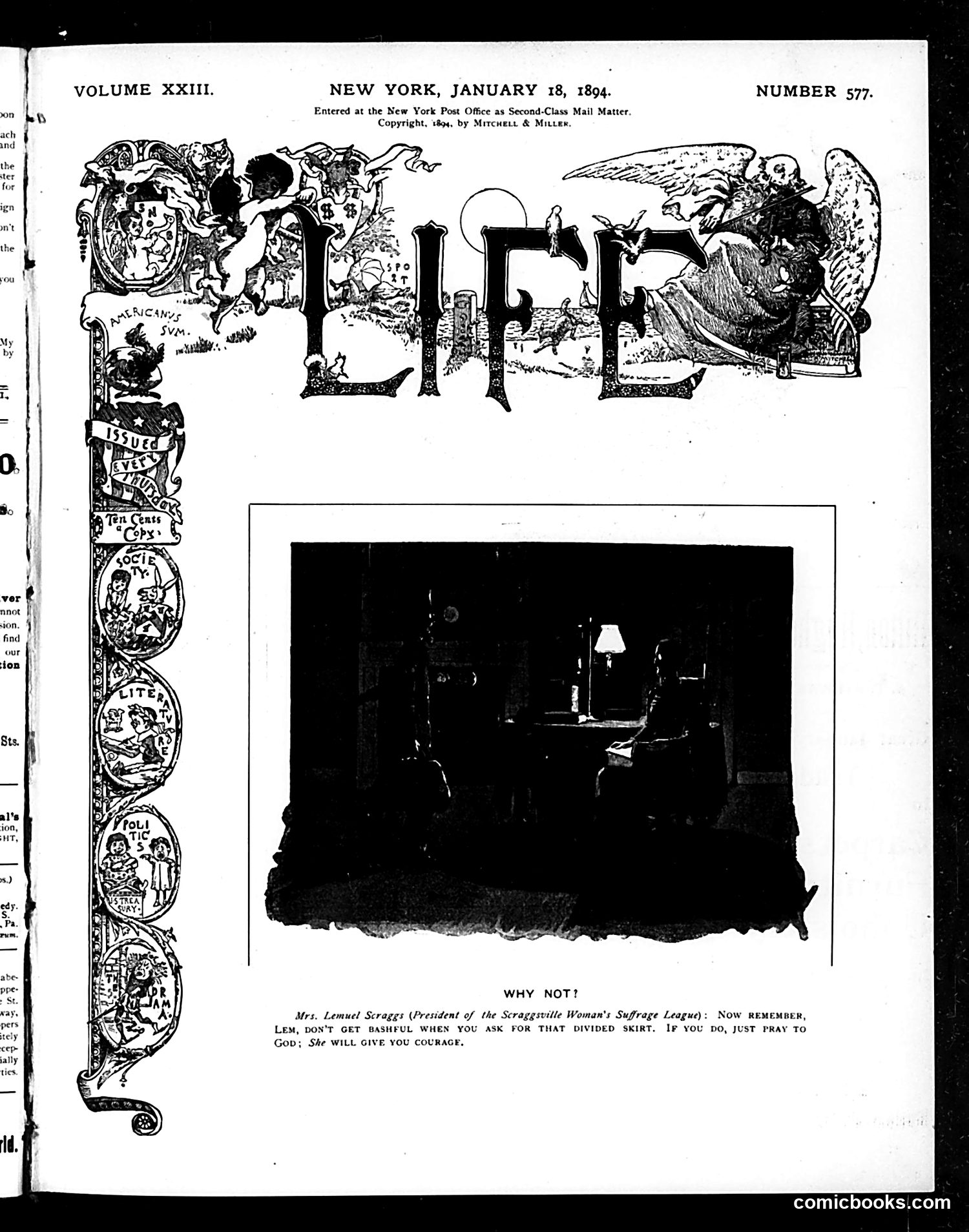
This page features a satirical cartoon titled "Why Not?" The text references Mrs. Lemuel Scrapggs, identified as "President of the Scrapgsville Woman's Suffrage League." The accompanying caption humorously advises that when asking for "that divided skirt," one should "just pray to God" for courage—suggesting the divided skirt (an early form of women's trousers or bloomers) was considered shockingly radical and required divine intervention. The joke targets the women's suffrage movement by mocking both the divided skirt as scandalous attire and women activists' moral earnestness. The dark photograph below remains unclear but likely illustrates the controversial garment or a suffragist gathering. This reflects 1894 attitudes that equated women's political rights with challenges to social propriety and feminine dress codes.
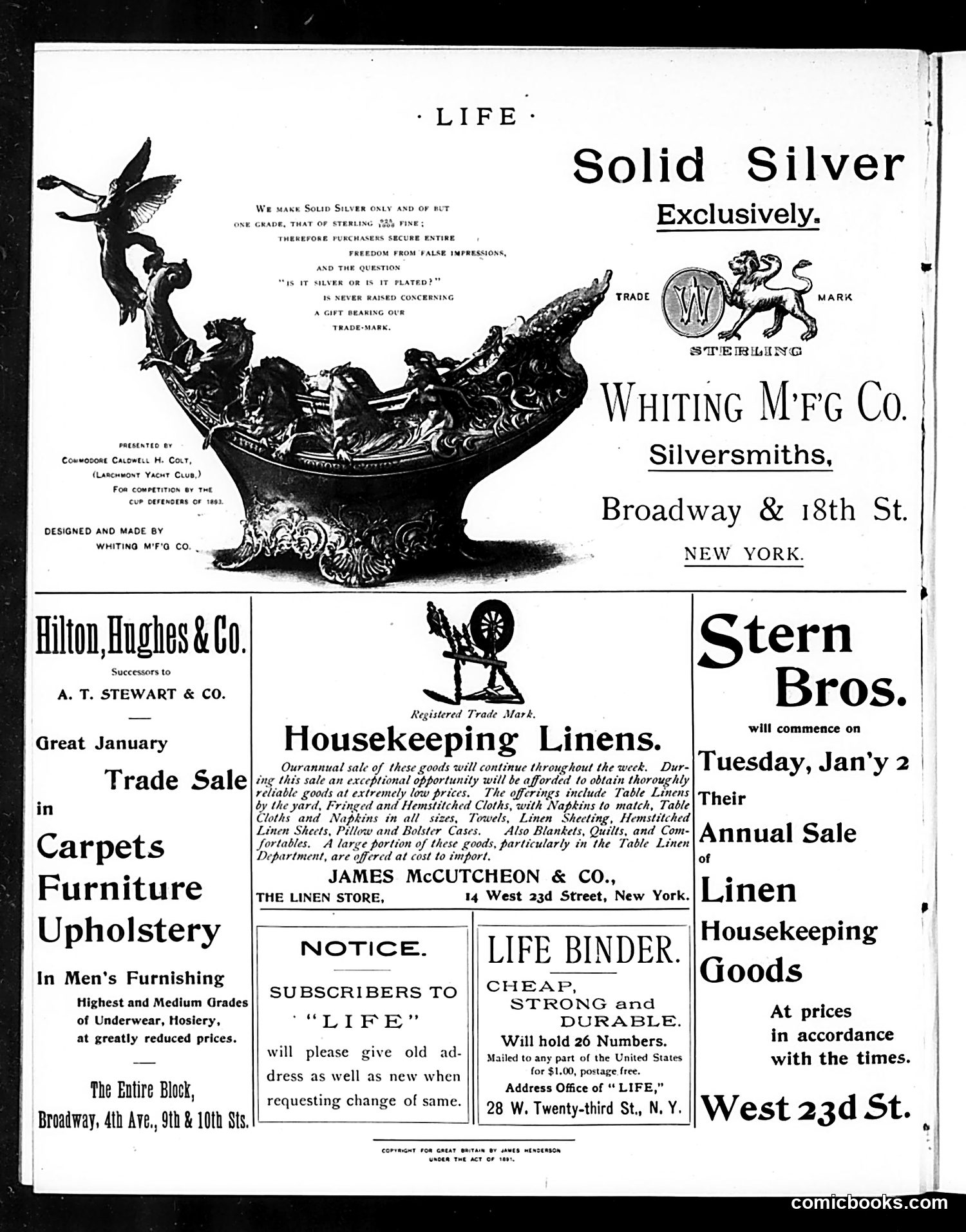
This page is primarily **advertising, not satirical content**. The central image shows an ornate silver vessel or trophy, promoting Whiting Manufacturing Company's sterling silver goods made exclusively in New York. The surrounding advertisements are for period retail establishments: Hilton, Hughes & Co. (carpets and furniture), James McCutcheon & Co. (linens), and Stern Bros. (housekeeping goods). There's also a notice to Life magazine subscribers about address changes and an advertisement for a "Life Binder" for collecting magazine issues. **No political cartoon or satire is evident here.** This is a commercial page from what appears to be an early 20th-century issue of Life magazine, when the publication heavily relied on advertising revenue alongside its actual editorial content.
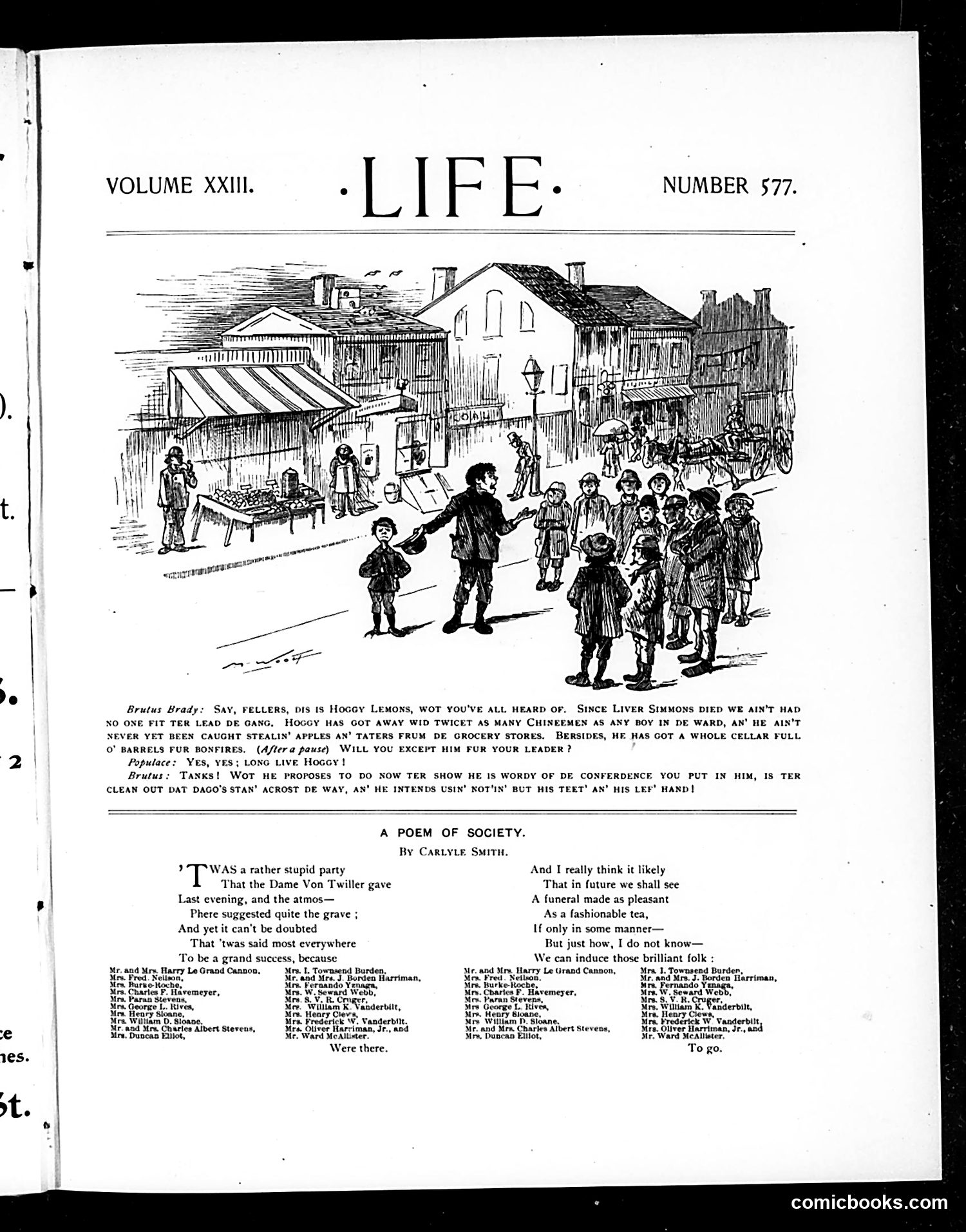
The main illustration depicts a street scene where a man in dark clothing is speaking to a group of children. The caption below, written in dialect, involves characters named "Brutus Brady," "Hoggy Lemons," and "Liver Simmons," discussing petty theft and the qualities of a street leader. The accompanying poem "A Poem of Society" by Carlyle Smith satirizes upper-class social gatherings, mocking a "rather stupid party" given by a "Dame Von Twitler" and suggesting that fashionable society functions are dull and superficial. Together, these pieces contrast working-class street life with genteel society, using humor to critique both the criminality of urban poverty and the pretensions of wealthy social circles. The satire suggests moral failings exist across all class levels.
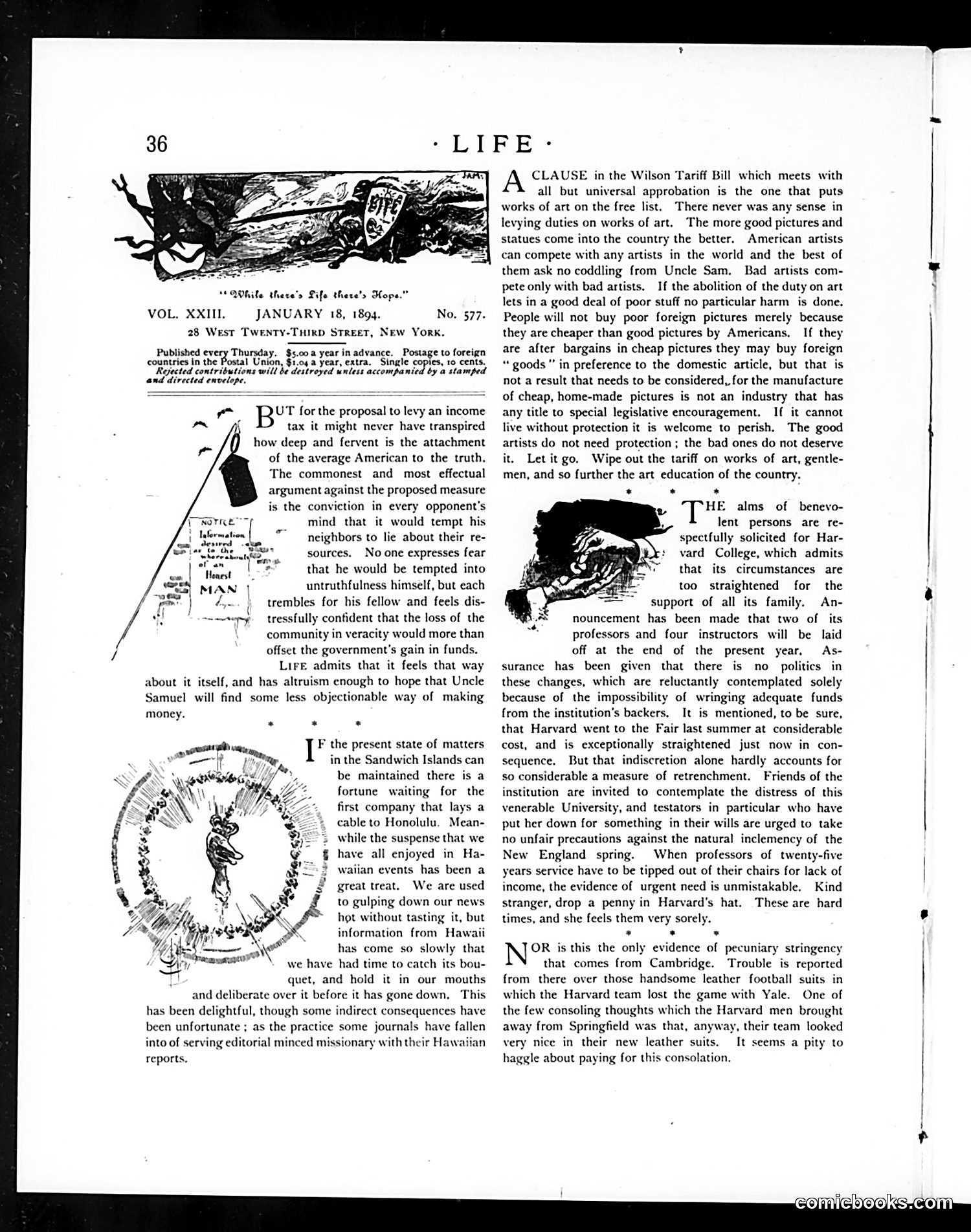
The page contains three editorial cartoons addressing contemporary issues: 1. **Top cartoon**: Depicts a skeletal, demonic figure labeled "While there's Life there's Hope"—likely satirizing poverty or economic hardship during the 1890s depression. 2. **Middle cartoon**: Shows a figure labeled "NOTICE" with text about "Information" and "MAN," appearing to critique public discourse or misinformation spreading about labor/economic issues. 3. **Bottom cartoon**: Features a figure suspended in a circular diagram, possibly referencing Hawaiian or colonial affairs—the text mentions Sandwich Islands and Hawaii, suggesting satire about American imperial interests in the Pacific. The accompanying editorial text discusses tariffs on imported art and Harvard College's financial difficulties, indicating Life's focus on elite intellectual and economic policy debates of the 1890s.
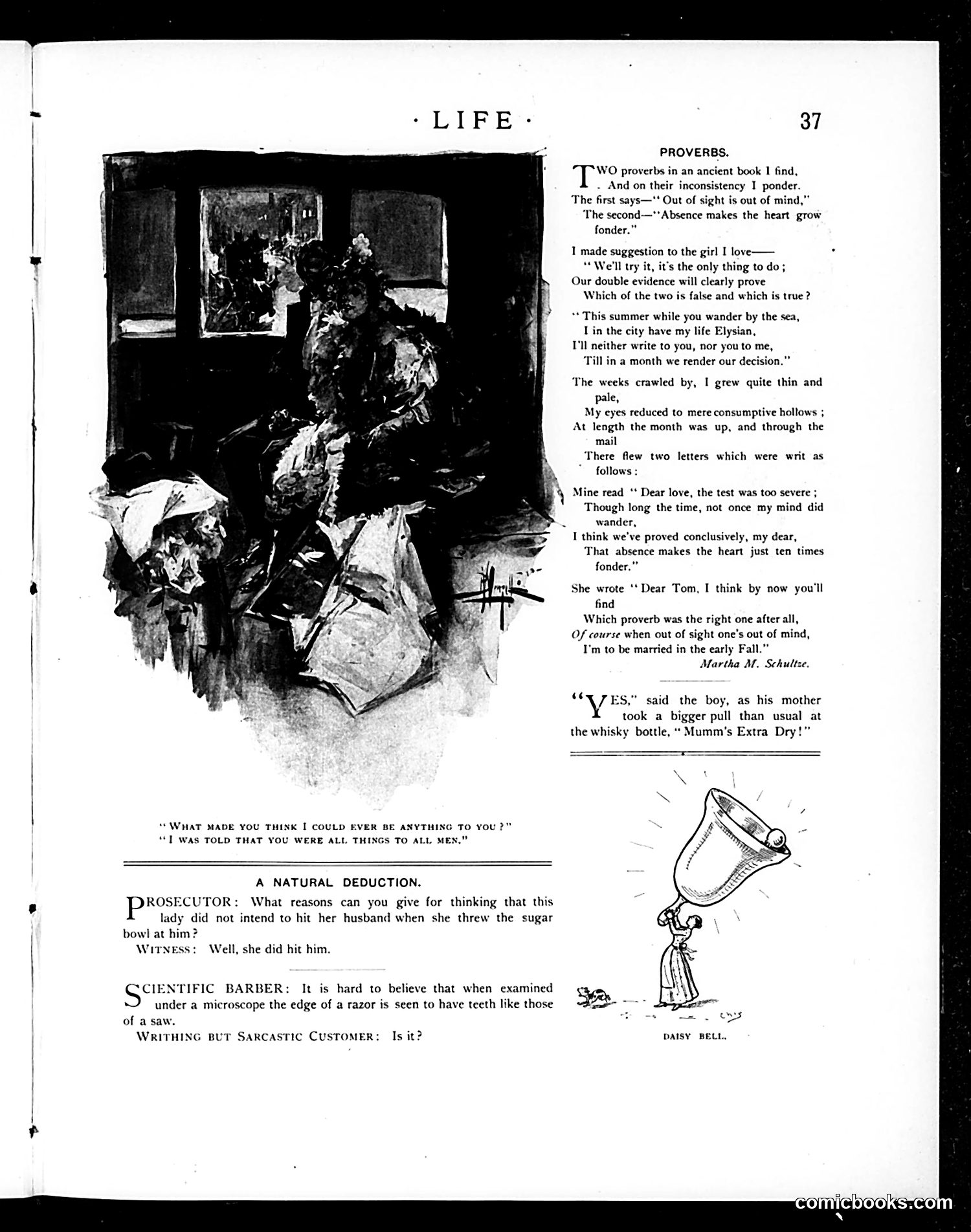
This page contains three distinct humor pieces: **"Proverbs"** (top right): A romantic narrative about separation testing a couple's love, concluding with the boy's mother offering whisky, suggesting alcohol as comfort—a joke about drinking habits. **"A Natural Deduction"** (bottom): A courtroom joke where a prosecutor asks why the lady didn't intend to hit her husband when she threw a sugar bowl at him. The witness responds "she did hit him," creating absurdist logic humor. **"Scientific Barber"** (bottom middle): A barber claims microscopic examination shows razor edges have saw-like teeth. A sarcastic customer questions this dubious "scientific" claim—satirizing pseudoscientific marketing. **"Daisy Bell"** (right): A small cartoon of someone holding a large drinking vessel, likely referencing the song "Daisy Bell." These represent typical early-20th-century satirical humor targeting romance, marriage dynamics, and consumer skepticism.
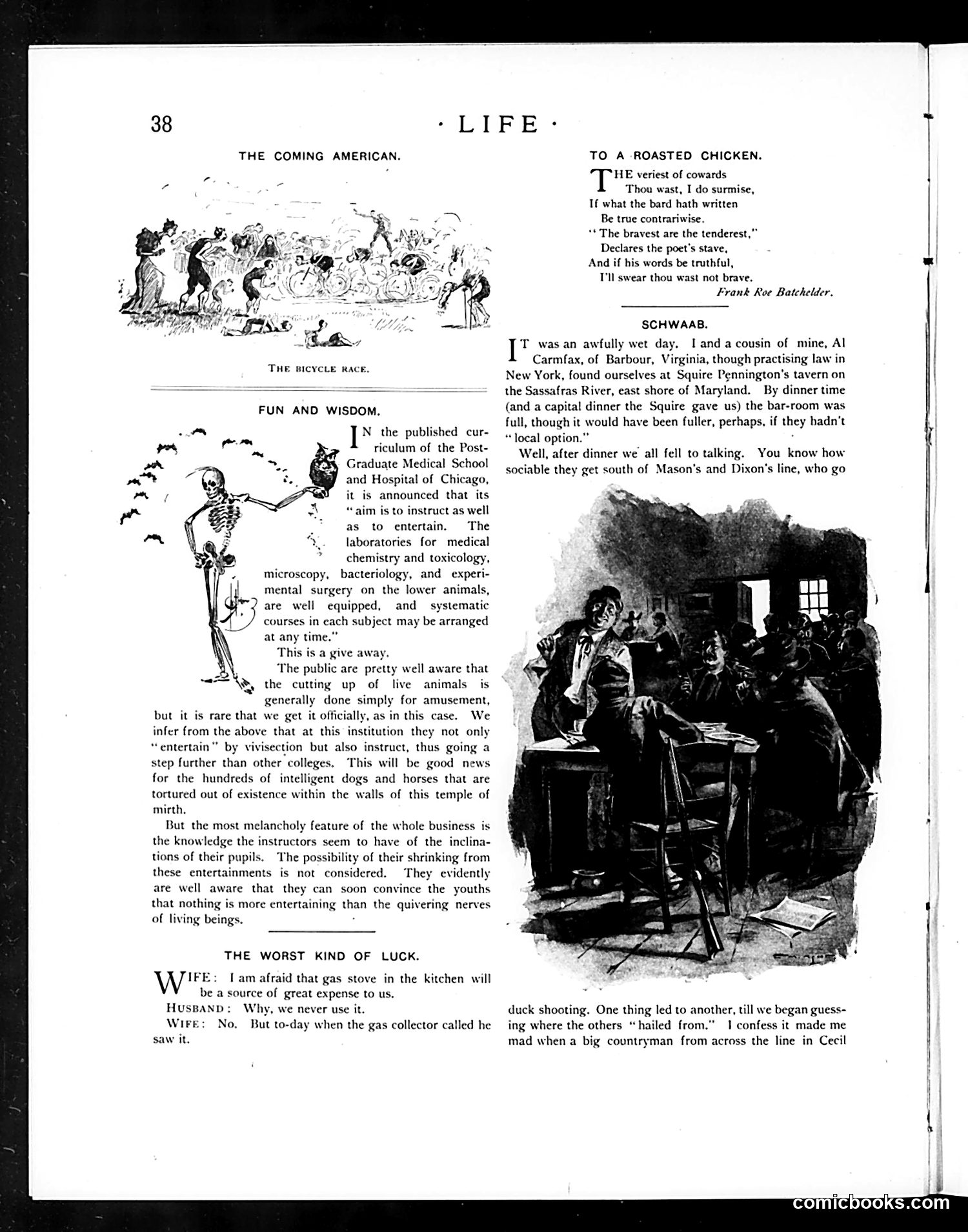
**"The Coming American"** (top left): A satirical sketch showing a bicycle race, mocking the popularity of cycling as a fad among Americans of the era. **"Fun and Wisdom"** (left): Critiques the Post-Graduate Medical School and Hospital of Chicago's claim to "instruct as well as entertain" through vivisection (live animal experimentation). The skeleton figure suggests dark humor about their methods. The satire questions whether torturing animals for entertainment disguises itself as education, and notes instructors seem unconcerned about animal suffering. **"To a Roasted Chicken"** (top right): A poem by Frank Roe Batchelder addressing timidity and bravery. **"Schwaab"** (right): A tavern anecdote about duck hunting and regional boasting, appearing to be humor focused on rural Americana.
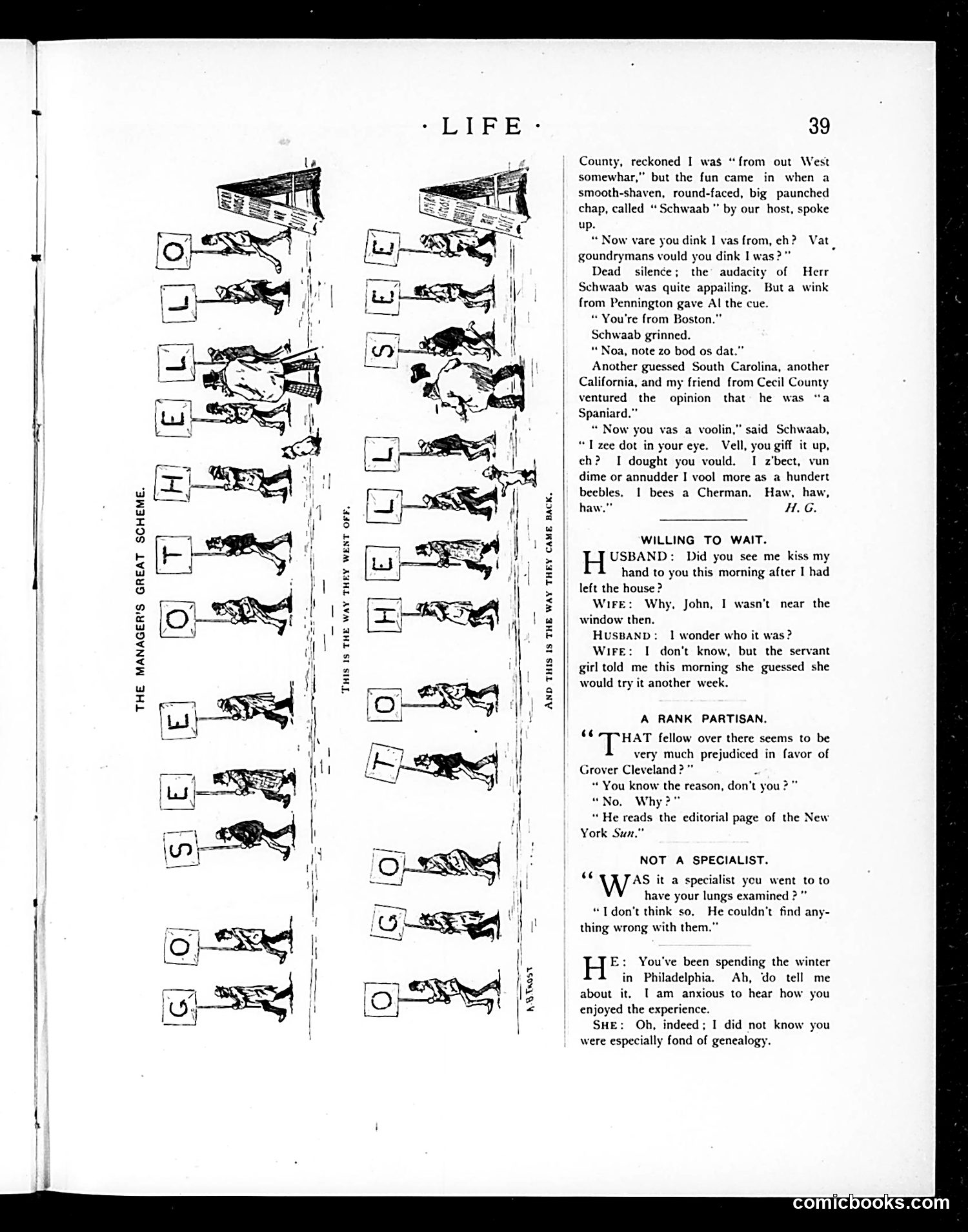
This page contains two visual elements: **Left side:** A vertical comic strip titled "The Members' Great Scheme" showing numbered figures (O through G) in various poses, appearing to demonstrate some kind of physical exercise or movement sequence. **Right side:** Three separate short satirical dialogues: 1. **"Willing to Wait"** - A husband-wife exchange about a mysterious morning visitor 2. **"A Rank Partisan"** - Mocks someone's political bias toward Grover Cleveland based on reading the New York Sun editorial page 3. **"Not a Specialist"** - A humorous conversation about lung examinations and a winter spent in Philadelphia The humor relies on wordplay, marital misunderstandings, and gentle mockery of contemporary attitudes. Without clearer image resolution, the exact subject of "The Members' Great Scheme" remains unclear, though it appears satirical in nature.
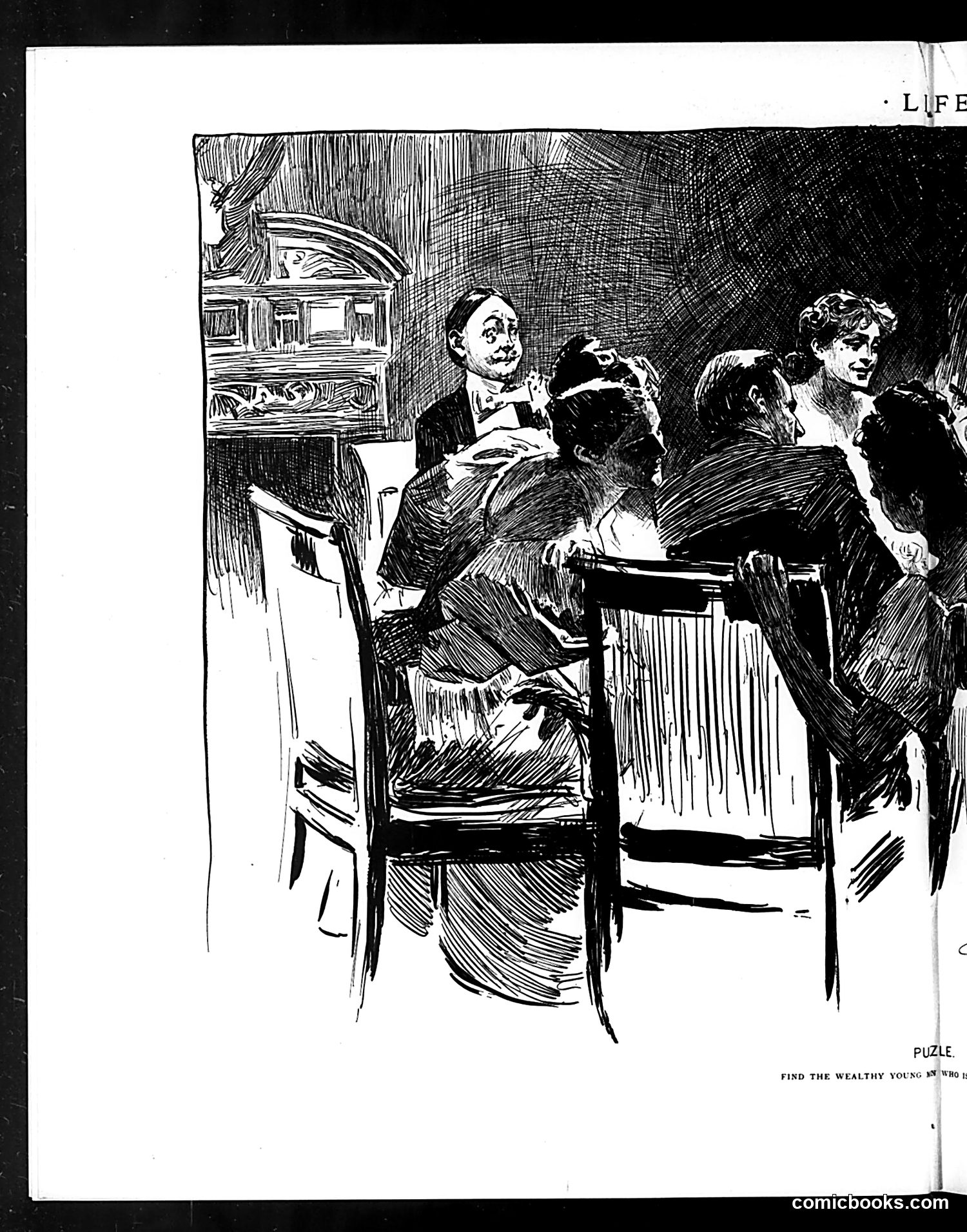
This is a visual puzzle from *Life* magazine's humor section. The caption reads "FIND THE WEALTHY YOUNG MAN" — a social satire typical of early 20th-century American magazines. The sketch shows several elegantly dressed figures in formal evening wear at what appears to be a social gathering or dinner party. The joke plays on class anxiety and social aspiration of the era: readers are challenged to identify which gentleman among the group is actually wealthy. The satire suggests that wealth and appearance were difficult to distinguish in polite society — that a truly rich young man might be indistinguishable from merely well-dressed middle-class suitors, undermining assumptions about obvious markers of wealth and social status.
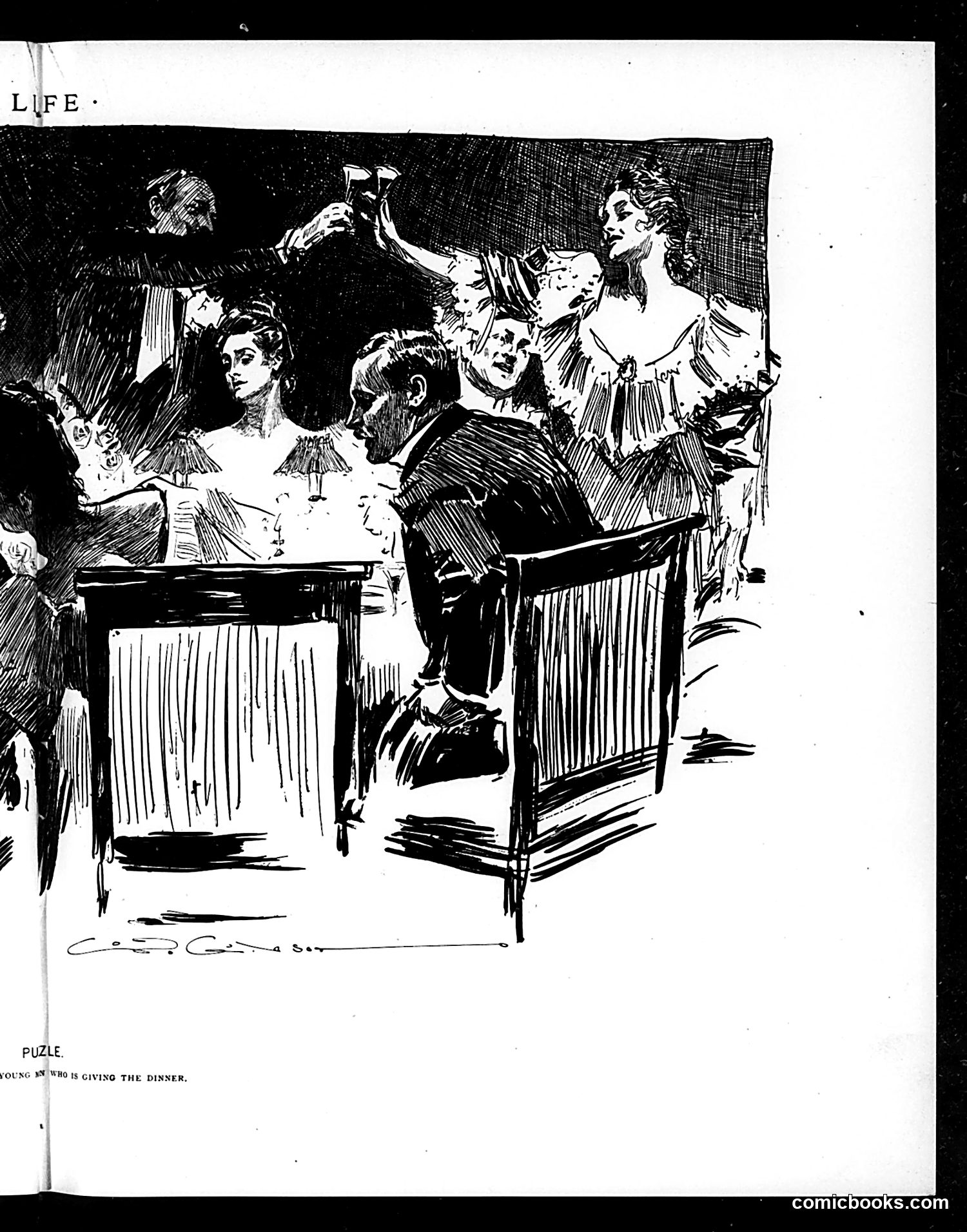
This page contains a puzzle cartoon titled "Young Man Who Is Giving the Dinner." The sketch shows an elegant dinner party scene with a formally dressed young man seated at the center of the table, surrounded by fashionably dressed women in elaborate gowns with decorative details. The women appear animated and engaged, suggesting a lively social gathering. The satire likely mocks the social pretensions and etiquette of early 20th-century high society dining. The puzzle element asks readers to identify something about the young host's character or situation based on visual clues in the scene. The exaggerated artistic style typical of Life magazine emphasizes the artificiality and performance of formal social gatherings among the wealthy.
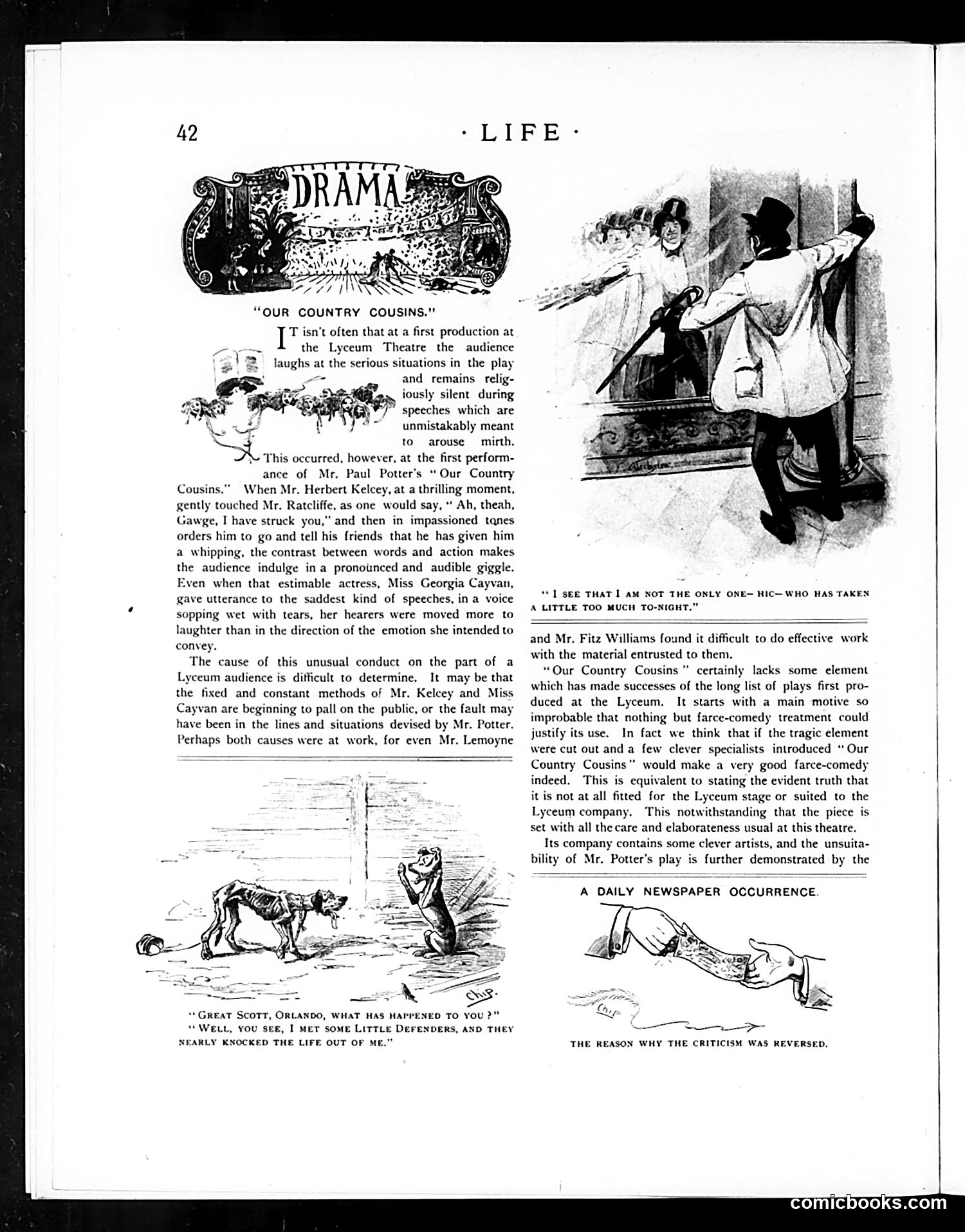
This page reviews Paul Potter's play "Our Country Cousins" at the Lyceum Theatre. The text criticizes an unusual audience response: laughs erupted during serious dramatic moments, particularly when actor Herbert Kelcey delivered what should have been a touching scene. Even actress Georgia Cavayan's tearful speech provoked laughter rather than emotion. The cartoons are satirical commentary: one depicts a dog and man with dialogue about meeting "Little Defenders" who nearly killed him—apparently mocking the play's dramatic content. Another cartoon titled "A Daily Newspaper Occurrence" shows someone knocked down, suggesting the play's action scenes were unconvincing or melodramatic. The overall critique suggests Potter's play failed to achieve its intended emotional impact at this prominent theater.
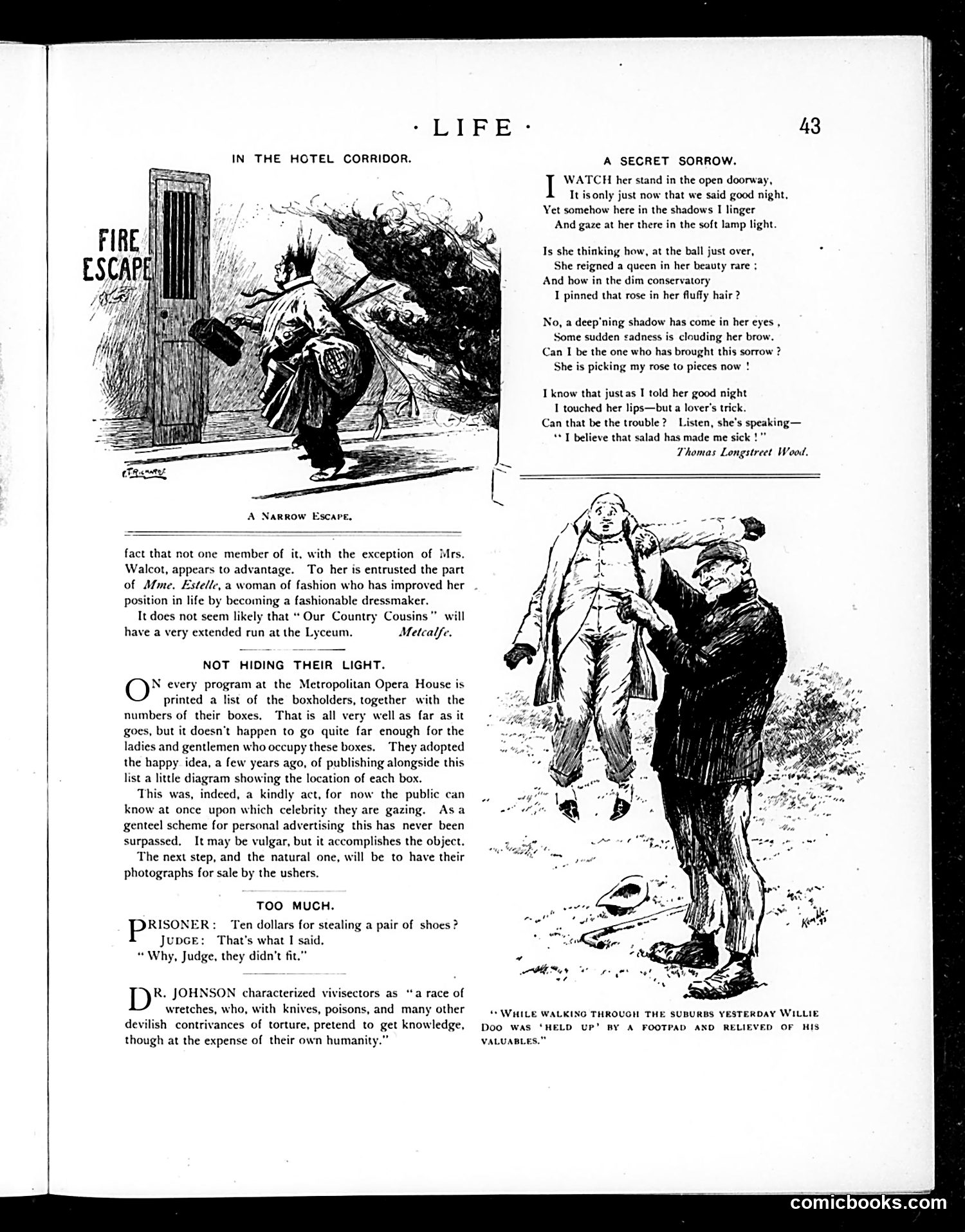
This page contains three distinct pieces: 1. **"In the Hotel Corridor" / "A Narrow Escape"**: A sketch showing someone fleeing through a fire escape, paired with a poem titled "A Secret Sorrow" by Thomas Longstreet Wood about romantic jealousy and suspicion. 2. **"Not Hiding Their Light"**: Commentary on the Metropolitan Opera House's practice of publishing boxholder lists with seat locations in programs, allowing the public to identify which celebrities sit where. The text critiques this as vulgar personal advertising, though acknowledging it serves the public's interest in celebrity-watching. 3. **"Too Much" / "Dr. Johnson"**: A brief joke about a prisoner sentenced to ten dollars for stealing shoes, followed by a quote from Dr. Johnson characterizing visitors as "wretches" who use torture and deception. The page is primarily satirical social commentary rather than political content.
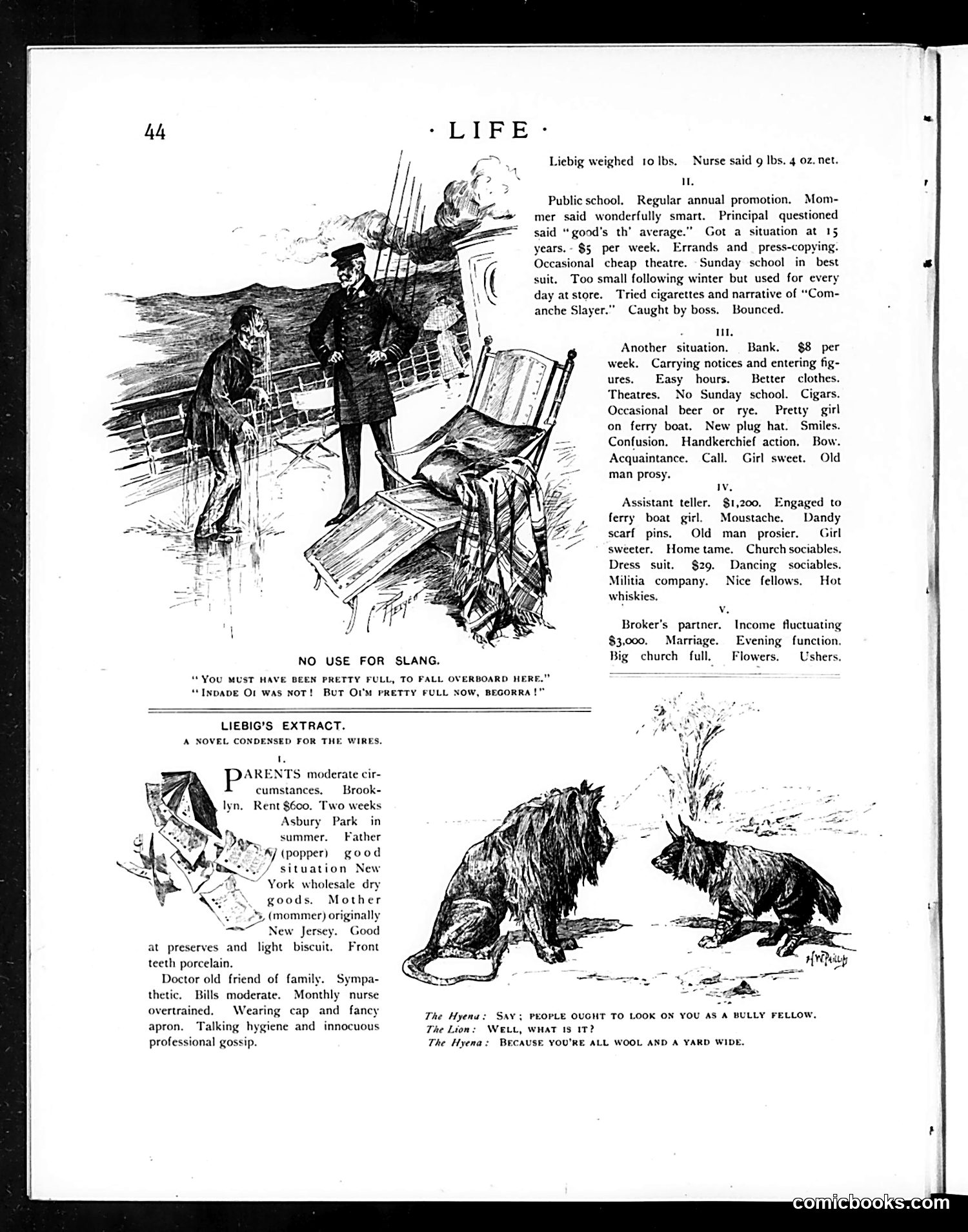
This page satirizes the rise of a young man through American social and economic classes—a "rags-to-riches" narrative common to turn-of-the-century optimism. **Main Cartoon (top):** Shows a man falling from a ship while intoxicated, using Irish dialect ("Begorra"). The satire mocks the cliché of the drunken Irish immigrant. **"Liebig's Extract" Section:** A condensed biographical sketch tracing a boy's upward mobility from birth (10 lbs.) through five increasingly prestigious jobs—from store errand boy ($5/week) to bank teller ($1,200) to broker's partner ($3,000 income). Each stage marks social advancement: better clothes, theaters, church sociables, and a "dress suit." The satire appears gentle, documenting American meritocracy's supposed rewards, though the frequent mention of drinking, theatres, and social climbing suggests ironic commentary on materialism and superficial status-seeking. **Bottom Comics:** A brief dialogue between a hyena and lion uses the phrase "all wool and a yard wide"—period slang meaning honest and genuine—ironically applied to predatory animals.
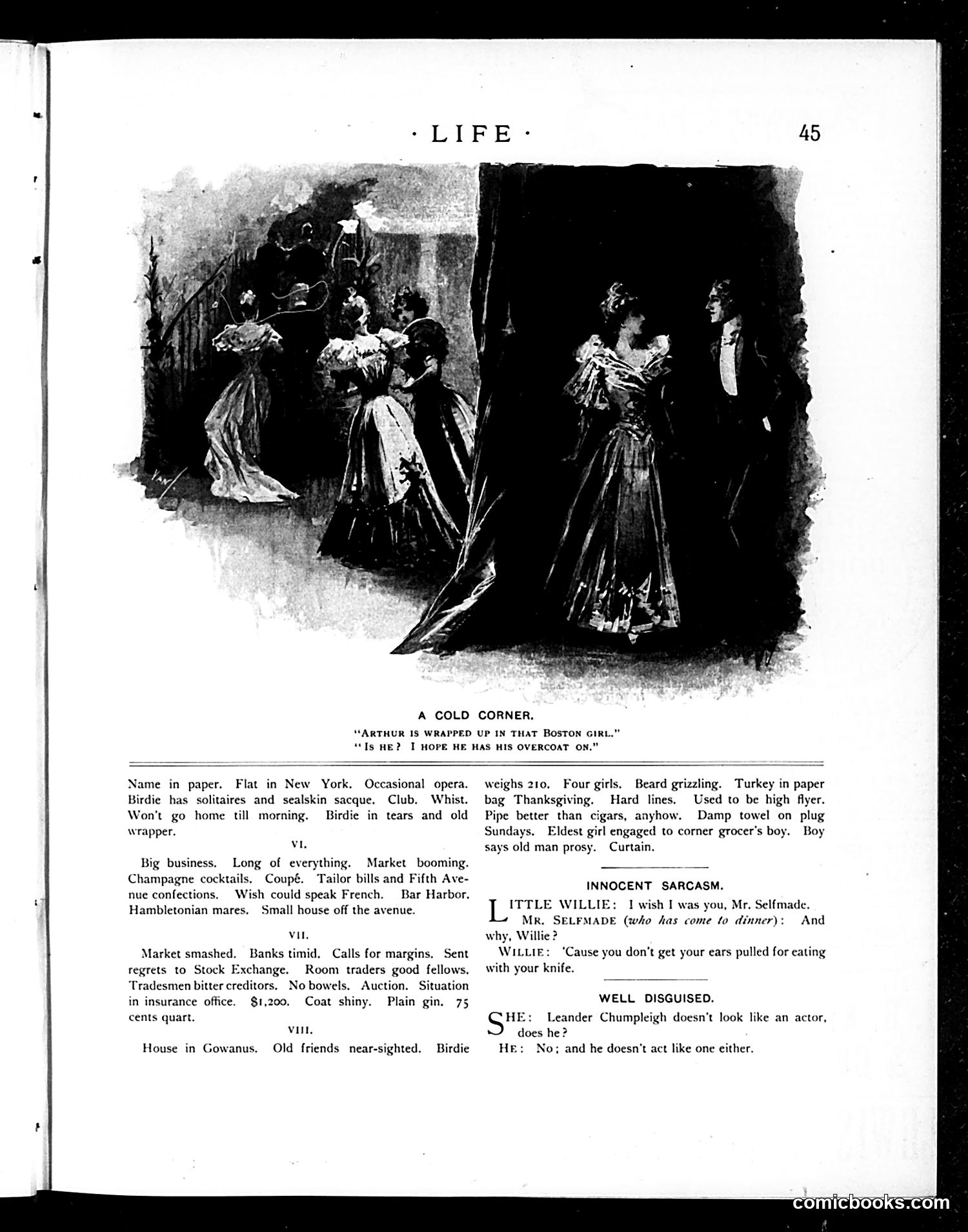
The main cartoon depicts a social situation where a young man ("Arthur") is romantically entangled with a "Boston girl"—the joke being that he needs his overcoat because she's so cold and emotionally distant, not because of weather. Below are brief satirical vignettes mocking upper-class New York life, tracing a man's fortunes through social climbing: he acquires fashionable trappings (opera, clubs, expensive clothes, Fifth Avenue tastes) during good economic times, then loses everything when "the market smashed" and banks fail, reducing him to poverty and damp towels. The smaller jokes mock social pretension: "Innocent Sarcasm" shows a wealthy self-made man uncomfortable when a boy correctly identifies his poor table manners; "Well Disguised" jokes that an actor named Leander Chumpleigh doesn't look or act like an actor—implying he's a con artist or fraud. The satire targets nouveau-riche materialism and the fragility of status-seeking in an economically volatile era.
This page contains **humorous anecdotes** rather than political cartoons. The stories satirize human nature and contemporary professions through folk-tale-style narratives: 1. **The Cobbler Story**: A French anecdote about a tradesman who, given coffee while sitting with a "corpse," becomes so cheerful he sings and hits the "body" with his hammer—illustrating how stimulants override rational behavior. 2. **The Lydia E. Pinkham Letter**: Satirizes a famous patent medicine company whose employees signed the founder's name to countless letters. The joke: an exhausted worker unconsciously ends her prayer with "Yours for health, Lydia E. Pinkham"—mocking both worker exhaustion and the company's ubiquitous marketing. 3. **The Prayer Story**: A woman claims she could recite the Lord's Prayer while thinking of other things, mocking the idea that multitasking is impossible. 4. **The Hypnotism Story**: A father's newfound interest in hypnotism terrifies his son, who thinks his father is losing his mind ("got the jim-jams"—gone crazy). These target late-19th-century crazes (hypnotism, patent medicines) and human foibles through gentle mockery.
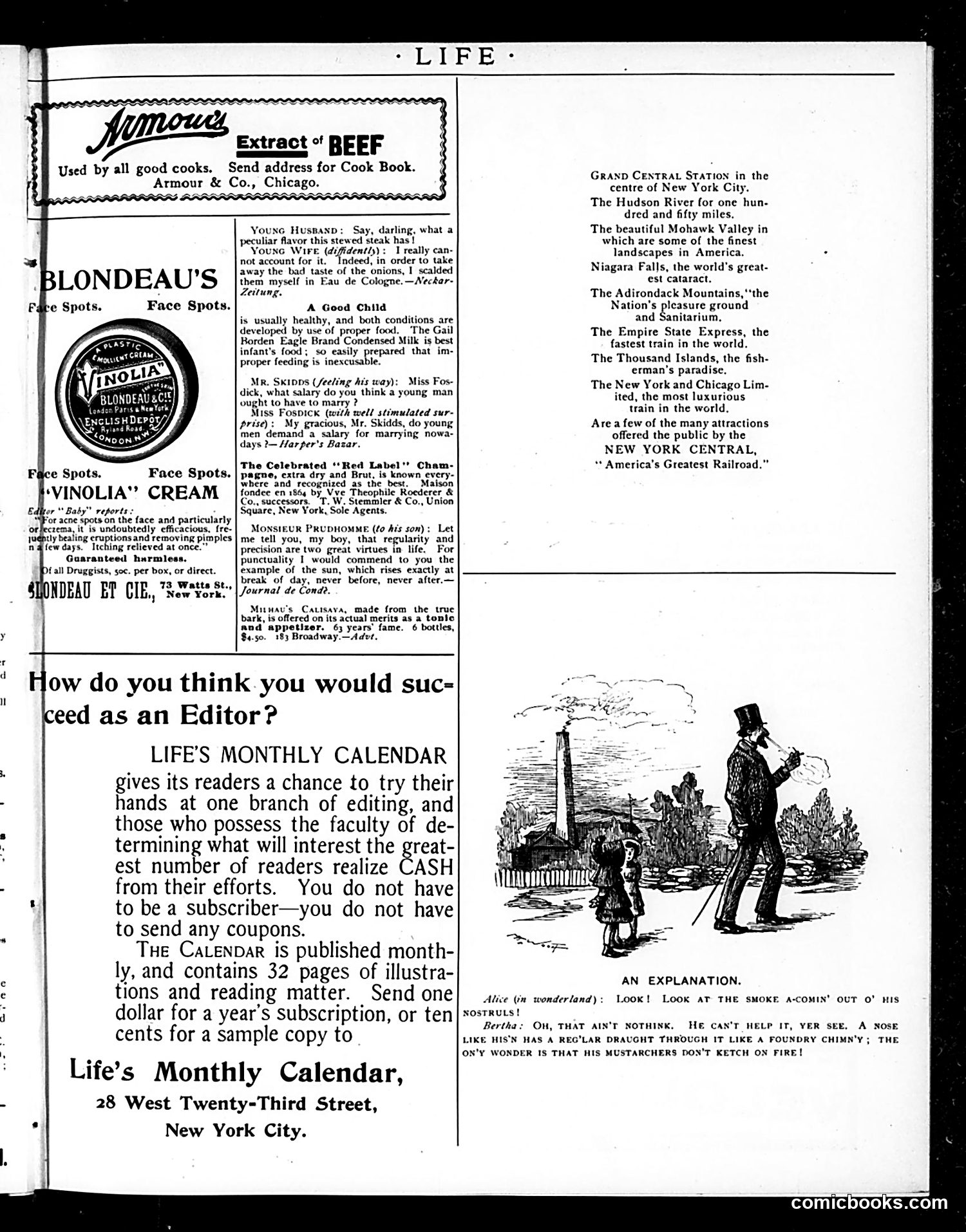
This page contains mostly **advertising and editorial promotion** rather than political satire. The primary content includes: **Advertisements** for consumer products (Armour's beef extract, Blondeau's face cream, Vinolia cream, condensed milk, champagne, etc.) interspersed with brief humorous anecdotes—a common magazine format of the era. **The cartoon** at bottom right depicts two figures in a rural setting observing a man smoking a pipe with exaggerated smoke pouring out. The caption jokes that his mustache hasn't caught fire despite the intensity of the smoke, presenting absurdist humor about an outsized pipe. This appears to be simple visual comedy rather than political commentary. **The main editorial feature** promotes Life's Monthly Calendar, a publication offering readers a chance to try their hand at editorial selection for cash prizes—essentially crowdsourcing content decisions. No specific political figures or dated events are referenced. This is primarily a **commercial page showcasing period advertising conventions and light domestic humor**.
This page is primarily **advertisements** with no political cartoons or satire. The main featured ad promotes **Redfern fashions** for early spring, displaying women's clothing designs from their Paris house and Fifth Avenue location. Below this are medical testimonials for **"Vin Mariani,"** a wine-based tonic marketed as a cure for influenza (La Grippe). Quotes from a French Army surgeon and New York's health department chief endorse it as an effective remedy for fever, congestion, and coughing. The product was sold at drugstores. Additional advertisements include: - Higgins & Seiter fine china and glassware - Deafness and head noise treatments - Eau de Cologne and glycerine soaps - Hygienic air mattresses - Veloutine Fay toilet powder - Hamilton Hotel in Bermuda **Historical note:** This reflects early 1900s medicine, when wine tonics were marketed as legitimate treatments and influenza was a serious public health concern.