
Life, 1894-01-18 · page 4 of 16
Life — January 18, 1894 — page 4: what you’re looking at
What you’re looking at
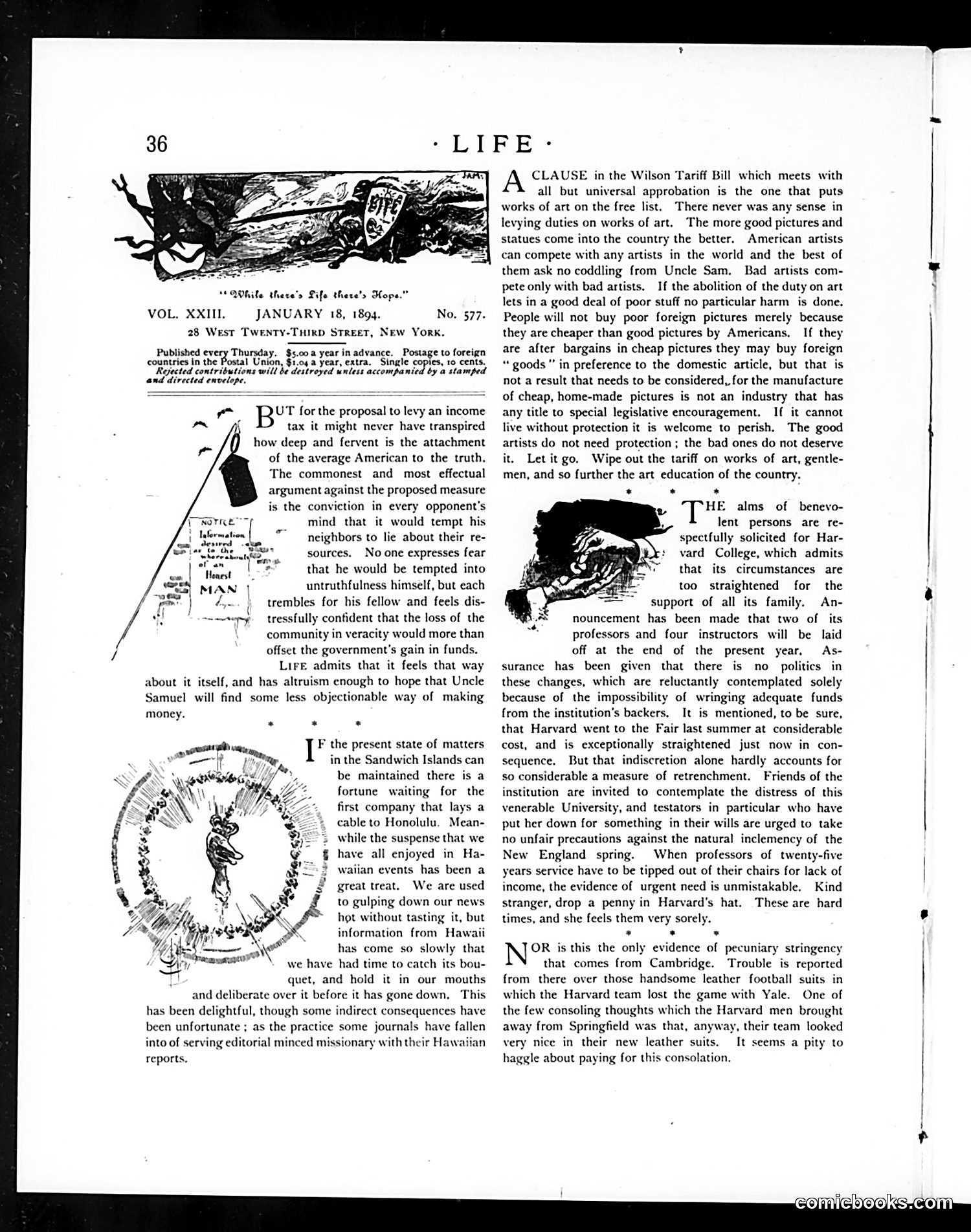
The page contains three editorial cartoons addressing contemporary issues: 1. **Top cartoon**: Depicts a skeletal, demonic figure labeled "While there's Life there's Hope"—likely satirizing poverty or economic hardship during the 1890s depression. 2. **Middle cartoon**: Shows a figure labeled "NOTICE" with text about "Information" and "MAN," appearing to critique public discourse or misinformation spreading about labor/economic issues. 3. **Bottom cartoon**: Features a figure suspended in a circular diagram, possibly referencing Hawaiian or colonial affairs—the text mentions Sandwich Islands and Hawaii, suggesting satire about American imperial interests in the Pacific. The accompanying editorial text discusses tariffs on imported art and Harvard College's financial difficulties, indicating Life's focus on elite intellectual and economic policy debates of the 1890s.
📄 Transcribed text from this page (OCR, searchable)
Machine-transcribed from the original scan — historical spelling and the odd misread are preserved.
QVhite there's Life there's Hope VOL. XXIII. JANUARY 18, 1894. No. 577. 28 West Twenty-Tuixp STREET, New York. Published every Thursday. $s.coa year in advance. | Postage to foreign countries in the Postal Union, $1.04 a year, extra. Single copies, 10 cents, Rejected contributions will be destroyed unless accompanied by a stamped and directed envelope, vo UT for the proposal to levy an income ~ tax it might never have transpired how deep and fervent is the attachment of the average American to the truth, The commonest and most effectual argument against the proposed measure is the conviction in every opponent's mind that it would tempt his neighbors to lie about their re- sources. No one expresses fear that he would be tempted into untruthfulness himself, but each trembles for his fellow and feels dis- tressfully confident that the loss of the community in veracity would more than offset the government's gain in funds. Lire admits that it feels that way about it itself, and has altruism enough to hope that Uncle Samuel will find some less objectionable way of making money. ROTRE . * . F the present state of matters in the Sandwich Islands can be maintained there is a fortune waiting for the first company that lays a cable to Honolulu. Mean- while the suspense that we have all enjoyed in Ha- waiian events has been a great treat. We are used to gulping down our news hot without tasting it, but information from Hawaii has come so slowly that we have had time to catch its bou- quet, and hold it in our mouths and deliberate over it before it has gone down, This has been delightful, though some indirect consequences have been unfortunate ; as the practice some journals have fallen into of serving editorial minced missionary with their Hawaiian reports, > LIFE: CLAUSE in the Wilson Tariff Bill which meets with all but universal approbation is the one that puts works of art on the free list. There never was any sense in levying duties on works of art. The more good pictures and statues come into the country the better. American artists can compete with any artists in the world and the best of them ask no coddling from Uncle Sam, Bad artists com- pete only with bad artists. If the abolition of the duty on art lets in a good deal of poor stuff no particular harm is done. People will not buy poor foreign pictures merely because they are cheaper than good pictures by Americans. If they are after bargains in cheap pictures they may buy foreign “ goods” in preference to the domestic article, but that is not a result that needs to be considered, for the manufacture of cheap, home-made pictures is not an industry that has any title to special legislative encouragement. If it cannot live without protection it is welcome to perish, The good artists do not need protection ; the bad ones do not deserve it. Let it go. Wipe out the tariff on works of art, gentle- men, and so further the art education of the country. * * * HE alms of benevo- lent persons are re- spectfully solicited for Har- vard College, which admits that its circumstances are too straightened for the support of all its family, An- nouncement has been made that two of its professors and four instructors will be laid off at the end of the present year, As- surance has been given that there is no politics in these changes, which are reluctantly contemplated solely because of the impossibility of wringing adequate funds from the institution’s backers. It is mentioned, to be sure, that Harvard went to the Fair last summer at considerable cost, and is exceptionally straightened just now in con- sequence, But that indiscretion alone hardly accounts for so considerable a measure of retrenchment. Friends of the institution are invited to contemplate the distress of this venerable University, and testators in particular who have put her down for something in their wills are urged to take no unfair precautions against the natural inclemency of the New England spring. When professors of twenty-five years service have to be tipped out of their chairs for lack of income, the evidence of urgent need is unmistakable. Kind stranger, drop a penny in Harvard's hat. These are hard times, and she feels them very sorely. * . . N° is this the only evidence of pecuniary stringency that comes from Cambridge. Trouble is reported from there over those handsome leather football suits in which the Harvard team lost the game with Yale. One of the consoling thoughts which the Harvard men brought away from Springfield was that, anyway, their team looked very nice in their new leather suits. It seems a pity to haggle about paying for this consolation.