
A complete issue · 16 pages · 1894
Life — January 4, 1894
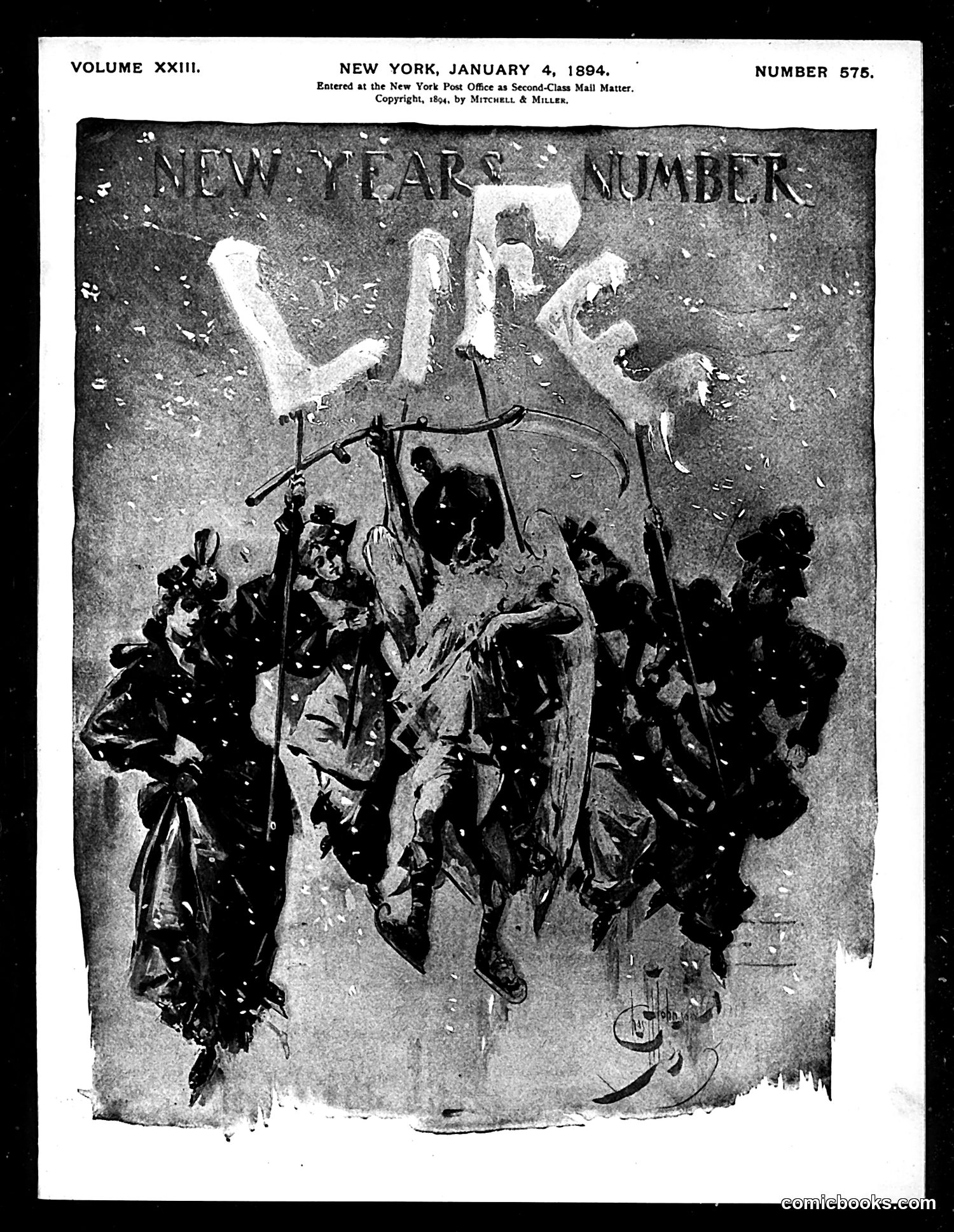
This is the cover illustration for Life's New Year issue. The image depicts a group of figures in dark clothing gathered around what appears to be a large "1894" numeral, suggesting they are celebrating or preparing to enter the new year. The figures are rendered in silhouette, making their specific identities unclear from the image alone. Without additional context from the magazine's interior text, I cannot definitively identify which specific political figures or social commentary this represents. The style is typical of Life's satirical approach, but the OCR'd text provided doesn't clarify the particular joke or reference intended. The illustration appears allegorical rather than depicting a specific identifiable event.
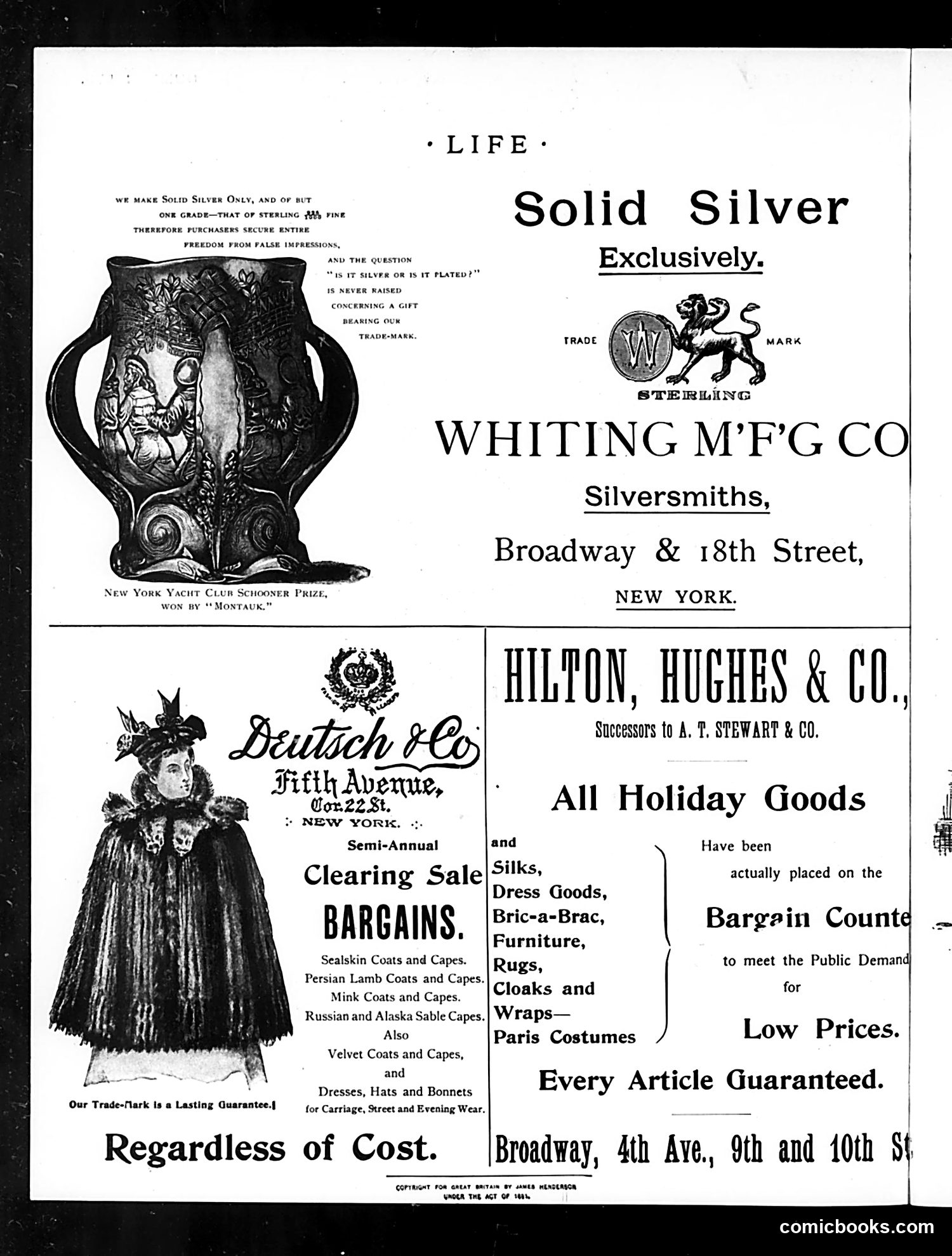
This page is primarily **advertising**, not political satire. It contains four commercial advertisements from late 19th-century New York merchants: 1. **Whiting M'fg Co.** (top right) — a silversmith advertising solid silver goods 2. **Deutsch & Co.** (left) — advertising a "Semi-Annual Clearing Sale" of furs and capes "Regardless of Cost" 3. **Hilton, Hughes & Co.** (right) — successor business offering holiday goods at bargain prices on "Bargain Counte" (likely "Counter") The page header says "LIFE" and mentions a "New York Yacht Club Schooner Prize," suggesting this appeared in *Life* magazine, but the content is purely commercial — typical of publications that relied on advertising revenue. There is no political cartoon or satirical commentary visible.
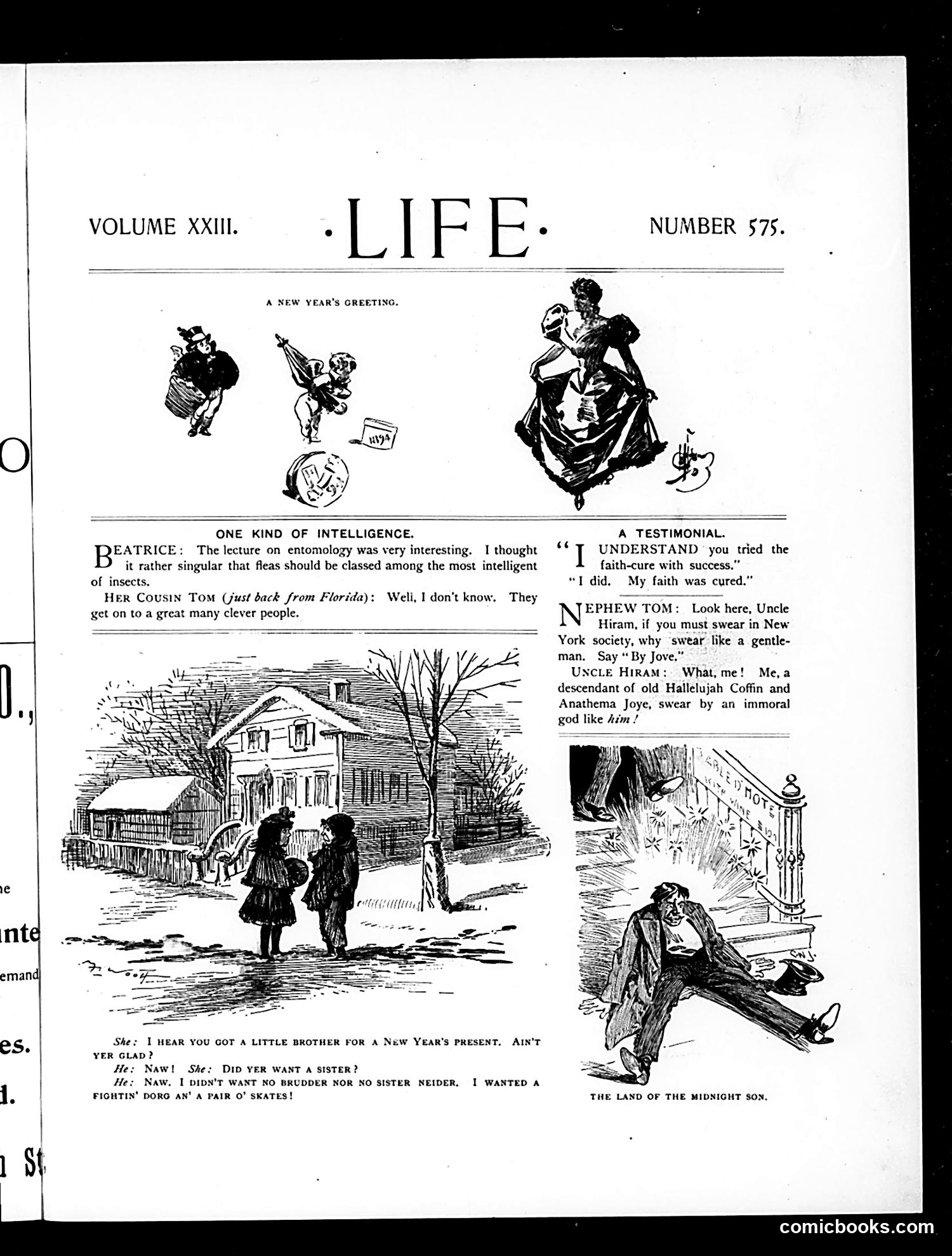
This page contains three separate humorous pieces from *Life*'s satirical content: 1. **"One Kind of Intelligence"**: A joke about insects being classified as intelligent, featuring a character named Cousin Tom from Florida dismissing the classification. 2. **"A New Year's Greeting"**: Decorative illustrations at the top showing New Year's celebrations and cherub figures. 3. **"A Testimonial"**: A dialogue between Nephew Tom and Uncle Hiram about swearing etiquette in New York society, with Uncle Hiram (appearing to be a Southern gentleman based on the "Hallelujah Coffin and Anathema Joye" reference) humorously objecting to Tom's suggestion to swear "like a gentleman." 4. **"The Land of the Midnight Son"**: A sketch showing a figure in winter clothing, likely depicting northern/Arctic conditions. The humor relies on period social conventions and regional American character types.
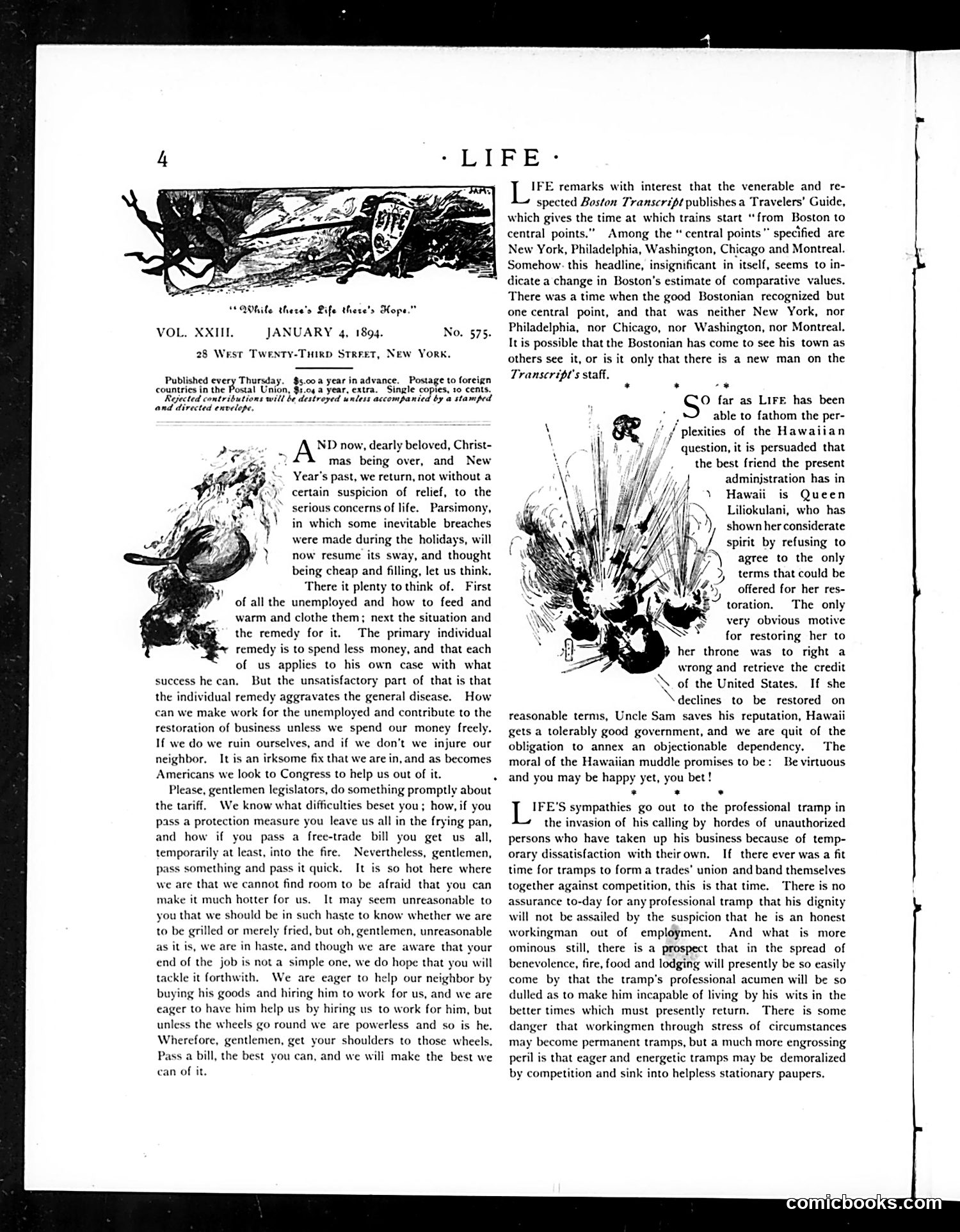
The page contains two editorial sections without political cartoons. The first article criticizes business leaders for inadequate charitable response to unemployment following the holidays. It argues that wealthy individuals must spend money freely to address poverty, calling for Congressional action on tariff reform to restore business and employment. The second article discusses Queen Liliuokalani of Hawaii, apparently defeated in a political conflict. It satirizes the situation by suggesting Hawaii's only value to the U.S. is territorial annexation. The piece mocks Hawaiian political complications while endorsing American expansion, arguing that restoring the queen on "reasonable terms" preserves American reputation while accomplishing annexation. Both sections reflect 1890s American political debates over labor, wealth distribution, and imperial expansion.
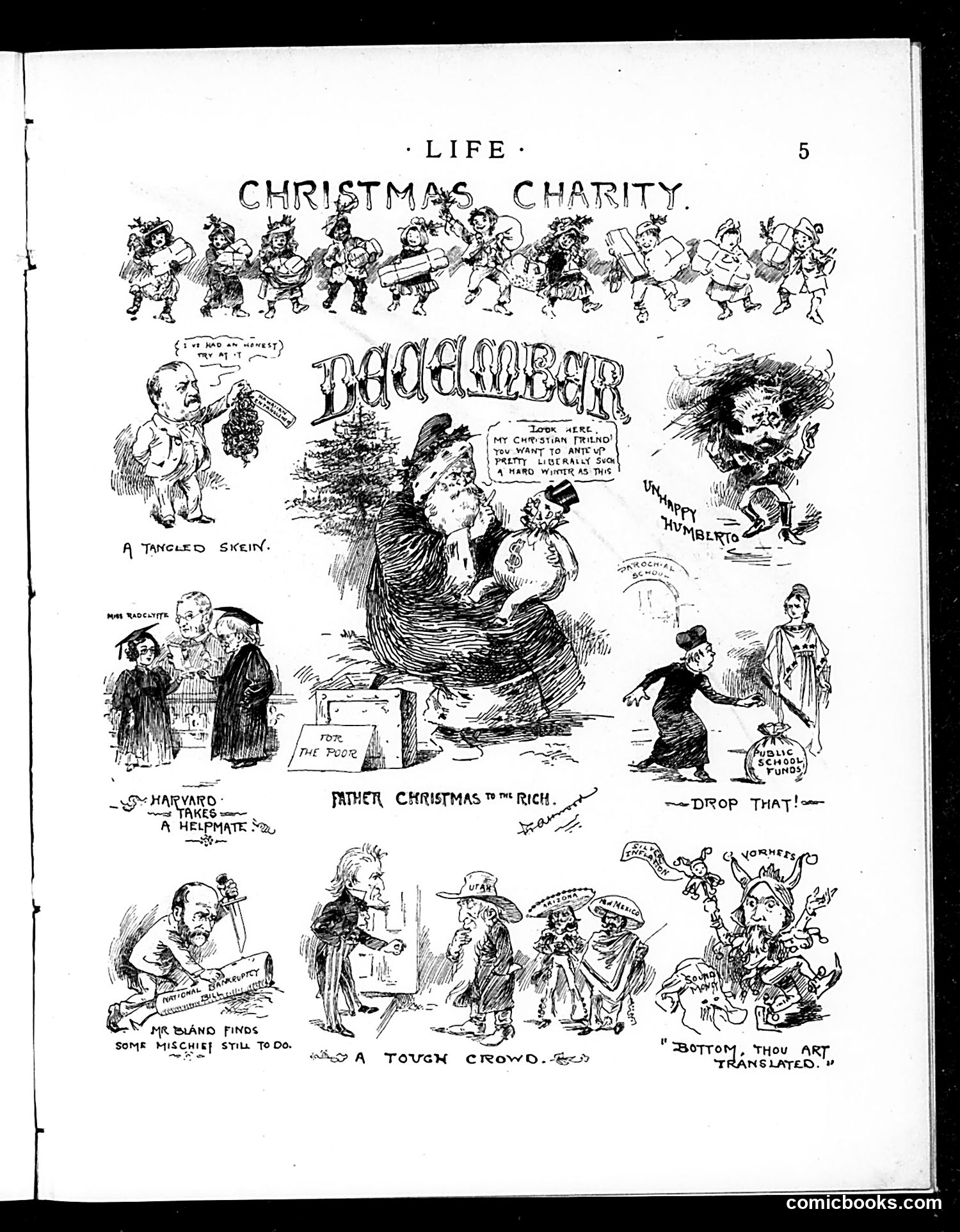
This page from *Life* magazine satirizes hypocrisy in Christmas charitable giving. The central "Bacchanal" scene depicts wealthy individuals indulging in excess while claiming Christian virtue. Key panels mock: - **"A Tangled Skein"**: confusion about proper charity - **"Father Christmas to the Rich"**: the disparity between Christmas ideals and practice - **"Harvard Takes a Helpmate"**: wealthy institutions' charitable pretense - **"Drop That!"**: criticism of inconsistent giving - **"A Tough Crowd"** and **"Bottom, Thou Art Translated"**: caricatured characters resisting genuine charity The satire suggests that the wealthy celebrate Christmas lavishly while neglecting actual charitable obligations to the poor. The grotesque caricatures and demonic figures emphasize the moral contradiction between Christmas's religious message and the selfishness of the affluent.
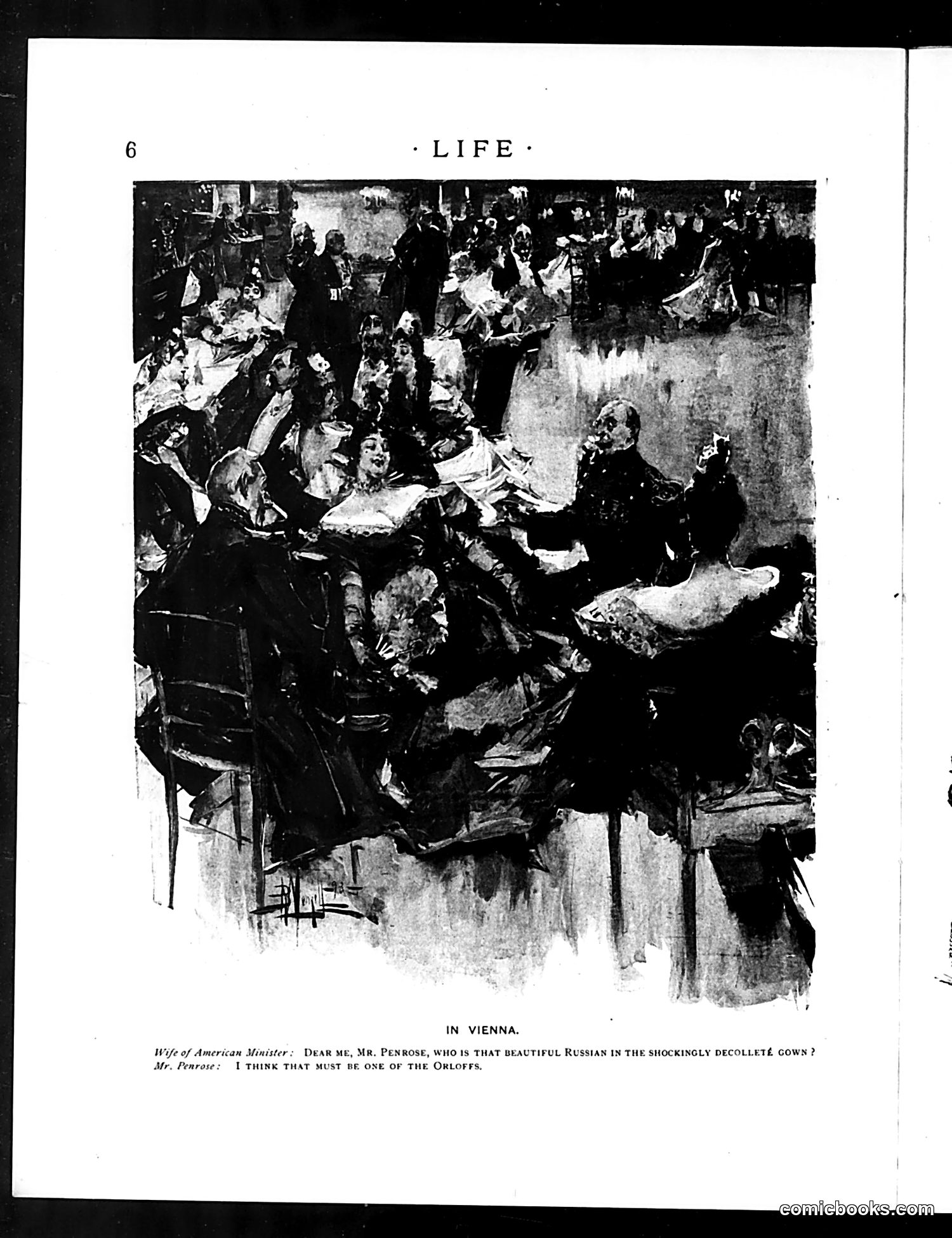
This satirical cartoon depicts a social scene in Vienna, likely from the early 20th century. The caption presents a conversation between the wife of an American Minister (diplomat) and Mr. Penrose, in which she asks him to identify a "beautiful Russian" woman in a "shockingly décolleté gown." Penrose's response—that the woman must be "one of the Orloffs"—serves as the joke's punchline. The humor relies on implying that Russian aristocratic women (specifically the Orloff family) were known for wearing scandalously revealing clothing or engaging in loose social behavior. The cartoon satirizes both the cultural differences perceived between American and European (particularly Russian) society, and the snobbish gossiping among diplomatic circles.
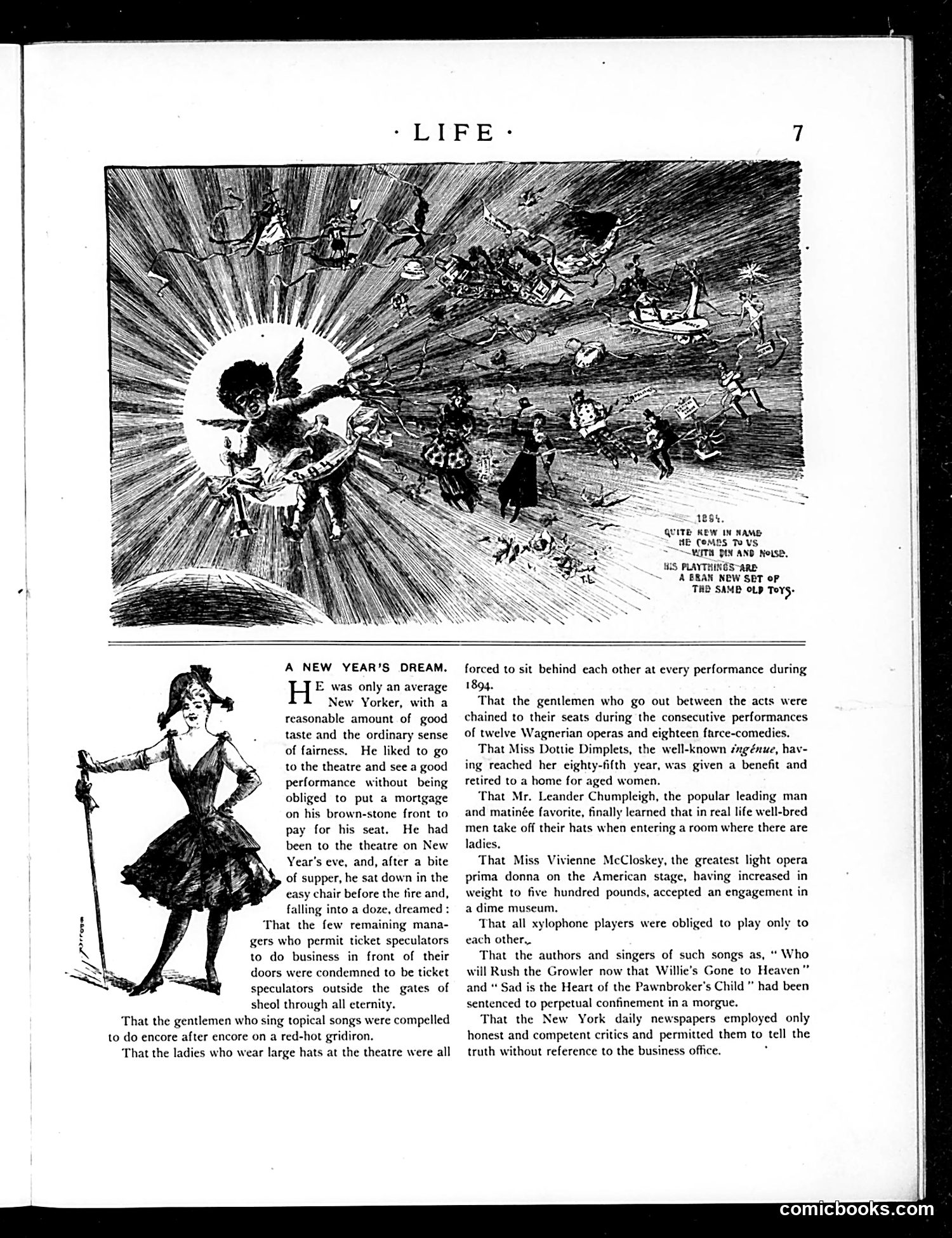
This 1894 satirical piece mocks New York theater culture. The main illustration depicts a chaotic dream scene with theatrical figures swirling around a central bright light, representing an average New Yorker's theater fantasy. The accompanying text humorously critiques theatrical conventions: gentlemen forced to remove hats during performances, ladies wearing oversized hats blocking views, and singers compelled to perform encores. It also lampoons specific opera practices—notably that xylophone players had to perform only to each other, and references to operatic works like "Who Will Rush the Growler" and "Sad is the Heart of the Pawnbroker's Child." The satire targets both theatrical absurdities and New York's newspaper critics' relationship with the theater business.
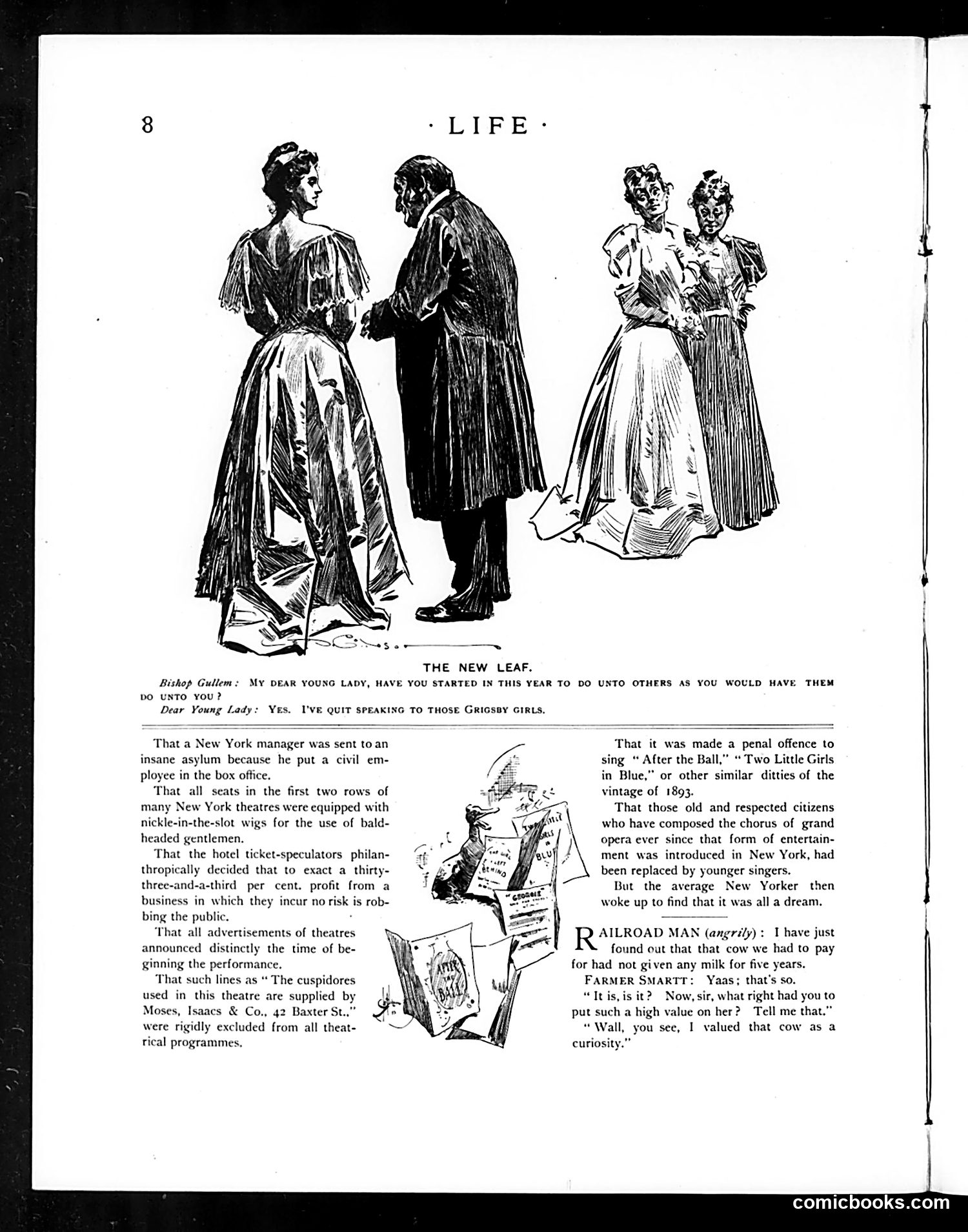
The main cartoon depicts a bishop counseling a young woman to reform her behavior by doing unto others as she'd have them do unto her. The woman responds that she's already quit associating with "those Grissby girls"—suggesting she's adopted moral superiority by distancing herself from peers deemed disreputable. Below, the page mocks various New York theater practices: inflated ticket prices, use of wigs for bald patrons, ticket speculation, and exclusive advertising in theater programs. A separate joke features a railroad man and farmer discussing a cow that hasn't produced milk in five years, with the farmer's punchline revealing he valued the animal merely as a curiosity—commentary on absurd values. The satire targets social hypocrisy and commercial exploitation.
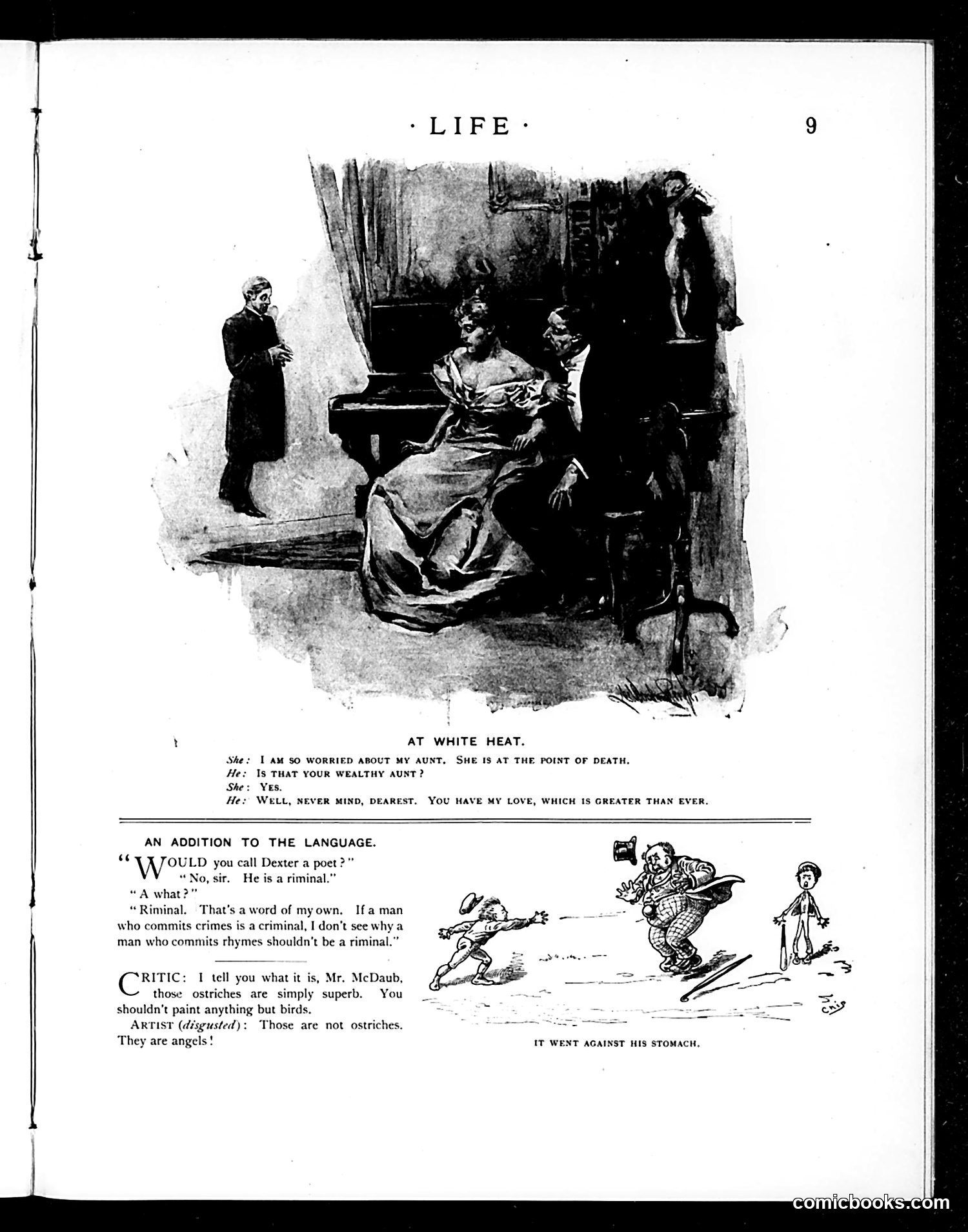
**Top Illustration ("At White Heat"):** A domestic drama depicting a woman in distress about her aunt's health. A wealthy man reassures her with his love, suggesting money matters less than emotion—typical sentimental melodrama of the era. **Bottom Section ("An Addition to the Language"):** A satirical dialogue mocking artistic pretension. A critic defends calling a poet a "criminal," arguing that artists committing artistic crimes deserve the label. The artist indignantly protests, claiming artists are "angels." The accompanying ski cartoon ("It Went Against His Stomach") shows slapstick humor. The satire targets the pomposity of art critics and the defensive posturing of artists in debates over aesthetic standards and merit.
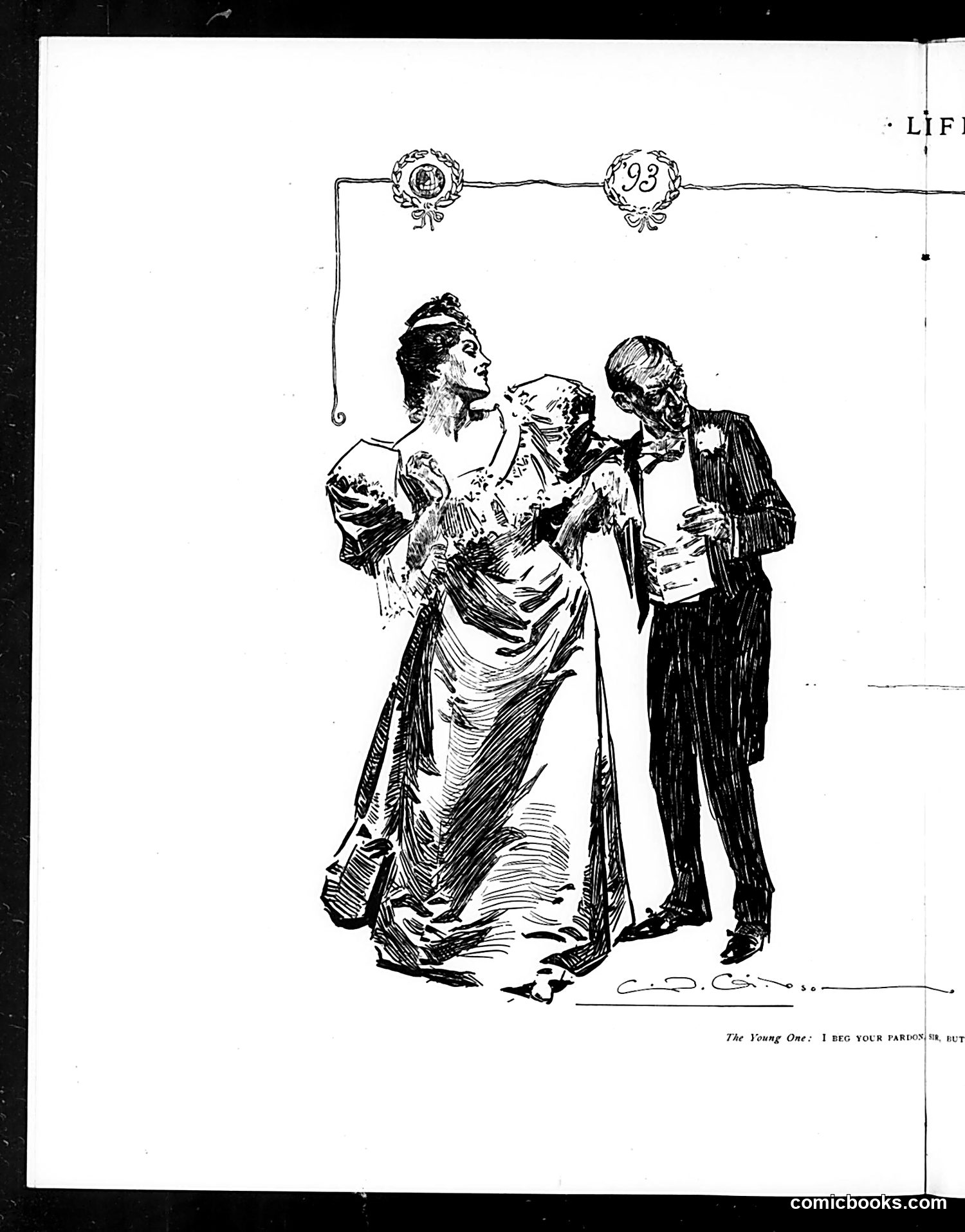
This illustration depicts a social scene with three figures: an elegantly dressed woman in an elaborate gown with puffed sleeves (typical of 1890s high fashion), a man in formal attire between them, and another man in a suit to the right. The caption "I Beg Your Pardon, But" suggests the young woman is interrupting or correcting someone—likely the man in the middle. The satire appears to target the social dynamics and etiquette of the era's upper class, possibly mocking the formal politeness conventions or awkward social situations young women navigated. The "93" marking and decorative emblems indicate this is from Life magazine's numbered issue pages, typical of their satirical commentary on contemporary manners and society.
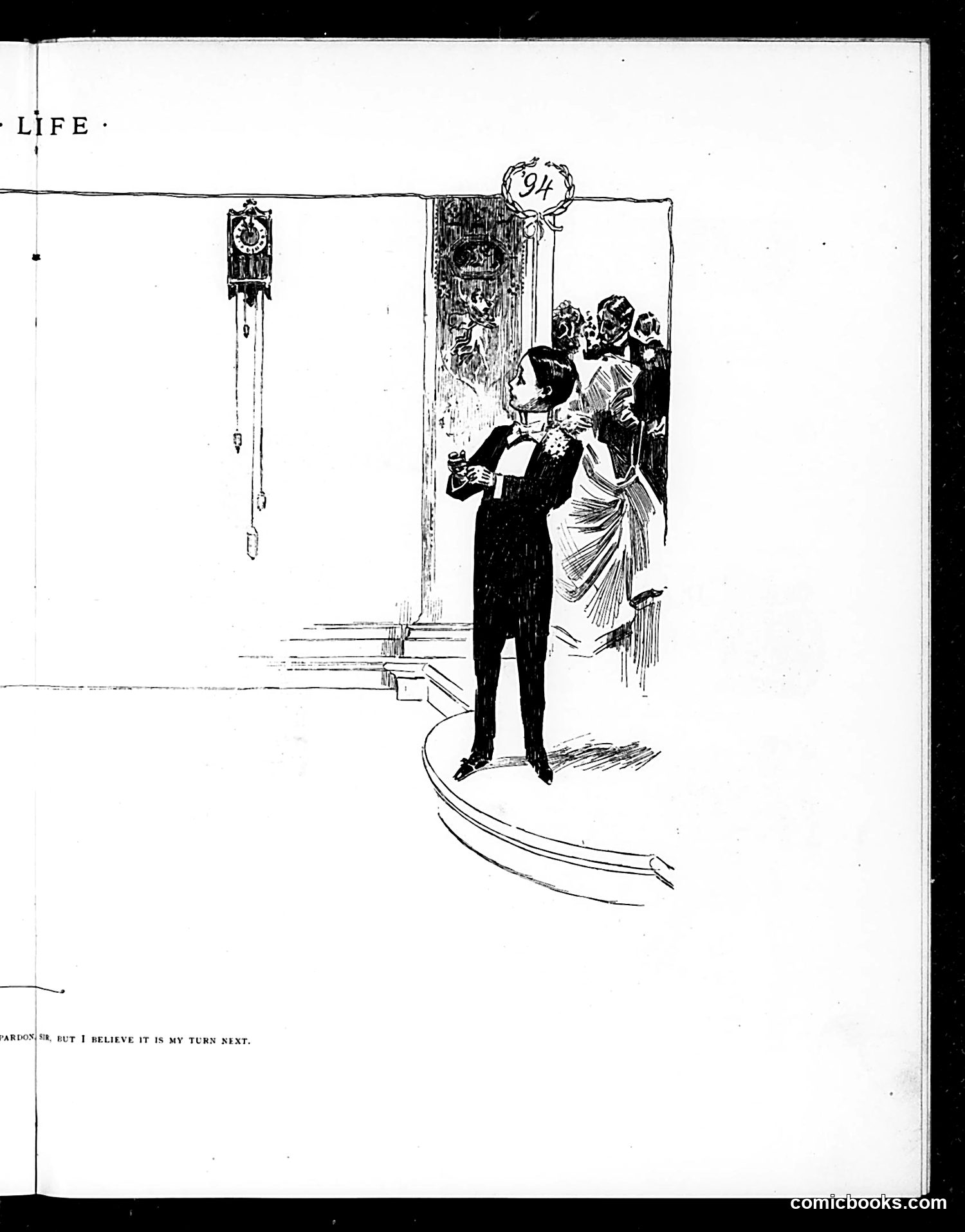
This Life magazine cartoon depicts a formal social scene, likely from the early 20th century. A man in formal attire (tuxedo and bow tie) stands in a doorway, looking upward at a balloon or sign marked "94," while elegantly dressed figures—including a woman in a flowing gown—stand behind him. The caption reads: "PARDON SIR, BUT I BELIEVE IT IS MY TURN NEXT." The joke appears to satirize social hierarchies and politeness at formal gatherings. The "94" likely indicates a queuing or waiting system, suggesting the man has been waiting his turn (perhaps for a dance, introduction, or other social interaction), only to be politely but firmly reminded of proper social protocol. The cartoon mocks either excessive formality or social pretension among the upper classes.
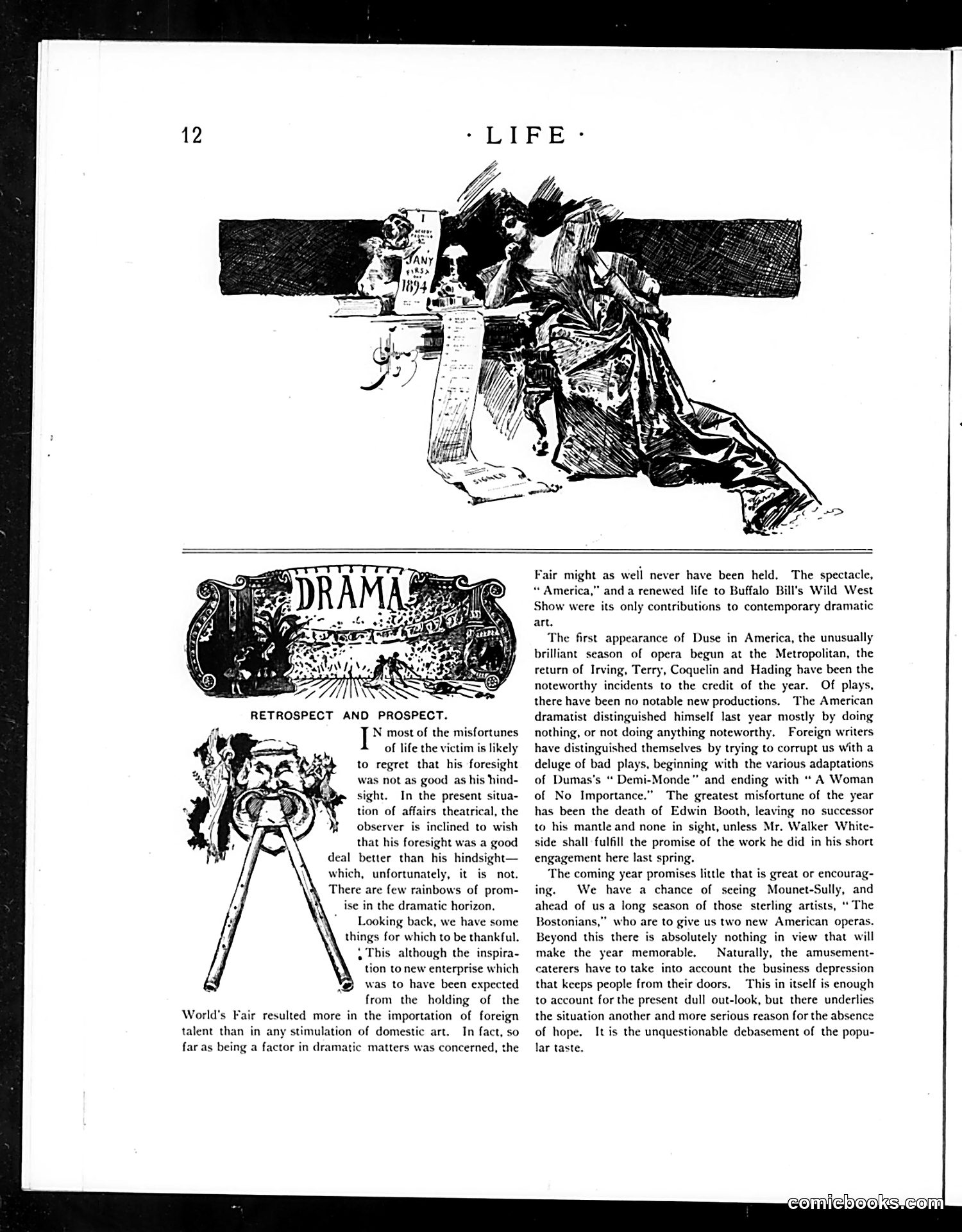
This is a theatrical criticism column titled "Retrospect and Prospect," reviewing the dramatic season following the 1893 World's Columbian Exposition in Chicago. The author laments that despite the World's Fair's promise, it failed to stimulate American drama—contributing only spectacles like "America" and reviving Buffalo Bill's Wild West Show. He credits the year's few highlights to foreign talent: the Italian actress Duse, opera at the Metropolitan, and visiting performers Irving, Terry, Coquelin, and Hading. The column criticizes American playwrights for producing nothing noteworthy while foreign writers flooded the market with poor adaptations, particularly of Dumas's works. The death of Edwin Booth is identified as the year's greatest theatrical loss. Looking forward, the author expresses pessimism: limited promising productions ahead, economic depression keeping audiences away, and—most importantly—a perceived decline in popular taste itself. The underlying concern is cultural degradation rather than temporary economic hardship.
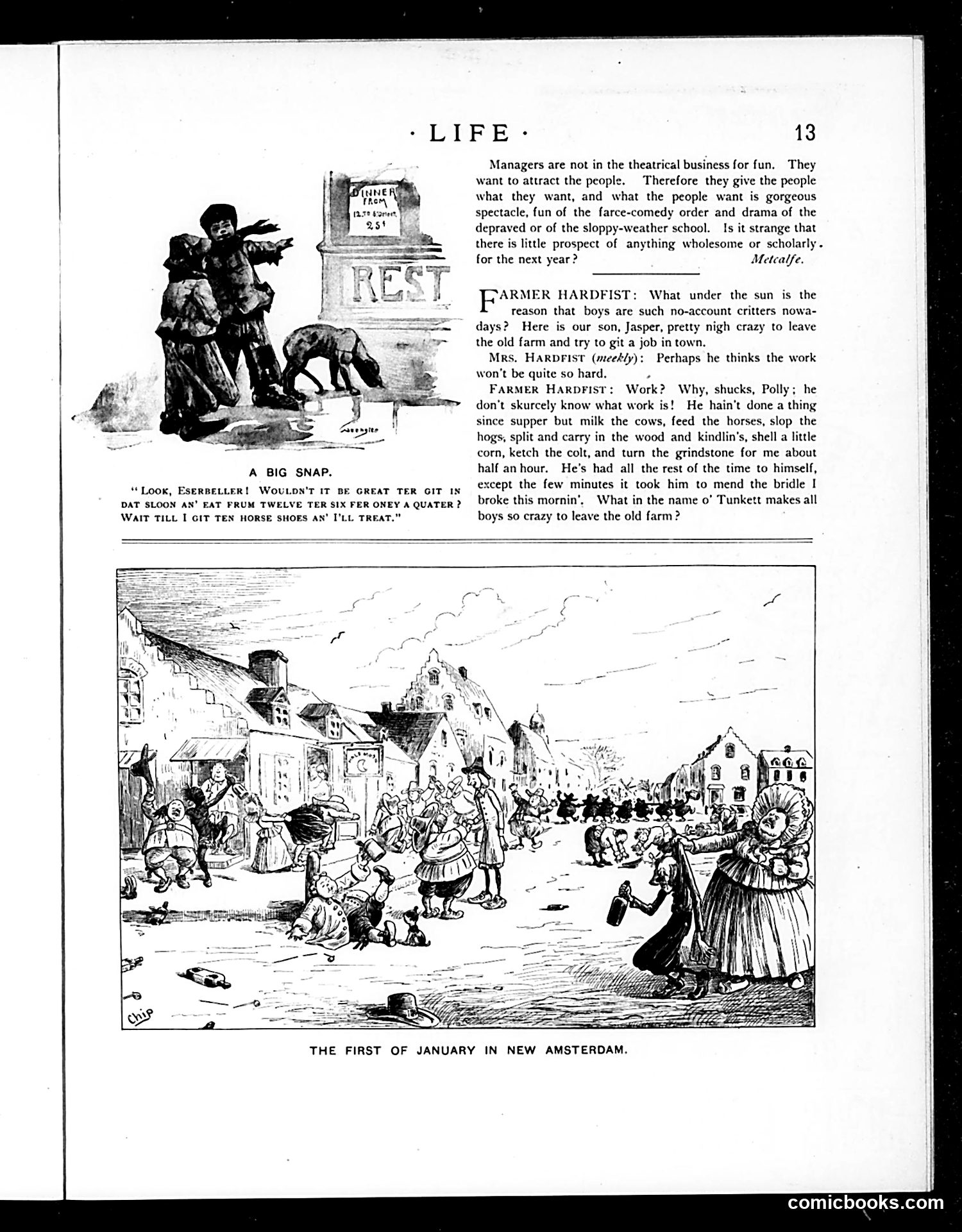
This Life magazine page contains two distinct satirical pieces: **"A Big Snap"** (top): Working-class characters in dialect speak discuss pooling money from horseshoe gambling to afford a cheap meal at a saloon—a commentary on urban poverty and the economics of survival among laborers who must gamble for basic sustenance. **"Farmer Hardfist" dialogue**: Satirizes rural attitudes toward farm labor. The farmer, oblivious to irony, lists exhausting chores (milking, feeding animals, wood-splitting, grinding grain) as "hardly work," genuinely confused why his son wants to escape to town. The joke targets farmers' denial about grueling agricultural labor and generational conflict over modernization. **"The First of January in New Amsterdam"** (bottom illustration): Depicts a crowded, chaotic New Year's celebration in what appears to be colonial New Amsterdam (early New York), likely satirizing holiday excess or cultural practices, though specific references are unclear without additional context. The page overall critiques labor conditions, social class, rural-urban migration, and entertainment spectacle in contemporary America.
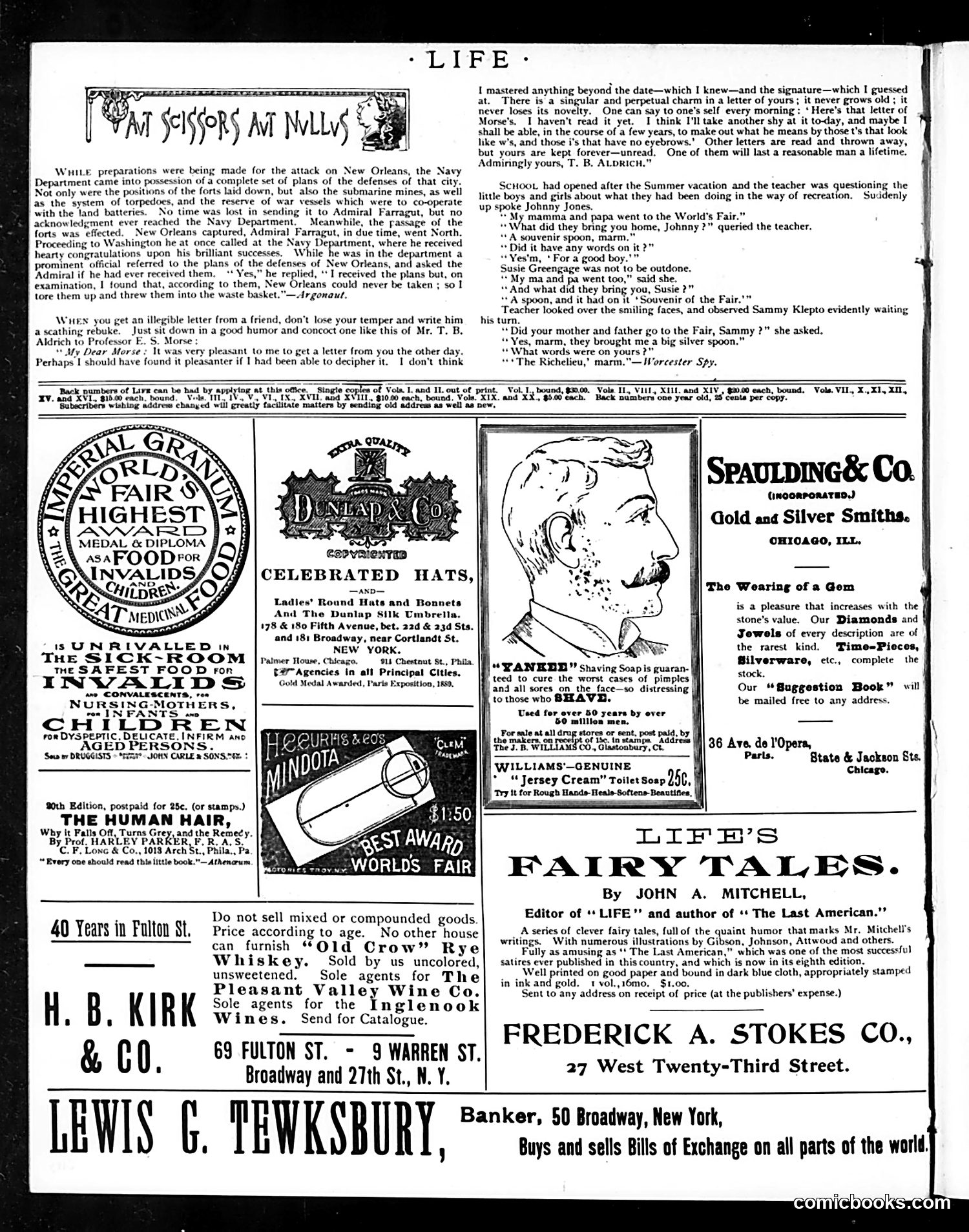
This page from *Life* magazine contains two main pieces of satirical content: **The Admiral Farragut anecdote** criticizes military bureaucracy. During the Civil War, the Navy Department sent Admiral Farragut detailed plans for defending New Orleans before his attack. Farragut's response—that the plans were so poorly drawn he couldn't understand them and therefore ignored them—mocks both the Navy's incompetence and suggests the attack succeeded *despite* official guidance, not because of it. **The "World's Fair Souvenirs" story** satirizes materialism and theft. Three schoolchildren report their parents' World's Fair trips, each bringing home a spoon. The joke's punchline—Sammy Klepto's spoon is engraved "The Richelieu" (a fancy hotel)—implies he stole it, not received it as a legitimate souvenir. His surname itself signals the satire: "Klepto" references kleptomania (compulsive stealing). The remainder consists of period advertisements and publication information.
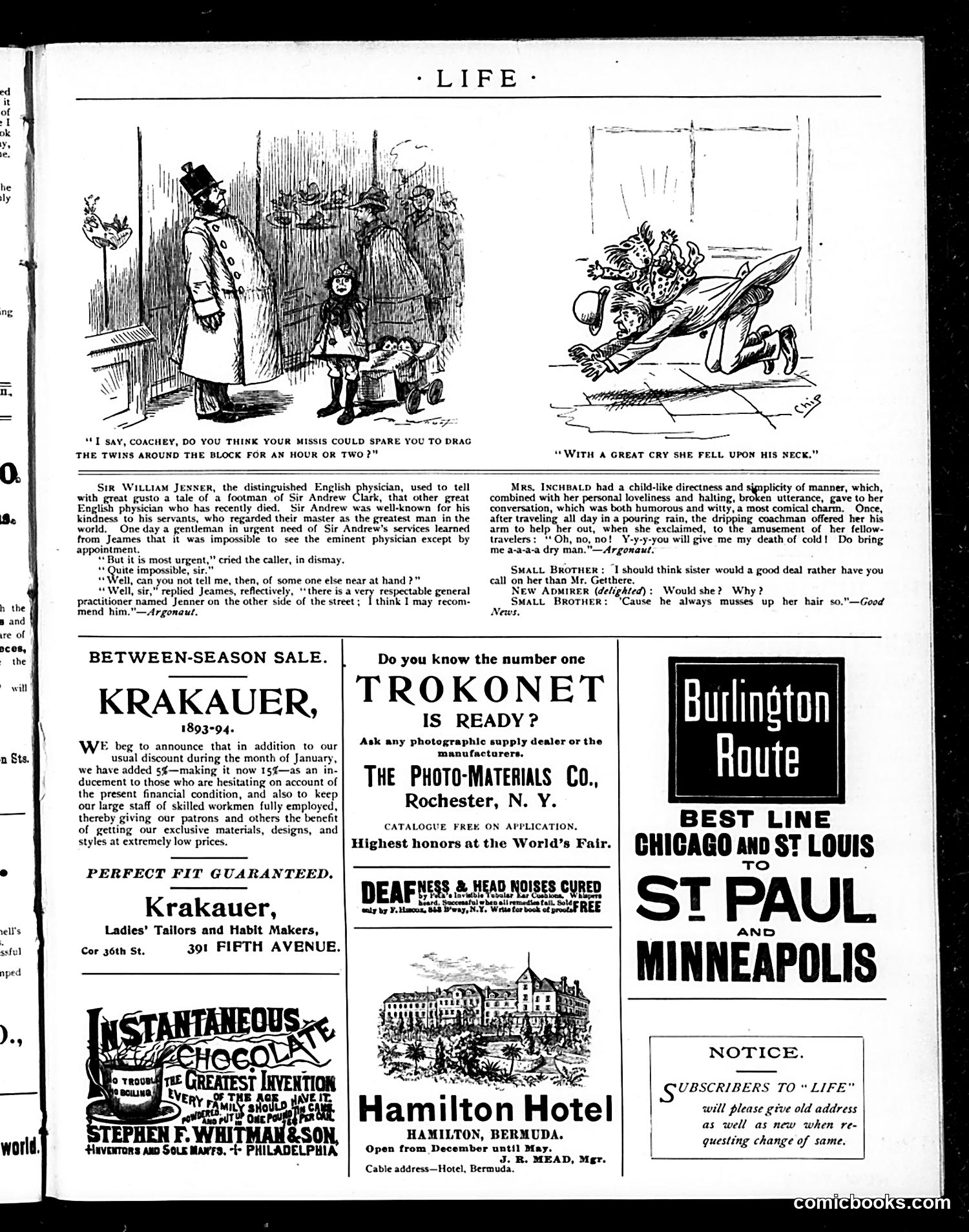
This page from *Life* magazine (circa 1893-94) contains two humorous anecdotes at the top, followed by period advertisements. **The Cartoons/Anecdotes:** The left cartoon illustrates a story about Sir William Jenner, a distinguished English physician, and his footman "Jeames." The humor relies on class-based wit: when a gentleman urgently needs medical attention but cannot reach Sir. Jenner, the footman dryly suggests a "respectable general practitioner named Jenner on the other side of the street"—implying the servant sees no meaningful difference between physicians, deflating the doctor's pretensions. The right cartoon shows a comic misunderstanding: after traveling in rain, Mrs. Inchbald tells a wet coachman offering his arm, "You will give me my death of cold! Do bring me a-a-a-a dry man"—she wants a dry *person*, not dry clothes, creating absurdist humor from her simple-minded literalism. Both jokes satirize Victorian social hierarchies and affectation through servant/working-class perspectives and linguistic mishaps. **Advertisements** occupy the lower half, promoting tailoring, photography supplies, chocolate, and travel services—typical period commercial content.
This is primarily an **advertising and announcements page** rather than a satirical cartoon page. The content reflects late 19th-century American commercial culture. **Key elements:** The page advertises patent medicines and consumer goods typical of the 1890s—Beecham's Pills (a popular laxative marketed as cure-all), Pears' Soap, Scott's Emulsion (cod-liver oil), and Glycerine Dentifrice. These ads employed exaggerated health claims now recognized as quackery. **Historical context:** The central feature announces Life's monthly calendar and upcoming anthology of humorous illustrations from 1892. The ads for Walter Baker & Co. chocolate and the Life Binder show the magazine's commercial partnerships. **What modern readers miss:** These "miracle cure" products were serious business—patent medicines dominated American advertising before FDA regulation (established 1906). The breathless marketing language ("Worth a Guinea a Box," "Act Like Magic") represents an era of minimal consumer protection and widespread medical fraud. The page reflects Life's dual identity: satirical humor magazine *and* commercial publication dependent on lucrative patent medicine advertising.