
Life, 1894-01-04 · page 4 of 16
Life — January 4, 1894 — page 4: what you’re looking at
What you’re looking at
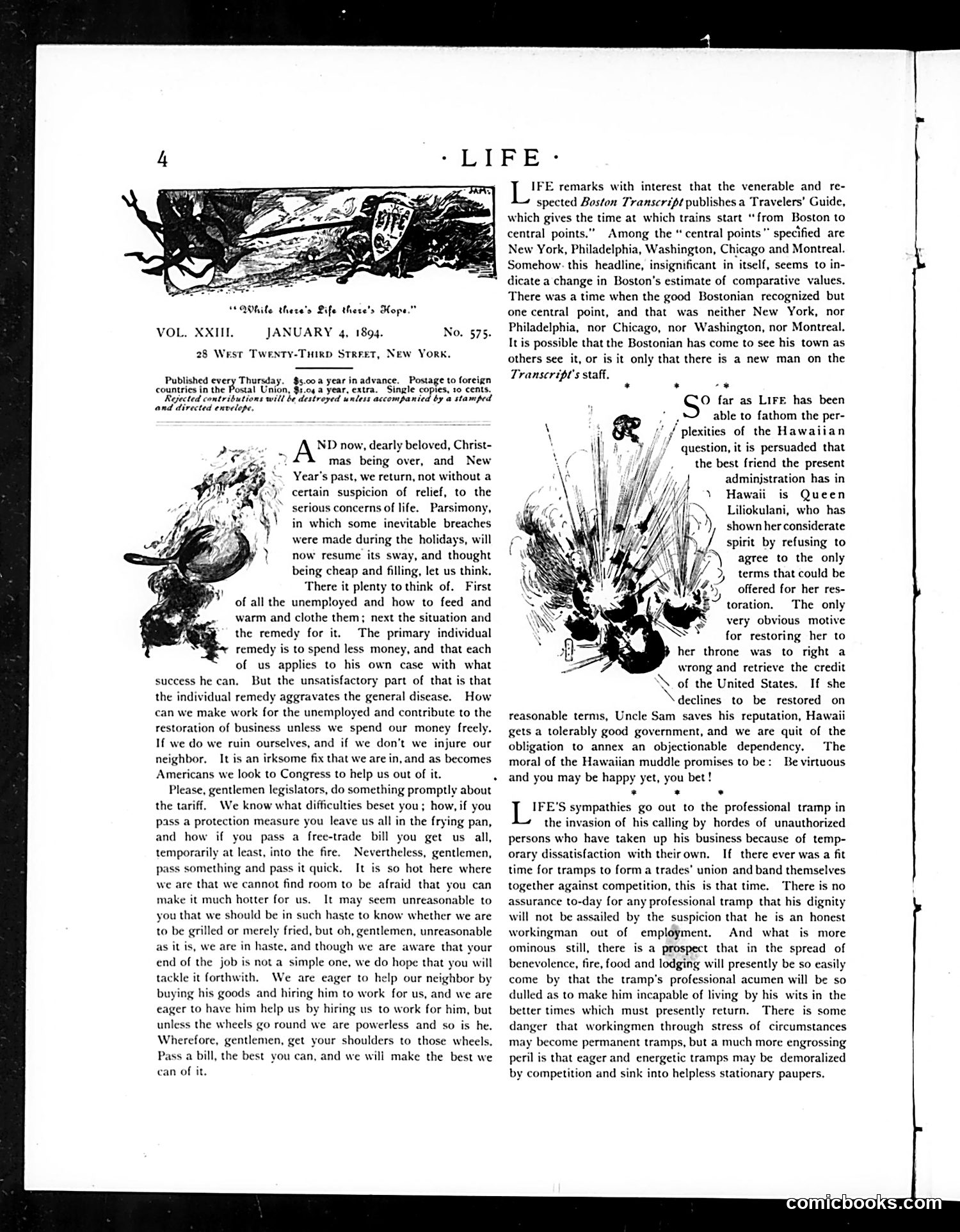
The page contains two editorial sections without political cartoons. The first article criticizes business leaders for inadequate charitable response to unemployment following the holidays. It argues that wealthy individuals must spend money freely to address poverty, calling for Congressional action on tariff reform to restore business and employment. The second article discusses Queen Liliuokalani of Hawaii, apparently defeated in a political conflict. It satirizes the situation by suggesting Hawaii's only value to the U.S. is territorial annexation. The piece mocks Hawaiian political complications while endorsing American expansion, arguing that restoring the queen on "reasonable terms" preserves American reputation while accomplishing annexation. Both sections reflect 1890s American political debates over labor, wealth distribution, and imperial expansion.
📄 Transcribed text from this page (OCR, searchable)
Machine-transcribed from the original scan — historical spelling and the odd misread are preserved.
fe there's Bife there's Hope.” XXIII. JANUARY 4, 1894. 28 West Twenty-THirp STREET, New York. VOL. No. 575. Published every Thursday. $5.00 a year in advance. Postage to foreign countries in the Postal Union, $1.04 a year, extra. Single copies, 10 cents. Rejected contributions will be destreyed unless accompanied by a stamped and directed envelepe. ND now, dearly beloved, Christ- mas being over, and New Year's past, we return, not without a ) certain suspicion of relief, to the ' rious concerns of life. Parsimony, \ in which some inevitable breaches were made during the holidays, will now resume its sway, and thought being cheap and filling, let us think. There it plenty to think of. First of all the unemployed and how to feed and warm and clothe them; next the situation and the remedy for it. The primary individual remedy is to spend less money, and that each of us applies to his own case with what success he can, But the unsatisfactory part of that is that the individual remedy aggravates the general disease. How can we make work for the unemployed and contribute to the restoration of business unless we spend our money frecly. If we do we ruin ourselves, and if we don’t we injure our neighbor, It is an irksome fix that we are in, and as becomes Americans we look to Congress to help us out of it. Please, gentlemen legislators, do something promptly about the tariff. We know what difficulties beset you; how, if you pass a protection measure you leave us all in the frying pan, and how if you pass a free-trade bill you get us all, temporarily at least, into the fire. Nevertheless, gentlemen, pass something and pass it quick. It is so hot here where we are that we cannot find room to be afraid that you can make it much hotter for us. It may seem unreasonable to you that we should be in such haste to know whether we are to be grilled or merely fried, but oh, gentlemen, unreasonable as it is, we are in haste, and though we are aware that your end of the job is not a simple one, we do hope that you will tackle it forthwith, We are eager to help our neighbor by buying his goods and hiring him to work for us, and we are eager to have him help us by hiring us to work for him, but unless the wheels go round we are powerless and so is he. Wherefore, gentlemen, get your shoulders to those wheels, Pass a bill, the best you can, and we will make the best we can of it. -LIFE-: IFE remarks with interest that the venerable and re- spected Boston Transcript publishes a Travelers’ Guide, which gives the time at which trains start “from Boston to central points.” Among the “ central points" specified are New York, Philadelphia, Washington, Chicago and Montreal. Somehow: this headline, insignificant in itself, seems to in- dicate a change in Boston's estimate of comparative values. There was a time when the good Bostonian recognized but one central point, and that was neither New York, nor Philadelphia, nor Chicago, nor Washington, nor Montreal. It is possible that the Bostonian has come to see his town as others see it, or is it only that there is a new man on the Transcript’s staff. * oe O far as LIFE has been able to fathom the per- plexities of the Hawaiian question, it is persuaded that the best friend the present adminjstration has in Hawaii is Queen Liliokulani, who has shown her considerate spirit by refusing to agree to the only terms that could be offered for her res- toration. The only very obvious motive for restoring her to her throne was to right a wrong and retrieve the credit \ of the United States. If she declines to be restored on reasonable terms, Uncle Sam saves his reputation, Hawaii gets a tolerably good government, and we are quit of the obligation to annex an objectionable dependency. The moral of the Hawaiian muddle promises to be: Be virtuous and you may be happy yet, you bet! * . . IFE’S sympathies go out to the professional tramp in the invasion of his calling by hordes of unauthorized persons who have taken up his business because of temp- orary dissatisfaction with theirown. If there ever was a fit time for tramps to form a trades’ union and band themselves together against competition, this is that time. There is no assurance to-day for any professional tramp that his dignity will not be assailed by the suspicion that he is an honest workingman out of employment. And what is more ominous still, there is a prospect that in the spread of benevolence, fire, food and lodging will presently be so easily come by that the tramp’s professional acumen will be so dulled as to make him incapable of living by his wits in the better times which must presently return. There is some danger that workingmen through stress of circumstances may become permanent tramps, but a much more engrossing peril is that eager and energetic tramps may be demoralized by competition and sink into helpless stationary paupers.