
A complete issue · 18 pages · 1893
Life — December 21, 1893
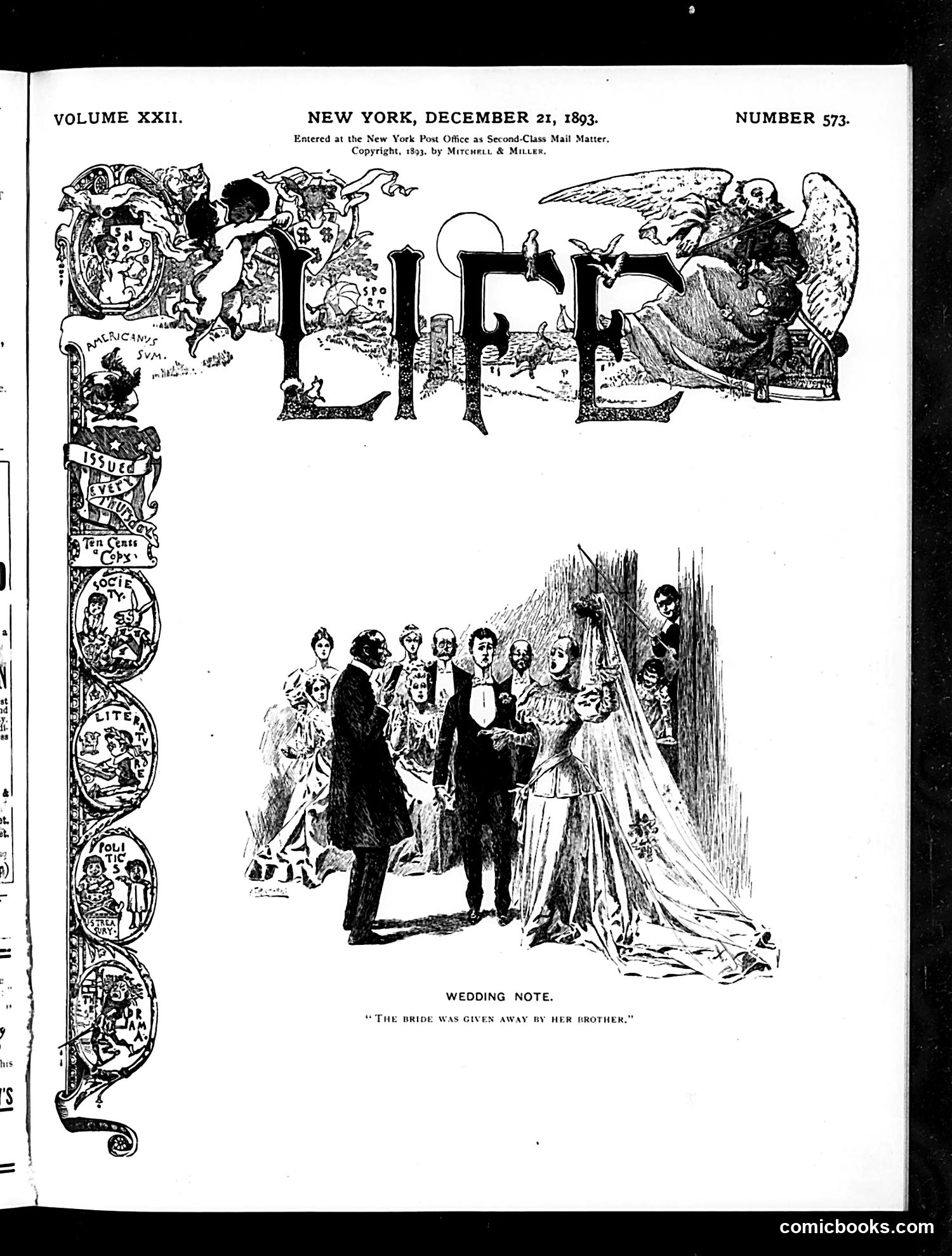
This page features a wedding illustration with the caption "Wedding Note: 'The Bride Was Given Away by Her Brother.'" The humor appears to be a play on the phrase "given away"—literally depicting a brother presenting his sister to be married, while the caption suggests a darker interpretation about familial disposal or loss of the woman through marriage. This reflects late-Victorian satirical commentary on marriage customs and women's legal status as property transferable between male guardians (father to husband). The elaborate decorative border with cherubs and ornamental details is typical of Life's design aesthetic. Without additional context about the specific wedding referenced, it's unclear if this mocks a particular society event or critiques marriage practices generally. The satire targets Victorian marital conventions rather than individuals.
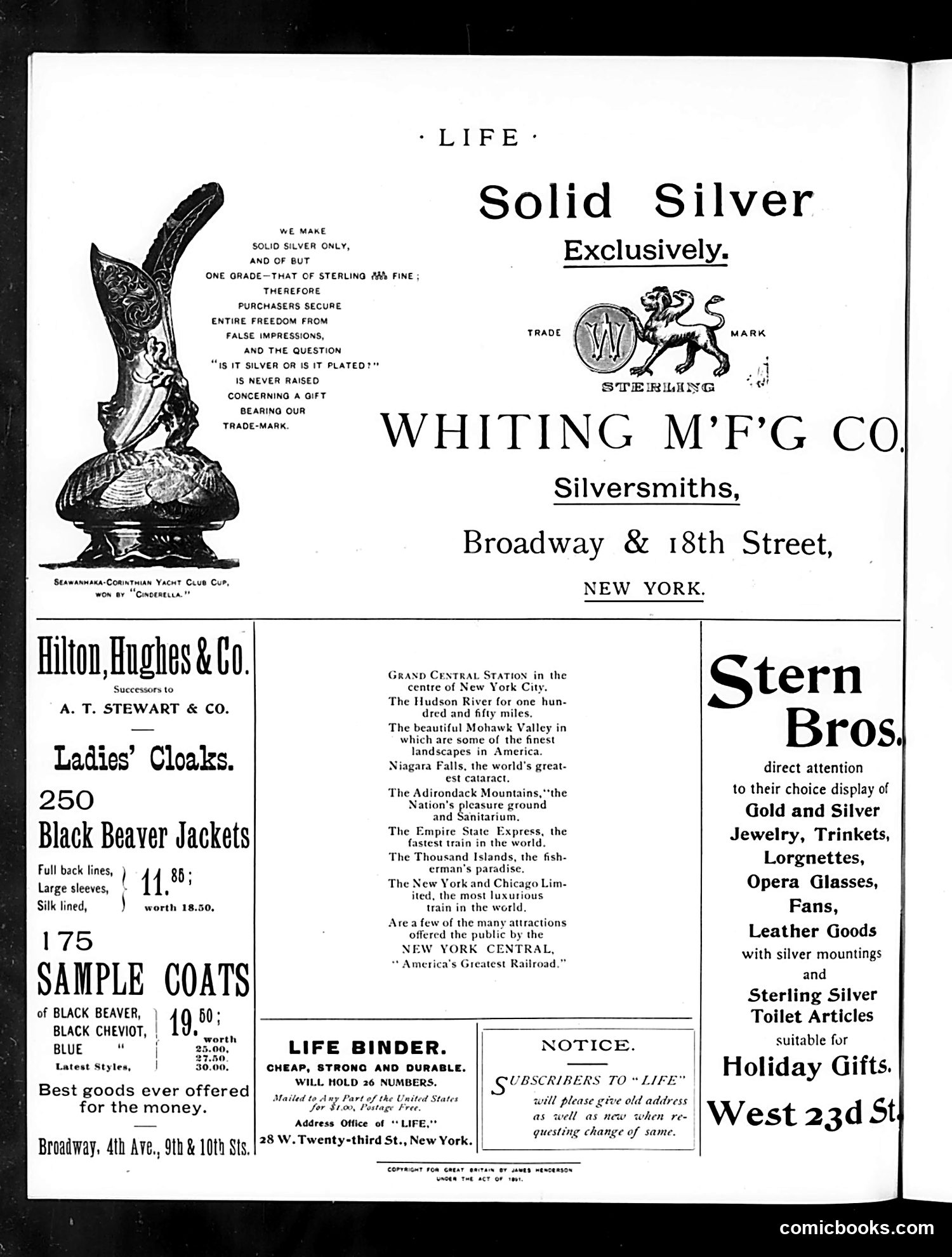
This page is primarily **advertising**, not satire or political commentary. The main content features: 1. **Whiting M'fg Co.** advertisement emphasizing they make "Solid Silver Exclusively" — addressing consumer concerns about whether items were silver or plated, a common fraud concern of the era. 2. **Stern Bros.** advertising luxury goods (jewelry, opera glasses, leather goods with silver mountings) as "Holiday Gifts." 3. **Hilton, Hughes & Co.** promoting ladies' cloaks and sample coats. 4. A decorative **trophy image** (Seawanhaka Corinthian Yacht Club Cup) serves as branding for quality. The left side contains editorial content about New York attractions and railroad travel, likely filler between advertisements. There is no political cartoon or satire present on this page.
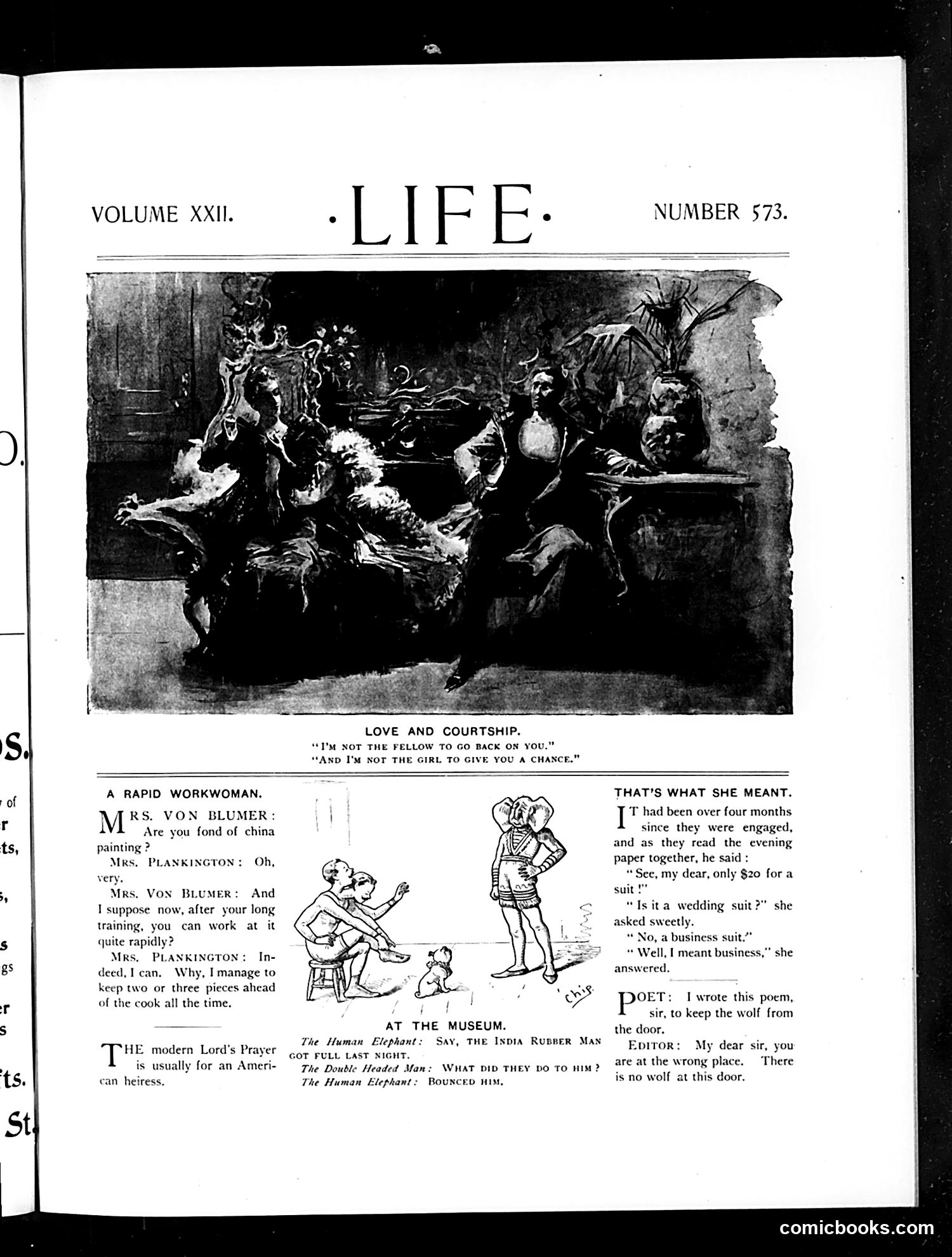
This page contains several unrelated satirical pieces typical of Life's humor magazine format: 1. **"Love and Courtship"** (top illustration): A dramatic scene with the caption "I'm not the fellow to go back on you" / "And I'm not the girl to give you a chance"—satirizing romantic melodrama and courtship game-playing. 2. **"A Rapid Workwoman"**: Mrs. von Blumer discusses painting with Mrs. Plankington, joking that after training, Mrs. von Blumer can "work at it quite rapidly"—likely satirizing amateur artists or wealthy women dabbling in painting. 3. **"That's What She Meant"**: A brief comic about a fiancée's "$20 business suit" misunderstanding—playing on gendered assumptions about women and shopping. 4. **"At the Museum"**: A joke about taxidermied animals, poking fun at museum exhibits.
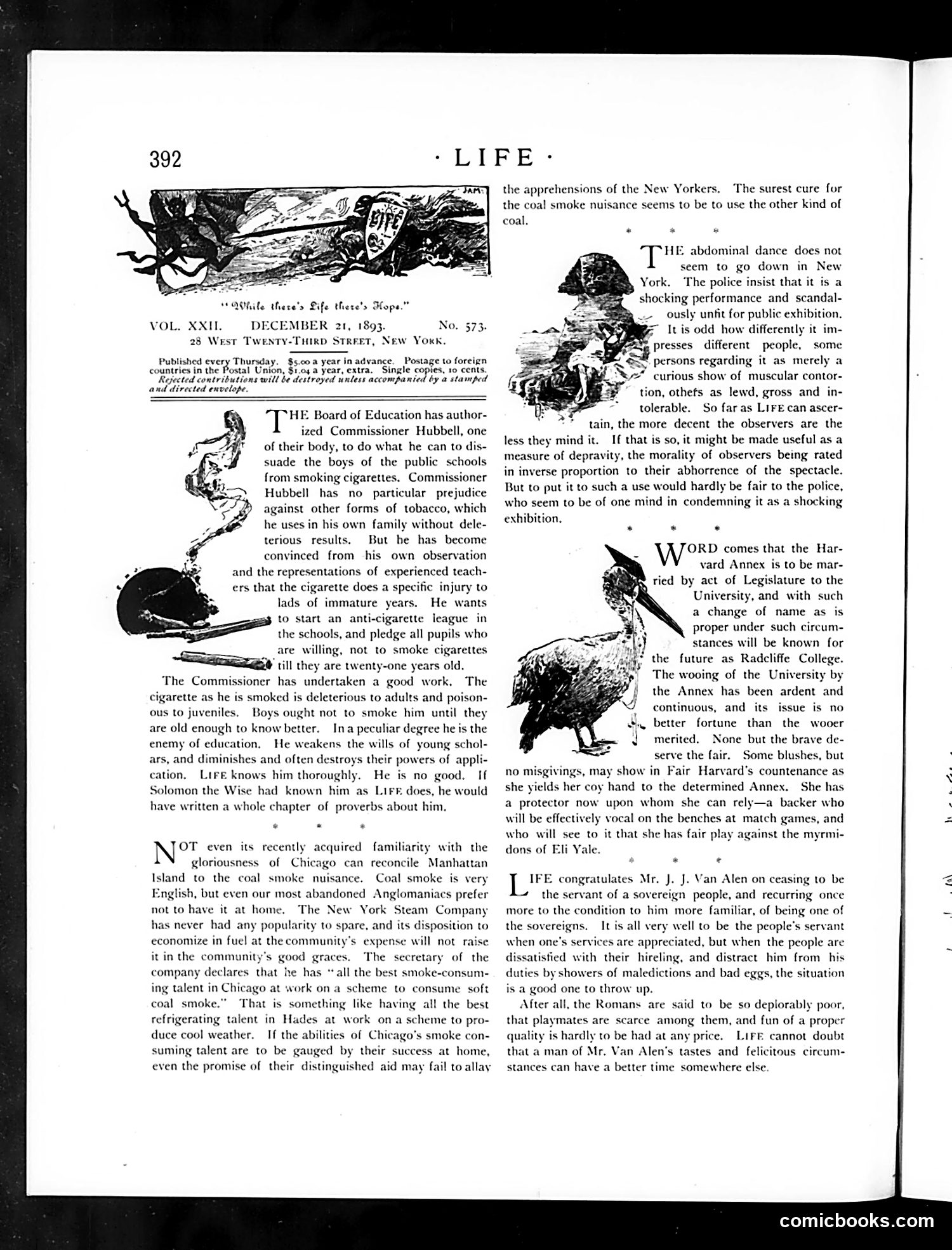
This page contains three satirical pieces about social issues of 1890s New York: 1. **Cigarette smoking in schools**: Commissioner Hubbell's anti-cigarette campaign targeting schoolboys. The text mocks the hypocrisy—the Commissioner uses tobacco himself but wants to ban it for youth, claiming it damages their health and education. 2. **The "abdominal dance"**: Police condemned a performance (likely a risqué dance) as obscene, but the author questions why observers' morality should be judged by their tolerance for such spectacles. 3. **Harvard's Radcliffe College**: Announcing the University's formal acknowledgment of its women's college, previously informal. The tone is congratulatory but somewhat patronizing. The illustrations are period woodcuts typical of Life's satirical style, using exaggeration for comedic effect.
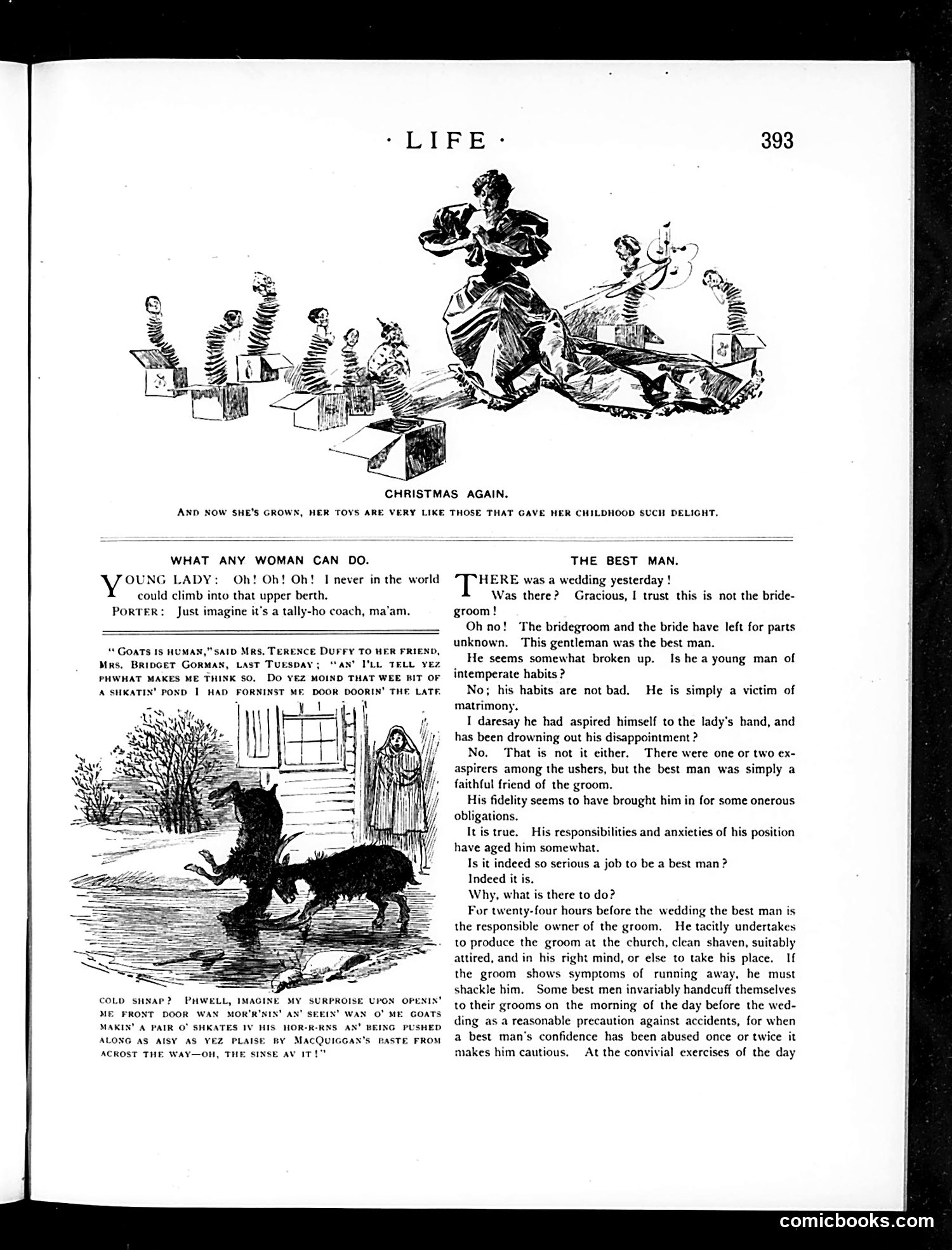
The top illustration shows a woman surrounded by jack-in-the-boxes, satirizing how adult women receive toys similar to childhood playthings—suggesting the cyclical nature of gift-giving and perhaps mocking commercialized Christmas excess. The lower section contains two articles. "What Any Woman Can Do" features a sketch of a woman with a dog in winter, with dialogue about imagining a "tally-ho coach." "The Best Man" discusses the responsibilities and pressures faced by the groom's best man at a wedding, particularly regarding his duties in the twenty-four hours before the ceremony and the potential for mishaps. Both pieces use gentle satire to comment on social rituals and expectations surrounding holidays and weddings in early 20th-century America.
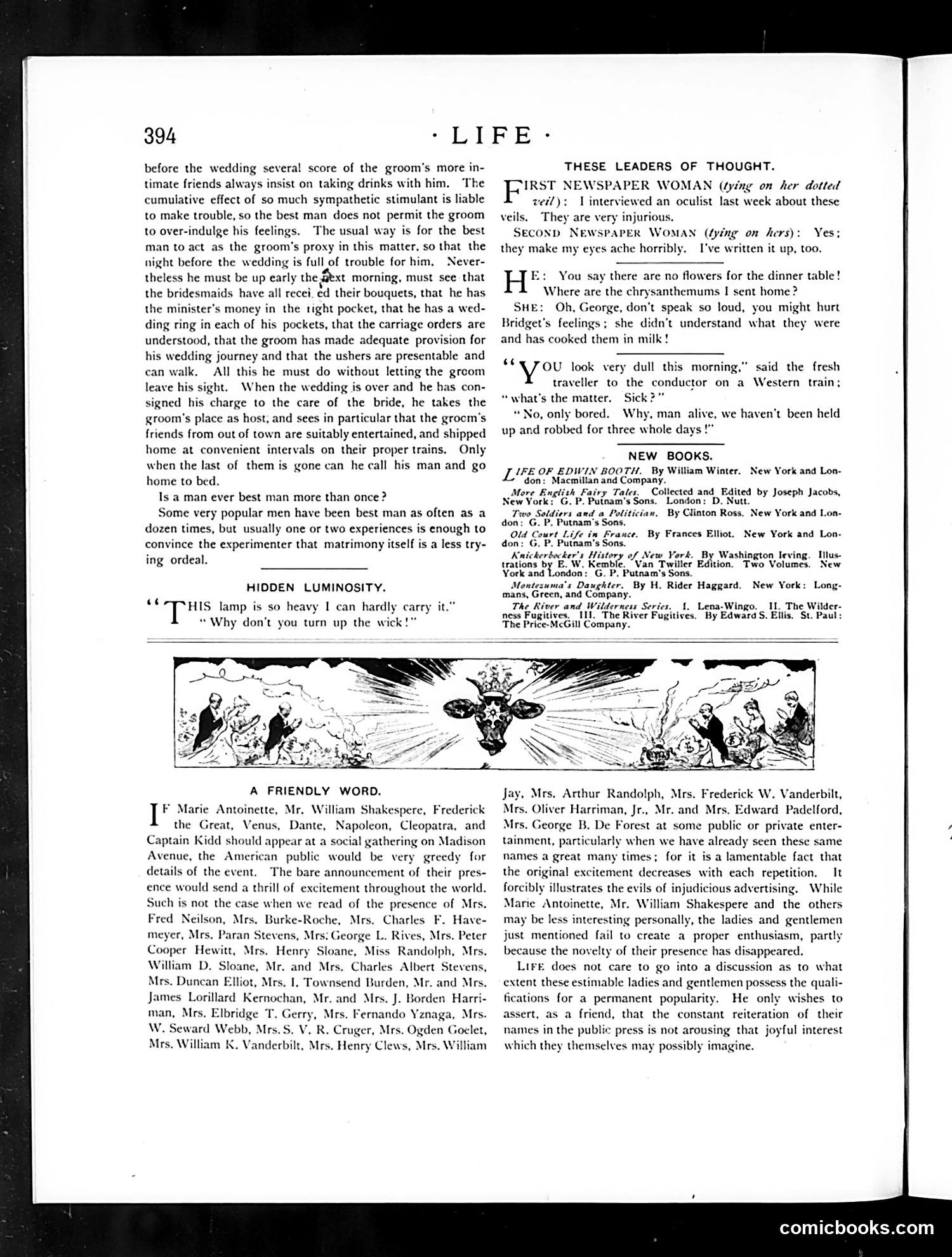
This page contains three separate items rather than a unified cartoon: 1. **"These Leaders of Thought"** - A brief satirical exchange between newspaper women discussing wilted flowers and chrysanthemums, poking fun at trivial women's conversation. 2. **"Hidden Luminosity"** - A two-line joke about a lamp and a candle, with no accompanying image visible in this section. 3. **"A Friendly Word"** - A longer piece criticizing the practice of listing society figures' names in announcements for events like Marie Antoinette and Shakespeare appearing at a social gathering. The satire mocks how repetitive publicity of the same prominent names eventually loses its appeal and fails to generate genuine enthusiasm among the public. The page appears to be social commentary from an early 20th-century satirical publication targeting American high society conventions.
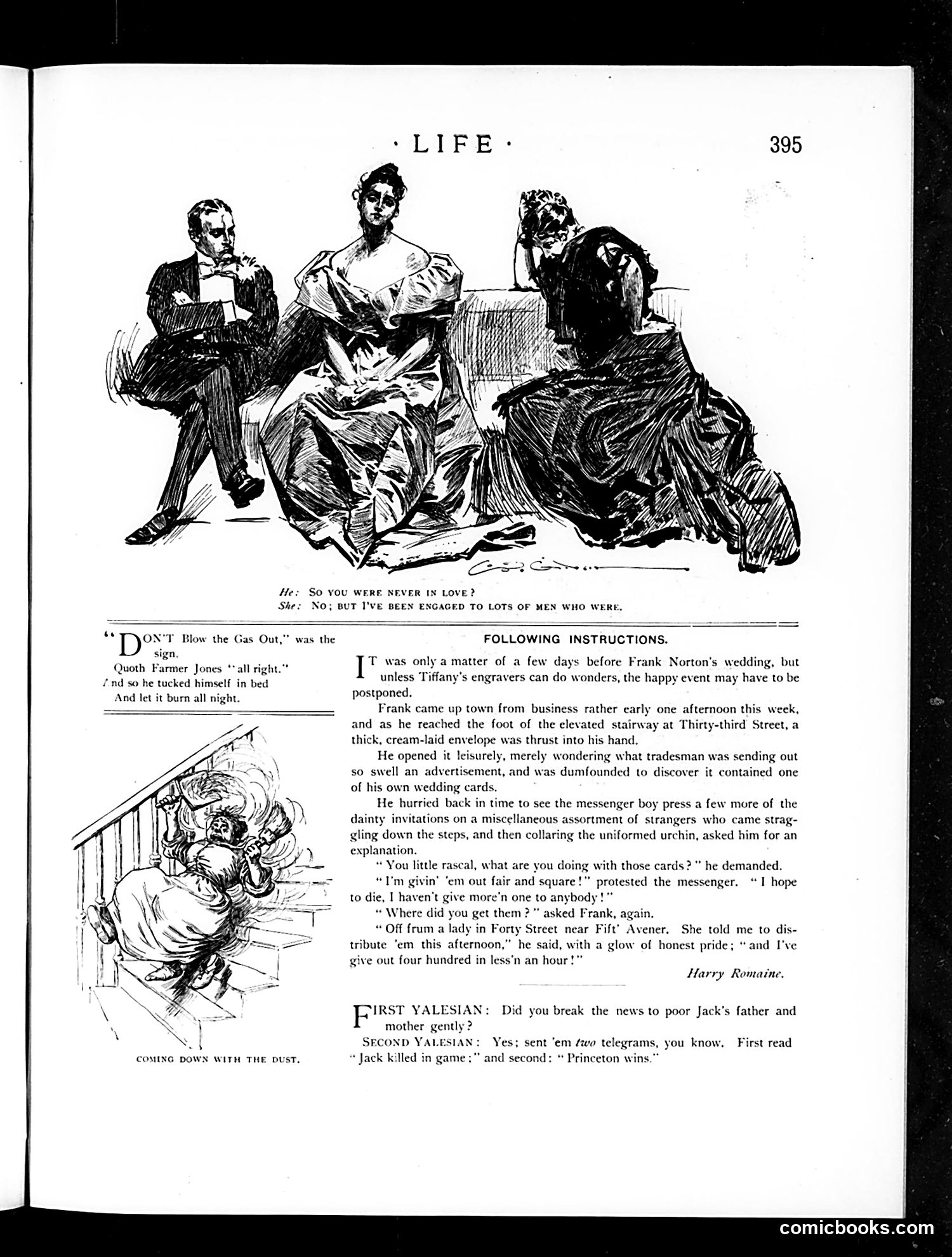
This page contains social satire about courtship and marriage. The top illustration shows three figures in conversation, with a man asking a woman if she was "never in love," to which she replies she's "been engaged to lots of men." The main text discusses Frank Norton's upcoming wedding and his receipt of wedding invitation cards from a messenger boy. The humor centers on Frank's shock that so many cards were printed—"four hundred in less'n an hour!"—suggesting either his fiancée's popularity or the absurdity of mass-producing such intimate announcements. The bottom section includes two humorous dialogue snippets between "Yalemen" about breaking bad news (a death in a game context), typical of the magazine's quick-joke format. The overall satire mocks upper-class courtship rituals and social conventions of the era.
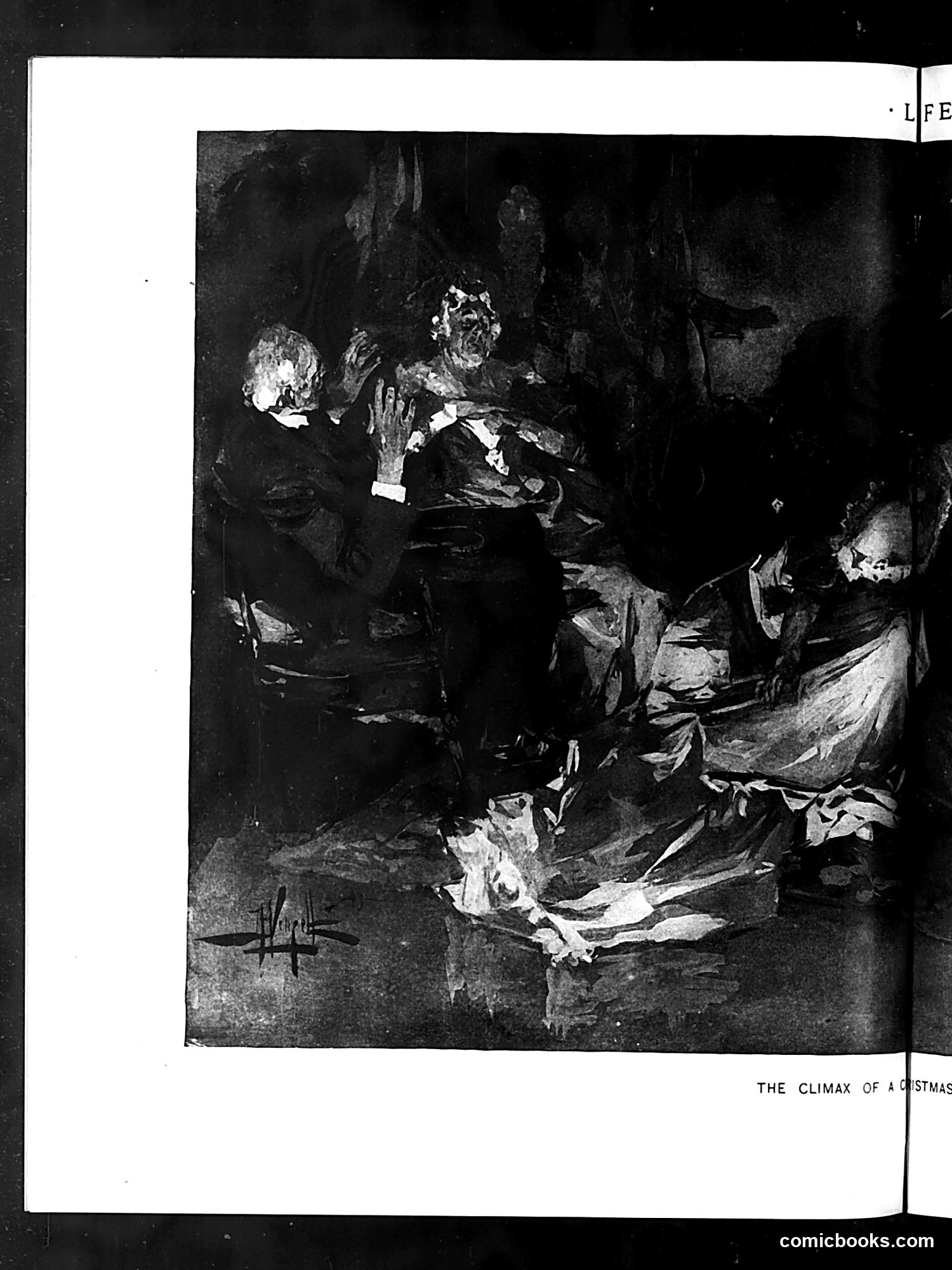
This appears to be a dramatic scene depicting what the caption identifies as a Christmas climax. The image shows multiple figures in what seems to be a domestic interior—likely a parlor or sitting room. The style and composition suggest this is satirizing Victorian-era Christmas celebrations, possibly mocking sentimental or melodramatic holiday gatherings. The figures' poses and the overall dark, theatrical composition suggest satirical commentary on Christmas sentimentality. However, without clearer details or additional page context, I cannot definitively identify the specific individuals depicted or the precise social commentary being made. The image's dramatic lighting and composition indicate this is likely political or social satire typical of *Life* magazine's satirical approach to holiday traditions.
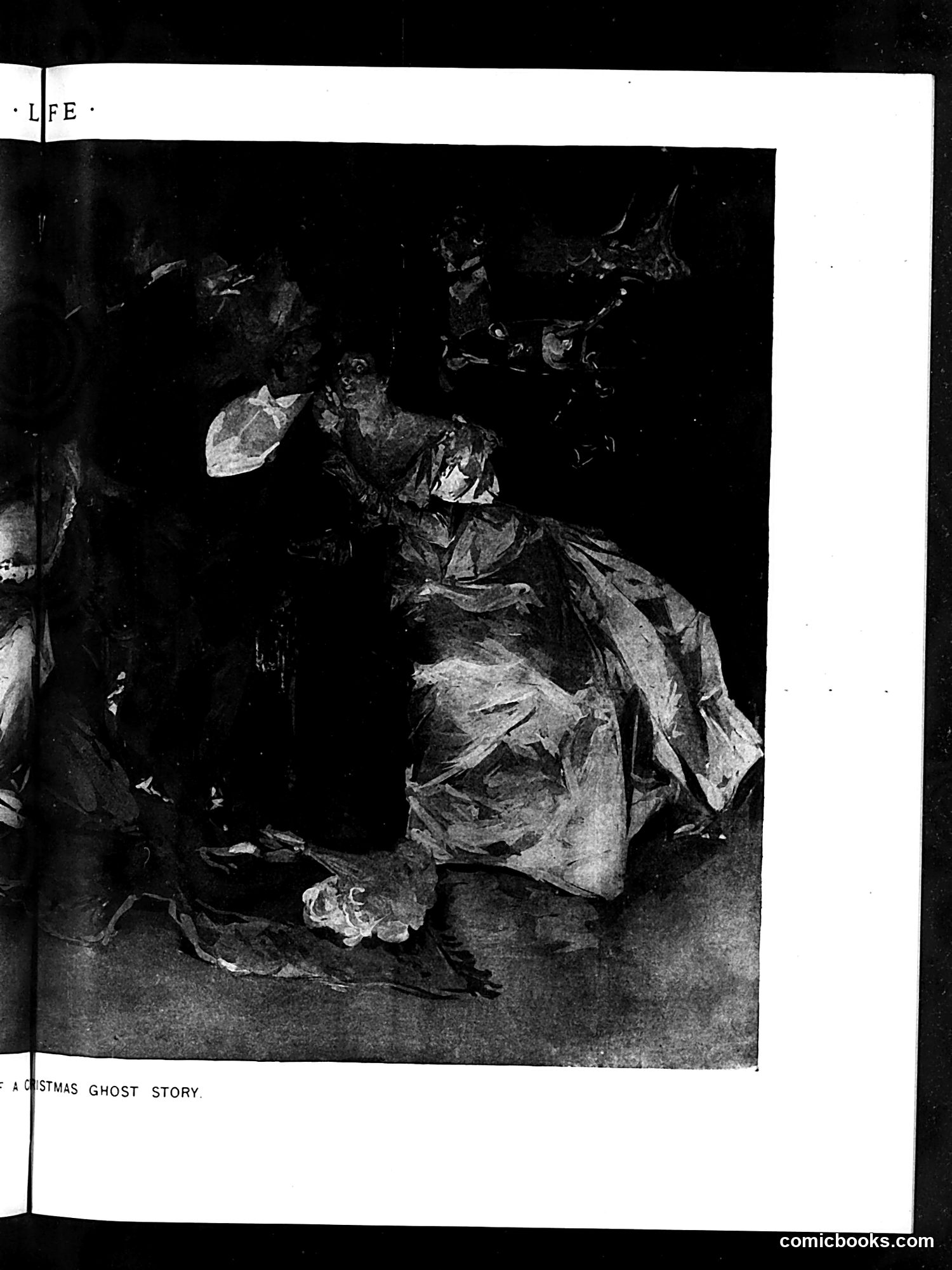
This appears to be an illustration for a Christmas ghost story published in *Life* magazine. The image shows a figure in tattered, flowing garments—seemingly a ghost or supernatural apparition—surrounded by dark shadows and atmospheric effects typical of Victorian-era ghost story imagery. The caption reads "A CHRISTMAS GHOST STORY," indicating this is likely accompanying a seasonal tale of the supernatural, a popular genre during the late 19th/early 20th century when *Life* was in circulation. The dramatic black-and-white imagery and ghostly figure suggest this illustrated a fictional narrative rather than political satire or social commentary. Without additional context or text, the specific story being referenced remains unclear.
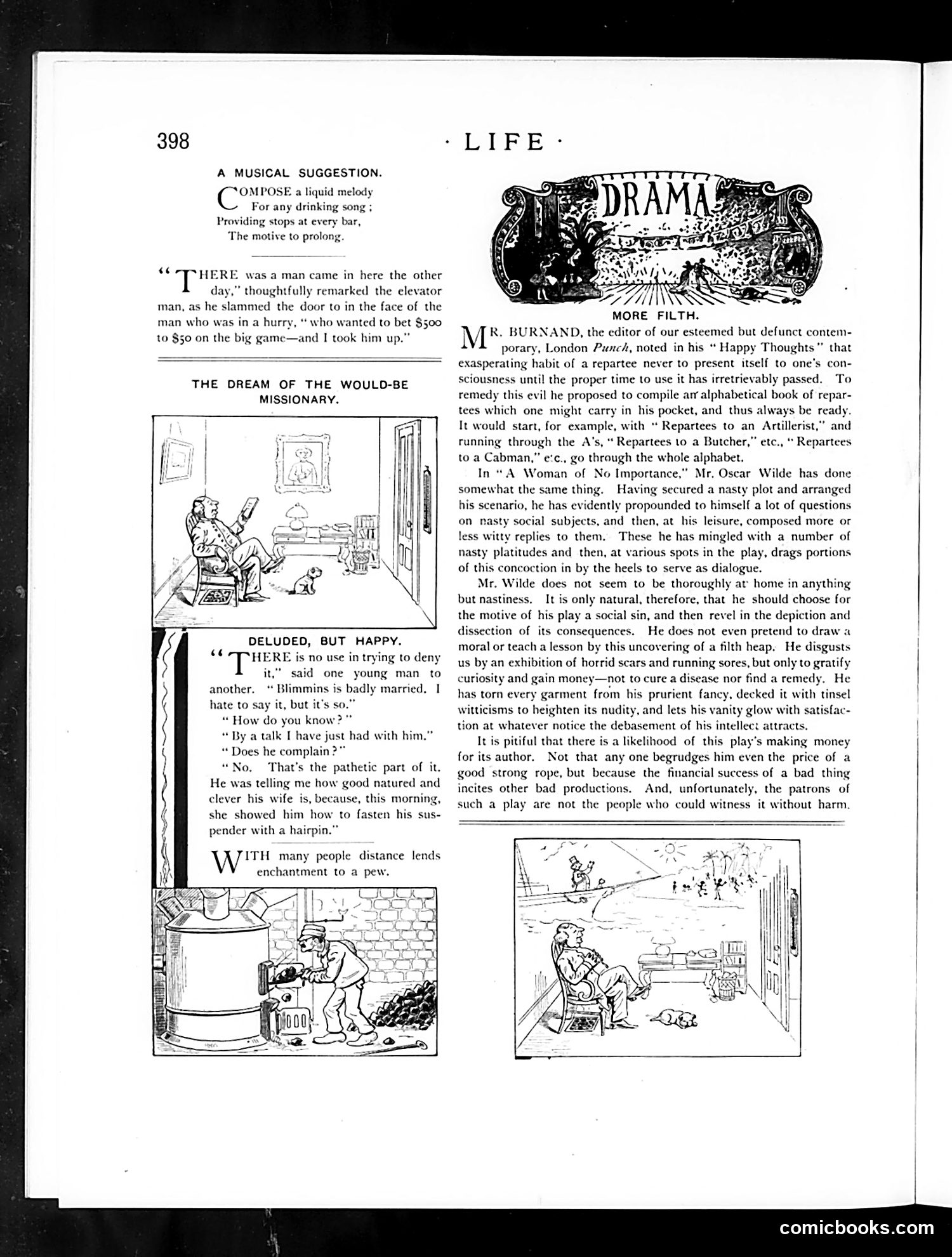
This page critiques contemporary theater, specifically targeting Oscar Wilde's play "A Woman of No Importance." The text accuses Wilde of manufacturing social controversy artificially—posing questions about "nasty social subjects" without genuine moral intent, merely to attract audiences and money. The cartoons illustrate humorous drinking and domestic scenes unrelated to the drama criticism. The "Musical Suggestion" jokes about bar culture, while the lower comics depict comedic situations. The core satire attacks Wilde's theatrical approach as cynical exploitation: using shock value and "nasty platitudes" as dialogue rather than meaningful social commentary. The critic argues Wilde deliberately undresses serious issues for entertainment profit, corrupting theater's potential for genuine moral education.
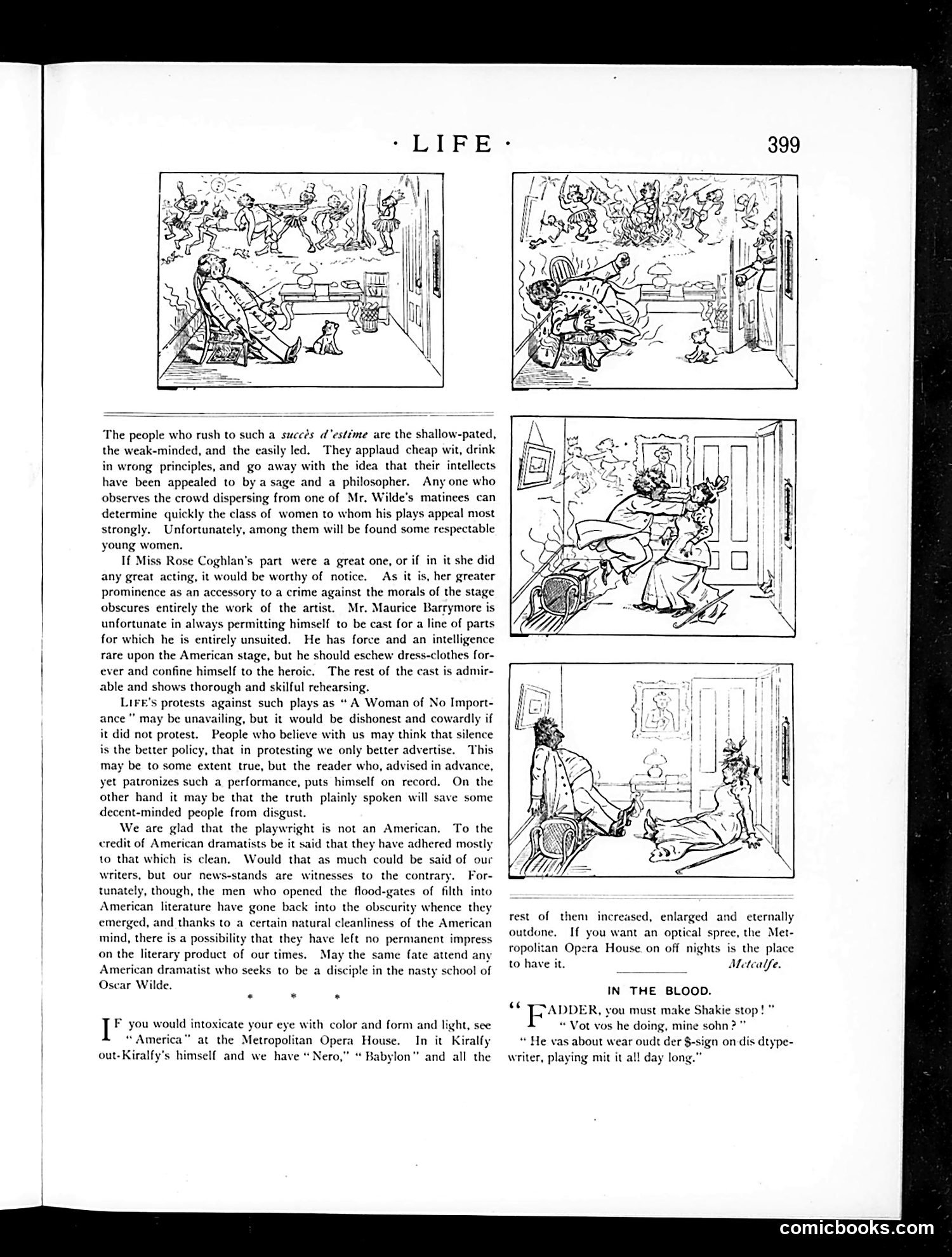
This page critiques theater audiences and practices circa early 1900s. The four cartoon panels depict chaotic domestic scenes, illustrating the article's complaint about shallow theatergoers who attend matinee performances ("succès d'estime"). The text attacks audiences for applauding "cheap wit" and easily-swayed intellectuals. It specifically criticizes Maurice Barrymore's casting and stage morality, referencing Oscar Wilde's theatrical work. The article argues American playwrights have retreated into obscurity due to poor stage standards. The final section introduces a theatrical dialogue ("In the Blood") featuring characters named Faddler and Shakie, using dialect ("Vos vos he doing"). The cartoons satirize how theater influences—or fails to influence—proper Victorian domestic conduct and audience taste.
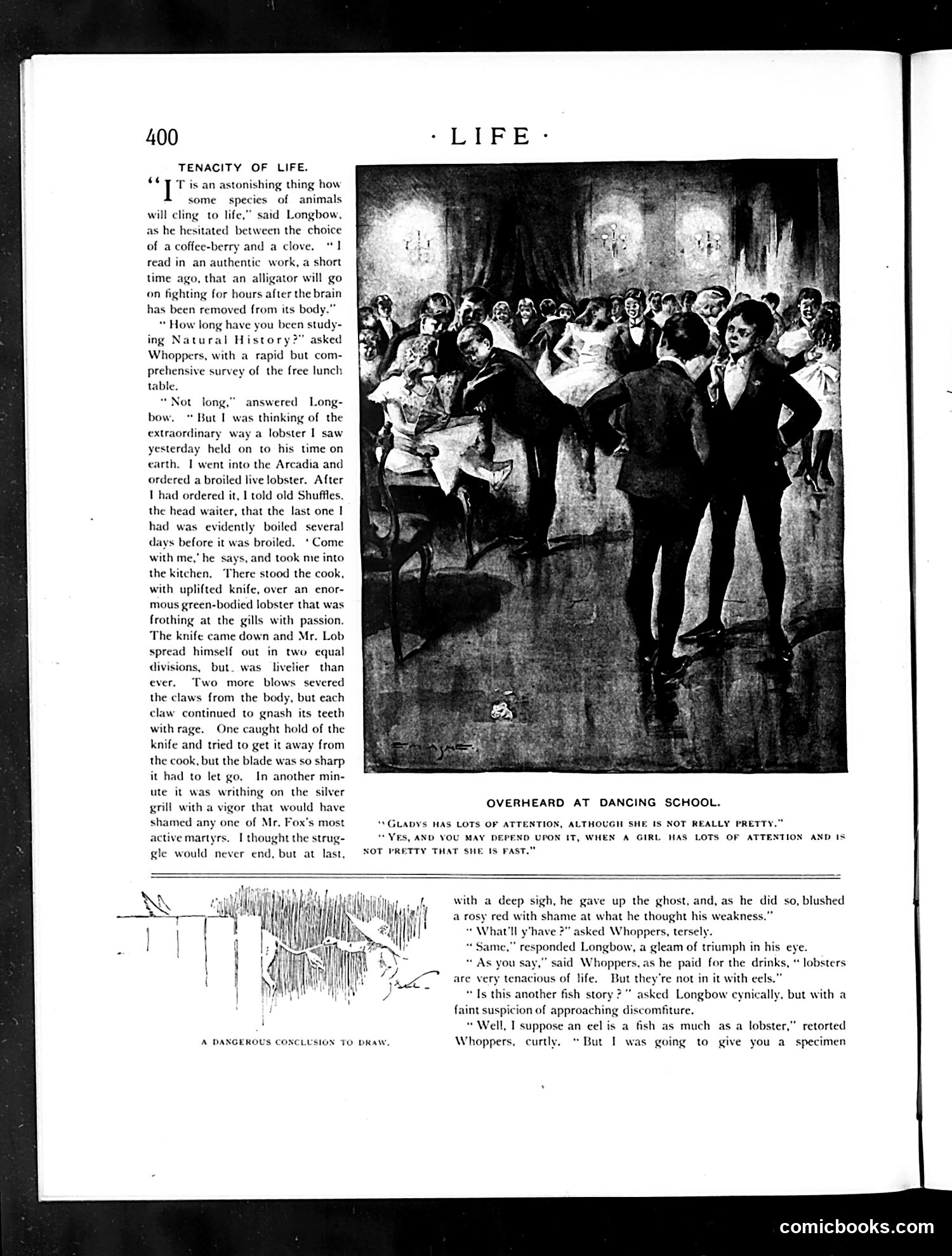
This page contains two satirical pieces mocking pretentious conversation at the turn of the 20th century. The main text features characters Longbow and Whoppers at a free lunch counter (a common saloon practice of the era), engaged in one-upmanship through increasingly exaggerated anecdotes about animal resilience. Longbow's graphic lobster story—describing a cook's brutal butchering of a live lobster that continues thrashing after being bisected—is presented as pseudo-scientific discourse. The satire targets masculine posturing: men attempting to impress through gruesome, dubious "natural history" facts while eating cheap free food. The small cartoon "Overheard at Dancing School" satirizes social hypocrisy among the upper classes. The caption suggests that when an unpretty girl receives male attention, she must be "fast" (promiscuous)—mocking both society's shallow beauty standards and the moral judgments applied to women's behavior. Both pieces ridicule pretension masquerading as knowledge and propriety masking cruelty.
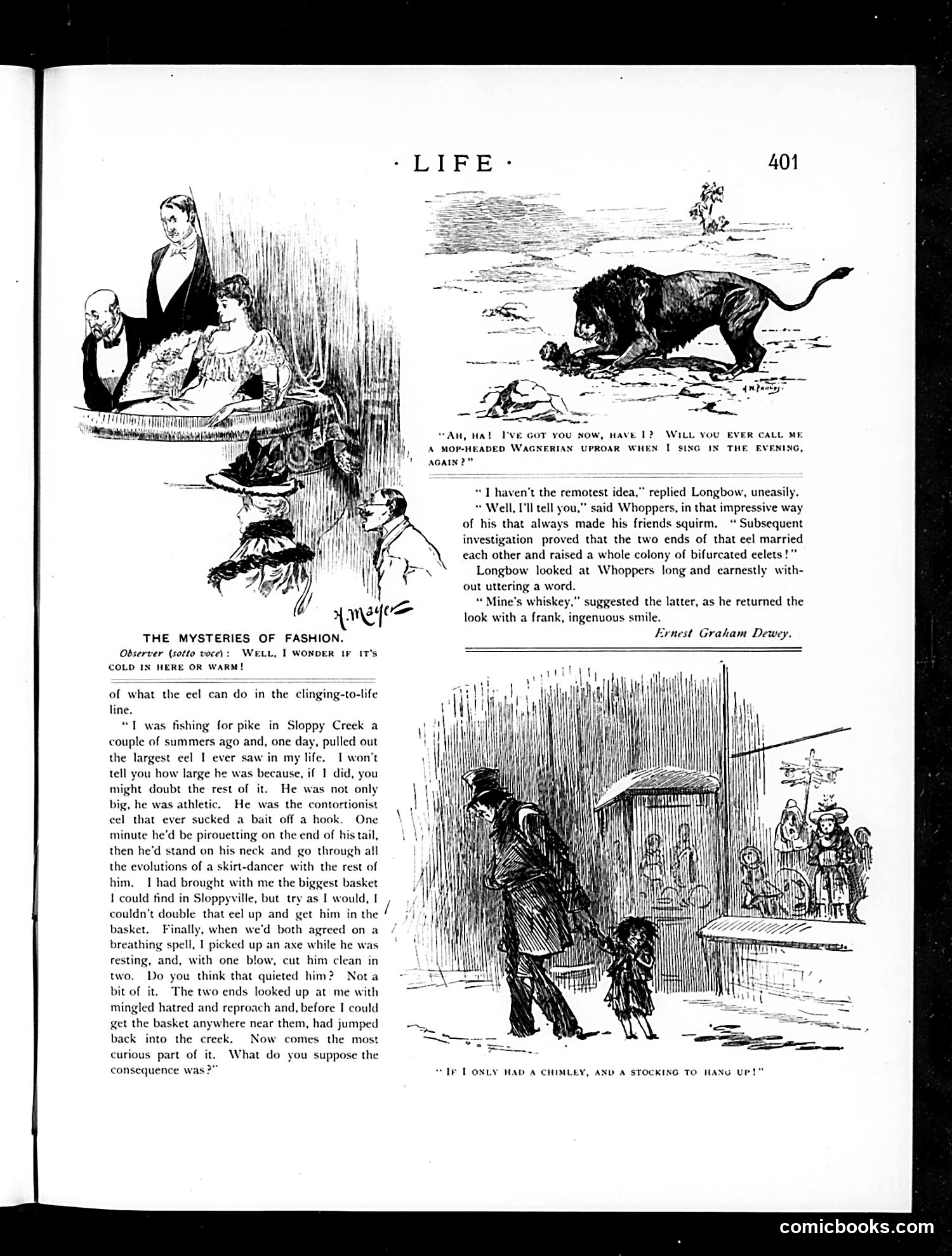
This page contains two separate satirical pieces: **Top left:** A cartoon mocking women's fashion constraints. The observer's sotto voce comment—wondering if it's cold or warm—suggests a woman is dressed so tightly in fashionable corsetry that her discomfort is obvious yet unmentionable in polite society. The joke satirizes the absurdity of restrictive Victorian/Edwardian women's clothing that prioritizes appearance over basic comfort. **Bottom:** A tall tale about an impossibly athletic eel that performs like a "skirt-dancer." When cut in half, both ends supposedly reunite, marry, and reproduce "bifurcated eelets." The humor relies on the narrator (Whoppers) spinning an increasingly ridiculous lie to his skeptical friend Longbow, who finally suggests the teller needs whiskey—implying only intoxication explains such nonsense. It's absurdist humor puncturing pretentious storytelling.
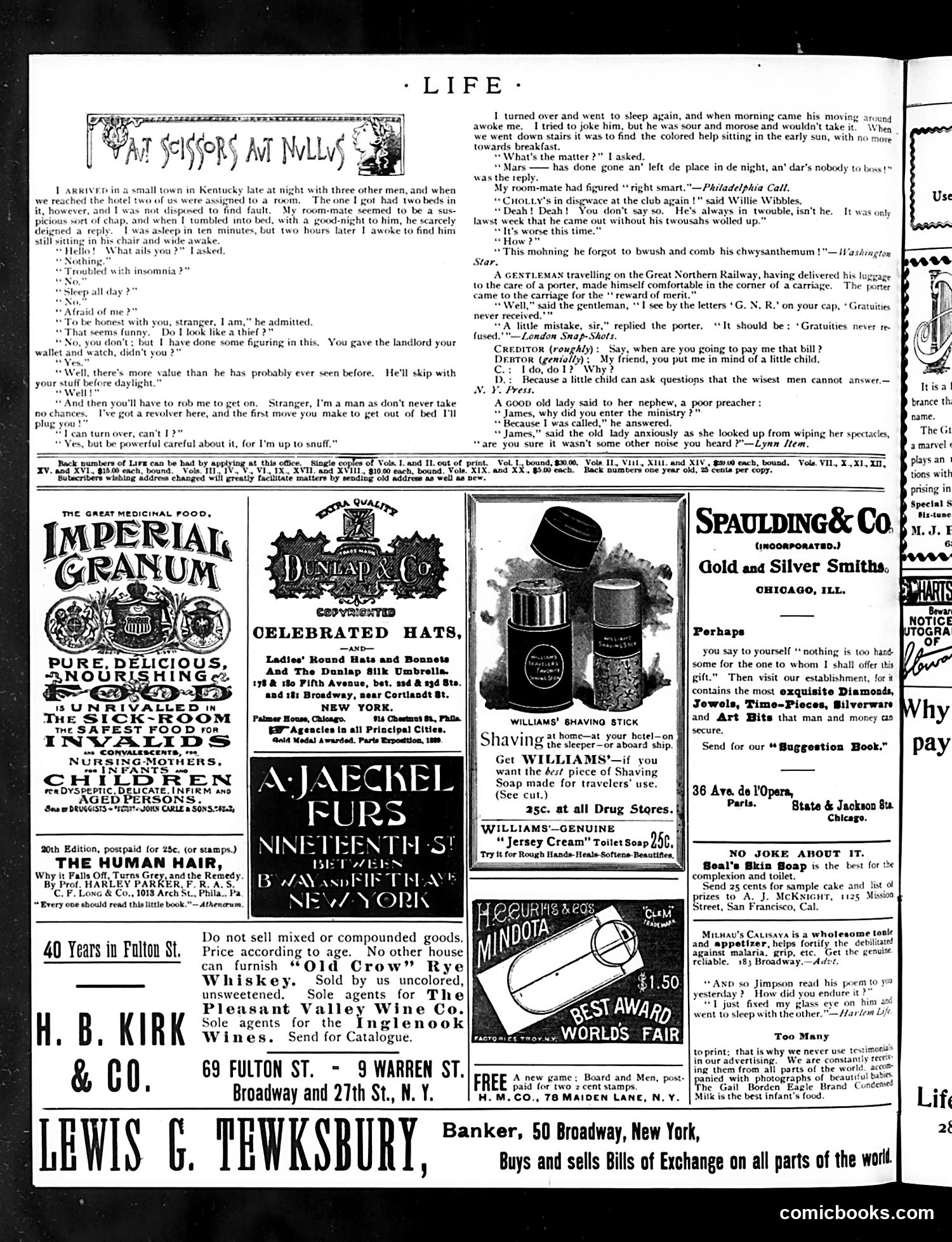
This page contains primarily **short humorous anecdotes** rather than political cartoons. The main story, "Scissors at Mills," is a narrative joke about frontier suspicion and cunning. **The Setup:** A traveler arrives at a Kentucky hotel and shares a room with a suspicious man. When asked why he won't sleep, the man reveals he's figured out the traveler has given his watch to the landlord as security—meaning the traveler has valuables worth stealing. **The Joke's Point:** The traveler admits the man's logic is sound but warns he's armed. By morning, it's the *suspicious man himself* who has fled with the traveler's belongings, leaving the hotel staff abandoned. The "figuring" that seemed clever was actually criminal intent revealed. **Context for Modern Readers:** This reflects 19th-century anxieties about travel safety, con artists, and frontier lawlessness. The humor relies on irony—the man's suspicious reasoning backfires when he becomes the thief himself. The page also contains period advertising and shorter jokes about social etiquette (wealthy men forgetting proper dress).
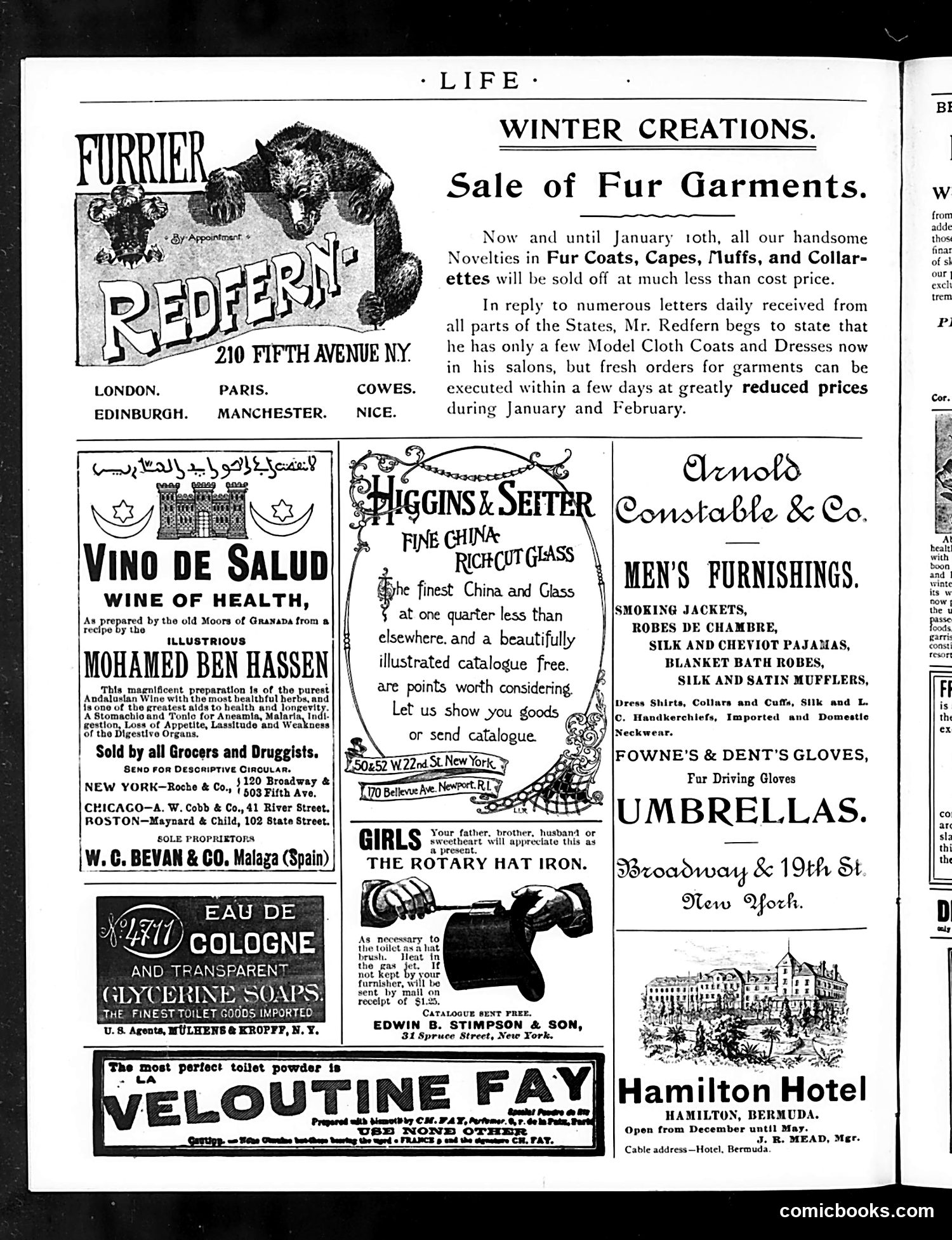
This page from *Life* magazine is dominated by commercial advertisements rather than satirical content. The masthead "Winter Creations" announces a fur garment sale, while the bulk of the page features ads for luxury goods: imported wines, fine china and glassware, men's clothing and accessories, toiletries, and hotel accommodations. The only item with comedic potential is the "Rotary Hat Iron" advertisement, which depicts a mechanical device for pressing hats—a practical Victorian-era grooming tool marketed as a gift for male relatives. However, there is no visible satire or cartoon commentary here. This appears to be a standard advertising section typical of *Life*'s era, showcasing high-end consumer products for affluent readers rather than political or social satire.
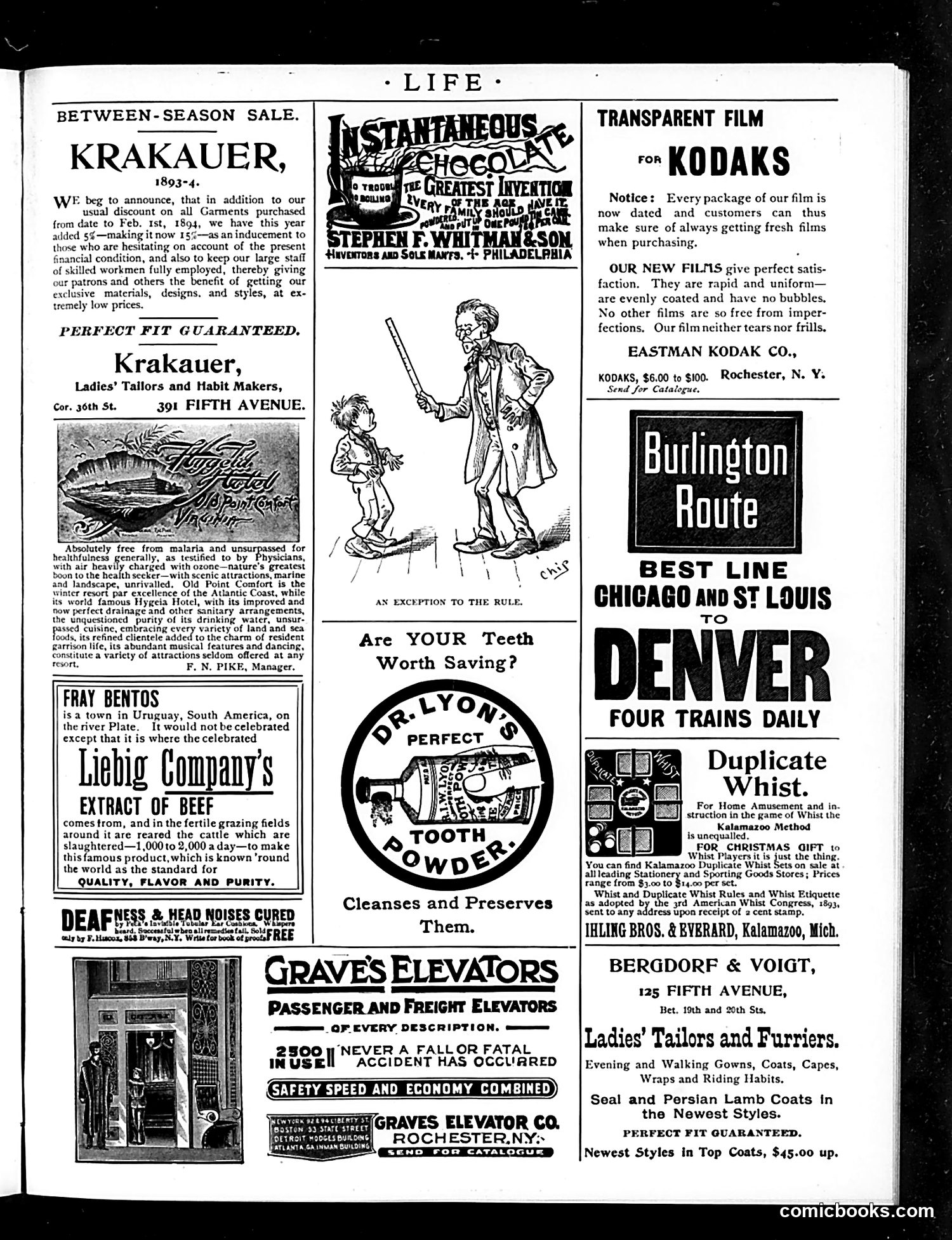
This is primarily an **advertising page** with one small cartoon. The lone illustration—captioned "An Exception to the Rule"—shows an adult and child walking together, drawn by someone signed "Cesare" (likely a cartoonist). The caption suggests the image depicts an unusual or noteworthy behavior, though the specific social commentary is unclear from the image alone. The page otherwise contains commercial advertisements typical of 1893-94 America: clothing tailors, beef extract, elevators, photographic film, railroad services, dental powder, and parlor games. One ad references the "3rd American Whist Congress, 1893," dating the page to that era. Notable is the Krakauer clothing ad announcing a **depression-era discount** (15% off), explicitly stating it's meant to "keep our large staff of workmen fully employed"—reflecting economic hardship of the period. The cartoon's meaning remains unclear without additional context about what behavior it's satirizing.
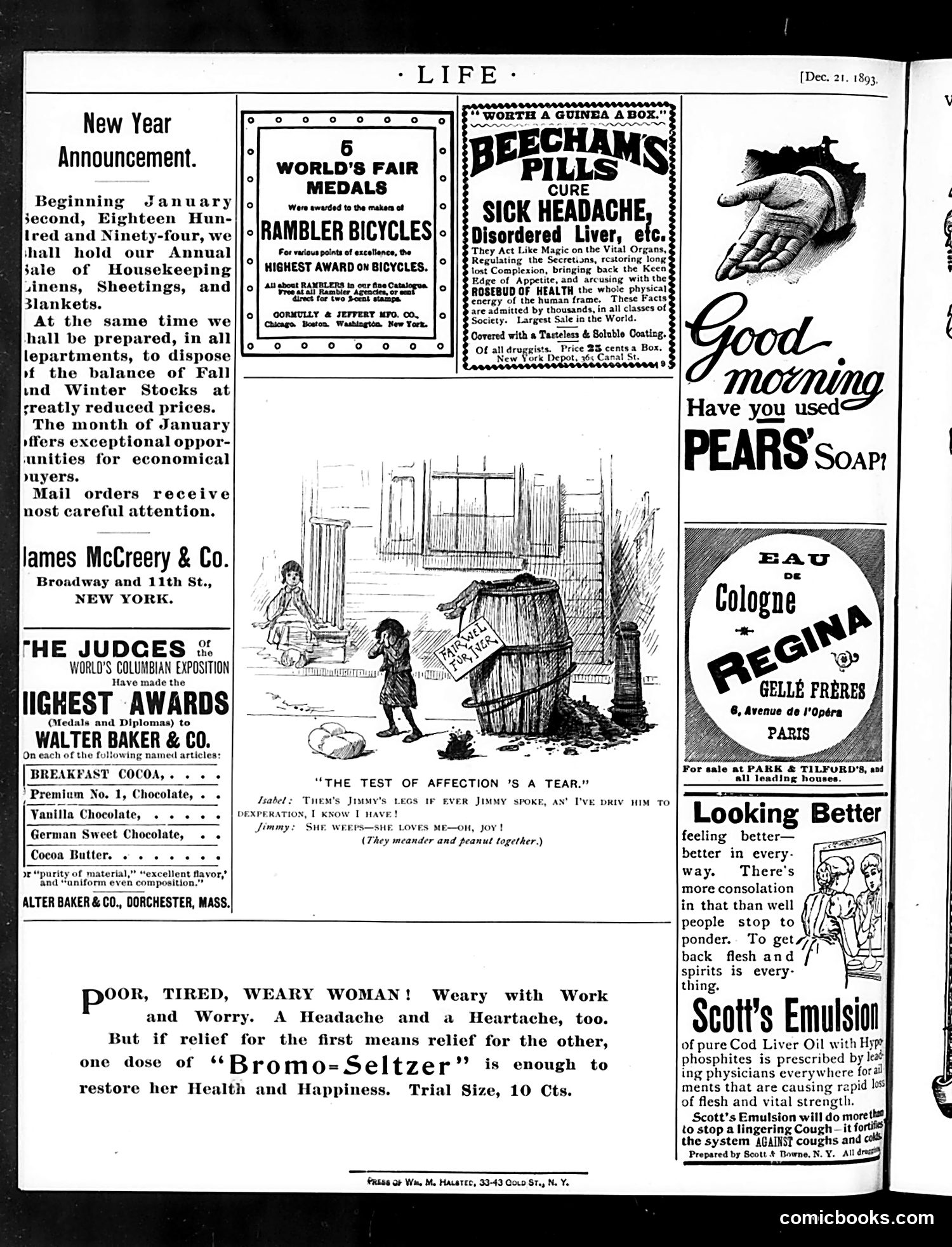
This page is primarily **advertising**, not political satire. It contains one small cartoon titled "The Test of Affection 'S a Tear," showing a domestic scene where Isabel tearfully tells Jimmy she weeps because she loves him—a sentimental, humorous take on romantic expression typical of the era. The page is dominated by period product advertisements: Beecham's Pills (a patent medicine claiming to cure headaches and liver ailments), Rambler Bicycles (World's Fair medal winner), Pears' Soap, Scott's Emulsion (cod liver oil tonic), and Walter Baker & Co. chocolate products. **New Year context**: The James McCreery & Co. announcement promotes their annual January housekeeping sale, reflecting late-19th-century retail seasonality. The advertisements reveal contemporary attitudes: patent medicines with extravagant health claims were standard; women were targeted as sickly consumers needing tonics; and bicycles represented modern technological achievement worthy of world's fair recognition.