
Life, 1893-12-21 · page 11 of 18
Life — December 21, 1893 — page 11: what you’re looking at
What you’re looking at
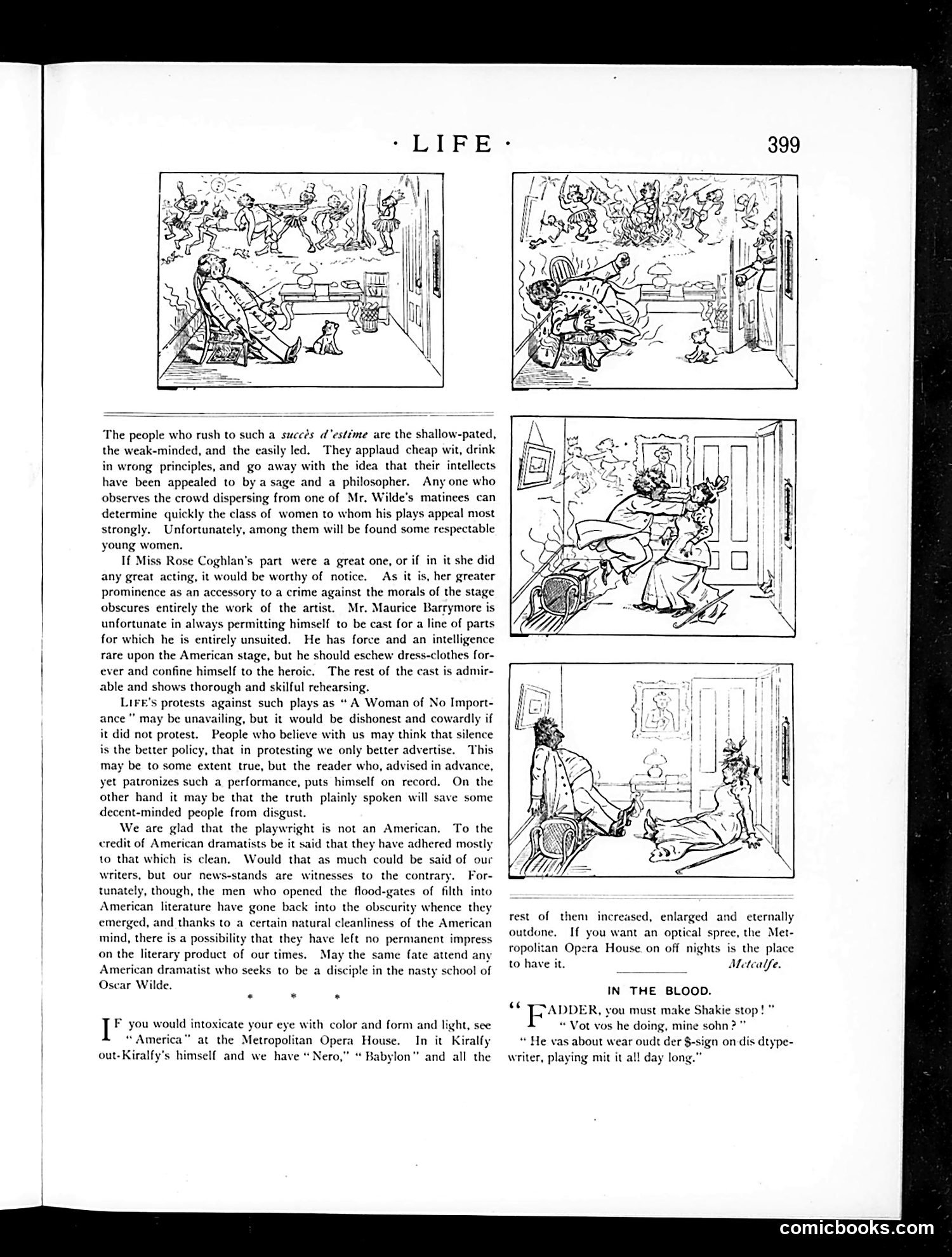
This page critiques theater audiences and practices circa early 1900s. The four cartoon panels depict chaotic domestic scenes, illustrating the article's complaint about shallow theatergoers who attend matinee performances ("succès d'estime"). The text attacks audiences for applauding "cheap wit" and easily-swayed intellectuals. It specifically criticizes Maurice Barrymore's casting and stage morality, referencing Oscar Wilde's theatrical work. The article argues American playwrights have retreated into obscurity due to poor stage standards. The final section introduces a theatrical dialogue ("In the Blood") featuring characters named Faddler and Shakie, using dialect ("Vos vos he doing"). The cartoons satirize how theater influences—or fails to influence—proper Victorian domestic conduct and audience taste.
📄 Transcribed text from this page (OCR, searchable)
Machine-transcribed from the original scan — historical spelling and the odd misread are preserved.
The people who rush to such a succes d'estime are the shallow-pated, the weak-minded, and the easily led. They applaud cheap wit, drink in wrong principles, and go away with the idea that their intellects have been appealed to by a sage and a philosopher. Any one who observes the crowd dispersing from one of Mr. Wilde’s matinees can determine quickly the class of women to whom his plays appeal most strongly. Unfortunately, among them will be found some respectable young women. If Miss Rose Coghlan’s part were a great one, or if in it she did any great acting, it would be worthy of notice. As it is, her greater prominence as an accessory to a crime against the morals of the stage obscures entirely the work of the artist. Mr. Maurice Barrymore is unfortunate in always permitting himself to be cast for a line of parts for which he is entirely unsuited. He has force and an intelligence rare upon the American stage, but he should eschew dress-clothes for- ever and confine himself to the heroic. The rest of the cast is admir- able and shows thorough and skilful rehearsing. LIFE's protests against such plays as “A Woman of No Import- ance" may be unavailing, but it would be dishonest and cowardly if it did not protest. People who believe with us may think that silence is the better policy, that in protesting we only better advertise. This may be to some extent true, but the reader who, advised in advance, yet patronizes such a performance, puts himself on record. On the other hand it may be that the truth plainly spoken will save some decent-minded people from disgust. We are glad that the playwright is not an American. To the credit of American dramatists be it said that they have adhered mostly to that which is clean, Would that as much could be said of our writers, but our news-stands are witnesses to the contrary. For- tunately, though, the men who opened the flood-gates of filth into American literature have gone back into the obscurity whence they emerged, and thanks to a certain natural cleanliness of the American mind, there is a possibility that they have left no permanent impress on the literary product of our times. May the same fate attend any American dramatist who seeks to be a disciple in the nasty school of Oscar Wilde. . * . I’ you would intoxicate your eye with color and form and light, see “America” at the Metropolitan Opera House. In it Kiralfy out-Kiralfy’s himself and we have “Nero,” “ Babylon” and all the >a at Ait rest of them increased, enlarged and eternally outdone. If you want an optical spree, the Met- ropolitan Opsra House. on off nights is the place to have it. Metcalfe. IN THE BLOOD. ss Fever. you must make Shakie stop!” “ Vot vos he doing, mine sohn ?” “ He vas about wear oudt der $-sign on dis dtype- writer, playing mit it al! day long.” comicbooks.com