
Life, 1893-12-21 · page 4 of 18
Life — December 21, 1893 — page 4: what you’re looking at
What you’re looking at
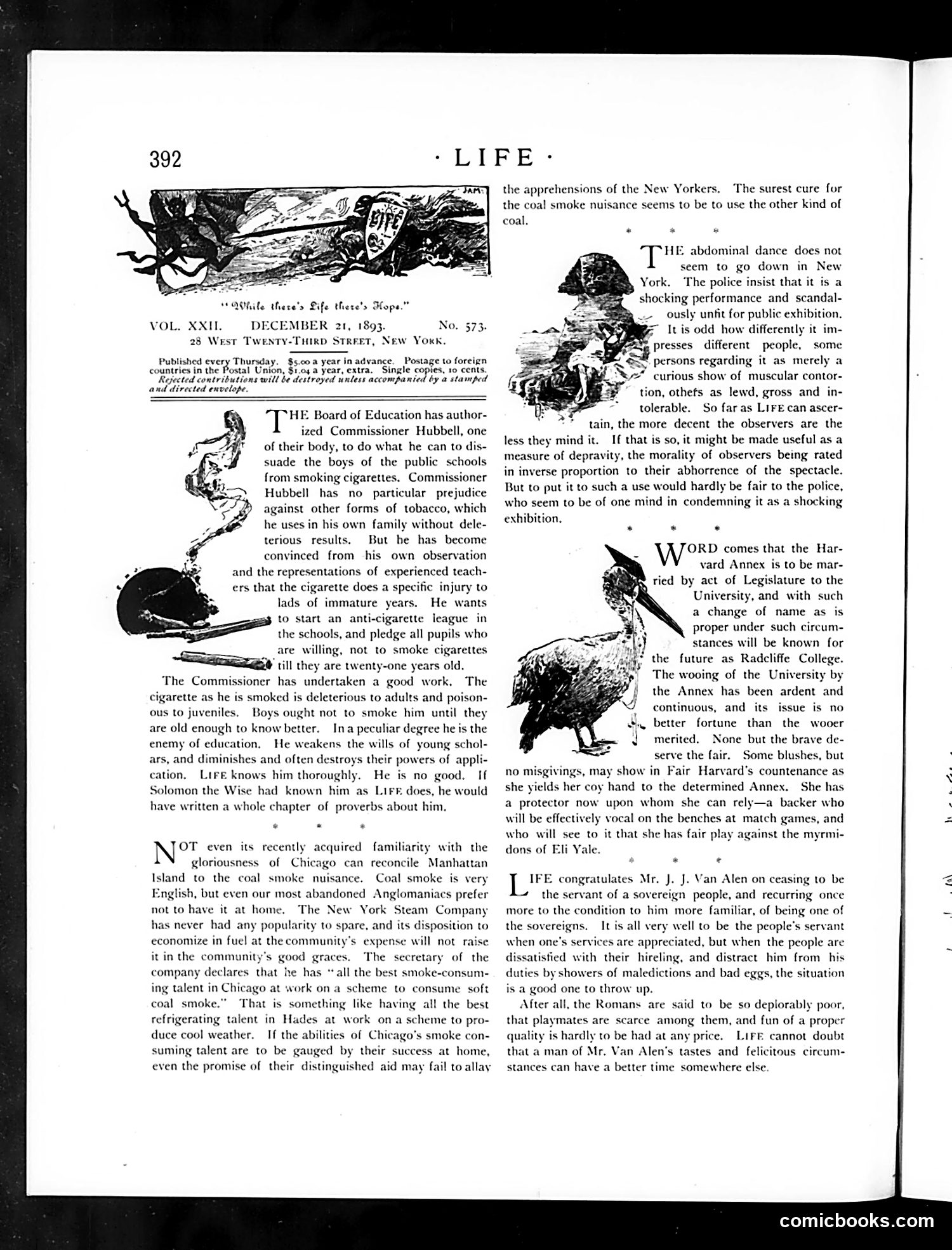
This page contains three satirical pieces about social issues of 1890s New York: 1. **Cigarette smoking in schools**: Commissioner Hubbell's anti-cigarette campaign targeting schoolboys. The text mocks the hypocrisy—the Commissioner uses tobacco himself but wants to ban it for youth, claiming it damages their health and education. 2. **The "abdominal dance"**: Police condemned a performance (likely a risqué dance) as obscene, but the author questions why observers' morality should be judged by their tolerance for such spectacles. 3. **Harvard's Radcliffe College**: Announcing the University's formal acknowledgment of its women's college, previously informal. The tone is congratulatory but somewhat patronizing. The illustrations are period woodcuts typical of Life's satirical style, using exaggeration for comedic effect.
📄 Transcribed text from this page (OCR, searchable)
Machine-transcribed from the original scan — historical spelling and the odd misread are preserved.
- LIFE: VOL, XXII. DECEMBER 21, 1893. 28 West Twenty STRRE Published every Thursday. $5.00 a year in advance. Postage to foreign countries in the Postal Union, $1.04 a year, extra. Single copies, 10 cents. Rejected contributions will be destroyed unless accompanied by a stamped and directed envelope. HE Board of Education has author- ized Commissioner Hubbell, one of their body, to do what he can to dis: suade the boys of the public schools from smoking cigarettes. Commissioner Hubbell has no_ particular prejudice against other forms of tobacco, which he uses in his own family without dele- terious results. But he has become convinced from his own observation and the representations of experienced teach- ers that the cigarette does a specific injury to lads of immature years. He wants to start an anti-cigarette league in the schools, and pledge all pupils who re willing, not to smoke cigarettes till they are twenty-one years old. The Commissioner has undertaken a good work, The cigarette as he is smoked is deleterious to adults and poison- ous to juveniles. Boys ought not to smoke him until they are old enough to know better. Ina peculiar degree he is the enemy of education. He weakens the wills of young schol- ars, and diminishes and often destroys their powers of appli- cation, LiFe knows him thoroughly. He is no good. If Solomon the Wise had known him as LiFr does, he would have written a whole chapter of proverbs about him. familiarity with the Chicago can reconcile Manhattan OT even its recently acquired I gloriousness of Island to the coal smoke English, but even our most abandoned Anglomaniacs prefer not to have it at home. nuisance. Coal smoke is very The New York Steam Company has never had any popularity to spare, and its disposition to economize in fuel at the communi expense will not raise it in the community’s good graces. company declares that he has The secretary of the all the best smoke-consum- ing talent in Chicago a coal smoke.” T york on a scheme to consume soft is something like having all the best refrigerating talent in Hades at work ona scheme to pro- duce cool weather. If the abilities of Chicago's smoke con- suming talent are to be gauged by their suci even the promise of their distinguished aid may Ss at home, fail to allay the apprehensions of the New Yorkers. ‘The surest cure for the coal smoke nuisance seems to be to use the other kind of coal. “[= abdominal dance does not seem to go down in New \ York. The police insist that it is a shocking performance and scandal- ously unfit for public exhibition. It is odd how differently it im- presses different people, persons regarding it as merely a “ curious show of muscular contor- tion, othefs as lewd, gross and in- tolerable. So far as LIFE can ascer- tain, the more decent the observers are the less they mind it. If that is so, it might be made useful as a measure of depravity, the morality of observers being rated in inverse proportion to their abhorrence of the spectacle. But to put it to such a use would hardly be fair to the police, who seem to be of one mind in condemning it as a shocking exhibition. some . . ORD comes that the Har- vard Annex is to be mar- tied by act of Legislature to the University, and with such a change of name as is proper under such circum- stances will be known for the future as Radcliffe College. The wooing of the University by the Annex has been ardent and continuous, and its better fortune than merited. issue is no the wooer None but the brave de- serve the fair. Some blushes, but no misgivings, may show in Fair Harvard's countenance as she yields her coy hand to the determined Annex. She has a protector now upon whom she can rely—a_ backer who will be effectively vocal on the benches at match games, and who will see to it that she has fair play against the myrmi- dons of Eli Yale. I IFE congratulates Mr. J. J. Van Alen on ceasing to be ~ the servant of a sovereign people, and recurring once more to the condition to him more familiar, of being one of the sovereigns. It is all very well to be the people's servant when one’s services are appreciated, but when the people are dissatistied with their hireling, and distract him from his duties by showers of maledictions and bad eggs, the situation is a good one to throw up. After all, the Romans are said to be so deplorably poor, that playmates are sca quality is hardly to be had at any price. that a man of Mr. Van ¢ ree among them, and fun of a proper LiFr cannot doubt len’s tastes and felicitous circum- stances can have a better time somewhere else. comicbooks.com