
A complete issue · 16 pages · 1893
Life — December 14, 1893
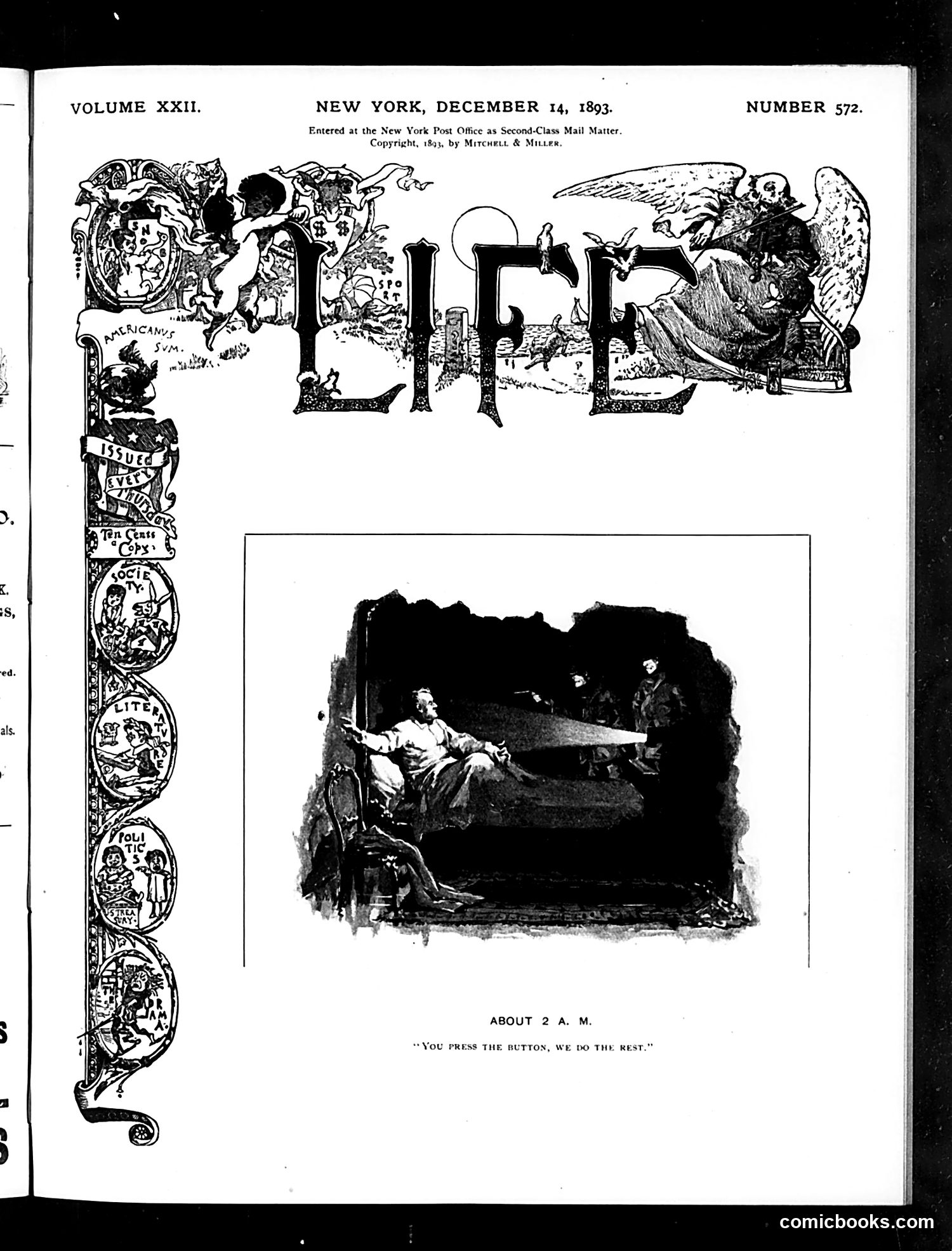
This page features an illustration titled "About 2 A.M." with the caption "You press the button, we do the rest." The caption is a famous advertising slogan from Eastman Kodak, promoting their new handheld camera technology that simplified photography for ordinary people. The darkened interior scene appears to depict an intimate or compromising moment being secretly photographed—likely satirizing concerns about privacy invasion enabled by this new technology. The image critiques how accessible cameras made surveillance and unauthorized picture-taking possible. This represents early anxiety about photography's democratization and its potential for voyeurism or invasion of privacy—concerns that remain relevant today with modern digital cameras and smartphones.
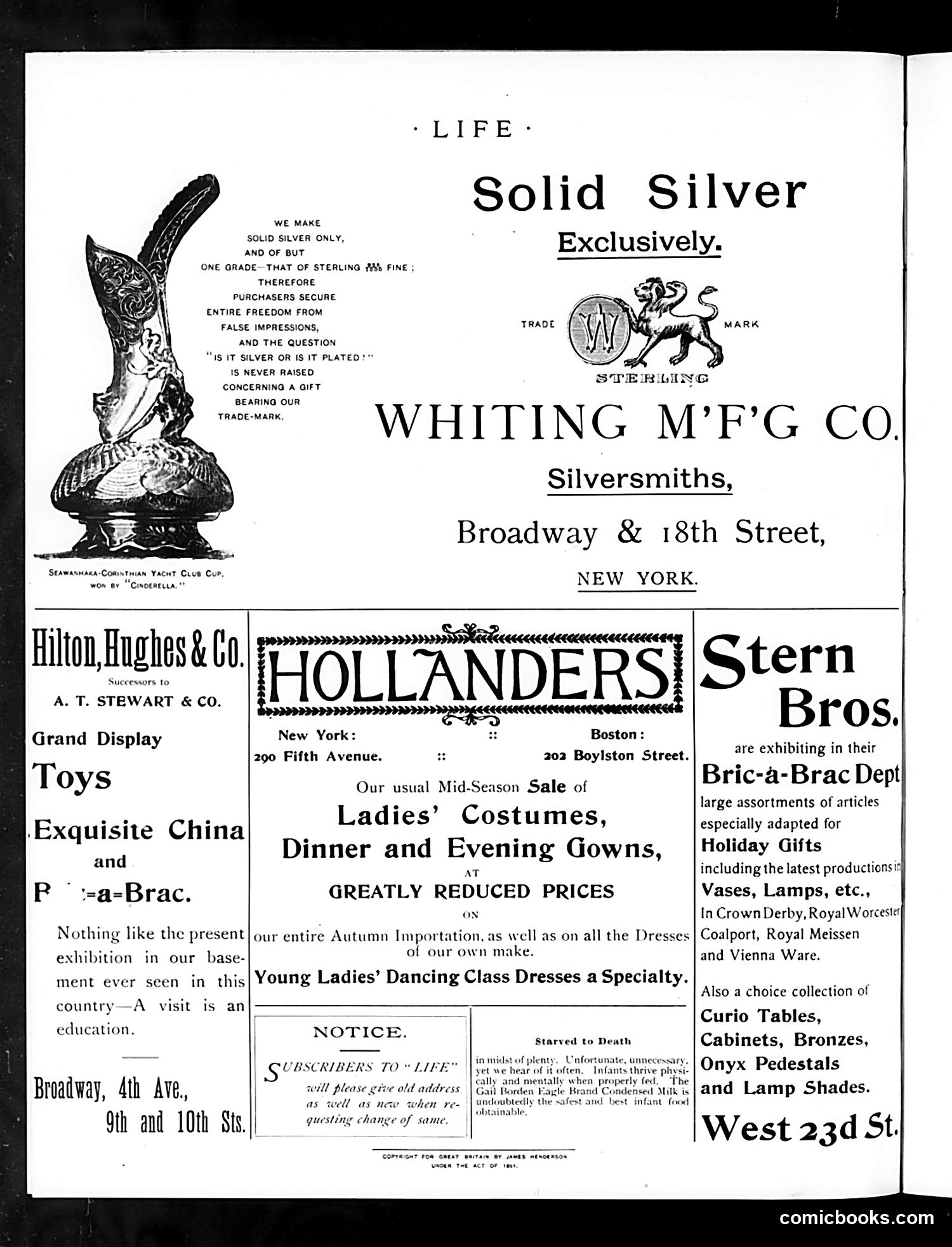
This page is primarily **advertising**, not political satire. The main content features: 1. **Whiting M'FG Co.** - A sterling silver company emphasizing they make "solid silver only" to assure customers they're not selling plated goods. Their trade mark features a lion. 2. **Hilton, Hughes & Co.** - Advertising toys, exquisite china, and bric-a-brac at Broadway locations. 3. **Hollanders** - Promoting a mid-season sale of ladies' costumes and evening gowns at reduced prices. 4. **Stern Bros.** - Showcasing holiday gift items including vases, lamps, and decorative pieces. A small notice addresses "Life" subscribers regarding address changes. The decorative Seawanhaka yacht club cup illustration appears purely ornamental. This is essentially a **classified advertising section** with no satirical content.
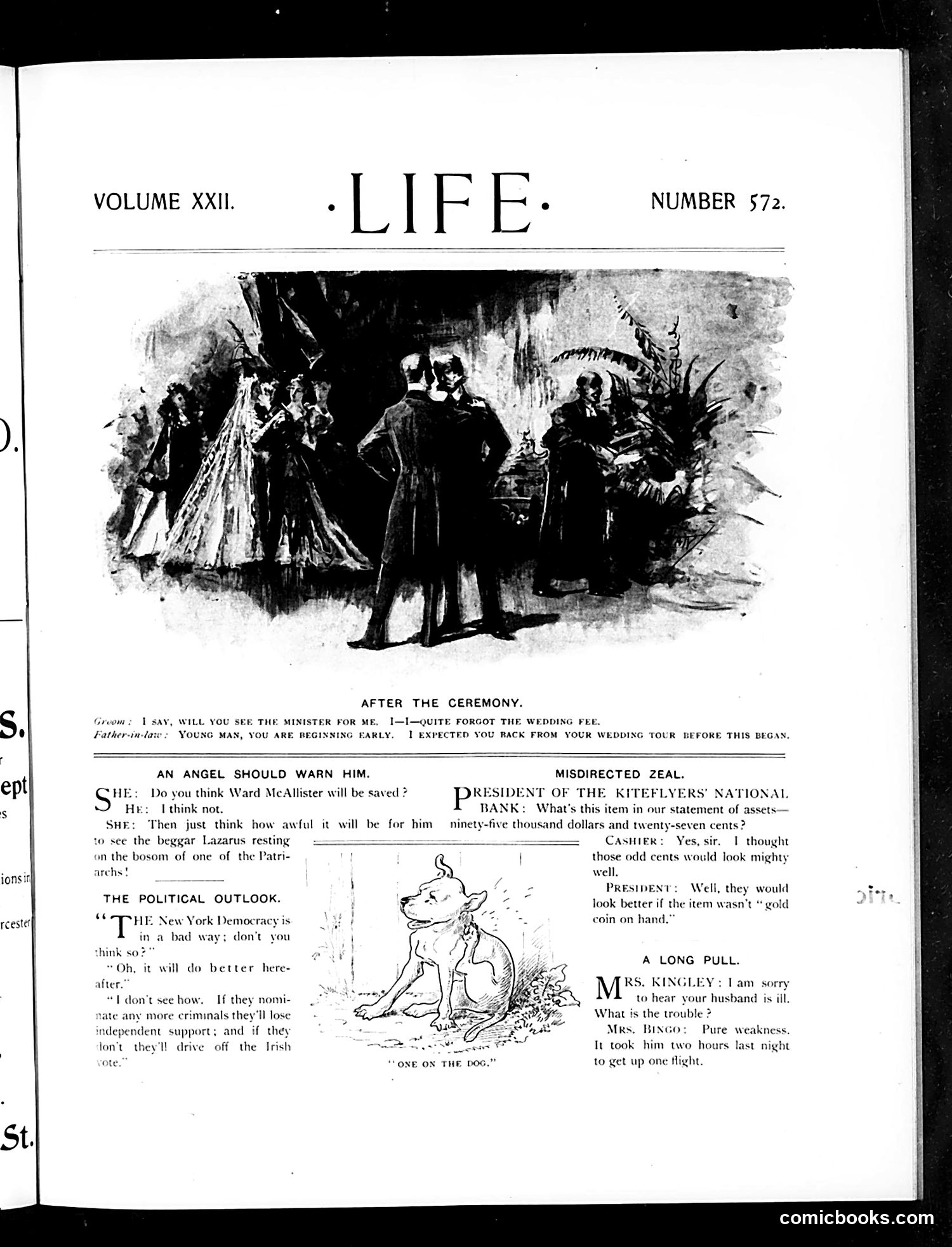
This page contains four separate satirical pieces from *Life* magazine (Volume XXII, Number 572). **"After the Ceremony"** (top illustration) depicts a wedding scene with social commentary about a groom's financial obligations. **"An Angel Should Warn Him"** presents dialogue between two women discussing Ward McAllister's potential salvation, referencing "beggar Lazarus" and "Patriarchs' arches"—likely satirizing McAllister's social standing and influence. **"The Political Outlook"** features dialogue mocking Democratic Party strategy regarding Irish voters and criminal support. **"One of the Dog"** (cartoon with small dog) and **"Misdirected Zeal"** mock the Kiteflyers' National Bank over a accounting error involving ninety-five thousand dollars and twenty-seven cents. **"A Long Pull"** shows Mrs. Kingley concerned about her husband's health after a difficult night. The page represents typical *Life* satirical content targeting social figures, political parties, and business institutions.
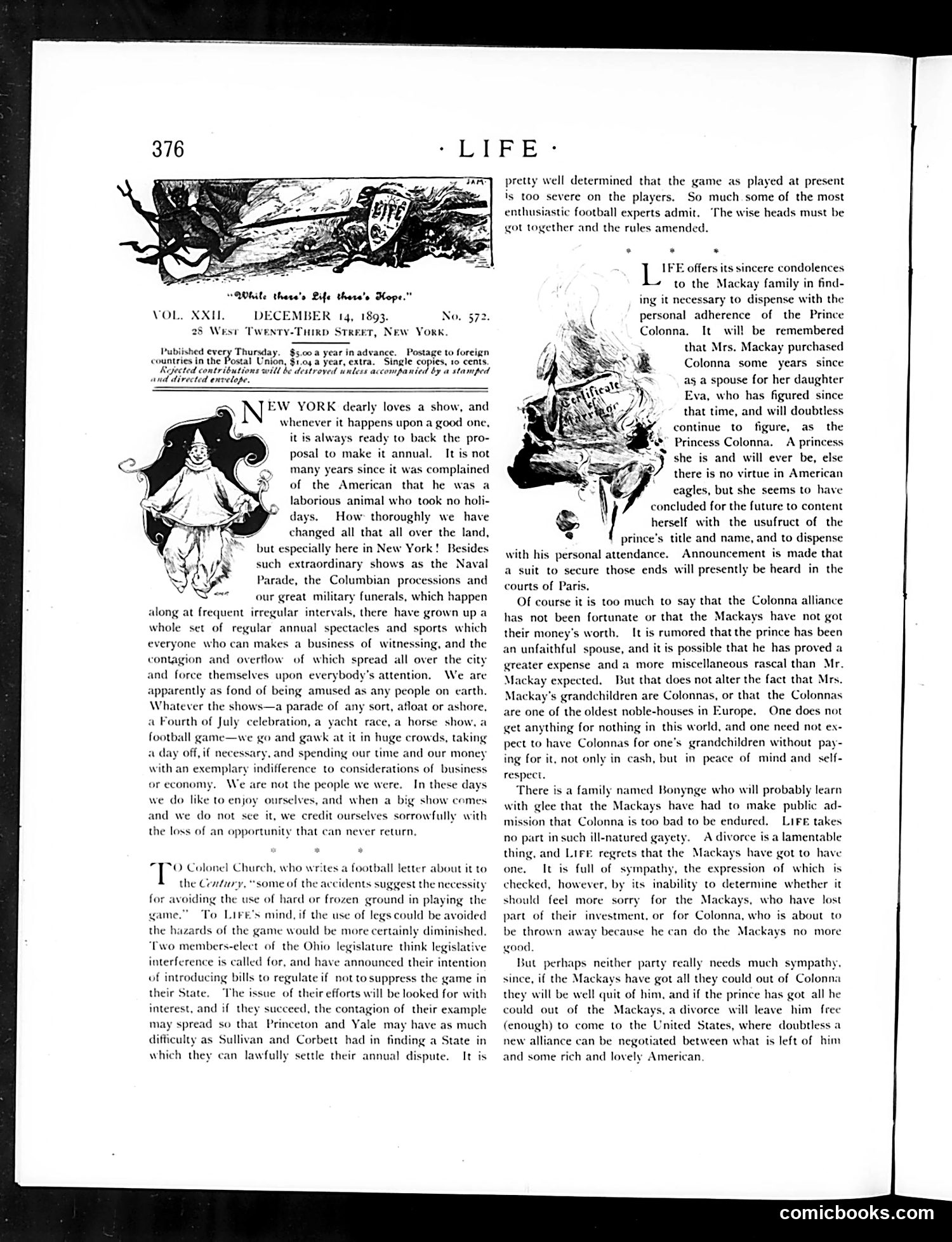
**The Cartoons:** The page contains two illustrated figures with banners reading "Where there's Life there's Hope" — appearing to be symbolic representations rather than specific caricatures. **The Content:** The text discusses New York's love of spectacles and annual shows, then pivots to commentary on a divorce involving the Mackay and Colonna families. The piece criticizes a failed marriage alliance between American wealth (the Mackays) and European nobility (Prince Colonna), suggesting neither party needs sympathy since both parties acted in self-interest. **The Satire:** The overall point critiques gilded-age marriages of convenience between American industrialists' families and impoverished European aristocracy — mocking both the financial calculations and the predictable failures of such unions. The "hope" banner ironically comments on such ill-fated ventures.
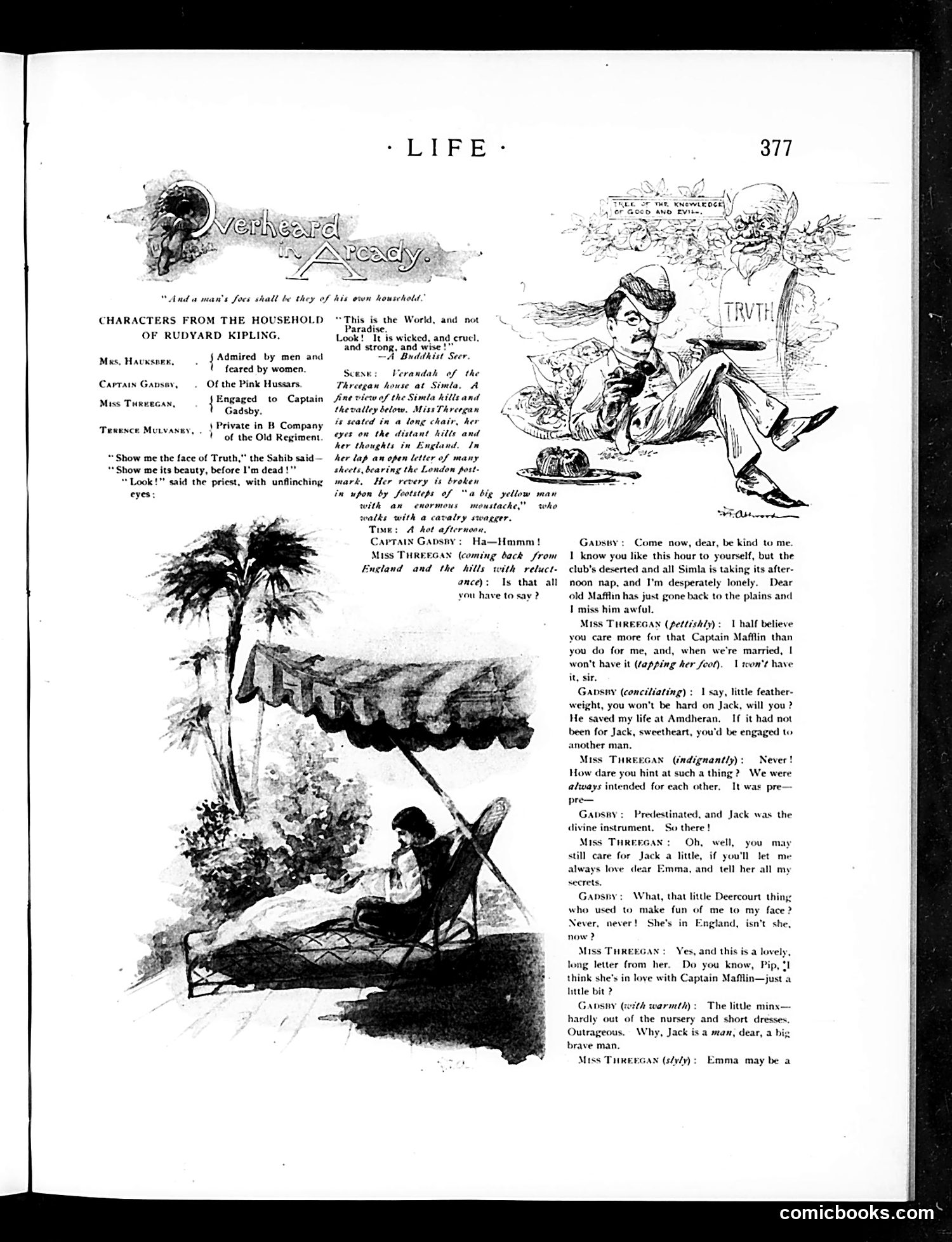
This page presents a dramatic scene from Rudyard Kipling's "Characters from the Household of Rudyard Kipling," featuring dialogue between Captain Gassby and Miss Thregan. The illustrations show colonial-era figures in what appears to be India, with palm trees and tropical settings. The satire concerns romantic entanglements and social pretense. Miss Thregan challenges Captain Gassby's claims about his importance, noting he abandoned her for India and now dismisses her acquaintance Emma as beneath him. Gassby responds with patronizing remarks ("little featherweight"), while Miss Thregan punctures his vanity by revealing his actual mediocrity—he's merely "a man, dear, a big, brave man." The humor targets masculine pretension and the self-deceptions of colonial society.
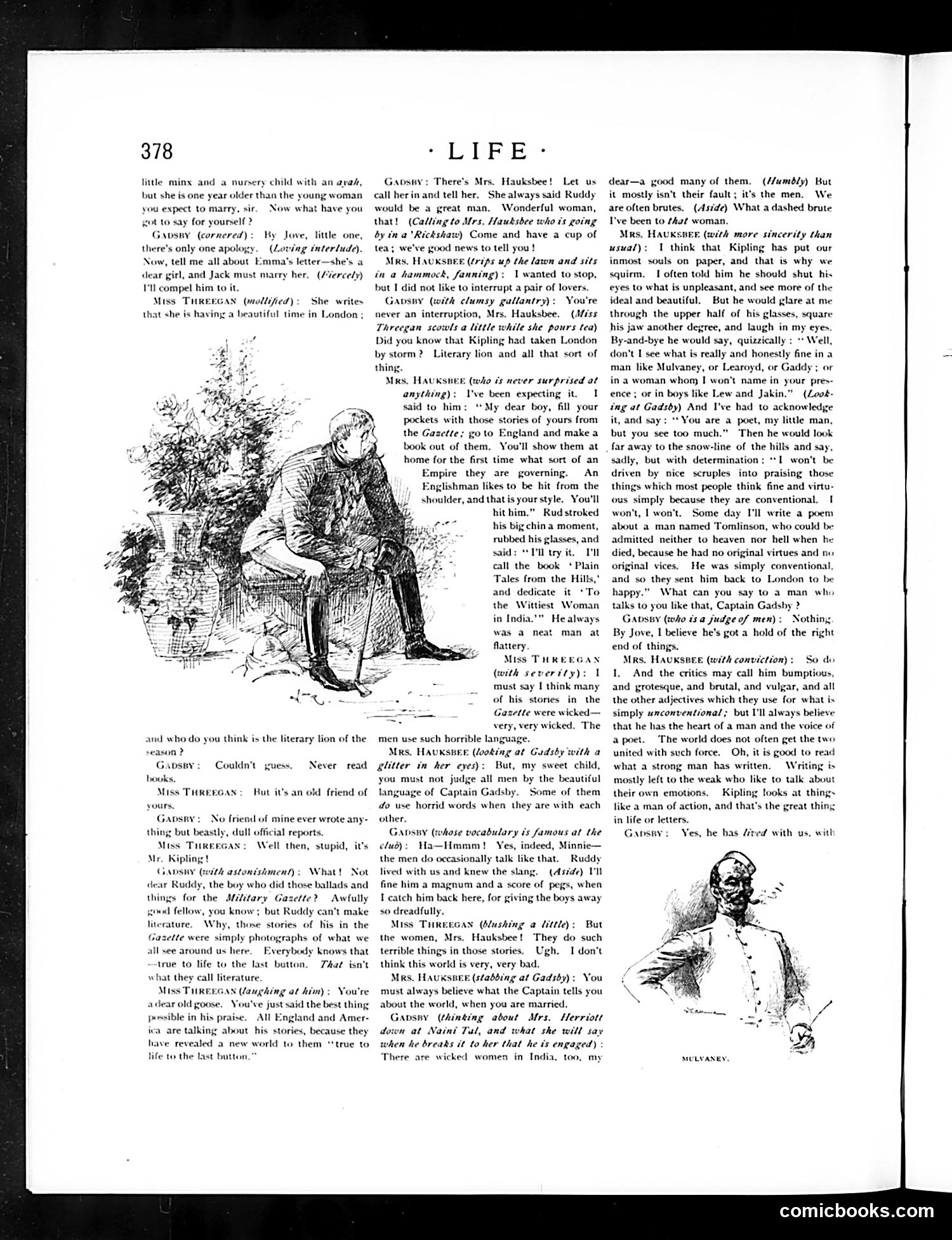
This page presents a literary dialogue satirizing Rudyard Kipling's writing style and subject matter. The conversation between characters (Gatsby, Miss Threlegan, and Mrs. Hauksbee) mocks Kipling's tendency to use crude language and his focus on military tales and Anglo-Indian colonial stories. The satire criticizes how Kipling's tales, though popular, employ "horrible language" and vulgar vocabulary. The speakers suggest his stories appeal primarily to soldiers and men rather than refined audiences. There's particular mockery of his representations of Indian life and his celebration of the British military experience. The two illustrations—showing figures in colonial dress—visually reinforce the Anglo-Indian setting typical of Kipling's work. The overall tone suggests contemporary literary criticism of Kipling's rougher, more masculine literary style versus conventional Victorian gentility.
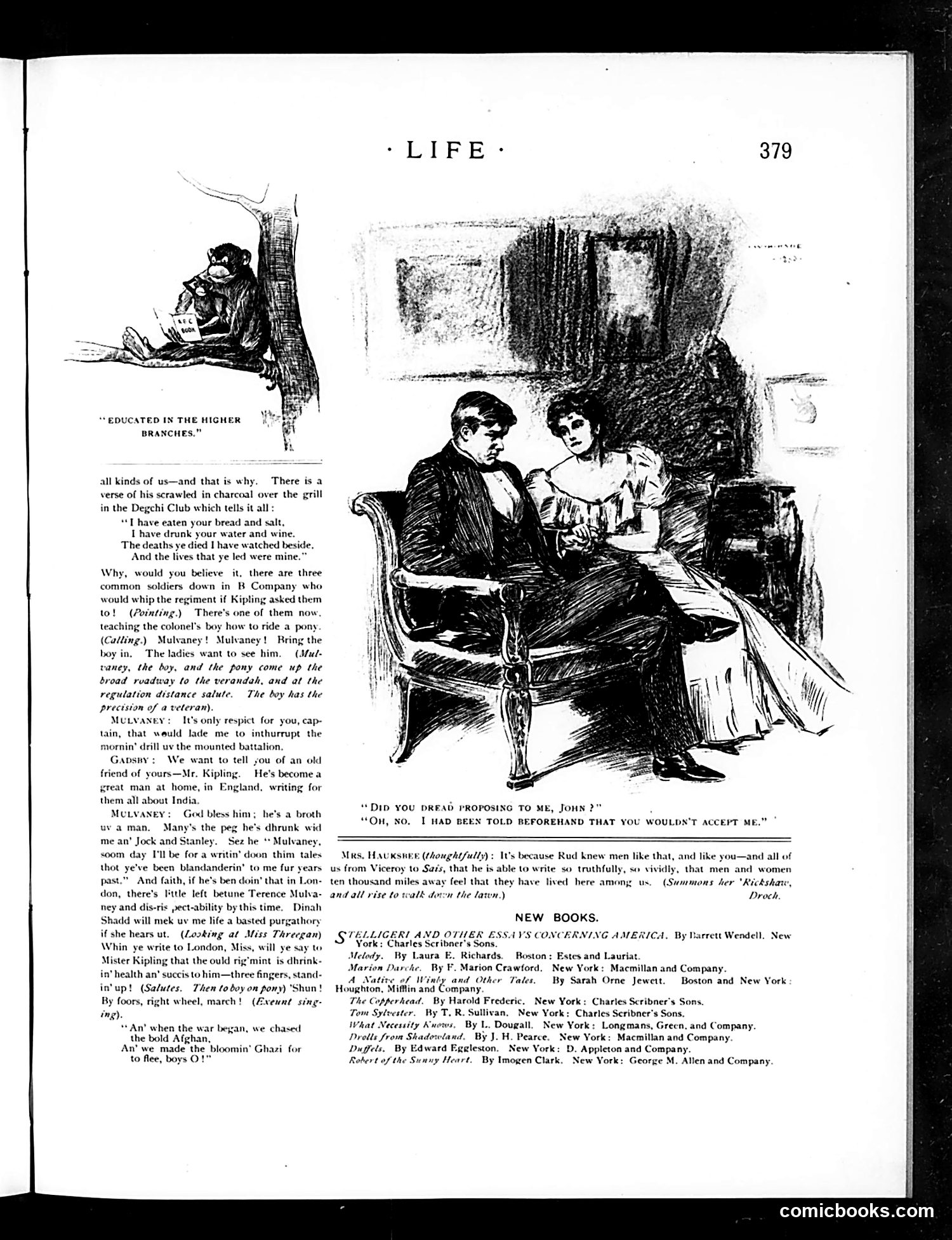
This page contains a literary excerpt featuring dialogue between characters named Mulvaney and Gatsby, alongside an illustration of two people in what appears to be an intimate conversation scene. The caption reads: "Did you dread proposing to me, John?" / "Oh, no. I had been told beforehand that you wouldn't accept me." The illustration depicts a romantic or courtship scene typical of early 20th-century satirical magazine content. The page also includes a "New Books" section listing various publications. Without additional context about the publication date or the specific literary work being excerpted, I cannot definitively identify the characters or the satirical point being made. The content appears to be literary satire rather than political commentary.
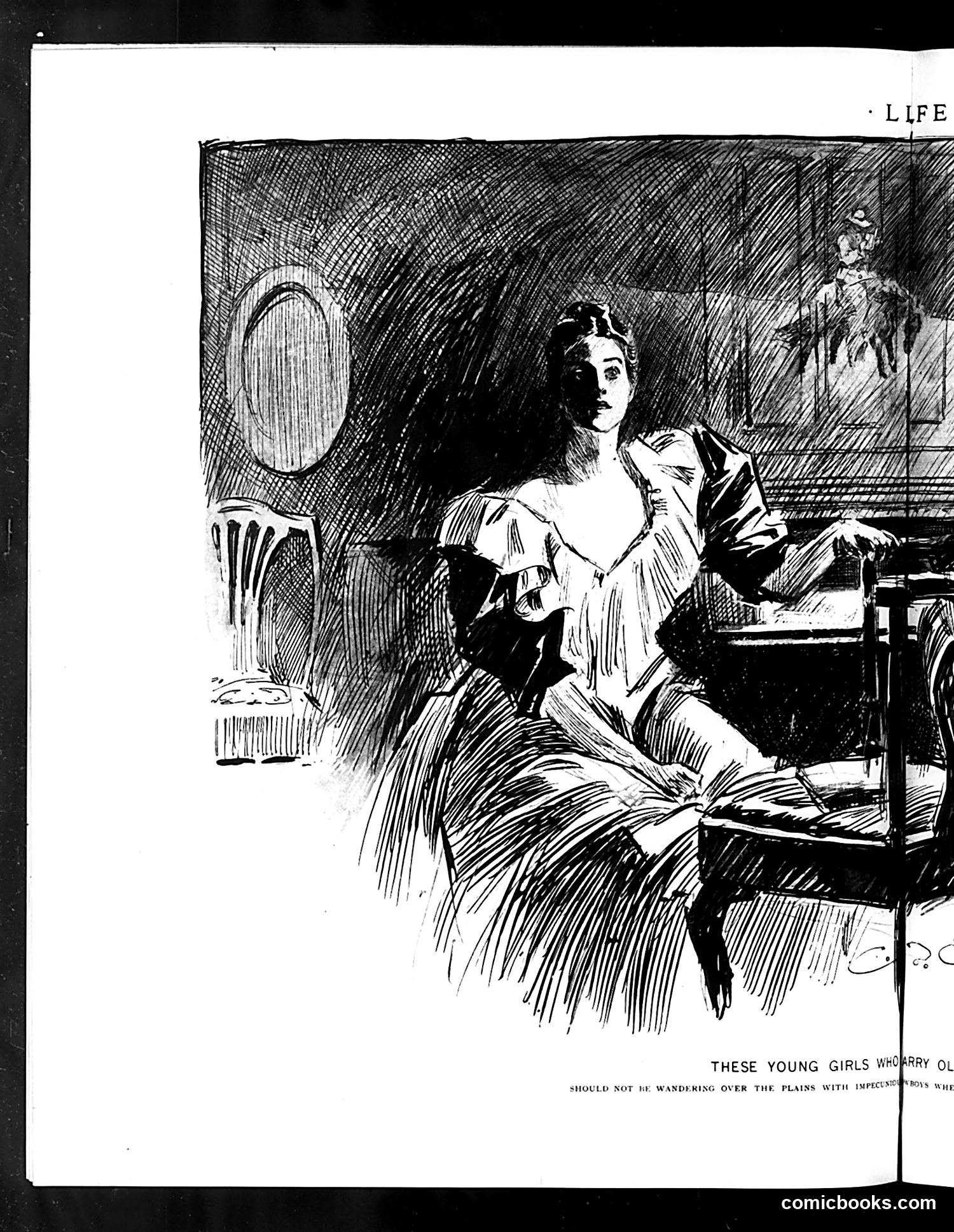
This appears to be a satirical illustration from Life magazine's "LIFE" section, depicting a young woman in an elegant interior setting. The caption reads: "THESE YOUNG GIRLS WHO WORRY OVER THE PLAINS WITH IMPECUNIOUS SWAINS" (text partially cut off). The satire targets young women of apparent leisure class who worry excessively about romantic relationships with men of modest financial means. The illustration's refined artistic style and the woman's fashionable dress emphasize the class contrast the caption references. The joke seems to mock upper-class female anxieties about romance across economic boundaries—suggesting such women have trivial concerns despite their privileged position. The "impecunious swains" (poor suitors) creates the satirical tension between her wealth and his lack thereof.
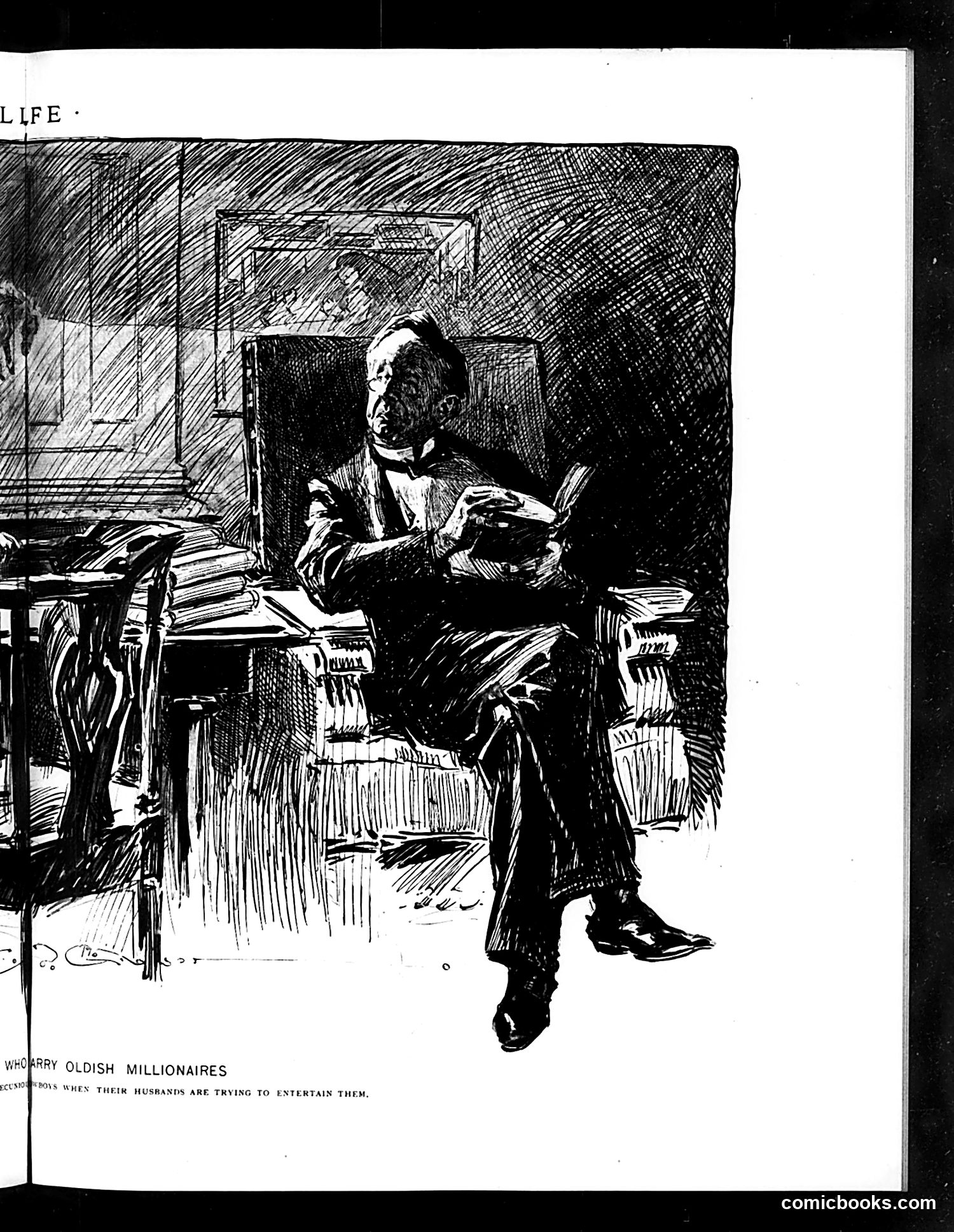
This is a satirical illustration from *Life* magazine titled "Who Worry Oldish Millionaires" with a subtitle about wives entertaining their husbands. The cartoon depicts a wealthy, middle-aged man in formal attire (black suit and bow tie) sitting in what appears to be a study or library, reading. The detailed cross-hatching and interior setting suggest affluence and leisure. The satire targets wealthy older men and their wives. The humor appears to rest on the idea that wives of rich men must devise entertainments to occupy their husbands' time — mocking both the idle leisure of the wealthy class and suggesting that even marriage cannot hold such men's attention without deliberate effort from their spouses. The title's deliberate misspelling ("Worry" instead of "Wary") is characteristic of *Life*'s satirical wordplay.
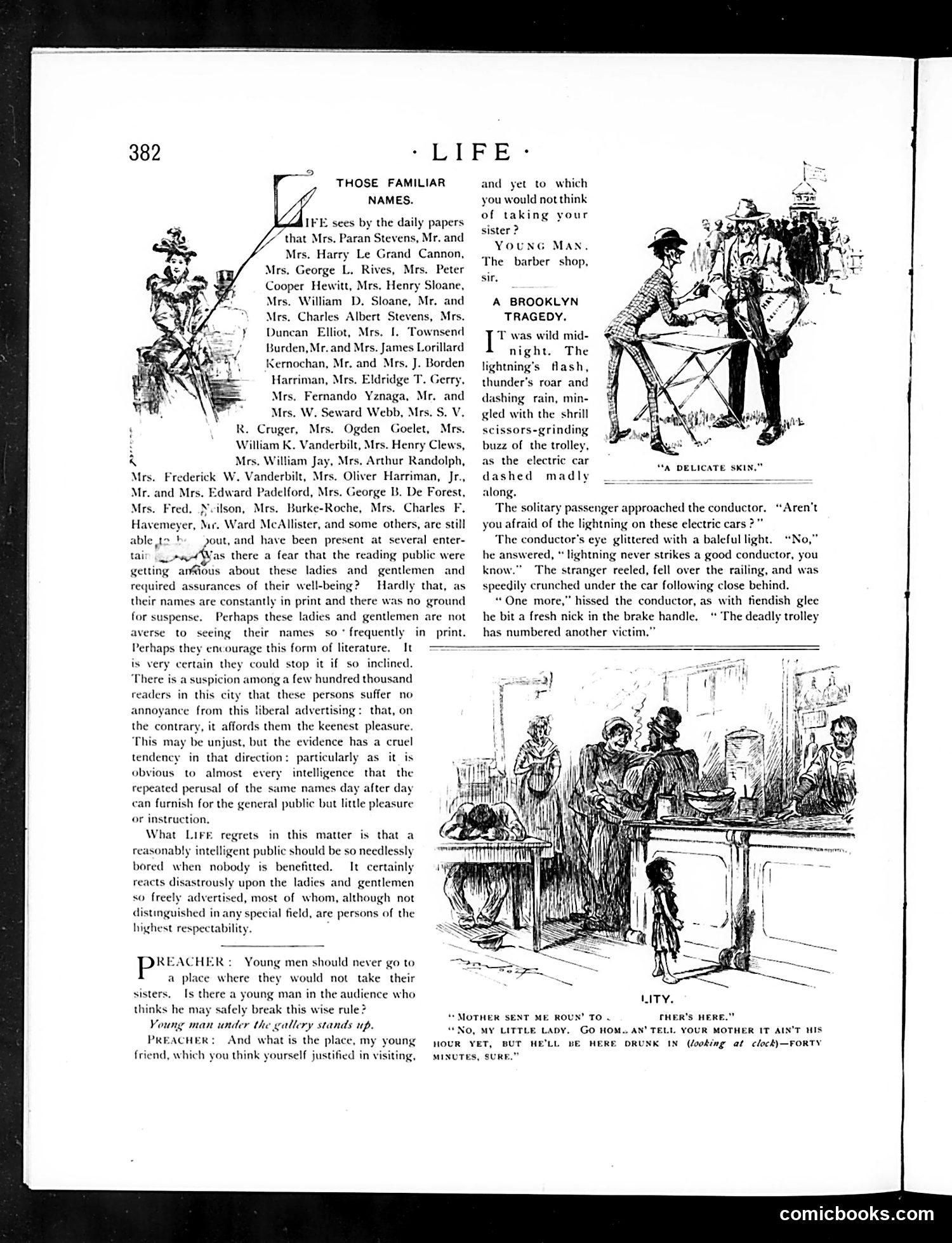
This page combines social commentary with humor about urban life. The main article "Those Familiar Names" critiques how Life magazine publishes society figures' names in its coverage, noting that readers find this both annoying and pleasurable—a tension the writer explores. "A Brooklyn Tragedy" depicts a streetcar accident where a passenger is struck. The accompanying illustration shows the grim aftermath in what appears to be a tenement building. Below, a dialogue between a Preacher and Young Man debates the propriety of visiting theaters, with the preacher questioning whether it's appropriate for young men to attend places where they wouldn't take their sisters—a period concern about entertainment venues' moral character. The cartoons satirize both urban dangers and Victorian social anxieties about proper conduct.
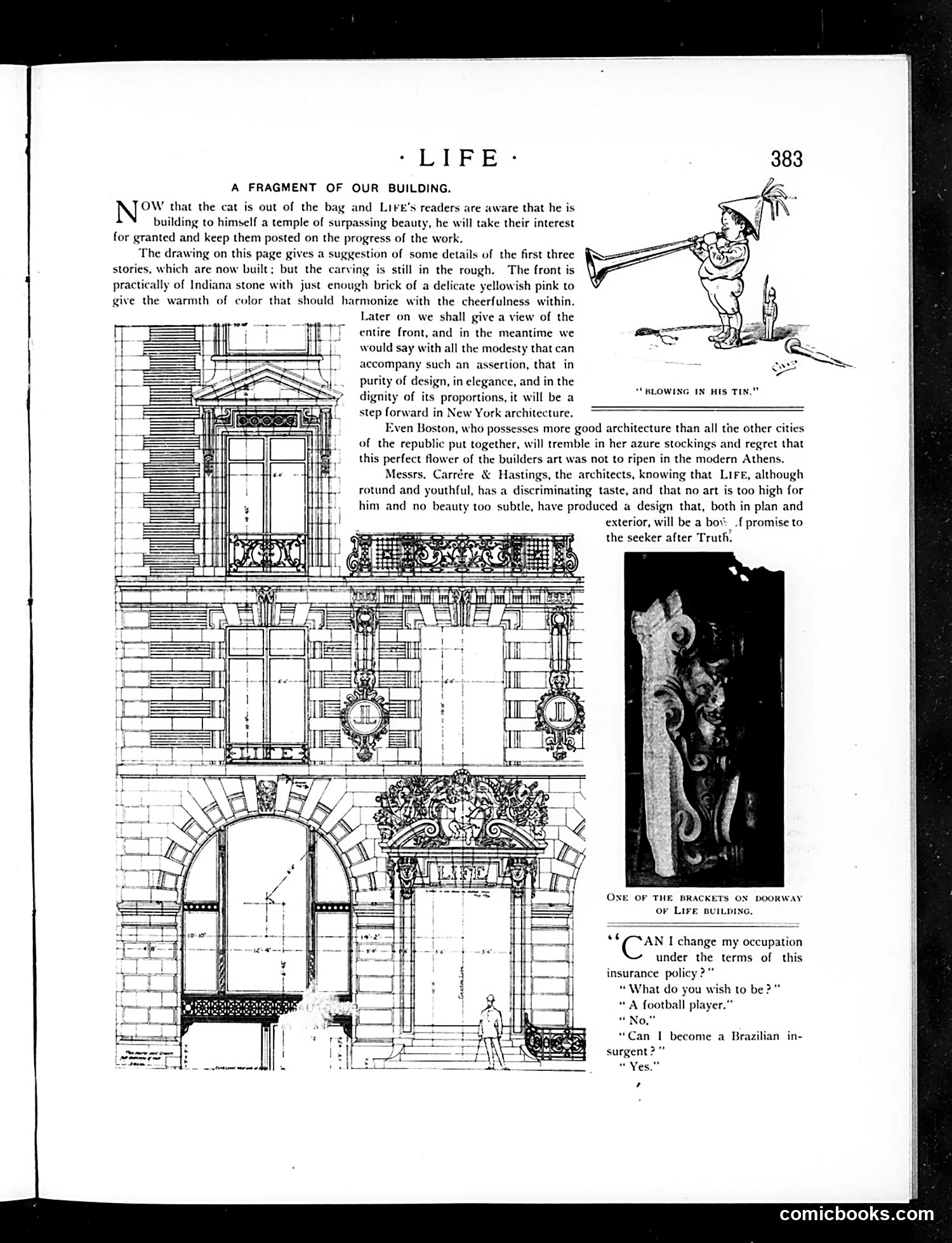
This page features architectural content rather than political satire. The main article, "A Fragment of Our Building," celebrates the LIFE magazine headquarters' design by architects Carrère & Hastings. The text praises the building's beauty and proportions, comparing it favorably to Boston's architecture and suggesting it represents progress in New York design. The page includes architectural drawings of the building's facade and a decorative bracket detail. A separate cartoon shows a figure "blowing in his tin" (a horn), likely generic humor unrelated to the architecture article. At bottom, a brief dialogue joke plays on insurance terminology—a non-sequitur about changing occupations and becoming a "Brazilian insurgent," typical of period magazine filler humor.
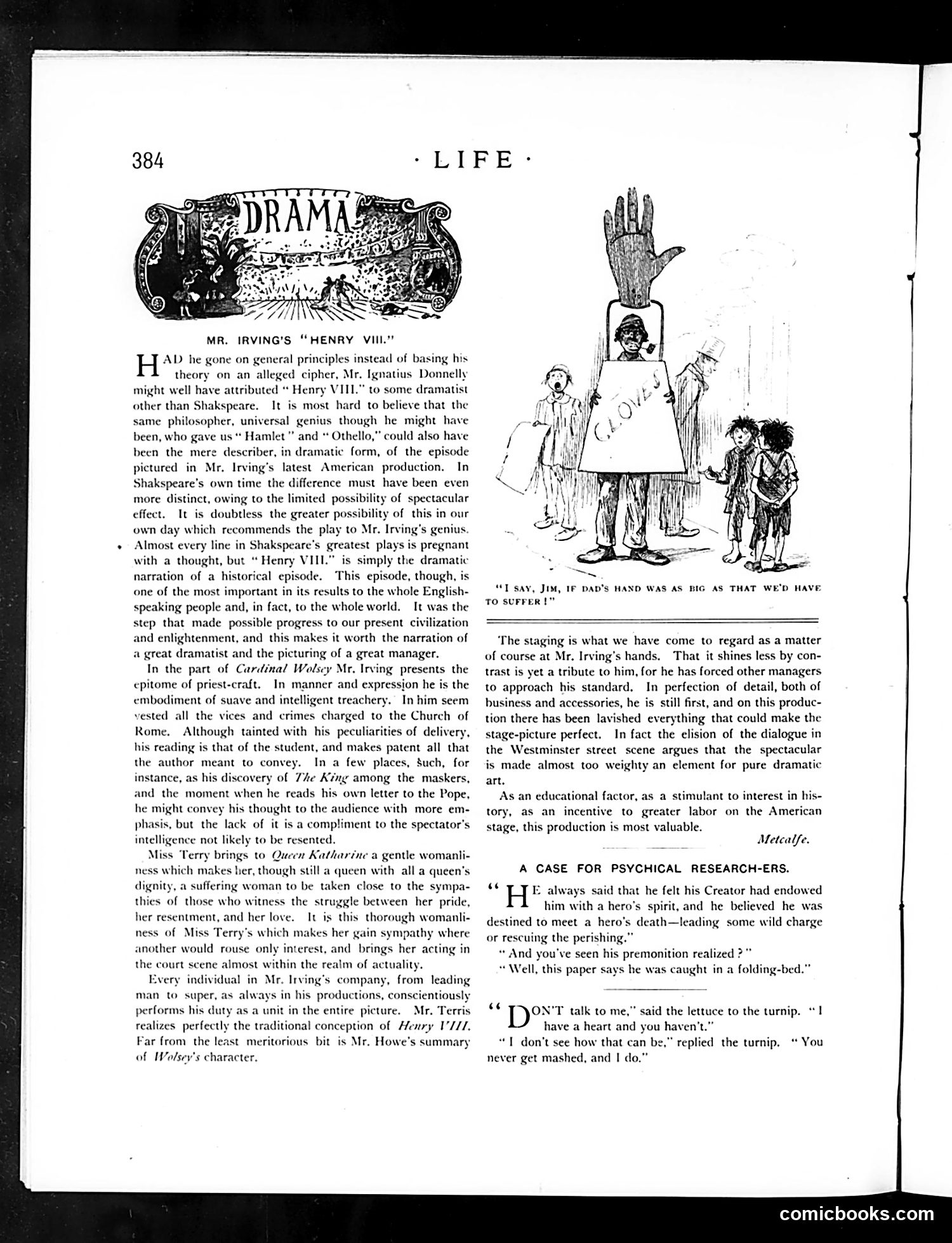
This page reviews Henry Irving's theatrical production of *Henry VIII*, praising both the play's historical importance and Irving's directorial genius. The small cartoon illustrates a child's reaction to a statue of King Henry VIII with an enormously enlarged hand—the joke being that if the child's father possessed such a massive hand, the family would "have to suffer" (endure hardship). This is a lighthearted visual gag playing on Henry VIII's famous appetites and tyrannical reputation. The review itself argues that while Shakespeare's *Henry VIII* lacks the philosophical depth of his greater works like *Hamlet*, the play's historical significance—depicting the break with Rome that enabled English-speaking civilization's progress—justifies Irving's elaborate staging. Irving's portrayal of Cardinal Wolsey and Ellen Terry's performance as Queen Katherine receive particular praise. The critic credits Irving with raising theatrical standards across the profession through his meticulous attention to detail and spectacle.
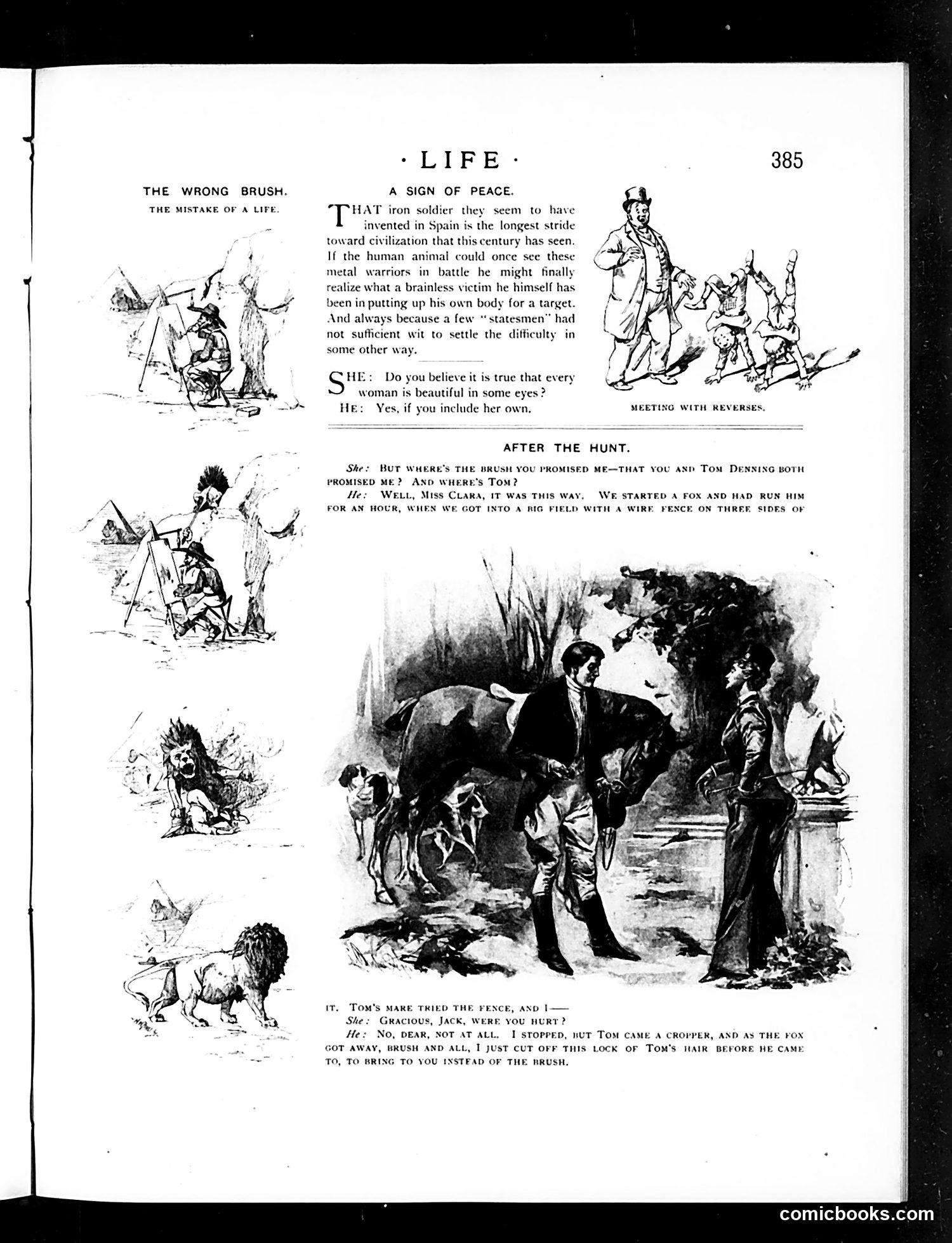
This page contains three separate satirical pieces: **"The Wrong Brush"** critiques militarism, praising Spain's invention of mechanical soldiers as superior to human warfare—sarcastically suggesting that seeing metal warriors in battle might finally convince humans to stop sacrificing their bodies due to politicians' inability to resolve disputes peacefully. **"A Sign of Peace"** is a brief joke about beauty being subjective—a woman is beautiful "if you include her own" eyes, mocking vanity. **"After the Hunt"** is a longer comic narrative about a fox hunt gone wrong. A man (Jack) promises his female companion (Miss Clara) a fox brush as a trophy, but when his friend Tom's horse crashes into a wire fence during the hunt, Jack cuts a lock of Tom's hair instead and presents it as a substitute—a dark joke playing on the similarity between hair and a fox's brush, combining physical comedy with crude humor about his injured friend.
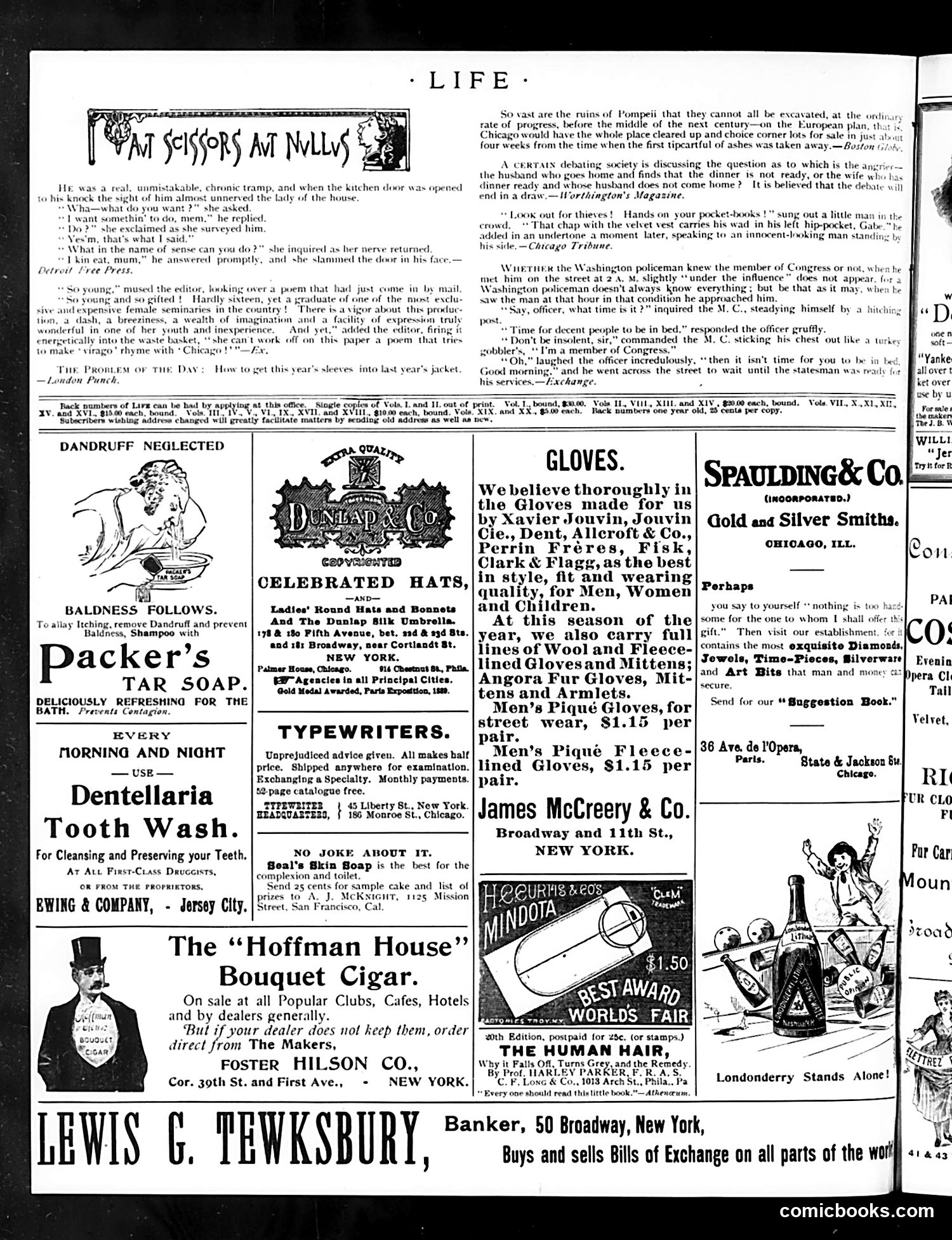
This page is primarily **advertising and humor content** rather than political cartooning. The main satirical pieces are brief anecdotes: 1. **"I Am Scissors Am Nulls"**: A tramp tells a housewife he can "eat, mum"—his only skill. The joke mocks vagrants' worthlessness. 2. **The editor's poem rejection**: A young female seminary graduate submits terrible poetry that forces the editor to throw it away. The satire targets both pretentious female education and bad amateur writing. 3. **Multiple brief jokes** about everyday social situations—a woman warning about pickpockets, a drunk congressman confronting a police officer who doesn't recognize his authority, a couple arguing over dinner timing. The cartoons are minimal. One small illustration shows a man with dandruff. The page is dominated by **period advertisements** for gloves, typewriters, soap, cigars, and other products. This reflects Life's format as a humor magazine mixing short satirical observations about American middle-class life with commercial advertising.
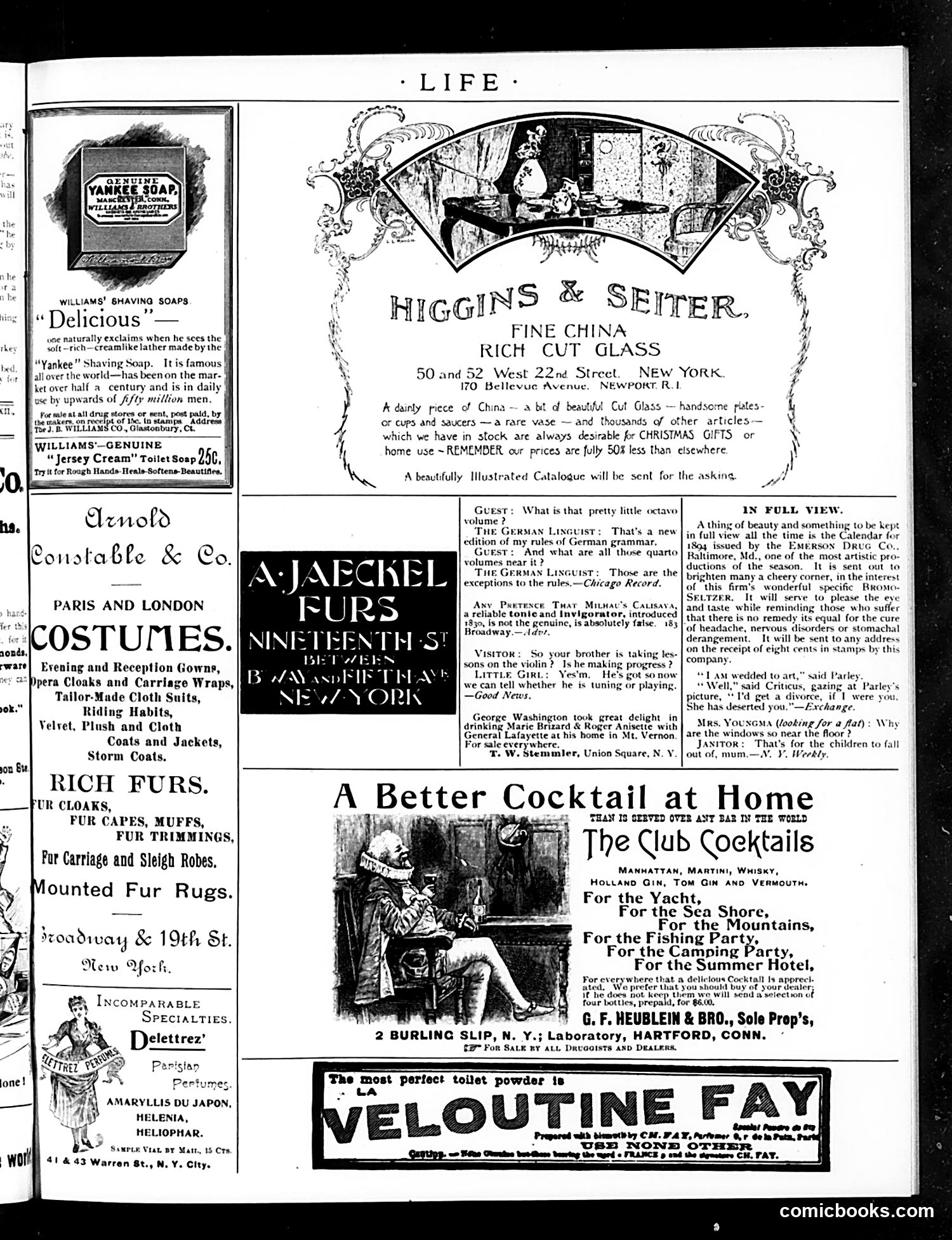
This page consists primarily of **advertisements** rather than editorial cartoons or satirical content. The ads showcase luxury goods typical of 1890s America: fine china and glassware, expensive furs and clothing, perfumes, and spirits. Notable elements include small **humorous anecdotes** embedded in ads—brief jokes about German grammar rules, a child's violin progress, and a woman seeking an apartment. These are light domestic humor rather than political satire. The only identifiable historical reference is **George Washington** mentioned in an anisette liqueur advertisement, claimed to have enjoyed the drink with Lafayette—likely a marketing ploy using patriotic associations. The page reflects **Gilded Age consumer culture**: targeting wealthy readers with expensive imported goods, fine spirits, and luxury services. The humor is gentle and apolitical—focused on everyday domestic situations and family life rather than social commentary or satire. This appears to be a standard advertising issue of Life magazine from the 1890s, not a satirical or political edition.
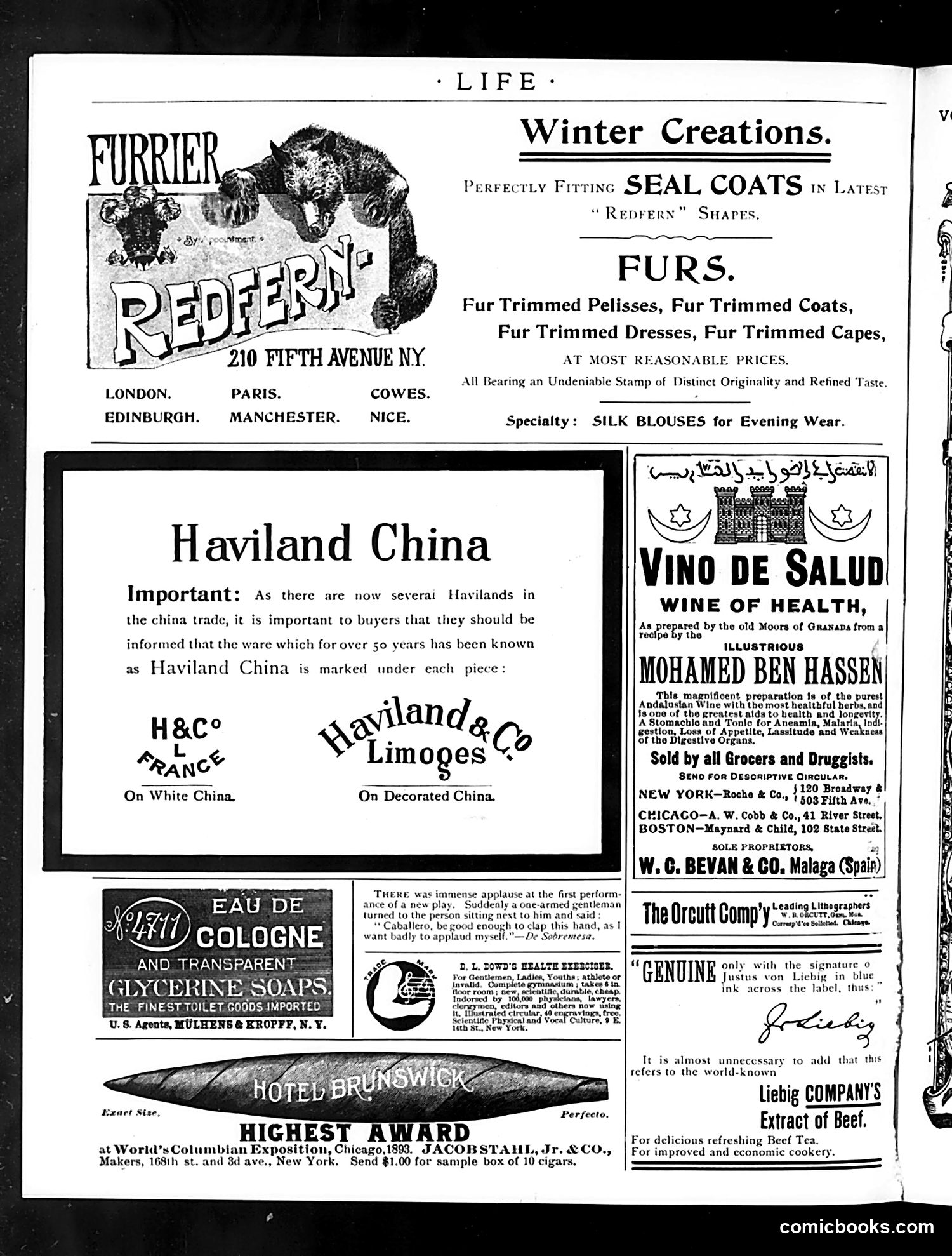
This is primarily an **advertising page** with minimal editorial content. The only potential humor appears in a brief anecdote: a one-armed gentleman at a theater asks his neighbor to clap his hand for him because he wants to "applaud myself"—a mild joke playing on the physical impossibility and social awkwardness of the situation. The page consists almost entirely of period advertisements for luxury goods: fur coats and trimmed garments from the Redfern furrier (with locations in London, Paris, and other European cities); Haviland china; Vino de Salud (a Spanish wine marketed as medicinal); eau de cologne and glycerine soaps; Hotel Brunswick cigars; and Liebig's beef extract. These ads reflect late-19th-century consumer culture targeting wealthy readers, emphasizing European sophistication, health claims, and refined taste. There is **no discernible political satire** on this page.