
Life, 1893-12-14 · page 6 of 16
Life — December 14, 1893 — page 6: what you’re looking at
What you’re looking at
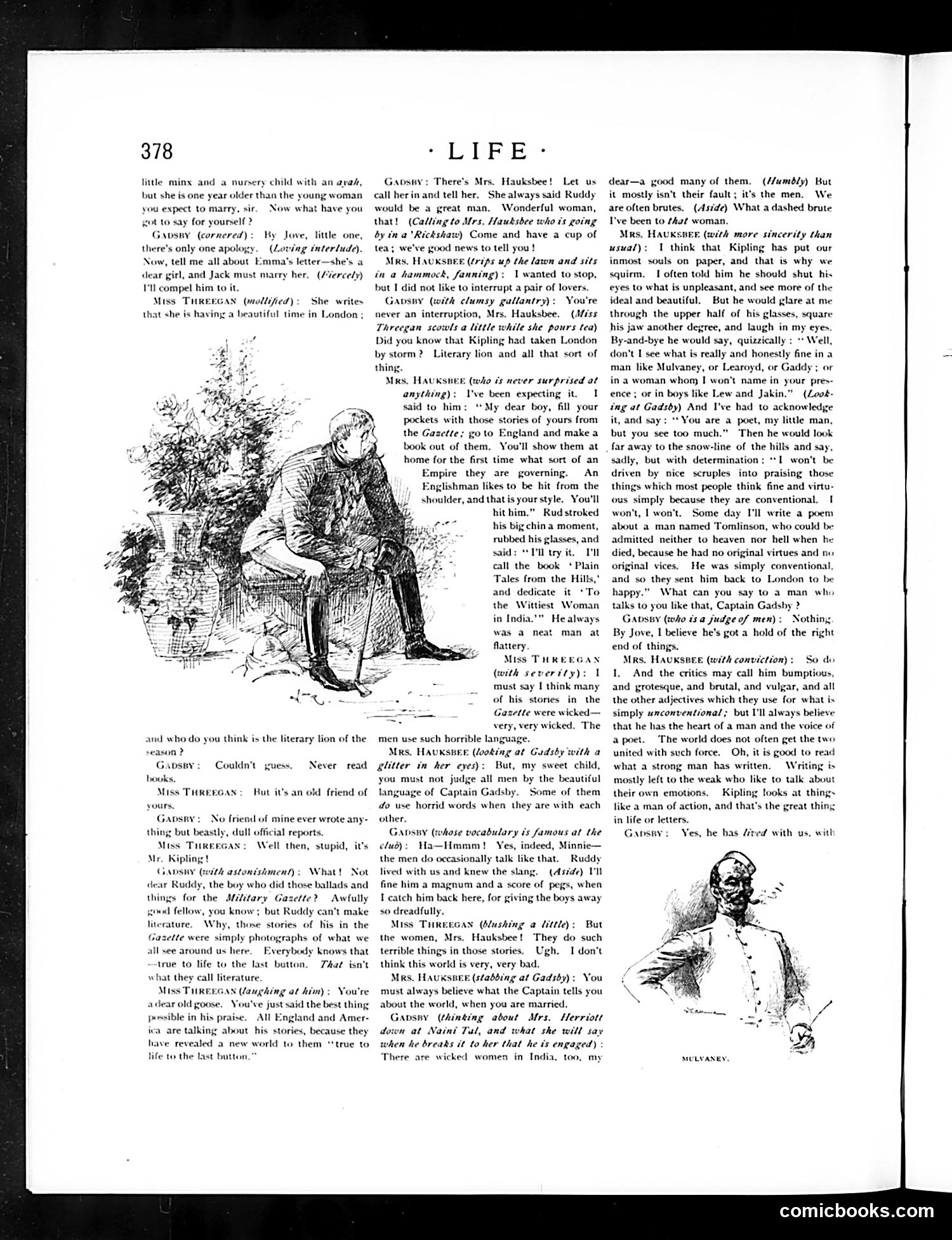
This page presents a literary dialogue satirizing Rudyard Kipling's writing style and subject matter. The conversation between characters (Gatsby, Miss Threlegan, and Mrs. Hauksbee) mocks Kipling's tendency to use crude language and his focus on military tales and Anglo-Indian colonial stories. The satire criticizes how Kipling's tales, though popular, employ "horrible language" and vulgar vocabulary. The speakers suggest his stories appeal primarily to soldiers and men rather than refined audiences. There's particular mockery of his representations of Indian life and his celebration of the British military experience. The two illustrations—showing figures in colonial dress—visually reinforce the Anglo-Indian setting typical of Kipling's work. The overall tone suggests contemporary literary criticism of Kipling's rougher, more masculine literary style versus conventional Victorian gentility.
📄 Transcribed text from this page (OCR, searchable)
Machine-transcribed from the original scan — historical spelling and the odd misread are preserved.
378 little minx and a nursery child with an ava/, but she is one year older than the young woman you expect to marry, sir Kot to say for yourself ? Gavsny (cornered): By there’s only one apole Now what have you Jove, little o y. (Loving interlude). Now, tell me all about Emma's letter—she's a dear girl, and Jack must marry her. (Hercely) TU compel him te Miss Tiree that she is having a t (moltified) autiful time She writes in London ; and who do you think is the literary lion of the son? Gapsny : books. Miss THREEGAN yours, Gapsnv: No friend of mine ever wrote any- thing but beastly, dull official reports, Miss Ture Well then, stupid, it's Mr. Kipling! Gansny (twith astonishment): What! Not ar Ruddy, the boy who did those ballads and things for the Military Gazette? Awtully good fellow, you know; but Ruddy can't make literature. Why, those stories of Kis in the Gazette were simply photographs of what we all see around us here, Everybody knows that true to life to the last button, That isn’t what they call literature. Miss THREEGAN (laughing at him): You're adear old goose, You've just said the best thing All England and Amer- ica are talking about his stories, because they aled a new world to them “true to last button.” Couldn't: guess, Never read. Rut it's an old friend of possible in his praise. ‘LIFE: Gaosny: There's Mrs. Hauksbee! Let us call her in and tell her. She always said Ruddy would be a great man. Wonderful woman, that! (Calling to Mrs. Hauksbee who ts going by ina "Rickshaw) Come and have a cup of tea; we've good news to tell you ! Mrs, HAUKSBEE (¢rips up the lawn and sits in @ hammock, fanning): 1 wanted to stop, but I did not like to interrupt a pair of lovers. Gavspy (with clumsy gallantry): You're never an interruption, Mrs, Hauksbee. (Miss Threegan scowls a little while she pours tea) Did you know that Kipling had taken London by storm? Literary lion and all that sort of thing. MRS. HAUKSBEE (tho is never surprised at anything): \'ve been expecting it. 1 said to him: “My dear boy, fill your pockets with those stories of yours from the Gazette; goto England and make a book out of them, You'll show them at home for the first time what sort of an Empire they are governing. An Englishman likes to be hit from the shoulder, and that is your style. You'll hit him.” Rud stroked his big china moment, rubbed his glasses, and said: “1M try it. TH call the book ‘Plain Tales from the Hills,” and dedicate it *To the Wittiest. Woman in India."" He always was a neat man at flattery Miss THREEGAN (with severity): 1 must say I think many of his stories in the Gazette were wicked— very, very wicked. The men use such horrible language Mus. HAUKSUEE (looking at Gadsby with a glitter in her eyes): But, my sweet child, you must not judge all men by the beautiful language of Captain Gadsby. Some of them do use horrid words when they are with each other, Gansny (whose vocabulary is famous at the clus); Ha—Hmmm! Yes, indeed, Minnie— the men do occasionally talk like that. Ruddy lived with us and knew the slang. (Aside) Vl fine him a magnum and a score of pegs, when I catch him back here, for giving the boys away so dreadfully, Miss THREEGAN (blushing @ little): But the women, Mrs, Hauksbee! They do such terrible things in those stories. Ugh. I don’t think this world is very, very bad. MRS. HAUKsBEE (stabbing at Gadsby): You must always believe what the Captain tells you about the world, when you are married. Gansny (thinking about Mrs. Herriott down at Naini Tal, and what she will say when he breaks it to her that he is engaged) : There are wicked women in India, too, my dear—a yood many of them, (/umd~y) But it mostly isn't their fault; it's the men. We are often brutes. (Aside) What a dashed brute I've been to that woman. Mrs, HAUKSBEE (w#¢h more sincerity than usual): 1 think that Kipling has put our inmost souls on paper, and that is why we squirm, [often told him he should shut his eyes to what is unpleasant, and see more of the ideal and beautiful. But he would glare at me through the upper half of his glasses, square his jaw another degree, and laugh in my eyes. By-and-bye he would say, quizzically : ** Well, don’t I see what is really and honestly fine in a man like Mulvaney, or Learoyd, or Gaddy ; or in a woman whom I won't name in your pres ence ; of in boys like Lew and Jakin.” (Loot- ing at Gadsby) And I've had to acknowledge it, and say: “You are a poet, my little man, but you see too much.” Then he would look far away to the snow-line of the hills and say, sadly, but with determination : “1 won't be driven by nice scruples into praising those things which most people think fine and virtu- ous simply because they are conventional. 1 won't, Lwon't. Some day I'll write a poem about a man named Tomlinson, who could be admitted neither to heaven nor hell when b died, because he had no original virtues and no. original vices. He was simply conventional, and so they sent him back to London to be happy.” What can you say to a man who talks to you like that, Captain Gadsby ? Gapsuy (tho tsa judge of men): Nothing By Jove, I believe he’s got a hold of the right end of things. MRS. HAUKSREE (twith conviction) : do I. And the critics may call him bumptious, and grotesque, and brutal, and vulgar, and all the other adjectives which they use for what is simply unconventional; but I'll always believe that he has the heart of a man and the voice of a poet. The world does not often get the two united with such force. Oh, it is good to read what a strong man has written. Writing is mostly left to the weak who like to talk about their own emotions. Kipling looks at things like a man of action, and that's the great thing in life or letters. Ganspy: Yes, he has /ived with us, with MULVANEY. comicbooks.com