
Life, 1893-12-14 · page 10 of 16
Life — December 14, 1893 — page 10: what you’re looking at
What you’re looking at
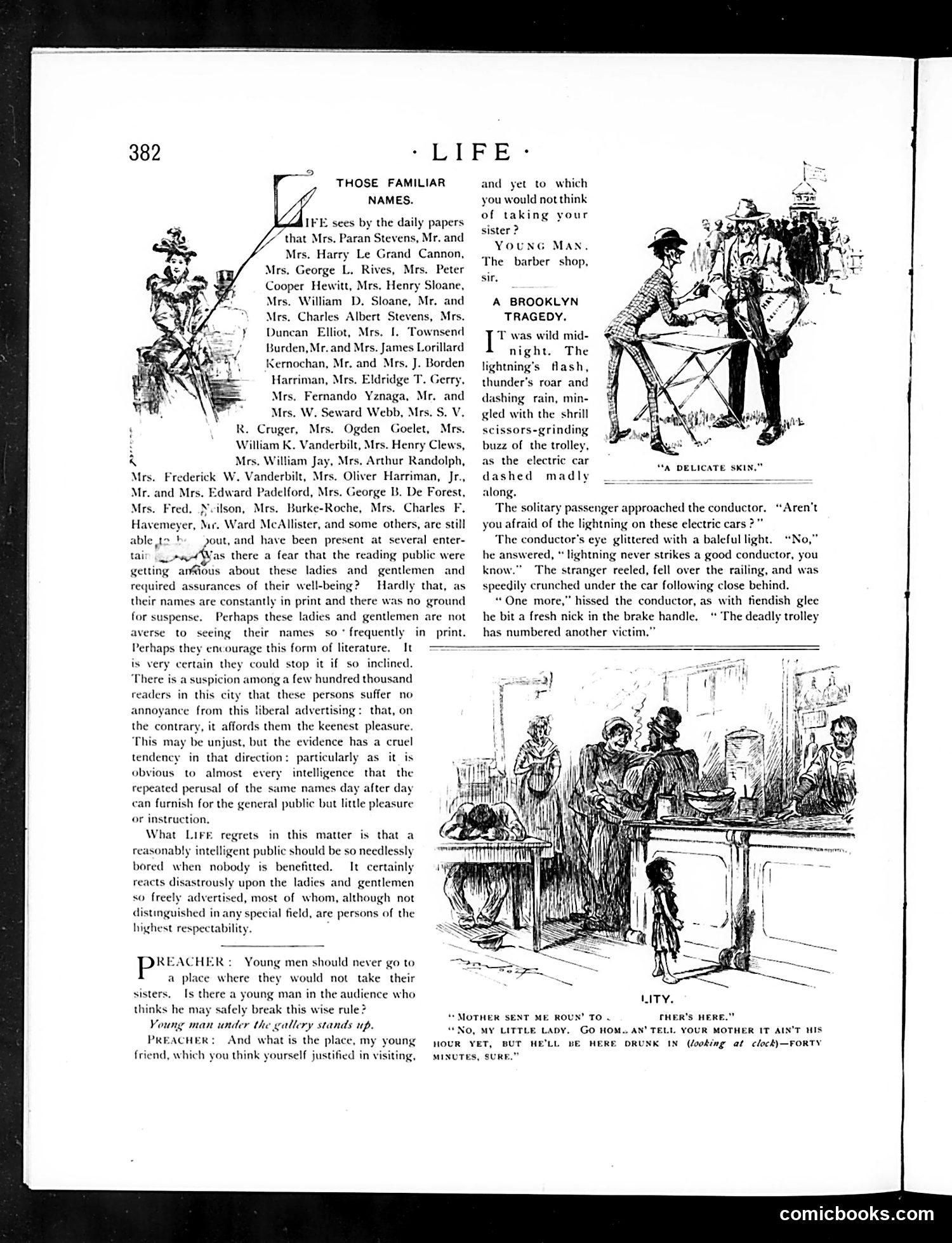
This page combines social commentary with humor about urban life. The main article "Those Familiar Names" critiques how Life magazine publishes society figures' names in its coverage, noting that readers find this both annoying and pleasurable—a tension the writer explores. "A Brooklyn Tragedy" depicts a streetcar accident where a passenger is struck. The accompanying illustration shows the grim aftermath in what appears to be a tenement building. Below, a dialogue between a Preacher and Young Man debates the propriety of visiting theaters, with the preacher questioning whether it's appropriate for young men to attend places where they wouldn't take their sisters—a period concern about entertainment venues' moral character. The cartoons satirize both urban dangers and Victorian social anxieties about proper conduct.
📄 Transcribed text from this page (OCR, searchable)
Machine-transcribed from the original scan — historical spelling and the odd misread are preserved.
“BIDE E : THOSE FAMILIAR NAMES. ZA IW: sees by the daily papers “that Mrs. Paran Stevens, Mr. and Mrs. Harry Le Grand Cannon, Mrs, George L, Rives, Mrs. Peter Cooper Hewitt, Mrs, Henry Sloane, Mrs. William D. Sloane, Mr. and Mrs. Charles Albert Stevens, Mrs. Duncan Elliot, Mrs. 1. Townsend Burden, Mr. and Mrs. James Lorillard Kernochan, Mr. and Mrs. J. Borden Harriman, Mrs. Eldridge T. Gerry, Mrs. Fernando Yznaga, Mr. and Mrs, W. Seward Webb, Mrs. S. V. R. Cruger, Mrs. Ogden Goelet, Mrs. William K. Vanderbilt, Mrs. Henry Clews, Mrs, William Jay, Mrs, Arthur Randolph, Mrs. Frederick W. Vanderbilt, Mrs. Oliver Harriman, Jr., Mr. and Mrs. Edward Padelford, Mrs. George B. De Forest, Mrs. Fred, Nvilson, Mrs. Burke-Roche, Mrs. Charles F, Havemeyer, Mr. Ward McAllister, and some others, are still able t> + pout, and have been present at several enter- tain sqWas there a fear that the reading public were getting arfious about these ladies and gentlemen and required assurances of their well-being? Hardly that, as their names are constantly in print and there was no ground for suspense. Perhaps these ladies and gentlemen are not averse to seeing their names so * frequently in print. and yet to which you would not think of taking your sister ? YOUNG MAN. The barber shop, sir. A BROOKLYN TRAGEDY. T' was wild mid- night. The lightning’s flash, thunder's roar and dashing rain, min- gled with the shrill scissors-grinding buzz of the trolley, as the electric car “A DELICATE SKIN.” dashed madly = along. The solitary passenger approached the conductor. “Aren't you afraid of the lightning on these electric cars ?" ‘The conductor's eye glittered with a baleful light. “No, he answered, “ lightning never strikes a good conductor, you The stranger reeled, fell over the railing, and was speedily crunched under the car following close behind. “One more,” hissed the conductor, as with fiendish glee he bit a fresh nick in the brake handle,‘ The deadly trolley has numbered another victim.” Perhaps they encourage this form of literature. It is very certain they could stop it if so inclined. ‘There is a suspicion among a few hundred thousand readers in this city that these persons suffer no annoyance from this liberal advertising: that, on the contrary, it affords them the keenest pleasure. This may be unjust, but the evidence has a cruel in that direction: particularly as it is obvious to almost every intelligence that the repeated perusal of the same names day after day can furnish for the general public but little pleasure or instruction, tendenc: What Lire regrets in this matter is that a reasonably intelligent public should be so needlessly It certainly strously upon the ladies and gentlemen y advertised, most of whom, although not distinguished in any special field, are persons of the highest respectability. bored when nobody is benefitted. ZSACHER: Young men should never go to a place where they would not take their sisters, Is there a young man in the audience who thinks he may safely break this wise rule? Young man under the gallery stands up. PREACHER: And what is the place, my young friend, which you think yourself justified in visiting, “MOTHER SENT ME ROUN’ TO “No, MY LUTTE uNouR YET, MINUTES, SURE.” THER'S HERE.” Go HOM. AN’ TELL. YOUR MOTHER IT AIN'T WIS HERE DRUNK IN (looking at clock)—FORTY ADY. BUT HE'LL BE comicbooks.com