
A complete issue · 18 pages · 1893
Life — November 30, 1893
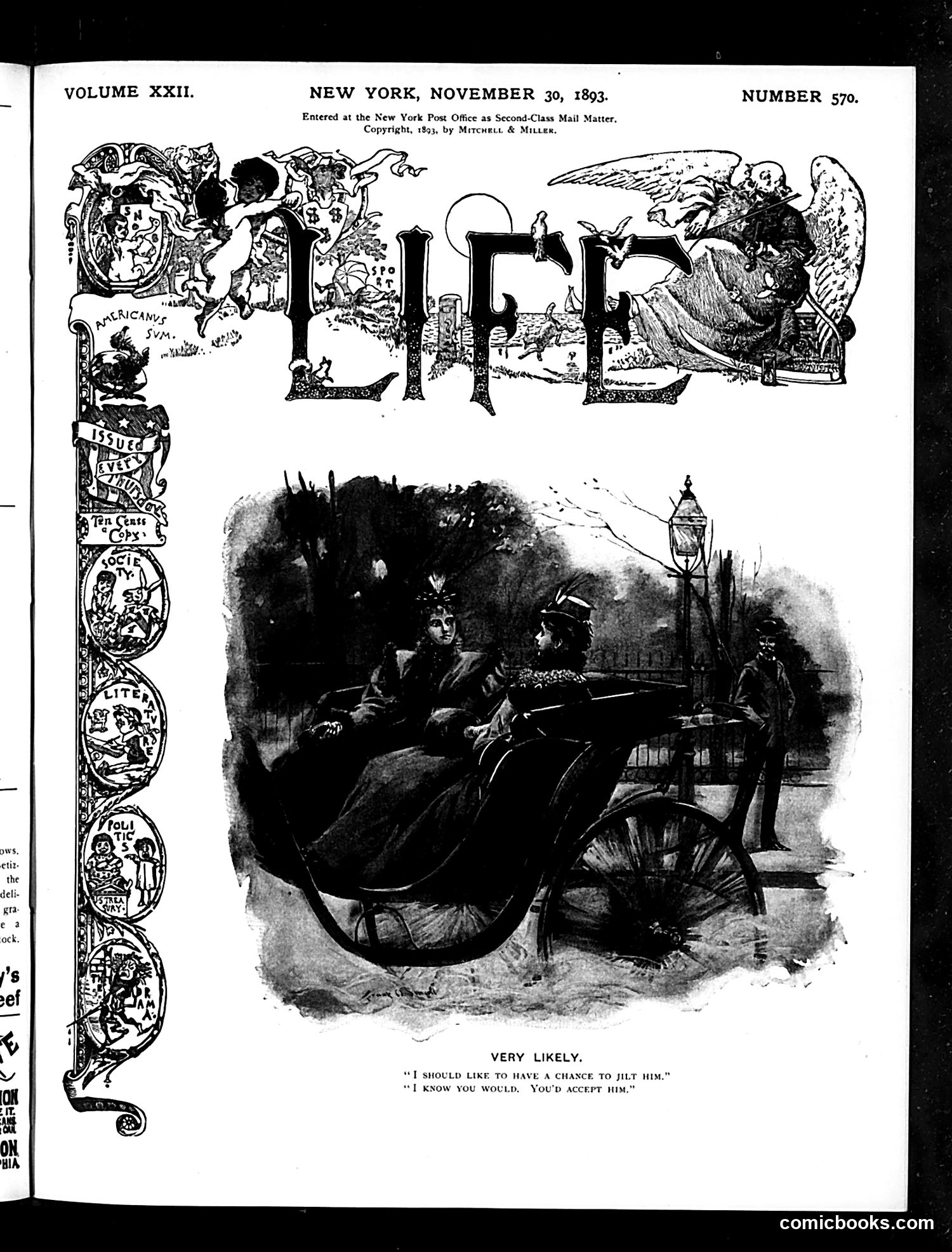
This page features a single cartoon titled "Very Likely" depicting a social scene. Two well-dressed figures in a carriage or sleigh are conversing, with the dialogue reading: "I should like to have a chance to jilt him" and "I know you would. You'd accept him." The cartoon satirizes courtship and marriage customs of the 1890s, specifically mocking the social dynamics where women of means might accept marriage proposals not from genuine affection but from social obligation or financial consideration. The "jilt" reference suggests the woman would reject the suitor after accepting him—a scandal in that era. The satire targets both the superficiality of matrimonial arrangements and the power dynamics between wealthy suitors and women using marriage strategically. It's a commentary on Gilded Age courtship practices among the upper classes.
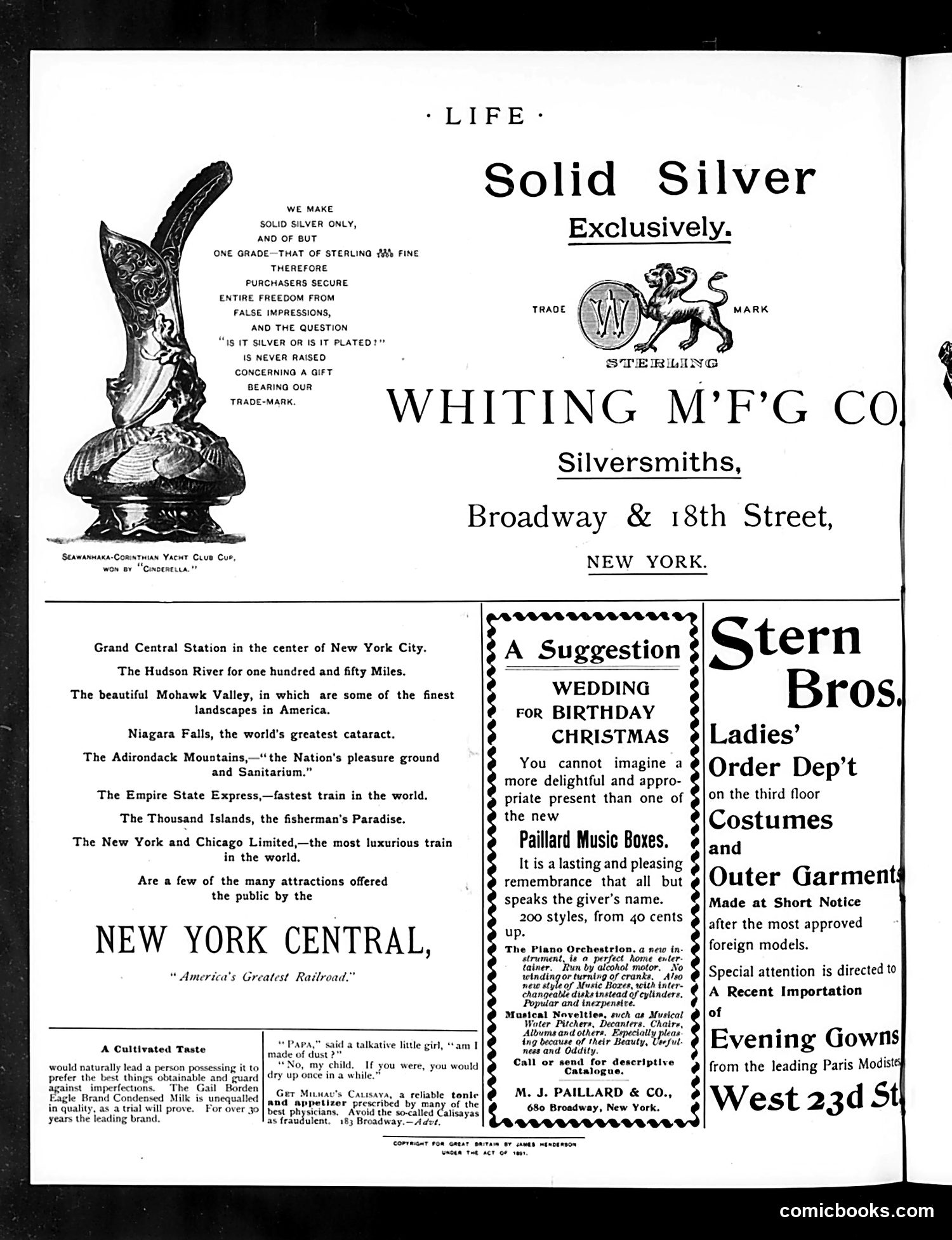
This page is primarily **advertising**, not satire or political commentary. The dominant feature is a Whiting Manufacturing Company advertisement for sterling silver goods, emphasizing that they use "solid silver only" to combat consumer concerns about silver-plated imitations—a significant market deception issue of the era. The page also advertises New York Central Railroad attractions, Stern Bros. department store (focusing on women's clothing), and M.J. Paillard & Co. music boxes as gift suggestions. A small section titled "A Cultivated Taste" promotes Eagle Brand Condensed Milk as a quality product. There is **no discernible political cartoon or social satire** on this page—it represents typical early 20th-century magazine advertising and product promotion.
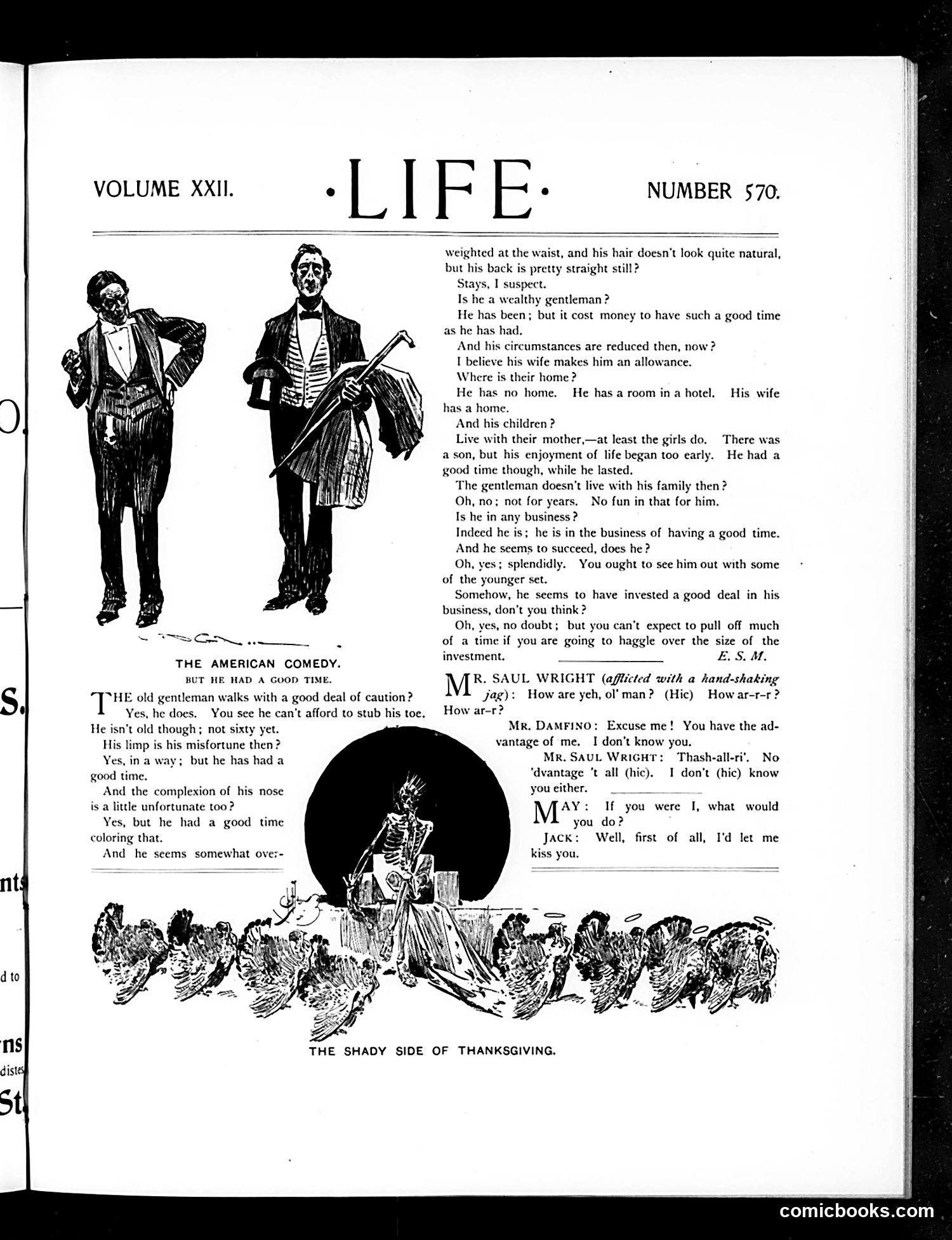
**"The American Comedy: But He Had a Good Time"** depicts two well-dressed gentlemen—one thin, one rotund—discussing a dissolute acquaintance. The conversation reveals a man of means who has squandered his fortune on leisure and excess, now living in a hotel room on an allowance from his wife, separated from his family. His son reportedly died young from similar overindulgence. **"The Shady Side of Thanksgiving"** (lower cartoon) shows Lady Liberty seated among skeletal turkeys, darkly suggesting that Thanksgiving's celebration masks suffering—possibly referencing poverty, labor exploitation, or social inequality during the holiday season. Both pieces satirize American prosperity and moral hypocrisy: the wealthy man's "good time" has destroyed his life, while national celebration ignores underlying social hardship.
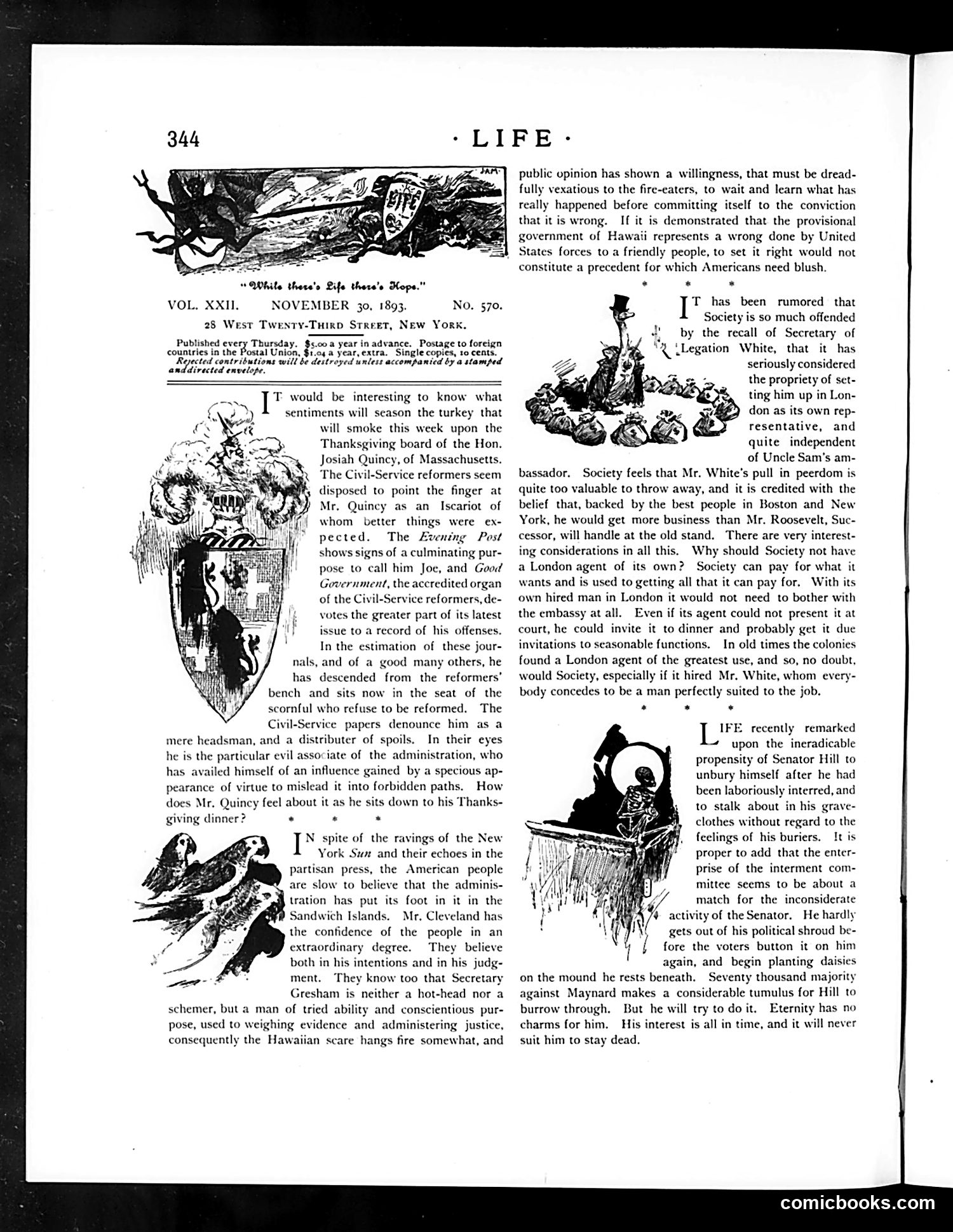
This page satirizes political figures and civil service reform debates of the 1890s. The text criticizes **Josiah Quincy of Massachusetts**, a civil-service reformer, suggesting reformers unfairly target certain officials while ignoring others' misconduct. The cartoons mock **Senator Hill**, depicted burying himself after political losses, and reference **Secretary Gresham** regarding the Hawaiian situation—likely the controversial 1893 overthrow of Hawaii's monarchy. The piece suggests Gresham is conscientious but questions whether the administration truly supports Hawaiian independence or merely appears to do so. The satire targets both specific politicians and broader hypocrisy in reform movements, using grave/burial imagery to emphasize political defeat and moral compromises.
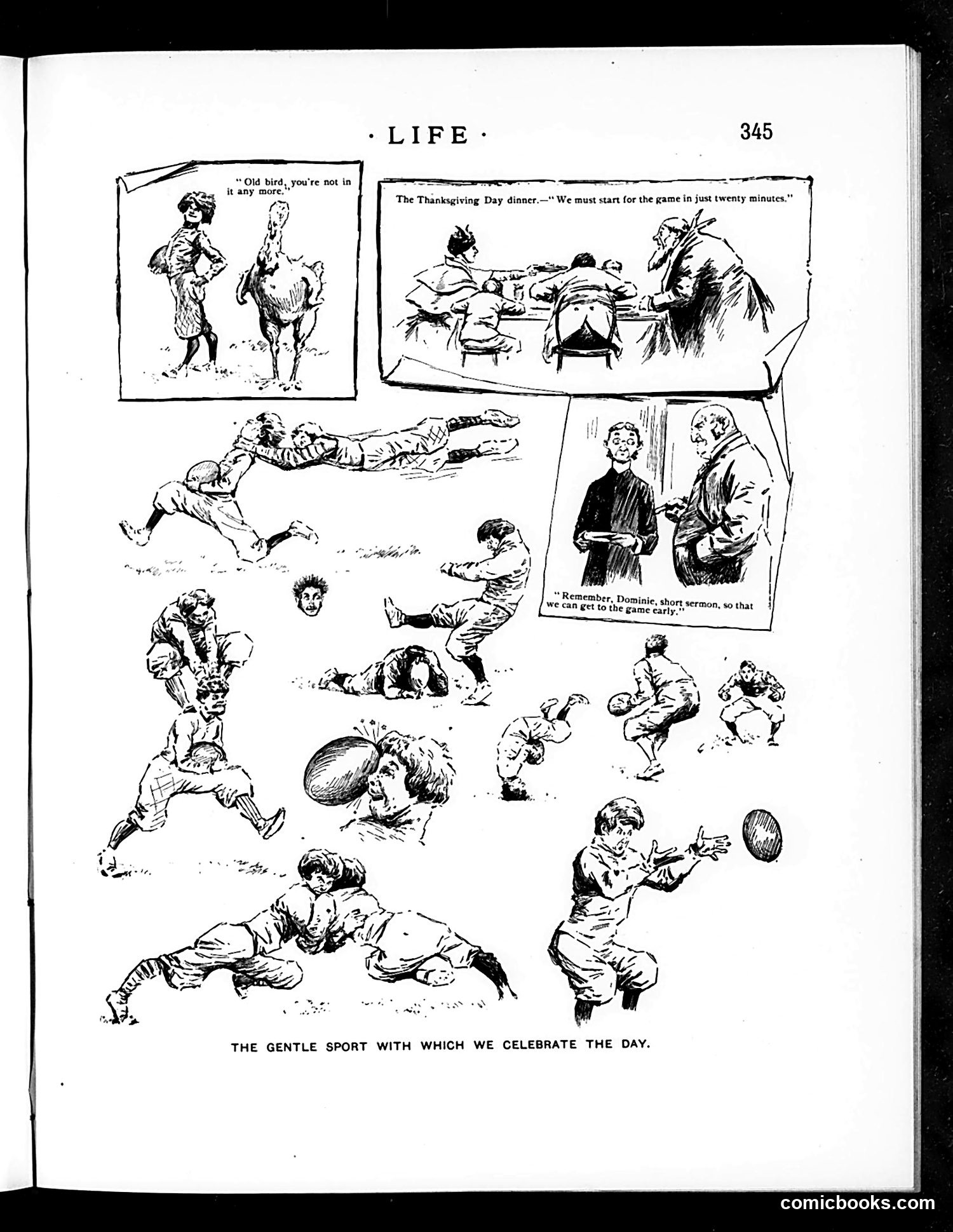
This Life Magazine page satirizes the conflict between Thanksgiving tradition and modern entertainment priorities. The top panels show a family's Thanksgiving dinner being interrupted—a man insists "We must start for the game in just twenty minutes," while another reminds someone to keep the sermon short "so that we can get to the game early." The numerous sketches below depict football players in various dynamic poses—running, catching, diving, and tackling—illustrating the sport's physical intensity. The caption "THE GENTLE SPORT WITH WHICH WE CELEBRATE THE DAY" is ironic: it sarcastically calls football "gentle" while the illustrations show rough, violent action. The satire critiques how Americans prioritize attending or watching football games over traditional family gatherings and religious observance on Thanksgiving.
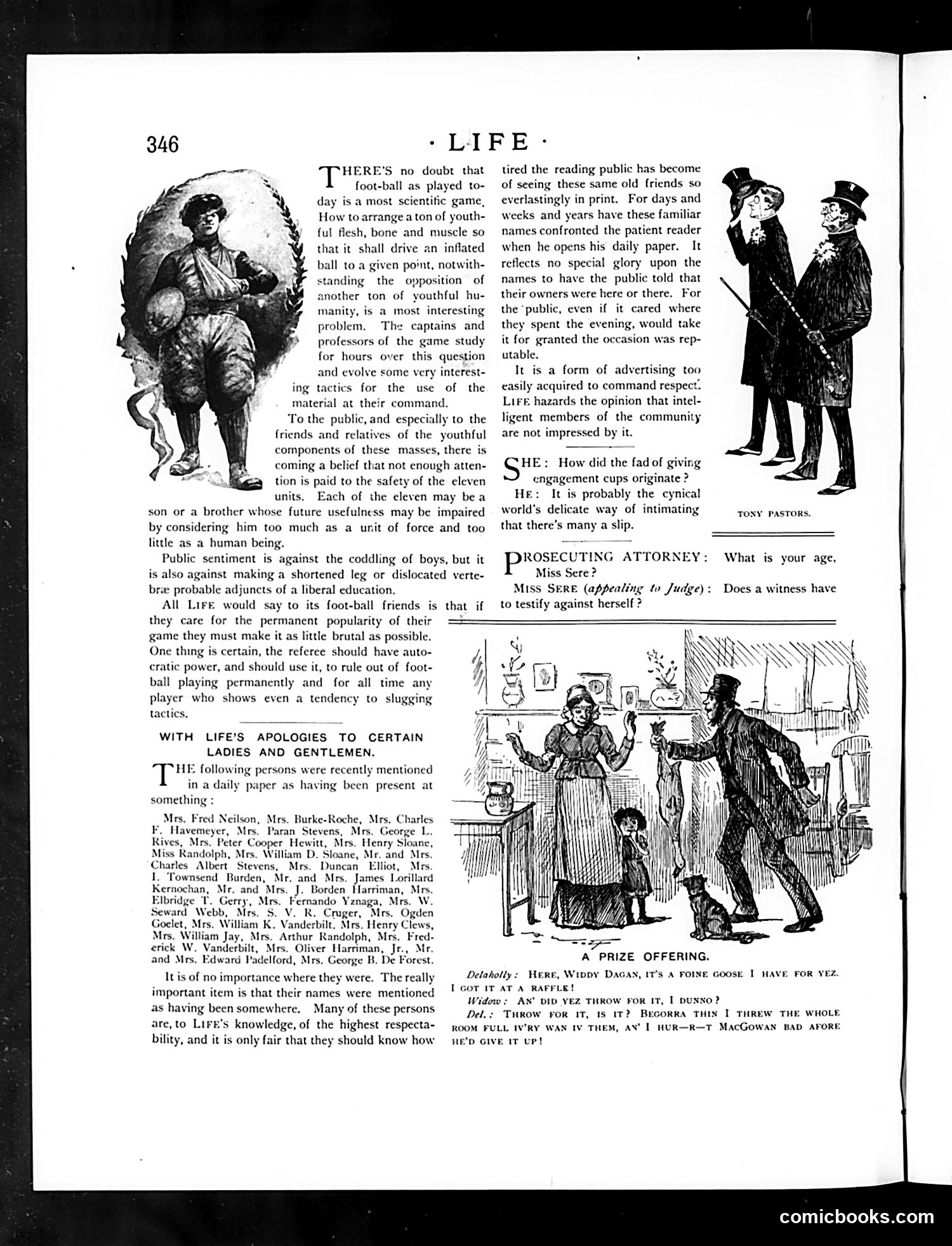
This page contains two main sections: **Upper Content:** Editorial discussion about football's role in developing youth, arguing the sport requires careful regulation to prevent injury. The text advocates for referee authority to eliminate dangerous tactics like "slugging." **"Tony Pastors" Cartoon:** Shows two well-dressed men in top hats, apparently discussing entertainment. The caption references "engagement cups" as a way of hinting at romantic entanglements—likely satirizing high society's gossip culture and the public's fascination with celebrities' personal lives. **"A Prize Offering" Cartoon:** Depicts a domestic dispute where a woman offers a goose as a prize, with crude dialogue about throwing it. This appears to be working-class humor about marriage and domestic conflict, typical of period comics. The page reflects early 20th-century concerns: youth safety in sports and satirical commentary on both elite and working-class social behavior.
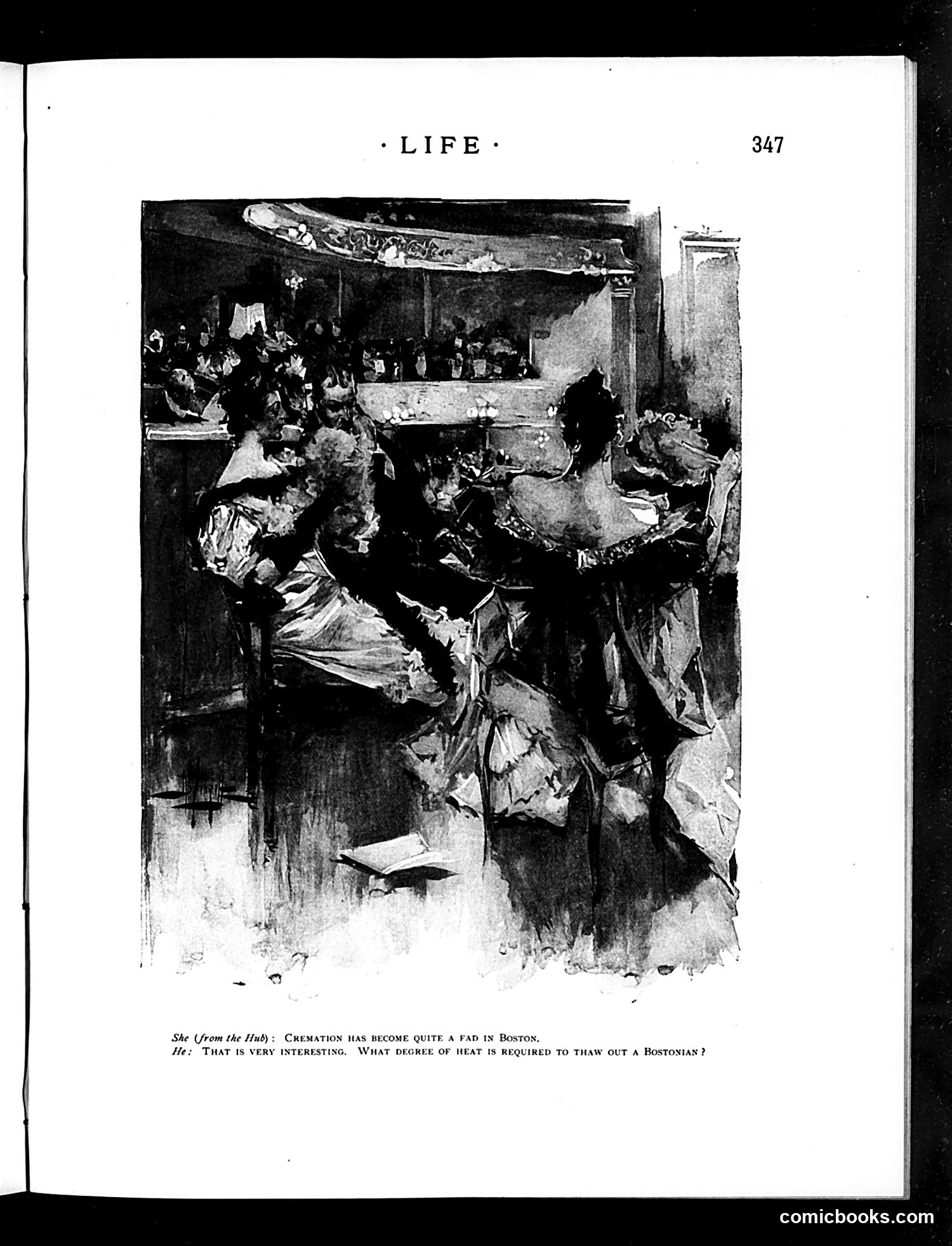
This appears to be a satirical illustration from *Life* magazine (page 347) depicting a social scene, likely from the late 19th or early 20th century based on the clothing styles. The caption indicates a conversation between a woman ("She") and a man ("He") about cremation becoming fashionable in Boston. She remarks it's "interesting," and he responds by asking what temperature is needed to cremate a Bostonian—an ethnic or regional joke implying Bostonians are particularly cold or emotionally frigid people. The illustration shows an elaborate social gathering with elegantly dressed women in elaborate gowns, suggesting the satirical target is upper-class Boston society. The joke appears to mock both the adoption of cremation as a trendy practice and characterizes Bostonians as inherently "cold" people, making the cremation joke doubly pointed.
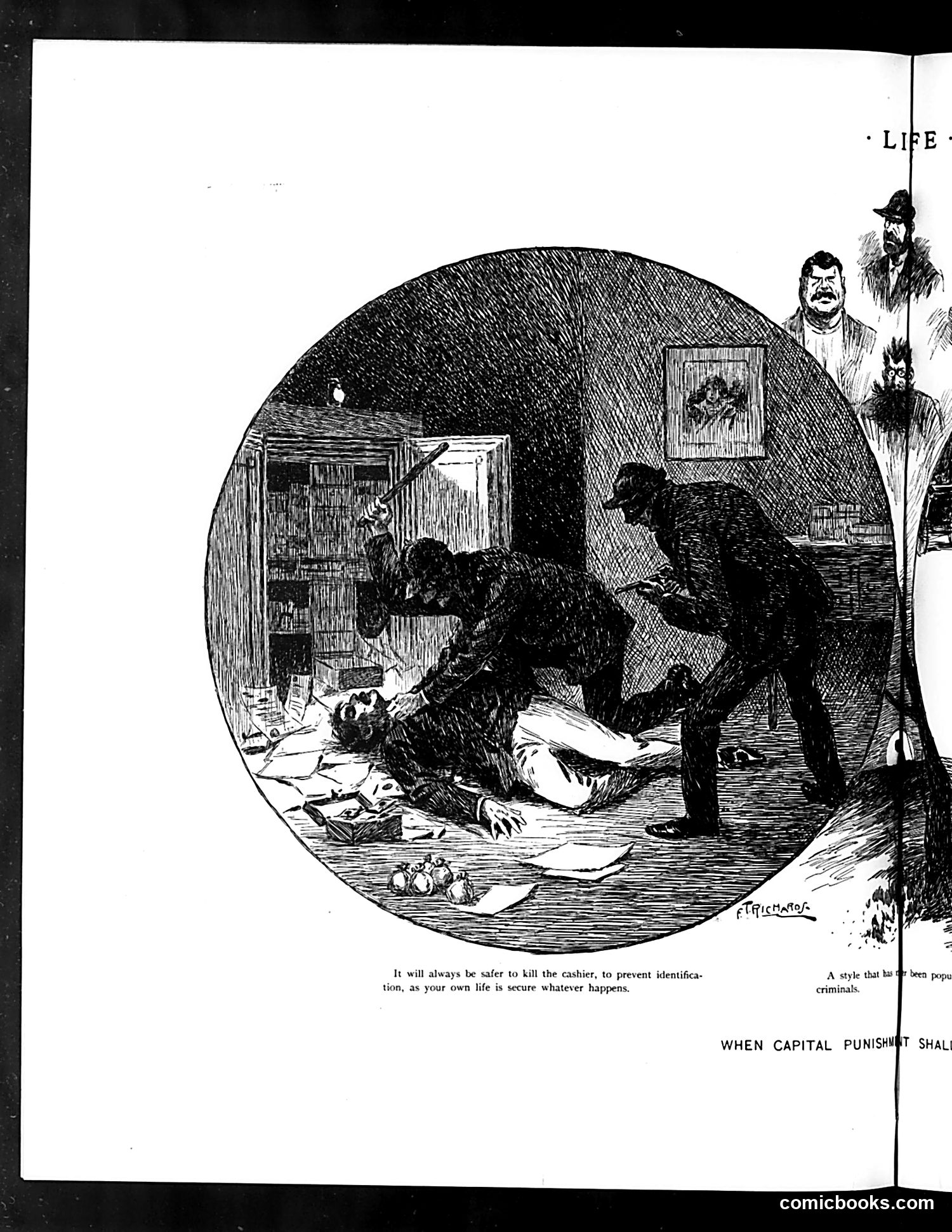
This is a satirical cartoon about capital punishment, likely from the early 20th century. The circular illustration depicts a crime scene: a murdered cashier lies on the floor while police officers and detectives investigate. The text below reads: "It will always be safer to kill the cashier, to prevent identification, as your own life is secure whatever happens." The satire criticizes capital punishment policy by suggesting it *encourages* murder. The logic: if criminals know execution awaits them anyway, they might as well eliminate witnesses to avoid identification. The cartoon argues that having capital punishment as the only severe punishment creates a perverse incentive—a criminal facing death for robbery might as well commit murder too, since the penalty is identical. This reflects contemporary debates about whether capital punishment effectively deterred crime.
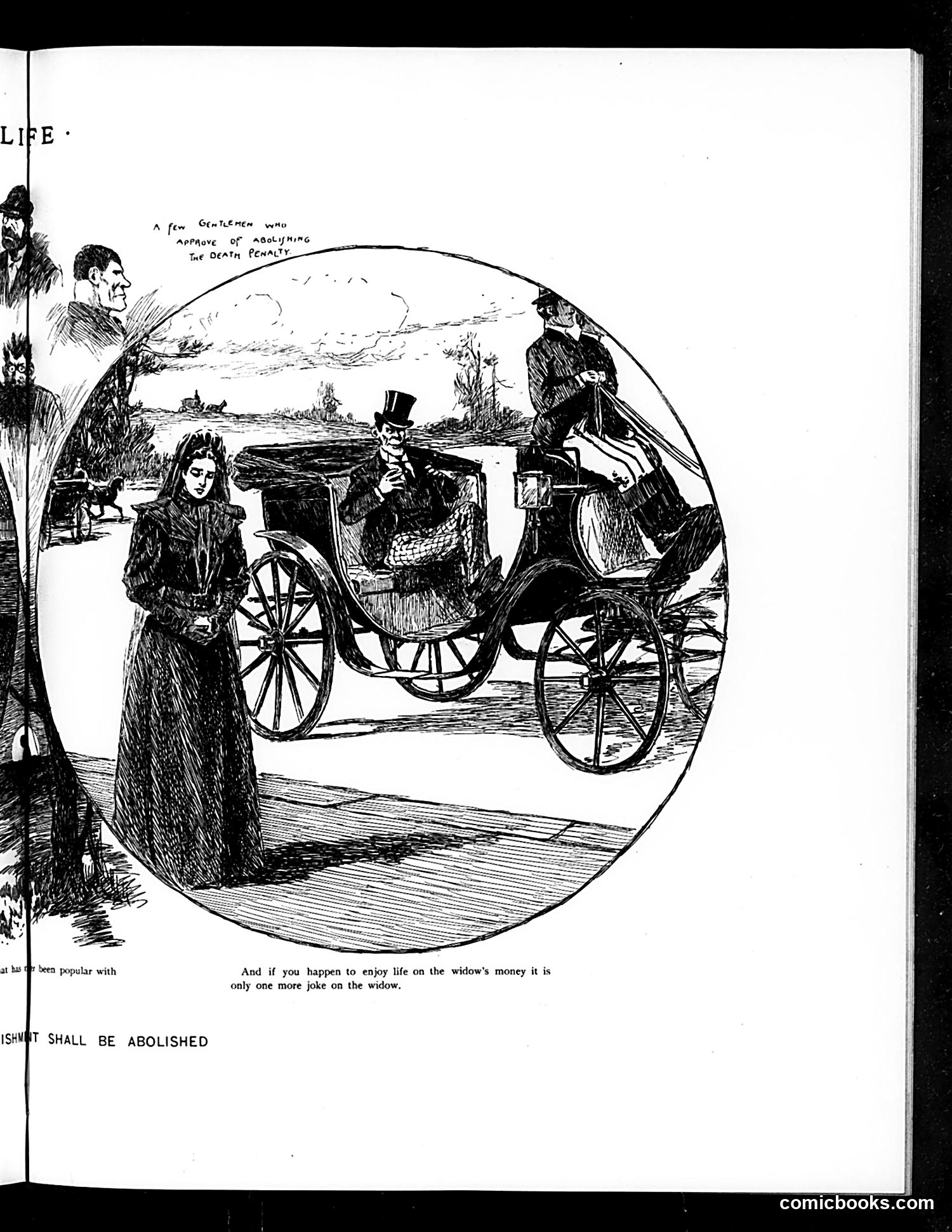
This illustration depicts a social commentary on inheritance and widow's finances. The main image shows a woman in mourning dress standing outside a carriage occupied by well-dressed gentlemen in top hats. The caption reads: "And if you happen to enjoy life on the widow's money it is only one more joke on the widow." The satire targets men who marry or court wealthy widows primarily for financial gain rather than genuine affection. The circular vignette framing suggests this is a common, cyclical problem. The text at top references "a few gentlemen who approve of abolishing the death penalty," likely implying these fortune-hunters wish to preserve wealthy relatives' lives—only to gain their wealth through marriage rather than inheritance. The joke critiques both predatory male behavior and the vulnerability of wealthy widows to exploitation.
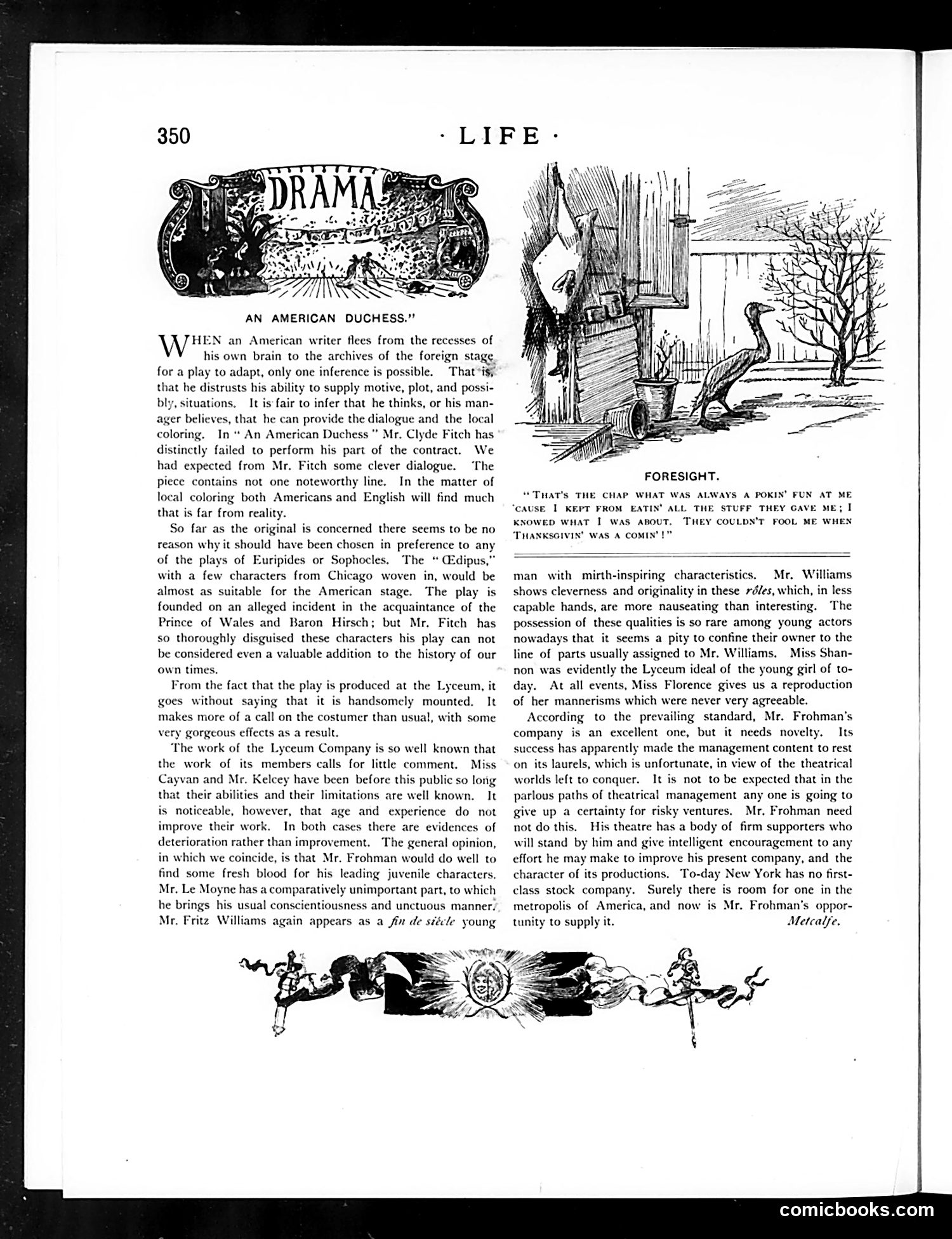
This page reviews a theatrical production called "An American Duchess," adapted by Clyde Fitch from a foreign play. The critic argues the play lacks notable dialogue and local color, despite being set in America. The accompanying illustration labeled "Foresight" shows a man at a doorway with a quote about Thanksgiving—apparently satirizing the play's weak American characterization. The review praises actor Fritz Williams's performance while critiquing the overall production quality at the Lyceum Theatre. It suggests the play needs fresh talent and novelty, encouraging theater manager Frohman to develop stronger American productions rather than rely on European adaptations. The satire targets adaptations that fail to capture authentic American voices and situations.
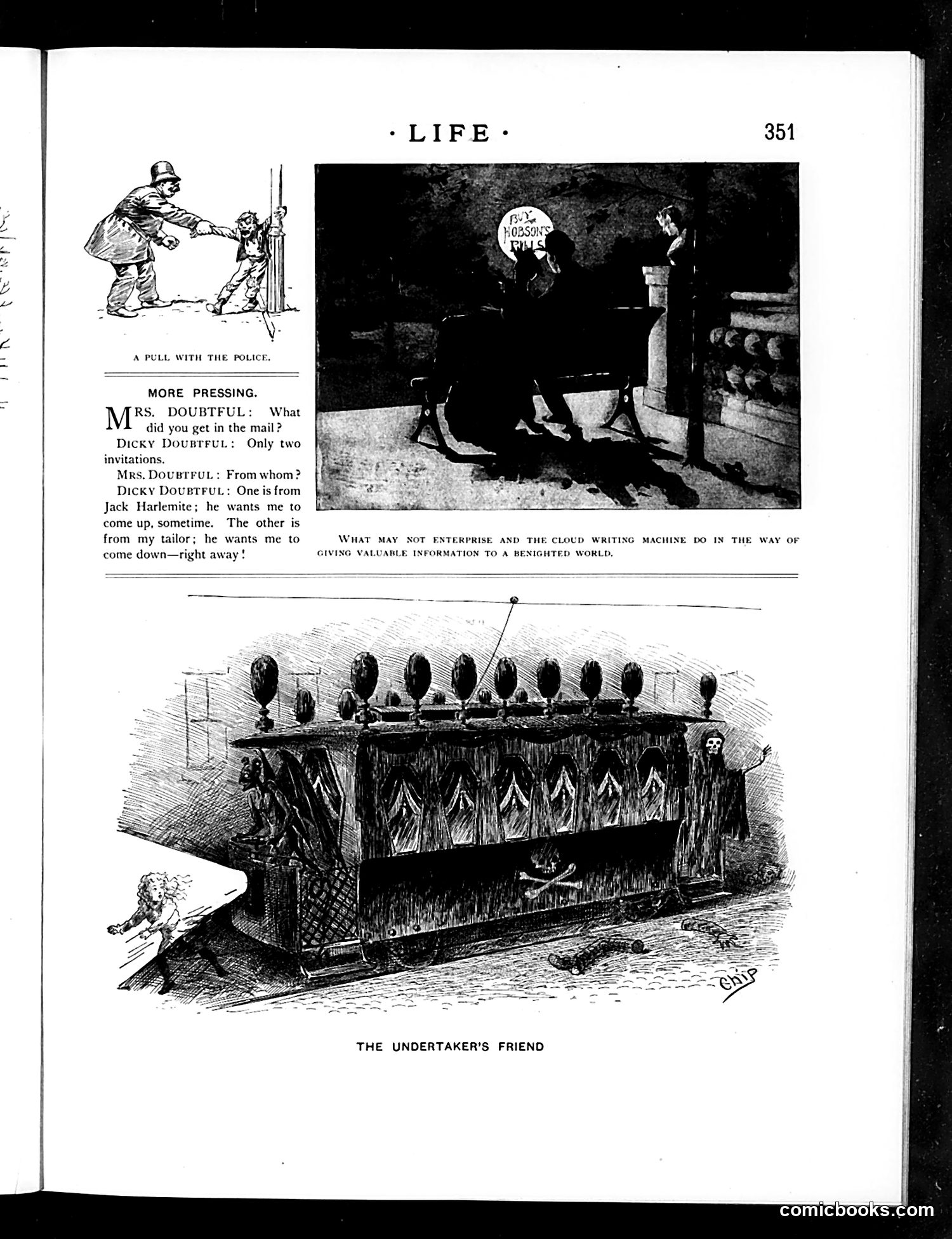
This page contains three separate satirical pieces: 1. **"A Full with the Police"** (top left): A sketch-based comic about a domestic dispute, where Mr. Doubtful receives two invitations—one from Jack Harlemite to "come up" and another from his tailor demanding payment ("come down"). The humor derives from the man's predicament between social obligations and financial debts. 2. **"What May Not Enterprise and the Cloud Writing Machine Do"** (center): A photograph showing what appears to be an early advertising or projection technology displaying text to an urban audience, satirizing commercial messaging's reach. 3. **"The Undertaker's Friend"** (bottom): A macabre cartoon depicting a crematorium or similar apparatus with multiple heads mounted on top, suggesting dark commentary on industrial-scale death or funeral industry profits. The humor is characteristically morbid for early 20th-century satire.
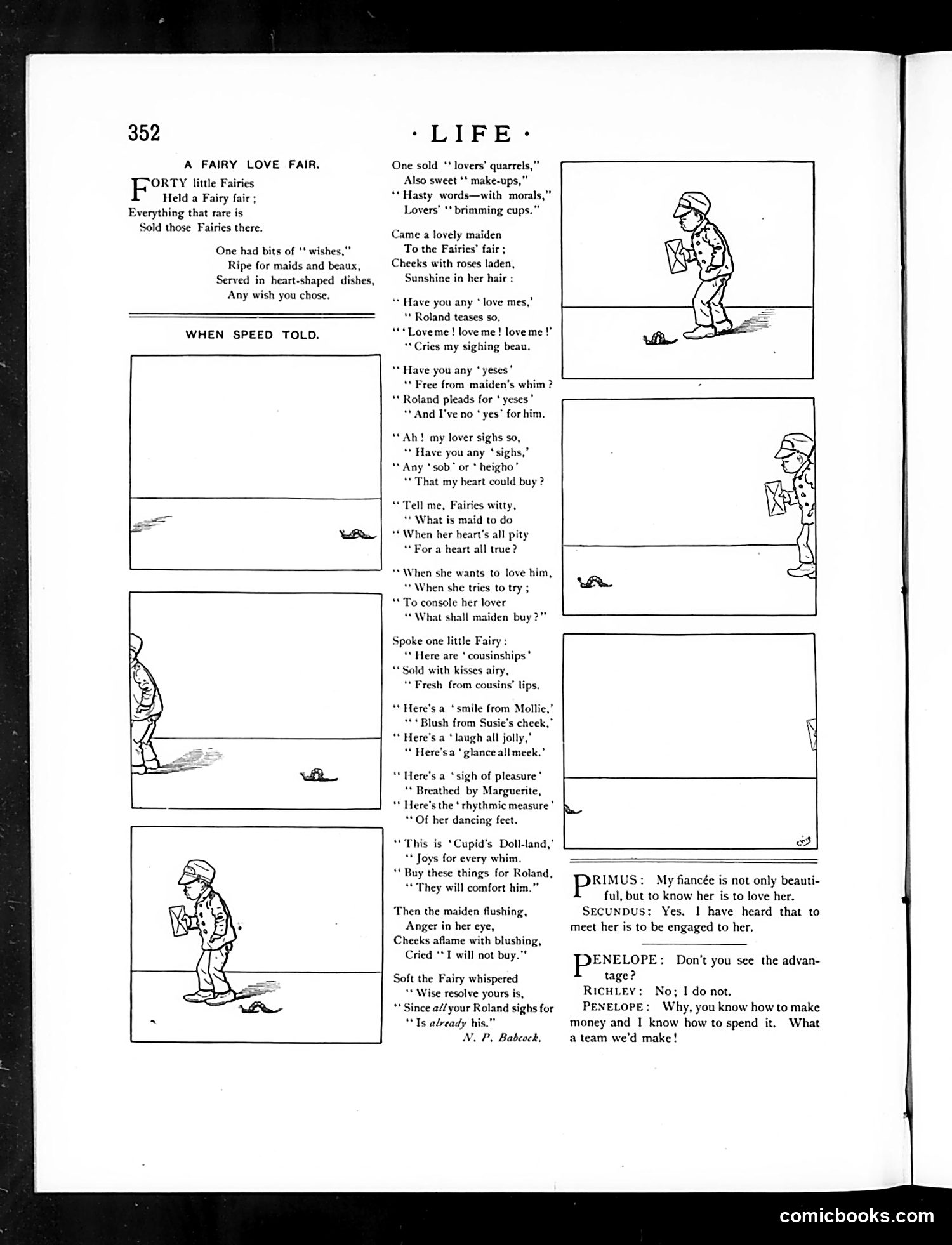
This page contains two distinct pieces of humor: **The Main Poem/Illustration**: A whimsical narrative about a young woman visiting a magical fair where fairies sell romantic commodities—"love mes," "yeses," sighs, and borrowed affections from other women. The maiden seeks ways to reciprocate her suitor Roland's love without compromising her modesty or independence. The joke satirizes Victorian courtship conventions: women were expected to be coy and withhold affection, yet men demanded emotional responsiveness. The fairies' absurd "goods" mock how romance was treated as a transaction. The maiden's final refusal to "buy" suggests her own agency—she already possesses Roland's devotion ("already his"), so artificial gestures are unnecessary. **The Brief Dialogue Below**: A joke about mercenary marriage. Penelope argues that her husband's money-making skills and her spending habits create a perfect "team"—satirizing marriages based on financial compatibility rather than love, reflecting early-20th-century anxieties about materialism in courtship. Both pieces gently mock relationship customs of the era.
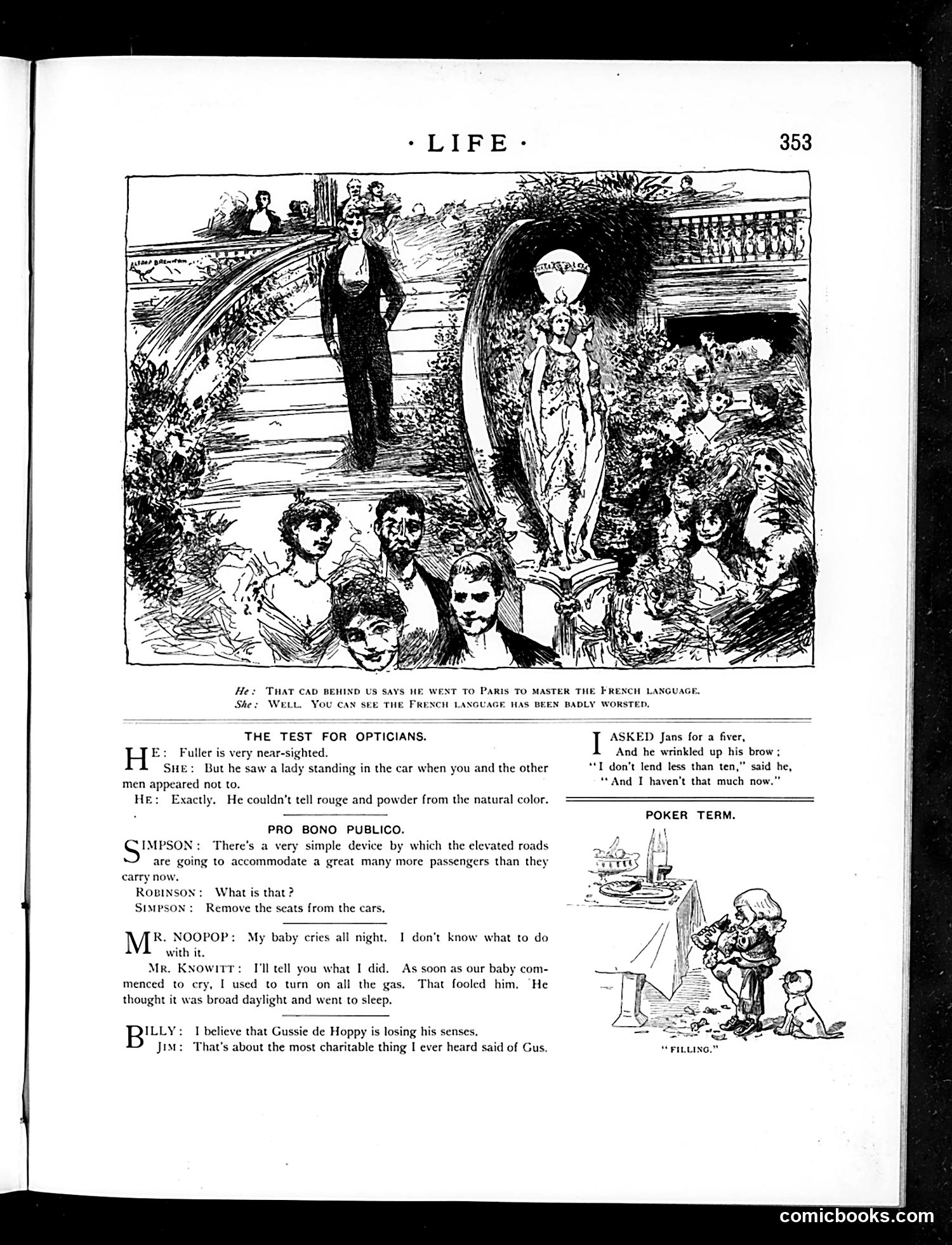
This page contains several brief, unrelated jokes typical of Life's satirical format: **"The Test for Opticians"** mocks women's makeup by suggesting a near-sighted man's inability to distinguish rouge and powder from natural skin is actually a sign of poor vision—implying women's cosmetics were obvious and heavily applied. **"Pro Bono Publico"** offers absurdist transit humor: removing seats from crowded elevated trains to fit more passengers is presented as a "simple device"—obvious nonsense offered as serious urban planning. **Other jokes** involve domestic situations (babies, lending money) with no political content. **"Poker Term"** appears to be a caption for a fishing illustration, making a pun on "filling" (the card term). The large illustration at top shows a social gathering or garden party where a figure appears to be displaying themselves dramatically. The caption suggests someone claimed to study French in Paris but apparently failed—a mild jab at pretension or incompetence. These are lighthearted, topical humor pieces rather than substantive political satire.
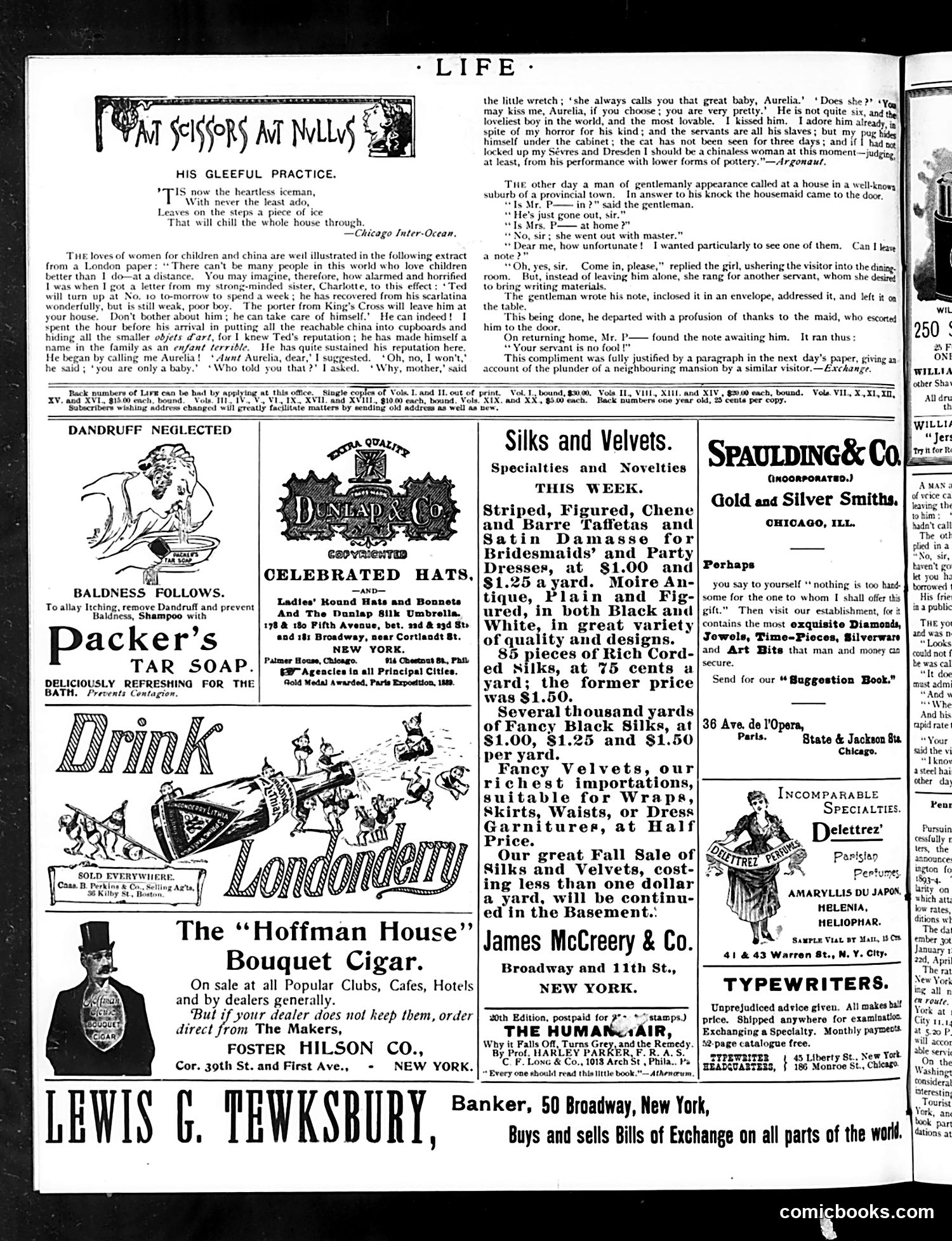
This page is primarily **advertising and miscellaneous content** rather than political satire. The main text elements include: 1. **"His Gleeful Practice"** – A poem satirizing the iceman who callously delivers ice regardless of consequences, letting it melt through entire houses. 2. **Two anecdotal prose pieces** about social etiquette: one describing a mischievous boy named Ted who disrupts a household, and another about a gentleman visitor whose note about a burglary becomes newspaper fodder—the humor deriving from the servant's good sense in documenting criminal intelligence. 3. **Extensive advertisements** for products (tar soap, hats, cigars, typewriters) and services typical of 1890s America. The cartoon illustrations are **small and decorative** rather than politically pointed. The "Dandruff Neglected" section uses humorous imagery but addresses personal grooming, not social commentary. Overall, this reflects *Life*'s shift toward lifestyle and consumer content by the late 1800s, alongside its earlier satirical tradition.
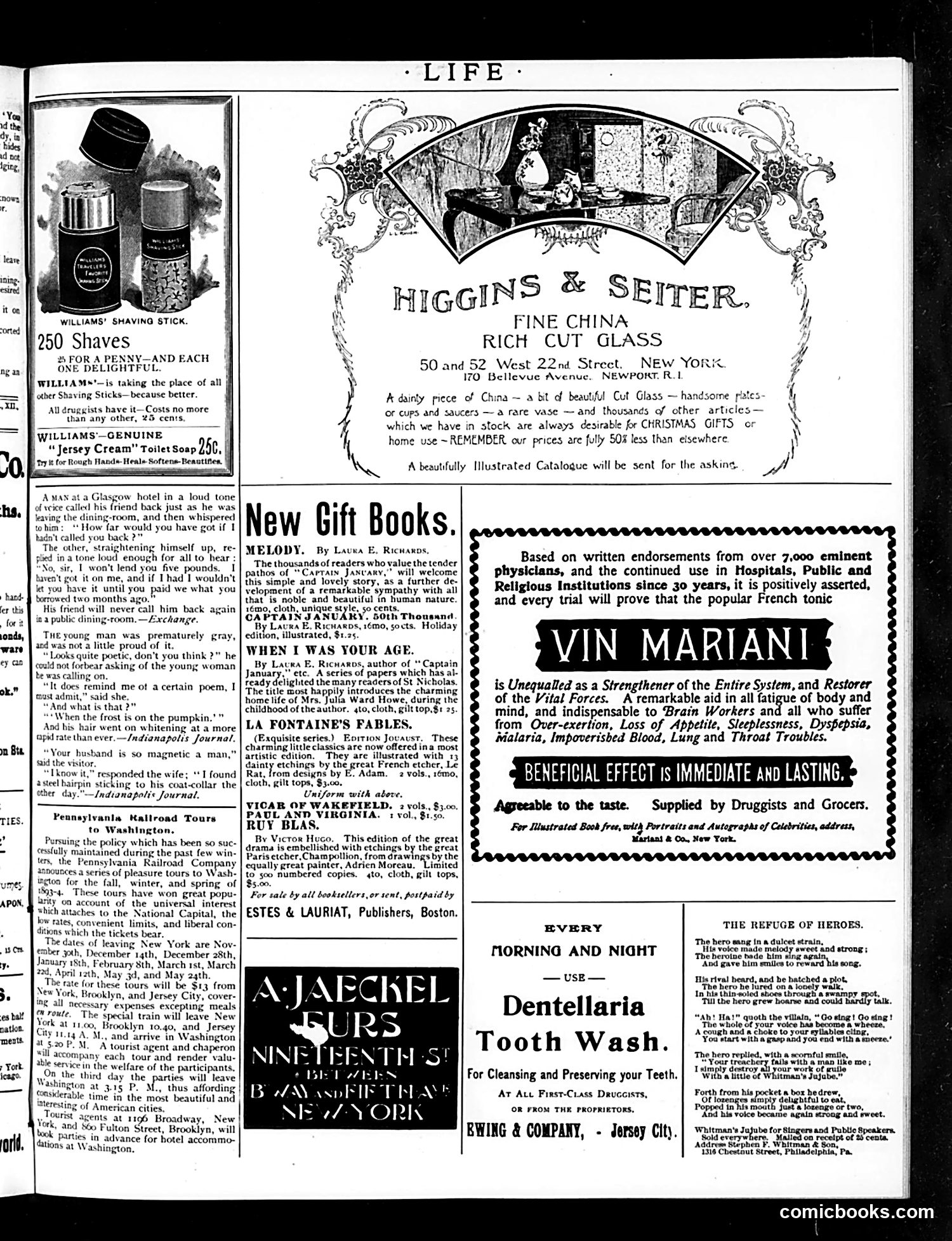
This page is primarily **advertisements and notices**, not political satire. The main content includes: **Advertisements:** - Williams' shaving products - Higgins & Seiter fine china and cut glass (luxury goods) - Vin Mariani (a patent medicine claiming broad health benefits) - Dentallaria tooth wash - A.J. Jaeckel Furs - Pennsylvania Railroad pleasure tours to Washington **Humor section:** Three brief anecdotes with no political content—just everyday comedic situations about social awkwardness and misunderstandings. **Book notices:** Reviews of new publications, including works by Laura E. Richards. **Notable element:** The Vin Mariani advertisement heavily emphasizes endorsements from "over 7,000 eminent physicians" and "continued use in Hospitals, Public and Religious Institutions"—typical patent medicine marketing of the era, making dubious health claims that would later be regulated. The page reflects 1890s consumer culture and advertising practices rather than containing satirical commentary.
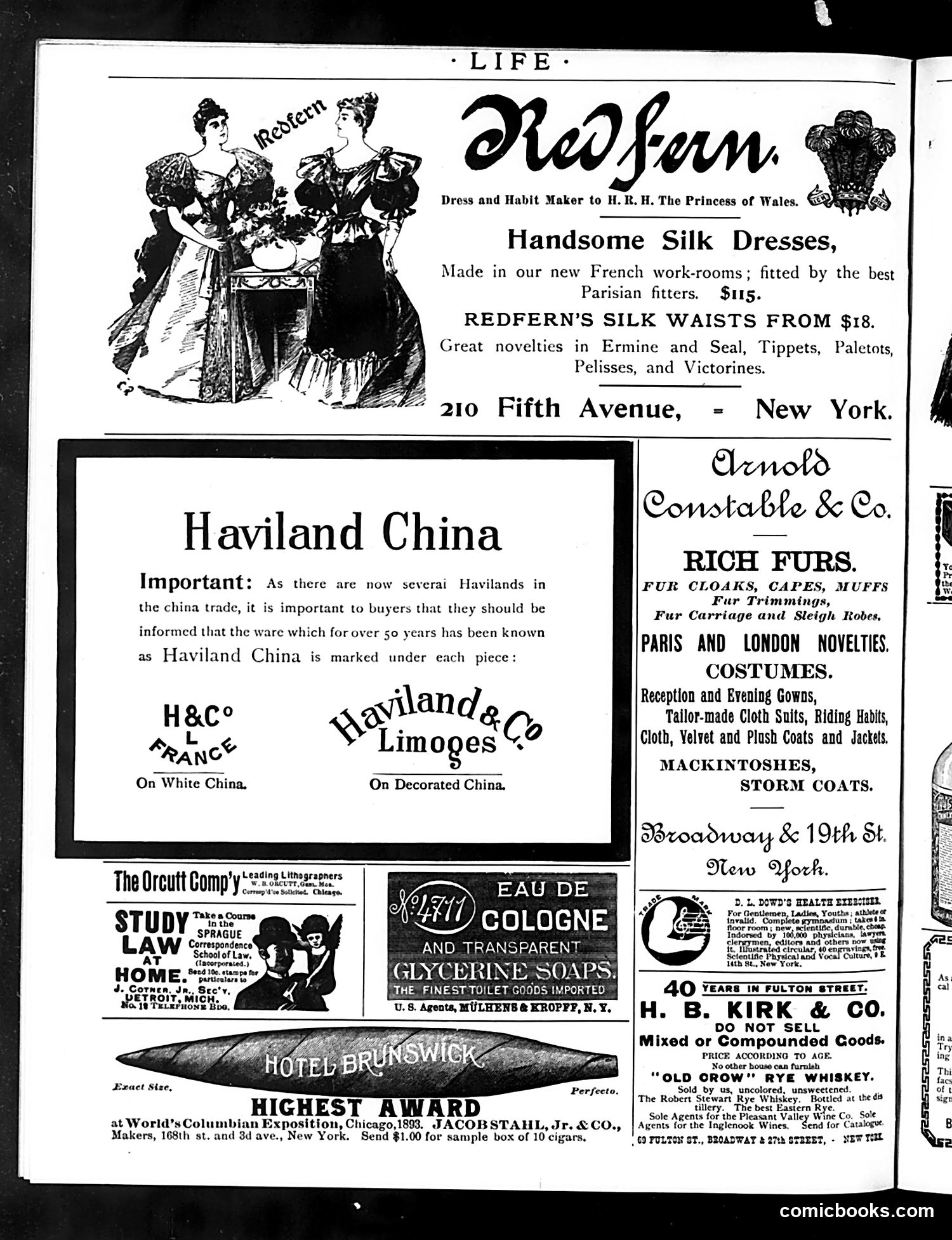
This is not a satirical or political cartoon page—it's a late-19th-century advertisement section from *Life* magazine. The page contains luxury retail ads targeting wealthy consumers, including: - **Redfern**: A prestigious dressmaker serving the Princess of Wales, advertising silk dresses and waists - **Haviland China**: Clarifying their brand identity among competing porcelain manufacturers - **Arnold Constable & Co.**: High-end furs, clothing, and coats - **H.B. Kirk & Co.**: Whiskey merchants - Various other luxury goods (cologne, cigars, hotels) The only non-advertising content appears to be small notices for educational courses and business services. There are no political cartoons, caricatures, or satirical commentary visible on this page—it's straightforwardly commercial, reflecting the gilded-age consumer market.
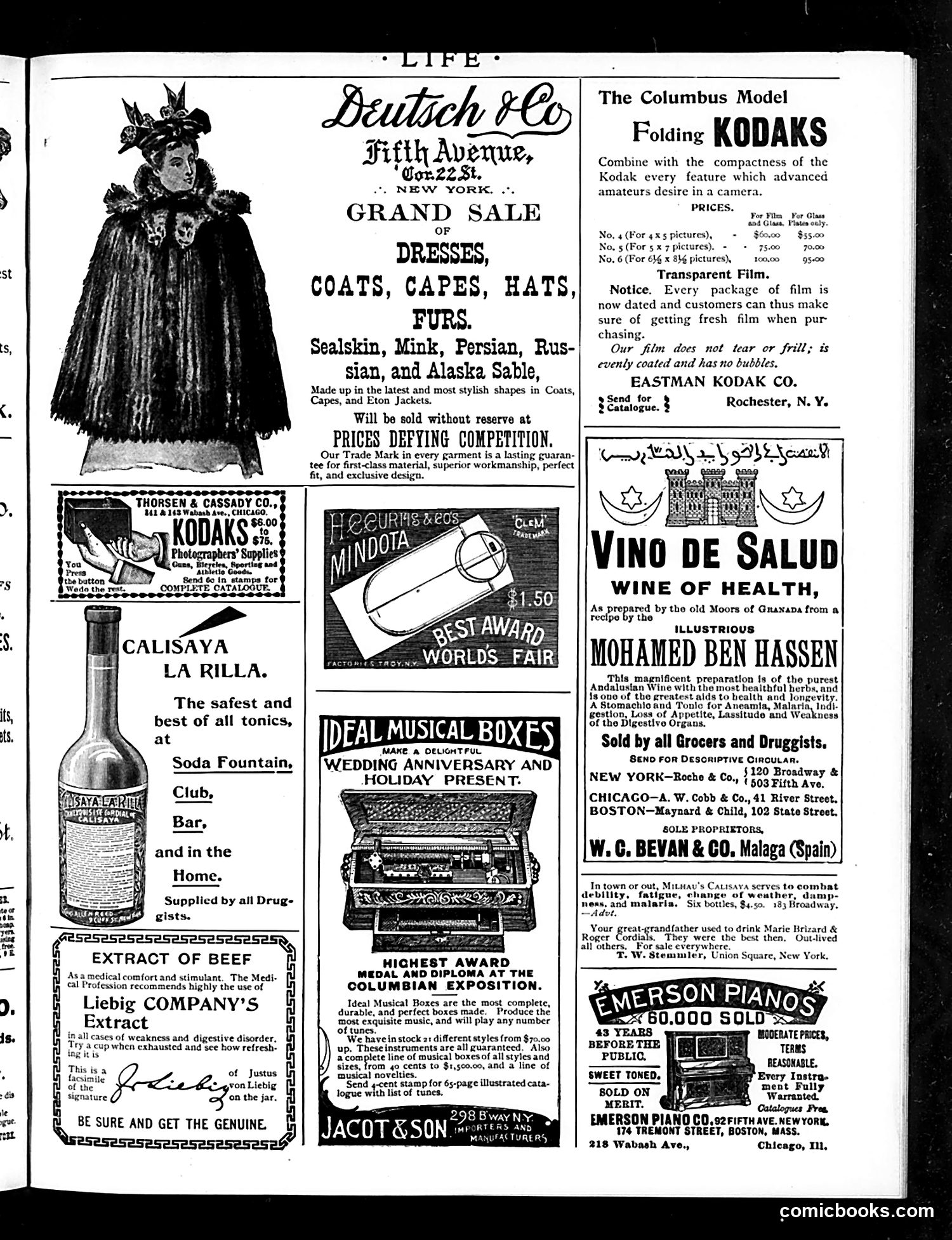
This is primarily an **advertising page**, not a satirical cartoon page. It showcases various consumer products from the early 1900s (likely 1890s-1900s based on the Columbian Exposition reference). **Key advertisements include:** - **Deutsch & Co.** fur/clothing sale featuring exotic pelts (sealskin, mink, sable) - **Calisaya La Rilla** tonic wine promoted as medicinal cure-all - **Liebig Company's Extract of Beef** for "weakness and digestive disorder" - **Kodak folding cameras** ("Columbus Model") - **Ideal Musical Boxes** (music boxes winning awards) - **Vino de Salud** ("Wine of Health") from Spain, attributed to "Mohamed Ben Hassen," claiming to cure malaria and digestive issues - **Emerson Pianos** ("60,000 sold") **Context for modern readers:** These ads reflect pre-FDA regulation era when medicinal claims were unregulated. Wine and tonics were commonly marketed as cure-alls. The page demonstrates how advertising, photography technology, and luxury goods represented consumer culture of the wealthy circa 1890s-1900s.
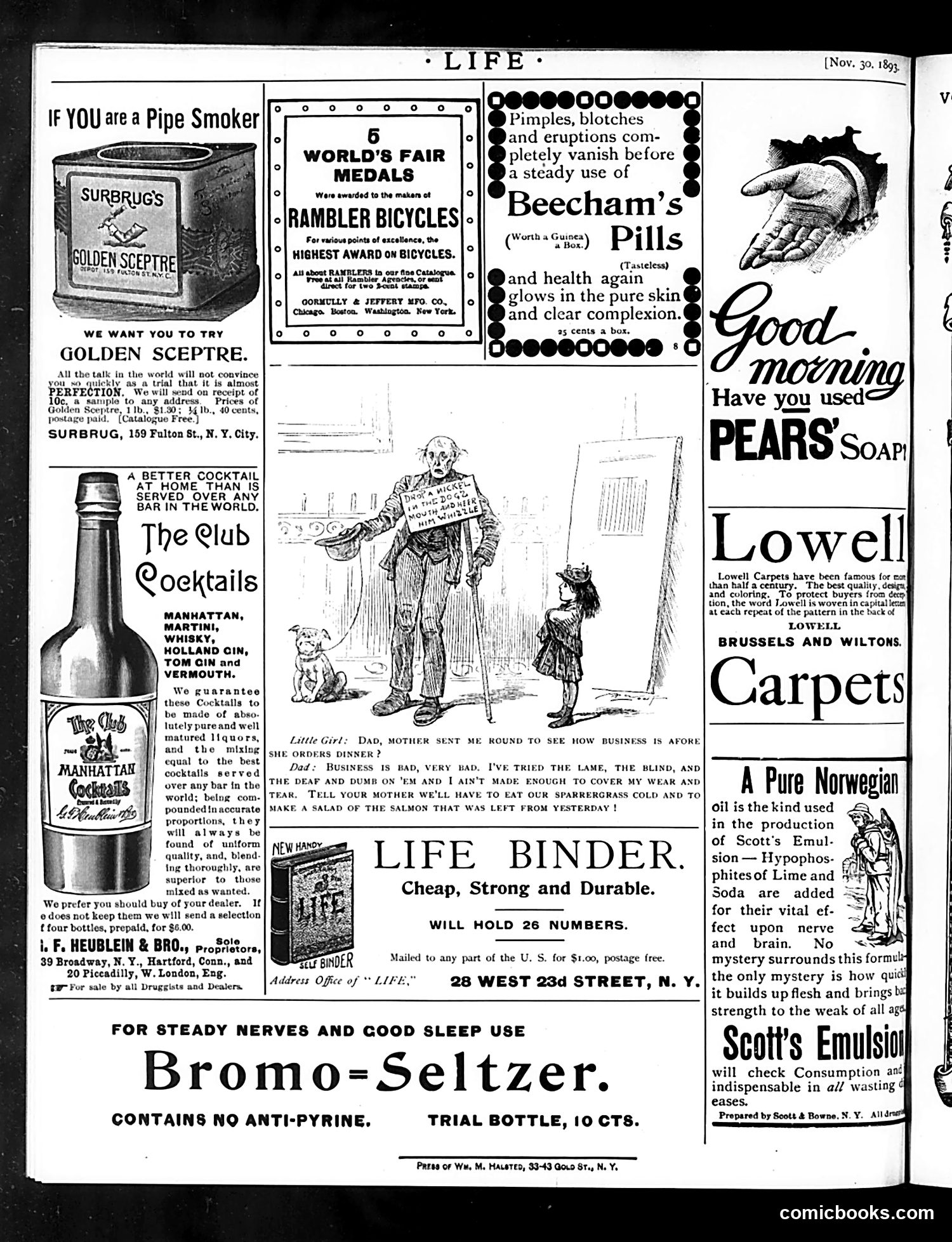
This is primarily an **advertising page** rather than political satire. The dominant content consists of product advertisements typical of the 1890s. The one cartoon present depicts a **business conversation between an adult and child**. A young girl reports to her father that her mother sent her to assess how business is faring. The father responds that business is "bad, very bad," listing failed attempts with various groups (the lame, the blind, the deaf), before joking about economizing by eating cold asparagus and leftover salmon. **The satire**: This reflects late-19th-century economic anxiety—likely referencing the economic depression of the 1890s. The joke's dark humor comes from the father's resigned acceptance of hardship and his absurd "solutions" (targeting vulnerable populations, then resorting to humble leftovers). It captures how economic downturns affected ordinary households. The surrounding ads (Beecham's Pills, Pears' Soap, Scott's Emulsion) reveal period consumer culture and health anxieties. These advertisements are notably unregulated by modern standards—making extraordinary medical claims without evidence.