
Life, 1893-11-30 · page 4 of 18
Life — November 30, 1893 — page 4: what you’re looking at
What you’re looking at
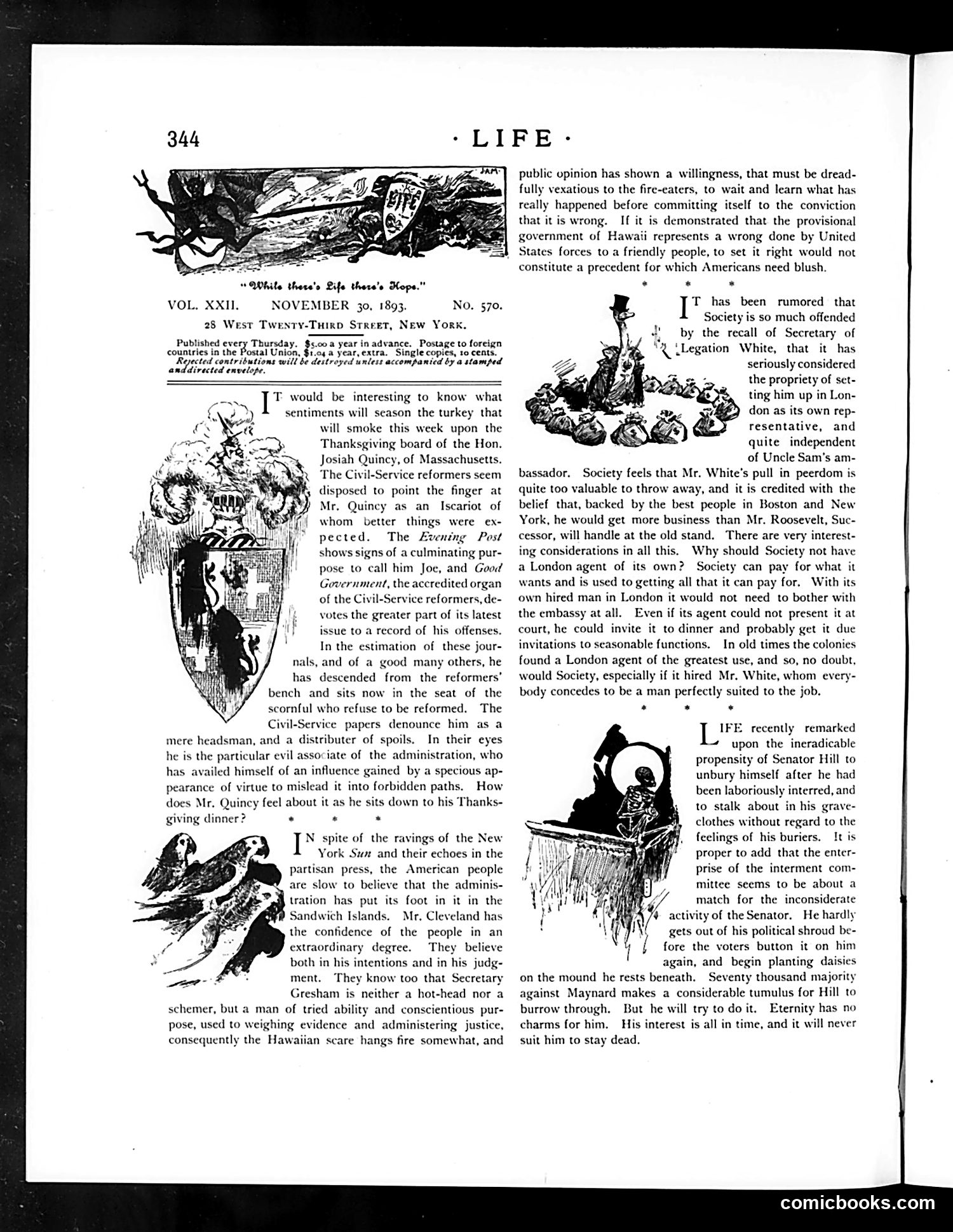
This page satirizes political figures and civil service reform debates of the 1890s. The text criticizes **Josiah Quincy of Massachusetts**, a civil-service reformer, suggesting reformers unfairly target certain officials while ignoring others' misconduct. The cartoons mock **Senator Hill**, depicted burying himself after political losses, and reference **Secretary Gresham** regarding the Hawaiian situation—likely the controversial 1893 overthrow of Hawaii's monarchy. The piece suggests Gresham is conscientious but questions whether the administration truly supports Hawaiian independence or merely appears to do so. The satire targets both specific politicians and broader hypocrisy in reform movements, using grave/burial imagery to emphasize political defeat and moral compromises.
📄 Transcribed text from this page (OCR, searchable)
Machine-transcribed from the original scan — historical spelling and the odd misread are preserved.
<< “While there's Life there's Hops.” XXii. NOVEMBER 30, 1893. 28 West Twenty-THixp Street, New York. countris inthe Boual Unioh, Sag a Jearveneee, Single copie socea fi Reyected contributions will be destroyed unless accompanied by @ stamped anddirected envelope. VOL. No. 570. s.00 a edd I" would be interesting to know what 2 ») sentiments will season the turkey that ra will smoke this week upon the ee Thanksgiving board of the Hon. 8 ~, Josiah Quincy, of Massachusetts. ‘ The Civil-Service reformers seem disposed to point the finger at Mr. Quincy as an Iscariot of whom better things were ex- pected. The Evening Post shows signs of a culminating pur- pose to call him Joe, and Good Government, the accredited organ of the Ci ervice reformers, de- votes the greater part of its latest issue to a record of his offenses. In the estimation of these jour- nals, and of a good many others, he has descended from the reformers’ bench and sits now in the seat of the scornful who refuse to be reformed. The Civil-Service papers denounce him as a mere headsman, and a distributer of spoils, In their eyes he is the particular evil associate of the administration, who has availed himself of an influence gained by a specious ap- pearance of virtue to mislead it into forbidden paths. How does Mr, Quincy feel about it as he sits down to his Thanks- giving dinner? . . * I spite of the ravings of the New York Su and their echoes in the partisan press, the American people are slow to believe that the adminis- tration has put its foot in it in the Sandwich Islands. Mr. Cleveland has the confidence of the people in an extraordinary degree. They believe both in his intentions and in his judg- ment. They know too that Secretary Gresham is neither a hot-head nor a schemer, but a man of tried ability and conscientious pur- pose, used to weighing evidence and administering justice, consequently the Hawaiian scare hangs fire somewhat, and public opinion has shown a willingness, that must be dread- fully vexatious to the fire-eaters, to wait and learn what has really happened before committing itself to the conviction that it is wrong. If it is demonstrated that the provisional government of Hawaii represents a wrong done by United States forces to a friendly people, to set it right would not constitute a precedent for which Americans need blush. * * * T has been rumored that Society is so much offended , by the recall of Secretary of 7 & (Legation White, that it has seriously considered the propriety of ting him up in Lon- don as its own rep- resentative, and quite independent of Uncle Sam's am- bassador. Society feels that Mr. White's pull in peerdom is quite too valuable to throw away, and it is credited with the belief that, backed by the best people in Boston and New York, he would get more business than Mr. Roosevelt, Suc- cessor, will handle at the old stand. There are very interest- ing considerations in all this. Why should Society not have a London agent of its own? Society can pay for what it wants and is used to getting all that it can pay for, With its own hired man in London it would not need to bother with the embassy at all. Even if its agent could not present it at court, he could invite it to dinner and probably get it due invitations to seasonable functions. In old times the colonies found a London agent of the greatest use, and so, no doubt, would Society, especially if it hired Mr. White, whom every body concedes to be a man perfectly suited to the job. * p . * I IFE recently remarked — upon the ineradicable propensity of Senator Hill to unbury himself after he had been laboriously interred, and to stalk about in his gra clothes without regard to the feelings of his buriers. It is proper to add that the enter- prise of the interment com- mittee seems to be about a match for the inconsiderate @ activity of the Senator. He hardly gets out of his political shroud be- fore the voters button it on him again, and begin planting d: on the mound he rests beneath. Seventy thousand majority against Maynard makes a considerable tumulus for Hill to burrow through. But he will try to do it. Eternity has no charms for him. His interest is all in time, and it will never suit him to stay dead. comicbooks.com