
Life, 1893-11-30 · page 10 of 18
Life — November 30, 1893 — page 10: what you’re looking at
What you’re looking at
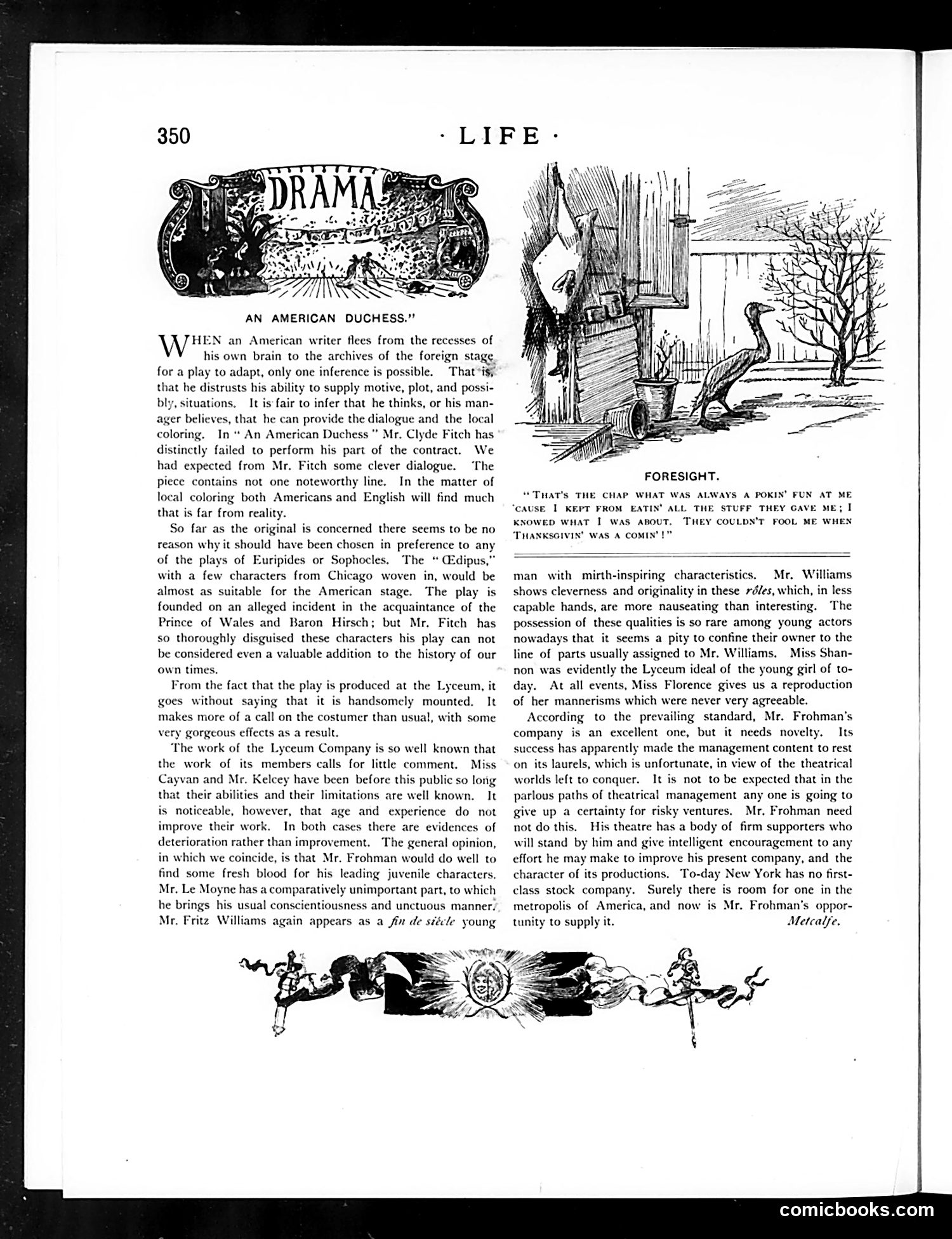
This page reviews a theatrical production called "An American Duchess," adapted by Clyde Fitch from a foreign play. The critic argues the play lacks notable dialogue and local color, despite being set in America. The accompanying illustration labeled "Foresight" shows a man at a doorway with a quote about Thanksgiving—apparently satirizing the play's weak American characterization. The review praises actor Fritz Williams's performance while critiquing the overall production quality at the Lyceum Theatre. It suggests the play needs fresh talent and novelty, encouraging theater manager Frohman to develop stronger American productions rather than rely on European adaptations. The satire targets adaptations that fail to capture authentic American voices and situations.
📄 Transcribed text from this page (OCR, searchable)
Machine-transcribed from the original scan — historical spelling and the odd misread are preserved.
his own brain to the archives for a play to adapt, only one inference is possible. that he distrusts his ability to supply motive, plot, bly, situations, It is fair to infer that he thinks, or his man- ager believes, that he can provide the dialogue and the loca coloring. In “* An American Duchess " Mr. Clyde Fitch has distinctly failed to perform his part of the contract. We had expected from Mr. Fitch some clever dialogue. The piece contains not one noteworthy line. In the matter of local coloring both Americans and English will find much that is far from reality. So far as the original is concerned there seems to be no reason why it should have been chosen in preference to any of the plays of Euripides or Sophocles, The “ CEdipus, with a few characters from Chicago woven in, would be almost as suitable for the American stage. The play is founded on an alleged incident in the acquaintance of the Prince of Wales and Baron Hirsch; but Mr. Fitch has so thoroughly disguised these characters his play can not be considered even a valuable addition to the history of our own times. From the fact that the play is produced at the Lyceum, it goes without saying that it is handsomely mounted. It makes more of a call on the costumer than usual, with some very gorgeous effects as a result. The work of the Lyceum Company is so well known that the work of its members calls for little comment. Miss Cayvan and Mr. Kelcey have been before this public so long that their abilities and their limitations are well known. It is noticeable, however, that age and experience do not improve their work. In both cases there are evidences of deterioration rather than improvement. The general opinion, in which we coincide, is that Mr. Frohman would do well to find some fresh blood for his leading juvenile character: Mr. Le Moyne has a comparatively unimportant part, to which he brings his usual conscientiousness and unctuous manner. Mr. Fritz Williams again appears as a fin de stéele young “cause I KEPT FROM EAT KNOWED WHAT I Was abot ‘THANKSGIVIN’ WAS A COMIN’ !” STUFF THEY Gav COULDN'T FOOL ME WHEN man with mirth-inspiring characteristics. Mr. Williams shows cleverness and originality in these ré/es, which, in less capable hands, are more nauseating than interesting. ‘The possession of these qualities is so rare among young actors nowadays that it seems a pity to confine their owner to the line of parts usually assigned to Mr. Williams. Miss Shan- non was evidently the Lyceum ideal of the young girl of to- day. At all events, Miss Florence gives us a reproduction of her mannerisms which were never very agreeable. | According to the prevailing standard, Mr. Frohman’s company is an excellent one, but it needs novelty, Its success has apparently made the management content to rest on its laurels, which is unfortunate, in view of the theatrical worlds left to conquer. It is not to be expected that in the parlous paths of theatrical management any one is going to give up a certainty for risky ventures. Mr, Frohman need not do this. His theatre has a body of firm supporters who will stand by him and give intelligent encouragement to any effort he may make to improve his present company, and the character of its productions. To-day New York has no first- class stock company. Surely there is room for one in the metropolis of America, and now is Mr. Frohman’s oppor- tunity to supply it. Metcalfe. comicbooks.com