
A complete issue · 18 pages · 1893
Life — November 9, 1893
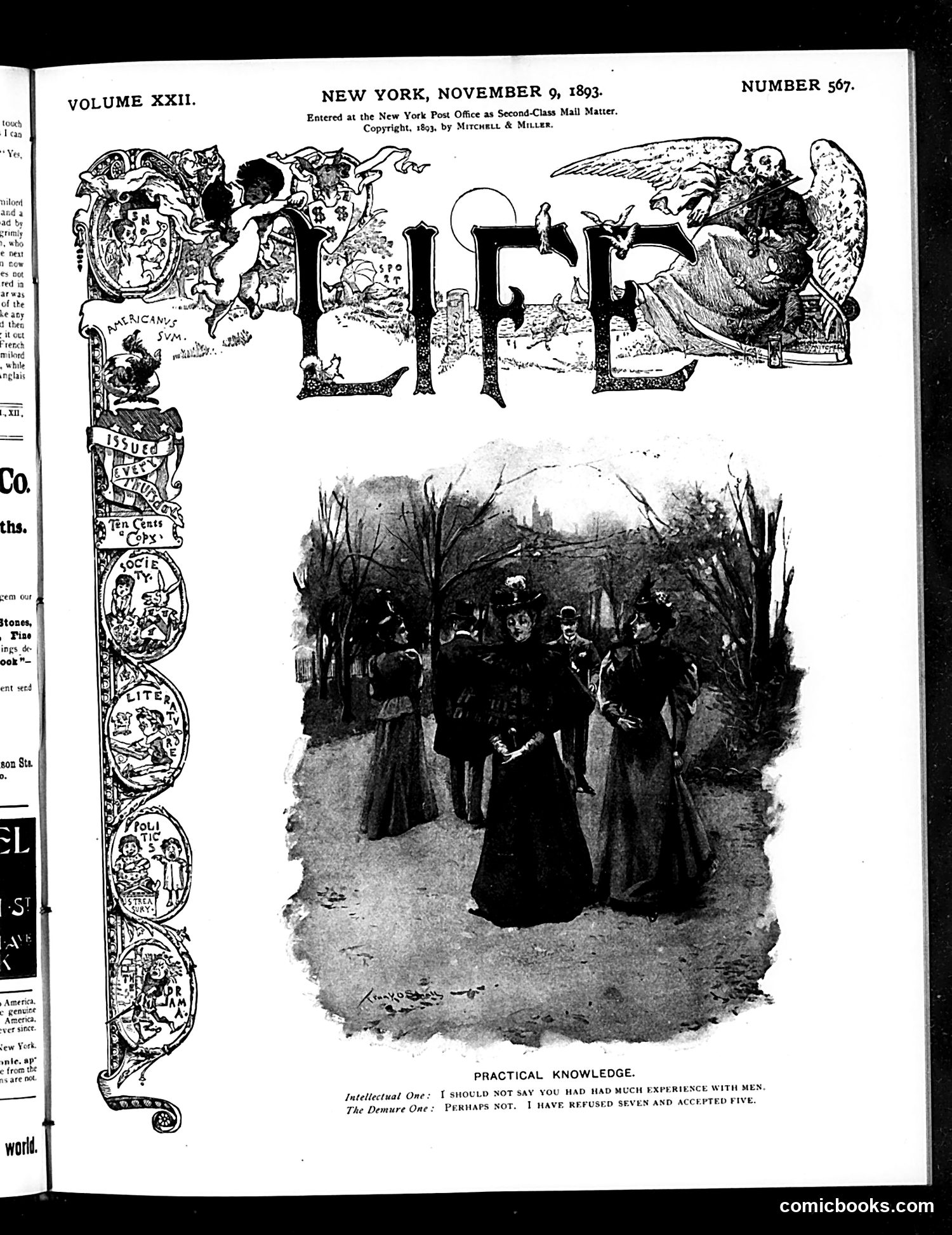
**Main Cartoon: "Practical Knowledge"** The lower illustration depicts a street scene with figures in Victorian dress. The caption presents a dialogue between an "Intellectual One" and "The Demure One": - Intellectual: "I should not say you had had much experience with men." - Demure: "Perhaps not. I have refused seven and accepted five." **Meaning:** This is a satire on the contradiction between intellectual pretension and practical romantic experience. The "intellectual" woman claims naiveté while admitting to rejecting seven suitors and accepting five—demonstrating considerable experience navigating male attention and marriage proposals. The joke mocks the era's expectation that respectable women feign inexperience while actually possessing shrewd understanding of courtship dynamics. It's commentary on gender, courtship conventions, and the gap between social performance and reality in 1890s society.
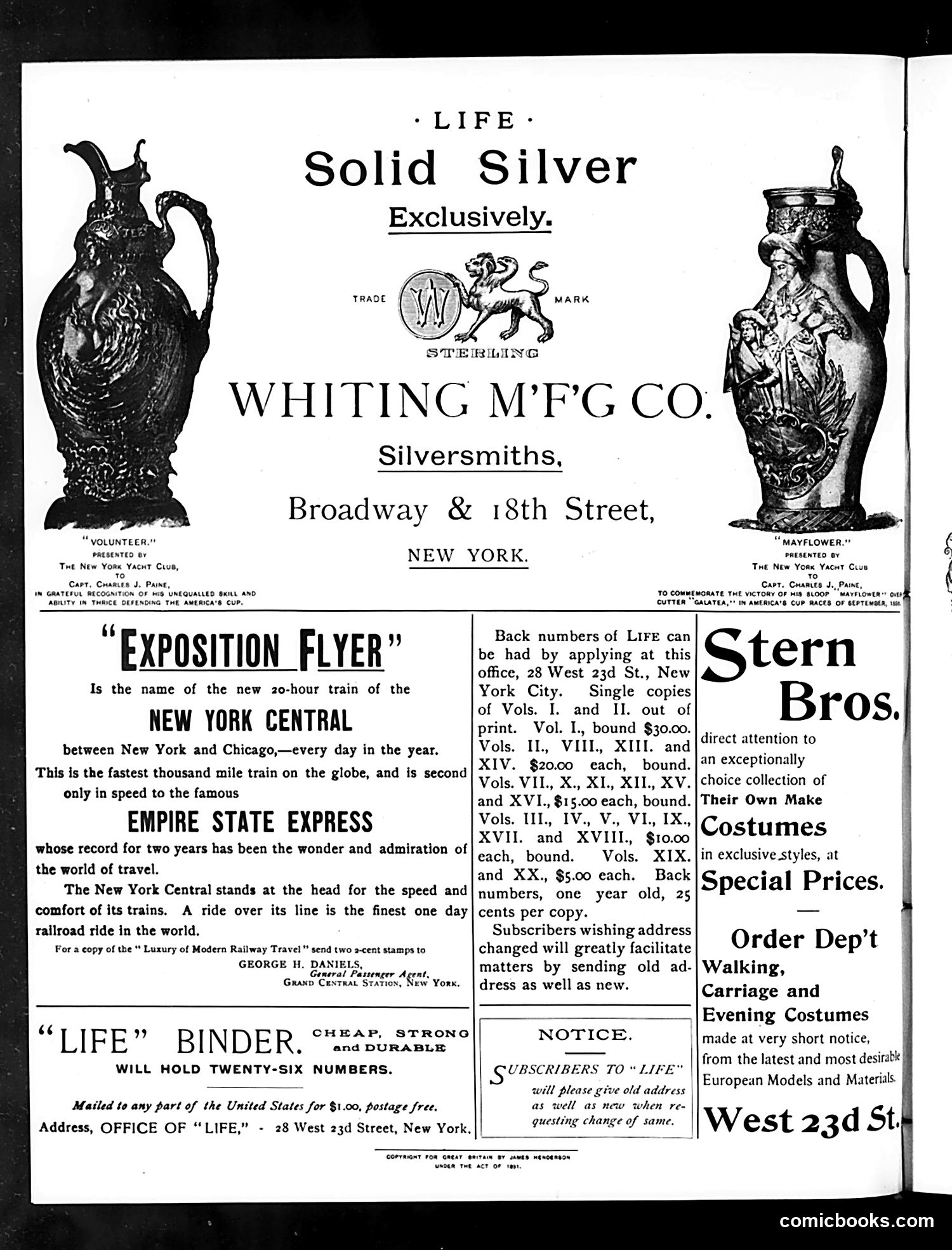
This page is primarily **advertising and announcements** for Life magazine and related businesses, with no political cartoons or satirical content visible. The main elements are: 1. **Whiting Mfg Co.** advertisement showcasing ornate sterling silver pitchers ("Volunteer" and "Mayflower"), presented as gifts from the New York Yacht Club 2. **New York Central Railroad** ad promoting the "Exposition Flyer," a fast passenger train between New York and Chicago 3. **Stern Bros.** advertisement for women's costumes at special prices 4. **Life magazine announcements** including subscription information and a binder offer The page reflects early 20th-century commercial life—luxury goods, transportation innovation, and fashion—rather than satirical commentary. Life magazine clearly functioned as both humor publication and advertising vehicle for affluent readers.
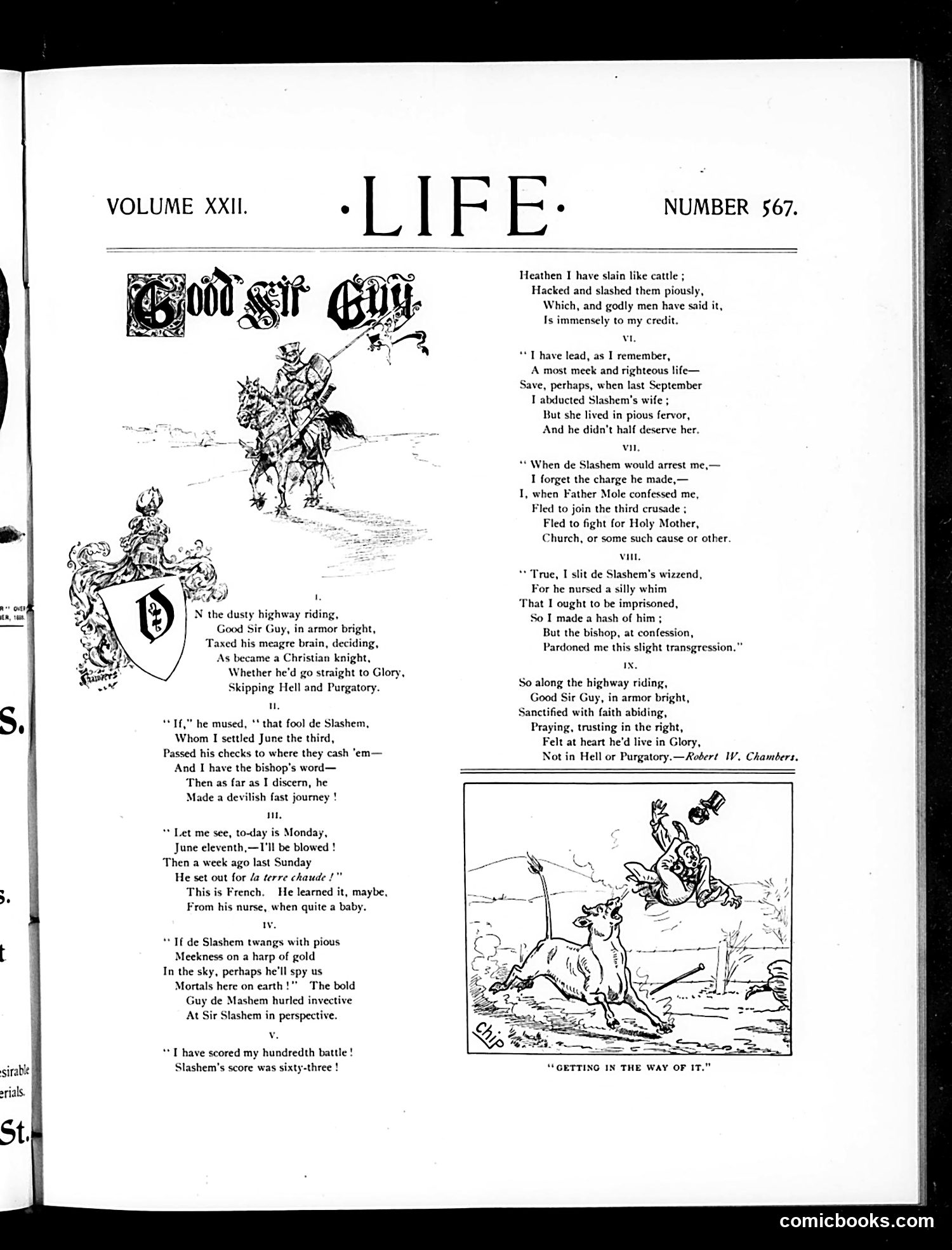
This page presents a mock-heroic poem titled "Good Sir Guy," likely satirizing a contemporary political or military figure through medieval romance parody. The verses mock someone named "de Slashem" (possibly a caricature of a real person) and reference crusades, battles, and religious hypocrisy. The illustration captioned "Getting in the Way of It" shows a mounted knight colliding with a cow, visually reinforcing the poem's theme of blundering incompetence dressed in noble language. The satire appears to criticize bellicose posturing—someone claiming martial heroism while actually causing collateral damage and harm. The religious references suggest mockery of using faith as justification for violence or poor governance. Without identifying the specific historical moment, the piece exemplifies Life's use of literary parody to deflate inflated reputations.
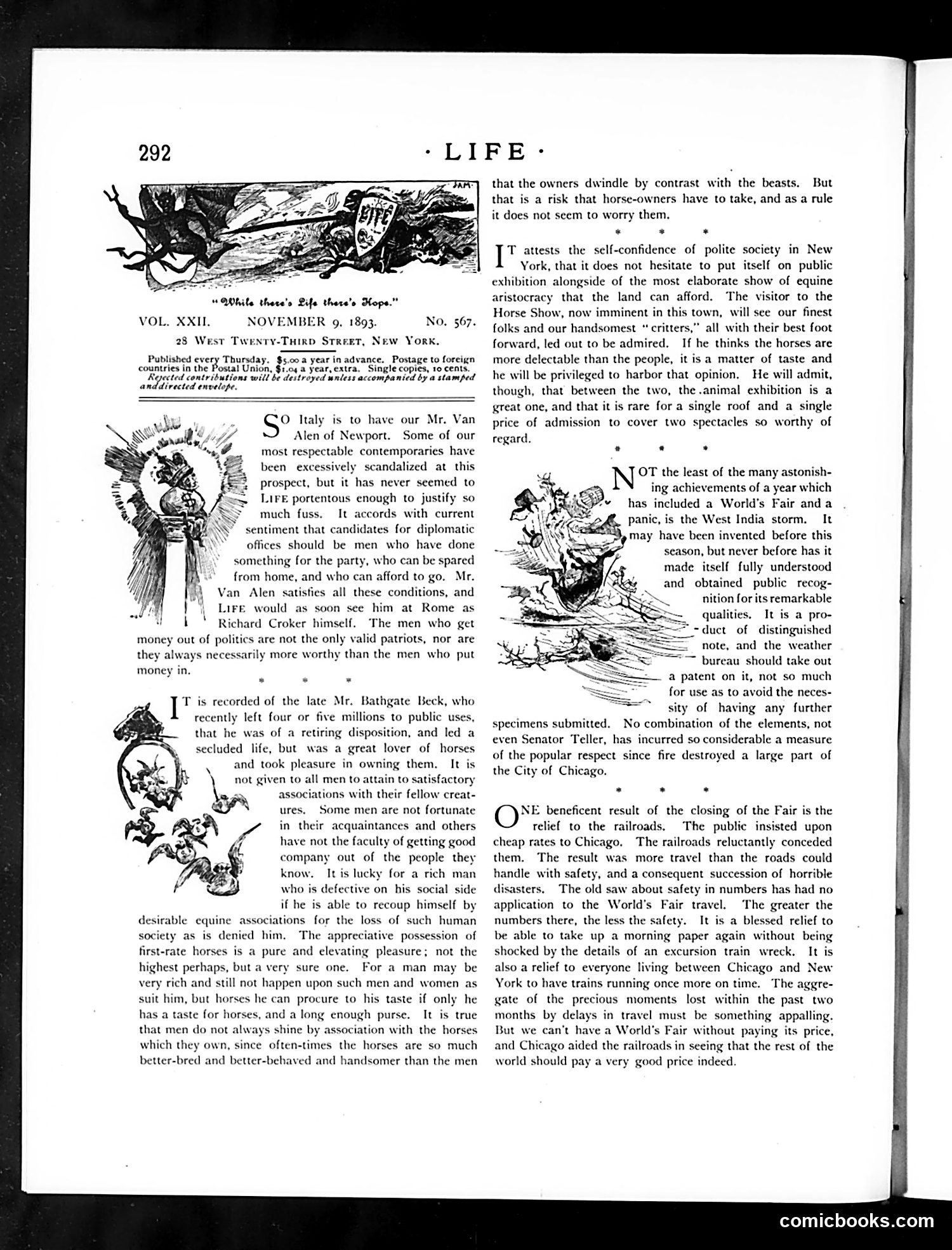
This page contains three editorial cartoons and accompanying commentary about prominent topics of 1893. The top cartoon illustrates a discussion of Mr. Van Alen of Newport, a wealthy society figure being considered for a diplomatic position. The satire mocks how riches don't guarantee worthiness for such posts—a commentary on wealthy individuals buying their way into prestige. The middle and lower cartoons relate to the recent World's Columbian Exposition (Chicago's World's Fair) and the tragic West India storm that devastated it. The text praises the storm's "beneficent result" of forcing railroads to improve safety standards and reduce fares to Chicago afterward. Overall, the page satirizes wealthy privilege while celebrating how disaster ironically improved railroad safety for ordinary travelers.
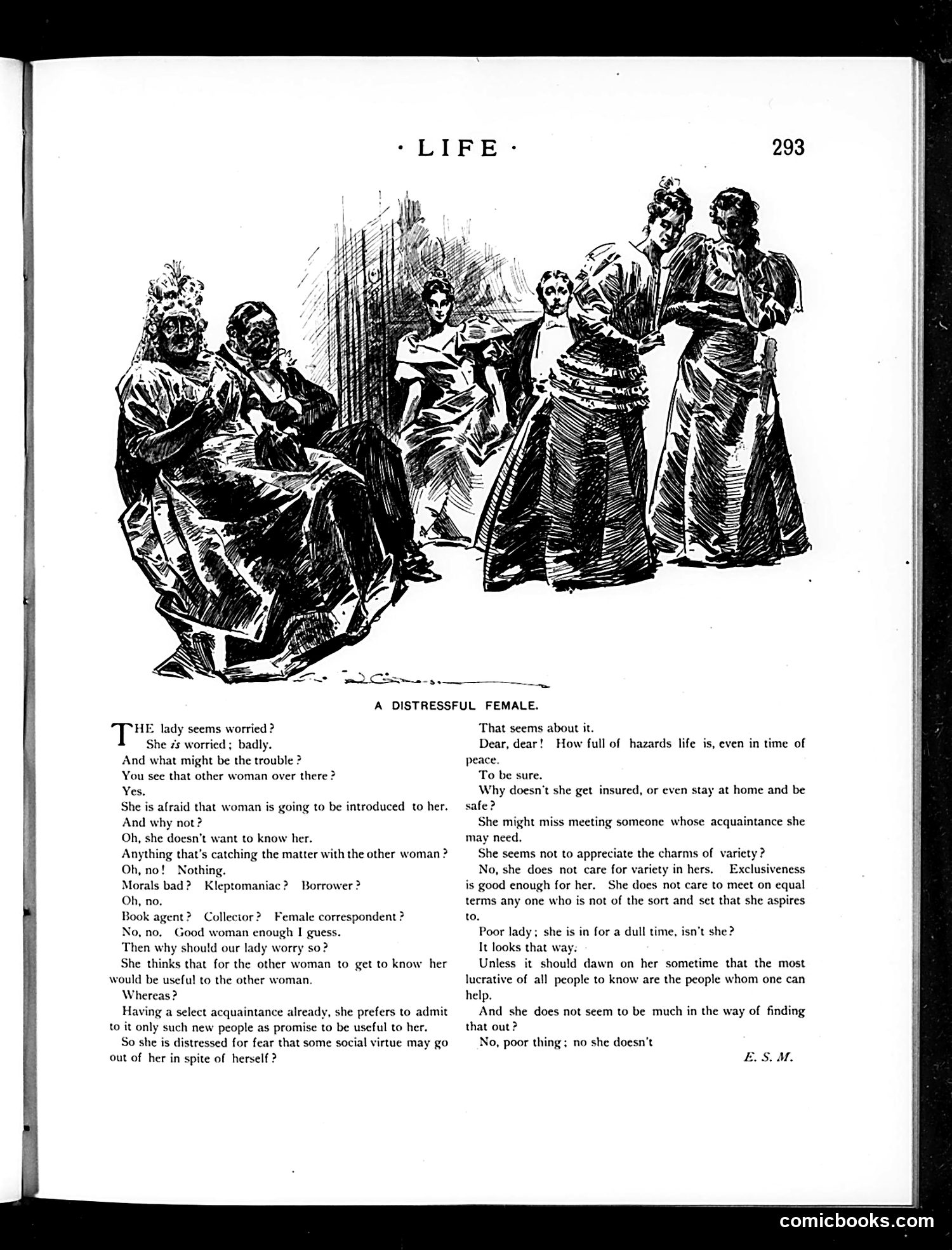
This satirical piece critiques a woman's social anxiety about meeting another woman at a gathering. The dialogue reveals period attitudes: the anxious woman fears the introduction because she worries about social competition and maintaining her exclusive circle of acquaintances. The satire targets upper-class snobbery—particularly the idea that knowing "useful" people serves social advantage, while meeting new people randomly threatens one's carefully curated social position. The correspondent (E.S.M.) mocks this exclusivity, suggesting the woman is actually missing opportunities for genuine human connection and mutual aid. The accompanying sketch shows Victorian-era women in formal dress, emphasizing the rigid social hierarchies the text satirizes. The piece lambastes aristocratic insularity and the fear of social mobility that characterized certain privileged circles.
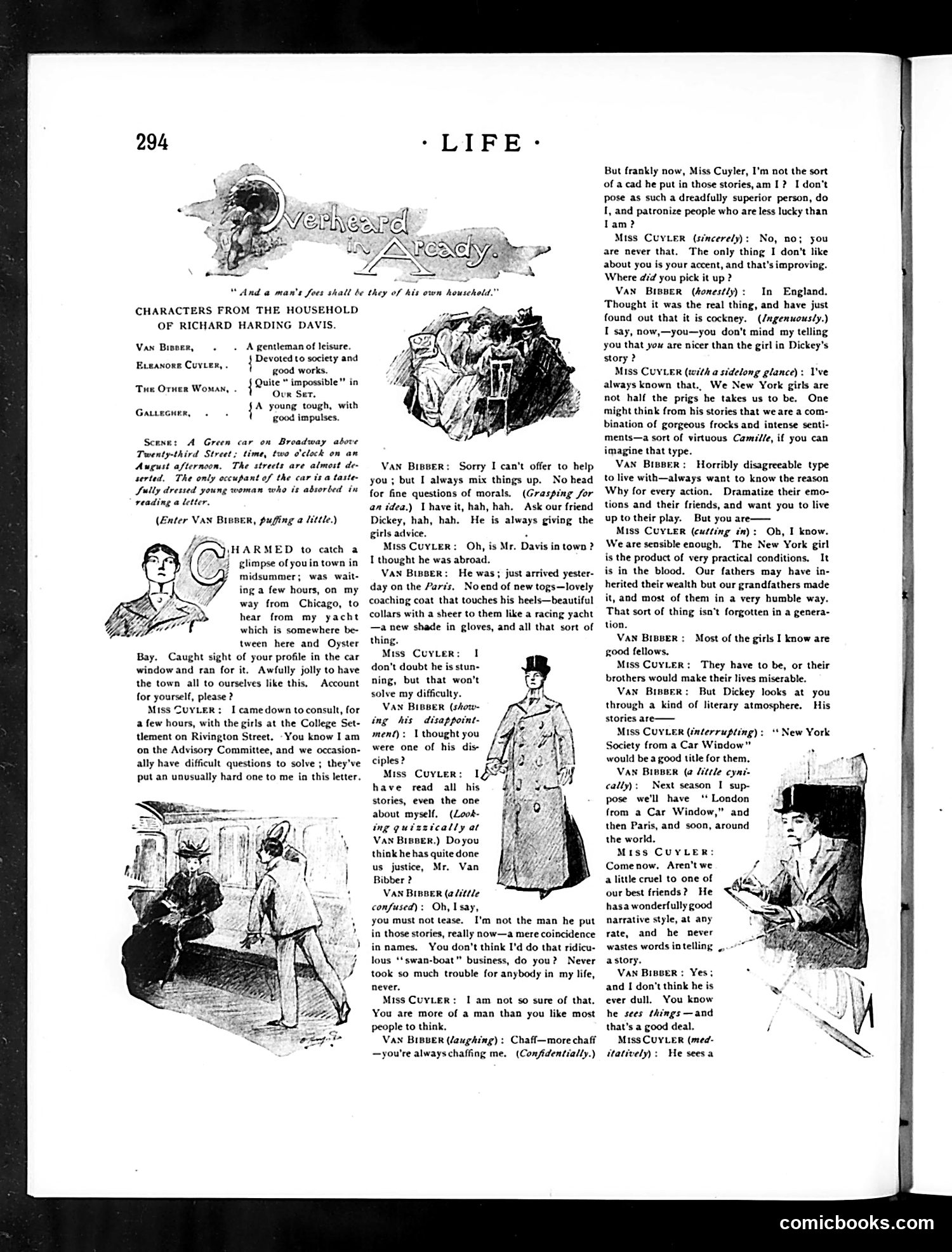
This page presents a dramatic dialogue between **Van Bibber** (a gentleman of leisure) and **Miss Cuyler** (a society woman), along with supporting characters. The sketch satirizes **New York high society's pretensions and gossip culture**. The humor centers on Van Bibber's chronic inability to keep secrets or maintain propriety—he constantly "mixes things up" and embarrasses himself socially. Miss Cuyler criticizes his behavior while simultaneously defending New York society's superiority to other cities. The accompanying illustrations show fashionably dressed characters in social settings, reinforcing the focus on **upper-class manners and social hierarchies**. The satire targets both Van Bibber's buffoonish unreliability and society women's defensive pride about their social status.
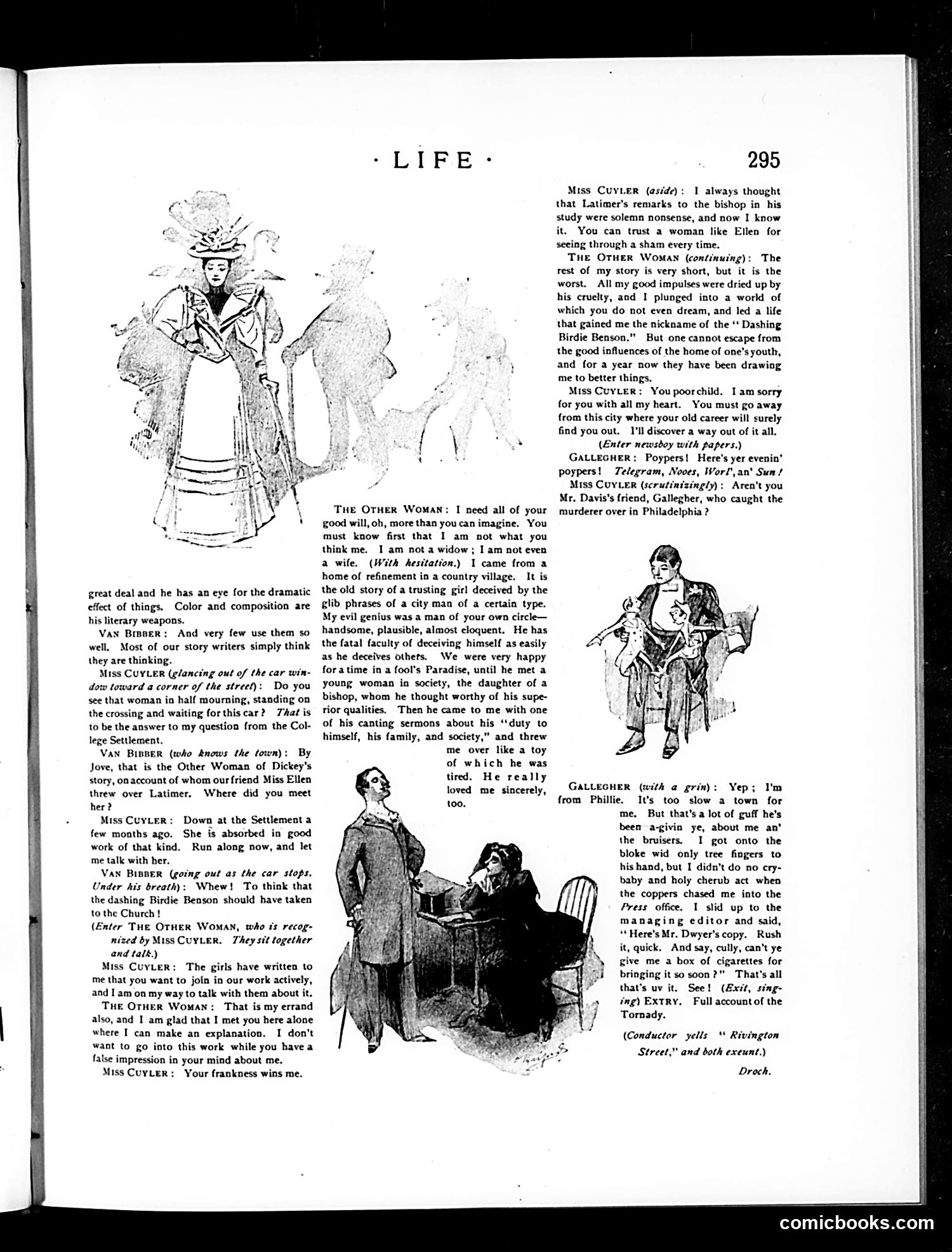
This page presents a theatrical dialogue featuring "The Other Woman" character—a stock figure in early 20th-century drama representing the seductress who corrupts innocent men. The satire mocks melodramatic stage conventions by having characters discuss clichéd plot devices: the "trusting girl deceived by a city man," the femme fatale's "fatal faculty of deceiving himself," and moral ruin. References to "Birdie Benson" and Philadelphia suggest specific theatrical productions or scandals. The illustrations show period-appropriate costume and staging. The humor targets overwrought theatrical storytelling and stock characters rather than specific political figures. This represents Life's regular satirizing of popular entertainment and its predictable moral narratives—poking fun at both the theater industry and audiences' appetite for formulaic melodrama about female villainy and masculine weakness.
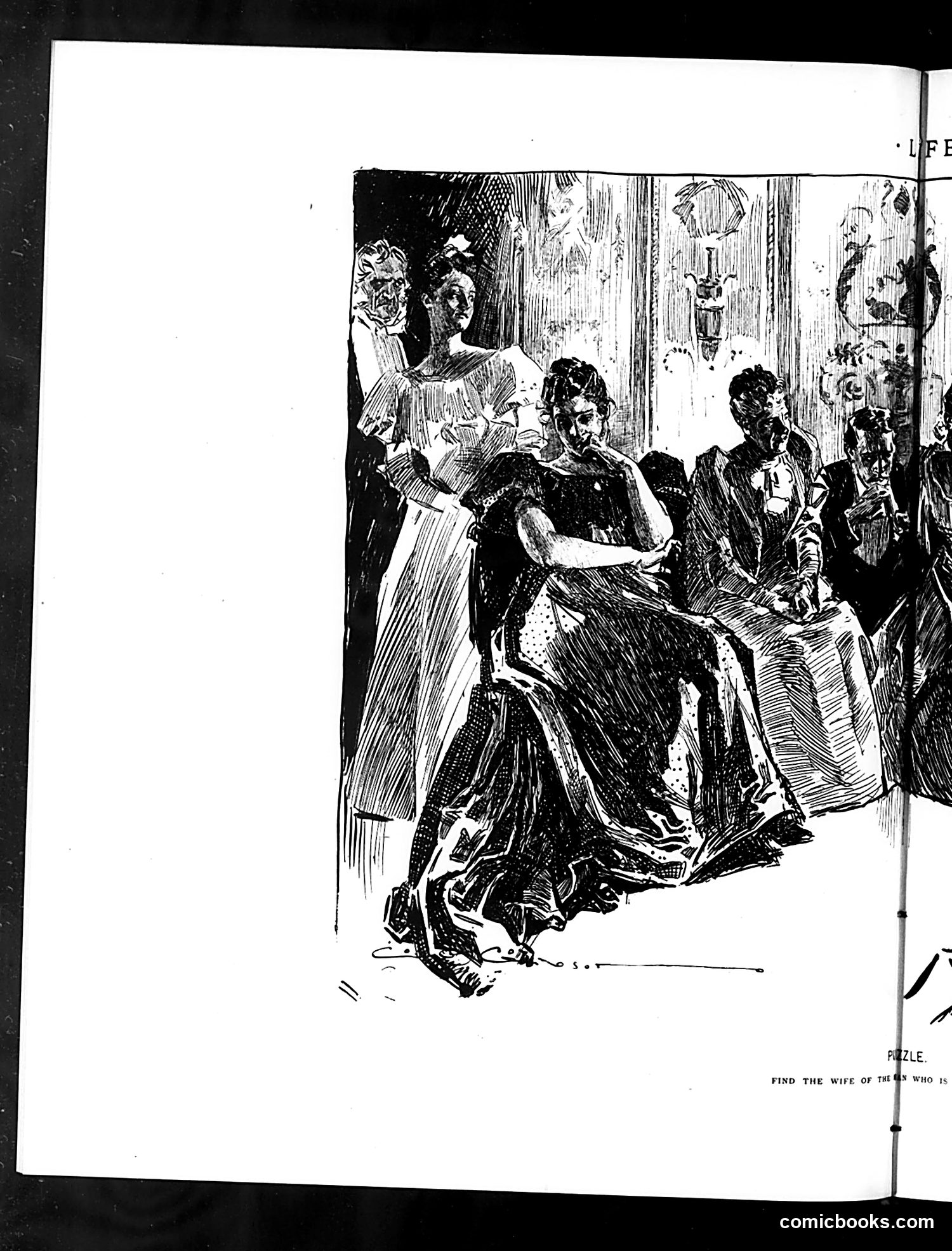
This page contains a puzzle feature titled "FIND THE WIFE OF THE MAN WHO IS..." (text cuts off). The illustration is a black and white sketch depicting an indoor social scene with multiple figures in formal dress from approximately the early 20th century. The image shows what appears to be a parlor or reception room with several well-dressed people, including men in suits and women in elaborate gowns. One woman is seated prominently in the center while others stand around her. The puzzle asks readers to identify relationships among the figures based on visual clues in the drawing. Without the complete caption text visible, the specific political or social satire cannot be fully determined, though the formal setting and "puzzle" format suggest commentary on high society or social connections of the era.
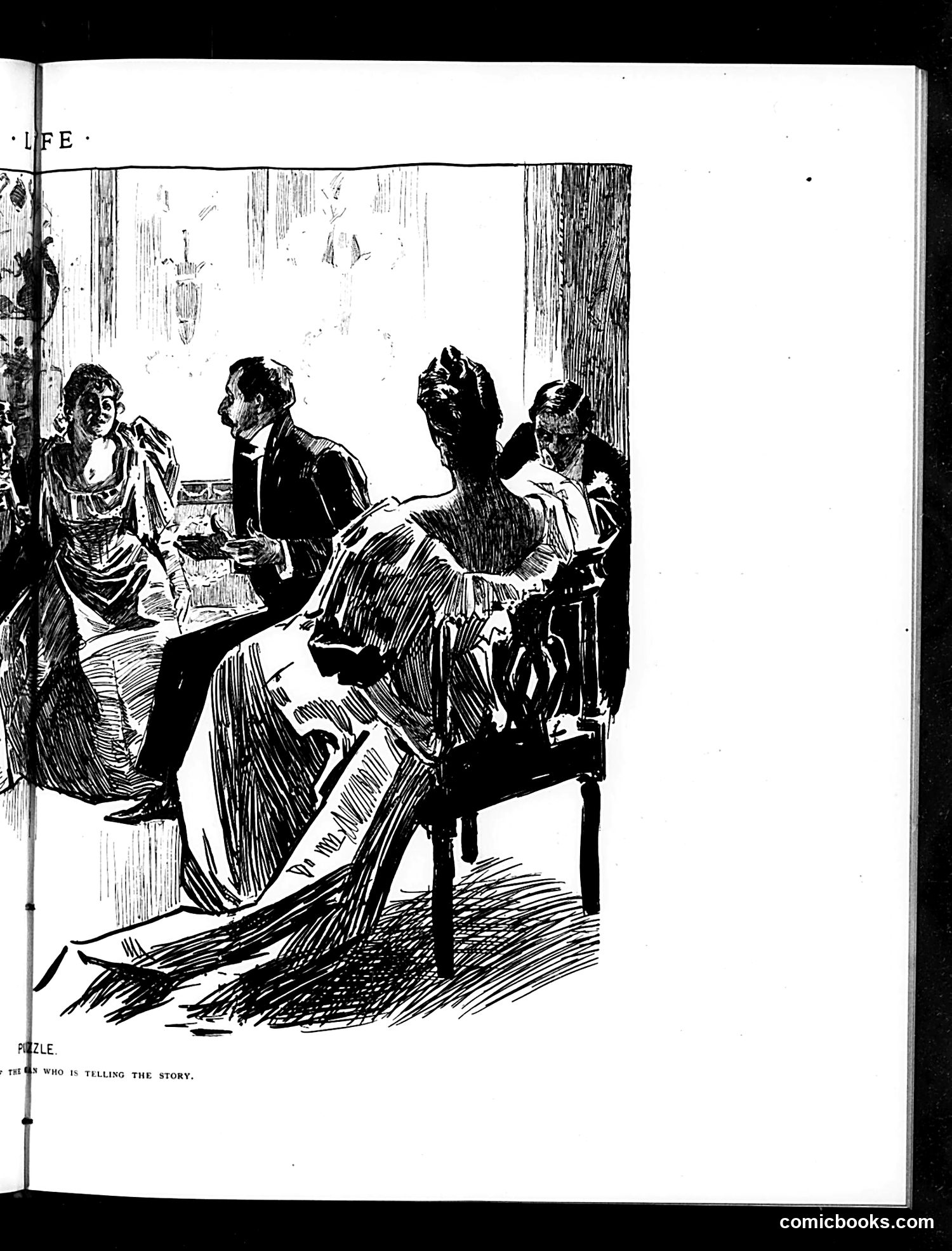
This is a social satire cartoon depicting a drawing room scene. A woman in an elaborate dress sits prominently in the foreground, apparently recounting a tale to an assembled group of well-dressed men and women in what appears to be a Victorian or Edwardian-era parlor. The cartoon's title—"The Man Who Is Telling the Story"—creates ironic humor: the visual focus is entirely on the woman speaking, yet the caption refers to "the man," suggesting she has commandeered the role typically held by male narrators or entertainers of that era. The satire likely comments on how women dominated social conversation or storytelling in polite society, subverting traditional gender hierarchies of public discourse. The other figures listen attentively, reinforcing her central social authority in this moment.
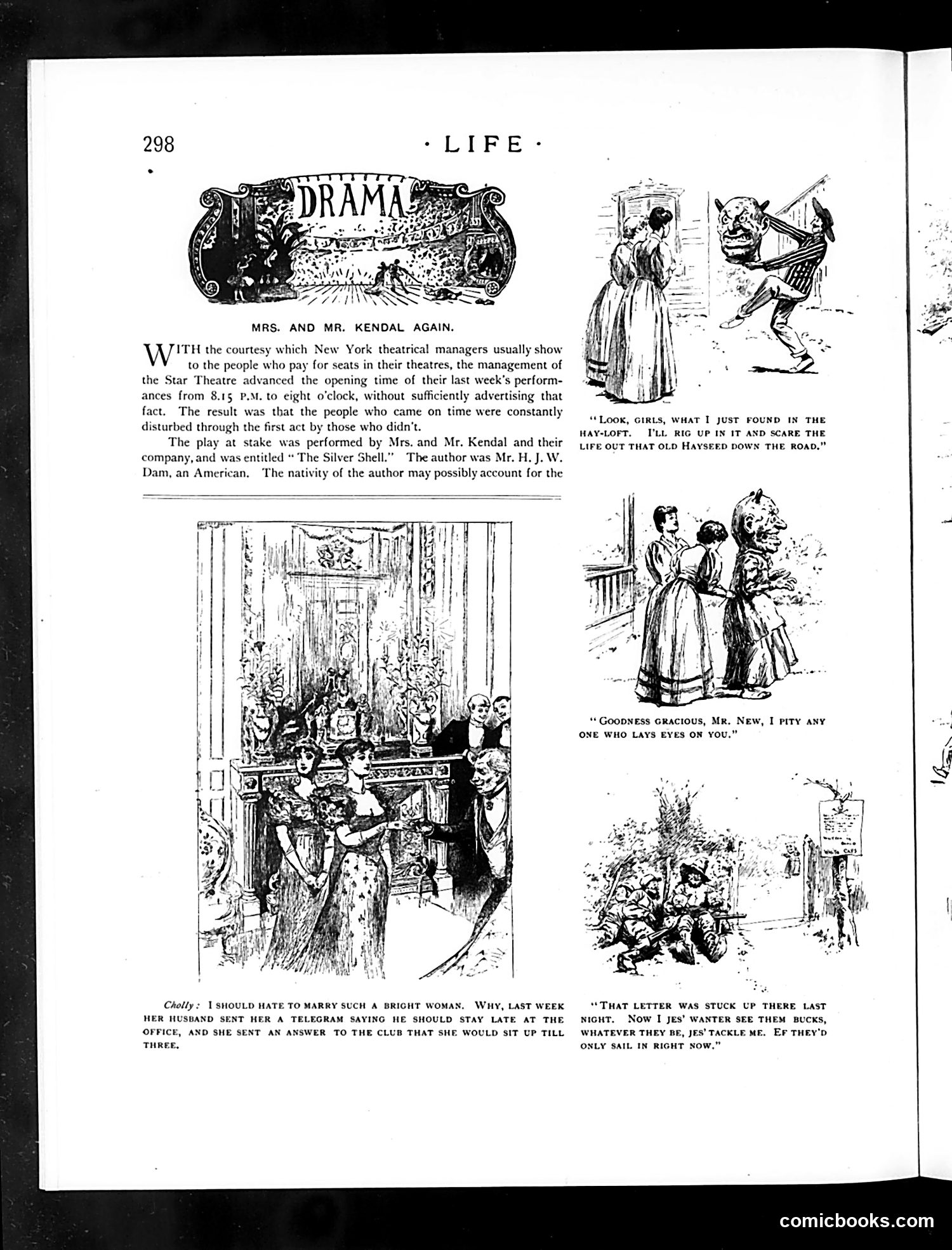
This page satirizes a theatrical scandal involving Mr. and Mrs. Kendal, performers at New York's Star Theatre. The article criticizes theater management for opening a show at 8:15 p.m. without adequate notice, causing disruption when latecomers arrived during the first act. The accompanying illustrations depict a domestic dispute: the wife (Challie) complains her husband sent a telegram saying he'd work late, then learns he actually attended his club. She sarcastically suggests she would "stay up till three" waiting for him, expressing marital frustration about infidelity or neglect. The satire mocks both theatrical mismanagement and upper-class marital tensions typical of early 20th-century Life magazine humor.
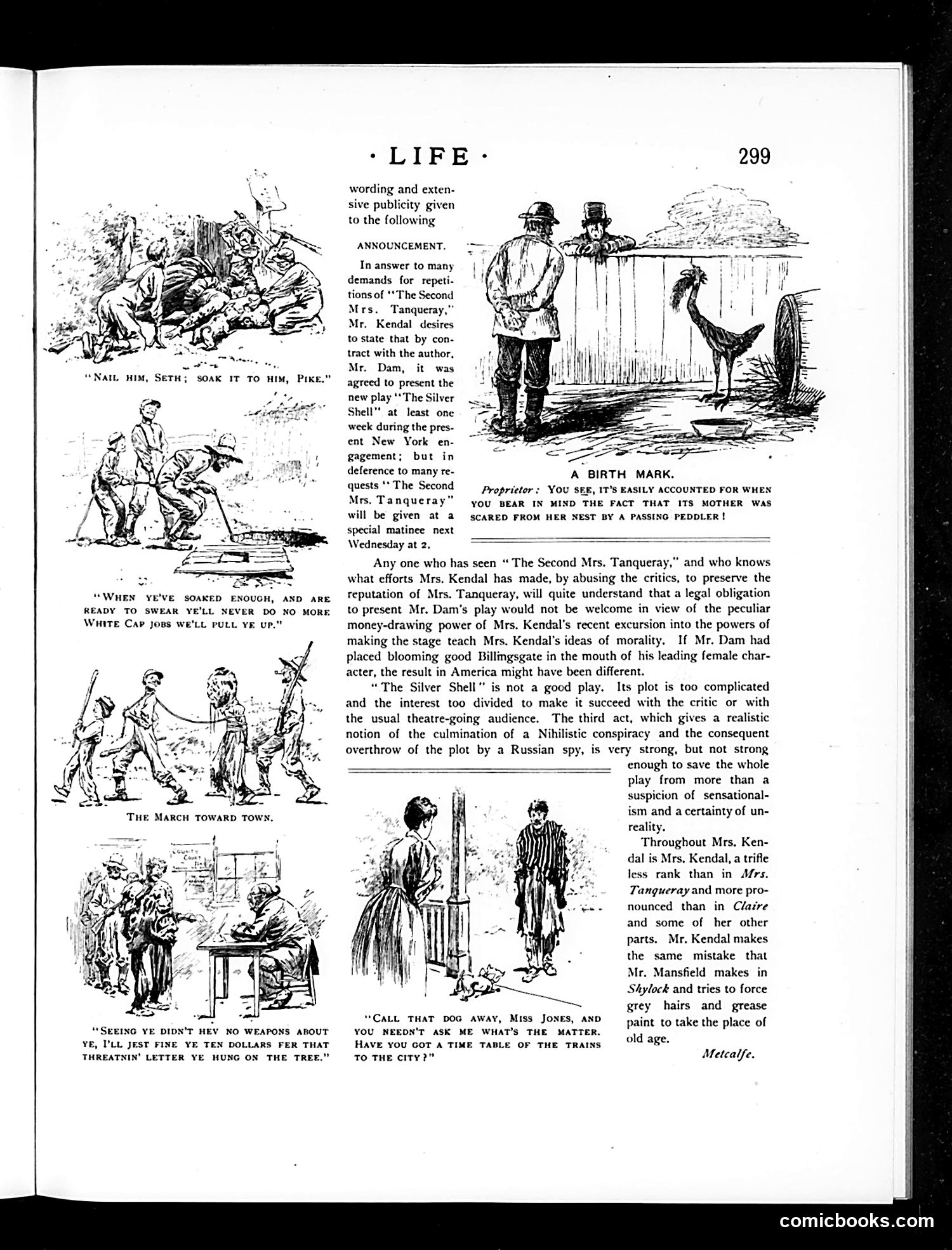
This page announces a special matinee performance of "The Silver Shell," a new play by Mr. Dam, presented due to repeated demands following Mrs. Kendal's recent success in "The Second Mrs. Tanqueray." The accompanying sketches illustrate scenes from a theatrical production—likely depicting working-class or rural characters in various comedic situations (soaking, swearing, marching toward town, discussing weapons and trains). The satirical point appears to target theatrical realism and the plot complications of "The Silver Shell," which the reviewer critiques as overly complicated, with a convoluted Nihilist conspiracy subplot involving a Russian spy. The reviewer notes Mrs. Kendal's miscasting and questions whether the play deserves its popularity given these narrative weaknesses.
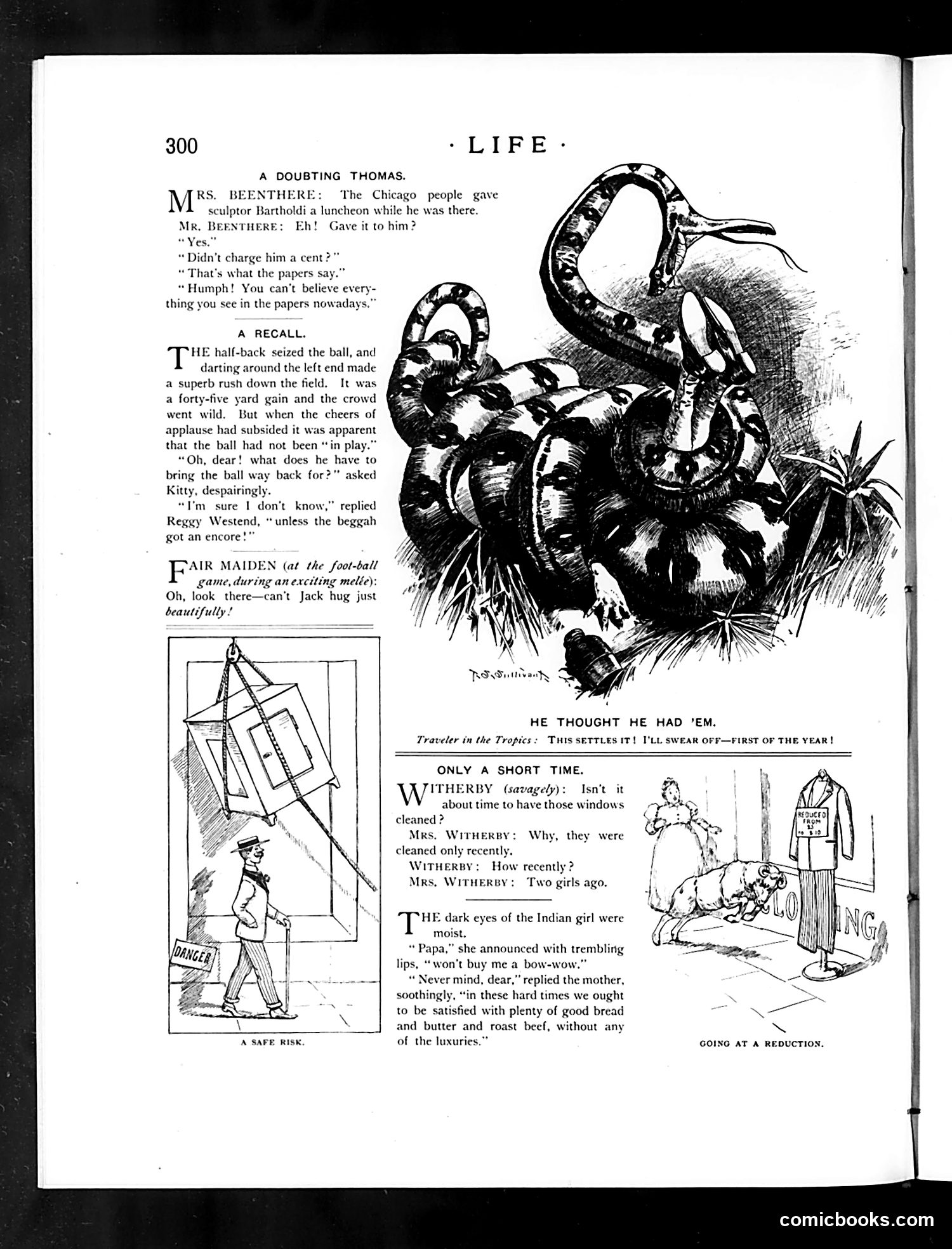
This page contains several unrelated satirical humor pieces typical of Life magazine's format: **"A Doubting Thomas"** mocks skepticism about newspaper reporting—Mr. Beenthere won't believe Bartholdi (the French sculptor of the Statue of Liberty) received a free luncheon in Chicago, dismissing it as newspaper exaggeration. **"A Recall"** jokes about football: a player makes an impressive 45-yard run, but the play doesn't count because the ball was out of bounds. A character quips he must want an "encore." **"A Safe Risk"** shows a man preparing to climb a dangerous structure with a "DANGER" sign—apparently tempting fate. **"Only a Short Time"** satirizes marital annoyance: Mrs. Witherby says windows were cleaned "two girls ago," implying servants are hired and fired rapidly. **"Going at a Reduction"** depicts economic hardship: an Indian girl wants a toy dog, but her mother insists hard times require accepting only basic food—reflecting period anxieties about poverty and luxury. The tone throughout is genteel mockery of middle-class concerns and human foibles.
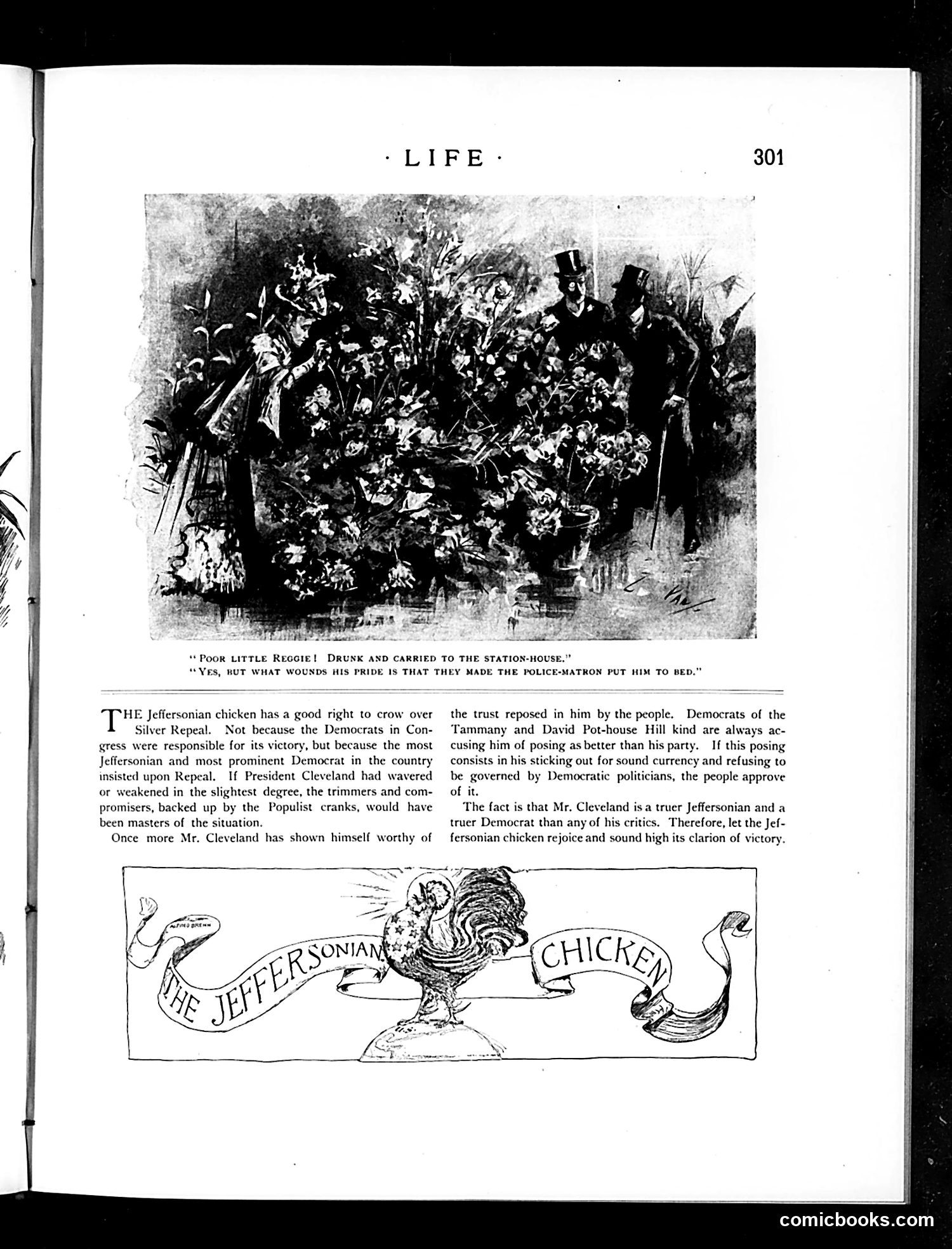
This page celebrates President Cleveland's victory in repealing the Sherman Silver Purchase Act. The "Jeffersonian chicken" is a metaphorical symbol of true Democratic principles—the article argues Cleveland embodies authentic Jeffersonian democracy by championing sound currency (gold standard) over the demands of party politicians, particularly the Tammany Hall machine and Populist faction who favored unlimited silver coinage. The top illustration depicts a chaotic political celebration with formally-dressed figures amid festive vegetation. The accompanying caption about "Poor Little Reggie" appears unrelated—a satirical joke about a drunk aristocrat, possibly mocking upper-class pretension. The article defends Cleveland against accusations that he's "posing as better than his party," arguing his independence on currency policy actually represents true Democratic virtue. The rooster illustration at bottom symbolizes triumphant crowing over policy victory.
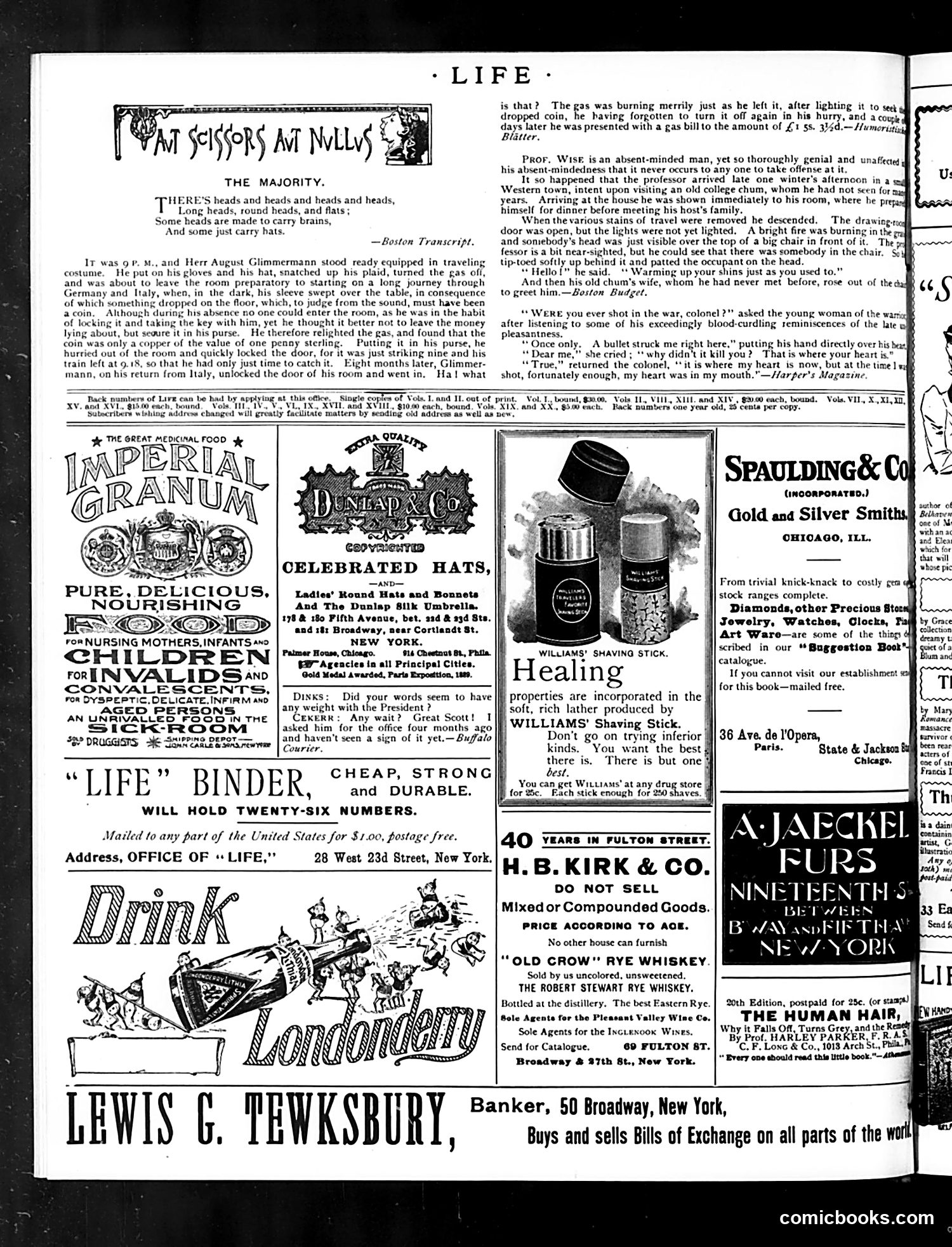
This page presents satirical short stories rather than visual cartoons. The title piece, "The Majority," opens with a verse mocking human diversity: "Some heads are made to carry brains, / And some just carry hats." The accompanying stories illustrate absent-minded professors—a common satirical target of the era. One man leaves his gas burning for eight months while traveling, receiving an enormous bill. Another absent-mindedly pats a woman on the head thinking she's his old friend. The satire targets educated elites' impracticality and social obliviousness. These "heads made to carry brains" are portrayed as comically incompetent in everyday life—forgetting practical details, making social blunders. The joke suggests that intellectual pretension doesn't translate to common sense, making such people fit objects of ridicule despite (or because of) their supposed superiority. The page is primarily advertisement-heavy, featuring period product promotions.
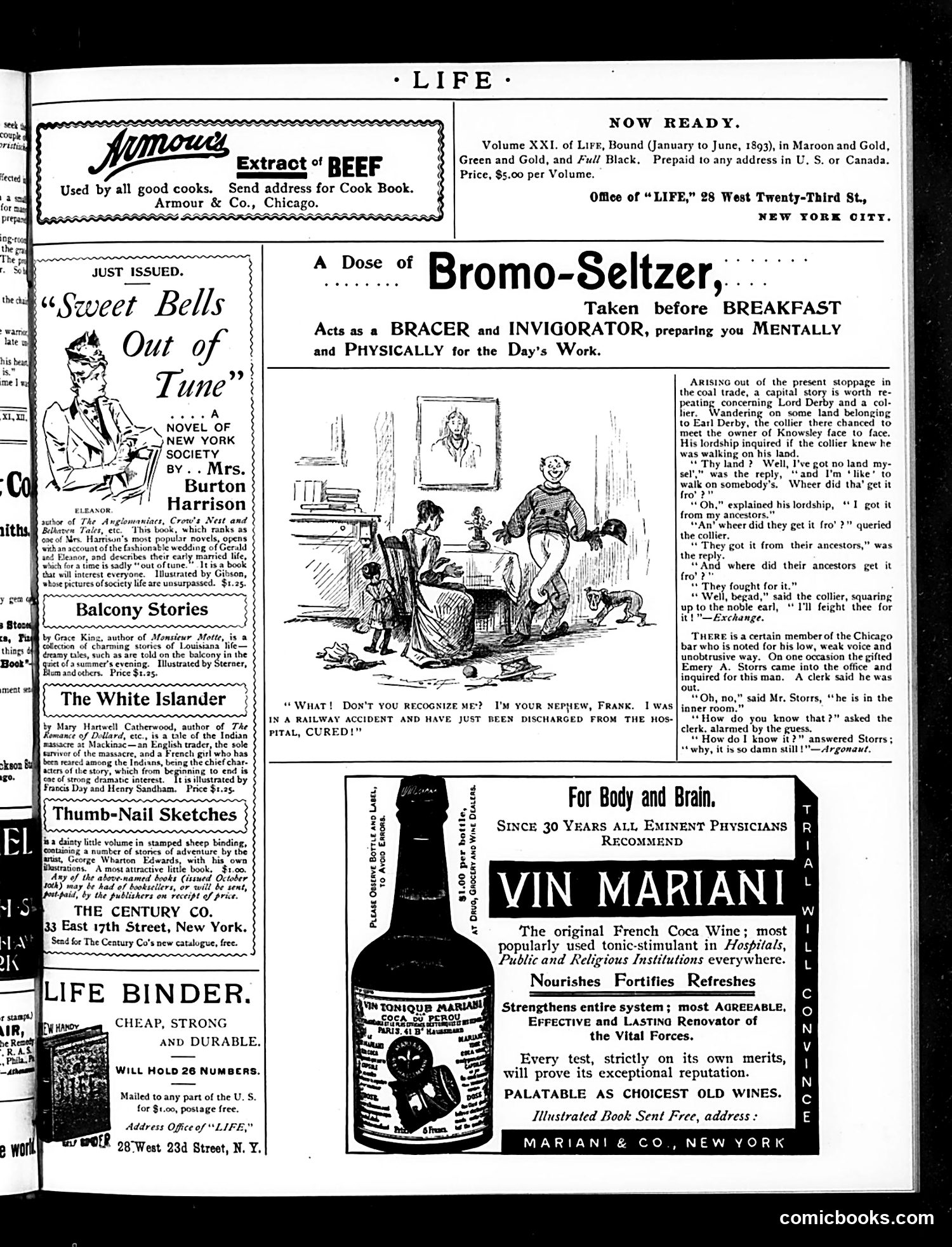
This page is primarily **advertising and book announcements** rather than political satire. The main cartoon depicts a humorous domestic scene with a caption about a man claiming to be someone's nephew recovered from a railway accident—a setup for mistaken identity or confidence scheme humor typical of the era. The only satirical content is a brief anecdote about **class conflict during a coal strike**. A collier (coal miner) encounters Lord Derby on his estate and challenges his right to the land. When the lord claims inheritance from ancestors, the miner demands "I'll fight thee for it!"—inverting the aristocratic logic of inherited property rights. This reflects contemporary labor disputes and class tension in 1890s Britain. The page otherwise features book advertisements (society novels), Bromo-Seltzer patent medicine ads, and a Life magazine binder advertisement—typical commercial content of the period.
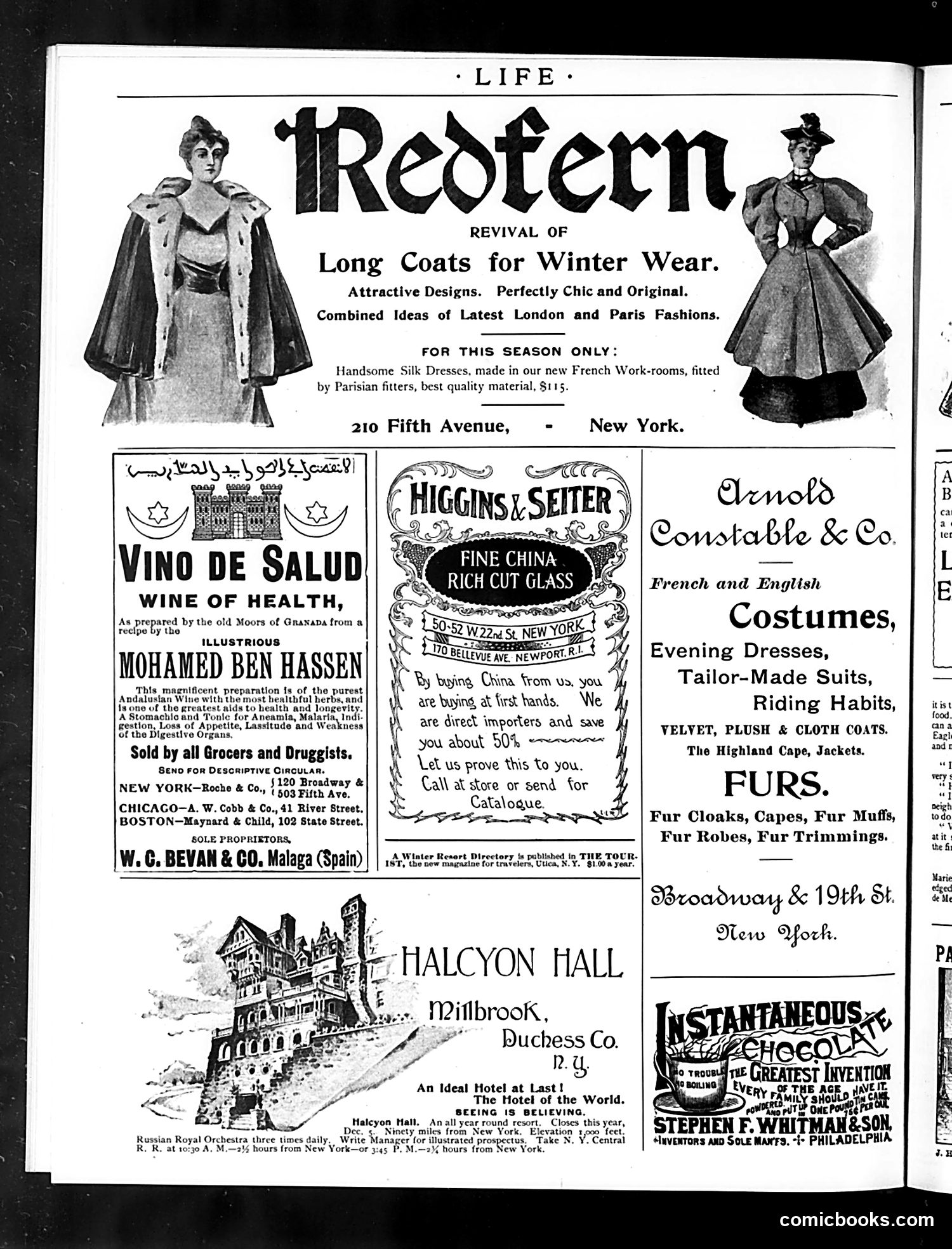
This page is **primarily advertising**, not satirical content. It features commercial promotions typical of early 1900s American magazines: **Main Advertisement**: Redfern clothing company promotes "Long Coats for Winter Wear" with fashionable designs combining London and Paris styles—reflecting the era's fascination with European fashion trends. **Other Advertisements**: - Vino de Salud wine (marketed as a health tonic) - Higgins & Seiter fine china and glassware - Arnold Constable & Co. offering French/English costumes and furs - Halcyon Hall resort hotel in Millbrook, advertising itself as "The Hotel of the World" - Instantaneous chocolate by Stephen F. Whitman & Son **Context for Modern Readers**: This reflects Gilded Age consumer culture—luxury goods, European sophistication, and health claims via patent medicines were standard advertising tropes. The page shows what wealthy Americans aspired to purchase and where Life's readership shopped. There is **no discernible political satire** on this page.
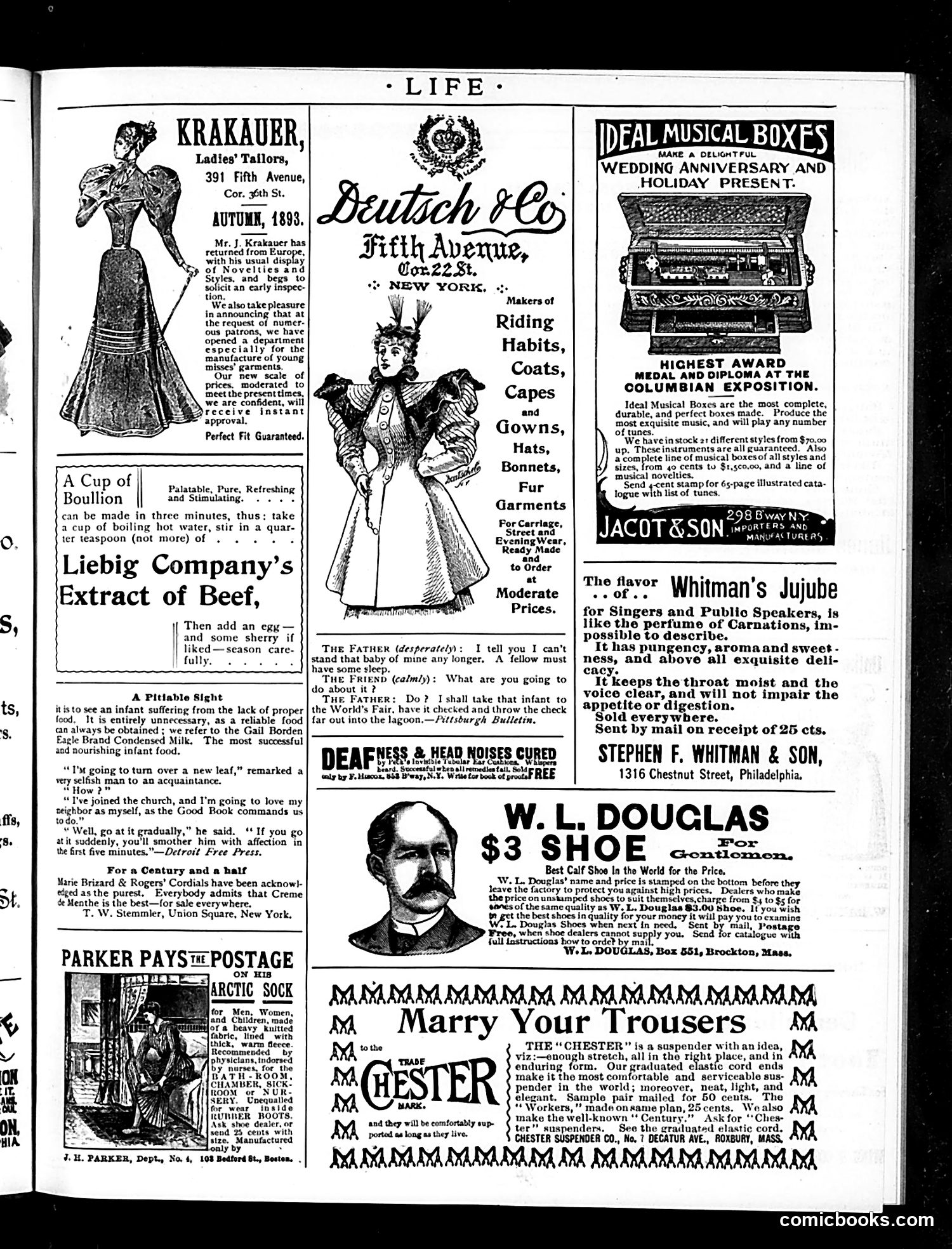
This is primarily an **advertising page** with minimal editorial content. The page features various commercial advertisements for 1890s consumer goods and services, including: - **Deutsch & Co.** (ladies' clothing on Fifth Avenue) - **Liebig Company's Extract of Beef** (food product) - **Ideal Musical Boxes** (awarded at the Columbian Exposition) - **W.L. Douglas $3 Shoe** - **Chester Suspenders** and other items The only **satirical content** is a brief dialogue labeled "The Father" and "The Friend," where a desperate father jokes about checking his crying baby at the World's Fair and throwing the ticket "far out into the lagoon." This is dark humor about parental exhaustion—a relatable domestic joke for the era. The page otherwise contains typical period advertisements promoting fashionable goods to middle and upper-class consumers, with no significant political or social satire. It reflects 1890s consumer culture and marketing approaches.
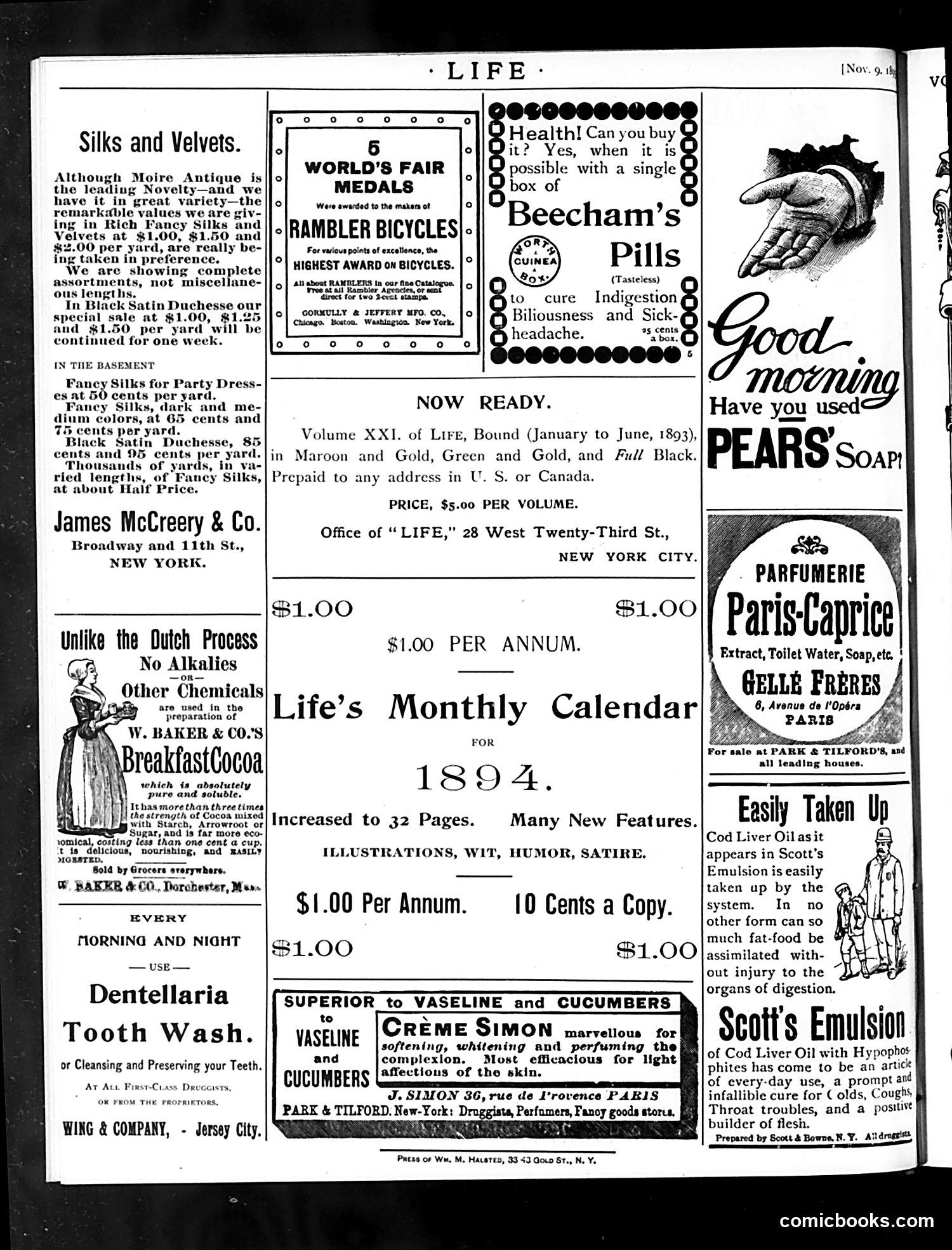
This is primarily a **title/advertisement page** rather than a satirical content page. It announces the November 1893 issue and promotes Life's 1894 Monthly Calendar subscription. **Key content:** - Volume XXI bound collection available ($5.00) - The 1894 Calendar expanded to 32 pages with "illustrations, wit, humor, satire" ($1.00 annual subscription) - Extensive period advertisements: silk merchants, bicycles (Rambler brand winning World's Fair medals), patent medicines (Beecham's Pills, Scott's Emulsion cod liver oil), beauty products (Pears' Soap, Crème Simon), and cocoa **Historical context:** This reflects 1890s consumer culture—patent medicines made unregulated health claims, World's Fairs were major advertising venues, and magazines were primary advertising media. The page itself contains **no visible cartoons or political satire**—it's essentially a cover/contents page with commercial sponsorship. The "satirical" content would appear inside the bound volume.