
Life, 1893-11-09 · page 6 of 18
Life — November 9, 1893 — page 6: what you’re looking at
What you’re looking at
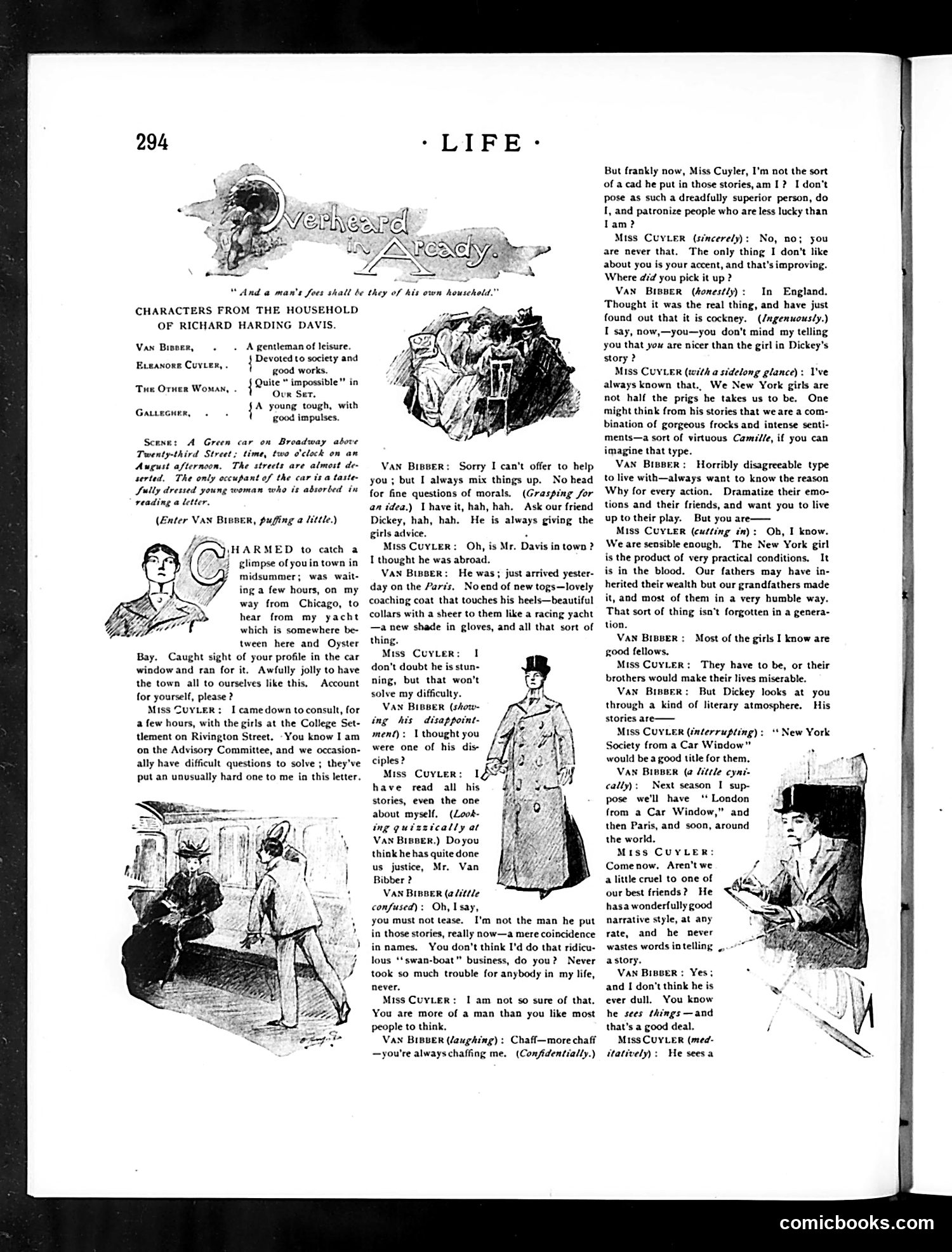
This page presents a dramatic dialogue between **Van Bibber** (a gentleman of leisure) and **Miss Cuyler** (a society woman), along with supporting characters. The sketch satirizes **New York high society's pretensions and gossip culture**. The humor centers on Van Bibber's chronic inability to keep secrets or maintain propriety—he constantly "mixes things up" and embarrasses himself socially. Miss Cuyler criticizes his behavior while simultaneously defending New York society's superiority to other cities. The accompanying illustrations show fashionably dressed characters in social settings, reinforcing the focus on **upper-class manners and social hierarchies**. The satire targets both Van Bibber's buffoonish unreliability and society women's defensive pride about their social status.
📄 Transcribed text from this page (OCR, searchable)
Machine-transcribed from the original scan — historical spelling and the odd misread are preserved.
iL ” Su INGEVPE| at » A “ And a man's foes shall be they of his own houscheld.” CHARACTERS FROM THE HOUSEHOLD OF RICHARD HARDING DAVIS. Vax Biooex, A gentleman of leisure. Devoted to society and good works. { Quite * impossibte” in Ovr Ser. A young tough, with ‘good impulses. Eueavone Cuvier, { Tue Orner Woman, - Gatiecner, Scene: A Green car on Broadway above Twenty-third Street; time, two o'clock on an August afternoon. The streets are almost de- serted, The only occupant of the car isa taste- Sully dressed young woman who is absorbed in reading a letter. (Enter Vax Brower, pufing a little) fx" ARMED to catch a (J) simpse otyouin town in Ly midsummer; was wait- a ing a few hours, on my —MIS way from Chicago, to eroy> hear from my yacht poo” which is somewhere be- tween here and Oyster Bay. Caught sight of your profile in the car window and ran for it. Awfully jolly to have the town all to ourselves like this, Account for yourself, please? Miss CUYLER: I camedown to consult, for a few hours, with the girls at the College Set- tlement on Rivington Street. -You know I am ‘on the Advisory Committee, and we occasion- ally have difficult questions to solve ; they've put an unusually hard one to me in this letter. Van BiBser: Sorry I can't offer to help you ; but I always mix things up. No head for fine questions of morals. (Grasping for an idea.) Ihave it, hah, hah, Ask our friend Dickey, hah, hah. He is always giving the girls advice. : Miss CuyLer: Oh, is Mr. Davis in town ? I thought he was abroad. VAN Binser: He was; just arrived yester- day on the Paris, Noend of new togs—lovely coaching coat that touches his heels—beautiful collars with a sheer to them like a racing yacht —a new shade in gloves, and all that sort of thing. Miss Cuyter: I don't doubt he is stun- ning, but that won't solve my difficulty. Van Bipper (show ing his disappoint- men): Lthought you were one of his dis- ciples? Miss CuyLer: have read all his stories, even the one about myself, (Look- ing guizzically at Vax Bipser.) Doyou think he has quite done us justice, Mr. Van Bibber ? VAN BippeRr (alittle confused): Oh, I say, you must not tease. I'm not the man he put in those stories, really now—a mere coincidence in names. You don't think I'd do that ridicu- lous ‘*swan-boat” business, do you? Never took so much trouble for anybody in my life, never. Miss CuYLER: I am not so sure of that. You are more of a man than you like most people to think, VAN BiBBER (Jaughing) : Chaff—more chaff —you're alwayschaffing me. (Confidentially.) But frankly now, Miss Cuyler, I'm not the sort of acad he put in those stories,am 1? I don't pose as such a dreadfully superior person, do I, and patronize people who are less lucky than lam? Miss CUVLER (sincerely): No, no; you are never that. The only thing I don't like about you is your accent, and that’s improving. Where did you pick it up ? VAN BIBBER (honestly): In England. Thought it was the real thing, and have just found out that it is cockney. (/ngenuously.) I say, now,—you—you don't mind my telling you that you are nicer than the girl in Dickey’s story ? Miss CUYLER (with a sidelong glance): I've always known that., We New York girls are not half the prigs he takes us to be. One might think from his stories that we are a com- bination of gorgeous frocks and intense senti- ments—a sort of virtuous Camiéd/e, if you can imagine that type. VaN BibbER: Horribly disagreeable type to live with—always want to know the reason Why for every action. Dramatize their emo- tions and their friends, and want you to live up to their play. But you are— Miss CUYLER (cutting in): Ob, I know. Weare sensible enough, The New York girl is the product of very practical conditions. It is in the blood. Our fathers may have in- herited their wealth but our grandfathers made it, and most of them in a very humble way. That sort of thing isn’t forgotten in a genera- tion. VaN BIBBER : good fellows. Miss CUYLER: They have to be, or their brothers would make their lives miserable. Van Binser: But Dickey looks at you through a kind of literary atmosphere. His stories are— Miss CUYLER (interrupting): “New York Society from a Car Window" would be a good title for them, VaN BinpER (a fitele cyni- cally); Next season I sup- pose we'll have ‘ London from a Car Window,” and then Paris, and soon, around the world. Miss CUYLER: Comenow. Aren't we a little cruel to one of ‘our best friends? He hasa wonderfully good narrative style, at any rate, and he never wastes words in telling astory. VAN Bipser ; Yes; and I don’t think he is ever dull, You know he sees things —and that’s a good deal. Miss CUYLER (med- ttatively): He sees a Most of the girls I know are comicbooks.com