
Life, 1893-11-09 · page 4 of 18
Life — November 9, 1893 — page 4: what you’re looking at
What you’re looking at
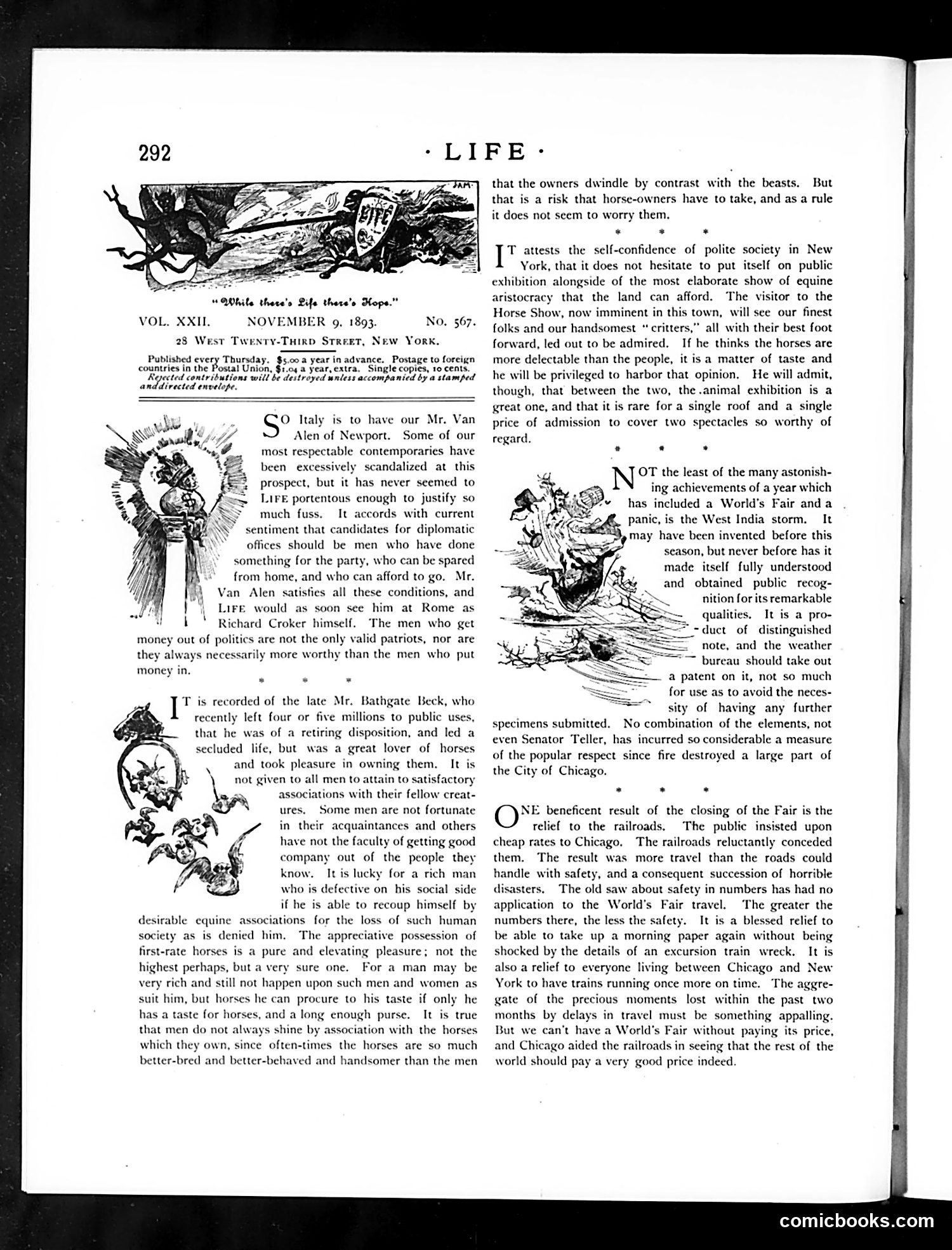
This page contains three editorial cartoons and accompanying commentary about prominent topics of 1893. The top cartoon illustrates a discussion of Mr. Van Alen of Newport, a wealthy society figure being considered for a diplomatic position. The satire mocks how riches don't guarantee worthiness for such posts—a commentary on wealthy individuals buying their way into prestige. The middle and lower cartoons relate to the recent World's Columbian Exposition (Chicago's World's Fair) and the tragic West India storm that devastated it. The text praises the storm's "beneficent result" of forcing railroads to improve safety standards and reduce fares to Chicago afterward. Overall, the page satirizes wealthy privilege while celebrating how disaster ironically improved railroad safety for ordinary travelers.
📄 Transcribed text from this page (OCR, searchable)
Machine-transcribed from the original scan — historical spelling and the odd misread are preserved.
- LIFE: “While there's Life there's Hope.” VOL. XXII. NOVEMBER 9. 1893. 28 West Twenty-Tuirp Street, New York. countries in the Postal Unde, Stag a fear.cuures Singlecopien socenie Reyected contributions will be destroyed wnless accompanied by a stamped anddirected envelope. O Italy is to have our Mr. Van Alen of Newport. Some of our most respectable contemporaries have been excessively scandalized at this prospect, but it has never seemed to LIFE portentous enough to justify so much fuss. It accords with current sentiment that candidates for diplomatic offices should be men who have done something for the party, who can be spared from home, and who can afford to go. Mr. Van Alen satisfies all these conditions, and LiFe would as soon see him at Rome as Richard Croker himself. The men who get money out of politics are not the only valid patriots, nor are they always necessarily more worthy than the men who put money in, T is recorded of the late Mr. Bathgate Beck, who recently left four or five millions to public uses, that he was of a retiring disposition, and led a secluded life, but was a great lover of horses and took pleasure in owning them. It is not given to all men to attain to satisfactory \. EN associations with their fellow creat- ures, Some men are not fortunate in their acquaintance id others. have not the faculty of getting good company out of the people they know. It is lucky for a rich man who is defective on his social side if he is able to recoup himself by desirable equine associations for the loss of such human society as is denied him. The appreciative possession of first-rate horses is a pure and elevating pleasure; not the highest perhaps, but a very sure one. For a man may be very rich and still not happen upon such men and women as suit him, but horses he can procure to his taste if only he It is true sociation with the hor: which they own, since often-times the horses are so much has a taste for horses, and a long enough pu that men do not always shine b better-bred and better-behaved and handsomer than the men that the owners dwindle by contrast with the beasts. But that is a risk that horse-owners have to take, and as a rule it does not seem to worry them. « . * I" attests the self-confidence of polite society in New York, that it does not hesitate to put itself on public exhibition alongside of the most elaborate show of equine aristocracy that the land can afford. The visitor to the Horse Show, now imminent in this town, will see our finest folks and our handsomest “critters,” all with their best foot forward, led out to be admired. If he thinks the horses are more delectable than the people, it is a matter of taste and he will be privileged to harbor that opinion. He will admit, though, that between the two, the .animal exhibition is a great one, and that it is rare for a single roof and a single price of admission to cover two spectacles so worthy of regard. * * . OT the least of the many astonish- ing achievements of a year which <j" has included a World's Fair anda panic, is the West India storm. It may have been invented before this season, but never before has it made itself fully understood and obtained public recog- nition for its remarkable qualities. It is a pro- duct of distinguished note, and the weather ™ bureau should take out a patent on it, not so much for use as to avoid the neces- sity of having any further specimens submitted. No combination of the elements, not even Senator Teller, has incurred so considerable a measure of the popular respect since fire destroyed a large part of the City of Chicago. O beneficent result of the closing of the Fair is the relief to the railroads. The public insisted upon cheap rates to Chicago. The railroads reluctantly conceded them, The result was more travel than the roads could handle with safety, and a consequent succession of horrible disasters, The old saw about safety in numbers has had no application to the World’s Fair travel. The greater the numbers there, the less the safety. It is a blessed relief to be able to take up a morning paper again without being shocked by the details of an excursion train wreck. It is also a relief to everyone living between Chicago and New York to have trains running once more on time. The aggre- gate of the precious moments lost within the past two months by delays in travel must be something appalling. But we can't have a World's Fair without paying its price, and Chicago aided the railroads in seeing that the rest of the world should pay a very good price indeed. . * . comicbooks.com