
Life, 1893-11-09 · page 7 of 18
Life — November 9, 1893 — page 7: what you’re looking at
What you’re looking at
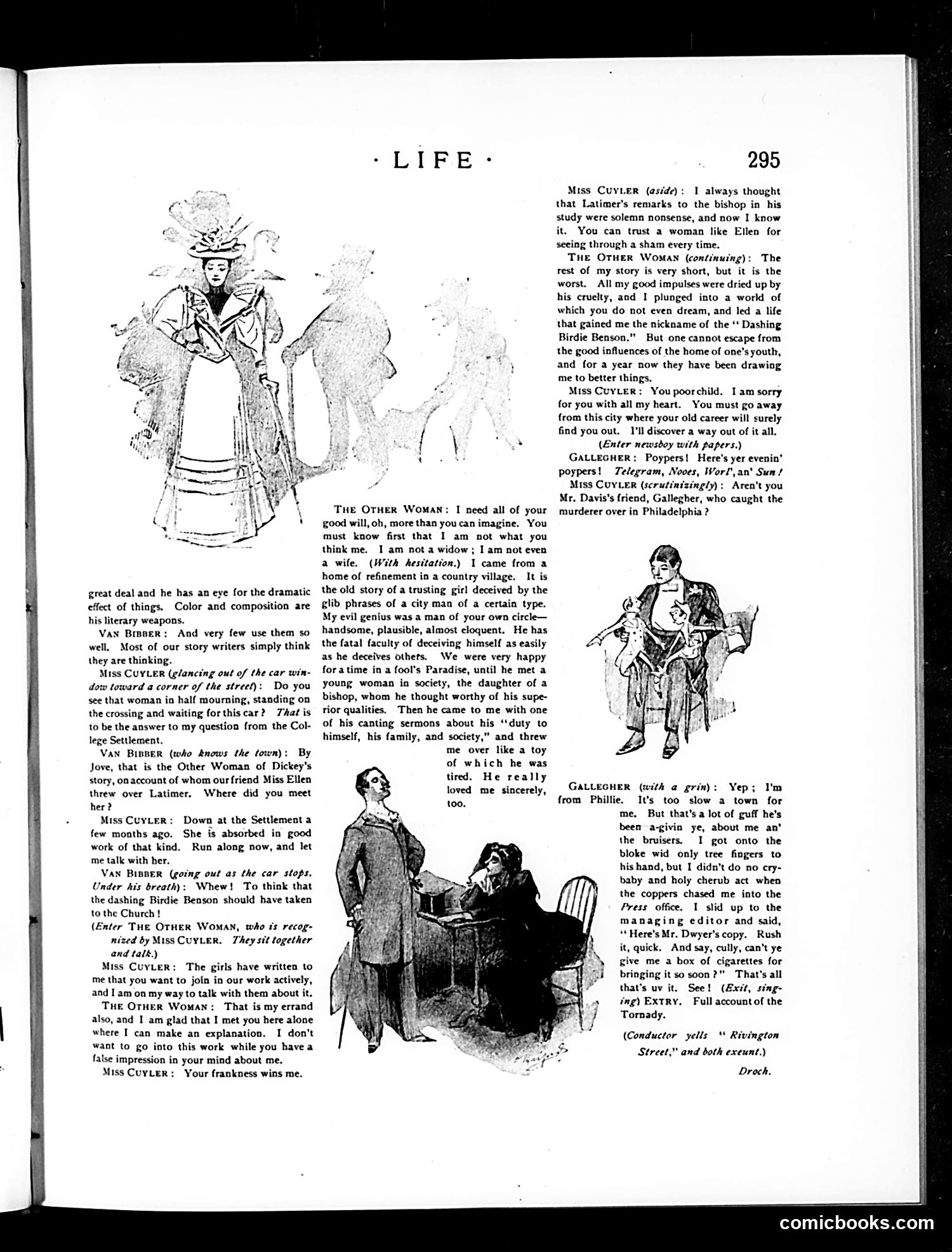
This page presents a theatrical dialogue featuring "The Other Woman" character—a stock figure in early 20th-century drama representing the seductress who corrupts innocent men. The satire mocks melodramatic stage conventions by having characters discuss clichéd plot devices: the "trusting girl deceived by a city man," the femme fatale's "fatal faculty of deceiving himself," and moral ruin. References to "Birdie Benson" and Philadelphia suggest specific theatrical productions or scandals. The illustrations show period-appropriate costume and staging. The humor targets overwrought theatrical storytelling and stock characters rather than specific political figures. This represents Life's regular satirizing of popular entertainment and its predictable moral narratives—poking fun at both the theater industry and audiences' appetite for formulaic melodrama about female villainy and masculine weakness.
📄 Transcribed text from this page (OCR, searchable)
Machine-transcribed from the original scan — historical spelling and the odd misread are preserved.
great deal and he has an eye for the dramatic effect of things, Color and composition are his literary weapons. Vax Brewer: And very few use them so well, Most of our story writers simply think they are thinking. Miss CUYLER (glancing out of the car win- dow toward a corner of the street): Do you see that woman in half mourning, standing on the crossing and waiting forthiscar? That is to be the answer to my question from the Col- lege Settlement. VAN BIBBER (who Anows the town): By Jove, that is the Other Woman of Dickey’s story, onaccount of whom ourfriend Miss Ellen threw over Latimer, Where did you meet her? Miss CuyLER: Down at the Settlement a few months ago. She is absorbed in good work of that kind. Run along now, and let me talk with her. Van Binner (going out as the car stops. Under his breath): Whew! To think that the dashing Birdie Benson should have taken to the Church ! (Enter Tue OTHER Woman, who ts recog- nized by Miss CUYLER. They stt together and talk.) Miss CuyLer: The girls have written to me that you want to join in our work actively, and I am on my way to talk with them about it. Tue OrneR Woman: That is my errand also, and I am glad that I met you here alone where I can make an explanation. I don't want to go into this work while you have a false impression in your mind about me. Miss CuyLer: Your frankness wins me. THe OTHER Woman: I need all of your good will, oh, more than you can imagine. You must know first that I am not what you think me. I am not a widow ; I am not even a wife, (With hesitation.) I came from a home of refinement in a country village. It is the old story of a trusting girl deceived by the glib phrases of a city man of a certain type. My evil genius was a man of your own circle— handsome, plausible, almost eloquent. He has the fatal faculty of deceiving himself as easily as he deceives othets. We were very happy for atime in a fool's Paradise, until he met a young woman in society, the daughter of a bishop, whom he thought worthy of his supe- rior qualities. Then he came to me with one of his canting sermons about his ‘duty to himself, his family, and society,” and threw me over like a toy of which he was tired. He really loved me sincerely, 295 Miss CuyLer (aside): 1 always thought that Latimer’s remarks to the bishop in his study were solemn nonsense, and now I know it. You can trust a woman like Ellen for seeing through a sham every time. THE OTHER WoMAN (continuing): The rest of my story is very short, but it is the worst. All my good impulses were dried up by his cruelty, and I plunged into a world of which you do not even dream, and led a life that gained me the nickname of the ‘* Dashing Birdie Benson.” But one cannot escape from the good influences of the home of one’s youth, and for a year now they have been drawing me to better things. Miss CUYLER: You poorchild. I am sorry for you with all my heart. You must go away from this city where your old career will surely find you out. I'll discover a way out of it all. (Enter newsboy with papers.) GALLEGHER: Poypers! Here's yer evenin’ poypers! Telegram, Nooes, Worl’, an’ Sun! Miss CUYLER (scrutinisingly): Aren't you Mr, Davis's friend, Gallegher, who caught the murderer over in Philadelphia ? GALLEGHER (with @ grin): Yep; I'm from Phillie. It's too slow a town for me. But that’s a lot of guff he's been a-givin ye, about me an’ the bruisers. I got onto the bloke wid only tree fingers to his hand, but I didn’t do no cry- baby and holy cherub act when the coppers chased me into the Press office. 1 slid up to the managing editor and said, “Here's Mr. Dwyer’s copy. Rush it, quick. And say, cully, can't ye ive me a box of cigarettes for bringing it so soon?" That's all that's uv it, See! (Exit, sing- ing) ExtRY. Full account of the Tornady. (Conductor yells “ Rivington Street,” and both exeunt.) Droch. comicbooks.com