
A complete issue · 16 pages · 1893
Life — October 5, 1893
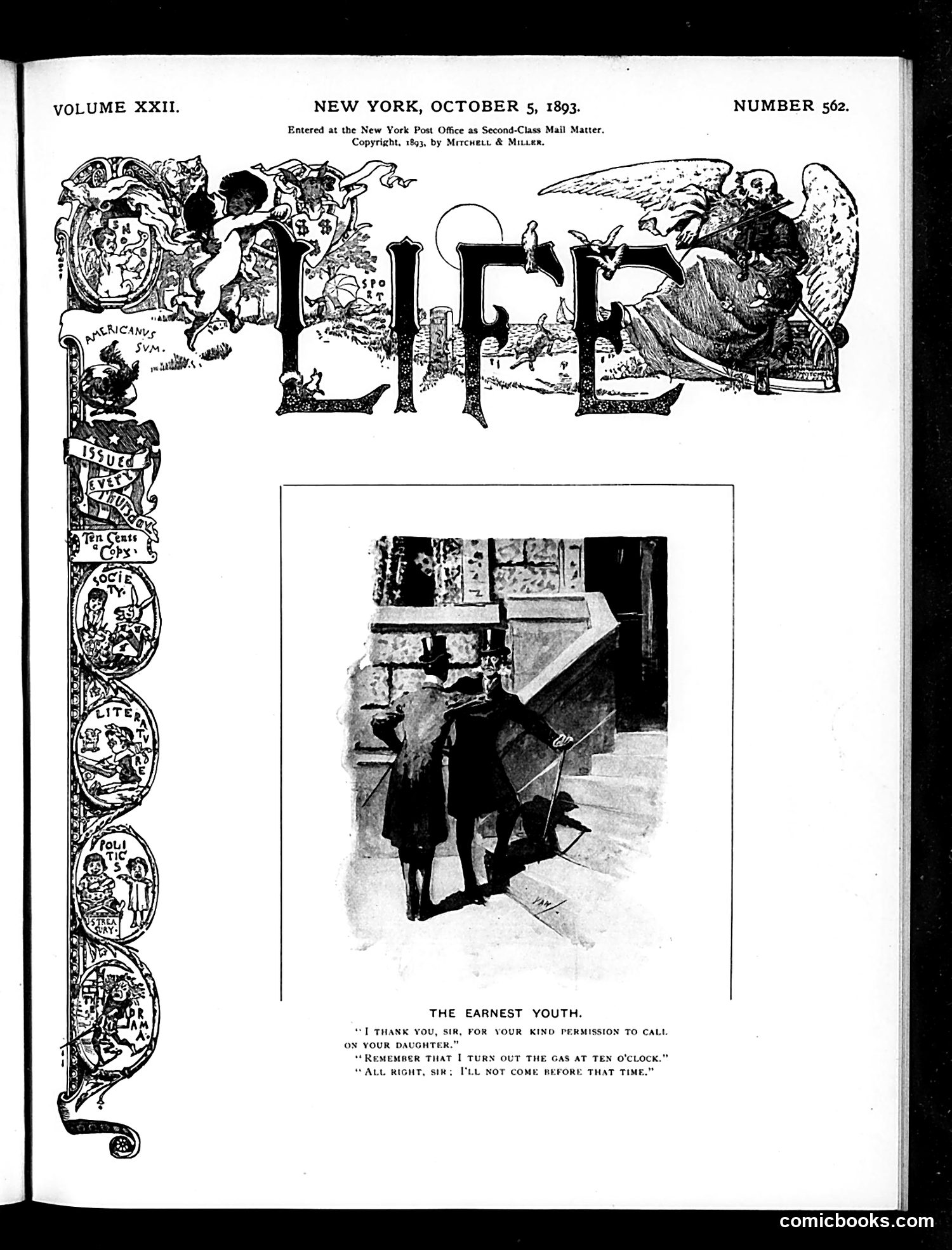
This cartoon satirizes a young man's overly formal courtesy toward his date's father. The dialogue shows the youth thanking the father "for your kind permission to call on your daughter" and promising to return her by 10 PM, to which the father responds, "All right, sir; I'll not come before that time." The humor lies in the youth's exaggerated earnestness and rigid adherence to propriety—he's so scrupulously polite that he seems almost comically stiff. The father's dry reply suggests amusement at this excessive formality. This reflects early 1900s dating conventions where young men were expected to show strict respect to their girlfriends' parents, though the cartoon gently mocks taking such proprieties to absurd extremes.
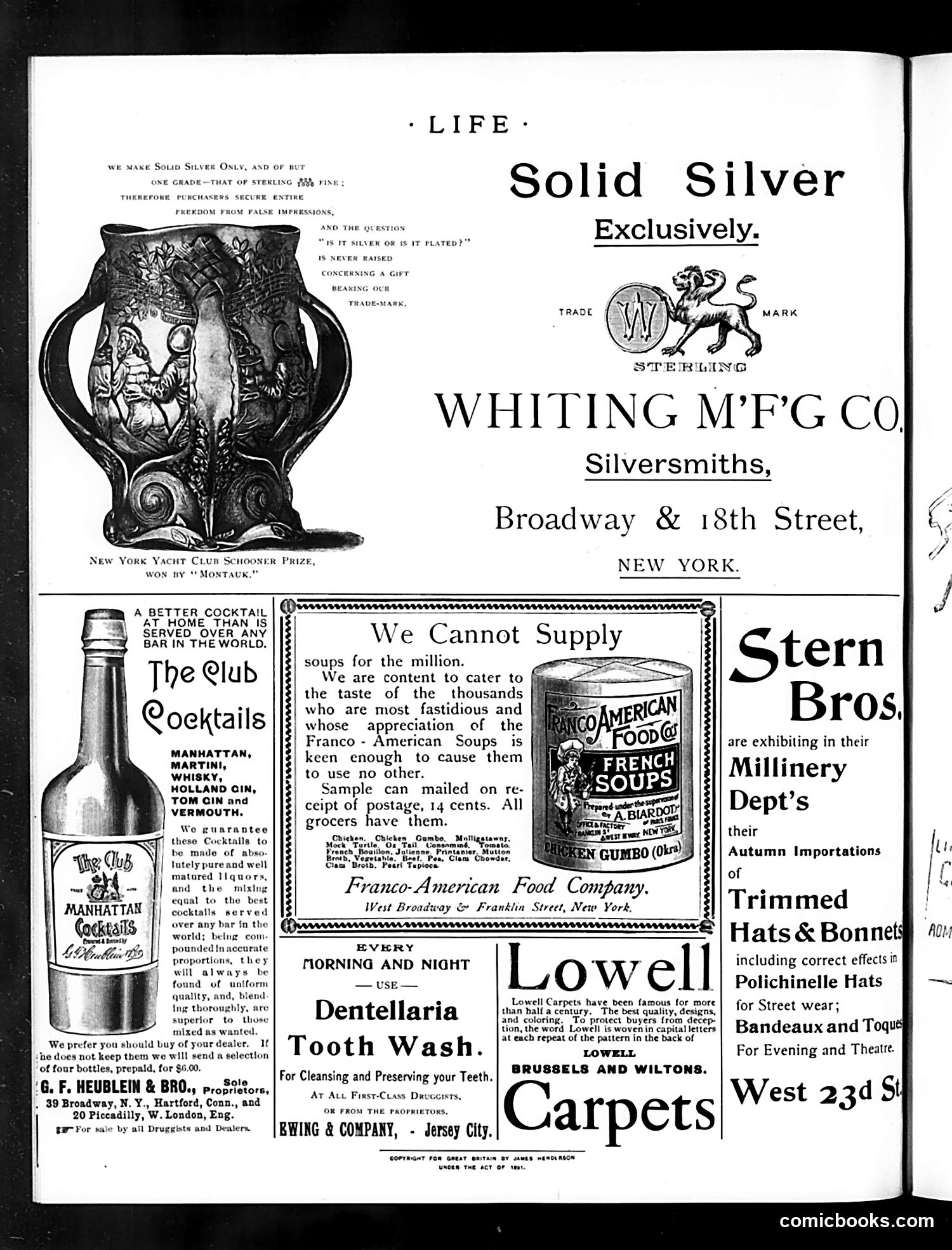
This page is predominantly **advertising**, not satirical content. The main advertisements include: - **Whiting MFG Co.** (silversmiths): Promoting solid silver goods, featuring an ornate vase that won a New York Yacht Club prize - **The Club Cocktails**: A spirits brand advertisement - **Franco-American Food Company**: Soup products - **Stern Bros.**: Millinery department store - **Lowell Carpets**: Home furnishings - **Dentellaria Tooth Wash**: Dental hygiene product The only potentially satirical element is the small text accompanying The Club Cocktails, which humorously claims "A BETTER COCKTAIL AT HOME THAN IS SERVED OVER ANY BAR IN THE WORLD"—a self-promotional boast typical of advertising hyperbole from this era. The page reflects early 20th-century consumer culture and product marketing to affluent readers.
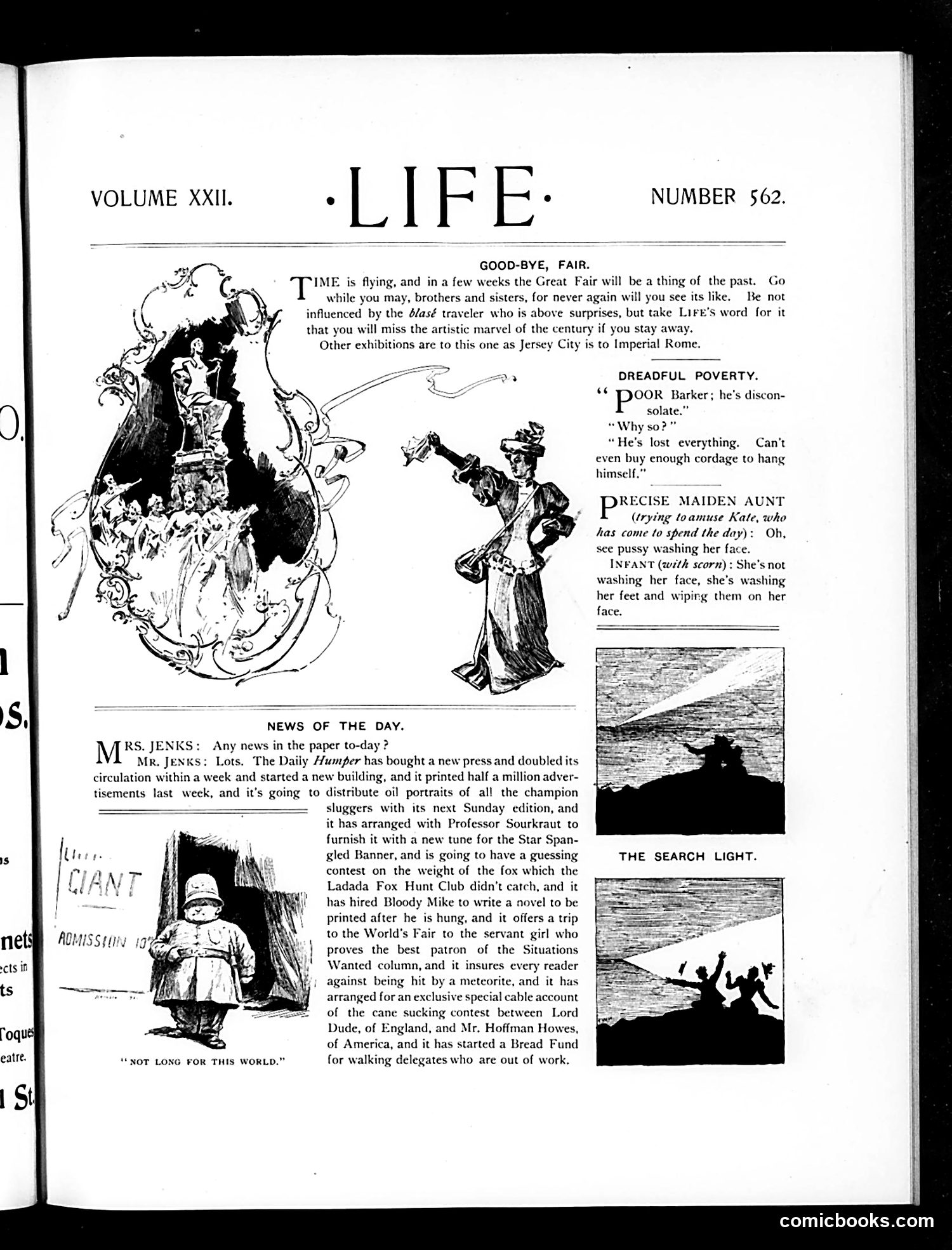
This page contains several satirical pieces about contemporary social issues: **"Good-Bye, Fair"** encourages attendance at what appears to be a major fair (likely the 1904 World's Fair), comparing it favorably to other exhibitions. **"Dreadful Poverty"** depicts a poor man ("Parker") unable to afford even cordage for hanging himself—dark humor about economic desperation. **"Precise Maiden Aunt"** mocks an elderly relative's fastidious hygiene habits, shown washing her feet and wiping them on her face. **"News of the Day"** discusses press industry developments, including a new building and various promotional contests. The illustrations throughout use exaggerated caricature typical of early 1900s American satire, with particular focus on class disparities and social pretension—recurring themes in *Life* magazine's satirical commentary.
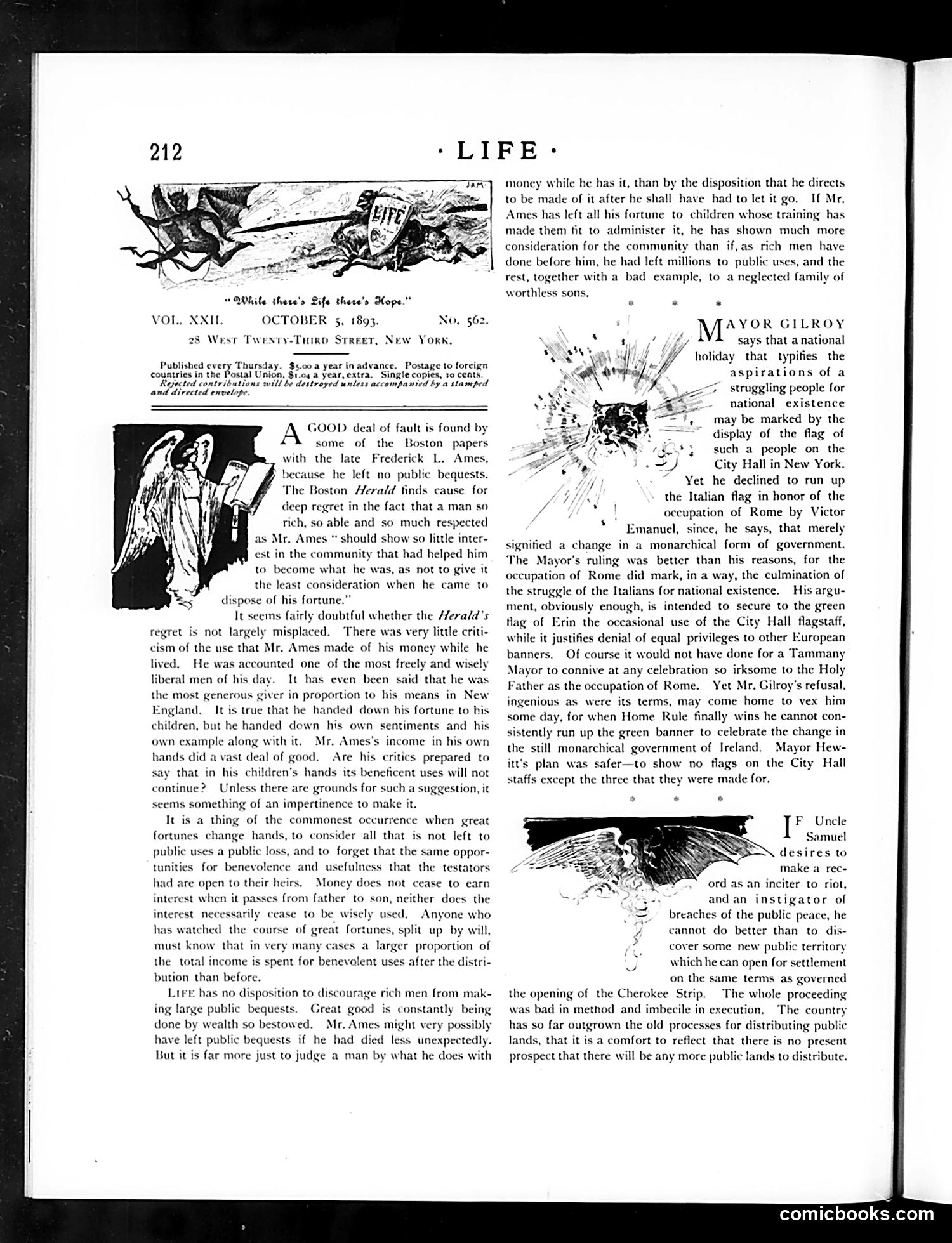
**The Main Cartoon:** The left illustration shows an angel figure holding a scroll labeled "Life," appearing to weep or express sorrow. This visualizes the magazine's criticism of Frederick L. Ames, a wealthy Bostonian who died without making public charitable bequests. **The Satire:** Life attacks Ames for hoarding his fortune rather than using it for community benefit. The text argues that despite being "respected" and wealthy, he showed "little interest in the community" during his lifetime. The angel imagery suggests Life views such selfishness as spiritually lamentable—a failure of moral duty. **Social Context:** This reflects 1890s debates about wealthy industrialists' obligations to society, predating modern philanthropy expectations.
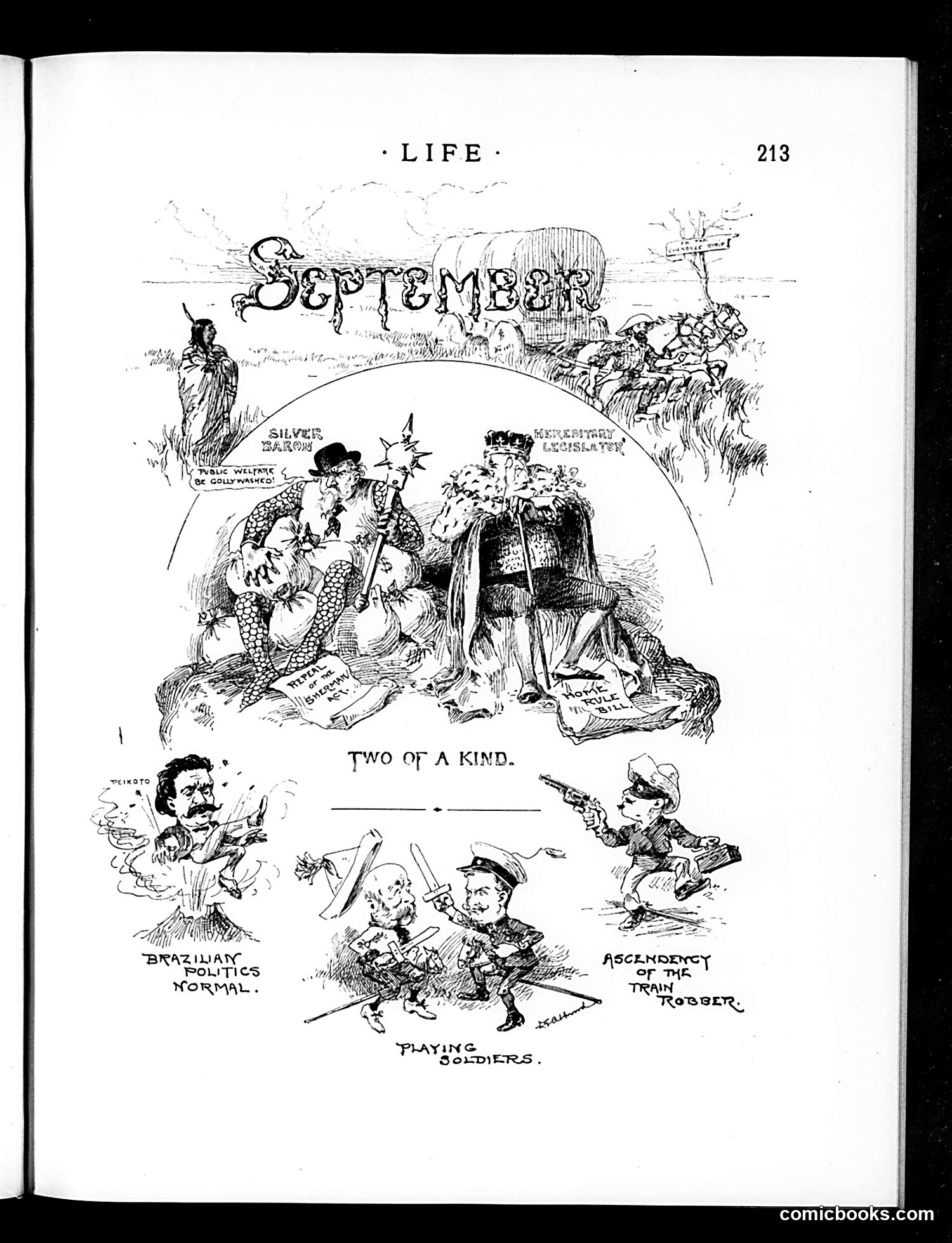
This September page satirizes political figures through four vignettes. The main cartoon depicts what appears to be royalty or dignitaries meeting common criminals or con artists, with labels including "Silver Baron" and "Secretary-[Treasurer]"—suggesting corrupt wealthy elites are morally equivalent to criminals. Below, four smaller scenes mock different "types": "Brazilian Normal" (a man's head exploding), "Playing Soldiers" (two figures with weapons), and "Ascendency of the Train Robber" (a figure with a gun). The overall message—"Two of a Kind"—implies the page is drawing parallels between legitimate power holders and actual criminals, suggesting their behavior and morality are indistinguishable. The satire critiques corruption among the wealthy and politically connected.
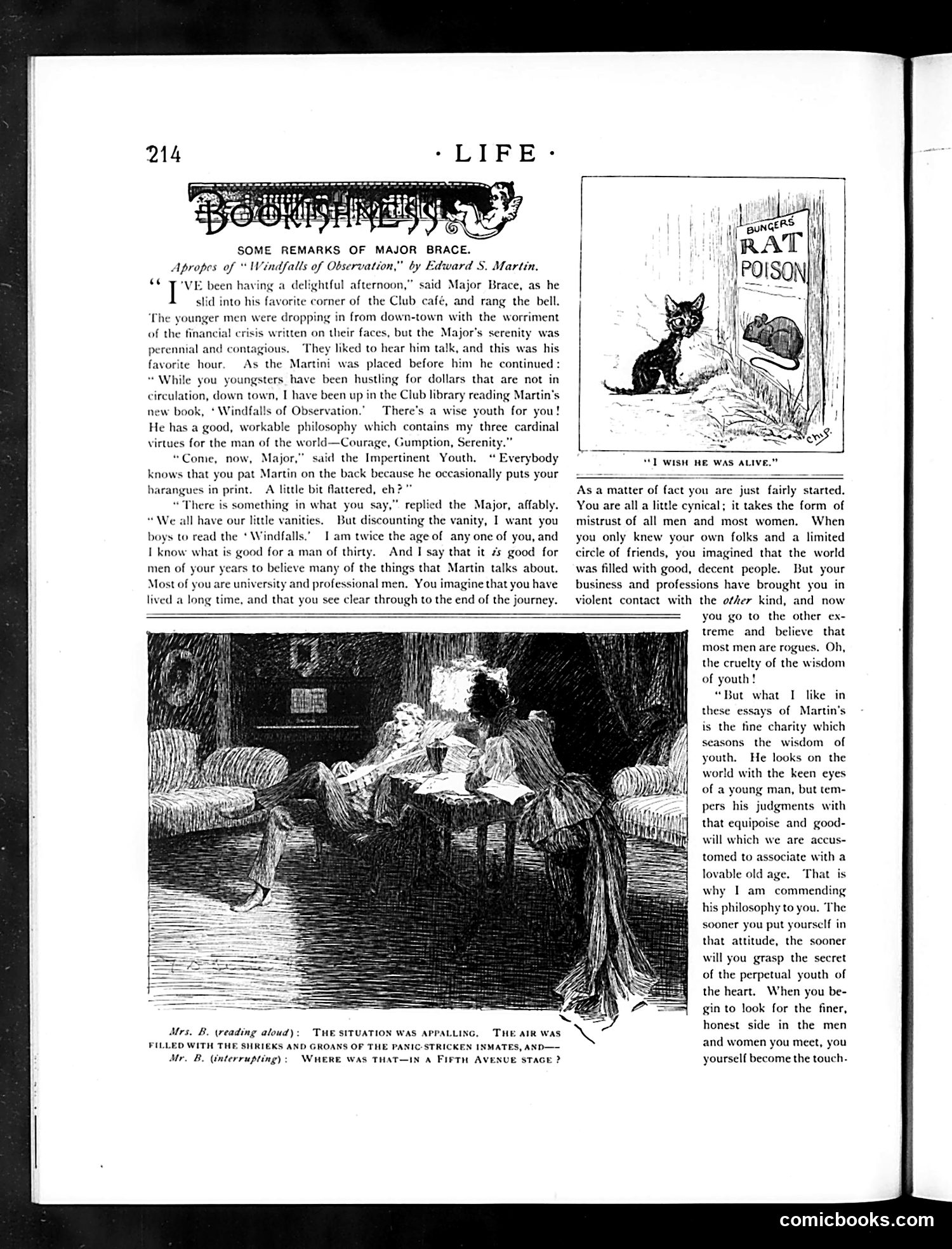
This page contains two distinct elements: **Main Article**: "Some Remarks of Major Brace" presents a dialogue between Major Brace and an "Impertinent Youth" discussing Edward S. Martin's philosophical essays. The Major defends Martin's "Windfalls of Observation," recommending young men read them to develop wisdom and character through understanding human nature. **Cartoon (top right)**: Shows a black cat discovering rat poison, captioned "I WISH HE WAS ALIVE." The dark humor suggests the poison was set for mice/rats, but the cat discovered it instead—implying fatal consequences. The page reflects early 20th-century Life magazine's blend of social commentary, literary discussion, and satirical humor about urban life and human folly.
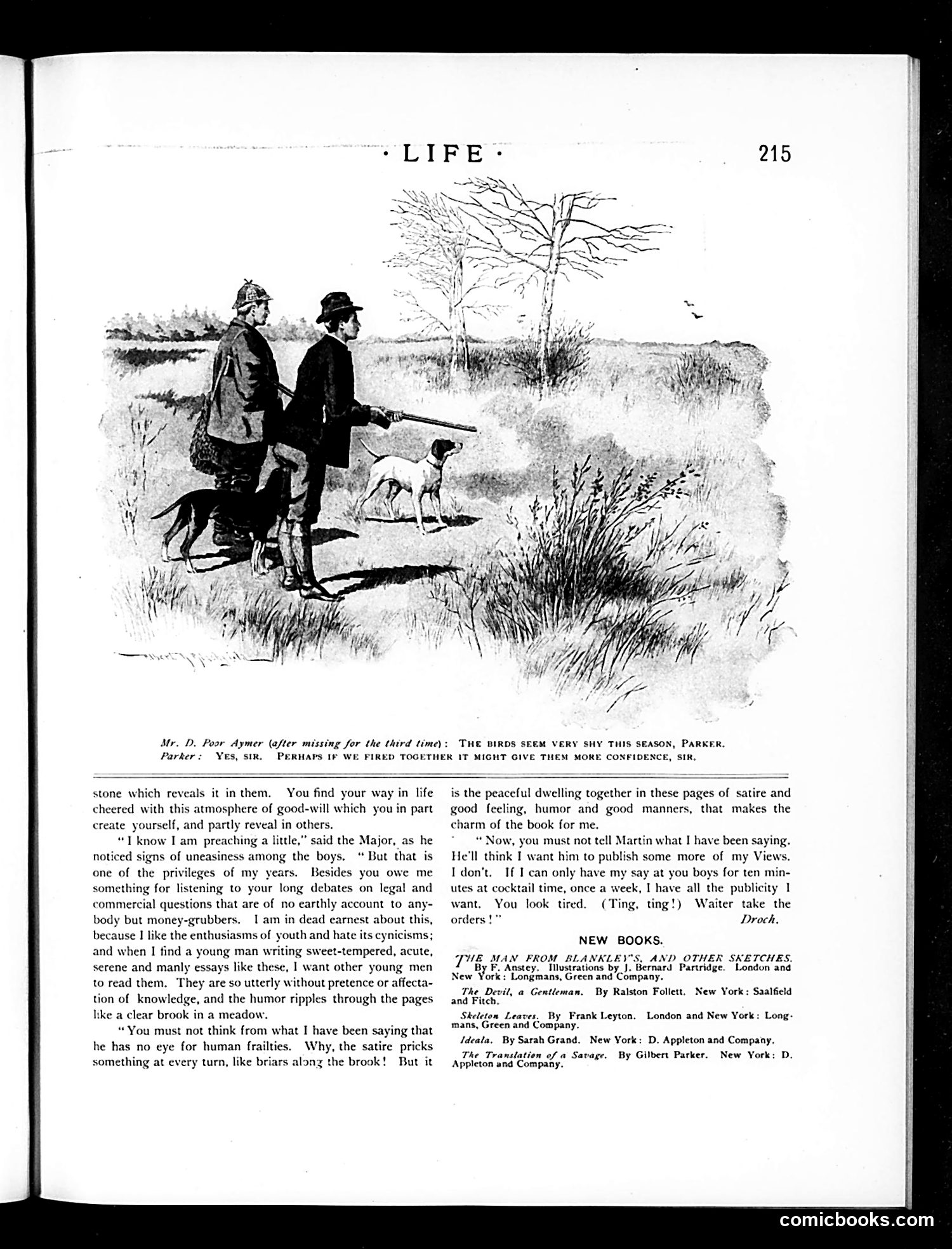
This page features a hunting scene illustration with dialogue between two gentlemen and their hunting dogs. The caption identifies "Mr. D. Poor Aymer" (after missing for the third time) and "Parker," establishing a humorous exchange about poor marksmanship. The joke relies on Parker's diplomatic suggestion that firing together "might give them more confidence, sir"—a polite way of mocking Aymer's repeated failures. The accompanying text discusses satirical writing, praising works that combine "satire and good feeling, humor and good manners." The lower section lists newly published books, suggesting this is primarily a literary/cultural magazine page rather than political commentary. The hunting scene exemplifies the genteel, class-based humor typical of Life magazine's satirical approach to upper-class leisure activities and social awkwardness.
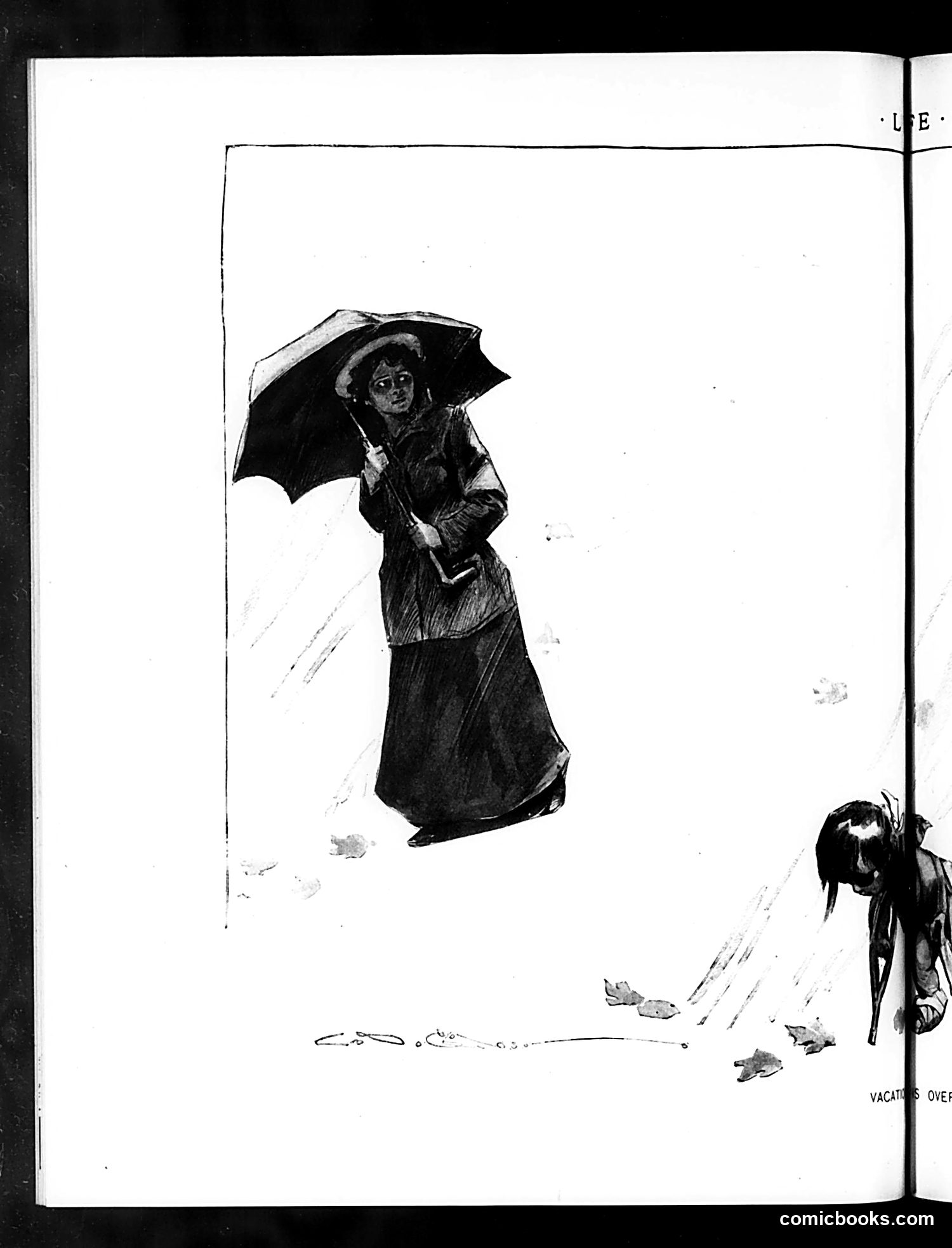
This appears to be a satirical illustration from *Life* magazine depicting a woman in Edwardian-era dress walking in the rain with an umbrella, accompanied by what looks like a small dog. The sketch style is characteristic of early 20th-century editorial illustration. The partial text visible reads "VACATIO[N]S OVE[R]," suggesting the cartoon comments on the end of vacation season—likely satirizing the return to ordinary life or domestic duties. The woman's somewhat melancholic posture and formal attire suggest commentary on social expectations or the tedium of resuming normal routines after leisure time. Without complete text or clearer identification, the specific satirical target remains unclear, though it likely addresses themes of class, gender roles, or seasonal social patterns relevant to *Life*'s contemporary readership.
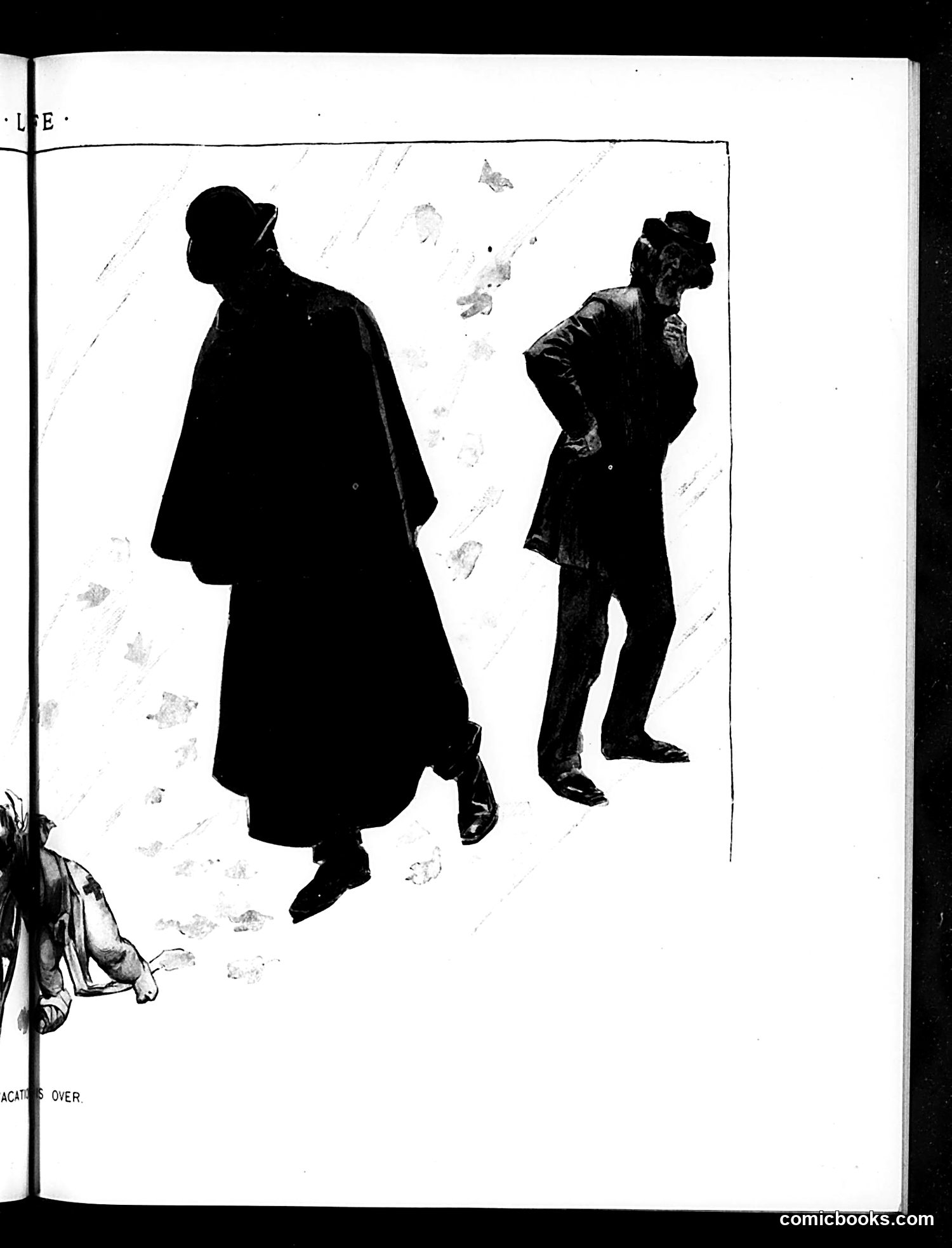
This appears to be a silhouette illustration from Life magazine showing two figures in formal attire (suits and hats) standing in what looks like snow or rain, with footprints visible on the ground. The page header reads "LIFE" and there's text at the bottom that's partially visible. Without clearer context from the OCR text or additional identifying information on the page, I cannot definitively identify who these figures represent or what specific political or social event is being satirized. The silhouette style and formal dress suggest commentary on public figures or social commentary, but the specific satire or joke remains unclear from the image alone. The footprints might suggest a trail of consequences or movement through events, but this is speculative without additional context.
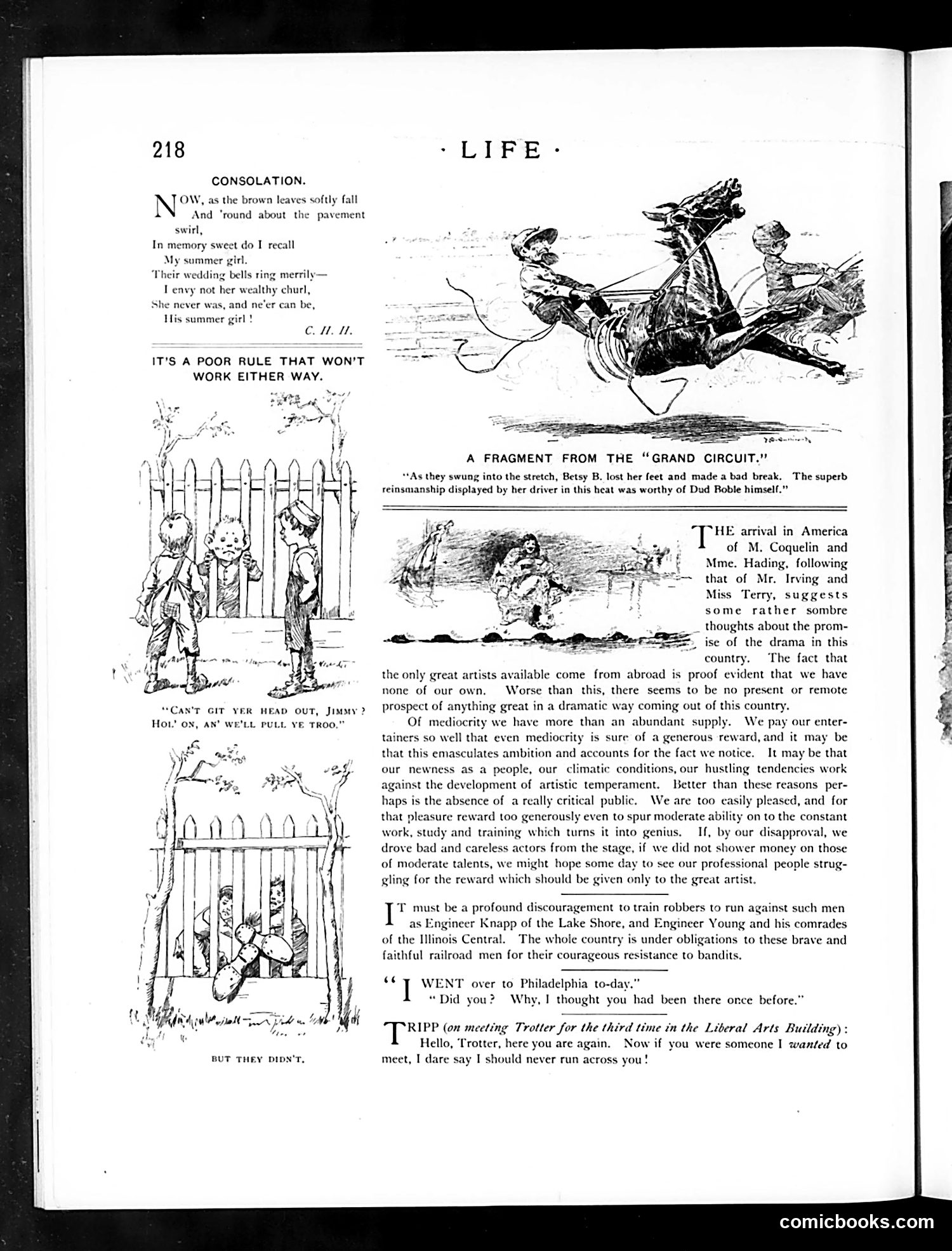
This page contains several cartoon vignettes and literary excerpts rather than a single political cartoon. The sketches depict everyday domestic scenes: children at a fence, people in various comedic situations. The captions employ gentle humor about social conventions—one reads "Can't git yer head out, Jimsy? Hold on, as yer will ye troo," suggesting physical comedy involving stuck heads. The text discusses drama in America, lamenting the absence of great native playwrights and noting that talented artists come from abroad. It references specific railroad engineers (Knapp, Young) resisting bandits, suggesting contemporary news events. The final section shows social encounters, including a meeting between "Trotter" characters at a Liberal Arts Building, employing ironic commentary on chance meetings and social propriety rather than explicit political satire.
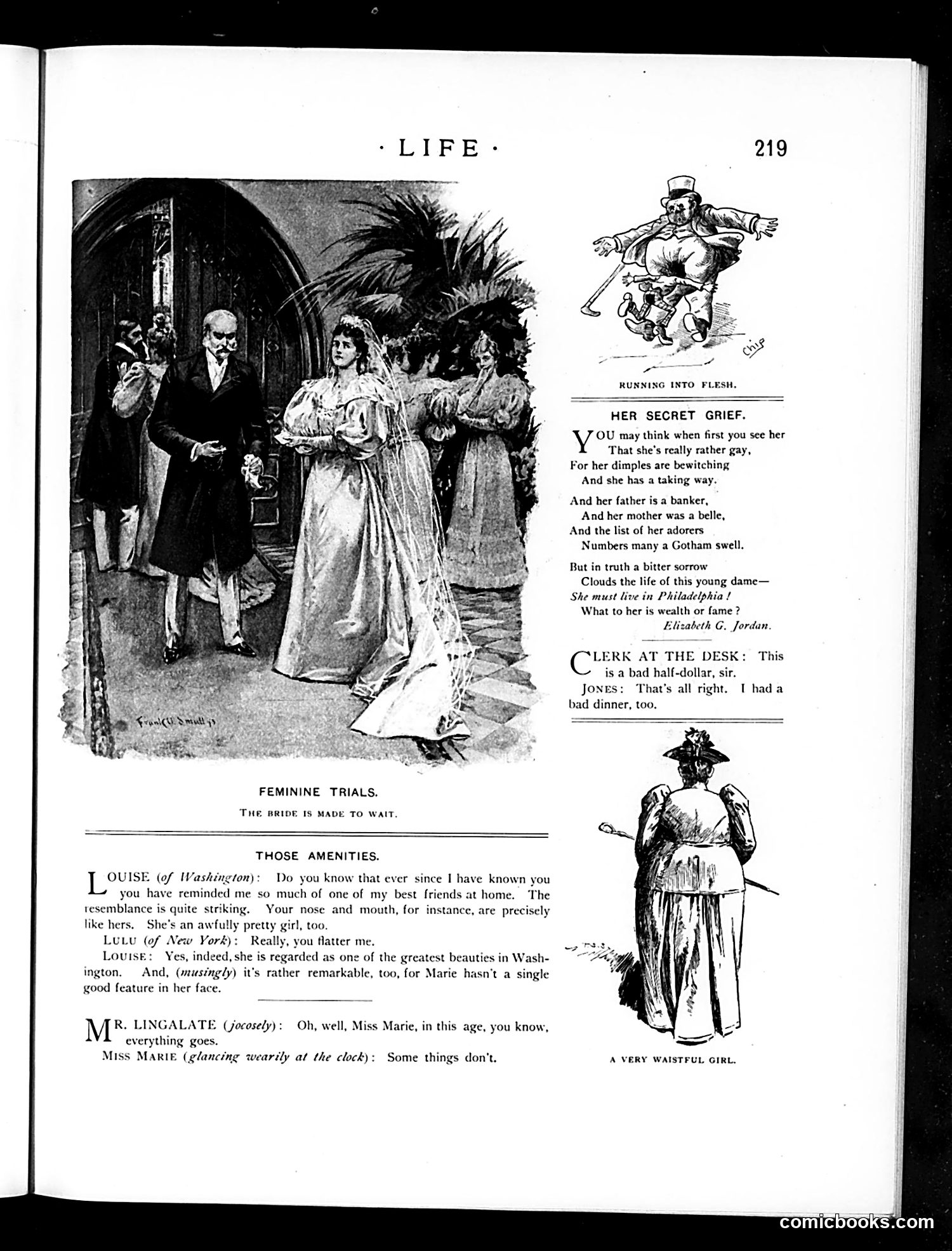
This page contains three satirical pieces about women and romance: **"Feminine Trials"** shows a bride waiting at an altar—a visual joke about the nervous anticipation of marriage. **"Her Secret Grief"** is a poem by Elizabeth G. Jordan suggesting a young woman appears cheerful but harbors "bitter sorrow," implying disappointment in her romantic prospects or social standing despite her mother's social success ("a belle") and numerous admirers. **"Those Amenities"** features dialogue mocking women's appearance and aging. Louise compliments Marie's beauty and resemblance to a friend, while Mr. Lingalate dismissively notes that "everything goes" with age—a backhanded insult about women's declining looks over time. The cartoons satirize period attitudes toward female beauty, marriage anxiety, and women's social value tied entirely to attractiveness and marriageability.
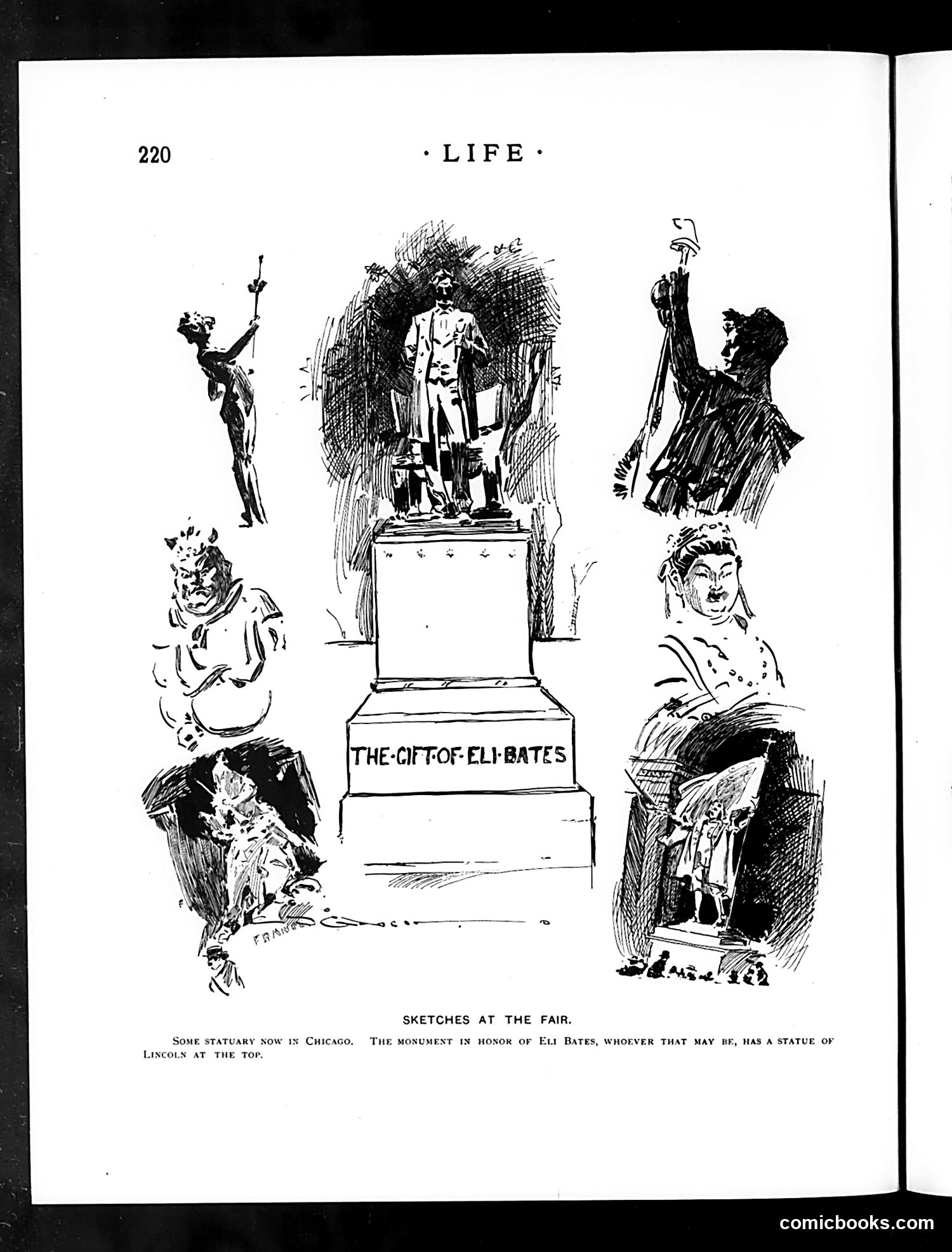
This satirical page mocks a monument to "Eli Bates" at what appears to be a Chicago fair (likely the 1893 World's Columbian Exposition). The central image shows a statue of Lincoln atop a pedestal inscribed "THE GIFT OF ELI BATES." The surrounding sketches depict various grotesque figures—appearing to be caricatured fair-goers or statuary—positioned around the monument. The satire operates on multiple levels: the absurdity of honoring an obscure figure (Eli Bates) by using Lincoln as his monument's crowning element, and the crude quality of the surrounding sculptural work displayed at the fair. The caption's parenthetical "whoever that may be" emphasizes the obscurity of the honoree, suggesting the monument is an example of poor artistic judgment or misplaced civic pride.
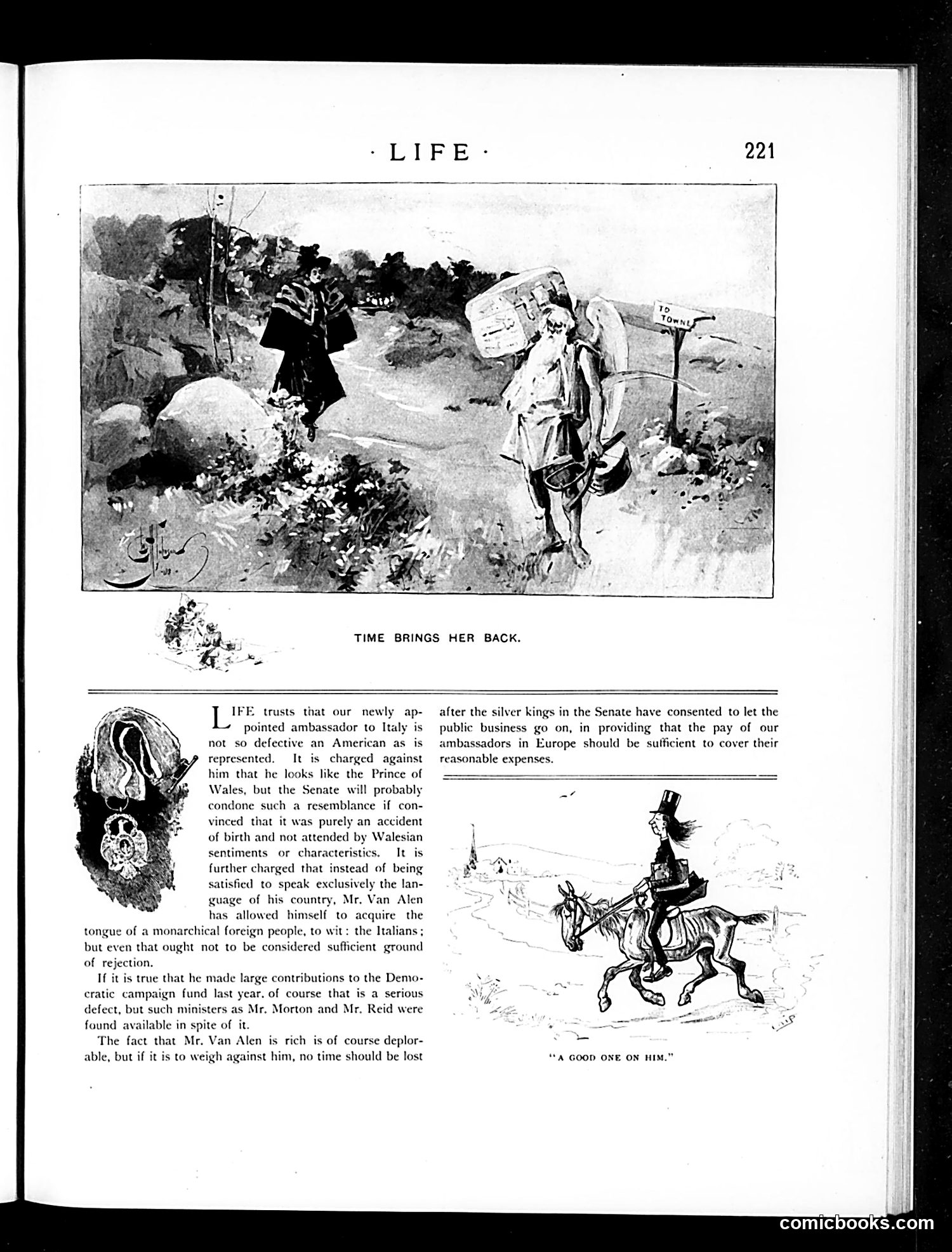
This Life magazine piece satirizes the appointment of a new U.S. ambassador to Italy, likely James Van Alen (though not explicitly named in visible text). The article mockingly defends him against various criticisms: **The charges against him:** - He physically resembles the Prince of Wales - He speaks Italian rather than exclusively English - He made substantial donations to the Democratic campaign - He is wealthy **The satire's point:** Life sarcastically argues these objections are absurd. The piece suggests that Senate opposition to Van Alen relies on trivial grounds (his appearance, language skills, political donations, wealth) rather than actual diplomatic qualifications. By defending him with tongue-in-cheek logic, the magazine critiques how patronage and personal characteristics—rather than merit—influenced diplomatic appointments in the Gilded Age. The illustrations show a woman returning (top) and a mounted figure (bottom), likely related to the satirical commentary on diplomatic representation.
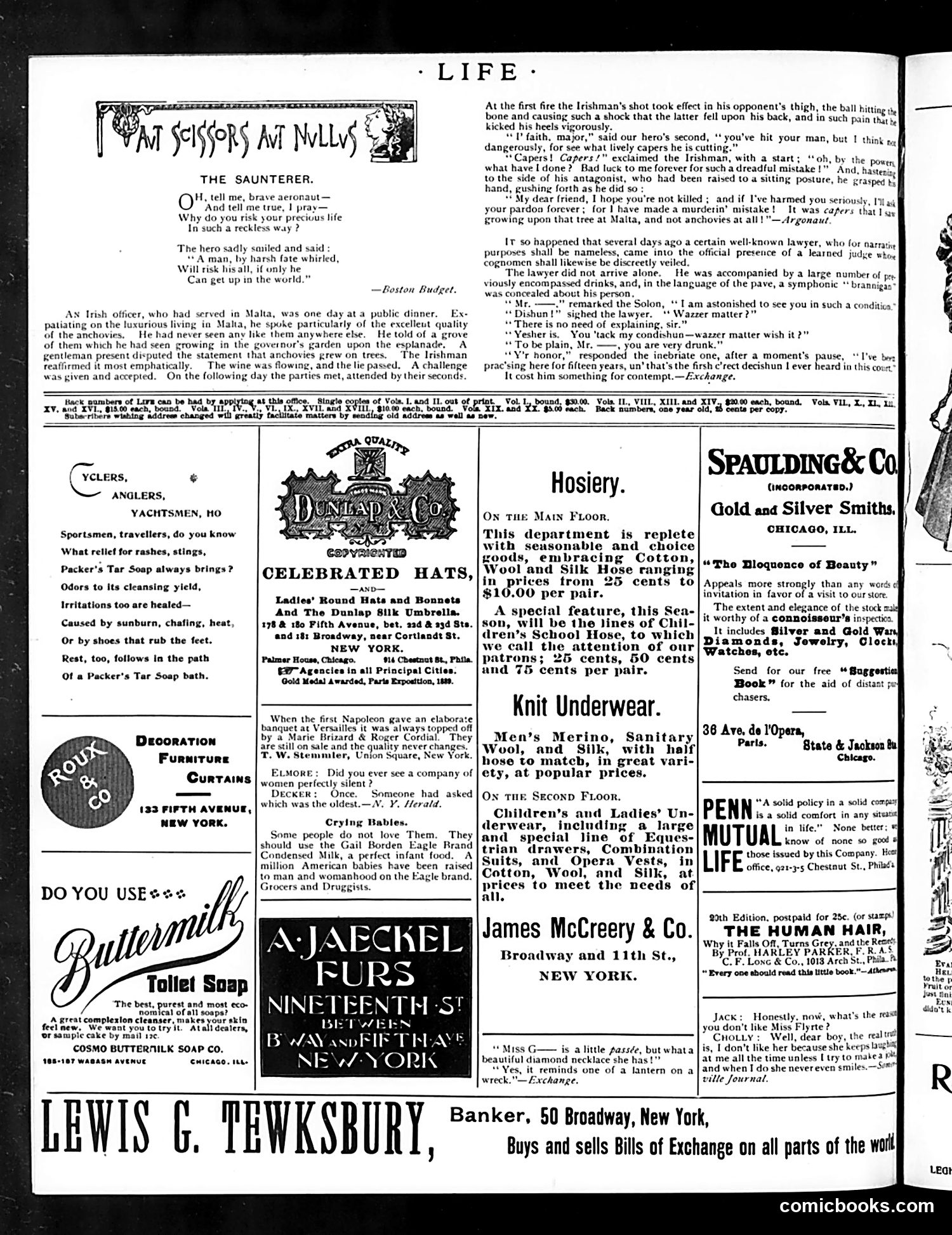
This page from *Life* magazine contains three humorous anecdotes exemplifying the consequences of exaggeration and dishonesty: **The Aeronaut joke**: A play on social aspiration—the aeronaut risks his life hoping to "get up in the world" (literal vs. figurative meaning). **The Irish Officer's duel**: An Irishman claims anchovies grow on trees in Malta. When challenged to a duel, he shoots his opponent in the thigh. Seeing the man convulse in pain, the Irishman exclaims with horror: he thought "capers" (the plant) grew on trees, not anchovies, and assumes he's killed someone over a vegetable. The satire mocks both the absurdity of dueling over trivial lies and Irish stereotypes of gullibility. **The Drunk Lawyer**: An intoxicated attorney arrives at court after heavy drinking. When the judge scolds him for his condition, the lawyer quips that in fifteen years of practice, this is the first correct decision he's heard—earning contempt charges. The joke satirizes judicial incompetence. The remainder is advertising.
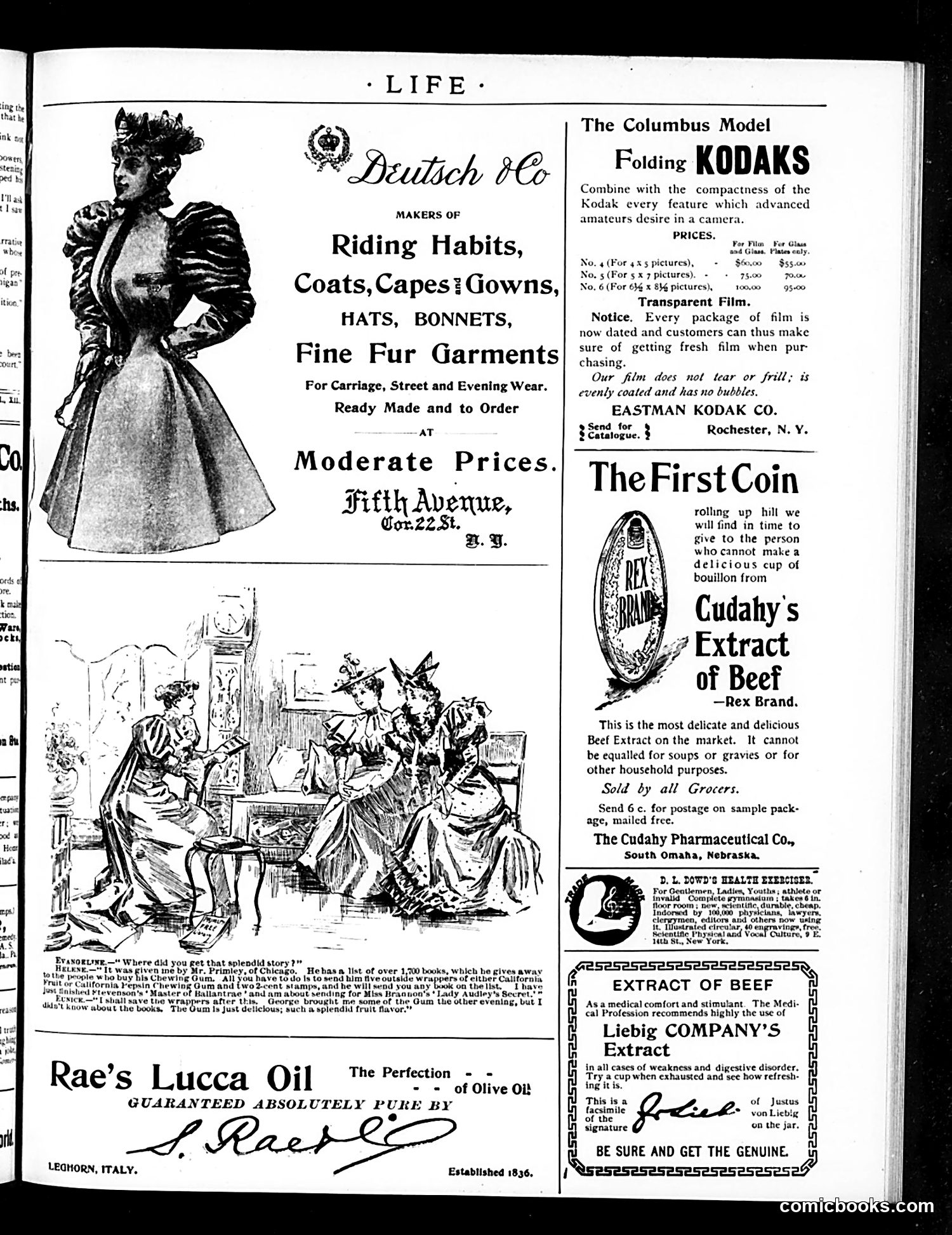
This page is primarily **advertising**, not political satire. The main content consists of period product advertisements (clothing, cameras, beef extract, olive oil) typical of early 1900s *Life* magazine. The one narrative element is a small dialogue joke about **mail-in promotional schemes**. A character describes receiving a book from someone who collected California Pepsin Chewing Gum wrappers to redeem from a Mr. Primley of Chicago, who allegedly distributed 1,700+ books this way. The humor lies in the absurdity of the promotional system—requiring multiple gum purchases and postage stamps just to obtain books like Stevenson's *Master of Ballantrae*. This reflects turn-of-the-century consumer marketing tactics that seem quaint today: brands incentivizing purchases through lengthy redemption processes. The joke mocks both the elaborate scheme and the enthusiast's willingness to participate in such tedious collecting.
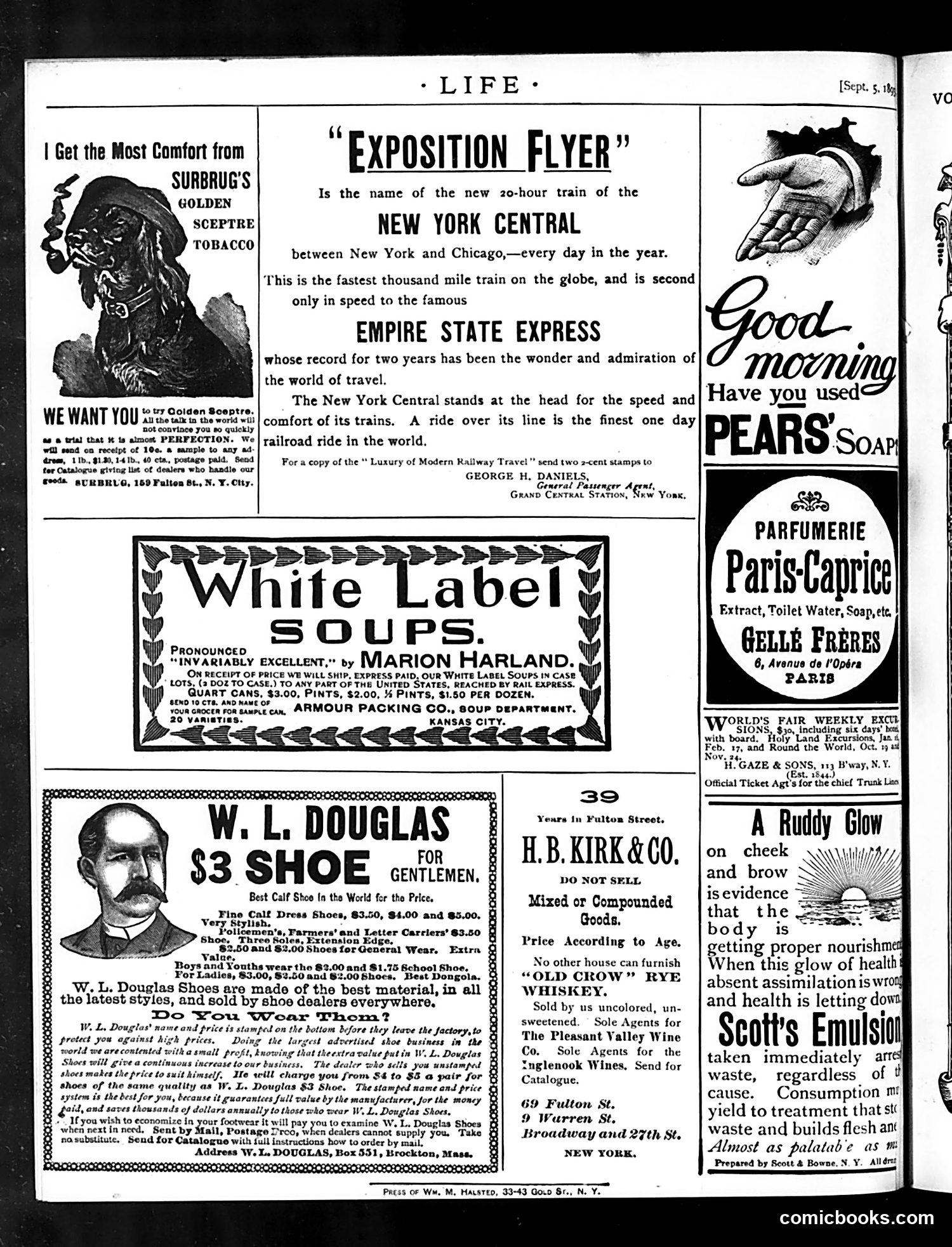
This is primarily an **advertising page** from Life magazine (dated September 5, 1903, based on the header). It contains no political cartoons or satire—rather, it showcases period advertisements. The main content advertises: - **New York Central Railroad's "Exposition Flyer"** train service (20 hours New York to Chicago) - **Surburg's Golden Sceptre Tobacco** - **White Label Soups** (endorsed by Marion Harland, a famous cookbook author) - **W.L. Douglas $3 shoes** for men and women - **Scott's Emulsion** (a cod liver oil health supplement) - Various luxury imports (Paris perfume, whiskey, wines) The only illustrated figure is **W.L. Douglas himself**, shown in a portrait promoting his shoe brand. The ads employ period marketing techniques: celebrity endorsements, value-for-price arguments, and health claims (particularly Scott's Emulsion's promise of "proper nourishment"). This reflects 1903 consumer culture and advertising priorities rather than satirical content.