
Life, 1893-10-05 · page 4 of 16
Life — October 5, 1893 — page 4: what you’re looking at
What you’re looking at
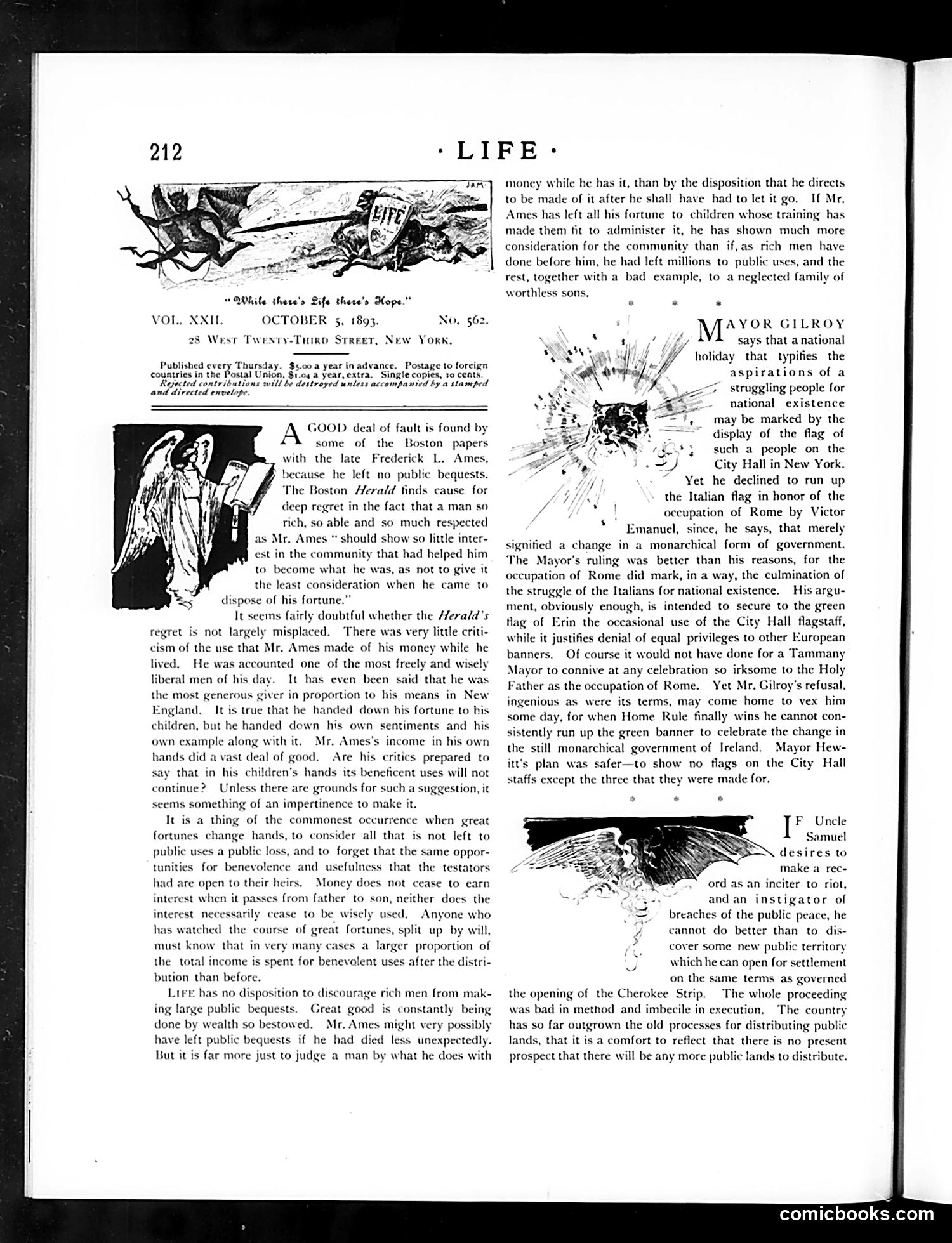
**The Main Cartoon:** The left illustration shows an angel figure holding a scroll labeled "Life," appearing to weep or express sorrow. This visualizes the magazine's criticism of Frederick L. Ames, a wealthy Bostonian who died without making public charitable bequests. **The Satire:** Life attacks Ames for hoarding his fortune rather than using it for community benefit. The text argues that despite being "respected" and wealthy, he showed "little interest in the community" during his lifetime. The angel imagery suggests Life views such selfishness as spiritually lamentable—a failure of moral duty. **Social Context:** This reflects 1890s debates about wealthy industrialists' obligations to society, predating modern philanthropy expectations.
📄 Transcribed text from this page (OCR, searchable)
Machine-transcribed from the original scan — historical spelling and the odd misread are preserved.
* LIFE: “While there's Life there’s Hope.” VOL. XXII. OCTOBER 5, 1893. No, 562. 28 West Twenty-Tuiro Street, New York, Published every Thursday. $s.co a year in advance. Postage to foreign countries in the Postal Union, $1.04 a year, extra. Single copies, 10 cents. Rejected contributions will be destroyed untess accompanied by a stamped and directed envelope. A GOOD deal of fault is found by some of the Boston papers. with the late Frederick L. Ames, ‘ause he left no public bequests. The Boston Herald tinds cause for deep regret in the fact that a man so rich, so able and so much respected Mr. Ames “ should show so little inter- est in the community that had helped him to become what he was, as not to give it the least consideration when he came to dispose of his fortune.” It seems fairly doubtful whether the Herald's ret is not largely misplaced. There was very little criti- cism of the use that Mr, Ames made of his money while he lived. He was accounted one of the most freely and wisely liberal men of his day. It has even been said that he was the most generous giver in proportion to his means in New gland. It is true that he handed down his fortune to his children, but he handed down his own sentiments and his. own example along with it. Mr. Ames's income in his own hands did a vast deal of good. Are his critics prepared to say that in his children’s hands its beneficent uses will not continue? Unless there are grounds for such a suggestion, it seems something of an impertinence to make It is a thing of the commonest occurrence when great fortunes change hands, to consider all that is not left to public uses a public loss, and to forget that the same oppor- tunities for benevolence and usefulness that the testators had are open to their heirs. Money does not cease to earn interest when it passes from father to son, neither does the interest necessarily cease to be wisely used. Anyone who split up by will, must know that in very many cases a larger proportion of the total income is spent for benevolent uses after the distri- bution than before. has watched the course of great fortunes LiFe has no disposition to discourage rich men from mak- ing large public bequests. Great good is constantly being done by wealth so bestowed. Mr. Ames might very possibly have left public bequests if he had died less unexpectedly. But it is far more just to judge a man by what he does with money while he has it, than by the disposition that he directs. to be made of it after he shall have had to let it go. If Mr. Ames has left all his fortune to children whose training has made them fit to administer it, he has shown much more consideration for the community than if, as rich men have done before him, he had left millions to public uses, and the rest, together with a bad example, to a neglected family of worthless sons, Marek GILROY says that a national holiday that typifies the aspirations of a struggling people for national existence may be marked by the display of the flag of such a people on the City Hall in New York. Yet he declined to run up the Italian flag in honor of the occupation of Rome by Victor Emanuel, since, he says, that merely signified a change in a monarchical form of government. The Mayor's ruling was better than his reasons, for the occupation of Rome did mark, in a way, the culmination of the struggle of the Italians for national tence. His argu- ment, obviously enough, is intended to secure to the green lag of Erin the occasional use of the City Hall flagstaff, while it justifies denial of equal privileges to other European banners. Of course it would not have done for a Tammany Mayor to connive at any celebration so irksome to the Holy Father as the occupation of Rome. Yet Mr. Gilroy's refusal, ingenious as were its terms, may come home to vex him some day, for when Home Rule finally wins he cannot con- sistently run up the green banner to celebrate the change in the still monarchical government of Ireland. Mayor Hew- itt’s plan was safer—to show no flags on the City Hall staffs except the three that they were made for. F Uncle Samuel desires to make a ree- ord as an inciter to riot, and an instigator of breaches of the public peace, he cannot do better than to dis- cover some new public territory which he can open for settlement on the same terms as governed the opening of the Cherokee Strip. The whole proceeding was bad in metnod and imbecile in execution. has so far outgrown the old processes for distributing public lands, that it is a comfort to reflect that there is no present prospect that there will be any more public lands to distribute. The country comicbooks.com