
A complete issue · 18 pages · 1893
Life — September 14, 1893
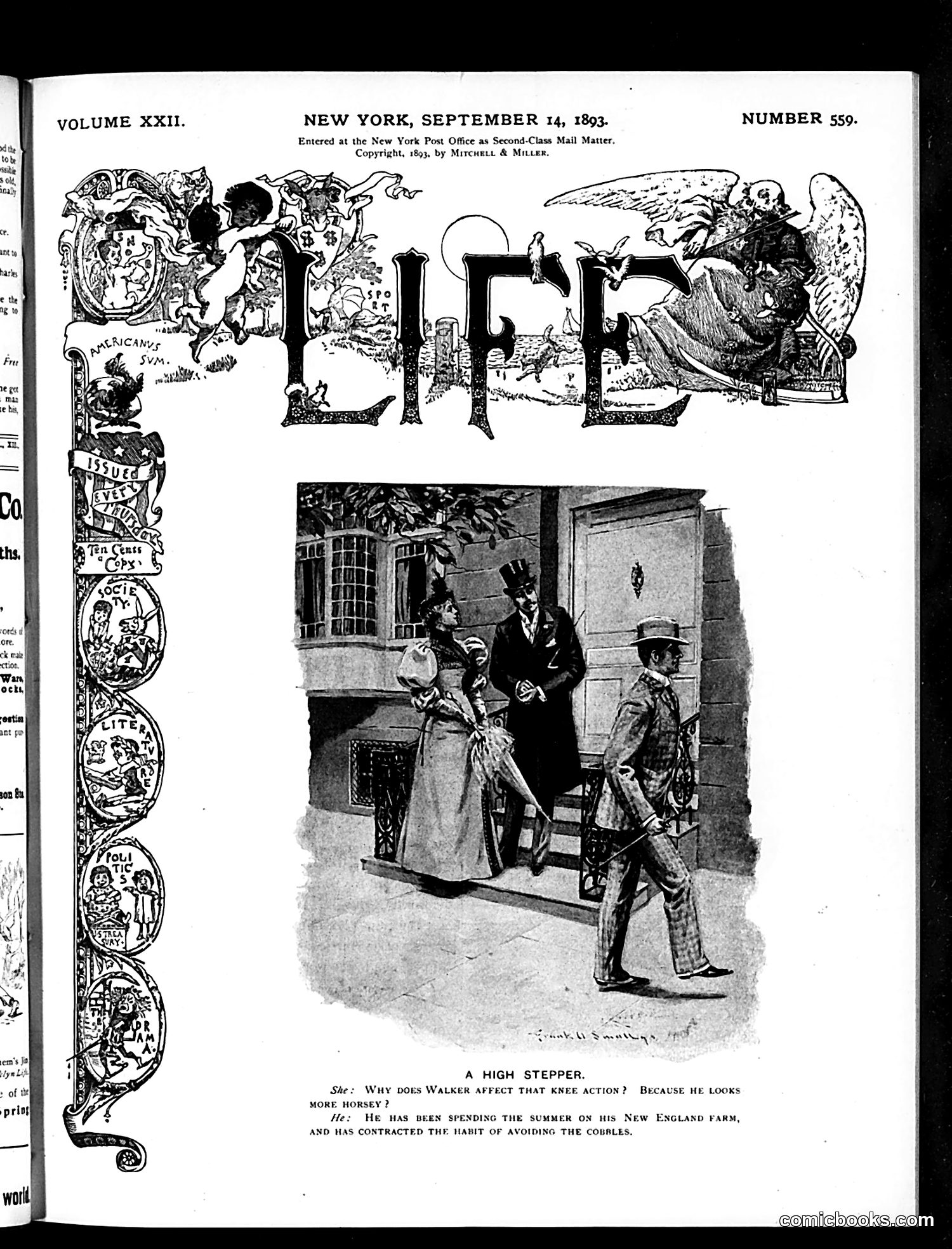
This cartoon satirizes a character named Walker for an exaggerated high-stepping gait. The caption explains the joke: Walker's affected knee action results from spending summer on his New England farm, where he developed "the habit of avoiding the couples"—meaning he's learned to step high to avoid cow manure in pastures. The humor relies on physical comedy and social observation typical of 1890s satire. The illustration shows well-dressed men observing Walker's peculiar walking style on a city street, contrasting urban sophistication with rural clumsiness. The joke mocks both rustic habits and the pretension of city dwellers who notice such behavioral quirks. The decorative border contains heraldic emblems and classical imagery, characteristic of Life's ornate design aesthetic.
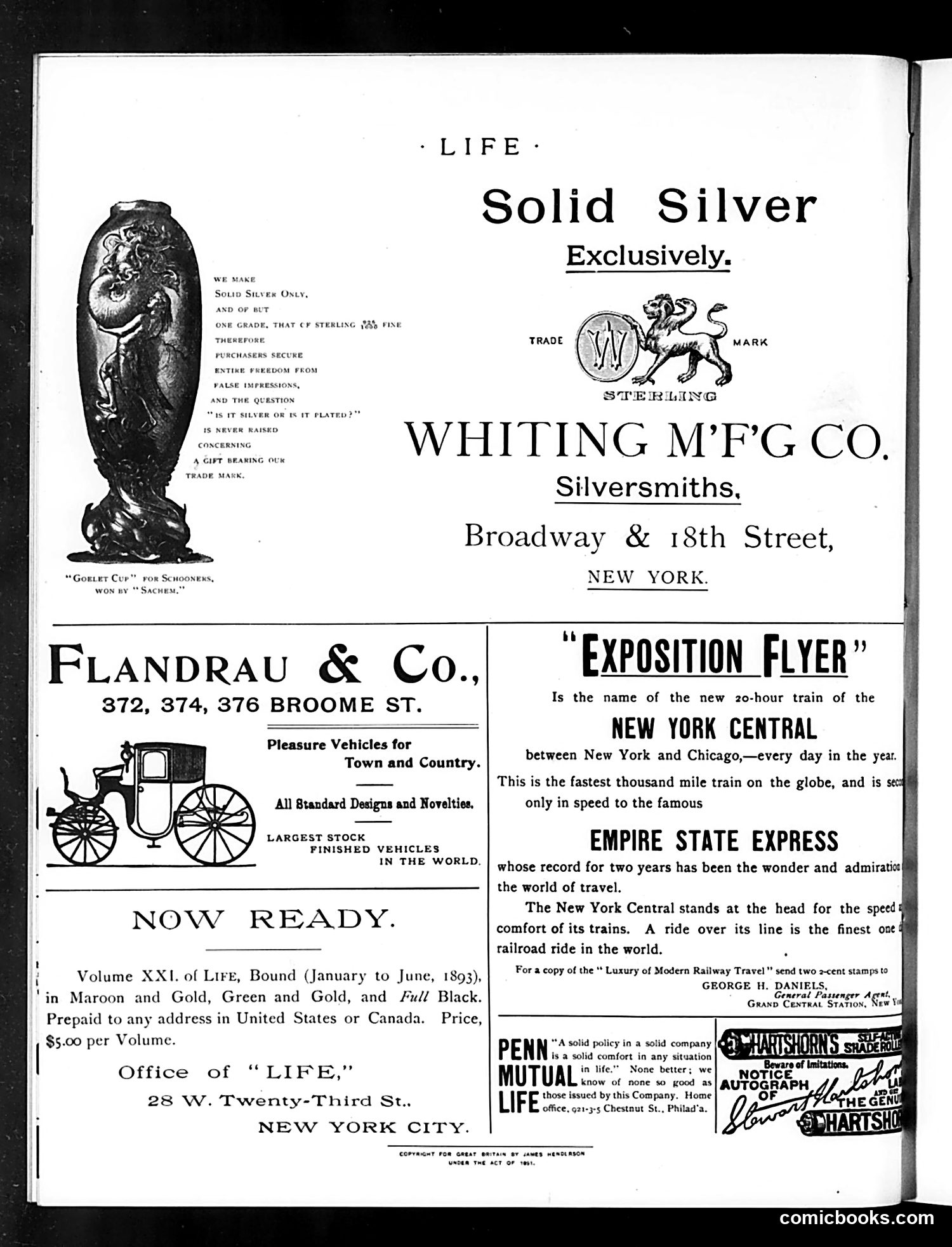
This page is **primarily advertising** with minimal editorial content. The main advertisements are: 1. **Whiting M'f'g Co.** (top right): Promotes solid sterling silver flatware and serving pieces, emphasizing quality and the company's sterling mark. 2. **Flandrau & Co.** (left): Advertises pleasure carriages and vehicles for town and country use, claiming to manufacture "the largest stock of finished vehicles in the world." 3. **Life Magazine subscription** (center-left): Announces Volume XXI bound volumes available in multiple bindings. 4. **New York Central Railroad** (right): Advertises the "Exposition Flyer," a high-speed 20-hour train between New York and Chicago, and the "Empire State Express." The remaining ads promote insurance and photography services. There are no political cartoons or satirical commentary visible on this page—it functions primarily as a vehicle for commercial advertising typical of late-19th-century magazine publishing.
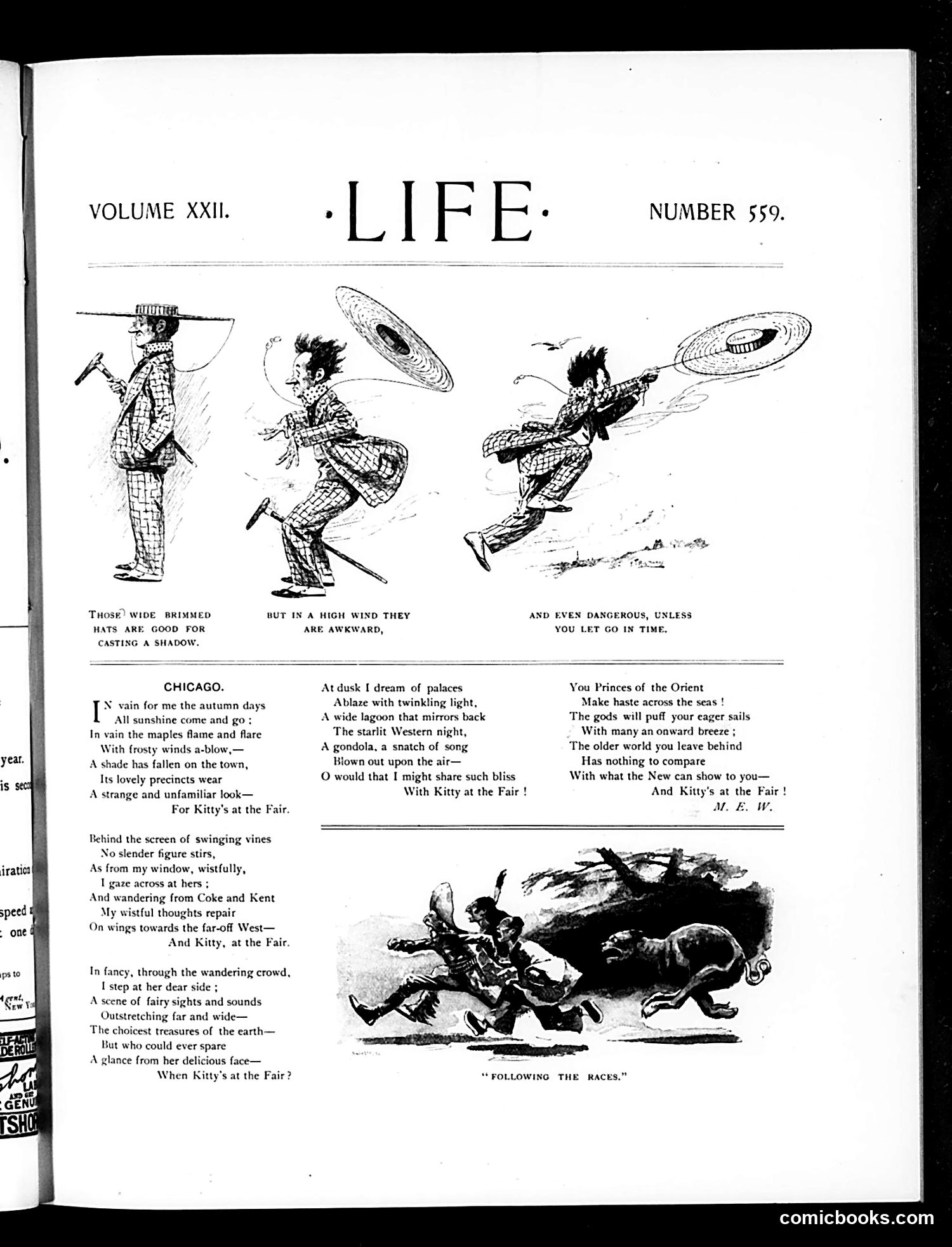
This Life magazine page contains humorous illustrations about windy weather and two literary pieces set at "Kitty's at the Fair." **Top cartoons:** Three sequential drawings depict men struggling with wide-brimmed hats in strong wind—the hats are blown away, requiring desperate chasing. The captions explain the practical joke: such hats "are good for casting a shadow" but become "awkward" and "dangerous" in high wind, requiring you to "let go in time." This is straightforward physical comedy about the perils of fashion in bad weather. **Literary content:** Two poems—"Chicago" and "You Princes of the Orient"—nostalgically reference "Kitty's at the Fair," apparently a popular social venue or fair attraction. The bottom illustration shows people chasing/following horses at races, labeled "Following the Races," supporting the fair setting. The humor is gentle, focusing on leisure and romantic daydreaming rather than political satire.
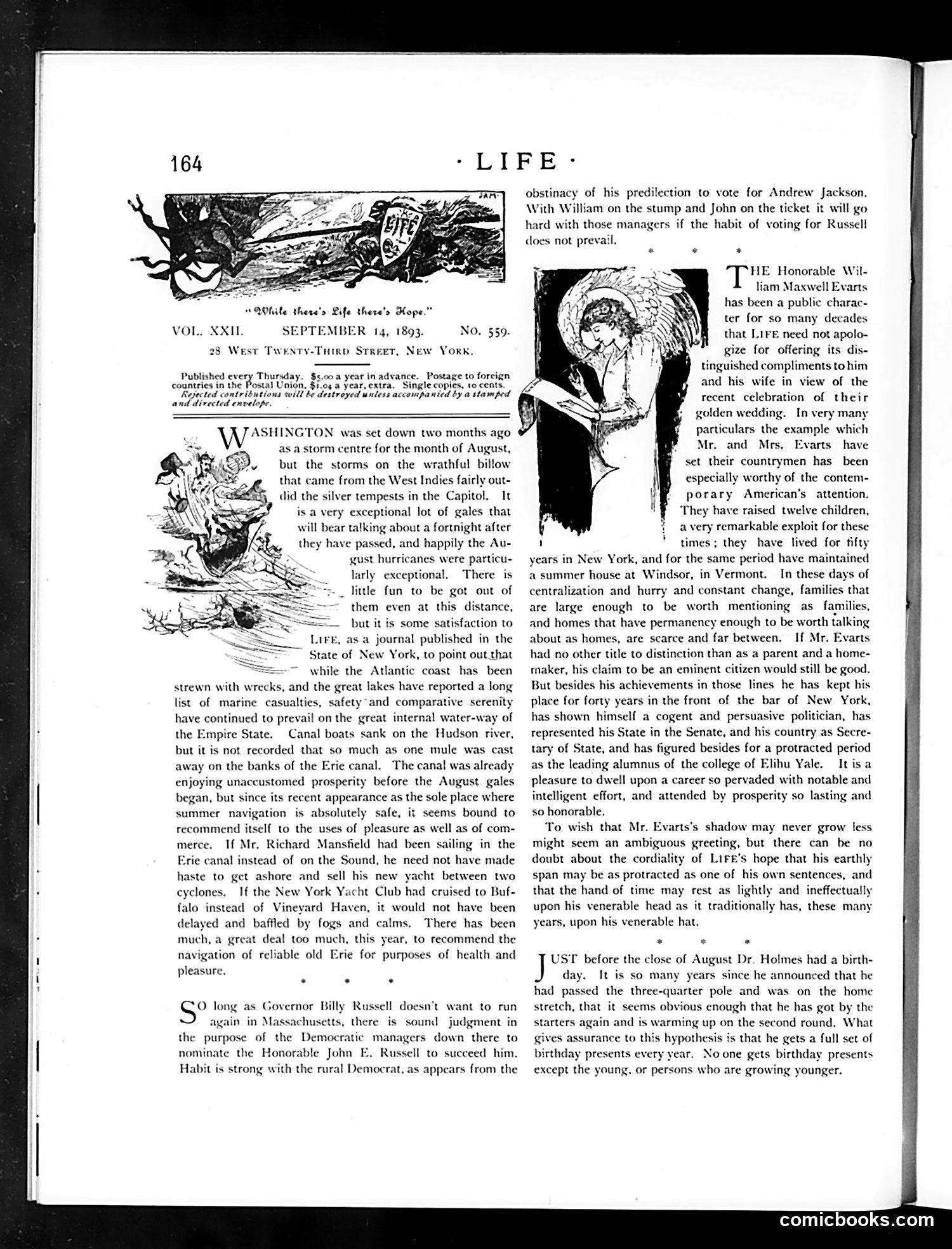
**Top Cartoon**: The caption "What's there's Life there's Hope" accompanies an illustration of a shipwreck or disaster scene with debris. This appears to be commentary on maritime casualties along the Atlantic coast—the text references wrecks, marine disasters, and the safety record of vessels like canal boats on the Hudson and Erie Canal. The satire seems to mock false optimism about navigation safety during a period of documented maritime accidents. **Main Article**: Discusses Governor Billy Russell and Democratic party maneuvering in Massachusetts politics regarding his potential re-nomination. The text expresses skepticism about Russell's electoral viability, suggesting party managers seek an alternative candidate (John E. Russell) instead. **Secondary Content**: Offers compliments to William Maxwell Evarts on his golden wedding anniversary, noting his distinguished public service record.
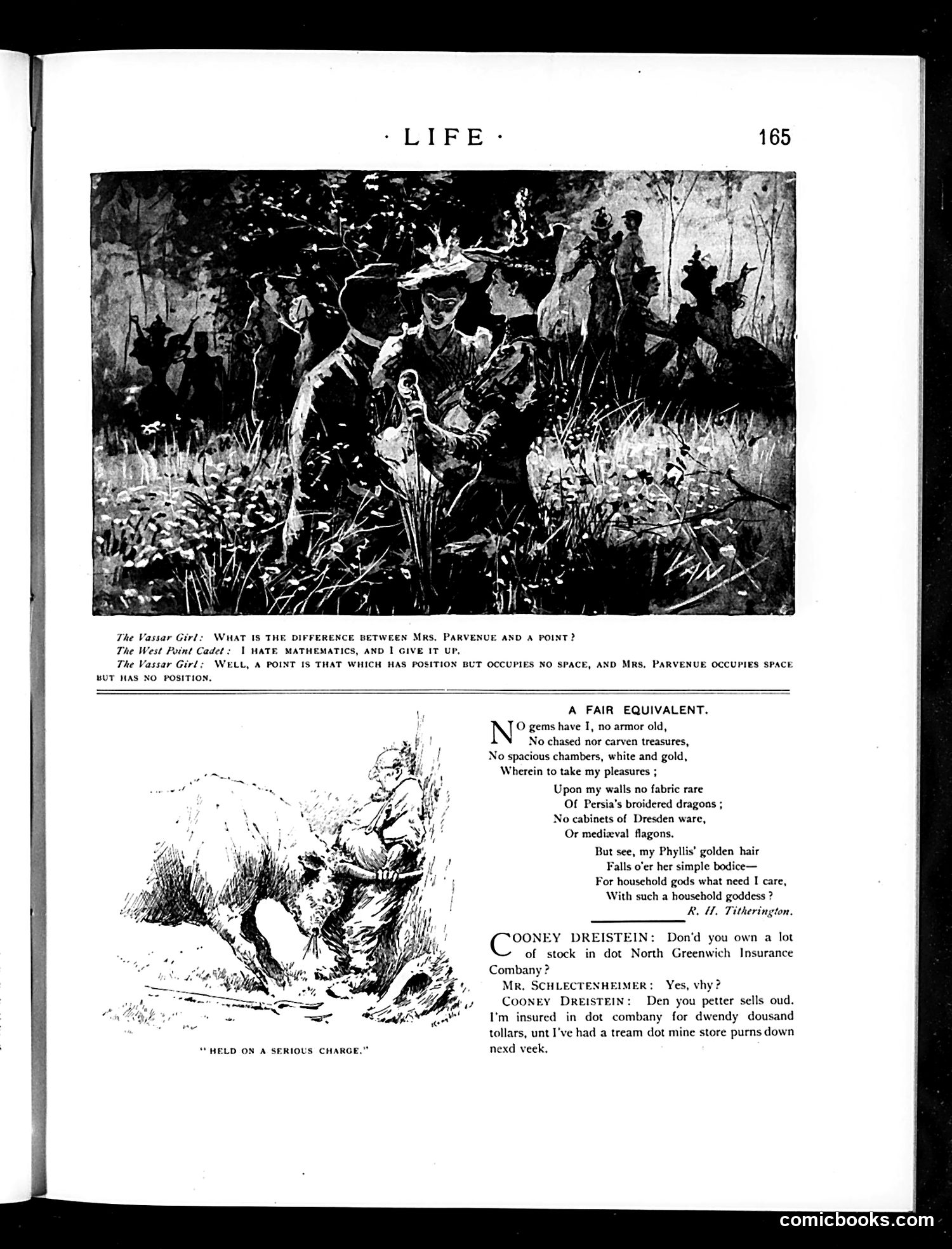
The top cartoon depicts a dialogue between two West Point cadets and a Vassar girl about mathematics. The cadets claim a point "has position but occupies no space," while Mrs. Parvenue "occupies space but has no position"—a sexist joke equating social status with mathematical properties. Below, "A Fair Equivalent" is a poem by R.H. Titterington contrasting material luxuries with simple domestic happiness, likely satirizing wealthy materialism. The final section shows a conversation between Cooney Dreistein and Mr. Schlechtenheimer about insurance stocks. Dreistein boasts of being insured for "twenty thousand dollars" after a store fire, implying either fraud or opportunistic profiteering—satirizing get-rich-quick schemes and questionable business practices of the era.
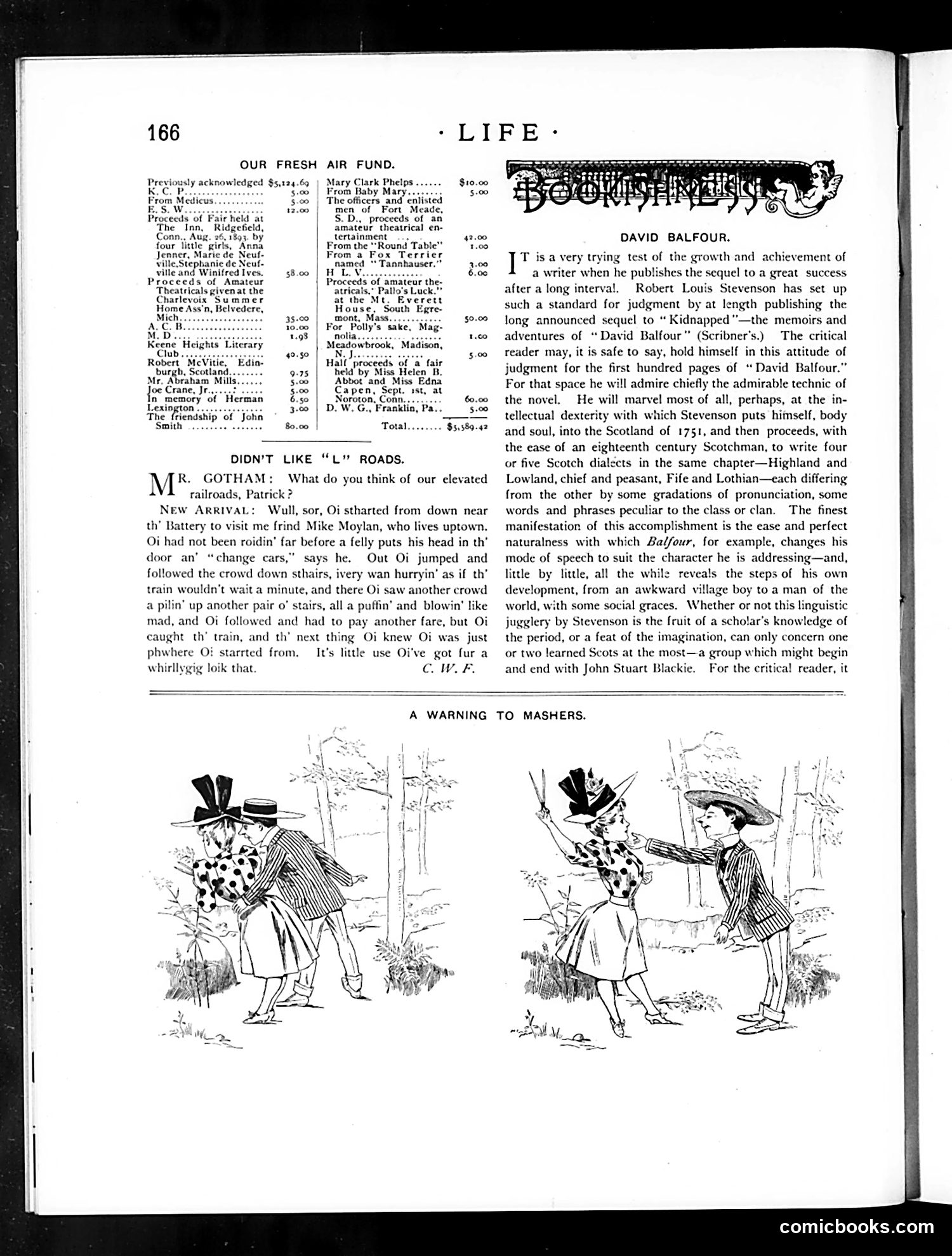
This cartoon depicts two scenes warning against aggressive male behavior toward women in public spaces. In both panels, a young woman wearing a hat and patterned dress encounters a man in formal attire (top hat and pinstriped suit). In the left panel, the man appears to be making unwanted advances. In the right panel, the woman retaliates by striking him with her parasol. The satire targets "mashers"—contemporary slang for men who made unsolicited romantic or sexual advances toward women on streets. The cartoon humorously advocates that women defend themselves physically against such harassment. This reflects early 20th-century social concerns about public decorum and women's safety, while also suggesting female empowerment through self-defense rather than passive acceptance of unwanted attention.
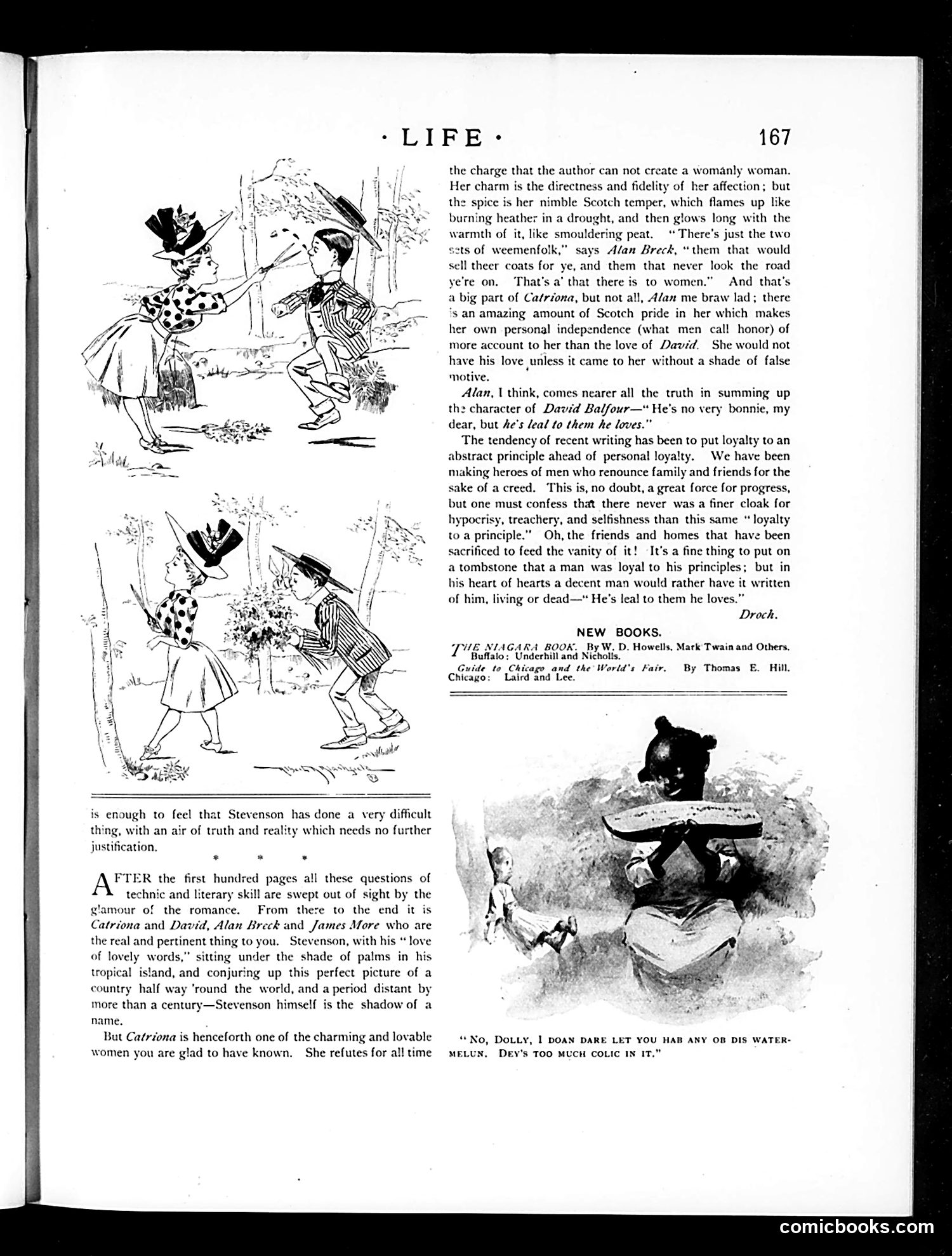
This page primarily contains a literary review discussing Robert Louis Stevenson's novel *Catriona*, featuring two similar ink illustrations of a man and woman in period dress (appearing to be Scottish, matching the novel's setting) engaged in playful interaction outdoors. The cartoons themselves are not political satire but rather decorative illustrations accompanying the book review. The text praises the female character Catriona for her charm, Scottish pride, and fidelity—noting her "nimble Scotch temper" and independence. The review concludes that loyalty to personal relationships matters more than abstract principles. A separate illustration at bottom-right shows a bear and child with a caption about avoiding water melons due to colic—likely an unrelated humorous spot illustration or advertisement.
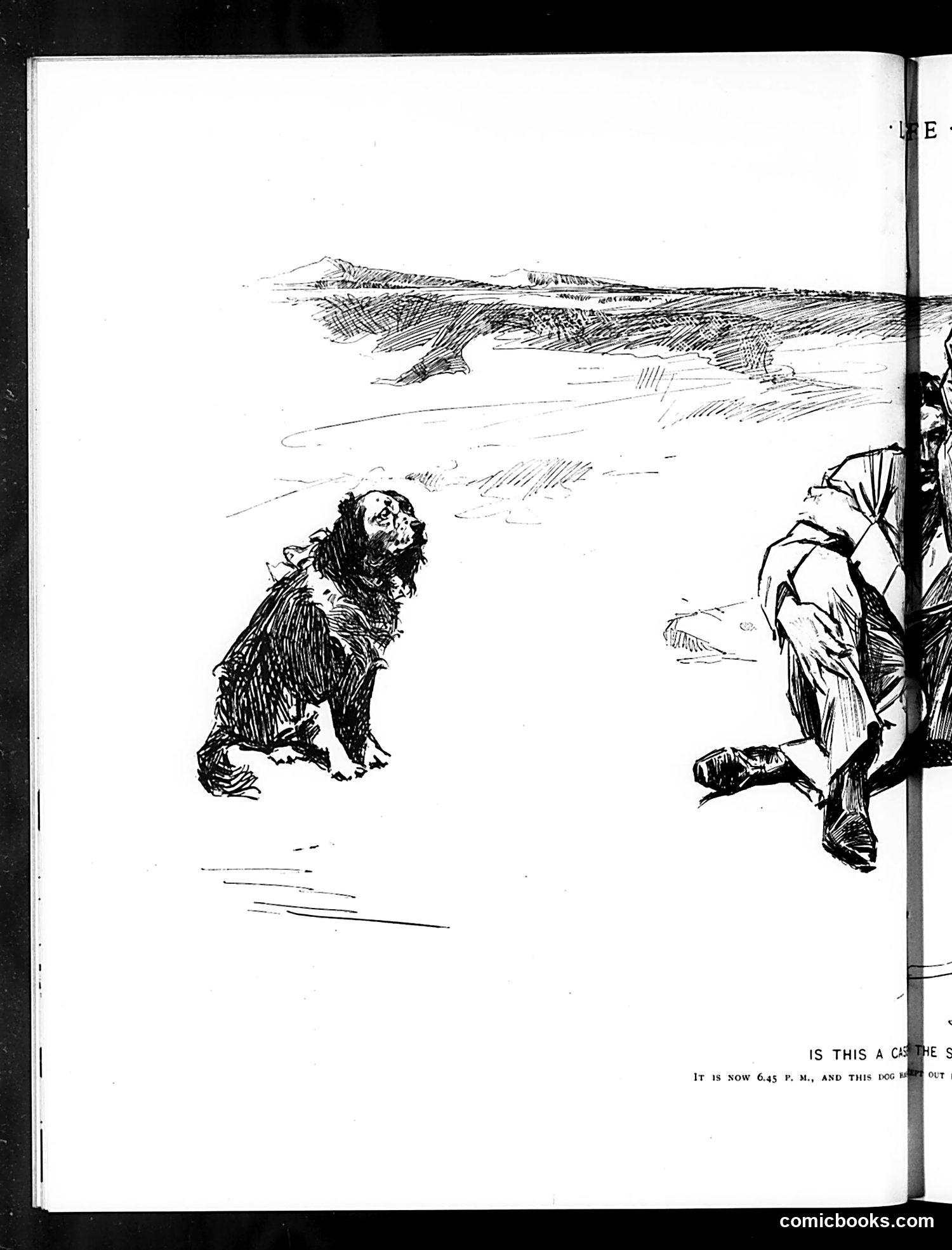
This is a satirical illustration from Life magazine showing a dog sitting in an open landscape, with a person crouching or bending on the right side. The OCR text reads "IS THIS A C[...] THE S[...]" and "IT IS NOW 6.45 P.M., AND THIS DOG KEPT OUT[...]" The cartoon appears to be a joke about a dog being let outside at a specific time (6:45 P.M.). Without the complete text, the full satirical point is unclear, but it likely comments on either pet ownership practices, punctuality, or domestic routines of the era. The illustration's careful attention to the dog's posture and the human's gestures suggests the humor derives from their interaction or the timing involved. The rural setting adds context, though the precise social or political commentary remains incomplete without legible text.
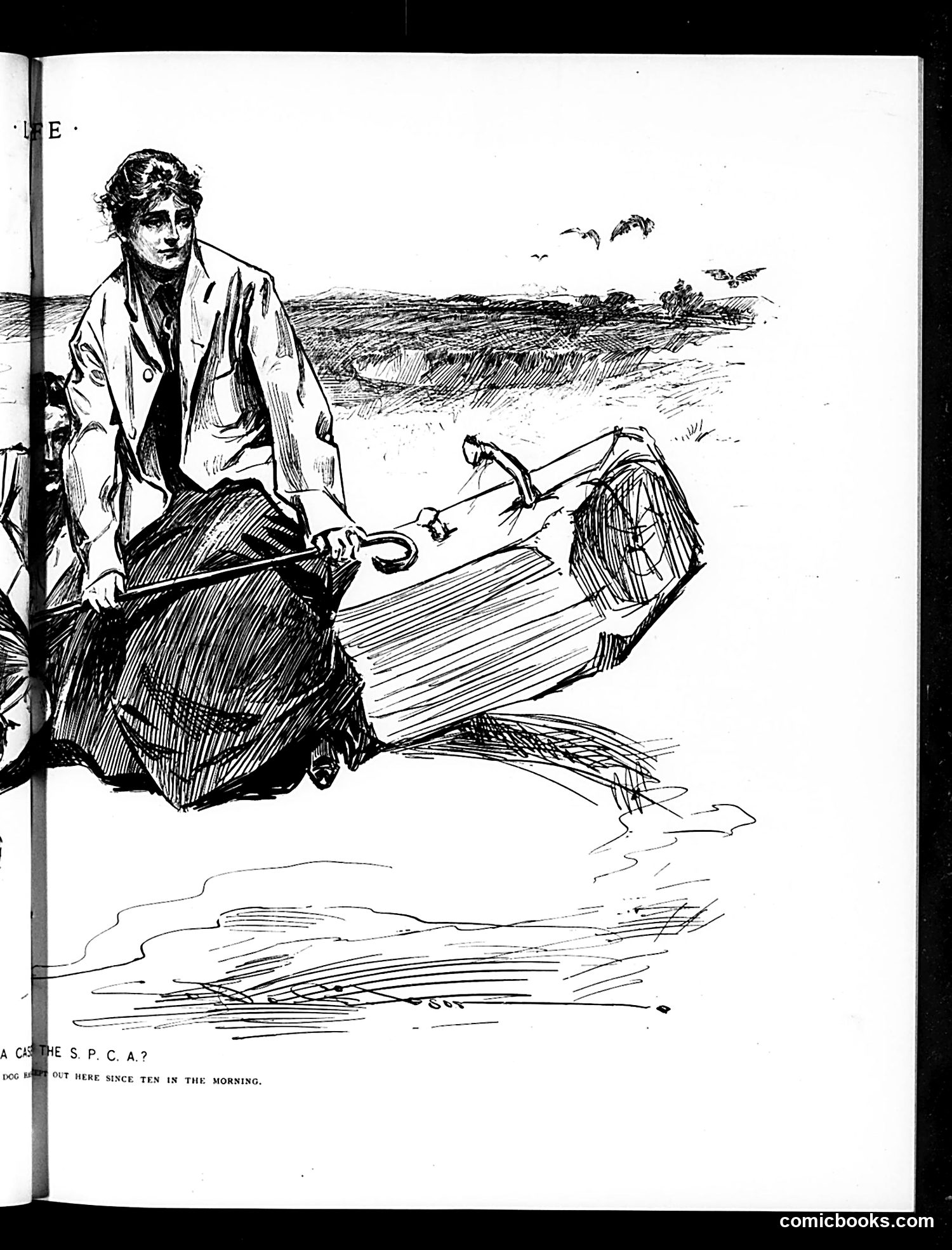
This appears to be a satirical cartoon from *Life* magazine showing a well-dressed man sitting by water, holding what looks like a dead fish or animal. The text references "A CASE THE S.P.C.A.?" and "DOG LEFT OUT HERE SINCE TEN IN THE MORNING." The cartoon mocks someone—likely a wealthy or prominent figure—for animal cruelty or neglect. The S.P.C.A. (Society for the Prevention of Cruelty to Animals) reference suggests the cartoon criticizes either actual animal abuse or the hypocrisy of someone who claims to care about animals while mistreating them. The rural setting and the man's formal dress contrast sharply, emphasizing the absurdity or callousness of the depicted behavior. The satire targets attitudes toward animal welfare, a growing social concern in the early 20th century.
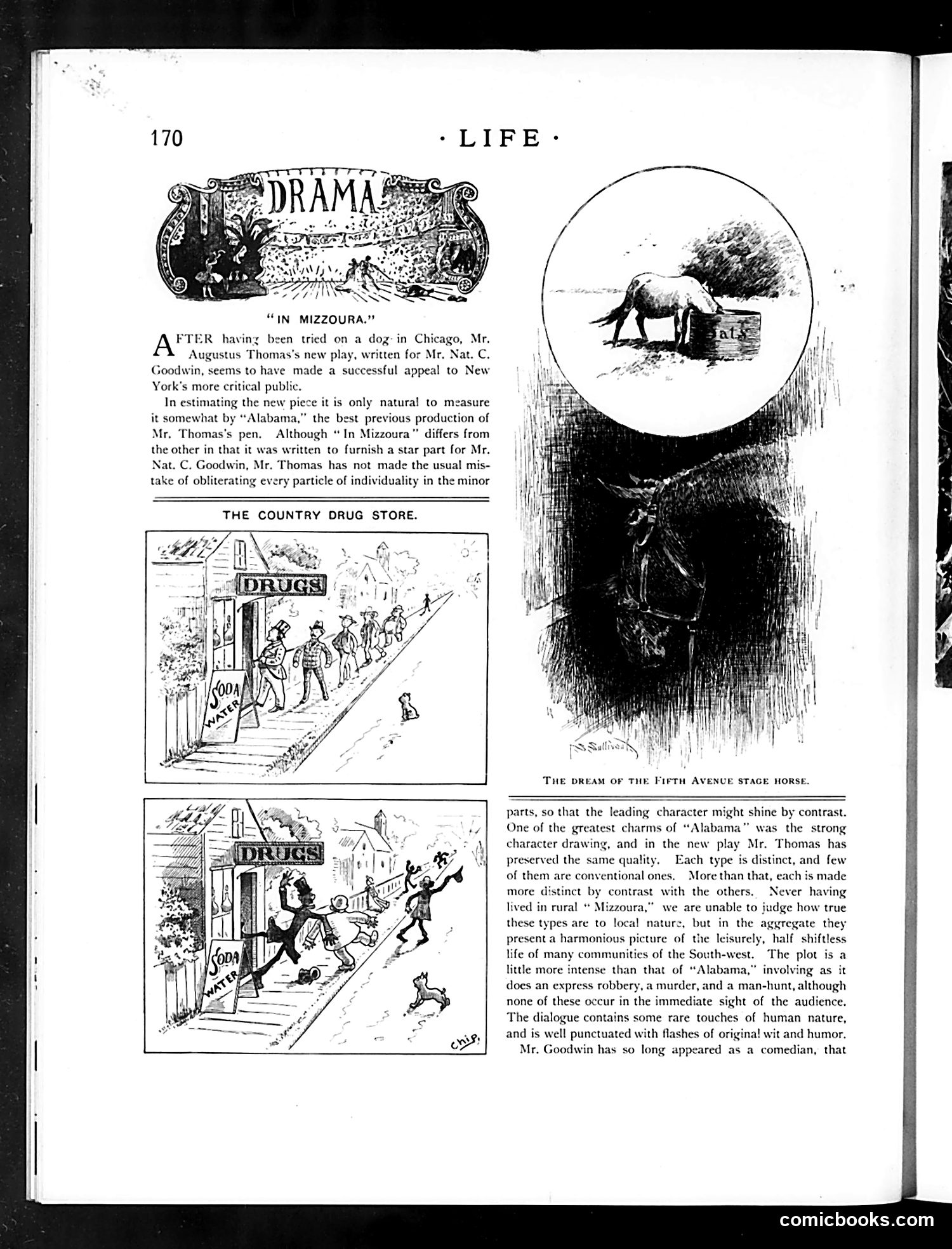
This page reviews Mr. Nat C. Goodwin's theatrical production "In Mizzoura," written by Augustus Thomas. The review favorably compares it to Thomas's earlier success "Alabama," noting that "Mizzoura" doesn't sacrifice individual character details for star vehicles. The two cartoons labeled "The Country Drug Store" depict a comedic scene outside a rural pharmacy—likely satirizing small-town life and social dynamics of the American South/Southwest setting depicted in the play. The illustration on the right, "The Dream of the Fifth Avenue Stage Horse," shows a horse imagining rural scenery, humorously contrasting urban and rural environments—possibly commenting on theatrical escapism or the play's setting. The review emphasizes the dialogue's wit and the play's realistic portrayal of Southeastern community life.
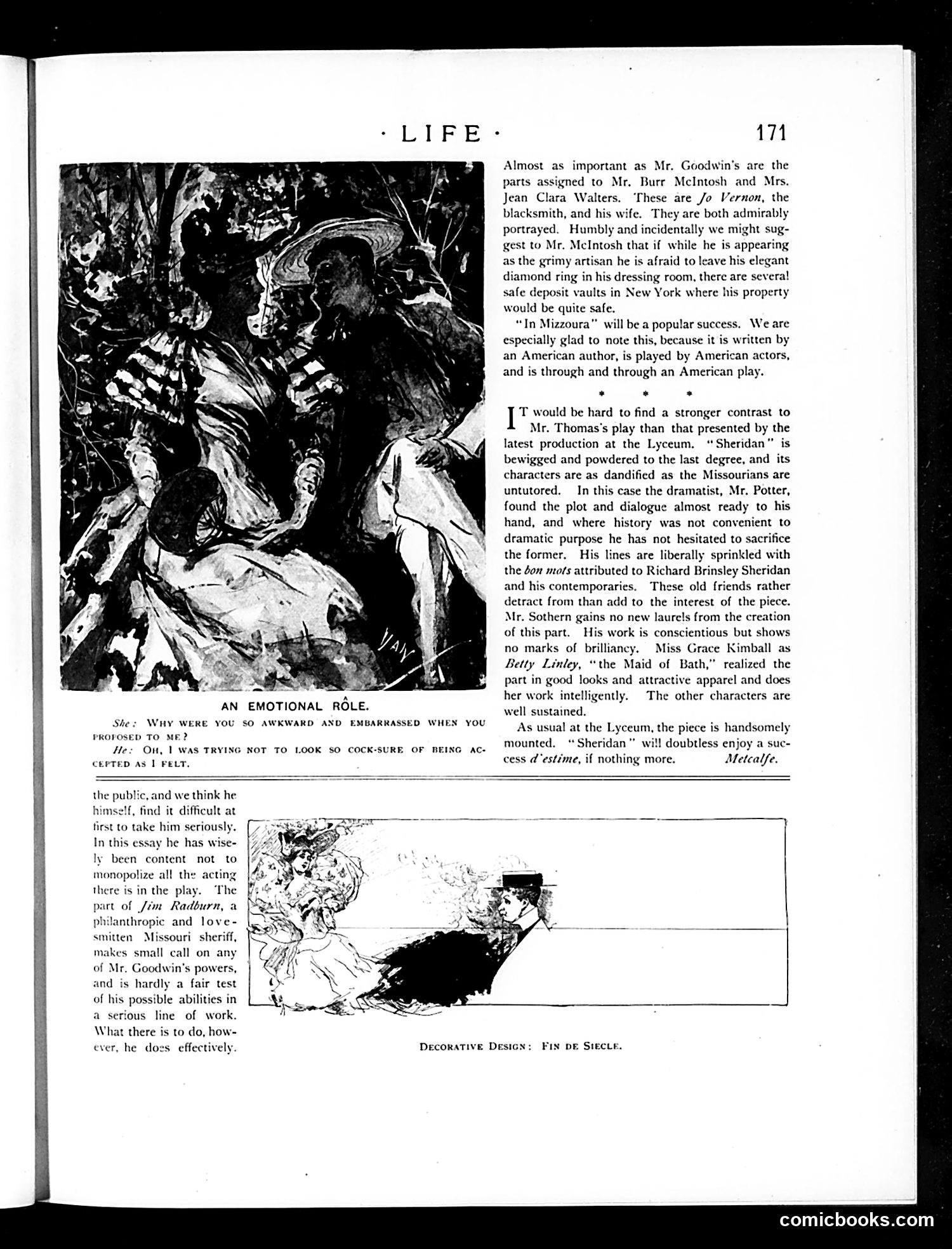
This page reviews theatrical productions. The main image shows a dramatic scene labeled "AN EMOTIONAL ROLE," depicting what appears to be a period costume drama with two figures in an intense moment. The text discusses Mr. Thomas's play "Sheridan," which the reviewer describes as heavily powdered and artificial, with characters "as dandified as the Missourians are untutored." The critic praises the dramatist's willingness to sacrifice historical accuracy for dramatic effect, noting the dialogue uses affected language ("bon mots") associated with Sheridan and his contemporaries. The lower illustration labeled "DECORATIVE DESIGN: FIN DE SIECLE" appears to be a decorative vignette, possibly satirizing fin-de-siècle artistic affectation through its refined, delicate style. The review concludes that despite the production's handsome mounting at the Lyceum theater, the play offers only superficial entertainment value.
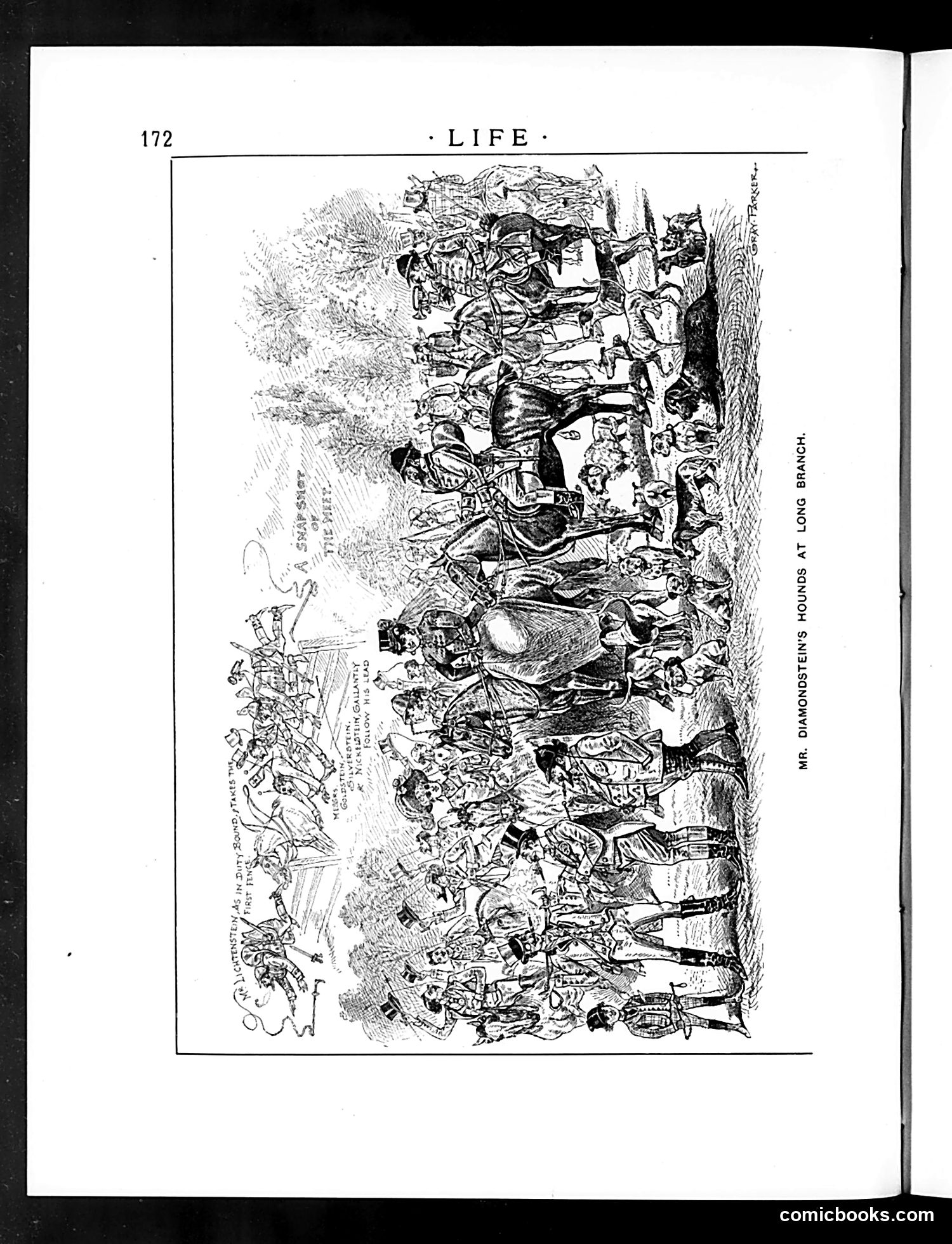
I can see this is a page from Life magazine (page 172) featuring a detailed satirical illustration titled "MR. DIAMONDSTEIN'S HOUNDS AT LION'S BRANCH" (based on the visible text on the right margin). The image appears to be a crowded scene with numerous figures in what looks like a chaotic social gathering or hunting scene. However, the OCR text is severely corrupted and unreadable, making it impossible to identify specific individuals, understand the particular satire, or explain the political/social references with confidence. To accurately explain this cartoon's meaning to a modern reader, I would need either clearer source text or additional context about the historical moment and individuals it references. The illustration's style and crowded composition suggest social commentary, but I cannot responsibly identify who "Diamondstein" is or what specific contemporary event is being satirized.
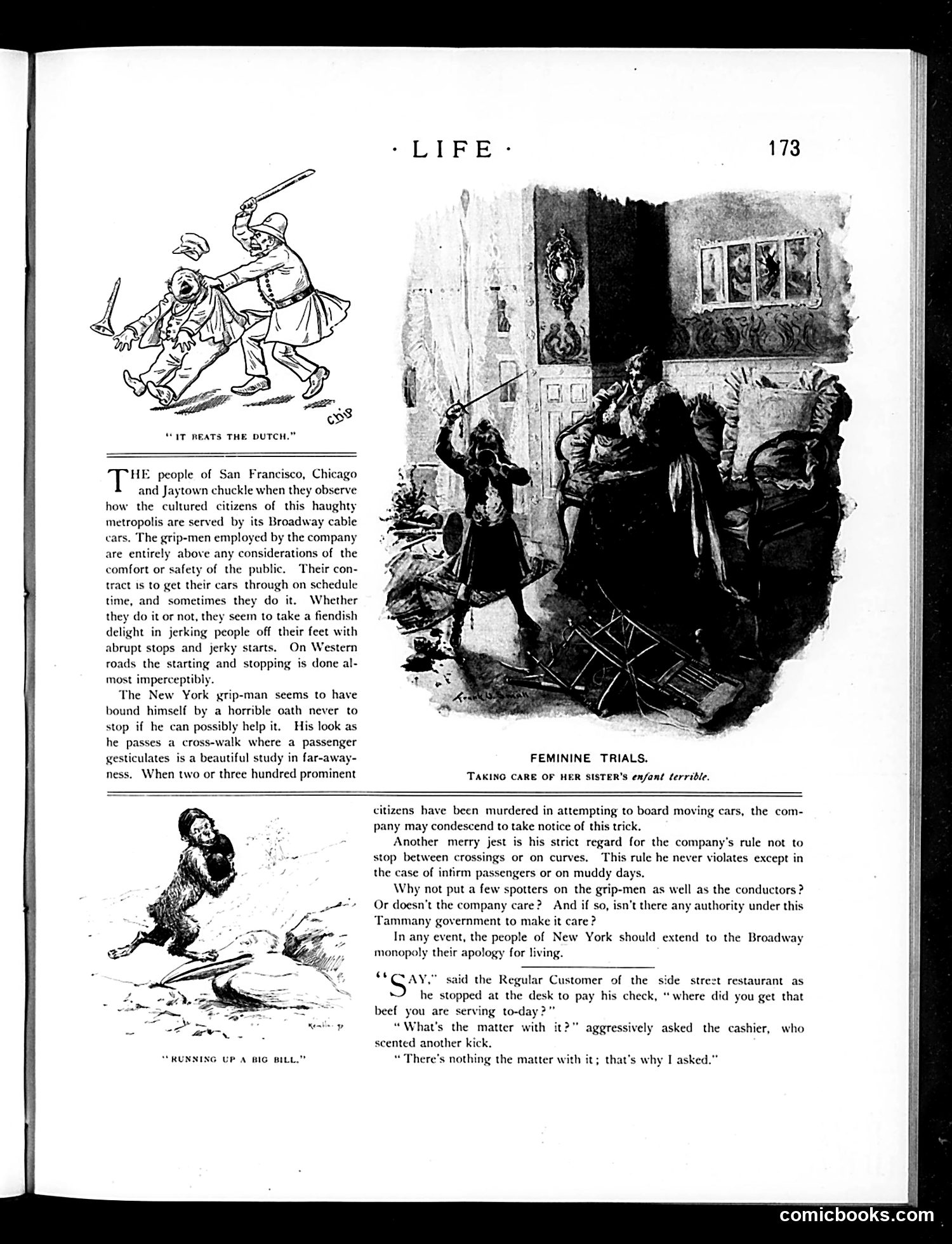
This page satirizes New York City's Broadway cable car system and its operators (called "grip-men"). The text mocks how cable car drivers prioritize schedule adherence over passenger safety, jerking people with abrupt stops and starts while ignoring those trying to board. The satire contrasts this with Western railroads' smoother operation. The cartoons illustrate passenger mistreatment: "It Beats the Dutch" shows a grip-man assaulting a passenger; "Running Up a Big Bill" depicts someone knocked down. The text references "Tammany government" (New York's corrupt political machine), suggesting regulatory failure. A separate joke about "Feminine Trials" shows a woman managing an unruly child (an "enfant terrible"), while another anecdote mocks poor beef quality at a side-street restaurant. Overall, the page critiques New York City's public services and Tammany Hall's governance.
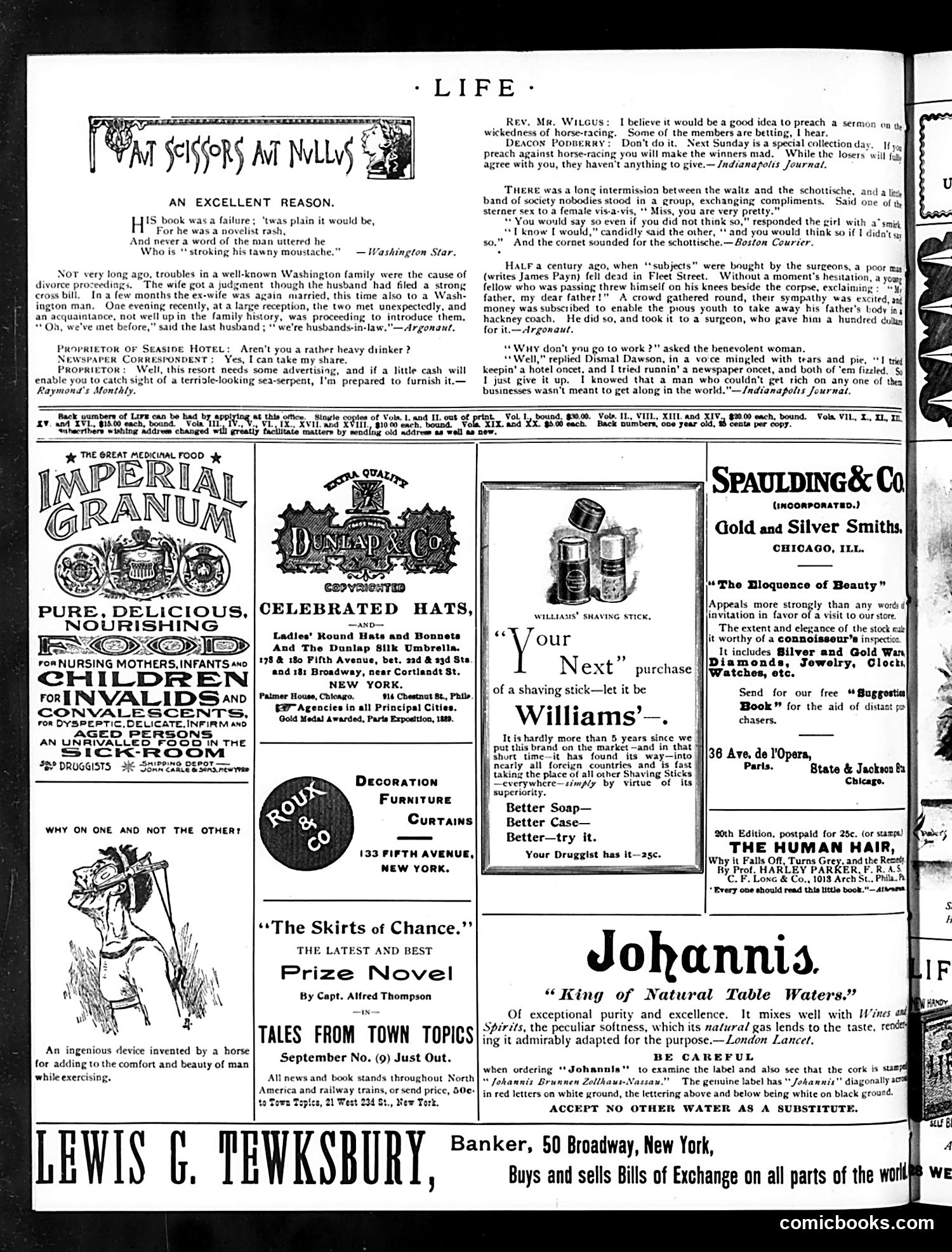
This page is primarily **advertising and humor anecdotes**, not political cartoons. The content consists of brief, disconnected jokes satirizing American social life circa the 1880s-1890s. The humor targets: - **Vanity and dishonesty**: A novelist "stroking his tawny moustache" (affected pretension) - **Divorce and remarriage**: A Washington scandal where a man remarries his ex-wife's ex-husband, creating awkward social situations - **Hypocrisy**: A clergyman avoiding temperance sermons because they'd alienate wealthy church donors - **Opportunism**: A street beggar exploiting a corpse for money by pretending it's his dead father - **Failed ambition**: A man who failed at hotel-keeping and newspapers resigns himself to poverty The cartoons mock middle-class social conventions, greed, and self-deception rather than specific political figures. The page is mostly filled with period advertisements for hair products, cordial furniture, and patent medicines.
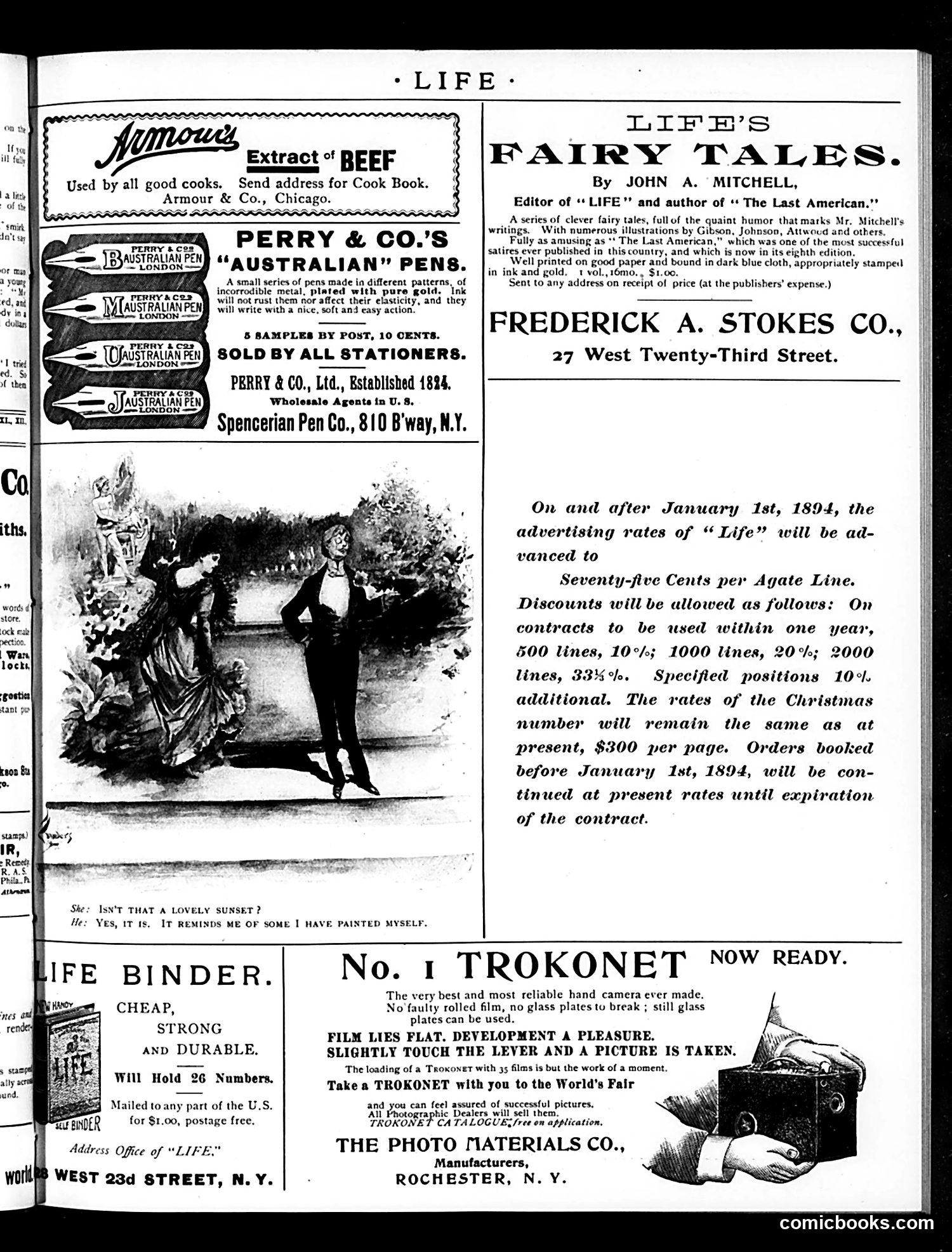
This page is primarily **advertising and announcements** rather than satirical content. The small cartoon depicts a couple viewing a sunset; the man claims the view reminds him of sunsets he himself has painted—a gentle joke about artistic pretension or amateur painters overestimating their abilities. The substantive content announces: 1. **"Life's Fairy Tales"** by editor John A. Mitchell—a book of humorous stories with illustrations, marketed as similarly successful to his earlier work *The Last American* 2. **Rate increases effective January 1, 1894**: Life's advertising costs are rising to 75 cents per agate line, with volume discounts offered 3. **Product advertisements**: Perry & Co. pens, Life binders, and the No. 1 Trokonet camera (promoting it for use at the upcoming World's Fair) The page reflects late-19th-century magazine operations—mixing editorial promotion with commercial advertising to sustain publication.
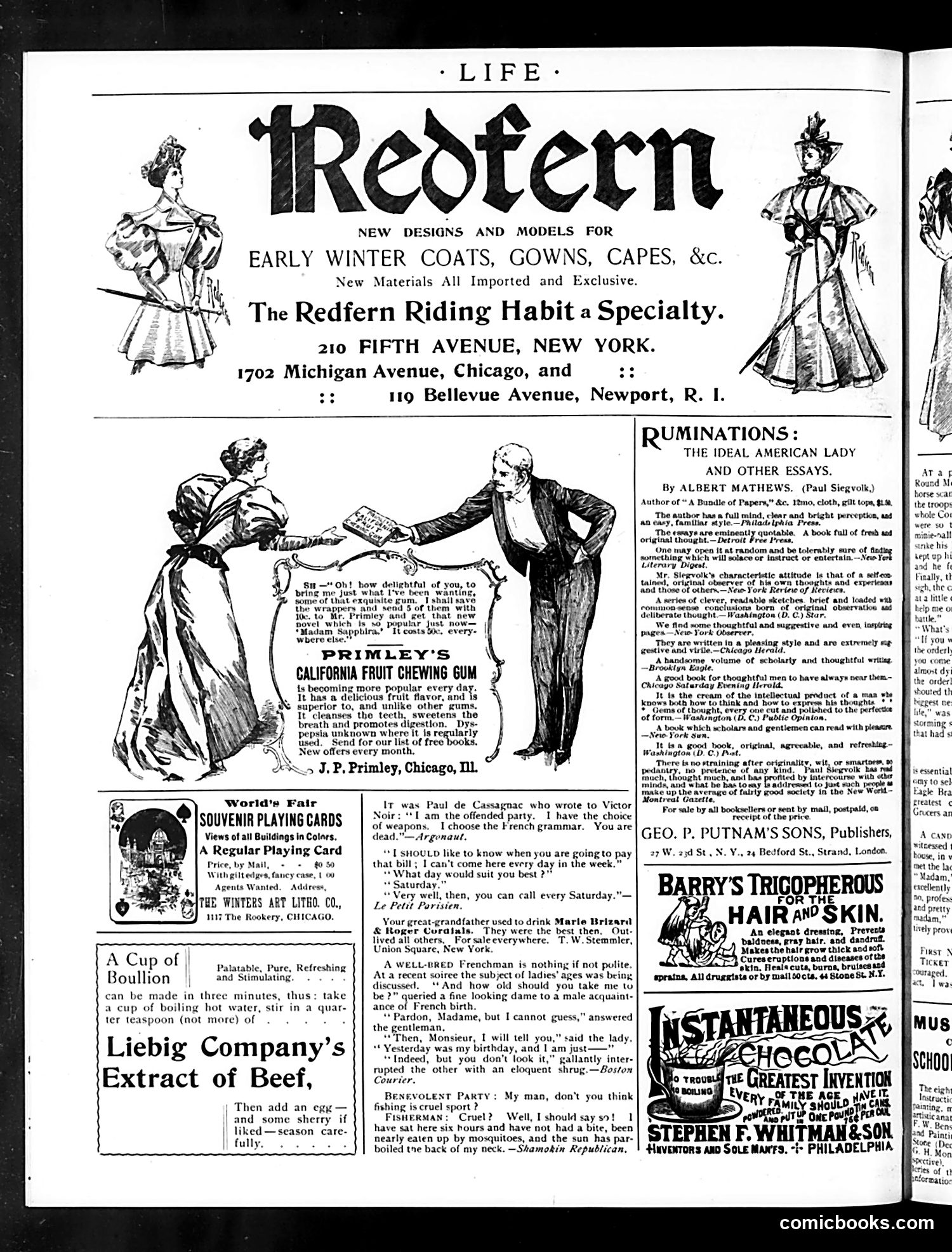
This is primarily a **commercial advertising page**, not political satire. The dominant content features ads for high-end fashion (Redfern clothing), chewing gum (Primley's), playing cards, beef extract, and other products. The small satirical elements are scattered anecdotes in the margins—lighthearted jokes about French politeness, a duel story, and domestic comedy (a woman saving gum wrappers to get a novel). These are **not political cartoons** but rather the sort of gentle social humor typical of Life magazine's lighter content. The page reflects early 20th-century American consumer culture: luxury goods marketed to wealthy readers, along with whimsical diversions. The artwork shows fashionably dressed women in elaborate coats and gowns—reflecting period fashion standards for the affluent. There's **no apparent political commentary or social critique**—just ads and mild jokes.
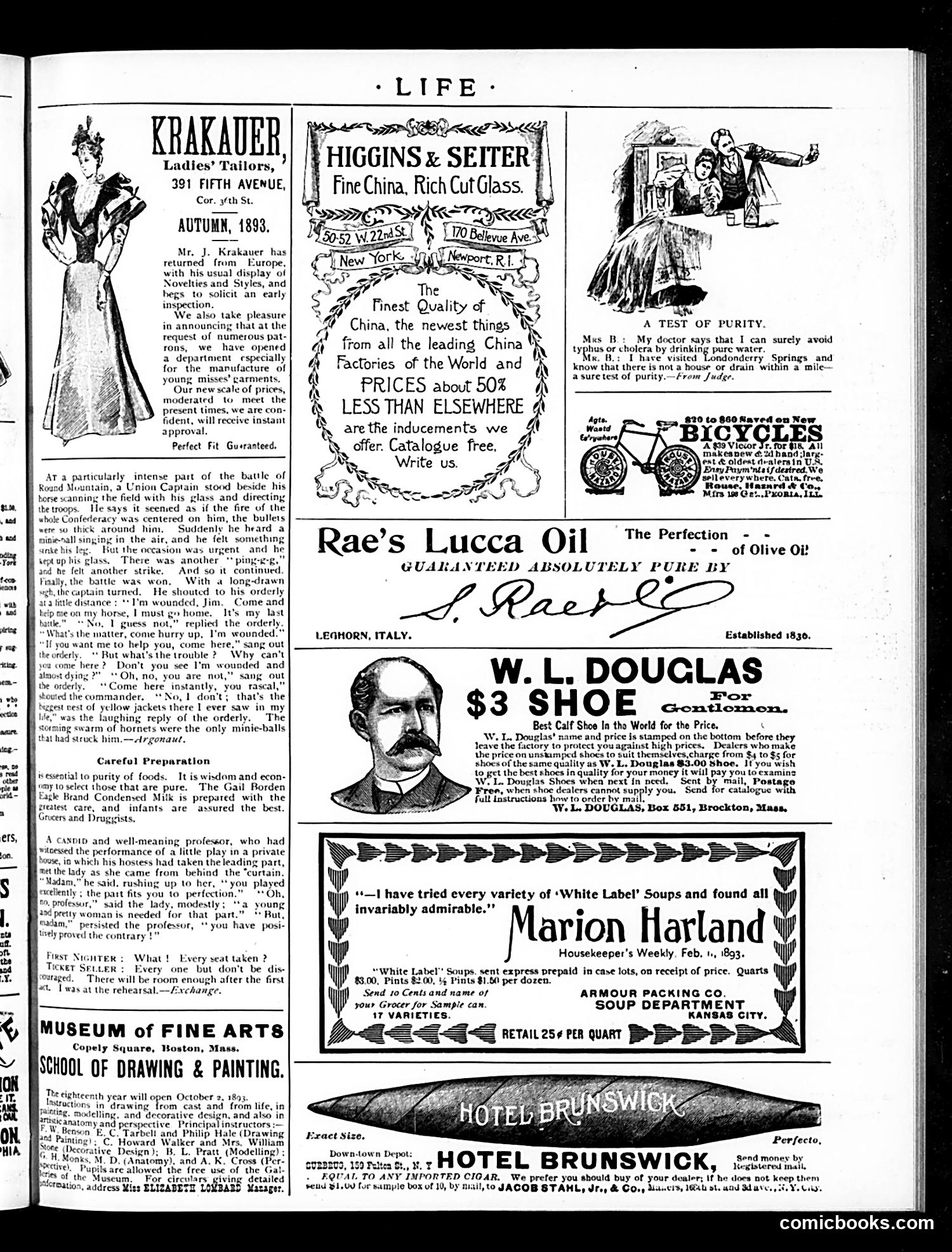
This is primarily an **advertising page** with minimal editorial cartoon content. The few short humorous pieces are typical *Life* magazine filler jokes: 1. **"Round Mountain" anecdote**: A Civil War story (appears to be from the 1860s, reprinted) where a Union captain mistakes hornet stings for bullet wounds—satire on military confusion or hypochondria. 2. **"A Test of Purity"**: A brief joke about water safety and typhoid—relevant to 1890s public health anxieties about contaminated water supplies. 3. **Professor anecdote**: A mild joke about a professor complimenting an actress, accidentally insulting her appearance. The advertisements dominate—china, bicycles, shoes, soup, olive oil, a hotel. The **"Test of Purity"** ad is notably ironic: it claims Londonderry Springs water is pure *because* no houses or drains exist nearby, reflecting contemporary understanding that sanitation and proximity to human waste indicated water safety.
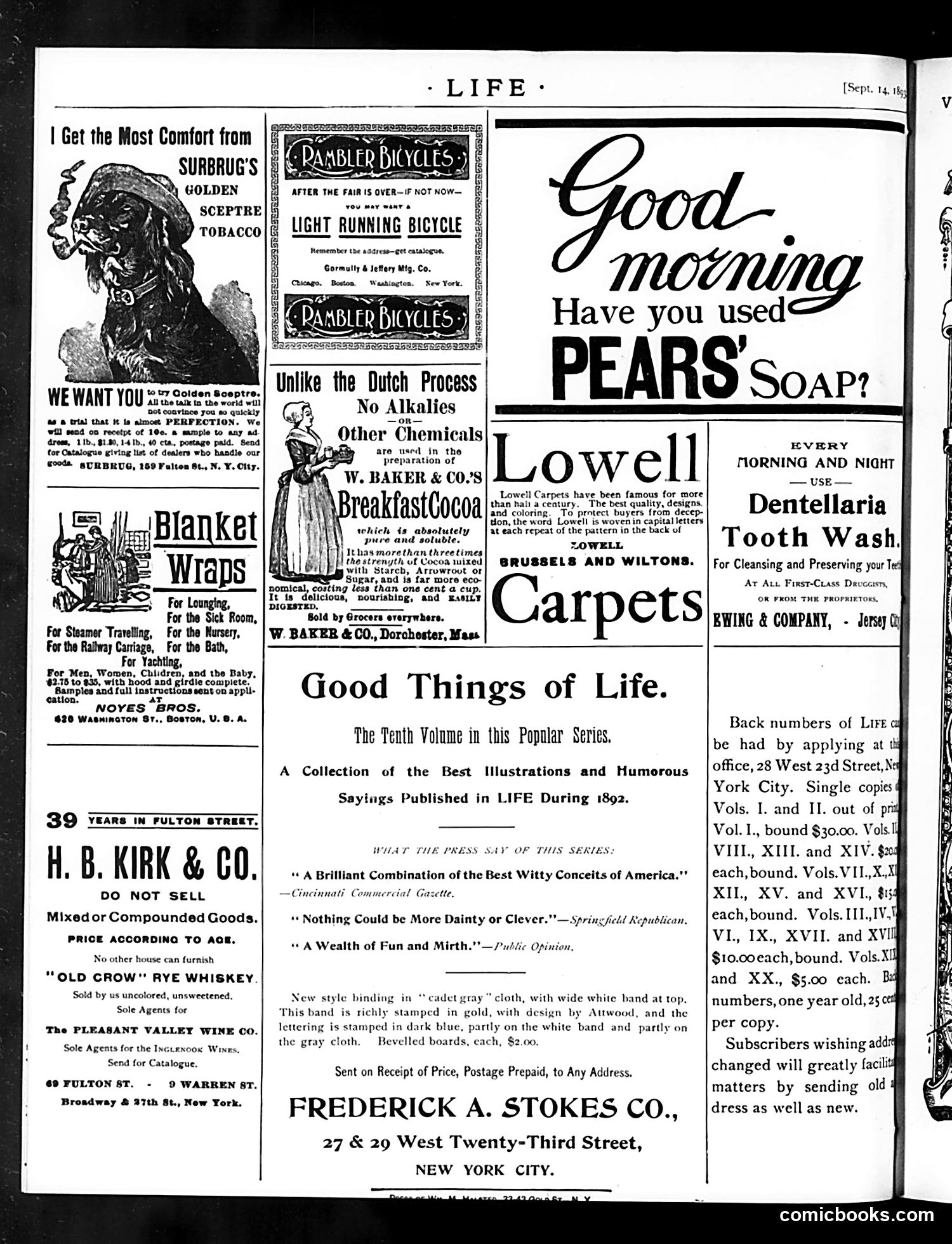
This page is primarily **advertising**, not satirical content. It showcases late-19th-century consumer goods typical of the era: tobacco, bicycles, cocoa, carpets, soap, and whiskey. The notable visual element is a **caricatured dog's head** (likely a St. Bernard or similar breed) advertising Surbrug's Golden Sceptre Tobacco on the left. This appears to be a straightforward mascot rather than political satire. The page's main "editorial" content is a book advertisement for "Good Things of Life: The Tenth Volume in this Popular Series"—a collection of Life magazine's humorous illustrations and sayings from 1892. Press quotes call it "witty" and full of "fun and mirth." **Modern context**: This reflects how 19th-century magazines sustained themselves through extensive advertising. The products advertised (uncolored whiskey, "pure" cocoa without alkalies) suggest contemporary anxieties about food/product adulteration and authenticity—concerns that drove early food regulation movements.