
Life, 1893-09-14 · page 6 of 18
Life — September 14, 1893 — page 6: what you’re looking at
What you’re looking at
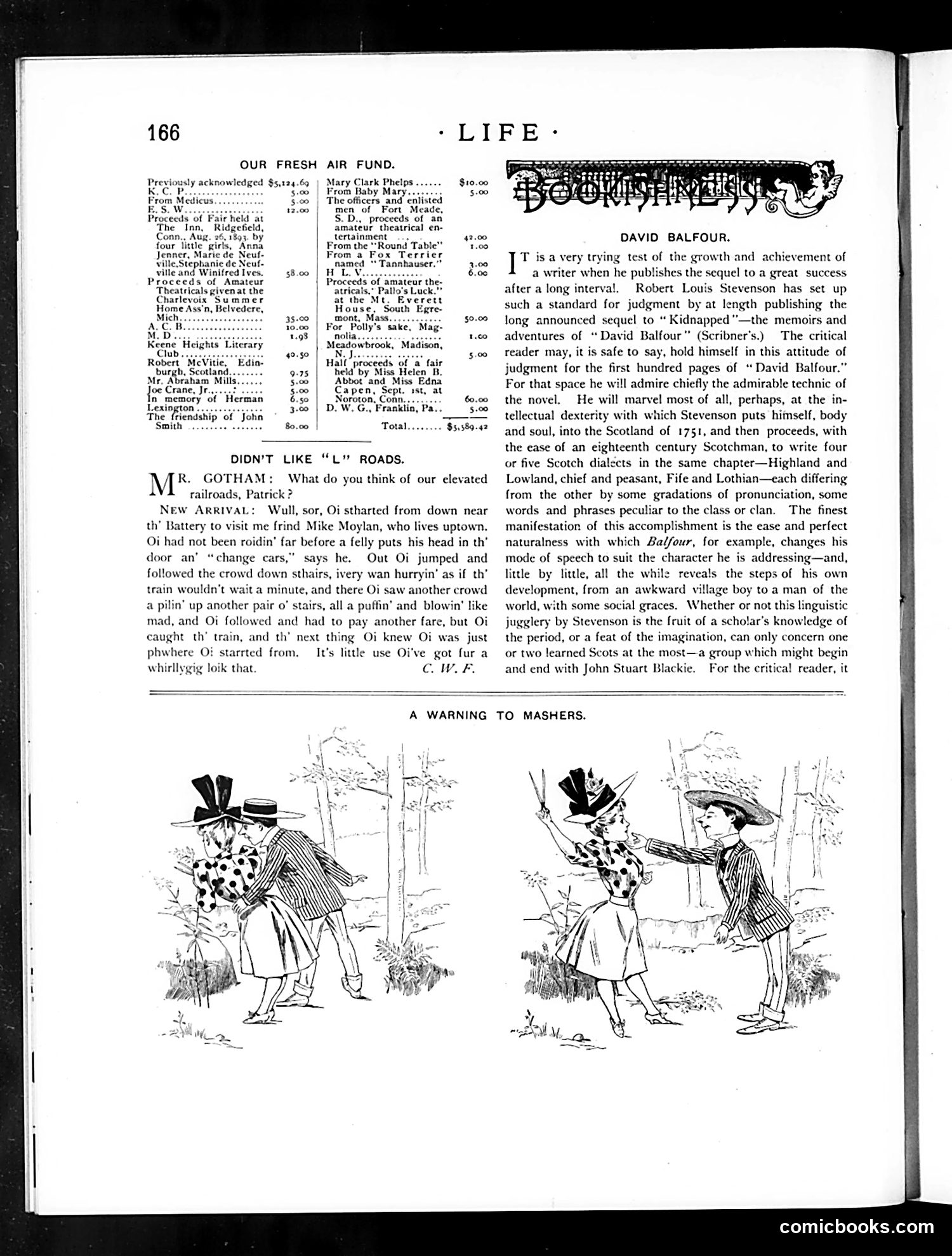
This cartoon depicts two scenes warning against aggressive male behavior toward women in public spaces. In both panels, a young woman wearing a hat and patterned dress encounters a man in formal attire (top hat and pinstriped suit). In the left panel, the man appears to be making unwanted advances. In the right panel, the woman retaliates by striking him with her parasol. The satire targets "mashers"—contemporary slang for men who made unsolicited romantic or sexual advances toward women on streets. The cartoon humorously advocates that women defend themselves physically against such harassment. This reflects early 20th-century social concerns about public decorum and women's safety, while also suggesting female empowerment through self-defense rather than passive acceptance of unwanted attention.
📄 Transcribed text from this page (OCR, searchable)
Machine-transcribed from the original scan — historical spelling and the odd misread are preserved.
166 OUR FRESH Previously acknowledged $5,124.69 5.00 5.00 12.00 AIR FUND. Mary Clark Phelps . From Baby Mary. The officers_and enlisted men of Fort Meade, S.D., proceeds of an amateur theatrical en- tertainment From the "Round Table” Proceeds of Fair held ‘at The Inn, Ridgefield, Conn,, Aug. 26,1893. by four little girls, Anna Tannhauser.”” tille]and Winilred Ives Proceeds of Amateur ‘Theatricals given at the Charlevoix Summer Home Ass'n, Belvedere, at the Mt. House, Everett South mont, Mass. For Polly nolia... Meadowbrook, Madison, sake, Mag- Hall proceeds of ‘a’ fair held by Miss Helen B. Abbot and Miss Edna Capen, Sept. ast, at Noroton, Conn. D.W. G., Frankiis, P. burgh, Scotland Mr. Abraham Mills foe Crane, Jr; in memory of Lexin, The riends Smith § voyve 8 8S8ea DIDN’T LIKE “L* ROADS. q® GOTHAM: What do you think of our elevated railroads, Patrick ? EW ARRIVAL: Wull, sor, Oi stharted from down near th’ Battery to visit me frind Mike Moylan, who lives uptown. Oi had not been roidin’ far before a felly puts his head in th’ an’ “change cars,” Out Oi jumped and followed the crowd down sthair. ivery wan hurryin’ as if th’ train wouldn't wait a minute, and there Oi saw another crowd a pilin’ up another pair o’ stairs, all a puffin’ and blowin’ like mad, and Oi followed and had to pay another fare, but Oi caught th’ train, and th’ next thing Oi knew Oi was just phwhere O} starrted from. It’s little use Oi’ve got fur a whirllygig loik that. COWL. door he. DAVID BALFOUR. ] T is a very trying test of the growth and achie a writer when he publishes the sequel to a great success after a long interval. Robert Louis Stevenson has set up such a standard for judgment by at length publishing the long announced sequel to “ Kidnapped "’—the memoirs and adventures of “David Balfour” (Scribner’s.) The critical reader may, it is safe to say, hold himself in this attitude of judgment for the first hundred pages of “David Balfour.” For that space he will admire chiefly the admirable technic of the novel. He will marvel most of all, perhaps, at the in- tellectual dexterity with which Stevenson puts himself, body and soul, into the Scotland of 1751, and then proceeds, with the ease of an eighteenth century Scotchman, to write four or five Scotch dialects in the same chapter—Highland and Lowland, chief and peasant, Fife and Lothian—each differing from the other by some gradations of pronunciation, some words and phrases peculiar to the class or clan. The finest manifestation of this accomplishment is the ease and perfect naturalness with which Badfour, for example, changes his mode of speech to suit the character he is addressing—and, litle by little, all the while reveals the steps of his own development, from an awkward village boy to a man of the world, with some social graces. Whether or not this linguisti jugglery by Stevenson is the fruit of a scholar’s knowledge of the period, or a feat of the imagination, can only concern one or two learned Scots at the most—a group w! hich might begin and end with John Stuart Blac For the critical reader, it A WARNING TO MASHERS. comicbooks.com