
Life, 1893-09-14 · page 7 of 18
Life — September 14, 1893 — page 7: what you’re looking at
What you’re looking at
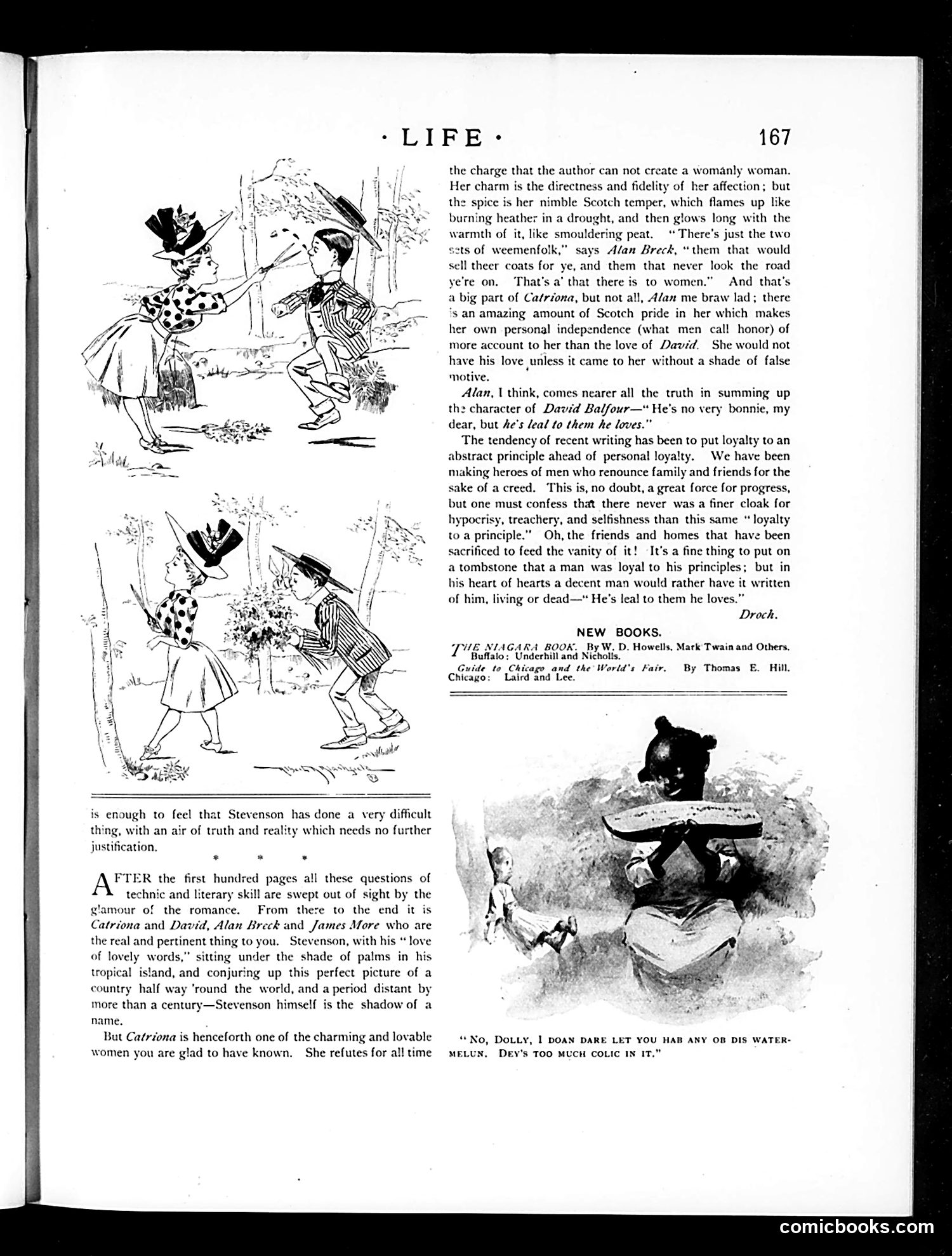
This page primarily contains a literary review discussing Robert Louis Stevenson's novel *Catriona*, featuring two similar ink illustrations of a man and woman in period dress (appearing to be Scottish, matching the novel's setting) engaged in playful interaction outdoors. The cartoons themselves are not political satire but rather decorative illustrations accompanying the book review. The text praises the female character Catriona for her charm, Scottish pride, and fidelity—noting her "nimble Scotch temper" and independence. The review concludes that loyalty to personal relationships matters more than abstract principles. A separate illustration at bottom-right shows a bear and child with a caption about avoiding water melons due to colic—likely an unrelated humorous spot illustration or advertisement.
📄 Transcribed text from this page (OCR, searchable)
Machine-transcribed from the original scan — historical spelling and the odd misread are preserved.
- LIFE: is enough to feel that Stevenson has done a very difficult thing, with an air of truth and reality which needs no further justification, * = . A ER the first hundred pages all these questions of technic and literary skill are swept out of sight by the glamour of the romance. From there to the end it is Catriona and David, Alan Breck and James More who are the real and pertinent thing to you. Stevenson, with his “love of lovely words,” sitting under the shade of palms in his tropical island, and conjuring up this perfect picture of a country half way ‘round the world, and a period distant by more than a century—Stevenson himself is the shadow of a name. But Caériona is henceforth one of the charming and lovable women you are glad to have known. She refutes for all time 167 the charge that the author can not create a womanly woman. Her charm is the directness and fidelity of her affection; but spice is her nimble Scotch temper, which flames up like ing heather in a drought, and then glows long with the warmth of it, like smouldering peat. “ There's just the two sts of weemenfolk,” says Alan Breck, “them that would sell theer coats for ye, and them that never look the road ye're on. That's a’ that there is to women.” And _ that’s a big part of Cafréona, but not all, A/an me braw lad; there ‘s an amazing amount of Scotch pride in her which makes her own personal independence (what men cal! honor) of more account to her than the love of David. She would not have his love unless it came to her without a shade of false motive. ; Alan, | think, comes nearer all the truth in summing up the character of David Balfour—*" He's no very bonnie, my dear, but he's deal to them he loves.” The tendency of recent writing has been to put loyalty to an abstract principle ahead of personal loyalty. We have been making heroes of men who renounce family and friends for the sake of a creed. is is, no doubt, a great force for progress, but one must confess that there never was a finer cloak for hypocrisy, treachery, and selfishness than this same “loyalty toa principle.” Oh, the friends and homes that have been sacrificed to feed the vanity of it! It’s a fine thing to put on a tombstone that a man was loyal to his princip! but in his heart of hearts a decent man would rather have it written of him, living or dead—" He's leal to them he loves.” Droch. NEW BOOKS. THE NIAGARA BOOK, ByW. D, Howells, Mark Twain and Others, Buflalo: Underhill and Nicholis. Guide to Chicago and the World's Fair, By Thomas E. Hill. Chicago: Laird and Lee. “No, DOLLY, 1 DOAN DARE LET YOU HAB ANY OB DIS WATER- Dey's Too MUCH COLIC IN IT.” comicbooks.com