
A complete issue · 18 pages · 1893
Life — July 20, 1893
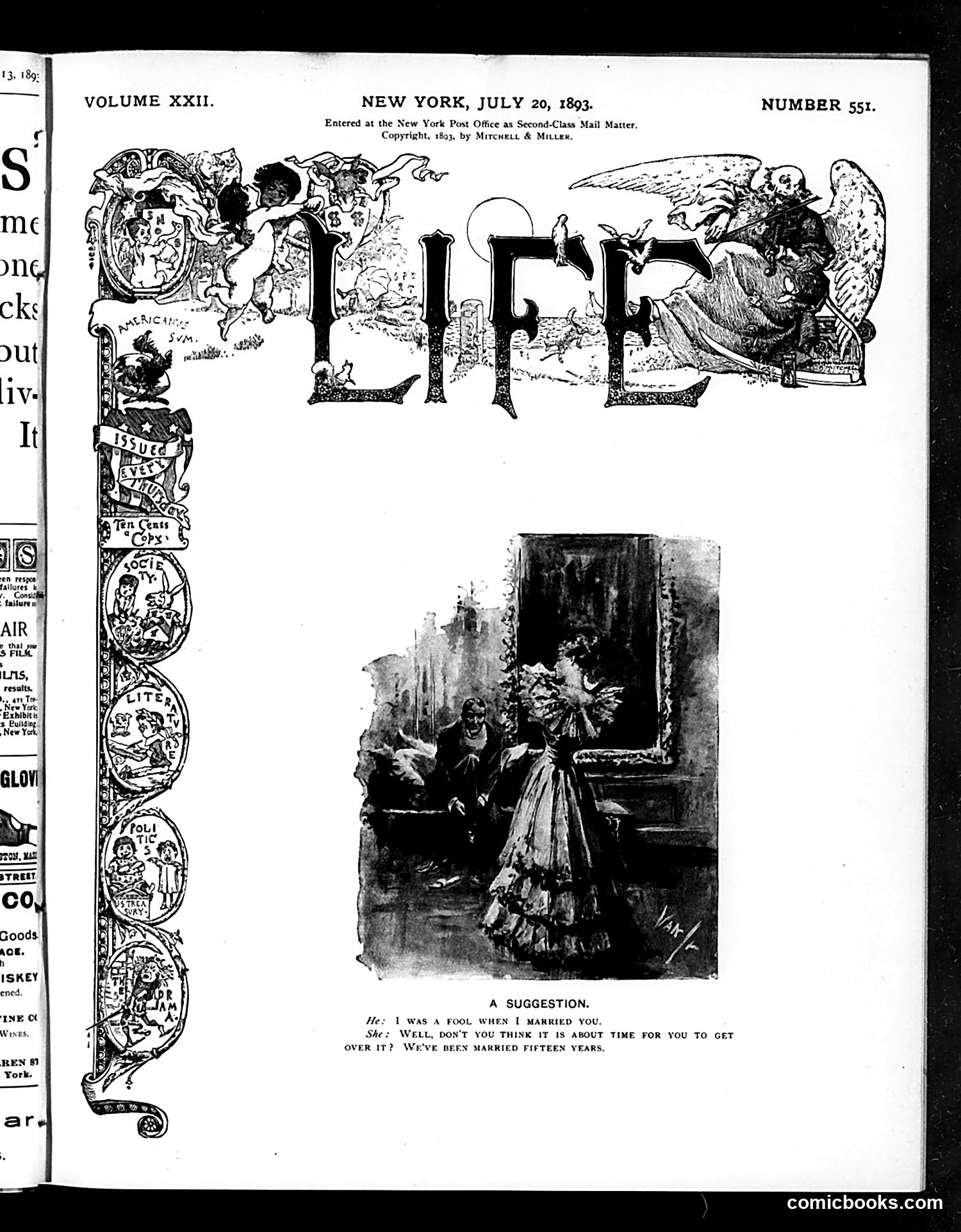
This cartoon presents a domestic dispute with satirical commentary on marriage. The titled caption reads: "He: I was a fool when I married you. She: Well, don't you think it is about time for you to get over it? We've been married fifteen years." The humor targets the husband's belated regret and the wife's sharp, cutting response. The cartoon satirizes marital discord and the expectation that a spouse should have "gotten over" such doubts after fifteen years of marriage. The woman's retort suggests resignation to an unhappy union while pointedly mocking her husband's continued self-recrimination. The ornate decorative border and magazine masthead frame typical satirical content mocking middle-class domestic relationships, a common theme in 1890s American humor magazines.
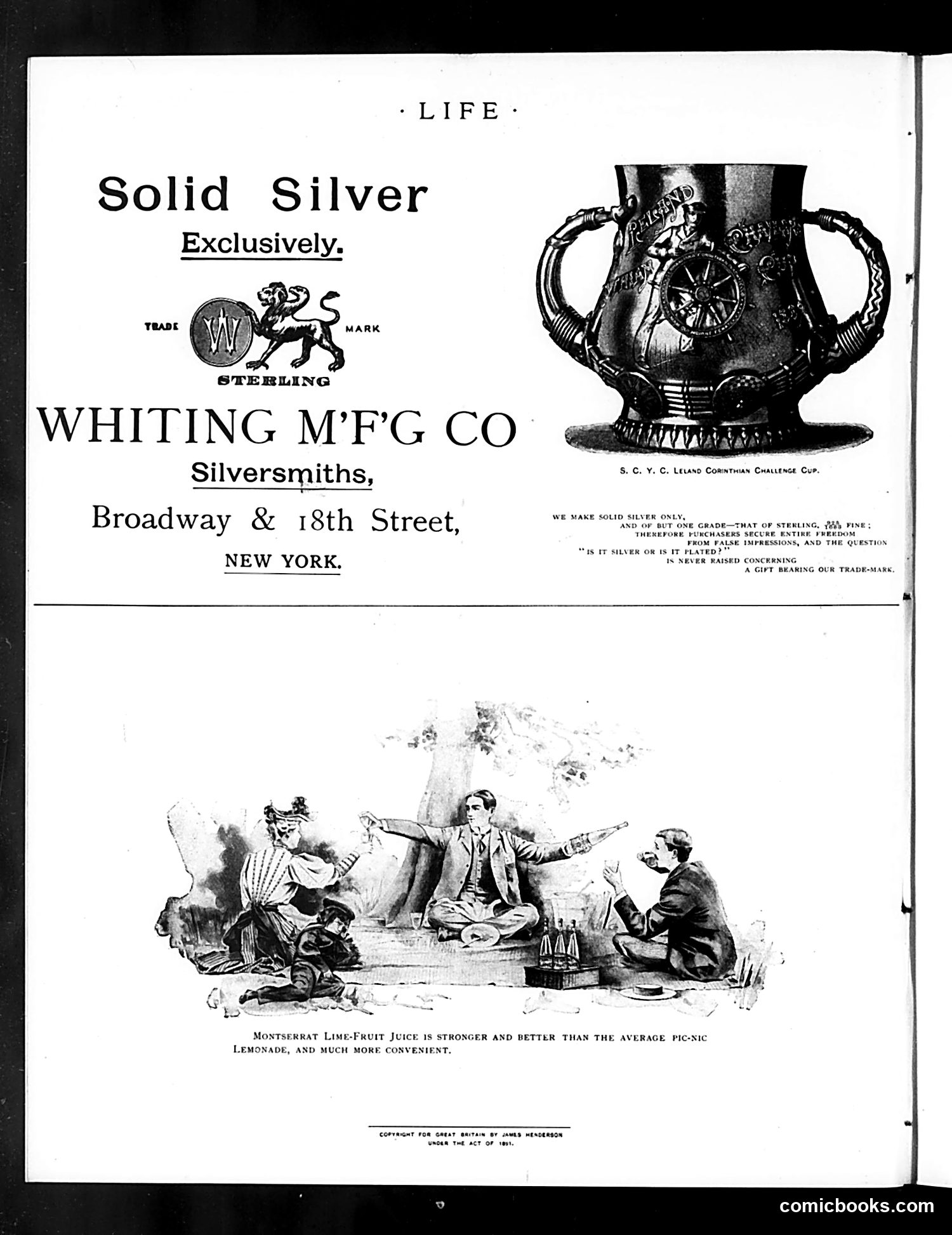
This page is primarily an **advertisement for Whiting Manufacturing Company**, silversmiths located on Broadway & 18th Street in New York, promoting their solid silver products exclusively. The upper right shows an ornate silver vessel labeled "S.C.Y.C. Liege Corinthian Challenge Cup," demonstrating their craftsmanship. The company emphasizes their work is "solid silver only, and of but one grade—that of sterling," addressing consumer concerns about whether silver items were plated or solid. The lower illustration appears unrelated to the silverware advertisement—it depicts a picnic scene with the caption about Montserrat Lime-Fruit Juice, likely filler content or a separate satirical cartoon about leisure activities or beverages. The connection between these elements is unclear.
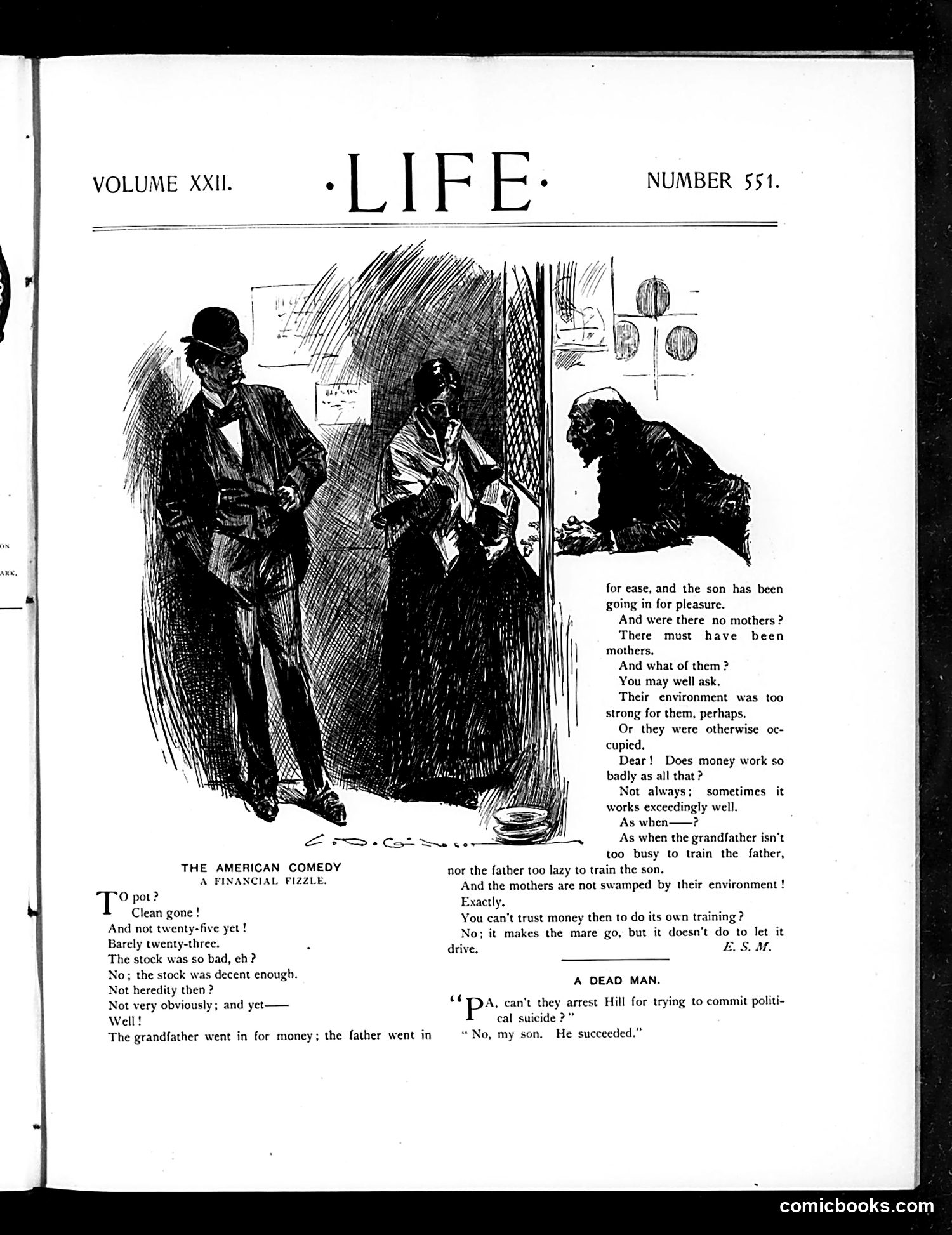
This satirical cartoon mocks the failure of financial schemes to improve social conditions. The dialogue depicts an exchange about inherited wealth and poverty: a grandfather invested in stocks that failed, passing loss to his father, who then failed to train his son properly. The satire's point: money cannot reliably create lasting improvement across generations—it either disappears through bad investment or fails to educate heirs to use it wisely. The accompanying dialogue about mothers and environmental factors suggests the cartoonist argues that financial solutions alone cannot solve social problems; character, training, and circumstance matter equally. The "Dead Man" section references a failed political suicide, further emphasizing themes of failure and futility.
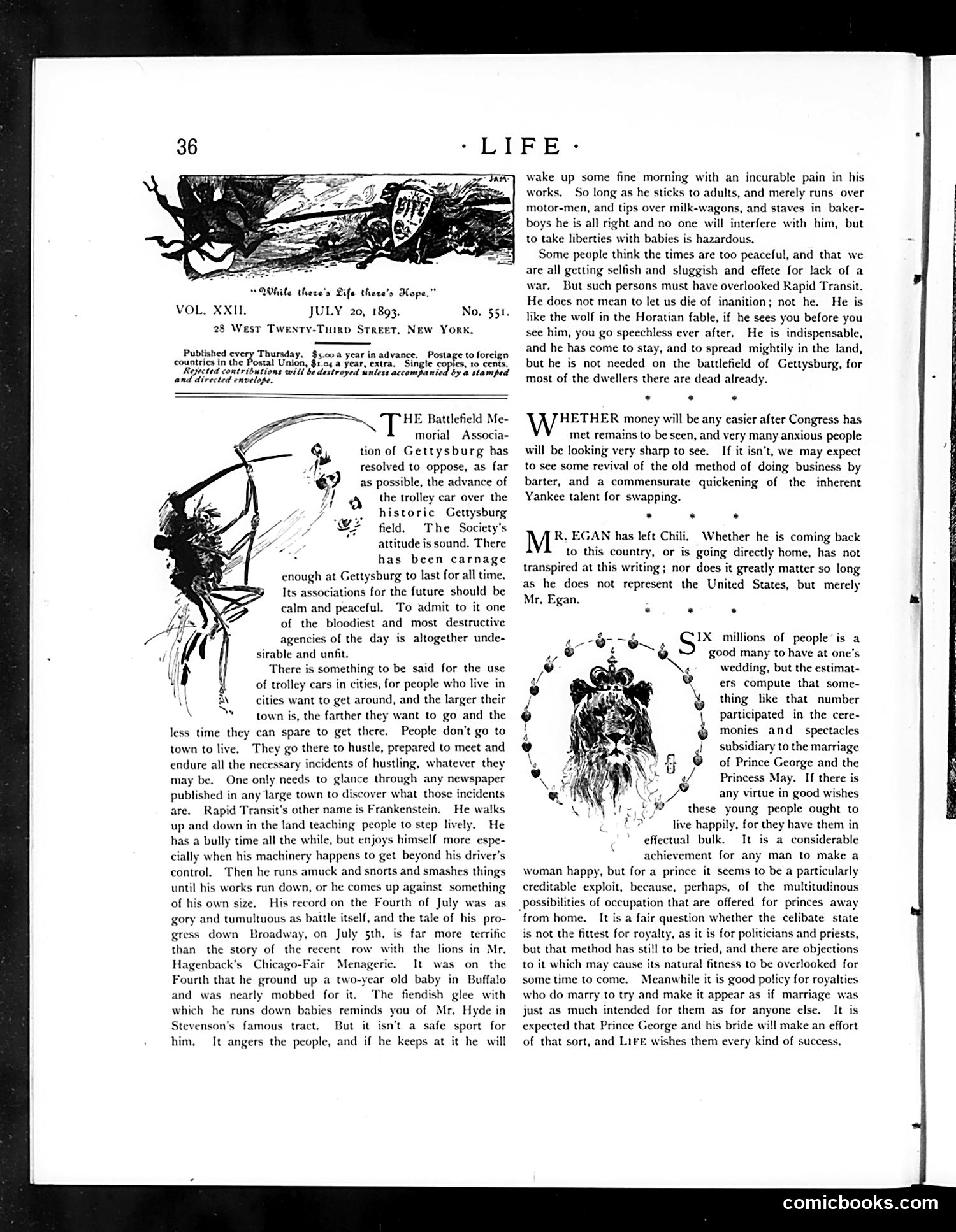
The main cartoon depicts a skeletal figure labeled "Rapid Transit" riding a trolley car wildly out of control. The skeleton represents death or danger; the satire critiques the reckless expansion of urban trolley systems in American cities. The accompanying text discusses the Gettysburg battlefield monument association and trolley cars in cities. It argues that while rapid transit enables urban growth, the inherent dangers—"one of the bloodiest and most destructive agencies of the day"—make it unsafe. The author sarcastically notes Rapid Transit's alternate name is "Frankenstein," comparing the technological innovation to an uncontrollable monster. The satire mocks how cities prioritize transportation convenience over public safety, with the skeleton embodying the death toll from trolley accidents.
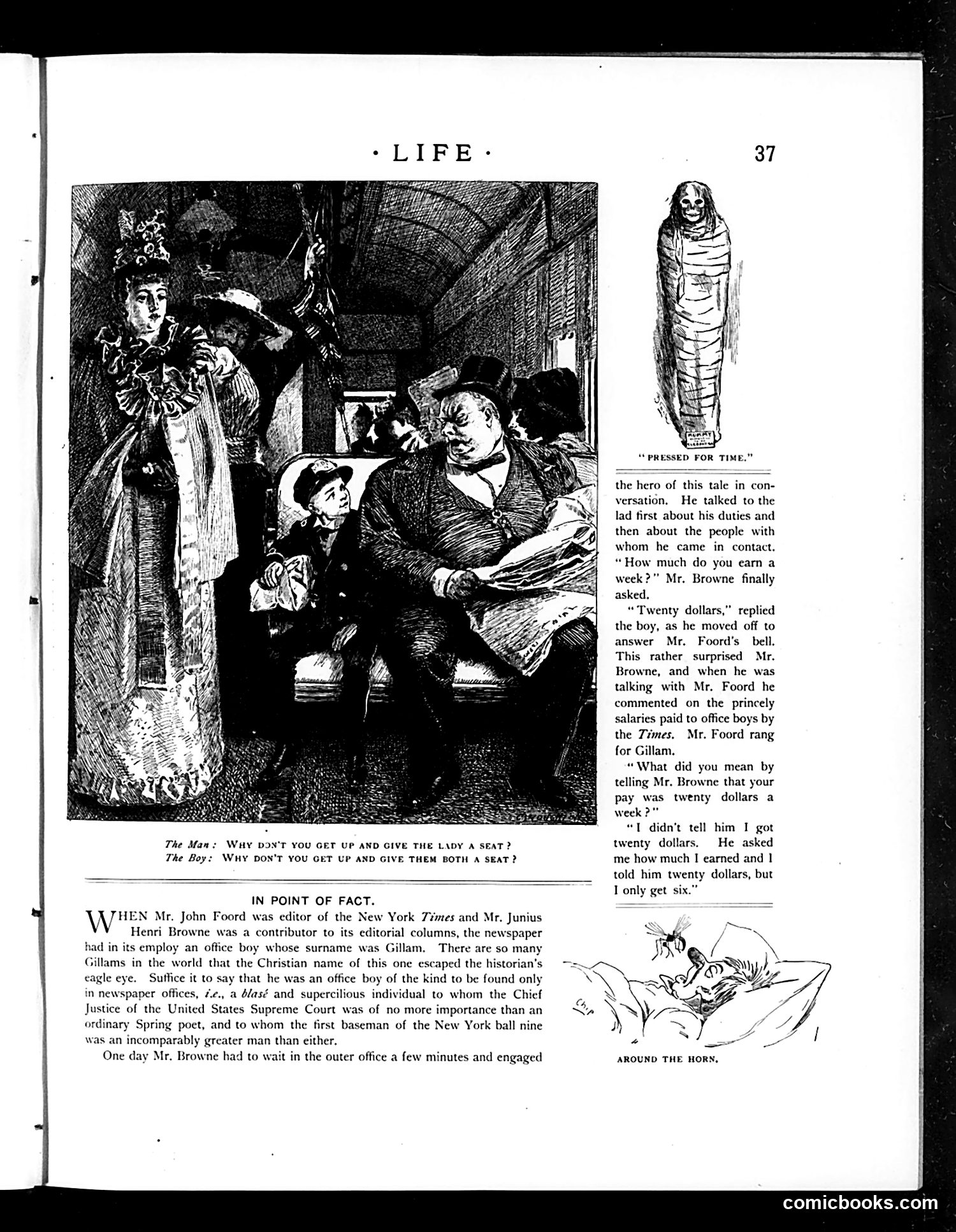
This page satirizes class and workplace dynamics in early 20th-century journalism. The main illustration depicts a scene at the New York *Times* offices where Mr. Browne (an editor or manager) questions an office boy named Gillam about his wages. The satire centers on the boy's claim of earning twenty dollars weekly—a respectable sum for the era—which surprises Browne. The joke reveals a disconnect: the boy inflated his salary when speaking to Browne but admitted earning less to another colleague. The text emphasizes Gillam's status as a dispensable "office boy" despite his minor importance to powerful editors. The mummy illustration captioned "Pressed for Time" appears unrelated, suggesting the page contains multiple satirical pieces mocking different aspects of contemporary life.
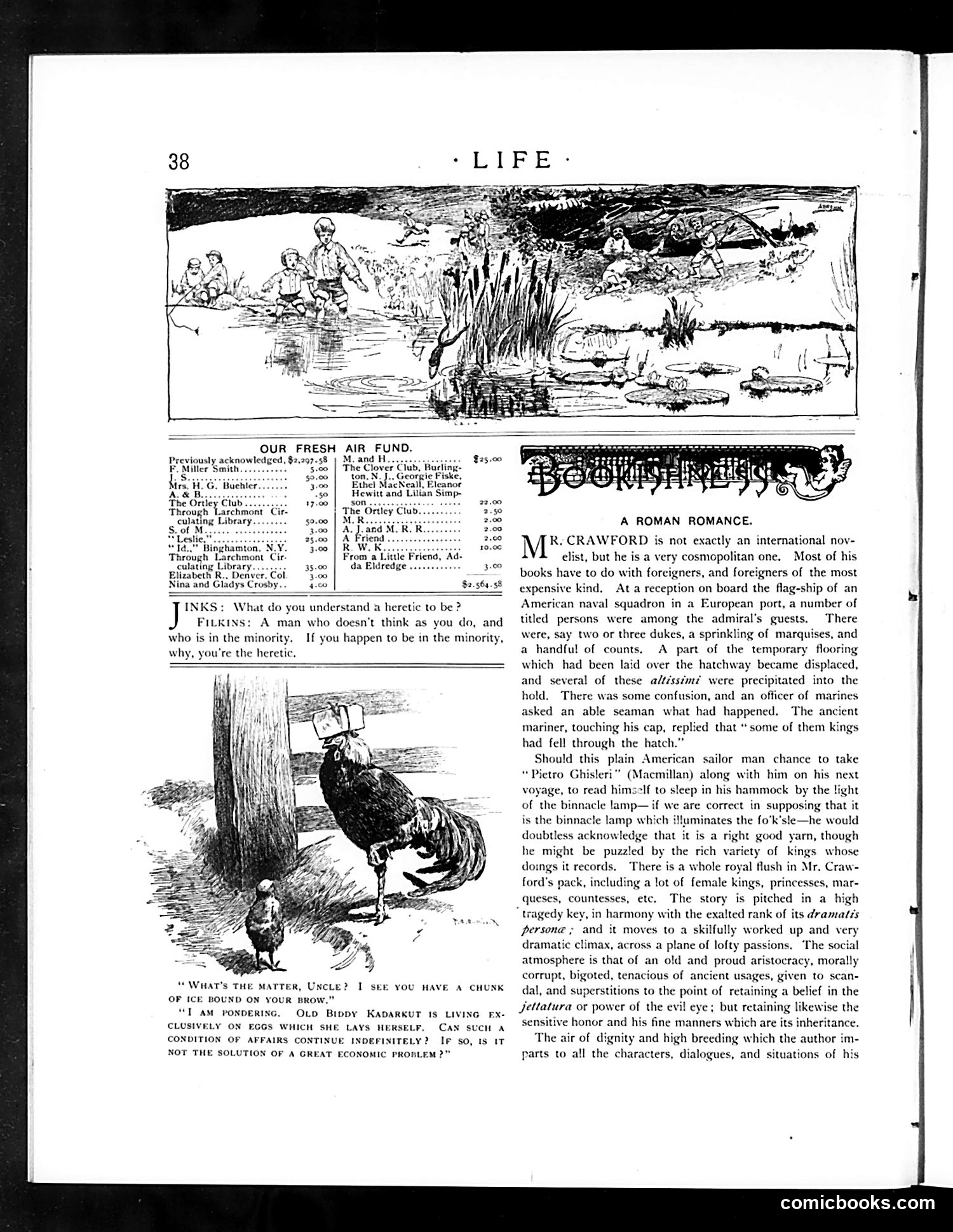
This page contains two distinct elements: 1. **"Our Fresh Air Fund"** - A charitable fundraising list acknowledging donations to a children's fresh air program, with contributors' names and amounts. 2. **The Cartoon** - A humorous dialogue between "Inkins" and "Filkins" debating what constitutes a "heretic." The joke plays on political/philosophical disagreement: Filkins defines a heretic as someone who thinks differently from the majority. This appears to be satirizing rigid conformity and intolerance of dissenting opinions—a commentary on social pressure to conform. 3. **"A Roman Romance"** - A book review of a novel by Mr. Crawford, discussing aristocratic characters, royal intrigue, and dramatic tension aboard a naval vessel. The rooster illustration accompanies the heretic dialogue, likely reinforcing themes of stubbornness or cockiness.
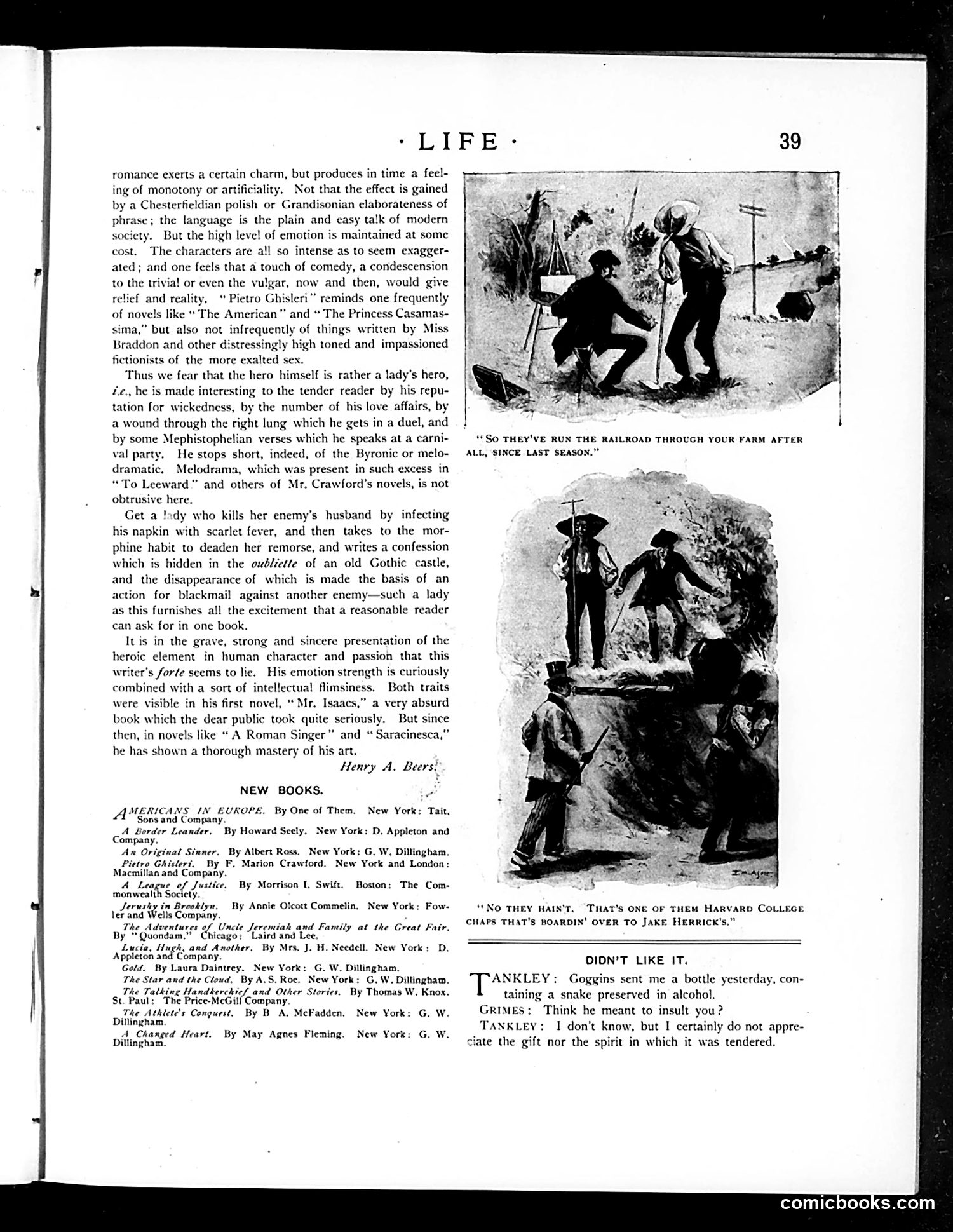
This page contains two satirical illustrations accompanying a literary review and new book advertisements. The **top cartoon** shows a farmer confronting what appears to be railroad officials or workers on his property, with the caption "So they've run the railroad through your farm after all, since last season." The satire critiques railroad companies' power to seize or damage private farmland, a common grievance of the era. The **bottom cartoon** depicts what appears to be a Harvard College student showing off to another figure, captioned "No they hain't. That's one of them Harvard College chaps that's boardin' over to Jake Herrick's." This mocks the pretensions of college-educated youth and rural people's skepticism toward outsiders. The page primarily features book reviews and new book listings rather than political satire.
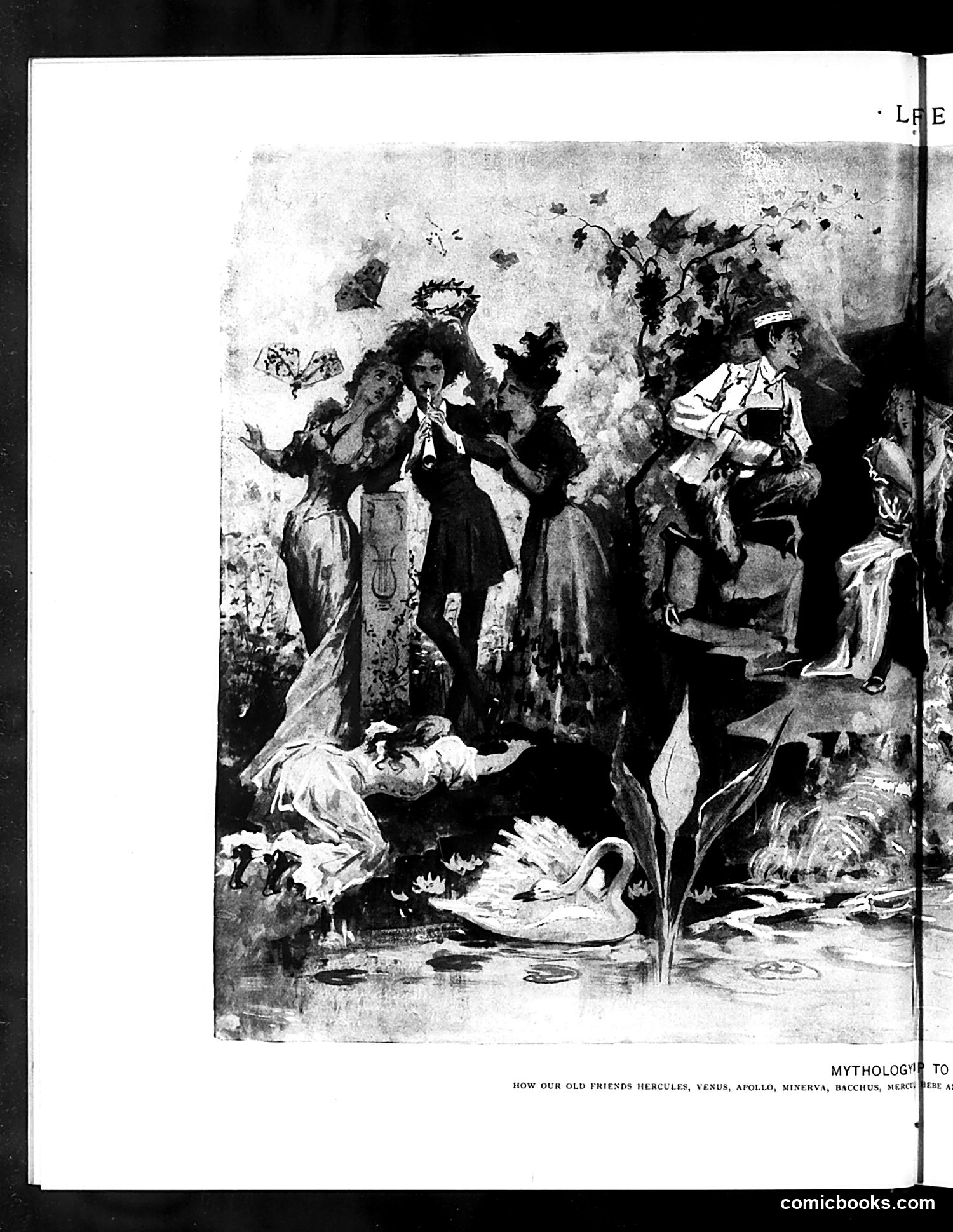
This appears to be a satirical illustration contrasting classical mythology with contemporary society. The caption references "how our old friends Hercules, Venus, Apollo, Minerva, Bacchus, Merc[ury]" (Roman/Greek gods) appear in modern contexts. The image shows a gathering of figures in period dress near water, with classical mythological characters depicted in what seems to be an ordinary or degraded scenario—possibly suggesting how traditional values or ideals have diminished in modern times. The composition and subject matter suggest *Life* magazine was using classical allusions to critique contemporary social conditions or morality. Without seeing the complete caption, the exact satirical point remains unclear, but the theme appears to be disillusionment with how classical virtues or ideals manifest in the present day.
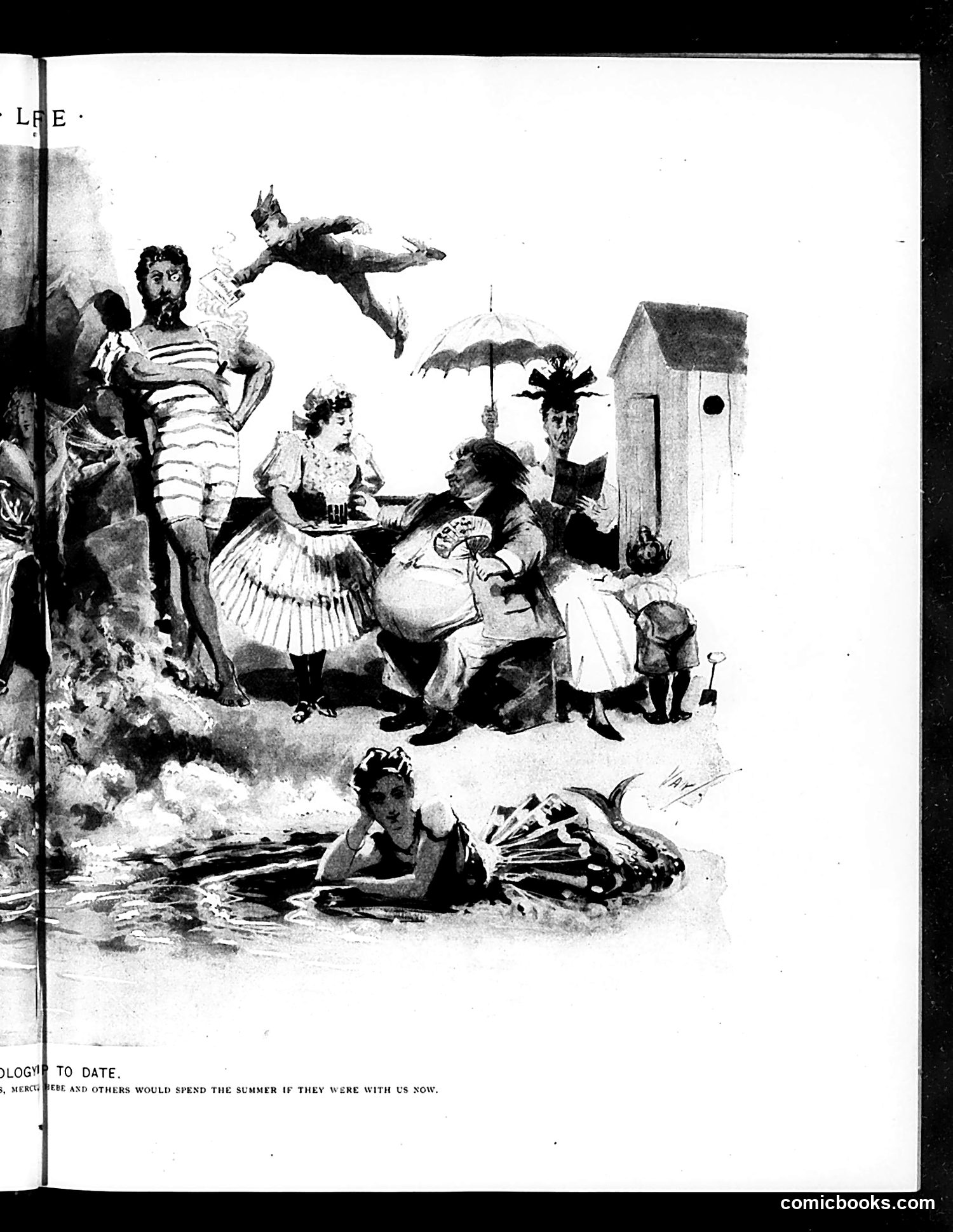
This appears to be a satirical illustration from *Life* magazine depicting a beach or seaside scene. The caption references "the summer" and mentions "if they were with us now," suggesting commentary on absent figures or a longing for their presence during vacation. The scene shows various Victorian-era figures: a man in striped bathing costume, women in period dress, a child, someone with an umbrella, and notably a person swimming or in water in the foreground. The style and composition suggest social satire about summer leisure activities or beach culture. However, without clearer text or additional context, I cannot definitively identify which specific political or social figures are being caricatured, or the precise satirical target. The illustration's exact meaning remains unclear from this image alone.
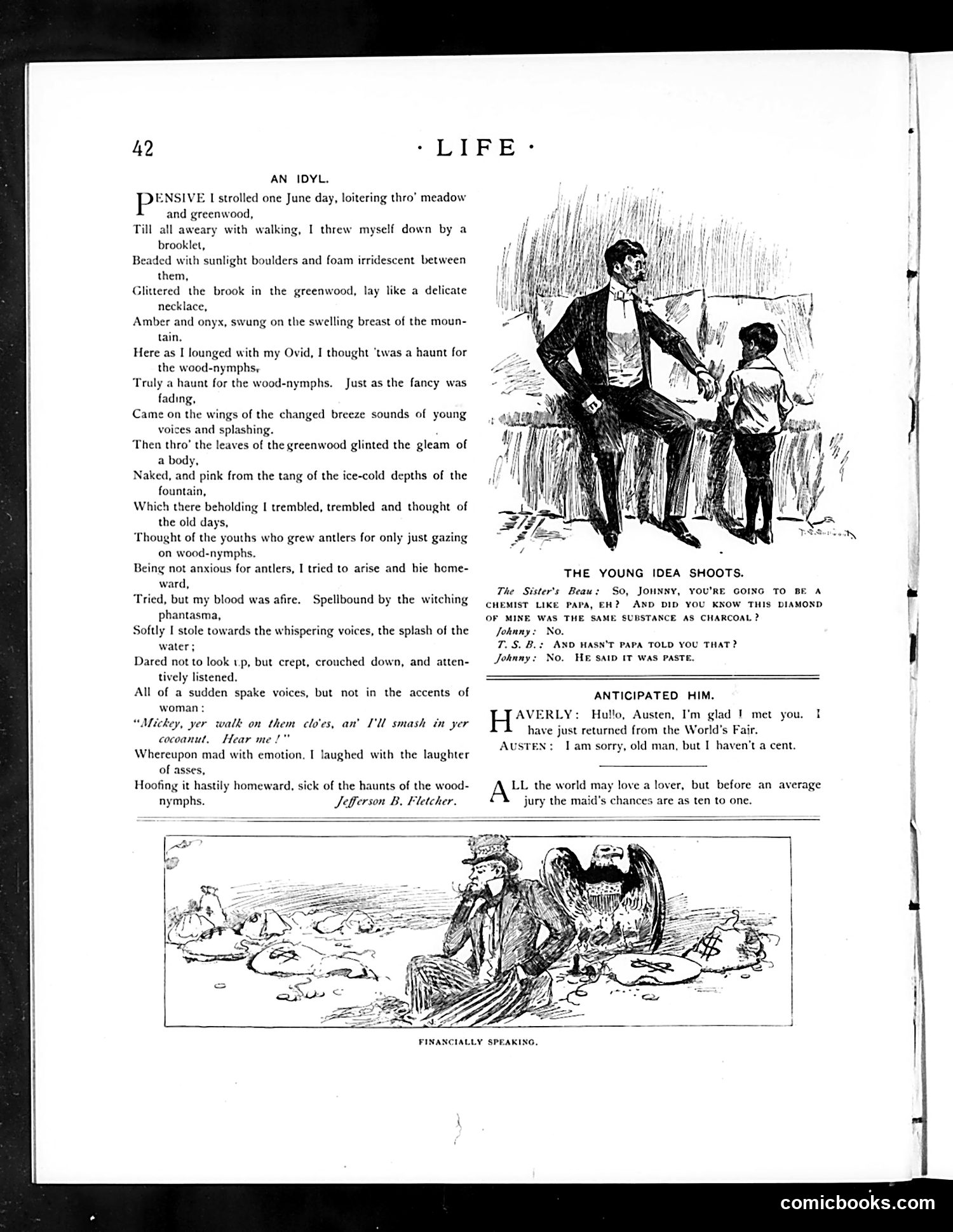
This page contains two distinct sections: **"An Idyl"** (top): A romantic poem by Jefferson B. Fletcher about a man daydreaming by a brook, imagining wood nymphs and classical beauty—before being interrupted by the sudden, crude voices of real people, deflating his poetic reverie. The accompanying illustration shows an adult and child at a stream, depicting the intrusion of reality into fantasy. **"Anticipated Him"** (middle): A brief dialogue where Haverly mentions returning from the World's Fair, and Austen quips that a maid's romantic chances are slim—"as ten to one" against her. **"Financially Speaking"** (bottom): A cartoon showing Death (skeletal figure with wings) and an old man amid scattered coins and financial documents, satirizing death's indifference to wealth—a memento mori on materialism.
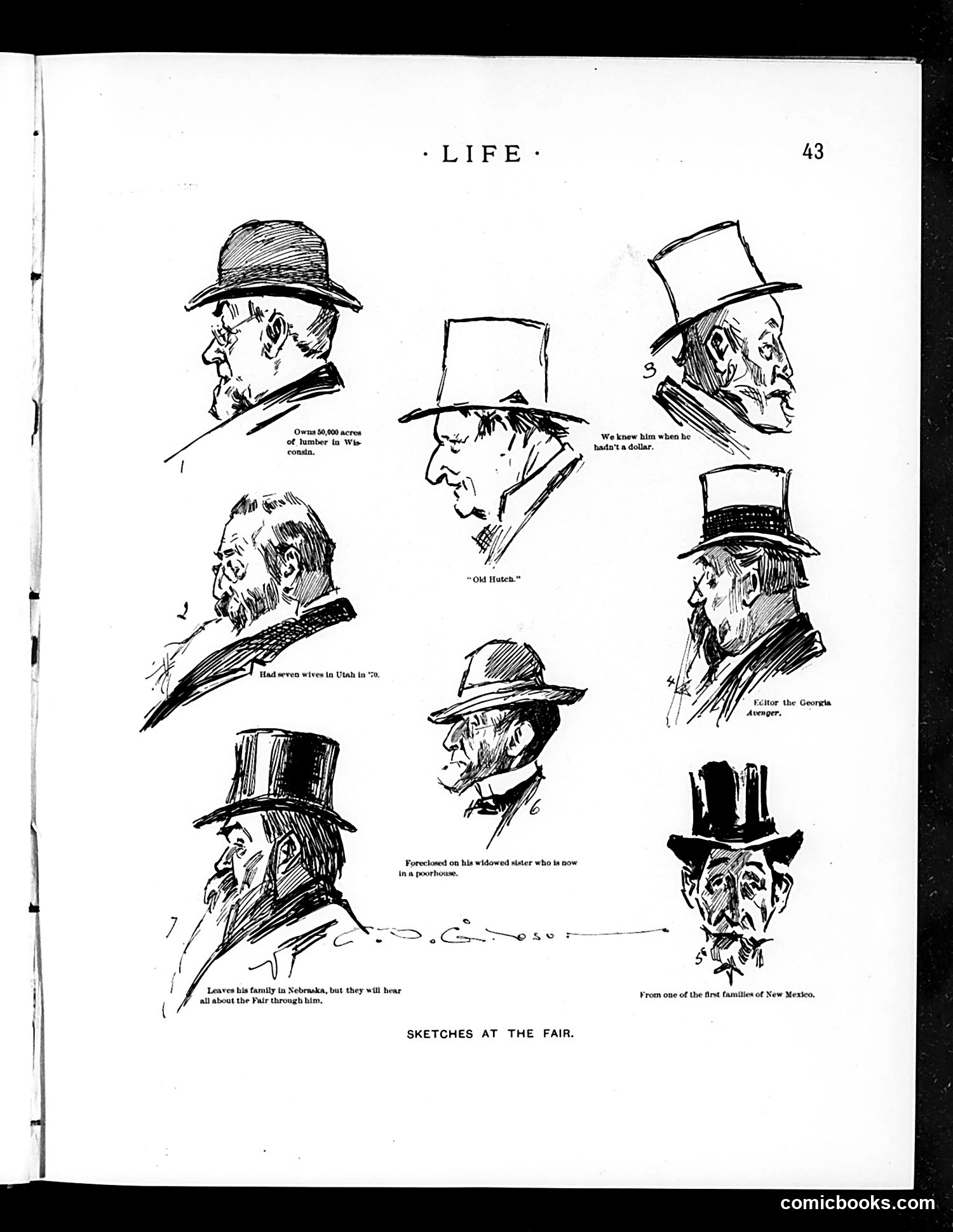
This page presents satirical character sketches, likely from a state or world's fair. Each numbered caricature depicts men wearing formal hats with accompanying caption-descriptions of their circumstances or characteristics. The captions reference specific individuals and situations: one mentions "Over 50,000 acres of lumber in his cordon," another "We know him when he hadn't a dollar," and references to Nebraska, Utah, and New Mexico. One describes someone who "Foreclosed on his widowed sister who is now in a poorhouse." The artwork uses exaggerated facial features typical of period political cartooning to satirize various wealthy or prominent men, likely prominent fair attendees or businessmen. The specific identities remain unclear without additional historical context, but the captions suggest commentary on wealth, fortune-changing circumstances, and questionable business practices.
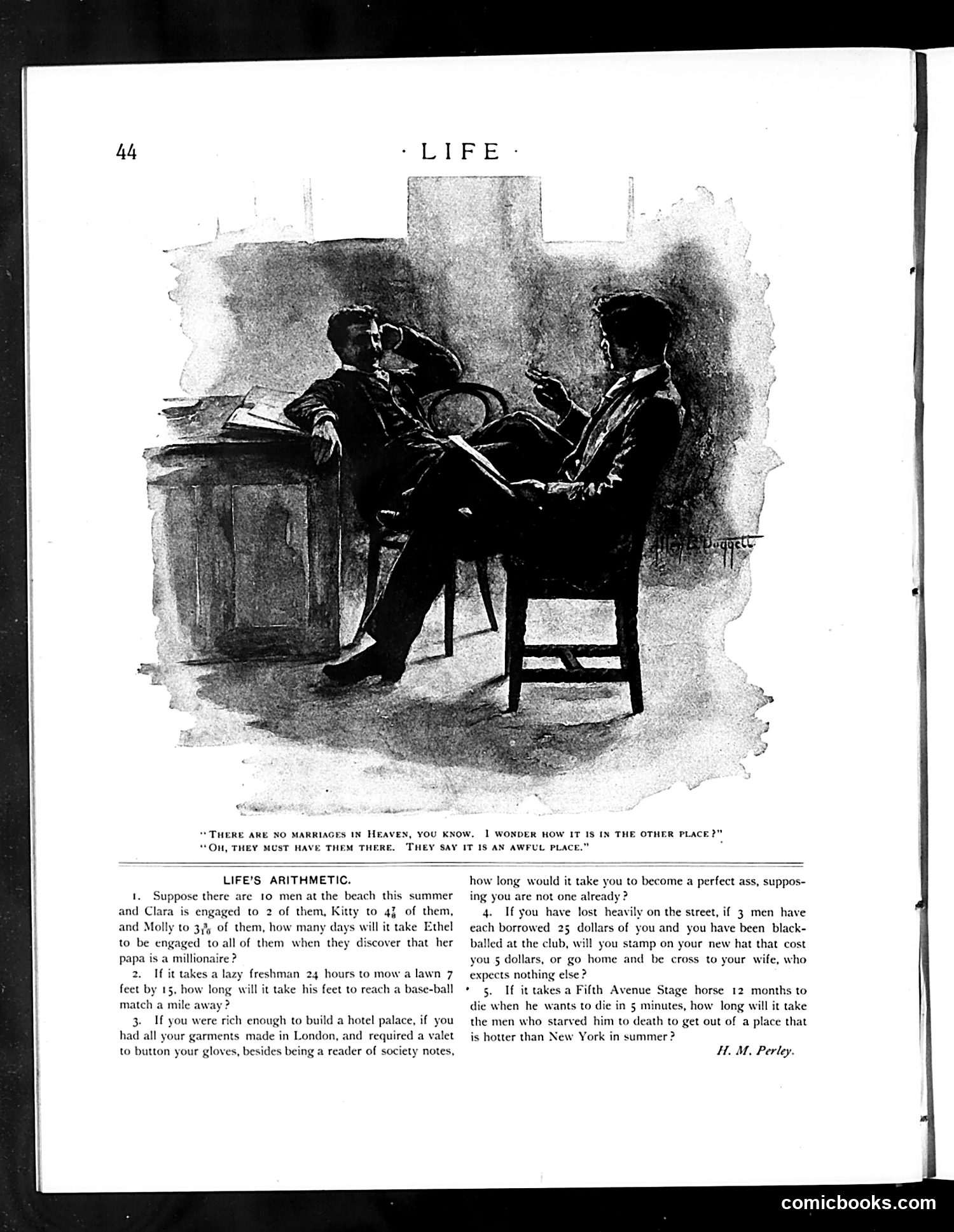
The main cartoon depicts two well-dressed men in conversation, with the caption presenting dark humor about marriage in heaven versus hell. One man suggests marriages must exist in the afterlife's lower regions because "they say it is an awful place"—the joke being that marriage itself is terrible, making it appropriate punishment for hell. Below is "Life's Arithmetic," a satirical column by H.M. Perley offering absurdist math problems mocking turn-of-century American society. The questions ridicule wealthy socialites (women engaged to multiple men whose interest correlates to the father's wealth), lazy college students, status-obsessed nouveaux riches, financially ruined men, and exploitative employers of working animals. The satire targets both the frivolous leisure class and broader social hypocrisy—particularly the contrast between polite society and moral corruption. The final problem about starving horses and damnation suggests Animal welfare concerns mixed with class critique.
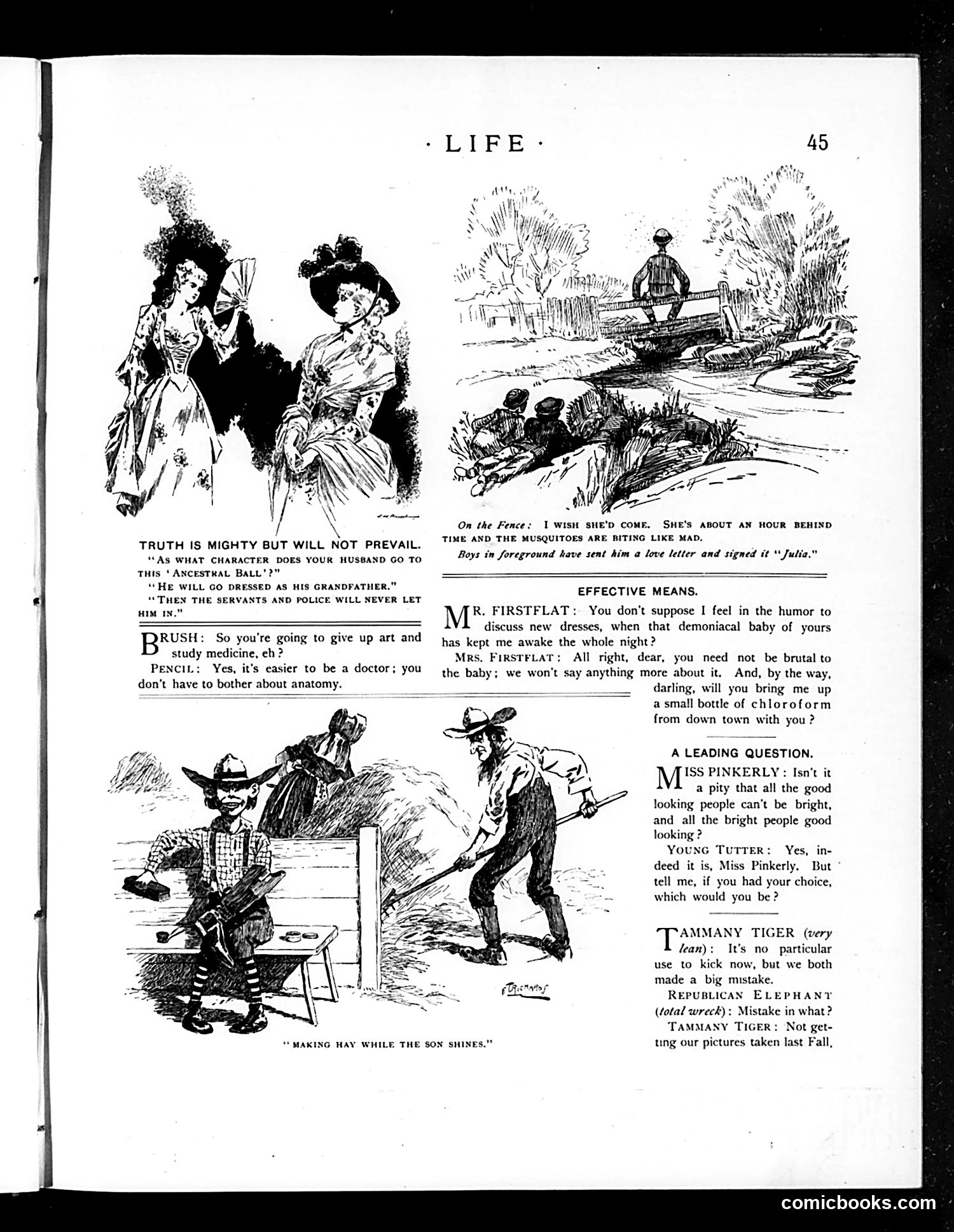
This page contains multiple unrelated humor pieces typical of early Life magazine: **Top left**: A joke about class pretension—a man attending a formal "ancestral ball" dressed as his grandfather will be mistaken for a servant or vagabond and denied entry by staff. **Middle left**: A dialogue between characters named "Rush" and "Pencil" (likely cartoonists) joking that medicine is easier than art because doctors don't need anatomical knowledge. **Right side**: Several brief satirical exchanges including one where a wife jokes about needing chloroform (a sedative/anesthetic) to cope with her baby—dark humor about parental exhaustion. **Bottom right**: A political cartoon featuring the **Tammany Tiger** (representing corrupt Democratic machine Tammany Hall in New York) and the **Republican Elephant** discussing a "mistake" about not getting their pictures taken the previous fall—likely referencing campaign photography or political publicity from a recent election cycle. The overall tone reflects turn-of-the-century American satirical humor mixing social commentary with slapstick and topical political references.
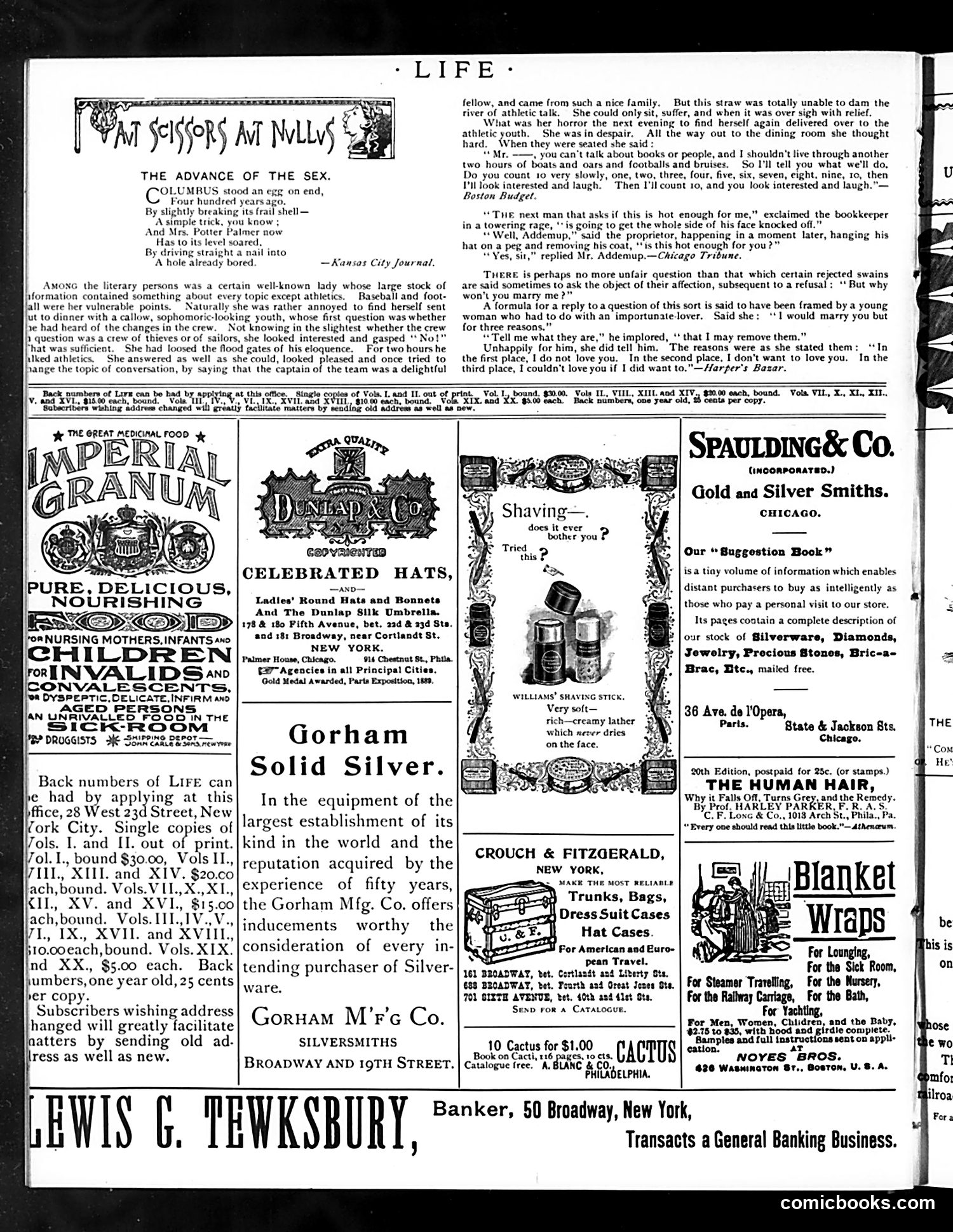
This page from *Life* magazine consists primarily of **three humorous anecdotes** about social interactions, plus advertisements. **The cartoons/jokes:** 1. **"The Advance of the Sex"**: A woman compares herself to Columbus breaking an egg by driving a nail into a pre-bored hole—mocking Mrs. Potter Palmer's supposed claim to innovation. The joke suggests women are taking credit for trivial accomplishments. 2. **The athletic youth story**: A woman trapped at dinner with a boring man who only discusses crew/athletics devises a counting scheme to fake interest and escape conversation—satirizing tedious male dinner companions. 3. **"Hot enough for you?"**: An annoyed bookkeeper threatens violence against anyone asking about the weather, then the proprietor asks anyway—mocking the repetitive, mindless small-talk of the era. 4. **The rejected suitor**: A woman gives three reasons she won't marry a persistent man—emphasizing she doesn't love him, doesn't want to, and couldn't even if she tried—poking fun at men's inability to accept rejection. The page is largely **advertising** for silverware, hats, banking, and other products. The satire targets predictable social conventions and gender dynamics of the early 1900s.
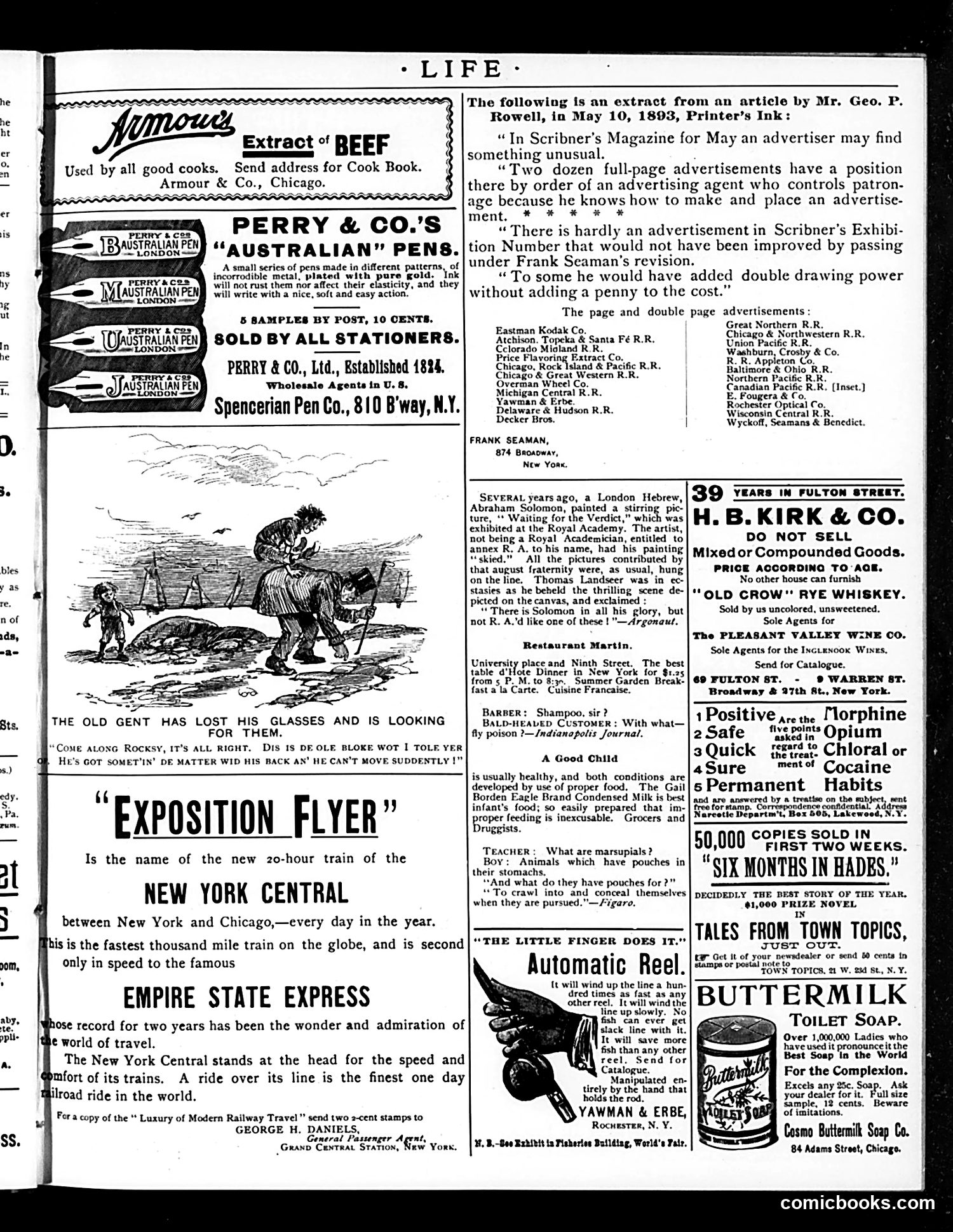
This cartoon depicts a visual gag about an elderly man who has misplaced his spectacles. Two figures (appearing to be street characters or working-class men) spot him searching and comment in dialect: one tells the other this is "de ole bloke" he mentioned who has back trouble and "can't move suddenly." The joke plays on physical comedy—the old gentleman's infirmity combined with his lost glasses creates a figure of comedic helplessness. The humor is typical of *Life* magazine's era: physical disability and age presented as entertainment, using exaggerated dialect speech to mark the speakers as lower-class comic relief. The cartoon relies on slapstick conventions and class-based humor common to 1890s American satire, where elderly or infirm figures were stock subjects for ridicule.
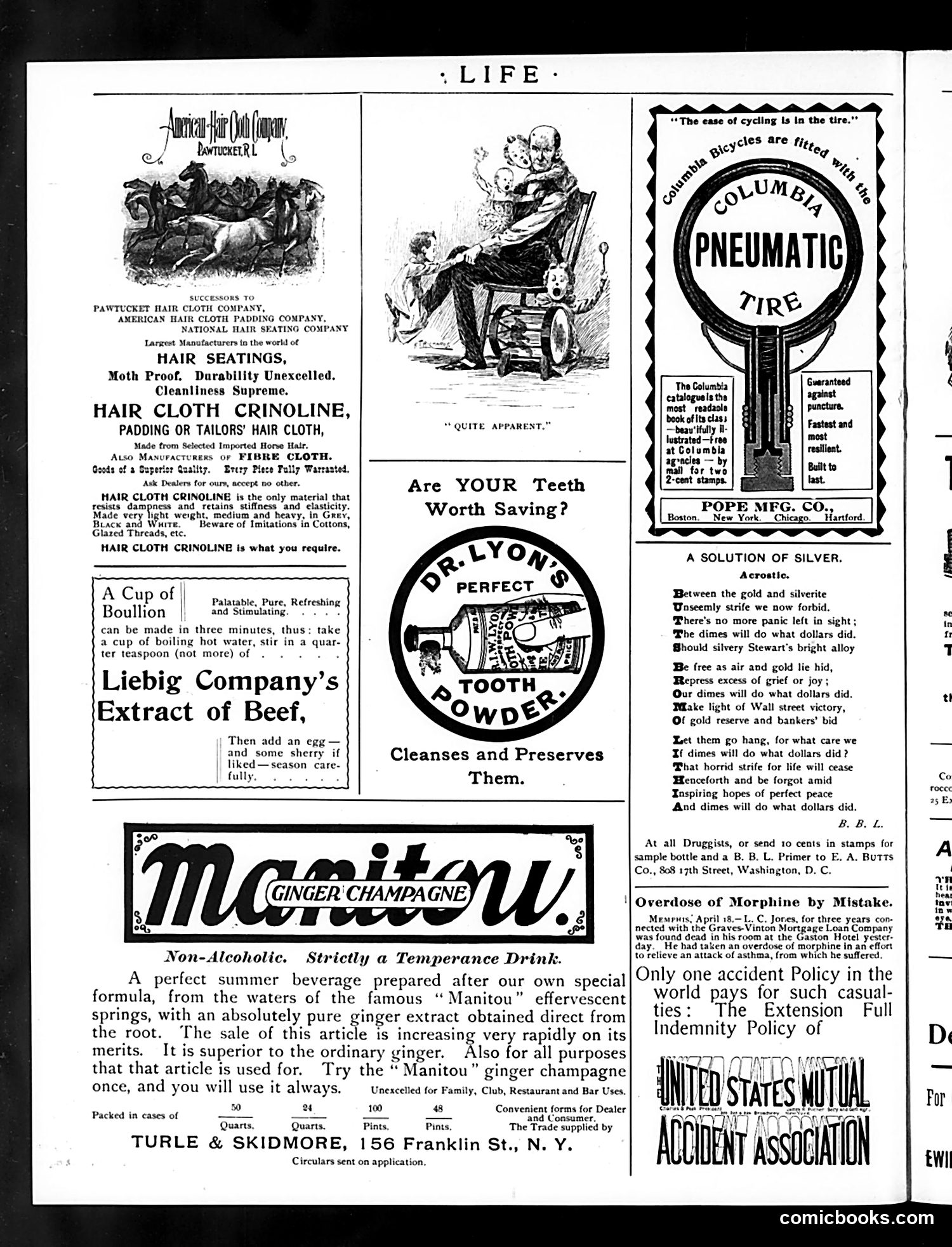
This is primarily an **advertising page** from Life magazine, with one notable **political cartoon** titled "Quite Apparent." The cartoon depicts a figure in a chair being pushed by cherubs/cupids, likely satirizing a political figure or public person of the era (the identity is unclear from the image alone). The caption "Quite Apparent" suggests the cartoon comments on something obvious or transparent about this person. The page is otherwise dominated by advertisements for products typical of the late 19th/early 20th century: hair cloth, beef extract, ginger champagne, tooth powder, and bicycle tires. One ad includes an **acrostic poem about "silver"** that appears to reference contemporary monetary policy debates—likely the free silver movement of the 1890s—though the specific political stance is ambiguous. The ads collectively reflect period concerns: health products, temperance (the "non-alcoholic" ginger drink), and industrial manufacturing. Without additional context about the magazine's publication date, precise identification of the cartoon's subject remains uncertain.
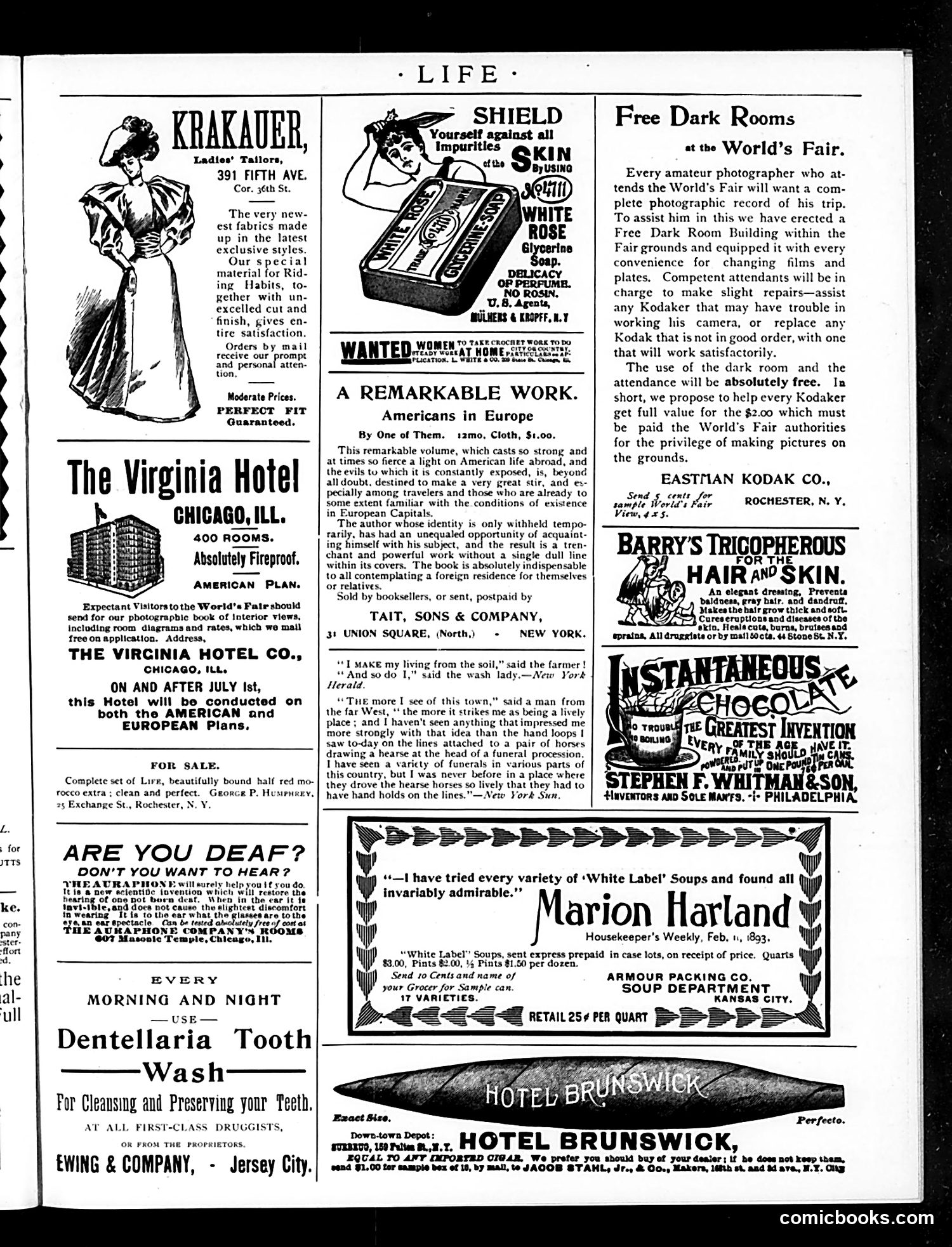
This page is primarily **advertising**, not political satire. It contains various commercial notices for hotels, products, and services circa the 1890s World's Fair era. Notable content includes: **The humor pieces** (two brief anecdotes at bottom-center) are light social observations: a farmer and washlady joke about "making their living from the soil," and a Western visitor's amusement at seeing lively horses pulling a funeral hearse with hand-holds. **Most advertisements** address Victorian-era concerns: ladies' fashion tailoring, fireproof hotels, hearing aids ("Aura Phone"), tooth wash, and hair/skin treatments. These reflect contemporary anxieties about health and propriety. **The book advertisement** for "Americans in Europe" suggests satirical social criticism exists elsewhere in Life, though not on this page. **World's Fair content** (dark rooms for photographers) dates this to the 1893 Chicago World's Columbian Exposition period. The page reflects Life's dual function: satirical magazine with extensive advertising supporting it, rather than primarily cartoon-driven satire.
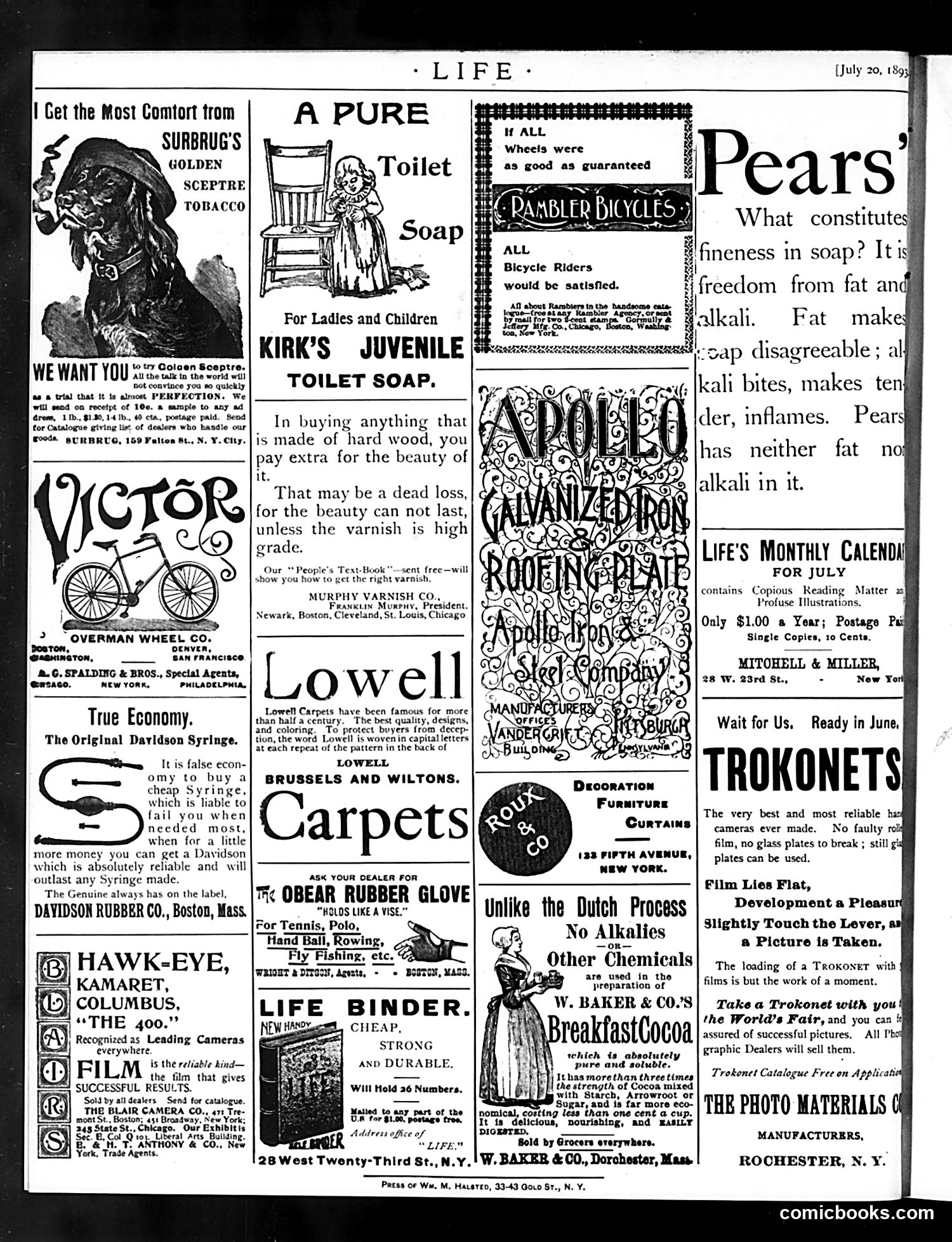
This is primarily an **advertising page** with no political cartoons or satirical editorial content. The page consists entirely of commercial advertisements typical of the 1890s. Notable ads include: - **Tobacco, bicycles, and cameras** dominating the layout, reflecting contemporary consumer interests - **Surbrug's Golden Sceptre Tobacco** and **Victor/Overman bicycles**, representing popular brands - **Kirk's Juvenile Toilet Soap** and other toiletries marketed to women and children - **Photography equipment** (Hawk-Eye, Blair Camera) and the new **Trokonets** film camera One ad for **W. Baker & Co.'s Breakfast Cocoa** emphasizes its purity—"no alkalies or other chemicals"—comparing itself favorably to competitors' products, likely addressing contemporary consumer concerns about food adulteration. The **Pears' soap advertisement** similarly stresses purity, claiming freedom "from fat and alkali." The page reflects 1890s consumer culture and emerging brand competition rather than satire or political commentary.