
Life, 1893-07-20 · page 4 of 18
Life — July 20, 1893 — page 4: what you’re looking at
What you’re looking at
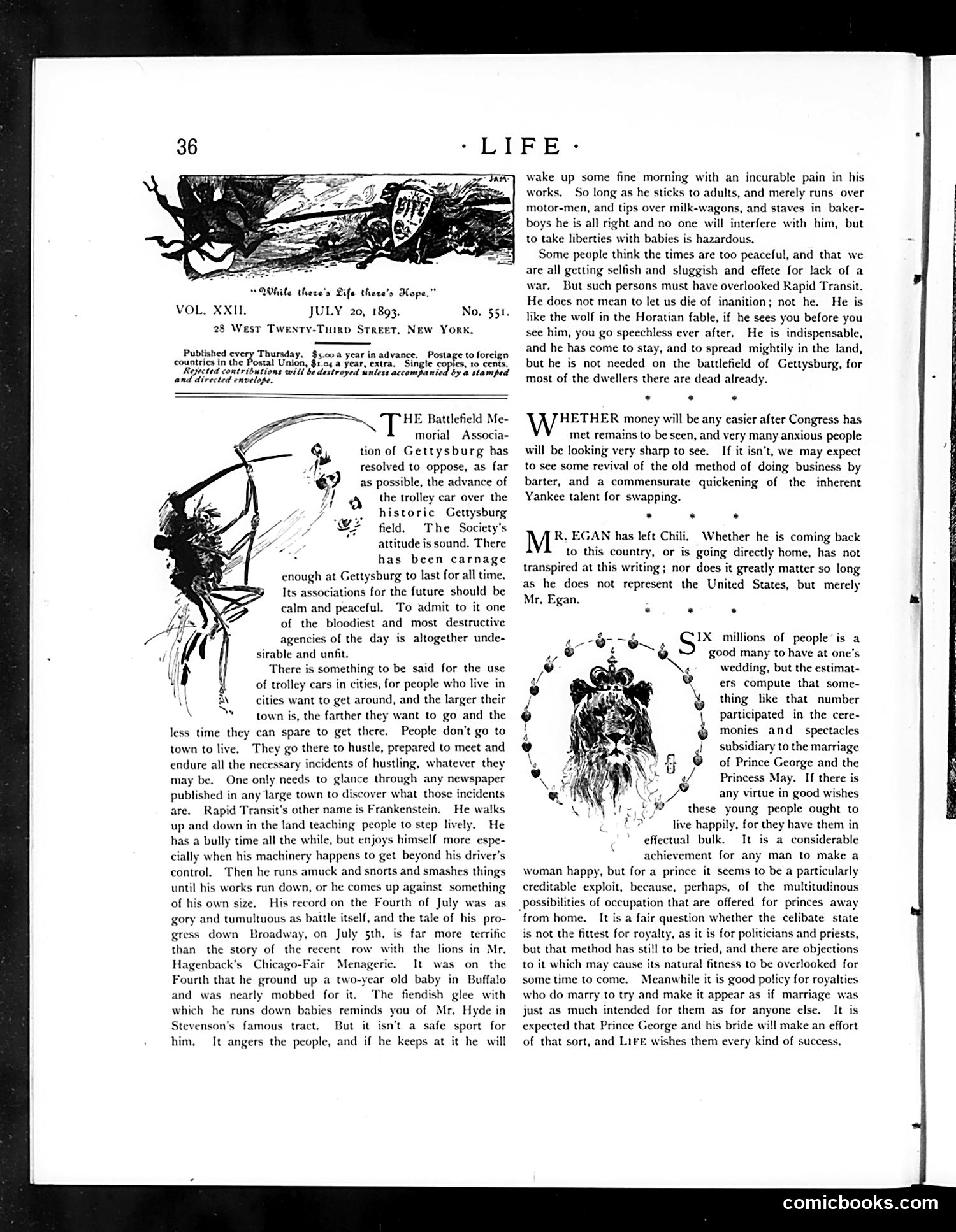
The main cartoon depicts a skeletal figure labeled "Rapid Transit" riding a trolley car wildly out of control. The skeleton represents death or danger; the satire critiques the reckless expansion of urban trolley systems in American cities. The accompanying text discusses the Gettysburg battlefield monument association and trolley cars in cities. It argues that while rapid transit enables urban growth, the inherent dangers—"one of the bloodiest and most destructive agencies of the day"—make it unsafe. The author sarcastically notes Rapid Transit's alternate name is "Frankenstein," comparing the technological innovation to an uncontrollable monster. The satire mocks how cities prioritize transportation convenience over public safety, with the skeleton embodying the death toll from trolley accidents.
📄 Transcribed text from this page (OCR, searchable)
Machine-transcribed from the original scan — historical spelling and the odd misread are preserved.
-LIFE- JULY 20, 1893. No. 551. 28 West Twenty-Tuirp Street, New York, Published every Thursday. $s.coa year in advance. Postage to foreign countries in the Postal Union, $1.04 a year, extra. Single copies, 10 cents, Rezected contributions will be destroyed unless accompanied by @ stamped and directed envelope, HE Battlefield Me- morial Associa- tion of Gettysburg has resolved to oppose, as far as possible, the advance of the trolley car over the cup. historic Gettysburg YW? field. The Society's ‘ attitude is sound. There has been carnage enough at Gettysburg to last for all time. Its associations for the future should be calm and peaceful. To admit to it one of the bloodiest and most destructive agencies of the day is altogether unde- sirable and unfit. There is something to be said for the use of trolley cars in cities, for people who live in cities want to get around, and the larger their town is, the farther they want to go and the less time they can spare to get there. People don’t go to town to live. They go there to hustle, prepared to meet and endure all the necessary incidents of hustling, whatever they may be, One only needs to glance through any newspaper published in any large town to discover what those incidents are. Rapid Transit’s other name is Frankenstein. He walks up and down in the land teaching people to step lively. He has a bully time all the while, but enjoys himself more espe- cially when his machinery happens to get beyond his driver's control. Then he runs amuck and snorts and smashes things until his works run down, or he comes up against something of his own size, His record on the Fourth of July was as gory and tumultuous as battle itself, and the tale of his pro- gress down Broadway, on July 5th, is far more terrific than the story of the recent row with the lions in Mr. Hagenback's Chicago-Fair Menagerie. It was on the Fourth that he ground up a two-year old baby in Buffalo and was nearly mobbed for it. The fiendish glee with which he runs down babies reminds you of Mr. Hyde in Stevenson's famous tract. But it isn’t a safe sport for him. It angers the people, and if he keeps at it he will wake up some fine morning with an incurable pain in his works. So long as he sticks to adults, and merely runs over motor-men, and tips over milk-wagons, and staves in baker- boys he is all right and no one will interfere with him, but to take liberties with babies is hazardous. Some people think the times are too peaceful, and that we are all getting selfish and sluggish and effete for lack of a war. But such persons must have overlooked Rapid Transit. He does not mean to let us die of inanition; not he. He is like the wolf in the Horatian fable, if he sees you before you see him, you go speechless ever after. He is indispensable, and he has come to stay, and to spread mightily in the land, but he is not needed on the battlefield of Gettysburg, for most of the dwellers there are dead already. * . * HETHER money will be any easier after Congress has met remains to be seen, and very many anxious people will be looking very sharp to see. If it isn’t, we may expect to see some revival of the old method of doing business by barter, and a commensurate quickening of the inherent Yankee talent for swapping. * * R. EGAN has left Chili. Whether he is coming back to this country, or is going directly home, has not transpired at this writing ; nor does it greatly matter so long as he does not represent the United States, but merely Mr, Egan. * . IX millions of people is a good many to have at one’s wedding, but the estimat- ers compute that some- thing like that number participated in the cere- monies and spectacles subsidiary to the marriage of Prince George and the Princess May. If there is any virtue in good wishes these young people ought to live happily, for they have them in effectual bulk. It is a considerable achievement for any man to make a woman happy, but for a prince it seems to be a particularly creditable exploit, because, perhaps, of the multitudinous possibili of occupation that are offered for princes away from home. It is a fair question whether the celibate state is not the fittest for royalty, as it is for politicians and priests, but that method has still to be tried, and there are objections to it which may cause its natural fitness to be overlooked for some time to come. Meanwhile it is good policy for royalties who do marry to try and make it appear as if marriage was just as much intended for them as for anyone else. It is expected that Prince George and his bride will make an effort of that sort, and LiFe wishes them every kind of success, comicbooks.com