
Life, 1893-07-20 · page 5 of 18
Life — July 20, 1893 — page 5: what you’re looking at
What you’re looking at
This page satirizes class and workplace dynamics in early 20th-century journalism. The main illustration depicts a scene at the New York *Times* offices where Mr. Browne (an editor or manager) questions an office boy named Gillam about his wages. The satire centers on the boy's claim of earning twenty dollars weekly—a respectable sum for the era—which surprises Browne. The joke reveals a disconnect: the boy inflated his salary when speaking to Browne but admitted earning less to another colleague. The text emphasizes Gillam's status as a dispensable "office boy" despite his minor importance to powerful editors. The mummy illustration captioned "Pressed for Time" appears unrelated, suggesting the page contains multiple satirical pieces mocking different aspects of contemporary life.
📄 Transcribed text from this page (OCR, searchable)
Machine-transcribed from the original scan — historical spelling and the odd misread are preserved.
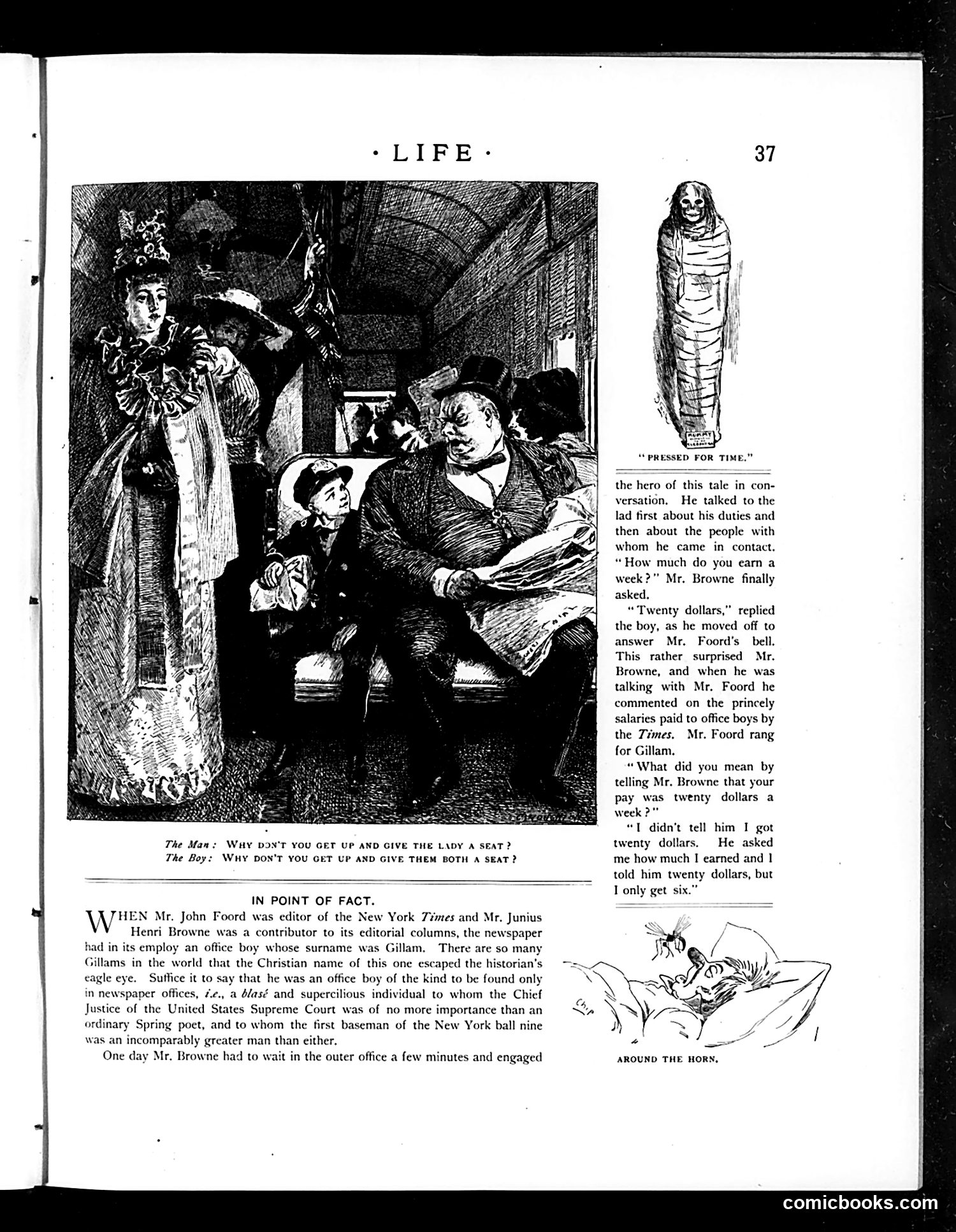
The Man; WAY DON'T YOU GET UP AND GIVE THE LADY A SEAT? The Boy: WHY DON'T YOU GET UP AND GIVE THEM BOTH A SEAT? IN POINT OF FACT. V HEN Mr. John Foord was editor of the New York 7ymes and Mr. Junius Henri Browne was a contributor to its editorial columns, the newspaper had in its employ an office boy whose surname was Gillam. There are so many Gillams in the world that the Christian name of this one ped the historian’s eagle eye. Suffice it to say that he was an office boy of the kind to be found only in newspaper offices, é.c., a d/asé and supercilious individual to whom the Chief Justice of the United States Supreme Court was of no more importance than an ordinary Spring poet, and to whom the first baseman of the New York ball nine was an incomparably greater man than either, One day Mr. Browne had to wait in the outer office a few minutes and engaged the hero of this tale in con- versation, He talked to the lad first about his duties and then about the people with whom he came in contact, “How much do you earn a week?” Mr. Browne finally asked, “Twenty dollars,” replied the boy, as he moved off to answer Mr. Foord's bell. This rather surprised Mr. Browne, and when he was talking with Mr. Foord he commented on the princely salaries paid to office boys by the Zimes. Mr. Foord rang for Gillam. “What did you mean by telling Mr. Browne that your pay was twenty dollars a week ?” “TL didn’t tell him I got twenty dollars. He asked me how much I earned and 1 told him twenty dollars, but I only get six.” AROUND THE HORN, comicbooks.com