
A complete issue · 14 pages · 1893
Life — June 22, 1893
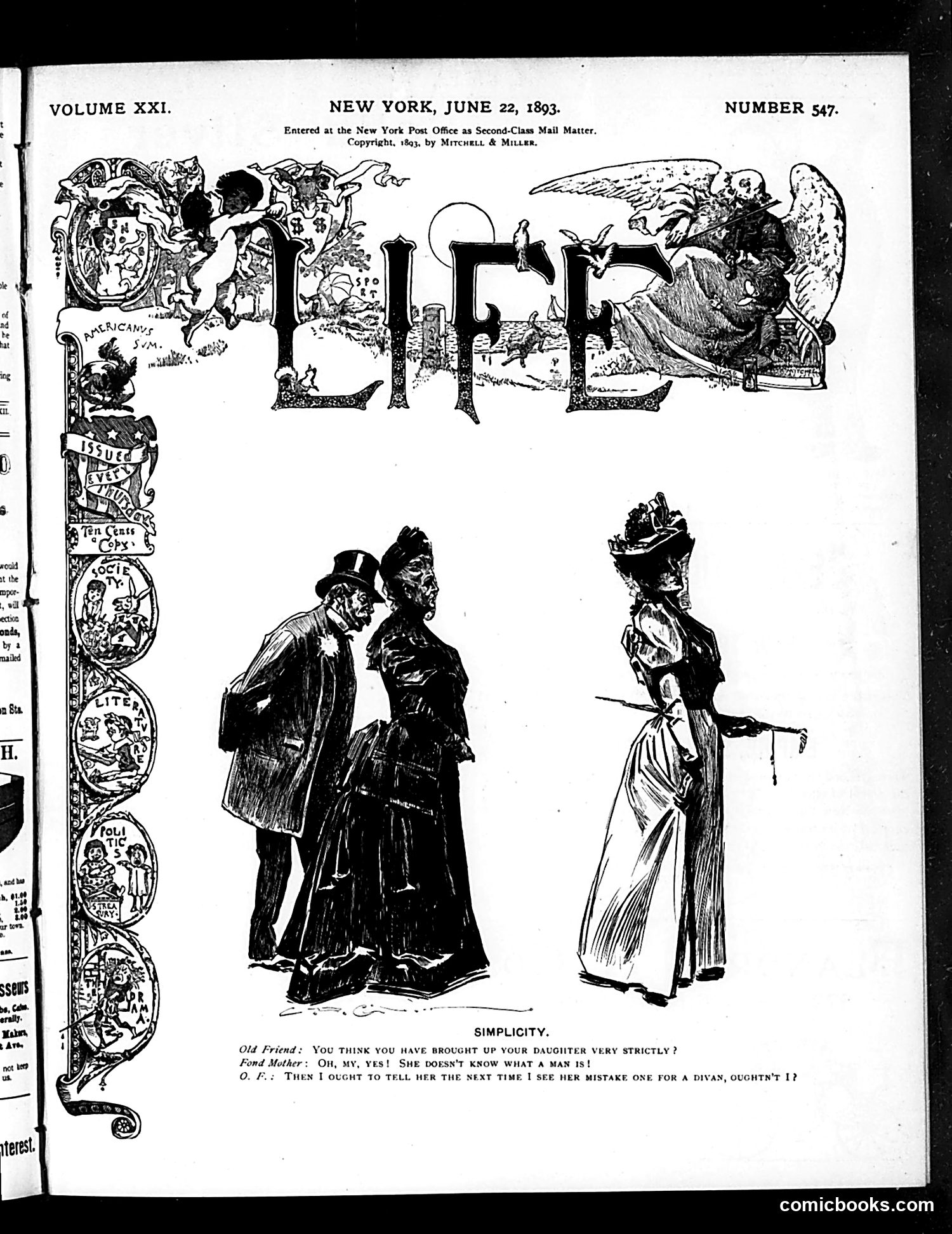
This cartoon satirizes parental hypocrisy regarding daughters' upbringing and social behavior. The dialogue shows: **Old Friend** questions the **Fond Mother** about her daughter's strict upbringing. The mother claims ignorance of "what a man is," yet the **O.F.** (Old Friend) observes the daughter has already made a "mistake" with a divan—likely implying romantic impropriety or scandal. The joke exposes the contradiction: wealthy parents claim to raise daughters in sheltered innocence while those daughters demonstrably engage in worldly behavior. The ornate decorative border on the left (typical Life magazine styling) frames this critique of Gilded Age pretense about female propriety and class status.
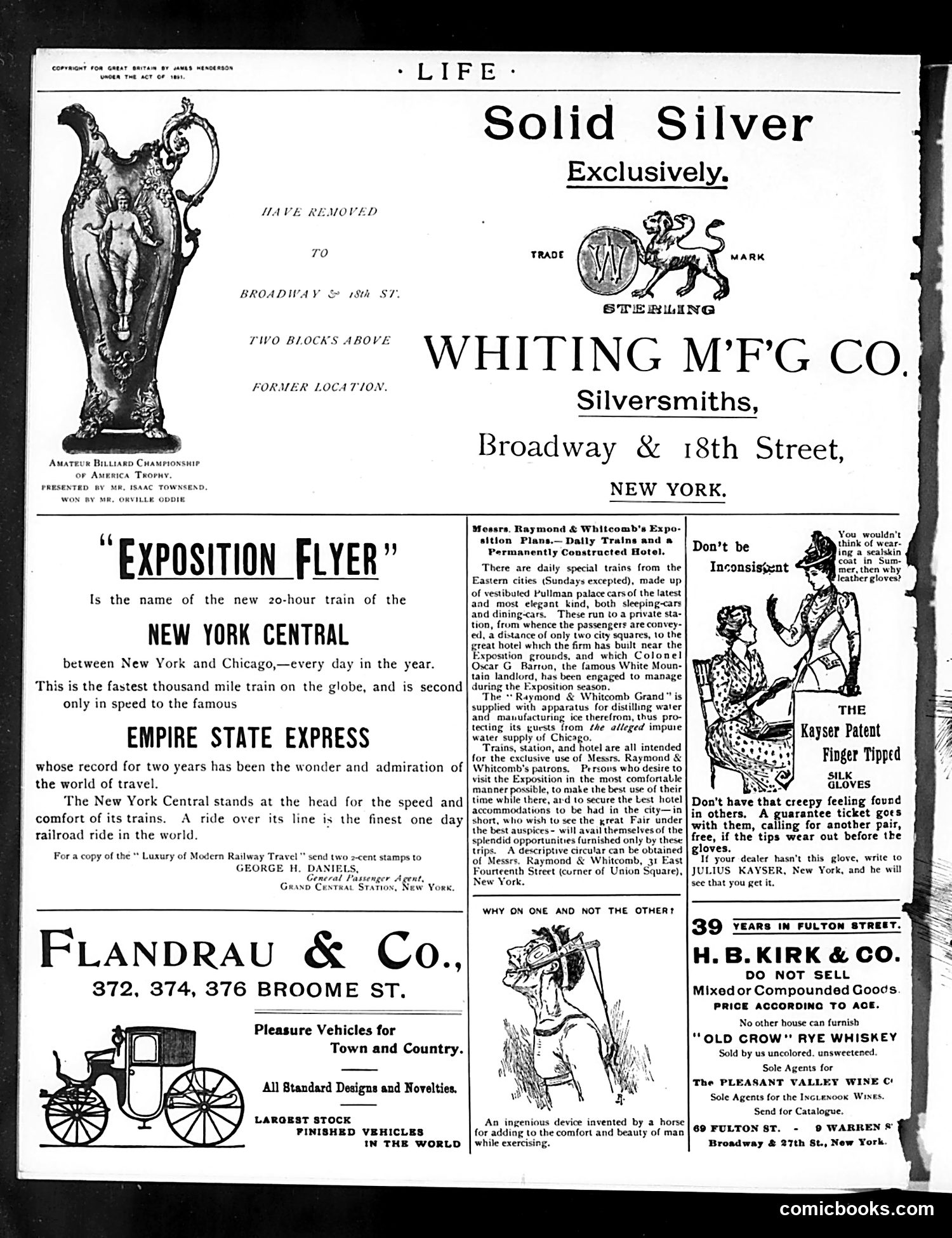
This page is primarily **advertising**, not satirical content. The dominant ads promote: 1. **Whiting Manufacturing Co.** — A silversmith selling solid silver goods from their Broadway location 2. **New York Central Railway** — Advertising the "Exposition Flyer," a 20-hour train between New York and Chicago, positioned as the fastest long-distance rail service (second only to the Empire State Express) 3. **Flandrau & Co.** — Carriage and pleasure vehicle manufacturer 4. **H.B. Kirk & Co.** — A whiskey distributor with 39 years on Fulton Street 5. **Kayser Patent Finger Tipped Silk Gloves** — With a small cartoon showing a woman examining gloves, humorously captioned "Don't be inconsistent" The only humor appears in the Kayser glove ad's mild cartoon joke about women's fashion choices. The page reflects turn-of-the-century consumer advertising rather than political satire.
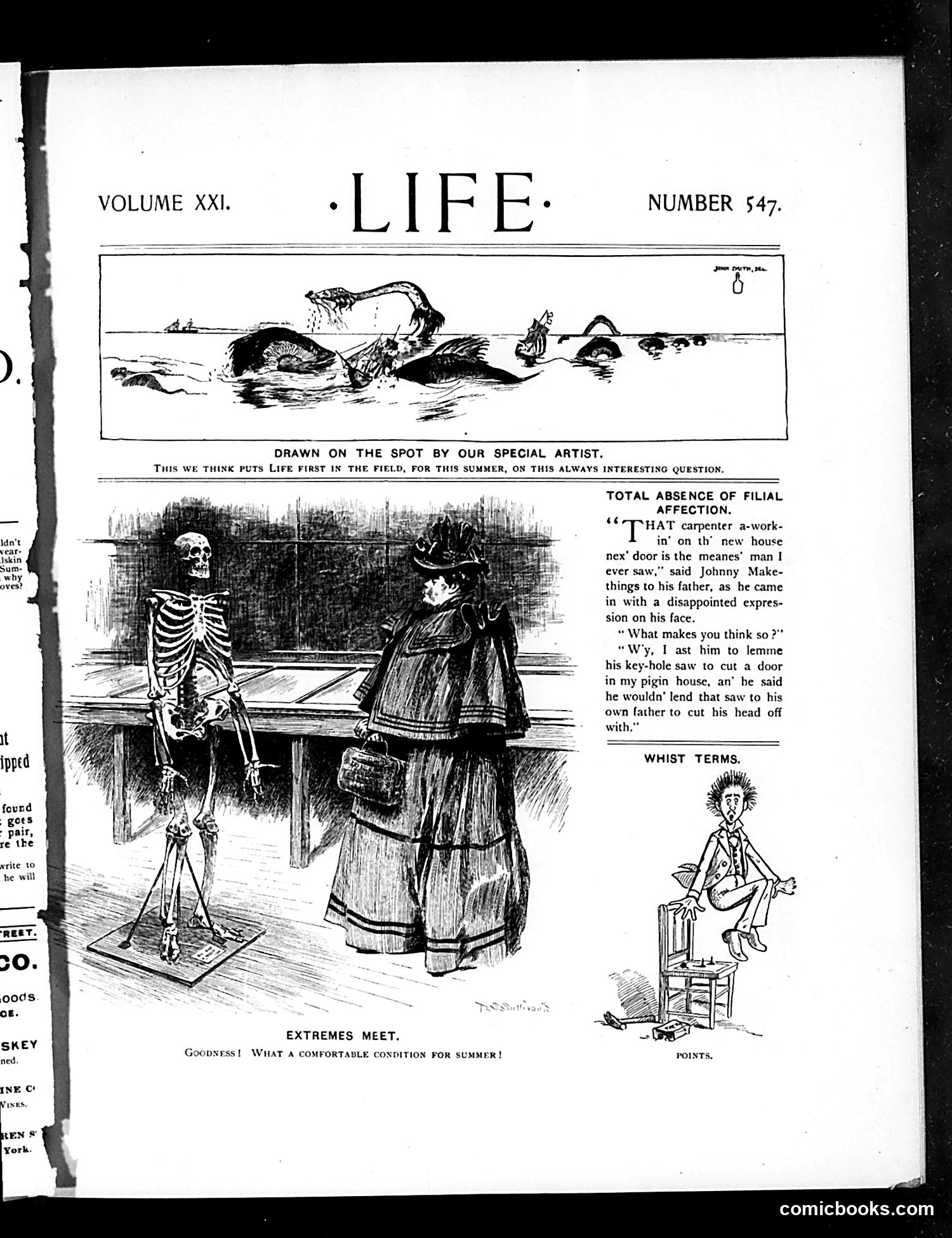
The page contains three distinct cartoons: **Top cartoon**: "Drawn on the Spot by Our Special Artist" depicts summer activities, though details are unclear. **Main cartoon**: "Extremes Meet" shows a skeleton conversing with an elderly woman. The caption reads: "Goodness! What a comfortable condition for summer!" This appears to be dark humor about extreme heat—suggesting summer weather is so oppressively hot it's nearly deadly (represented by Death/skeleton). The joke satirizes how unbearably hot summers can be, presenting it as a darkly comic meeting between life and death. **Right section**: "Whist Terms" contains a small illustration about card-playing terminology, unrelated to the main content. The page exemplifies Life magazine's characteristic blend of social satire and macabre Victorian-era humor.
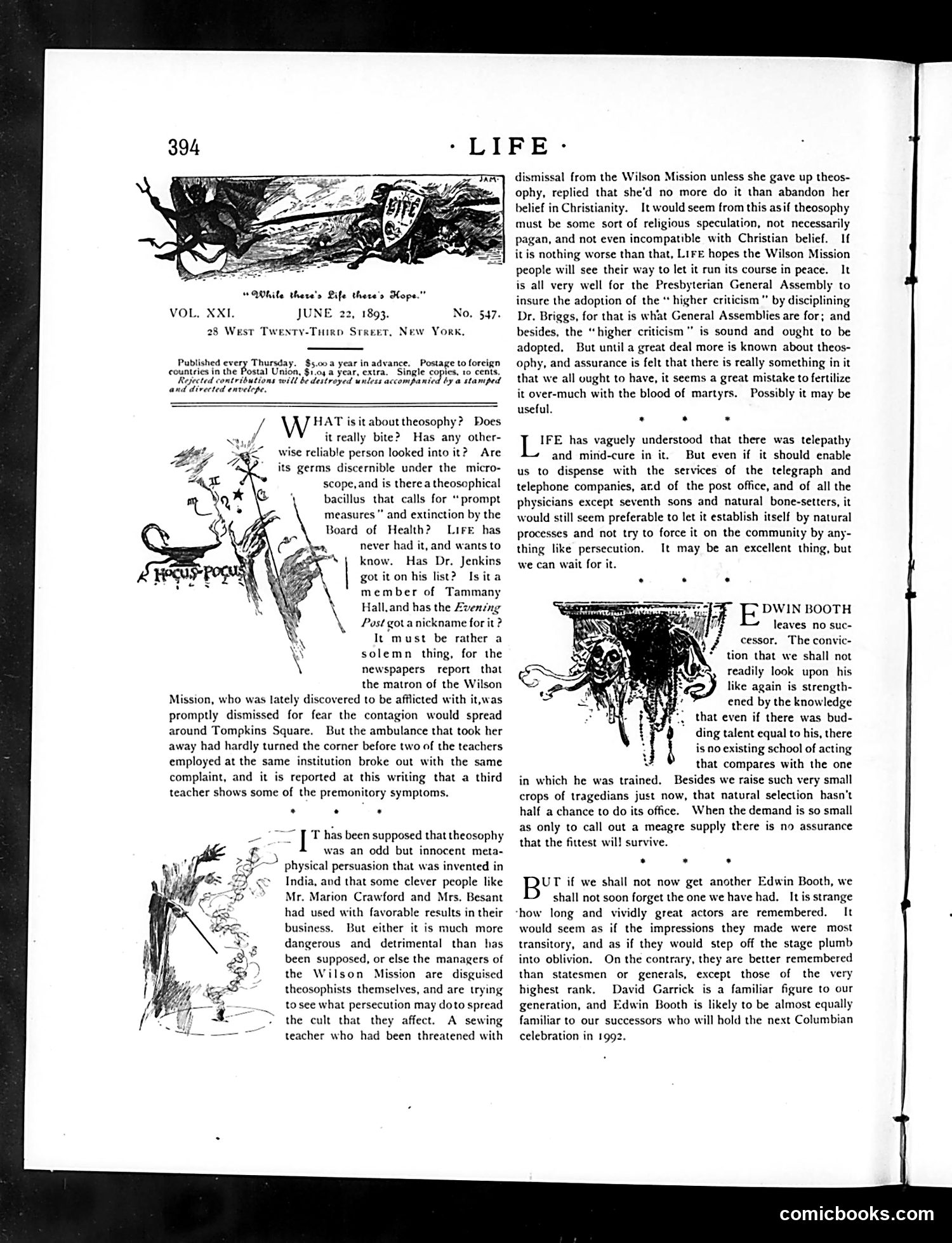
This page discusses **theosophy**, a late-19th-century spiritual movement claiming ancient esoteric knowledge. The article expresses skepticism about theosophists' claims while acknowledging the movement exists. The satirical illustrations mock theosophical practices and beliefs, though specific identifications are unclear from the artwork alone. The page criticizes the **Wilson Mission** (apparently connected to theosophy) for dismissing members unless they abandoned Christian belief—suggesting theosophy conflicted with conventional religion. A secondary section discusses **Edwin Booth's death** and his acting legacy, noting his towering importance to American theater and predicting his reputation would endure beyond his successors. The overall tone is characteristic of *Life*'s skepticism toward fringe movements while respecting legitimate cultural achievements.
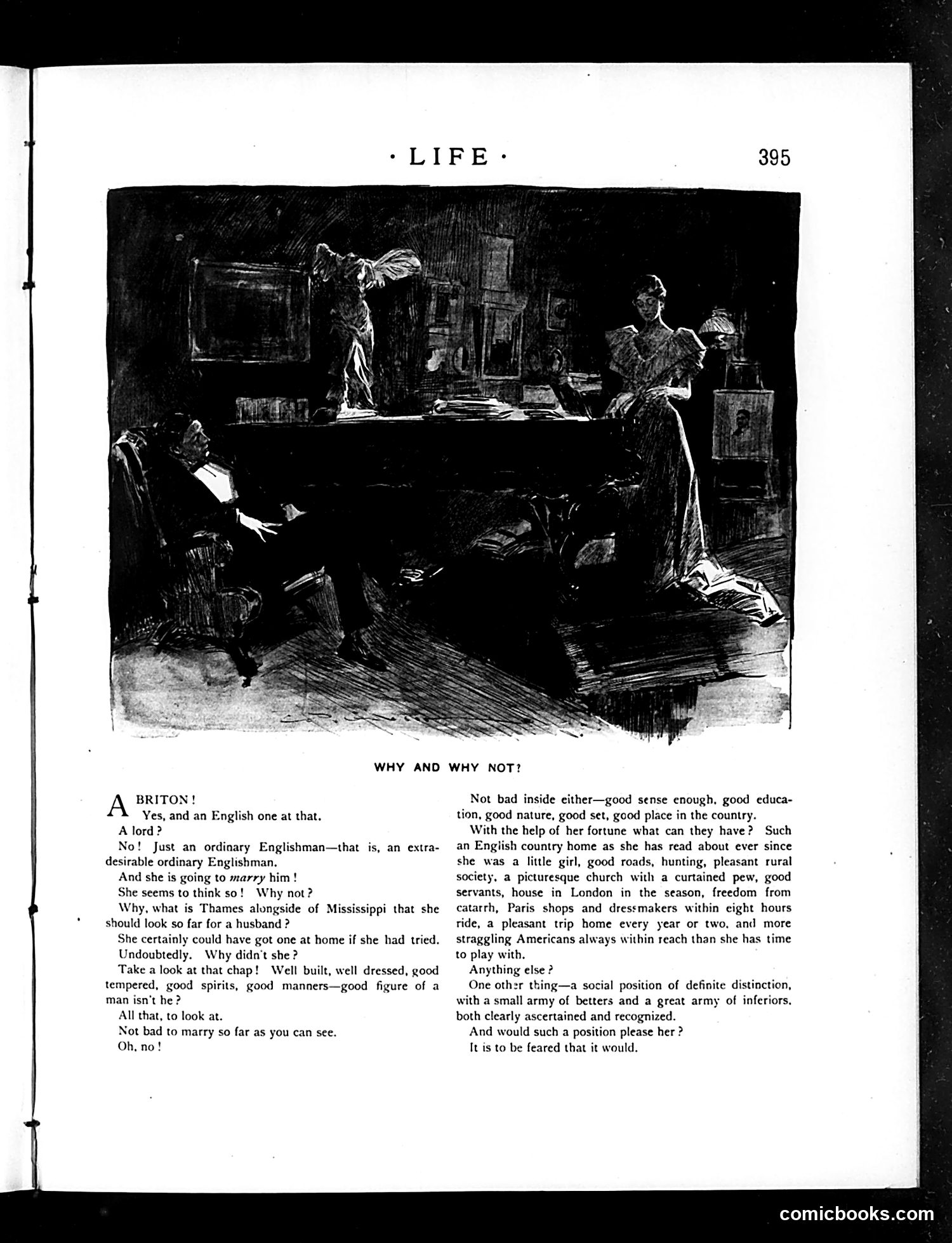
This satirical dialogue criticizes a young Englishwoman's decision to marry an "ordinary Englishman" rather than pursue a wealthy American match. The cartoon depicts what appears to be a drawing room scene with multiple figures in conversation. The text presents a debate: one speaker (labeled "A BRITON") defends the choice, listing the man's respectable qualities—good education, temperament, manners, and appearance. The counterargument emphasizes what marriage to an American wealthy man could offer: a country estate, Paris shopping, cathedra churches, servants, and elevated social status. The satire mocks both British insularity and American wealth-worship, suggesting early 20th-century tensions between American economic power and British social traditions—questioning whether love and character outweigh material advantage.
This page contains **no political cartoon**. Instead, it features: 1. **"Our Fresh Air Fund"** - a charitable fundraising section listing donations to send poor children to the countryside, a common early-20th-century philanthropy. 2. **"A New Kind of Army Novel"** - a book review discussing George Putnam's "In Blue Uniform" (Scribner's), which depicts quiet, realistic military post life rather than theatrical heroics. The reviewer praises its artistic restraint and authentic detail. 3. **"He Wanted to Know"** - a brief humorous dialogue between Willis and Wallace about finding a vacant seat on an elevated train to Harlem, playing on miscommunication. The page is primarily **literary content and social commentary** rather than satirical cartooning. The review reflects contemporary literary tastes and period attitudes toward military fiction.
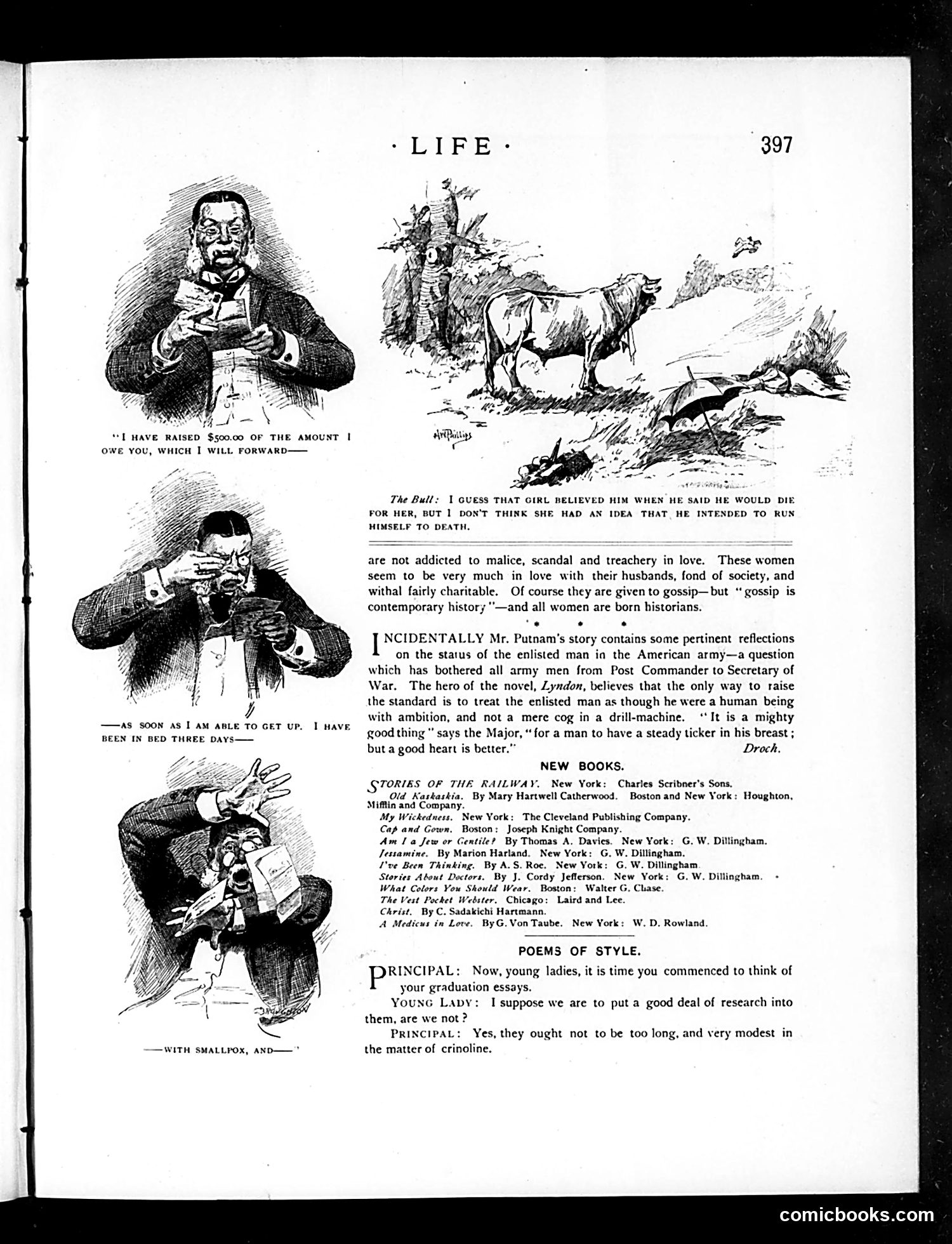
This page contains four satirical cartoon vignettes (left side) depicting a man in various financial predicaments, accompanied by captions about debt and money troubles. The cartoons illustrate consequences of borrowing and financial mismanagement—a common satirical theme in early 20th-century humor magazines. The right side features a pastoral illustration with livestock and includes discussion of Mr. Putnam's novel *Lyndon*, which addresses the status of enlisted men in the American army—apparently a contemporary social issue. The "New Books" section lists recent publications, while "Poems of Style" presents a dialogue between a Principal and Young Lady about graduation essays. The overall page mixes literary criticism, social commentary, and financial humor typical of *Life* magazine's satirical approach to contemporary American concerns.
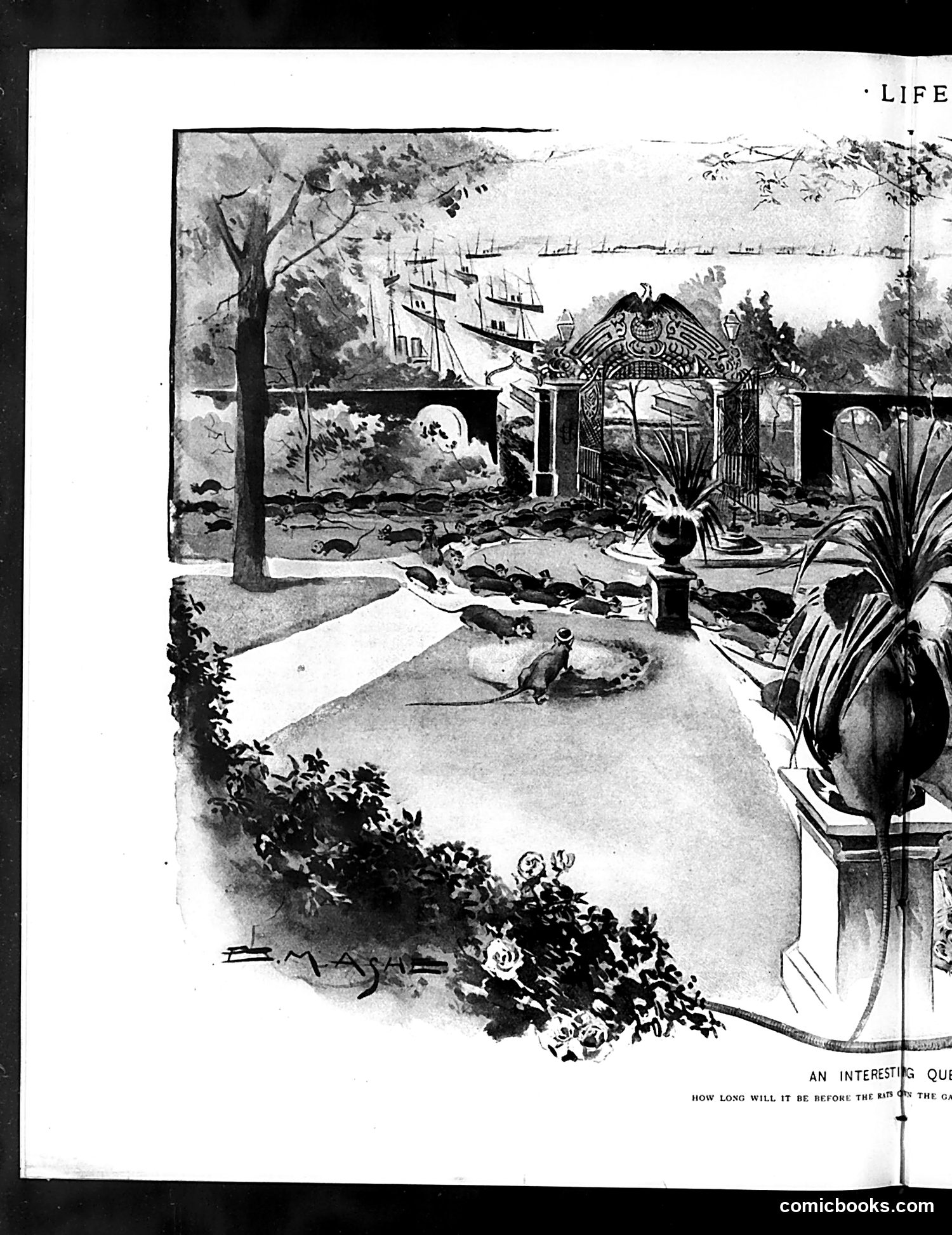
This is a satirical illustration from *Life* magazine depicting what appears to be a wealthy estate or garden setting. The scene shows an ornate gazebo or garden structure with ships visible in the distant harbor, suggesting a waterfront property. The foreground features manicured landscaping with roses and cultivated plants. The partially visible caption reads "AN INTERESTING QU[ESTION]" and "HOW LONG WILL IT BE BEFORE THE RAID[S?] THE GA[?]" The satire appears to target wealth disparity and vulnerability—likely commenting on how long the privileged classes' leisurely estates will remain untouched amid some approaching threat or raid (possibly referencing labor unrest, war, or economic collapse). The contrast between refined gardens and ominous ships suggests impending disruption to the comfortable lives of the wealthy.
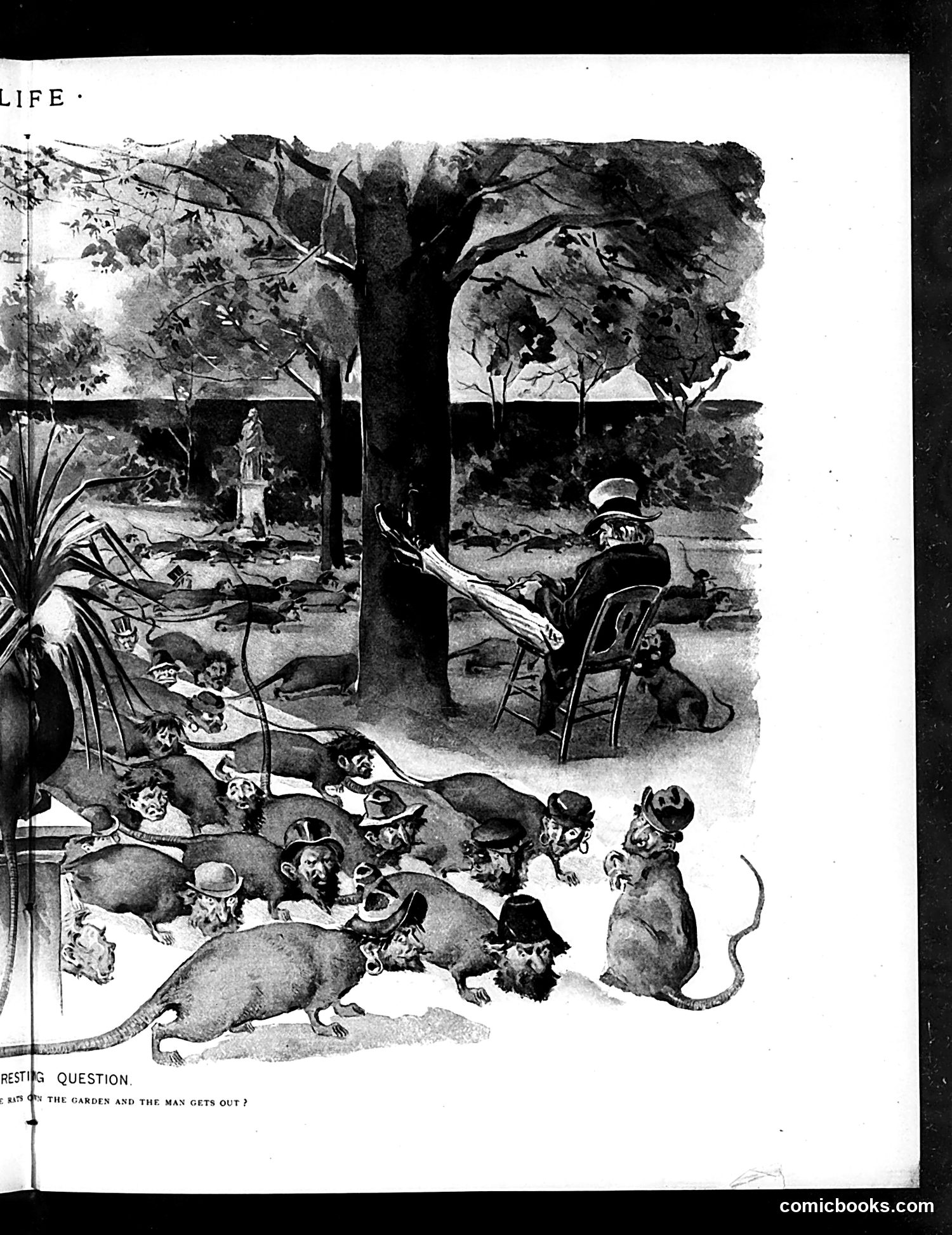
This page from *Life* magazine features an illustration titled "A Resting Question" with the subtitle "Who Gets the Garden and the Man Gets Out?" The cartoon depicts anthropomorphized rats and mice wearing hats and formal clothing in a garden setting. The animals appear to be occupying a human space—specifically a garden—while a human figure is visible in the background, seemingly displaced or evicted. The satire appears to comment on **pest infestation and property control**, suggesting a humorous inversion where rodents have taken over a cultivated garden space, forcing out the human owner. This likely reflects contemporary concerns about urban or suburban pest problems, presenting the absurd scenario where unwanted animals claim dominion over human property. The "resting question" sarcastically asks whose space this actually is.
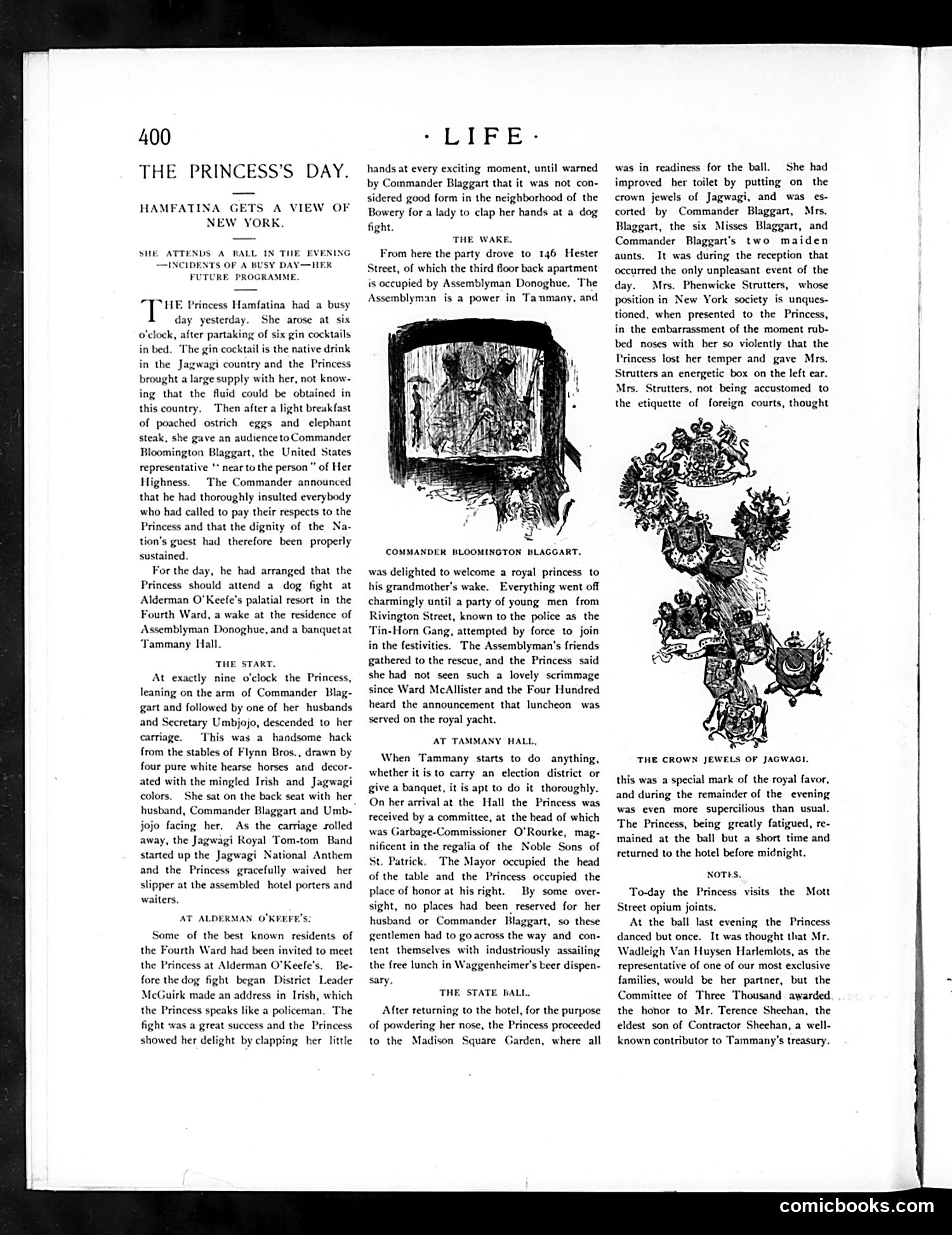
This article satirizes the visit of an unnamed princess to New York City. The humor targets the absurd spectacle surrounding royal visits and American eagerness to impress foreign nobility. The main illustration shows **Commander Bloomington Blaggart**, a fictional American character representing loud, boastful society figures who desperately court the princess's approval. The satire mocks how New York elites arrange elaborate events—dog fights, banquets, yacht lunches—to demonstrate sophistication, while actually revealing their uncouth nature and desperation for validation. The text describes chaotic scenes where distinguished citizens behave ridiculously in her presence, including an incident where a woman strikes another in embarrassment. The joke: American high society's transparent pretense and anxiety around royal approval exposes their actual vulgarity and social insecurity.
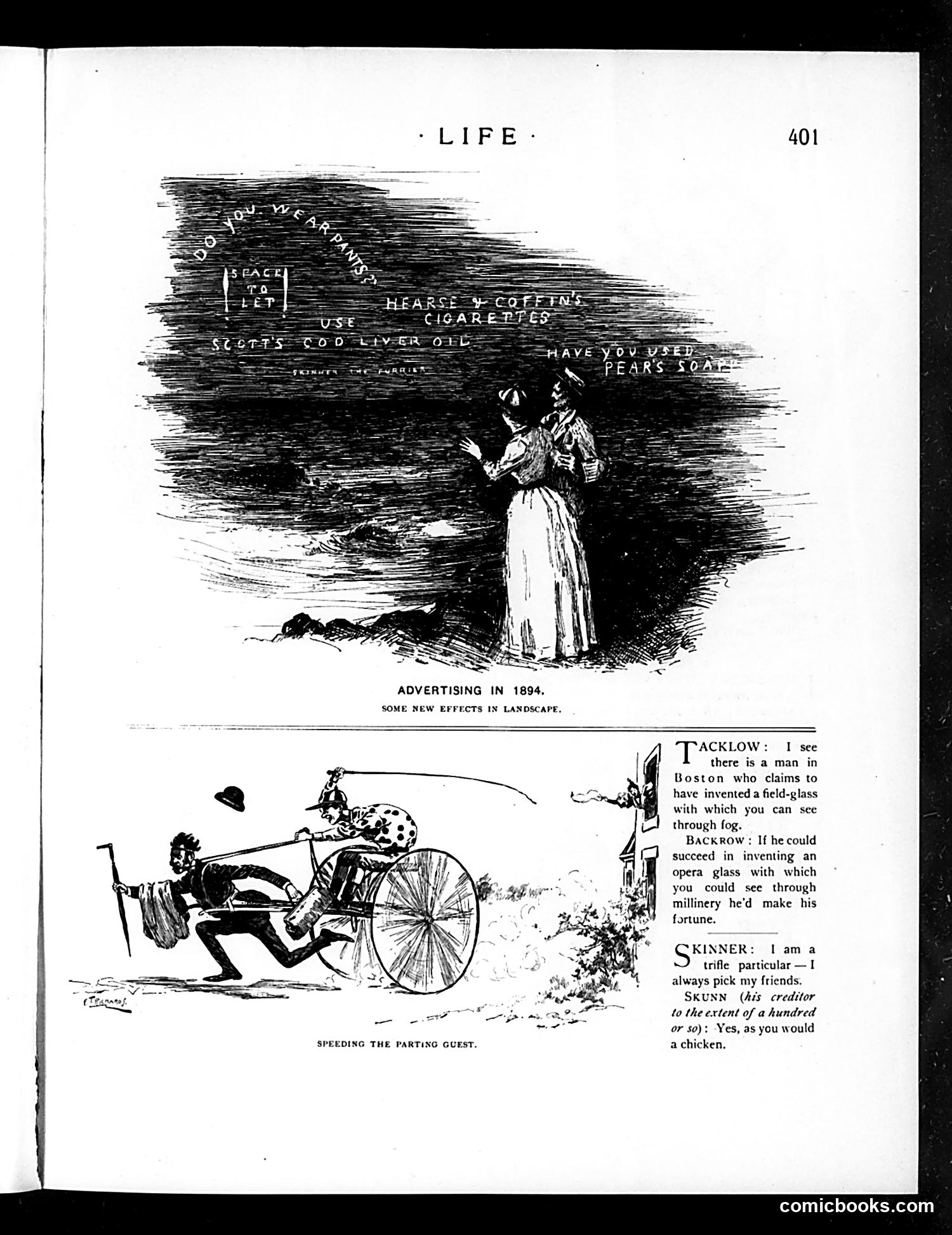
This page satirizes advertising trends of the 1890s. The top illustration shows a woman surrounded by product advertisements cluttering the landscape—Scott's Cod Liver Oil, Pears Soap, Hearse & Coffins Cigarettes, and others—suggesting how commercial messages invaded everyday life. The bottom cartoon, "Speeding the Parting Guest," depicts a man being violently propelled away on a bicycle by a woman wielding a fishing rod, satirizing overly aggressive hosting or perhaps the new bicycle craze's chaotic impact on society. The dialogue section mocks upper-class affectation and poor reasoning. The humor relies on absurdist logic and social pretension—typical of Life's satirical style targeting wealthy urbanites and their ridiculous pursuits during the Gilded Age.
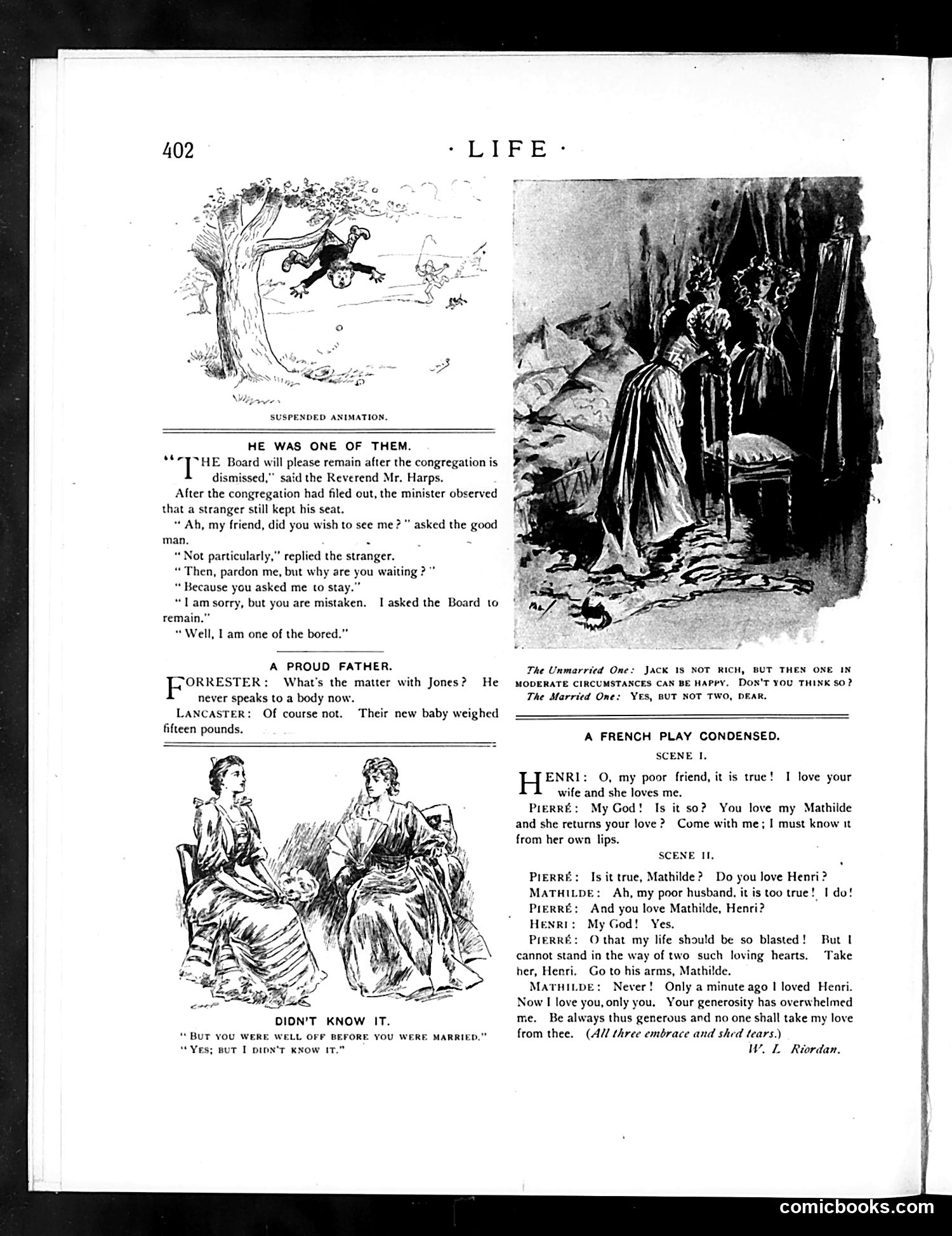
This page contains three separate humor pieces typical of early Life magazine's satirical style: **"He Was One of Them"** mocks church social conventions—a stranger remains seated after services, claiming the minister asked "the Board" to stay. His punchline ("I am one of the bored") jokes about enduring tedious church gatherings. **"A Proud Father"** satirizes how new parenthood changes men's personalities. Jones never speaks anymore because his baby weighed fifteen pounds—implying he's exhausted or preoccupied to the point of becoming antisocial. **"Didn't Know It"** plays on marriage's financial realities: a man was "well off before marriage" but didn't realize poverty would follow. **"A French Play Condensed"** parodies the overwrought melodrama of French theater—a tangled love triangle where characters bizarrely accept infidelity through excessive sentiment, with everyone weeping and embracing. The satire targets the genre's emotional excess and absurd plotting. These pieces reflect turn-of-century American attitudes toward domesticity, social obligation, and Continental theatrical pretension.
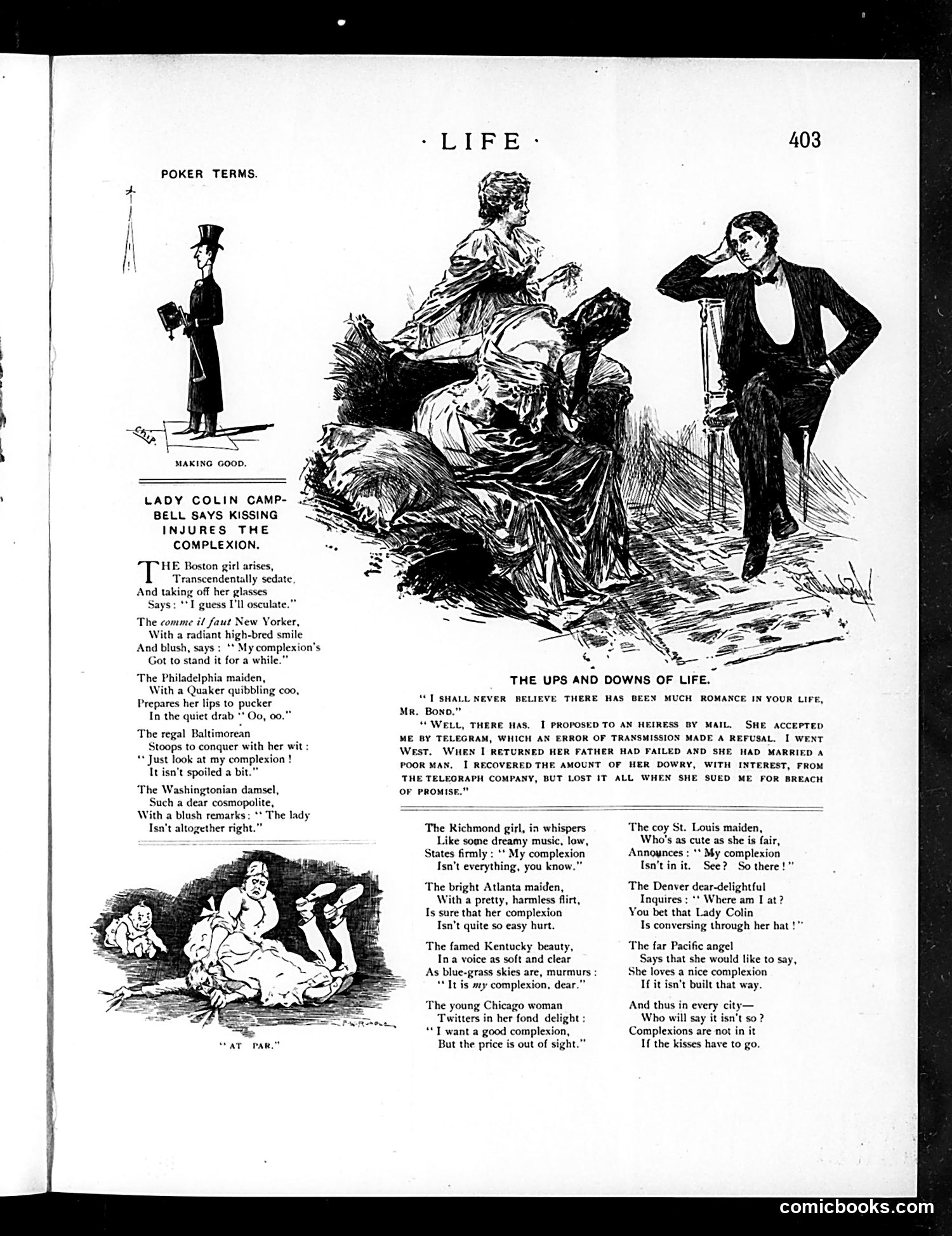
This page satirizes Lady Colin Campbell's claim that kissing damages women's complexions. The left section mocks various American regional types (Boston, New York, Philadelphia, Baltimore, Washington, etc.) all debating whether to kiss despite complexion concerns—each characterized by period stereotypes about their social pretensions and speech patterns. The main cartoon shows a man recounting romantic misfortune: he proposed by mail to an heiress, she accepted by telegram, but a transmission error made it a refusal. When he went west and returned, her father had failed financially and she'd married a poor man. The joke's dark twist: he recovered her dowry amount from the telegraph company but lost it when she sued him for breach of promise. The bottom verses continue the complexion theme across American cities, joking that women everywhere prioritize kissing over skin care—making Campbell's warning seem impractical against romantic desire.
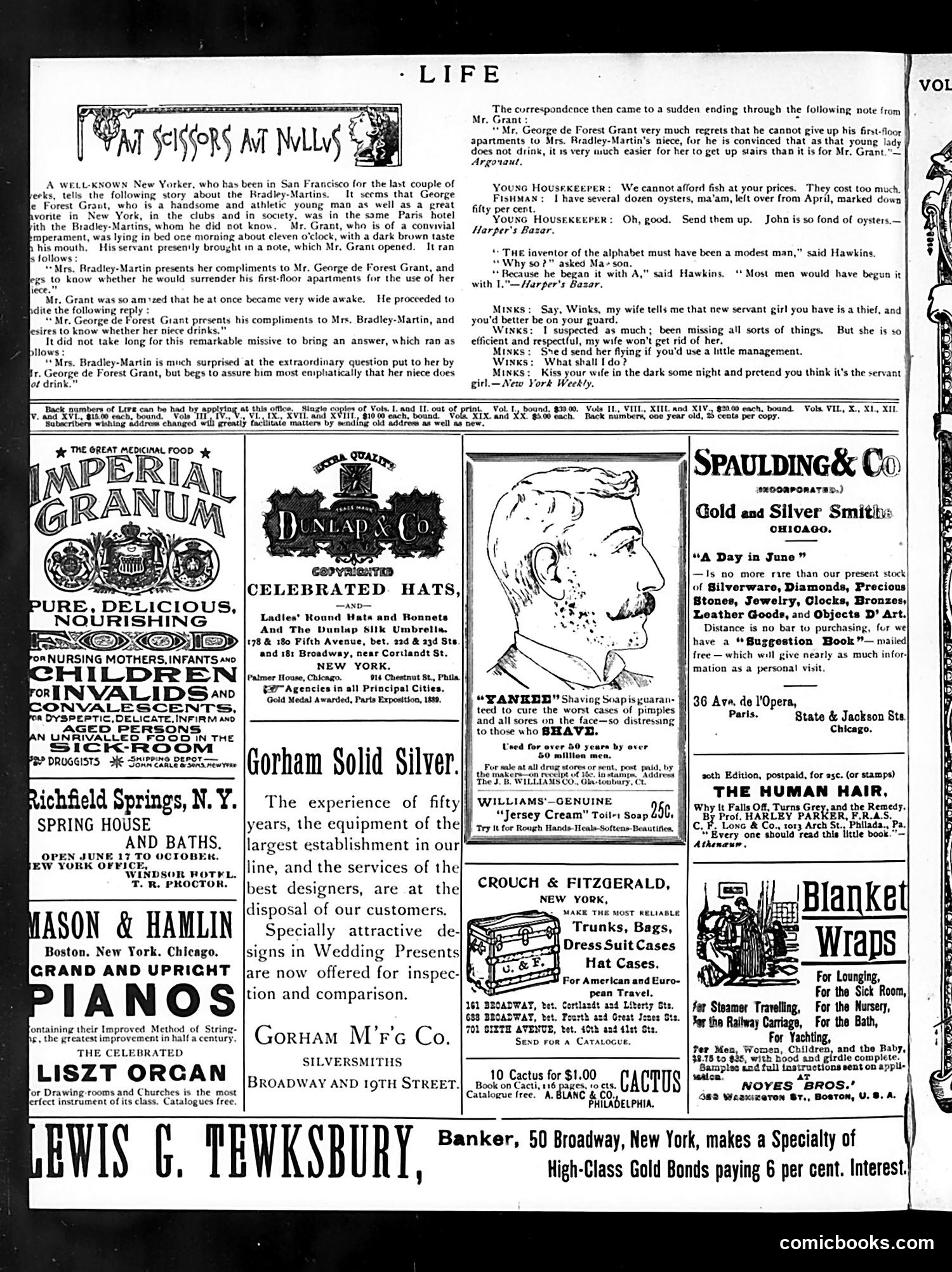
This appears to be primarily a **humorous anecdote page** rather than a political cartoon page. The main story mocks the Bradley-Martins, a wealthy New York family, through an exchange of letters between society figure George de Forest Grant and Mrs. Bradley-Martin. **The Satire:** Grant receives an audacious request from Mrs. Bradley-Martin to surrender his first-floor hotel apartment for her niece's use. His witty reply—asking if the niece drinks—implies she's an alcoholic requiring ground-floor access. When assured she doesn't drink, he responds that her sobriety makes stairs perfectly manageable for *her*, unlike himself. The humor targets **wealthy socialites' presumption and entitlement**, suggesting they're dissolute drinkers. The page also includes brief joke items about oyster prices, alphabet inventors, and infidelity, typical of Life magazine's satirical humor section. The remainder consists of **period advertisements** for musical instruments, hotels, and patent medicines.