
Life, 1893-06-22 · page 4 of 14
Life — June 22, 1893 — page 4: what you’re looking at
What you’re looking at
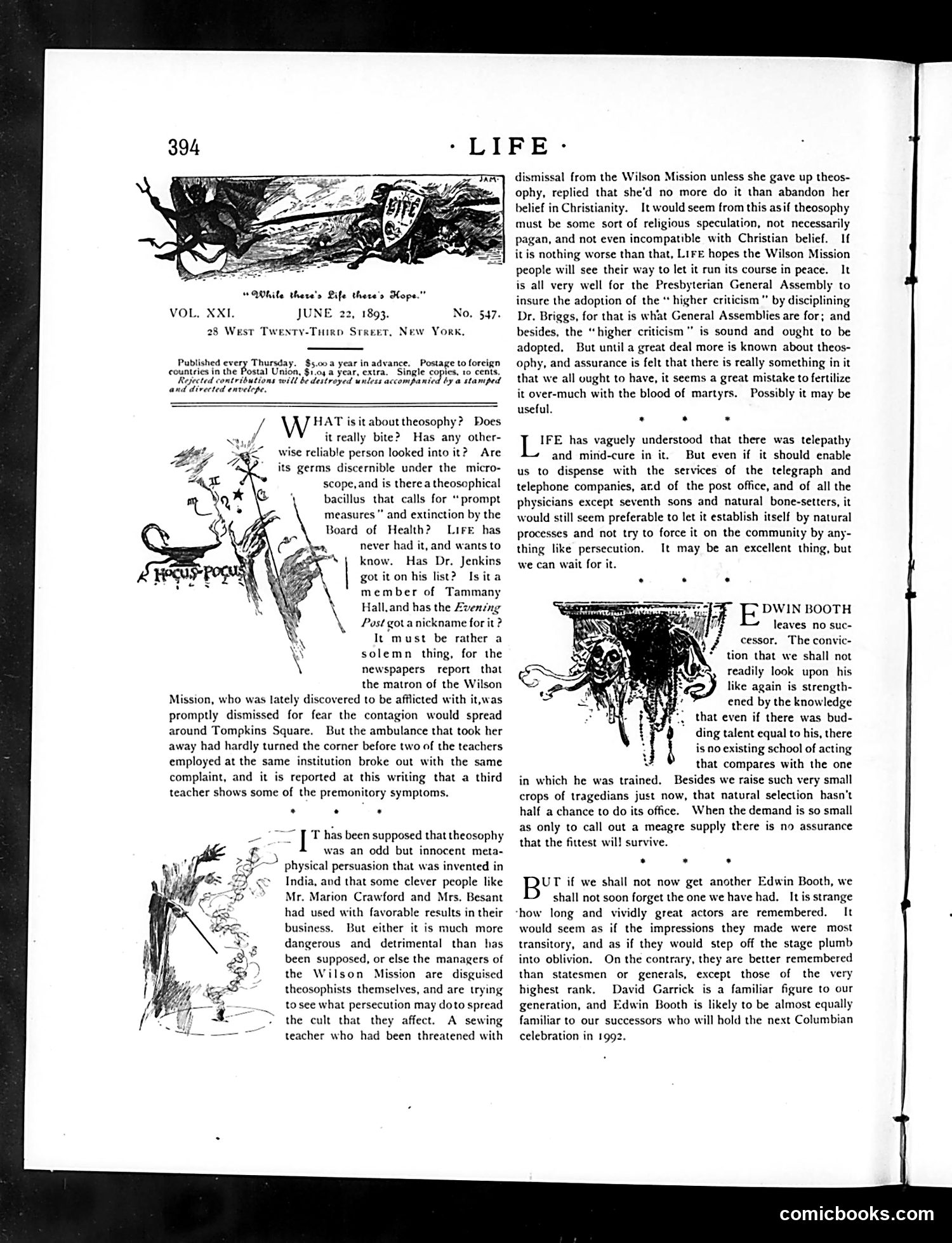
This page discusses **theosophy**, a late-19th-century spiritual movement claiming ancient esoteric knowledge. The article expresses skepticism about theosophists' claims while acknowledging the movement exists. The satirical illustrations mock theosophical practices and beliefs, though specific identifications are unclear from the artwork alone. The page criticizes the **Wilson Mission** (apparently connected to theosophy) for dismissing members unless they abandoned Christian belief—suggesting theosophy conflicted with conventional religion. A secondary section discusses **Edwin Booth's death** and his acting legacy, noting his towering importance to American theater and predicting his reputation would endure beyond his successors. The overall tone is characteristic of *Life*'s skepticism toward fringe movements while respecting legitimate cultural achievements.
📄 Transcribed text from this page (OCR, searchable)
Machine-transcribed from the original scan — historical spelling and the odd misread are preserved.
- LIFE: “OMe there's Life there's Hope.” VOL, XXI. JUNE 22, 1893. No. 547. 23 West Twenty-Tiirp Street, New Yorr, Published every Thursday. $5.00 a year in advance. Postage to foreign countries in the Postal Union, $1.04 a year, extra. Single copies, 10 cents. Rejected contributions will be destroyed unless accompanied by a stamped and directed envelope. HAT isit about theosophy? Does it really bite? Has any other- wise reliable person looked into it? Are its germs discernible under the micro- scope, and is there a theosophical bacillus that calls for “prompt measures" and extinction by the Board of Health? Lire has never had it, and wants to know. Has Dr. Jenkins got iton his list? Isita member of Tammany Hall.and has the Evening Post gota nickname for it ? It must be rather a solemn thing, for the newspapers report that the matron of the Wilson Mission, who was lately discovered to be afflicted with it,was promptly dismissed for fear the contagion would spread around Tompkins Square. But the ambulance that took her away had hardly turned the corner before two of the teachers employed at the same institution broke out with the same complaint, and it is reported at this writing that a third teacher shows some of the premonitory symptoms. . . . ~~ ] T has been supposed that theosophy . was an odd but innocent meta- ~ physical persuasion that was invented in India, and that some clever people like Mr. Marion Crawford and Mrs. Besant had used with favorable results in their business. But either it is much more dangerous and detrimental than has been supposed, or else the managers of the Wilson Mission are disguised theosophists themselves, and are trying to see what persecution may doto spread the cult that they affect. A sewing teacher who had been threatened with dismissal from the Wilson Mission unless she gave up theos- ophy, replied that she'd no more do it than abandon her belief in Christianity. It would seem from this asif theosophy must be some sort of religious speculation, not necessarily pagan, and not even incompatible with Christian belief. If it is nothing worse than that, LIFE hopes the Wilson Mission people will see their way to let it run its course in peace. It is all very well for the Presbyterian General Assembly to insure the adoption of the * higher criticism" by disciplining Dr. Briggs, for that is what General Assemblies are for; and besides, the “higher criticism" is sound and ought to be adopted, But until a great deal more is known about theos- ophy, and assurance is felt that there is really something in it that we all ought to have, it seems a great mistake to fertilize it over-much with the blood of martyrs. Possibly it may be useful. . . . LL has vaguely understood that there was telepathy and mind-cure in it. But even if it should enable us to dispense with the services of the telegraph and telephone companies, ard of the post office, and of all the physicians except seventh sons and natural bone-setters, it would still seem preferable to let it establish itself by natural processes and not try to force it on the community by any- thing like persecution. It may be an excellent thing, but we can wait for it. DWIN BOOTH leaves no suc- cessor. The convic- tion that we shall not readily look upon his like again is strength- ened by the knowledge that even if there was bud- ding talent equal to his, there is no existing school of acting that compares with the one in which he was trained. Besides we raise such very small crops of tragedians just now, that natural selection hasn't half a chance to do its office. When the demand is so small as only to call out a meagre supply there is no assurance that the fittest wil! survive. i . . . UT if we shall not now get another Edwin Booth, we shall not soon forget the one we have had. It is strange how long and vividly great actors are remembered. = It would seem as if the impressions they made were most transitory, and as if they would step off the stage plumb into oblivion. On the contrary, they are better remembered than statesmen or generals, except those of the very highest rank. David Garrick is a familiar figure to our generation, and Edwin Booth is likely to be almost equally familiar to our successors who will hold the next Columbian celebration in 1992. comicbooks.com