
Life, 1893-06-22 · page 6 of 14
Life — June 22, 1893 — page 6: what you’re looking at
What you’re looking at
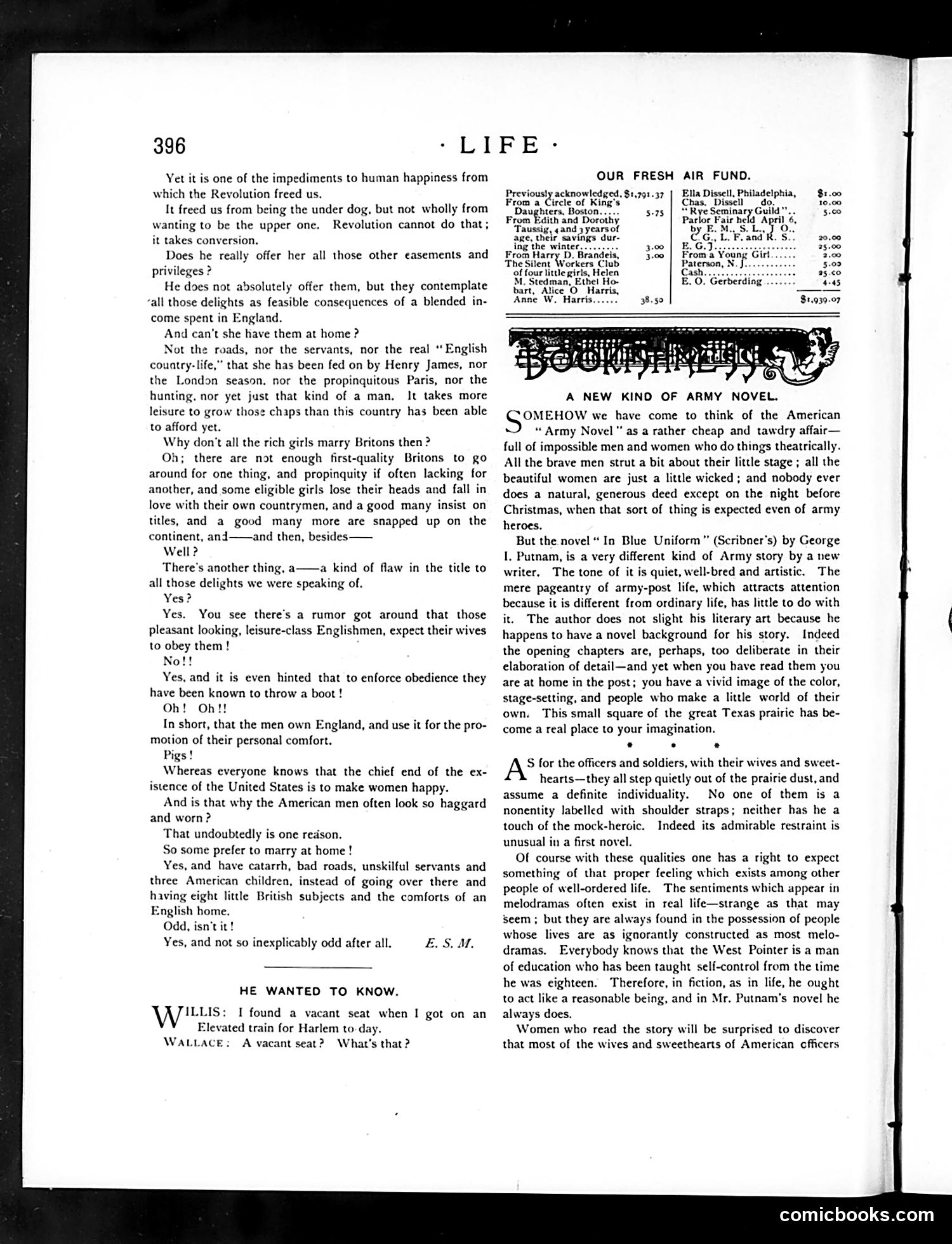
This page contains **no political cartoon**. Instead, it features: 1. **"Our Fresh Air Fund"** - a charitable fundraising section listing donations to send poor children to the countryside, a common early-20th-century philanthropy. 2. **"A New Kind of Army Novel"** - a book review discussing George Putnam's "In Blue Uniform" (Scribner's), which depicts quiet, realistic military post life rather than theatrical heroics. The reviewer praises its artistic restraint and authentic detail. 3. **"He Wanted to Know"** - a brief humorous dialogue between Willis and Wallace about finding a vacant seat on an elevated train to Harlem, playing on miscommunication. The page is primarily **literary content and social commentary** rather than satirical cartooning. The review reflects contemporary literary tastes and period attitudes toward military fiction.
📄 Transcribed text from this page (OCR, searchable)
Machine-transcribed from the original scan — historical spelling and the odd misread are preserved.
396 Yet it is one of the impediments to human happiness from which the Revolution freed us. It freed us from being the under dog, but not wholly from wanting to be the upper one. Revolution cannot do that; it takes conversion. Does he really offer her all those other easements and privileges ? He does not absolutely offer them, but they contemplate ‘all those delights as feasible consequences of a blended in- come spent in England. And can’t she have them at home ? Not the roads, nor the servants, nor the real ‘English couatry-life,” that she has been fed on by Henry James, nor the London season. nor the propinquitous Paris, nor the hunting, nor yet just that kind of a man, It takes more leisure to grow those chaps than this country has been able to afford yet. Why don’t all the rich girls marry Britons then ? Oh; there are not enough first-quality Britons to go around for one thing, and propinquity if often lacking for another, and some eligible girls lose their heads and fall in love with their own countrymen, and a good many insist on titles, and a good many more are snapped up on the continent, and——and then, besides—— Well? There's another thing, a a kind of flaw in the title to all those delights we were speaking of. Yes? Yes. You see there's a rumor got around that those pleasant looking, leisure-class Englishmen, expect their wives to obey them! No!! Yes, and it is even hinted that to enforce obedience they have been known to throw a boot ! Oh! Oh!! In short, that the men own England, and use it for the pro- motion of their personal comfort. Pigs! Whereas everyone knows that the chief end of the ex- istence of the United States is to make women happy. And is that why the American men often look so haggard and worn? That undoubtedly is one reason. So some prefer to marry at home! Yes, and have catarrh, bad roads, unskilful servants and three American children, instead of going over there and having eight little British subjects and the comforts of an English home. Odd, isn’t it! Yes, and not so inexplicably odd after all. £.S.M. HE WANTED TO KNOW. ILLIS: I found a vacant seat when I got on an vated train for Harlem to-day. WALLACE: A vacant seat? What's that ? - LIFE: OUR FRESH AIR FUND. Ella Dissell, Philadelphia, Chas. Dissell — do. “Rye Seminary Guild”’.. Parlor Fair held April 6, by E.M..S.L., J 0., $1.00 10.00 3.00 Previously acknowledged, $1,791.37 From a Circle of King's Daughters, Boston... From Edith and Dorothy Taussig, ¢and 3 yearsof 5-75 30.00 25.00 2.00 5.09 23.<o 4-45 $1,939.07 age, their savings dur- ud E. ing the winter From Harry D. ‘The Silent Workers Club of four little giris, Helen M. Stedman, Ethel Ho- bart, Alice 0 Harris, Anne W, Harris A NEW KINO OF ARMY NOVEL. ~ OMEHOW we have come to think of the American “ Army Novel" as a rather cheap and tawdry affair— full of impossible men and women who do things theatrically. All the brave men strut a bit about their little stage ; all the beautiful women are just a little wicked ; and nobody ever does a natural, generous deed except on the night before Christmas, when that sort of thing is expected even of army heroes. But the novel “ In Blue Uniform” (Scribner's) by George I, Putnam, is a very different kind of Army story by a new writer. The tone of it is quiet, well-bred and artistic. The mere pageantry of army-post life, which attracts attention because it is different from ordinary life, has little to do with it. The author does not slight his literary art because he happens to have a novel background for his story. Indeed the opening chapters are, perhaps, too deliberate in their elaboration of detail—and yet when you have read them you are at home in the post; you have a vivid image of the color, stage-setting, and people who make a little world of their own. This small square of the great Texas prairie has be- come a real place to your imagination, . . * S for the officers and soldiers, with their wives and sweet- hearts—they all step quietly out of the prairie dust, and assume a definite individuality. No one of them is a nonentity labelled with shoulder straps; neither has he a touch of the mock-heroic. Indeed its admirable restraint is unusual in a first novel. Of course with these qualities one has a right to expect something of that proper feeling which exists among other people of well-ordered life. The sentiments which appear in melodramas often exist in real life—strange as that may Seem ; but they are always found in the possession of people whose lives are as ignorantly constructed as most melo- dramas. Everybody knows that the West Pointer is a man of education who has been taught self-control from the time he was eighteen. Therefore, in fiction, as in life, he ought to act like a reasonable being, and in Mr. Putnam's novel he always does. Women who read the story will be surprised to discover that most of the wives and sweethearts of American cfficers comicbooks.com