
A complete issue · 14 pages · 1893
Life — May 25, 1893
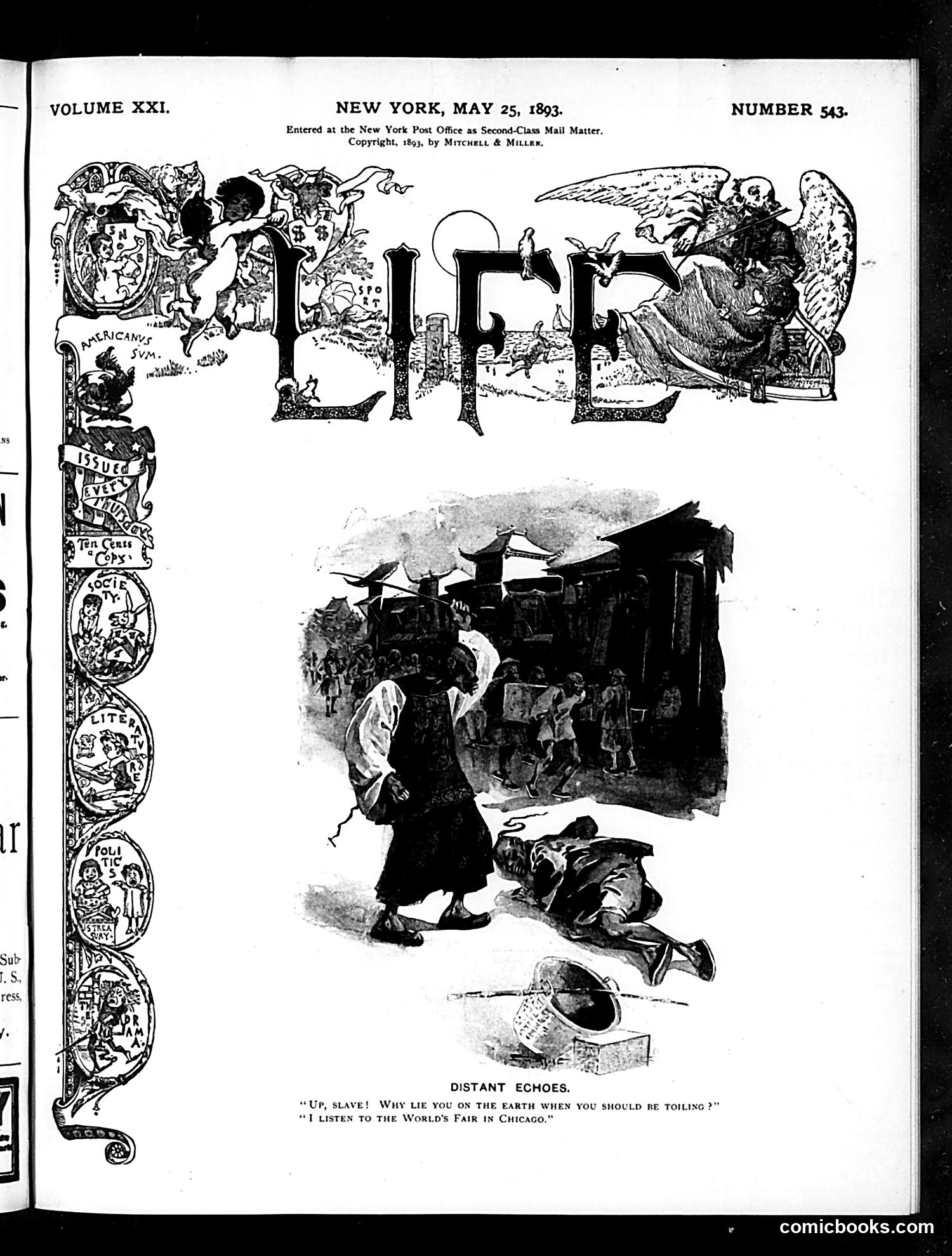
This cartoon satirizes the contrast between America's aspirational ideals and harsh reality. The title references the 1893 World's Columbian Exposition in Chicago, where a slave or laborer lies exhausted on the ground while being exhorted to "toil." The dialogue—"Up, slave! Why lie you on the earth when you should be toiling?" / "I listen to the World's Fair in Chicago"—suggests bitter irony: while the World's Fair celebrated progress and American achievement, working-class people experienced exploitation and exhaustion. The figure's collapse implies the human cost of rapid industrialization and labor abuses occurring simultaneously with the fair's celebration of technological advancement. The cartoon critiques the disconnect between national celebration and workers' lived suffering.
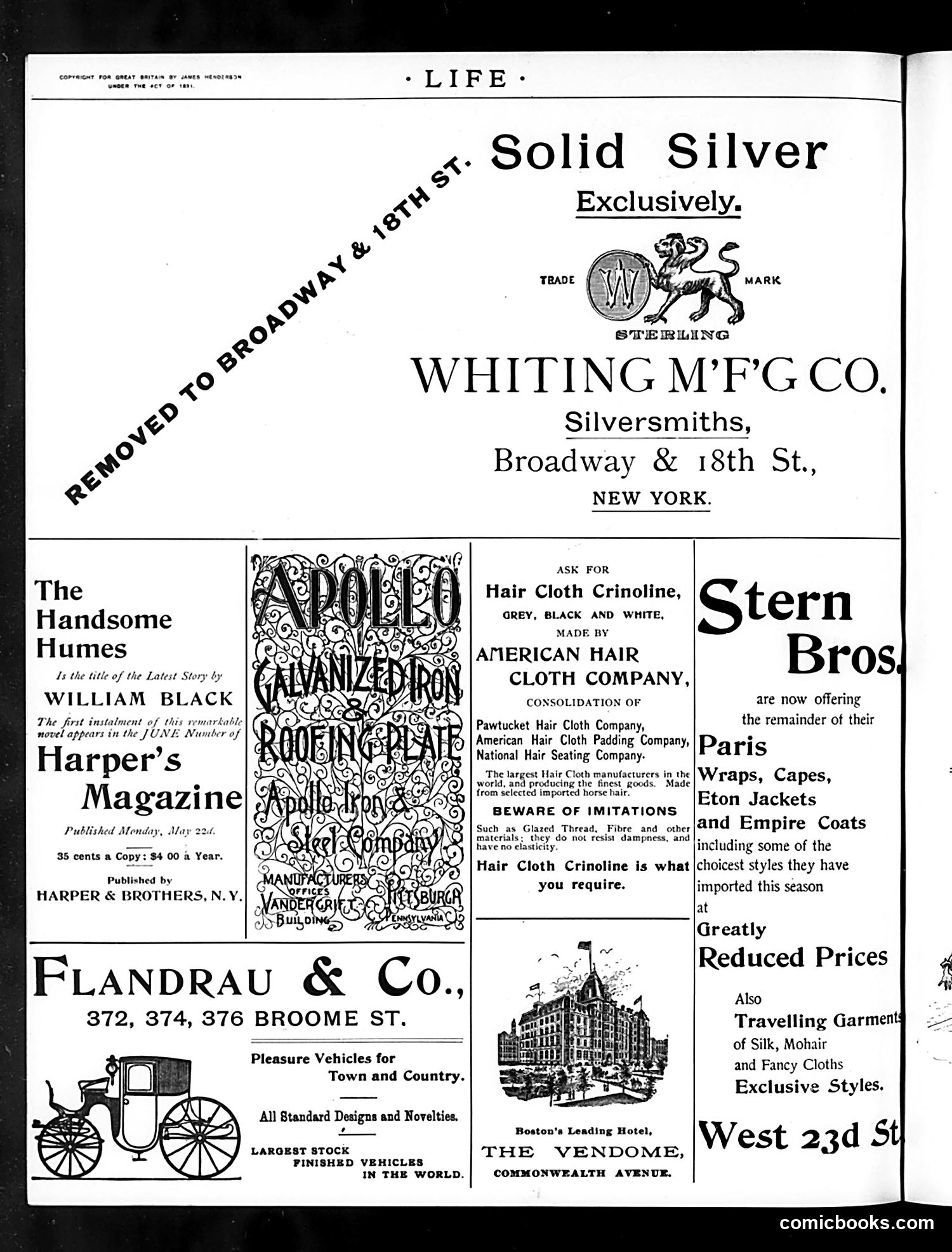
This page is **primarily advertising** from an early 1900s issue of *Life* magazine. The main content consists of commercial advertisements rather than editorial cartoons or satirical content. The visible advertisements include: - **Whiting M'FG Co.**: A silversmith business promoting solid silver goods - **Harper's Magazine**: Promoting William Black's story "The Handsome Humes" - **American Hair Cloth Company**: Advertising hair cloth crinoline products, with a warning against imitations - **Flandrau & Co.**: Selling pleasure vehicles (carriages) - **Stern Bros**: Marketing Paris wraps, capes, and Eton jackets at reduced prices - **The Vendome Hotel**: Boston's leading hotel No political cartoons or satirical commentary appear on this page—it's a straightforward commercial publication page typical of early-20th-century magazines.
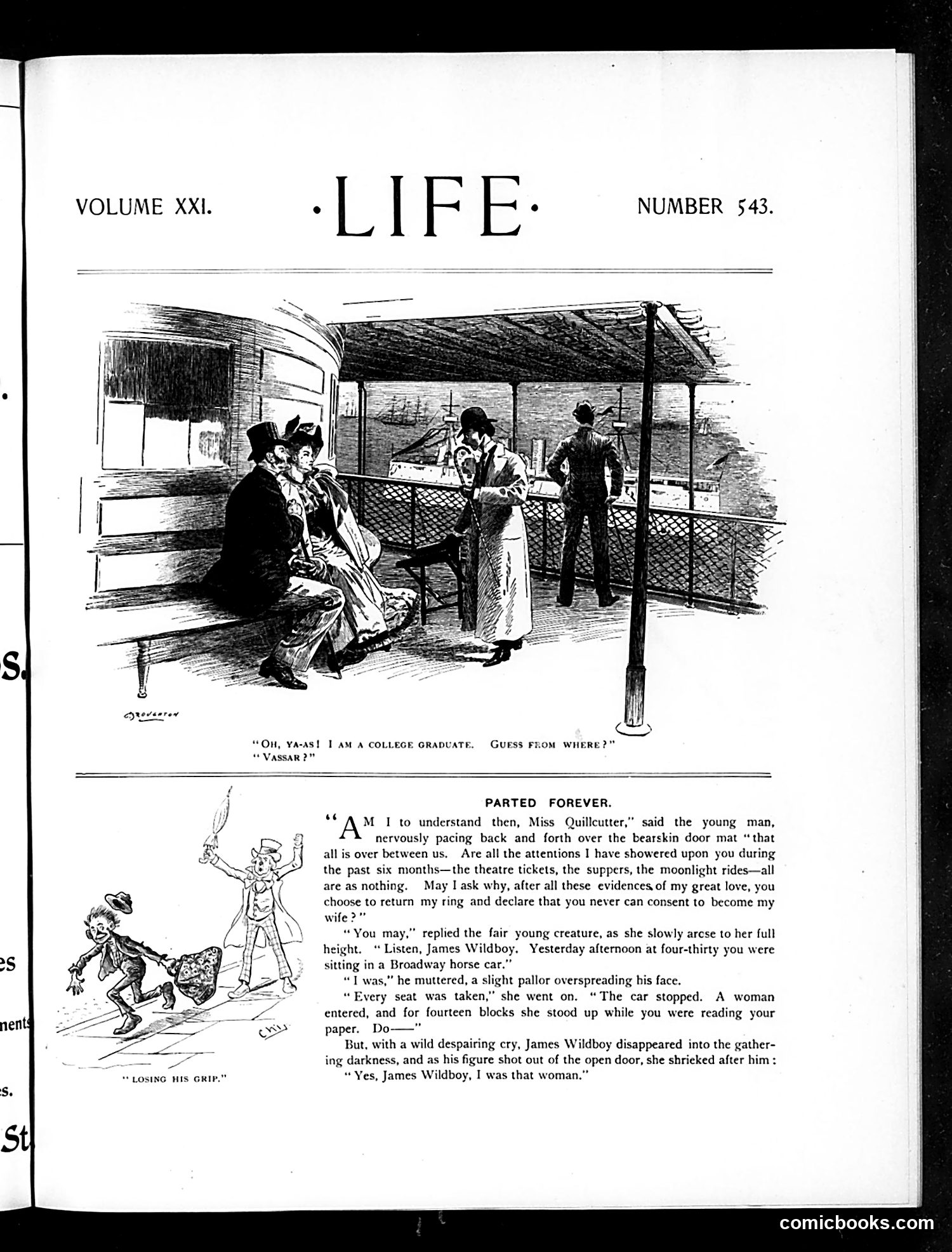
This page contains two distinct pieces: **Top Cartoon**: A sketch showing well-dressed men on what appears to be a ship or boat deck. The caption reads "Oh, yes! I am a college graduate. Guess from where? Vassar?" This is a joke about gender assumptions—the speaker is sarcastically suggesting someone looks like they attended Vassar (a women's college), implying the person appears feminine or unmanly. The humor relies on early 20th-century attitudes mocking men who seemed effeminate or insufficiently masculine. **Bottom Story ("Parted Forever")**: A romantic narrative about a young man named James Wildboy breaking his engagement with Miss Quillcutter after discovering she stood in a streetcar for fourteen blocks while he read his newspaper—a betrayal of chivalrous expectations. The accompanying small cartoon labeled "Losing His Grip" shows comedic distress. The satire mocks courtship conventions and male sensitivity to perceived slights.
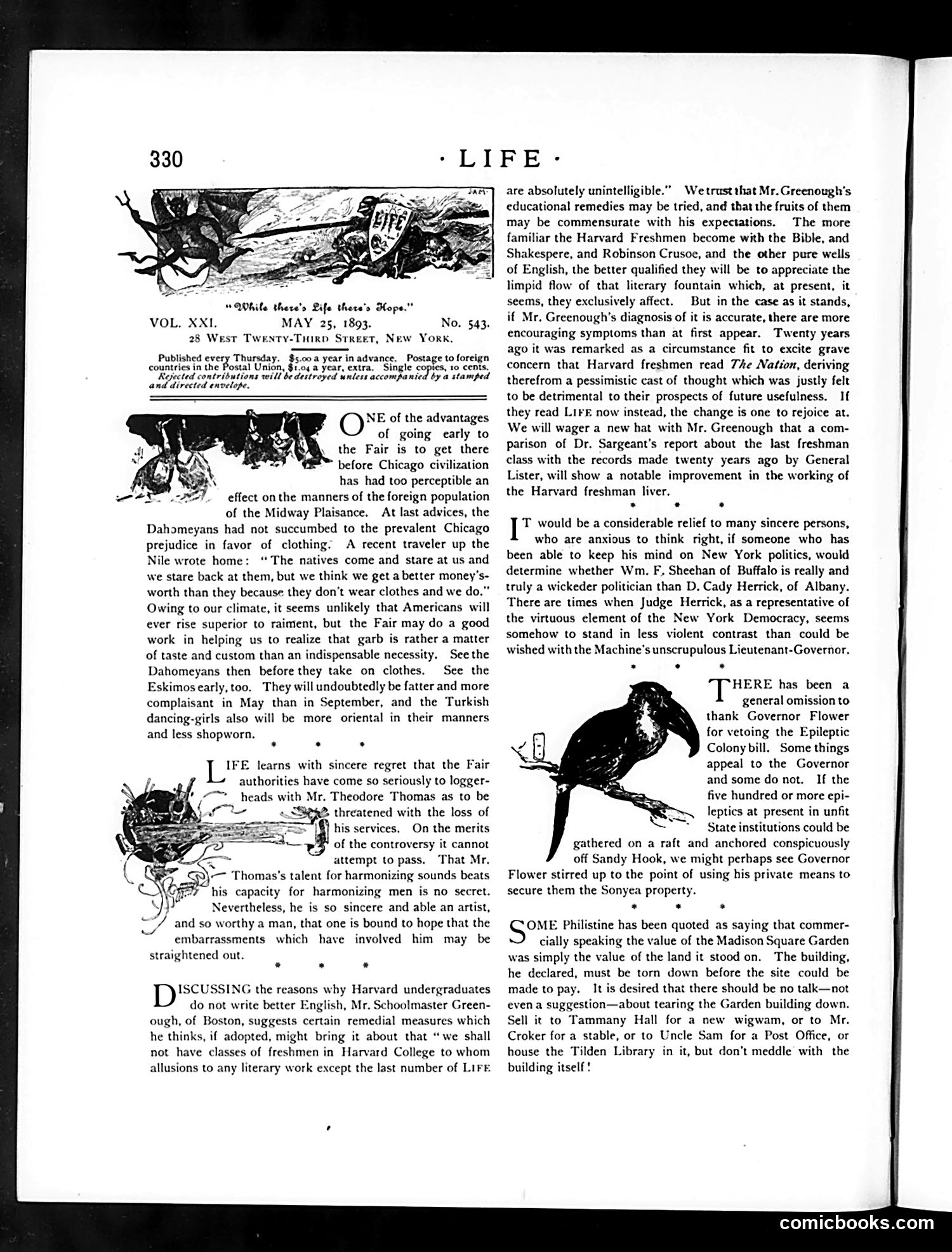
This page contains satirical editorial commentary rather than a cartoon. The main subjects are: 1. **Harvard Freshmen's English**: The editor discusses Mr. Greenough's concerns that Harvard students write poorly. The piece suggests comparing current student writing to older records to measure improvement—a somewhat tongue-in-cheek proposal. 2. **Chicago World's Fair**: Commentary on how attending the Fair affects foreign visitors' perceptions of American civilization and dress, mentioning Native Americans ("Dahomeyans"). 3. **Political figures**: References to Judge Herrick (Albany) and D. Cady Herrick, apparently discussing New York Democratic politics and comparing their integrity. 4. **Governor Flower**: Criticism for vetoing an Epileptic Colony bill. 5. **Madison Square Garden**: A note about its real estate value and disputes over its future use. The illustrations appear decorative rather than directly satirical.
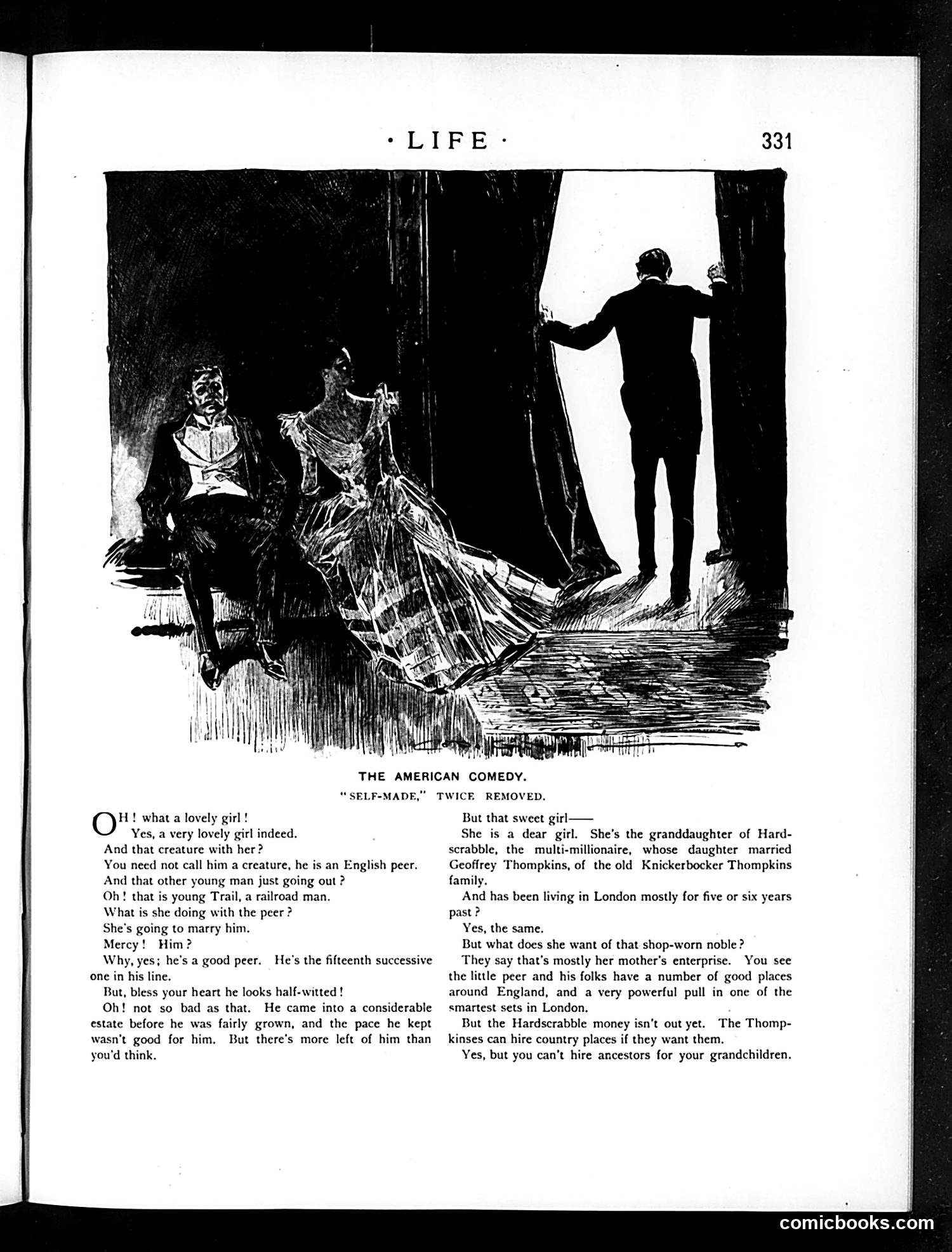
This satire mocks the myth of American self-made success. The dialogue reveals that a young man (Young Trail, a "railroad man") plans to marry a supposedly "lovely girl," but she is actually the great-granddaughter of Hardscrabble, a multi-millionaire. The joke critiques American pretensions: the girl appears to be marrying "up," but her family wealth—derived from Hardscrabble's self-made fortune—means she's actually marrying down. The title's "twice removed" suggests the original self-made achievement has been diluted through inheritance. The cartoon illustrates the tension between American ideals of meritocracy and the reality of dynastic wealth concentration among the wealthy elite, suggesting that "self-made" success becomes meaningless by the second or third generation.
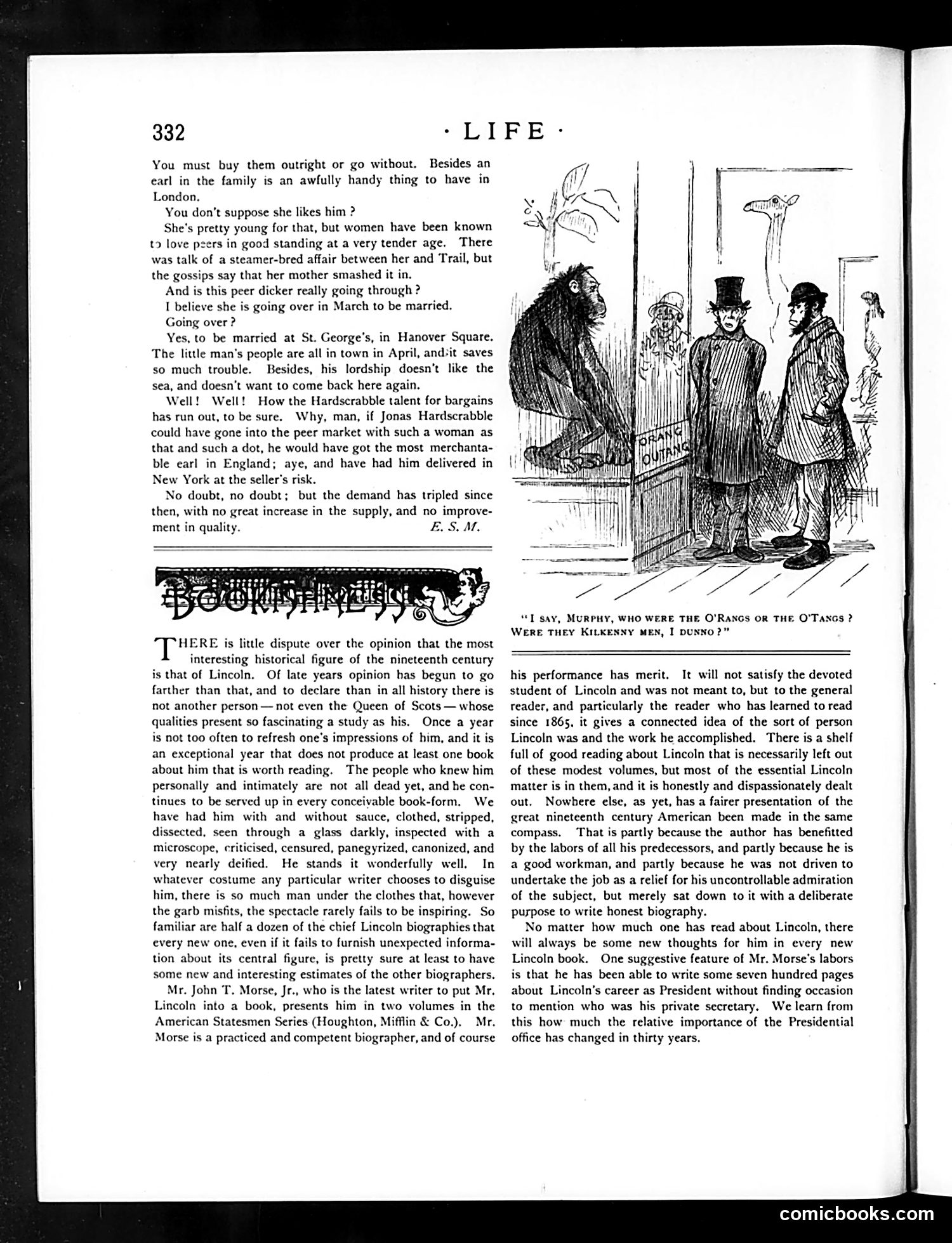
The main cartoon depicts a street scene where a man in a coat and top hat encounters what appears to be a woman in tattered clothing or possibly a street person. The caption reads: "I say, Murphy, who were the O'Rangs or the O'Tangs? Were they Kilkenny men, I dunno?" This appears to be **Irish-themed humor**, likely playing on stereotypes of Irish immigrants and their purported ignorance of history or current events. The formal-dressed gentleman's question about obscure Irish names to the ragged figure is probably meant as satire—mocking either pretension or the Irish working class. The page's text discusses Lincoln biographies, unrelated to the cartoon. Without additional historical context about specific 1890s Irish-American tensions or references, the precise satirical target remains unclear.
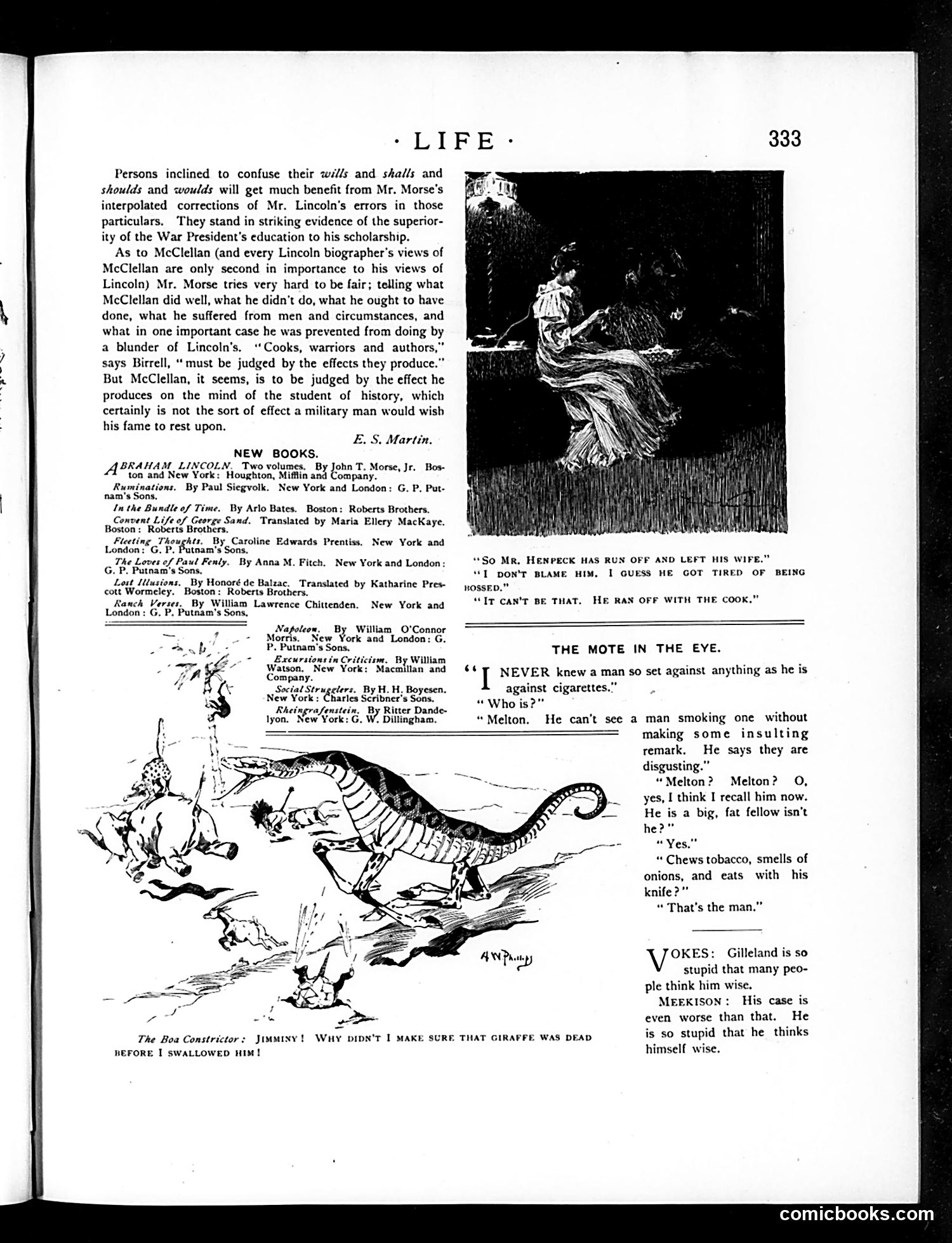
This page contains two distinct sections: **Upper section:** A serious editorial discussion about Abraham Lincoln biographies, specifically comparing John T. Morse Jr.'s work with earlier treatments. The author defends Lincoln's intellect and judgment against critics, arguing he should be evaluated by historical impact rather than military tactics. **Lower cartoons:** Two satirical sketches with accompanying dialogue. "The Boss Contractor" depicts a giraffe-like creature, apparently mocking someone's implausible claims. "The Mote in the Eye" presents a conversation between characters (Melton and others) discussing a man who smokes cigarettes, chews tobacco, and has poor table manners—used to satirize hypocrisy about judging others' vices. The page blends serious literary criticism with light social satire typical of Life magazine's format.
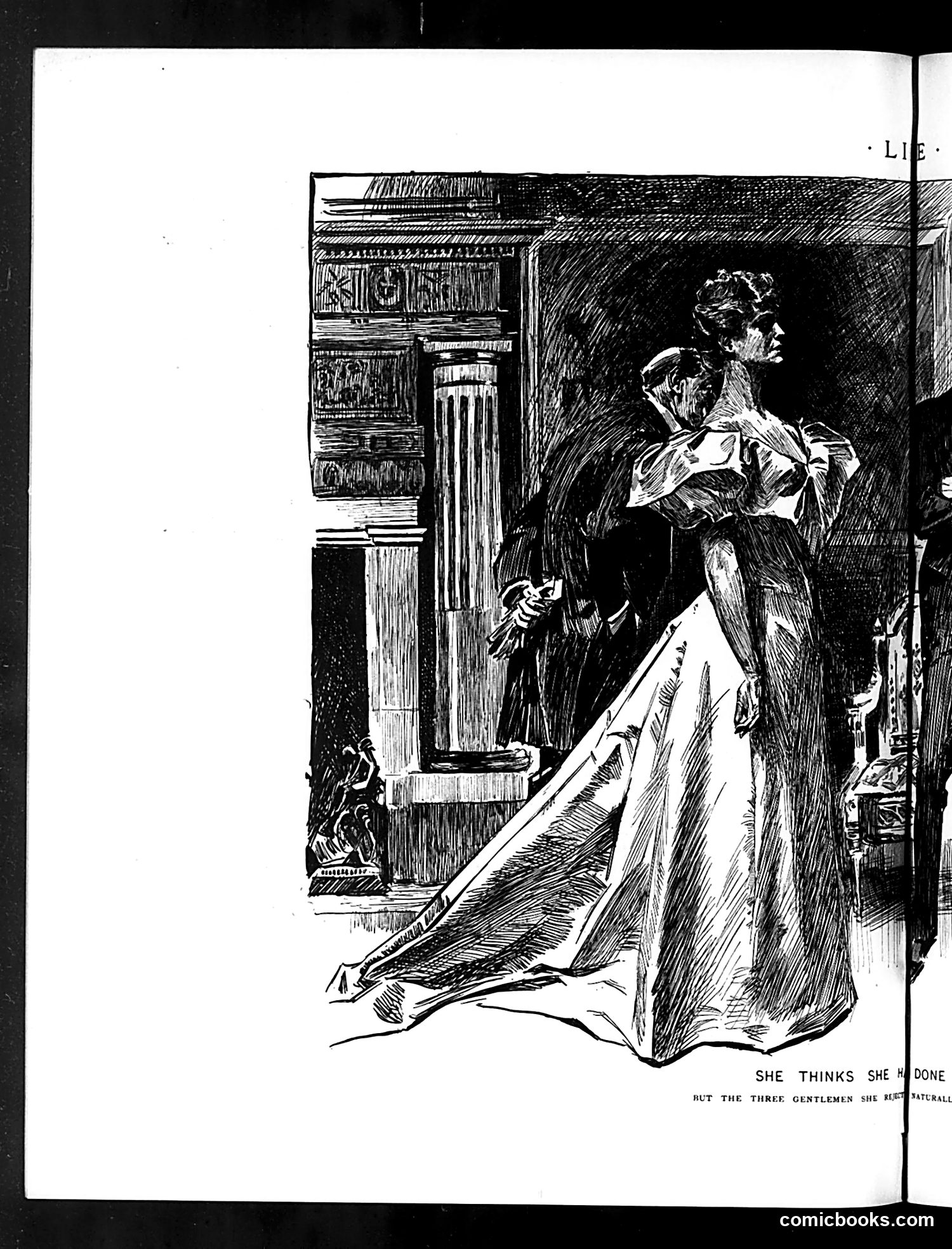
This is a satirical illustration from Life magazine showing a woman in an elaborate trailing gown and formal attire standing in what appears to be a doorway or hallway. The caption reads: "SHE THINKS SHE IS DONE / BUT THE THREE GENTLEMEN SHE JUST NATURALLY..." The satire appears to target **social pretension and courtship customs** of the era. The woman, dressed elaborately as if her social engagement or romantic business is concluded, is unaware that three gentlemen remain interested in her—suggesting she overestimates her control of the situation or underestimates male persistence. The joke likely mocks either **female vanity** regarding romantic prospects or the **stubbornness of male suitors** who refuse to accept rejection. The trailing gown emphasizes her theatrical self-importance, contrasting with the implication that her romantic circumstances are actually beyond her management.
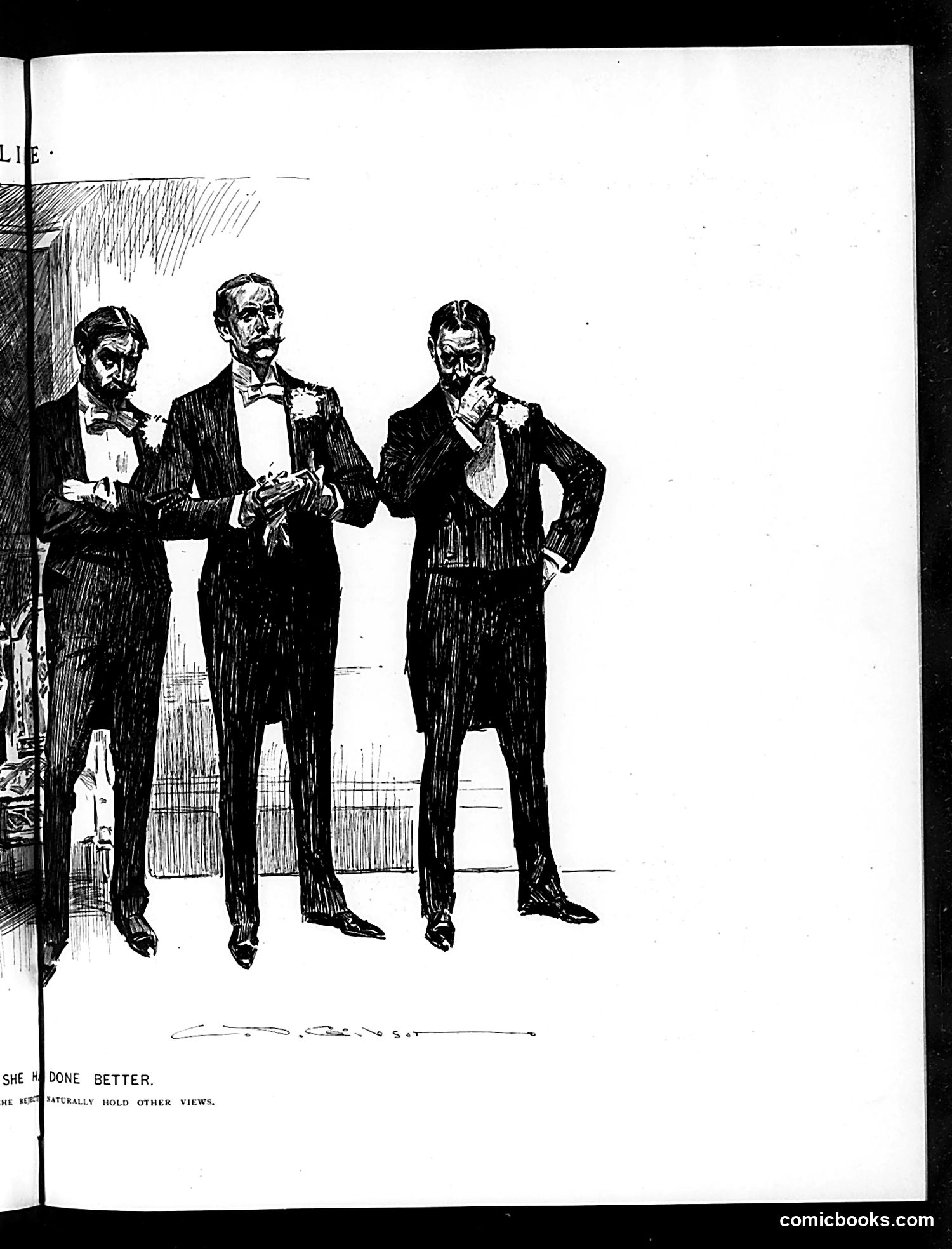
This page shows three men in formal evening wear (tuxedos with bow ties), depicted in a satirical pen-and-ink style typical of Life magazine's political humor. The partially visible text at bottom reads "SHE H DONE BETTER" and references someone who "NATURALLY HOLD OTHER VIEWS," though the full caption is cut off, making complete interpretation difficult. Without the complete caption or additional context, the specific identities and political references remain unclear. The illustration appears to critique three public figures or types of men—their formal dress and posed stances suggest they represent establishment or political figures—but the exact satirical point depends on the missing text that would explain what "she" should have "done better" at, or who these men represent. The image alone shows formal gentlemen; the joke requires the full caption to decode.
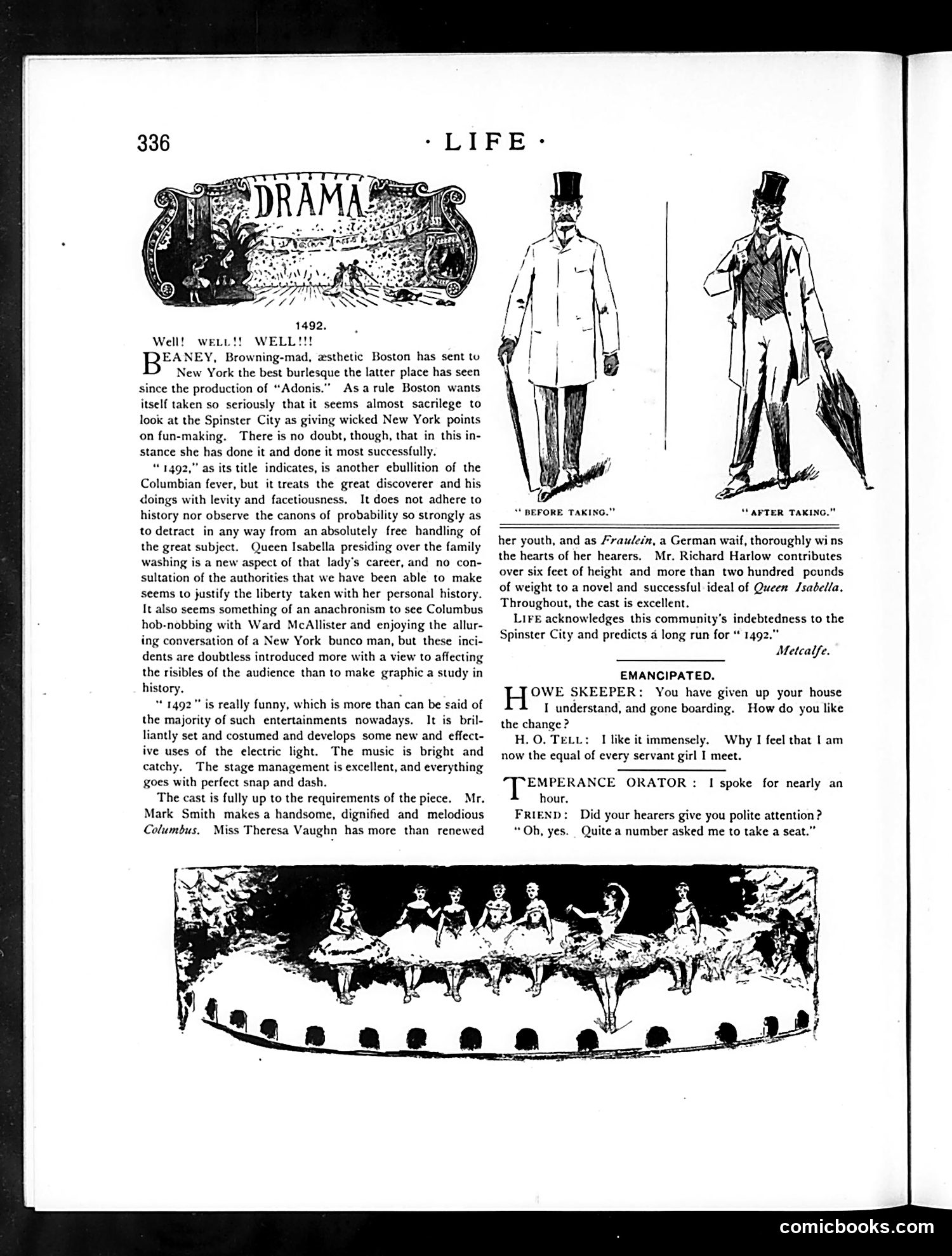
This page reviews a theatrical production called **"1492,"** a burlesque about Columbus, staged in Boston and sent to New York. The two illustrated figures show a character "before taking" and "after taking" — likely depicting a comedic transformation using the show's props or costumes. The review praises the Boston production for successfully bringing serious historical material to comic life without sacrilege. It commends the cast, particularly noting actors Mark Smith and Theresa Vaughn, for excellent staging and musical performance. The bottom section contains unrelated comedic dialogue between characters discussing boarding and temperance—typical of Life's satirical humor sections. The theatrical illustration shows a burlesque performance scene with audience silhouettes, supporting the page's focus on popular stage entertainment criticism.
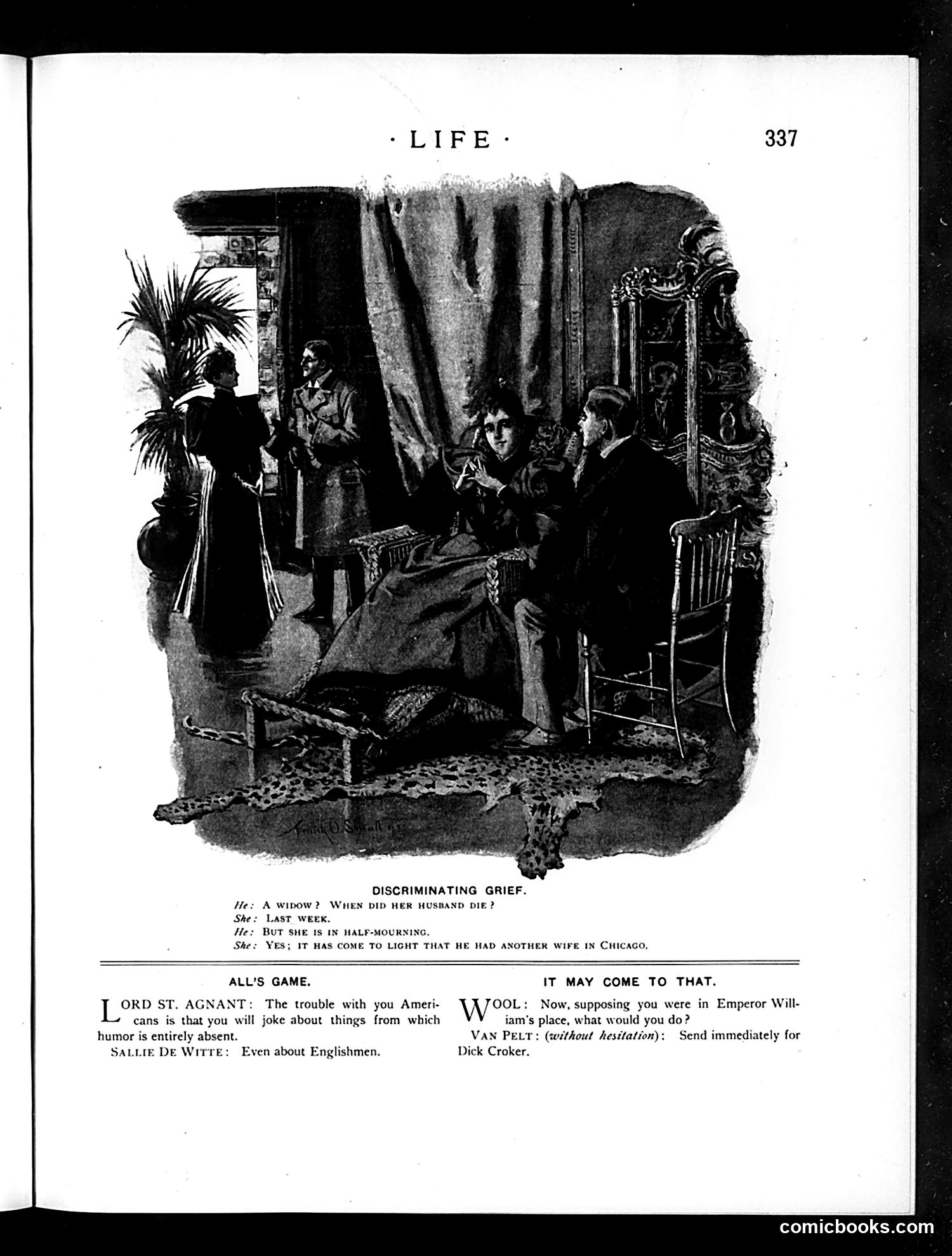
This page contains two satirical pieces from *Life* magazine: **"Discriminating Grief"** (top illustration): A widow receives condolences about her husband's death, but the joke reveals he had a second wife in Chicago. The satire mocks the widow's selective mourning—she's upset about his death while conveniently ignoring his bigamy. This reflects early 20th-century social commentary on infidelity and hypocrisy in mourning rituals. **"All's Game" and "It May Come to That"** (text sections below): These appear to be brief comedic dialogues poking fun at Americans' tendency to joke about serious matters, and a hypothetical scenario about succession in an imperial court involving "Dick Croker" (likely a political figure). The humor targets American irreverence and political corruption. The cartoons use exaggeration and dark humor typical of *Life's* satirical approach.
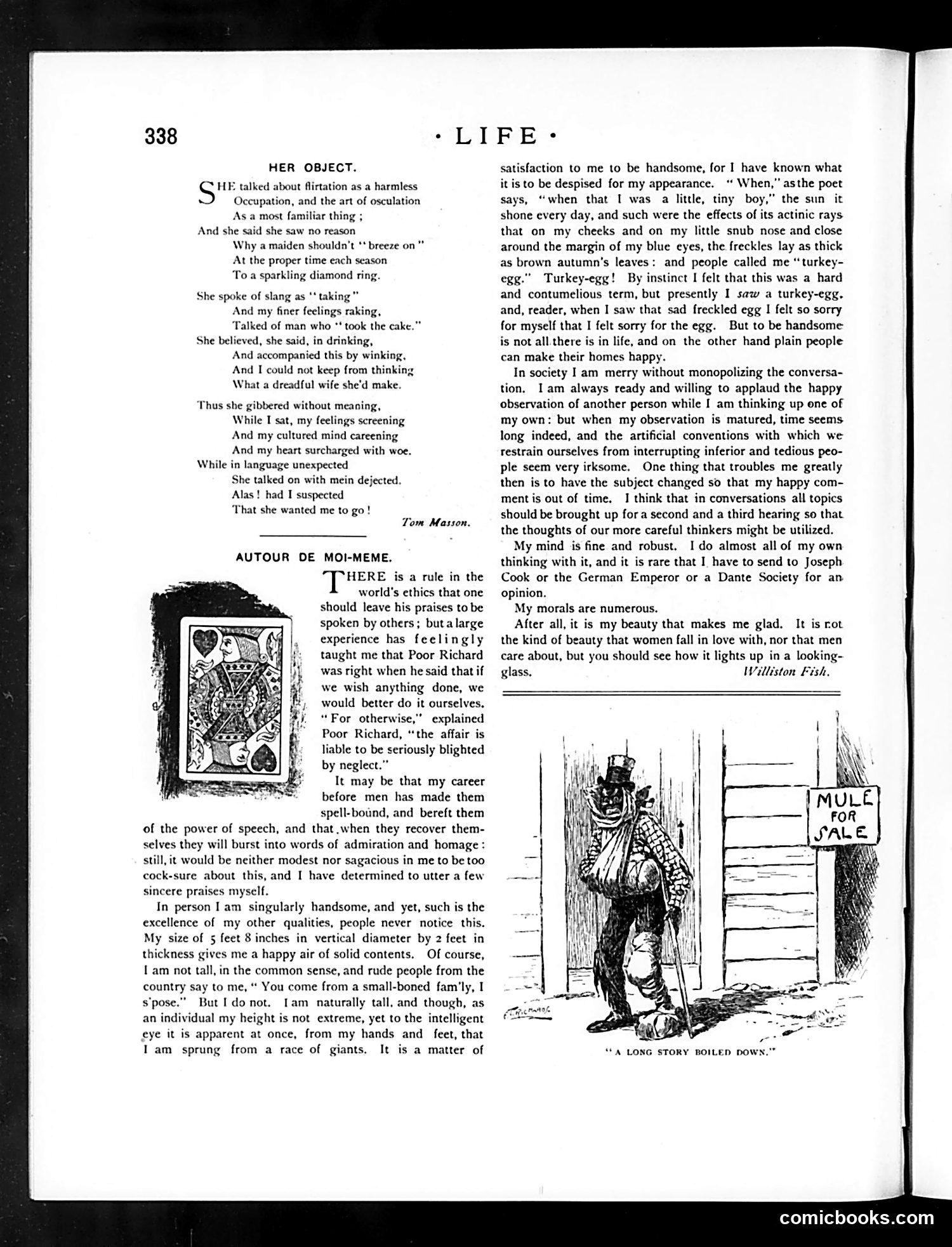
This page contains two distinct pieces of satire: **"Her Object"** (poem by Tom Masson): A humorous critique of a woman using flirtation and modern slang ("taking," "breeze on") to manipulate a suitor into marriage. The narrator is appalled by her brazen tactics and casual behavior—she drinks, winks, uses slang—viewing her as unsuitable wife material. The joke's irony: she's actually trying to get him to leave, not pursuing him. **"Autour de Moi-Même"** (self-portrait essay): Merciless self-mockery of a pompous man who praises himself excessively while pretending modesty. He boasts about being "singularly handsome" despite being 5'8" and overweight, claims to come from "a race of giants," and recalls childhood freckles called "turkey-egg" (an insult he doesn't understand). He brags about his wit while admitting he's too impatient to let others speak. The cartoon below shows a ragged man with a sign "MULE FOR SALE"—likely illustrating the concept of self-promotion or selling oneself, reinforcing the essay's satirical theme. Both pieces mock vanity and poor self-awareness.
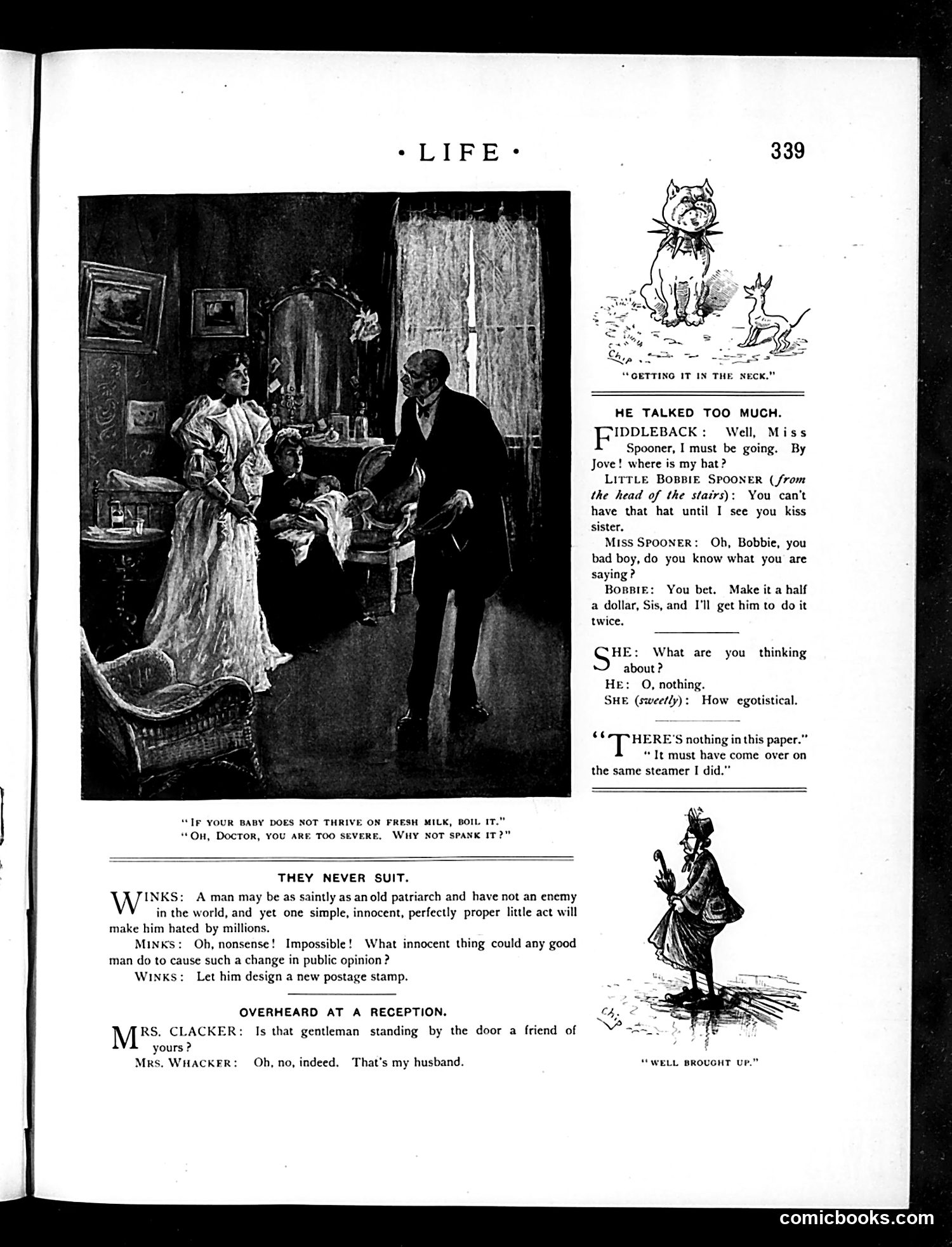
This page collects several short humorous sketches satirizing social awkwardness and human nature: **"He Talked Too Much"**: A young man (Fiddleback) attempts to leave a house but is blackmailed by the homeowner's precocious child, Little Bobbie Spooner, who withholds his hat unless he kisses the man's sister—and negotiates for payment to do it twice. The satire mocks childhood innocence corrupted by mercenary thinking. **"They Never Suit"**: A dialogue between Winks and Minks about how even innocent acts invite public hatred—the punchline being that designing a new postage stamp can mysteriously provoke universal disapproval. This satirizes how people irrationally oppose anything new or different. **"Overheard at a Reception"**: Mrs. Clacker mistakes the man by the door for a friend; Mrs. Whacker reveals he's actually her husband—implying marital estrangement or that she doesn't acknowledge him socially. The page's humor relies on wordplay, social commentary on manners and relationships, and the absurdity of human behavior—typical of early 20th-century American satirical magazine comedy.
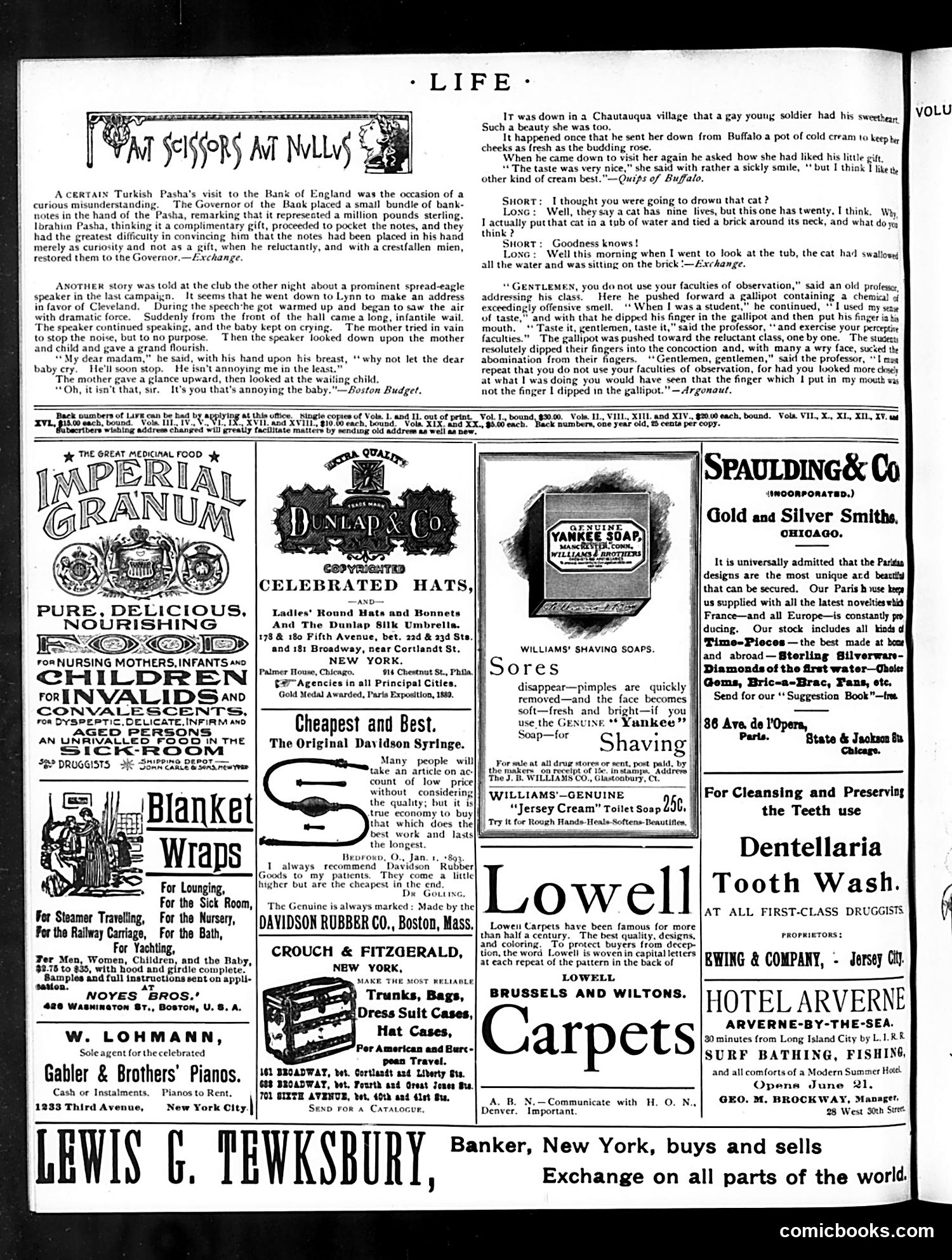
This page contains several humorous anecdotes rather than a political cartoon. The title appears to reference a legal/bureaucratic concept (scissors and nullus—"nothing"). The stories mock various subjects: 1. **Ibrahim Pasha's Bank Visit**: A Turkish official misunderstands a demonstration at the Bank of England, pocketing banknotes thinking they're a gift—satirizing diplomatic/cultural confusion. 2. **The Campaign Speaker**: A political speaker in Lynn during a Cleveland campaign is interrupted by a crying baby; the mother retorts that *he's* annoying the baby, not vice versa—mocking verbose political rhetoric. 3. **The Soldier's Cold Cream**: A soldier's sweetheart admits she ate his cold cream rather than using it cosmetically—a crude joke about appetite over vanity. 4. **The Drowned Cat**: A tall tale about a cat surviving drowning, comically exaggerating resilience. 5. **The Professor's Trick**: A chemistry professor teaches observation by pretending to taste something offensive, then revealing he switched fingers—a lesson in careful observation. The page is primarily **filler content** with advertisements, not political satire.