
Life, 1893-05-25 · page 6 of 14
Life — May 25, 1893 — page 6: what you’re looking at
What you’re looking at
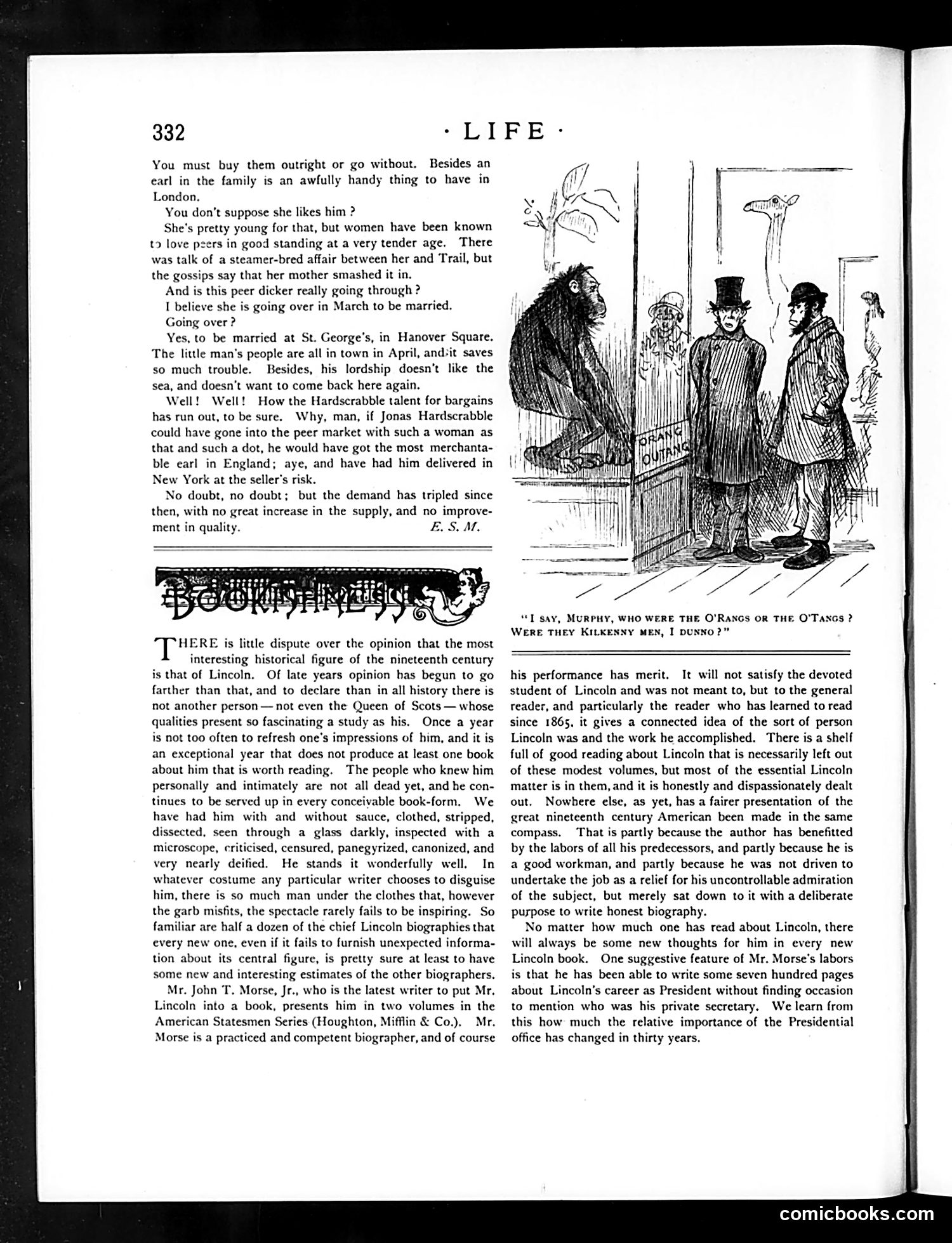
The main cartoon depicts a street scene where a man in a coat and top hat encounters what appears to be a woman in tattered clothing or possibly a street person. The caption reads: "I say, Murphy, who were the O'Rangs or the O'Tangs? Were they Kilkenny men, I dunno?" This appears to be **Irish-themed humor**, likely playing on stereotypes of Irish immigrants and their purported ignorance of history or current events. The formal-dressed gentleman's question about obscure Irish names to the ragged figure is probably meant as satire—mocking either pretension or the Irish working class. The page's text discusses Lincoln biographies, unrelated to the cartoon. Without additional historical context about specific 1890s Irish-American tensions or references, the precise satirical target remains unclear.
📄 Transcribed text from this page (OCR, searchable)
Machine-transcribed from the original scan — historical spelling and the odd misread are preserved.
332 You must buy them outright or go without. Besides an earl in the family is an awfully handy thing to have in London. You don’t suppose she likes him ? She's pretty young for that, but women have been known to love pzers in good standing at a very tender age. There was talk of a steamer-bred affair between her and Trail, but the gossips say that her mother smashed it in. And is this peer dicker really going through ? I believe she is going over in March to be married. Going over ? Yes, to be married at St. George’s, in Hanover Square. The little man’s people are all in town in April, andsit saves so much trouble. Besides, his lordship doesn’t like the sea, and doesn’t want to come back here again. Well! Well! How the Hardscrabble talent for bargains has run out, to be sure. Why, man, if Jonas Hardscrabble could have gone into the peer market with such a woman as that and such a dot, he would have got the most merchanta- ble earl in England; aye, and have had him delivered in New York at the seller's risk. No doubt, no doubt; but the demand has tripled since then, with no great increase in the supply, and no improve- ment in quality. ELS. M. - LIFE: HERE is little dispute over the opinion that the most interesting historical figure of the nineteenth century is that of Lincoln. Of late years opinion has begun to go farther than that, and to declare than in all history there is not another person — not even the Queen of Scots — whose qualities present so fascinating a study as his. Once a year is not too often to refresh one’s impressions of him, and it is an exceptional year that does not produce at least one book about him that is worth reading. The people who knew him personally and intimately are not all dead yet, and he con- tinues to be served up in every conceivable book-form. We have had him with and without sauce, clothed, stripped, dissected, seen through a glass darkly, inspected with a microscope, criticised, censured, panegyrized, canonized, and very nearly deified. He stands it wonderfully well. In whatever costume any particular writer chooses to disguise him, there is so much man under the clothes that, however the garb misfits, the spectacle rarely fails to be inspiring. So familiar are half a dozen of the chief Lincoln biographies that every new one, even if it fails to furnish unexpected informa- tion about its central figure, is pretty sure at least to have some new and interesting estimates of the other biographers. Mr. John T. Morse, Jr., who is the latest writer to put Mr. Lincoln into a book, presents him in two volumes in the American Statesmen Series (Houghton, Mifflin & Co.), Mr. Morse is a practiced and competent biographer, and of course “T say, MURPHY, WHO WERE THE O'RANGS OR THE O'TaNGs ? WERE THEY KILKENNY MEN, I DUNNO?” his performance has merit. It will not satisfy the devoted student of Lincoln and was not meant to, but to the general reader, and particularly the reader who has learned to read since 1865, it gives a connected idea of the sort of person Lincoln was and the work he accomplished. There is a shelf full of good reading about Lincoln that is necessarily left out of these modest volumes, but most of the essential Lincoln matter is in them, and it is honestly and dispassionately dealt out. Nowhere else, as yet, has a fairer presentation of the great nineteenth century American been made in the same compass. That is partly because the author has benefitted by the labors of all his predecessors, and partly because he is a good workman, and partly because he was not driven to undertake the job as a relief for his uncontrollable admiration of the subject, but merely sat down to it with a deliberate purpose to write honest biography. No matter how much one has read about Lincoln, there will always be some new thoughts for him in every new Lincoln book. One suggestive feature of Mr. Morse’s labors is that he has been able to write some seven hundred pages about Lincoln's career as President without finding occasion to mention who was his private secretary. We learn from this how much the relative importance of the Presidential office has changed in thirty years, comicbooks.com