
A complete issue · 16 pages · 1893
Life — April 20, 1893
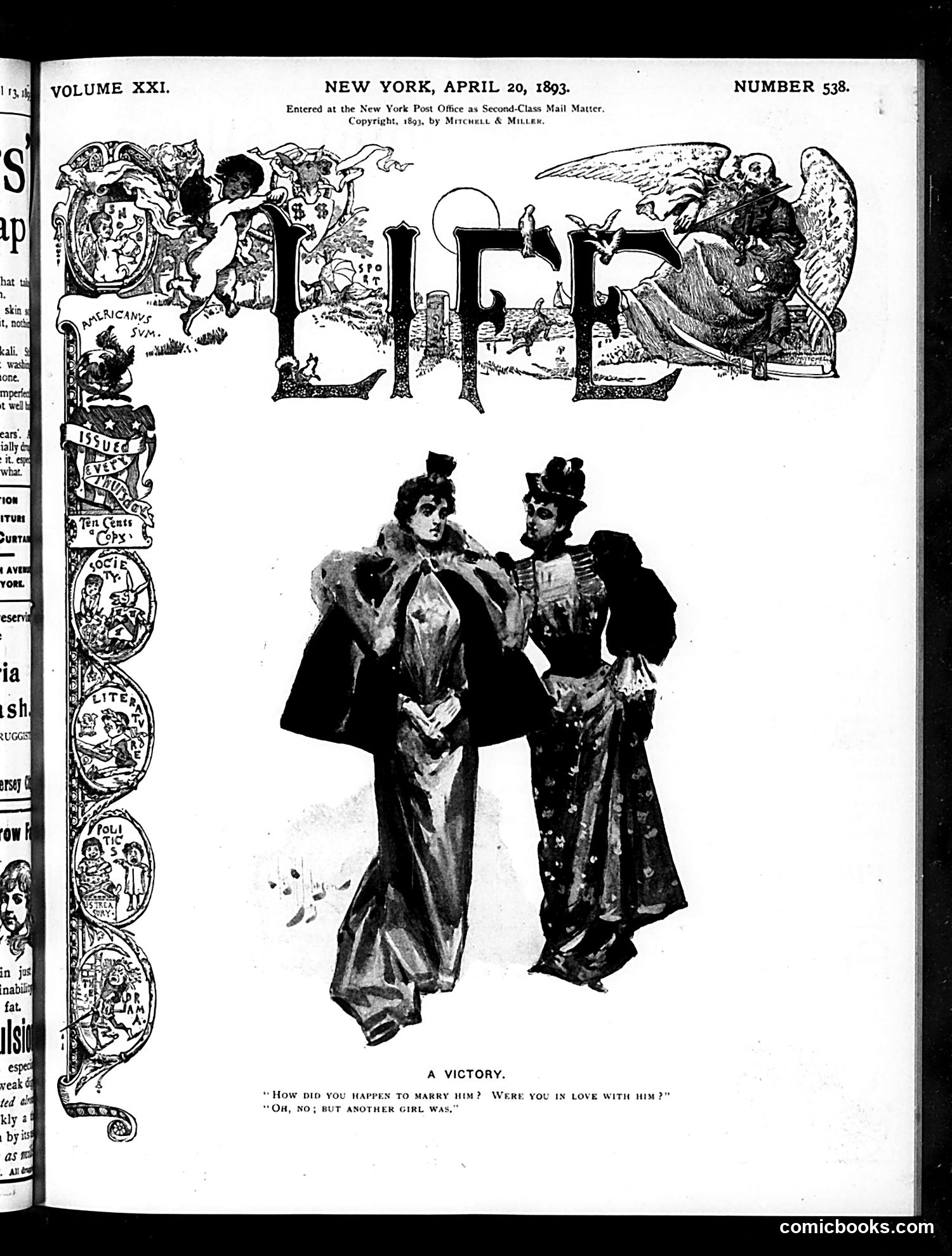
This cartoon depicts a woman in an elegant cape speaking with a uniformed military officer. The caption reads: "How did you happen to marry him? Were you in love with him?" / "Oh, no; but another girl was." The joke satirizes matrimonial strategy among the upper classes. The woman's "victory" is successfully marrying a desirable man—not through genuine love, but by competing with a rival and winning him away. The woman's fashionable dress and the officer's formal uniform suggest they represent society's elite. The satire mocks both the mercenary nature of upper-class marriages and the competitive, predatory approach women supposedly employ in securing advantageous matches. It's a commentary on marriage as economic/social transaction rather than romantic partnership.
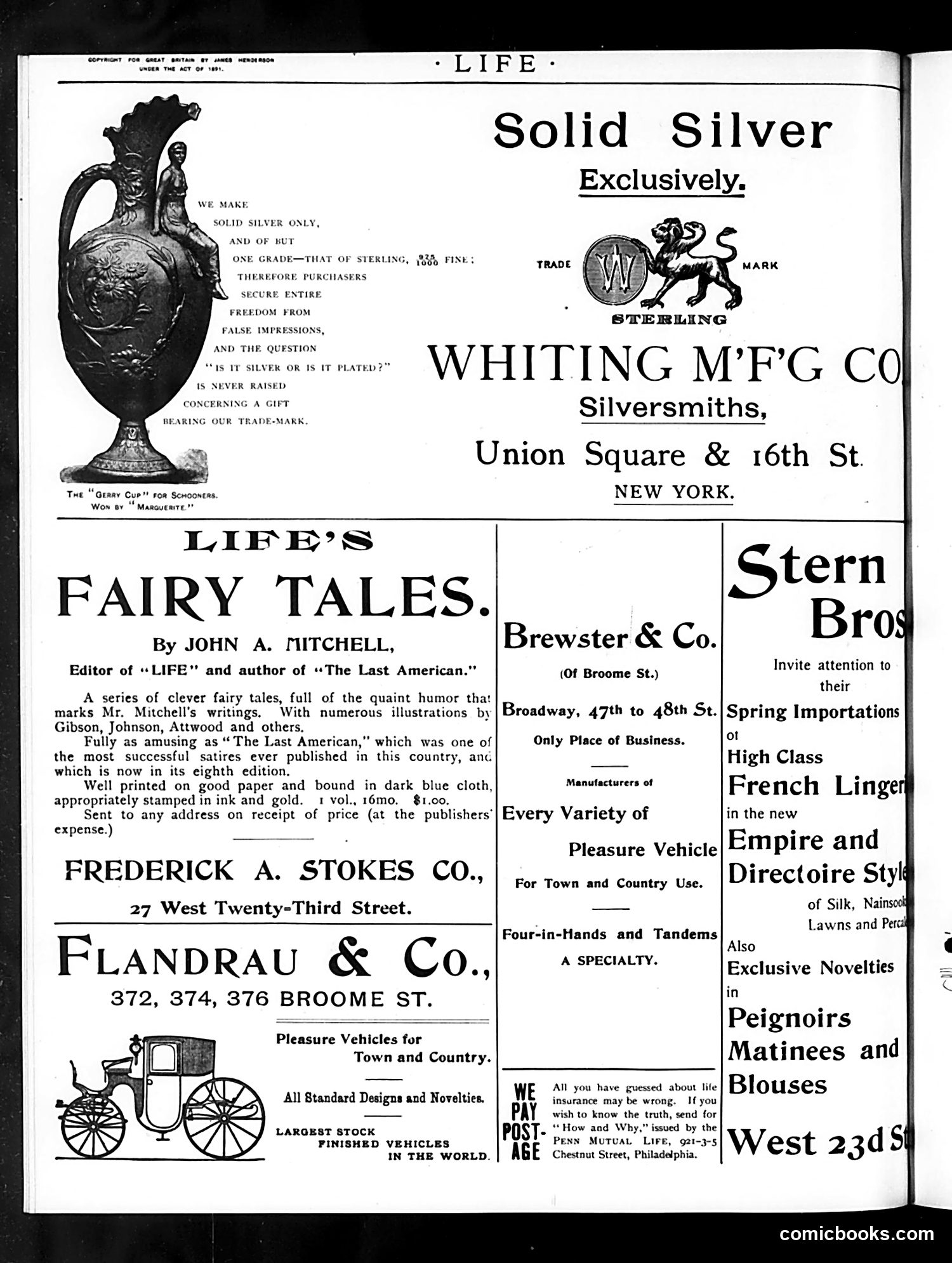
This page is primarily **advertising**, not political commentary. The top features Whiting M'FG Co.'s sterling silver products (emphasizing "solid silver exclusively" to counter fraudulent "plated" goods—a consumer concern of the era). Below are ads for: - **Life's Fairy Tales** by John A. Mitchell (editor of Life magazine) - **Frederick A. Stokes Co.** (publisher) - **Flandrau & Co.** (pleasure vehicles/carriages) - **Brewster & Co.** (vehicle manufacturers) - **Stern Bros** (French lingerie and fashion) - **Penn Mutual Life Insurance** (with a postage-paid inquiry card) The ornate silver pitcher illustration appears decorative rather than satirical. No political cartoons or caricatures are present on this page.
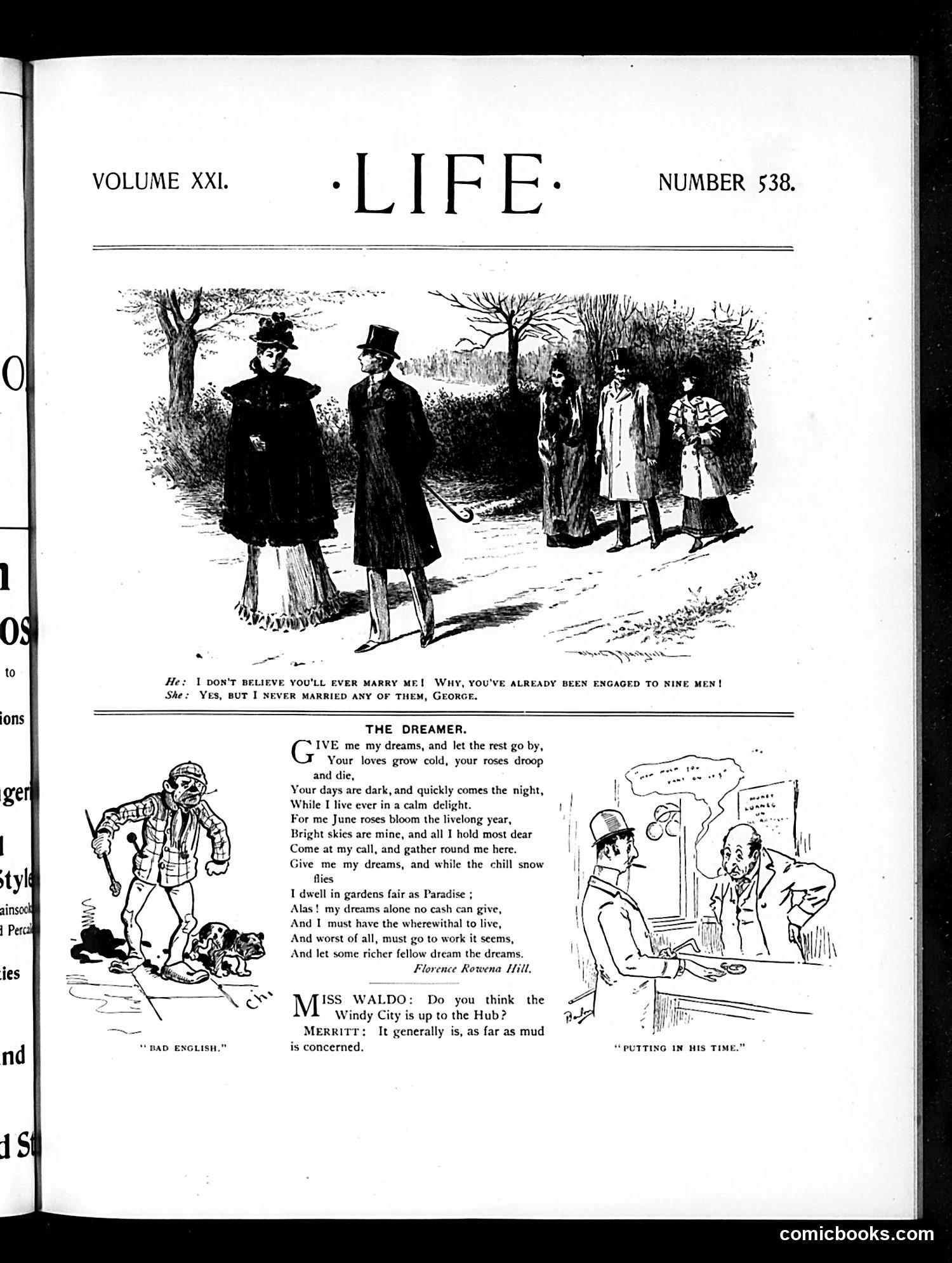
**Top Cartoon:** A social satire depicting a woman being approached by a man in a park setting. The caption reveals the joke: he protests "I don't believe you'll ever marry me!" while she responds that she's been engaged to nine men but never married any of them. This satirizes women's romantic fickleness and the era's anxieties about marriage commitments—a common theme in early 20th-century humor. **"The Dreamer" Poem:** Sentimental romantic verse about idealized love and dreams, likely intended as ironic counterpoint to the marriage joke above. **Bottom Cartoons:** Two separate sketches—"Bad English" (showing a disheveled figure) and "Putting in His Time" (showing men in conversation)—appear to be unrelated brief humorous vignettes typical of Life's miscellaneous content. The page exemplifies Life's blend of romantic satire and everyday social observation.
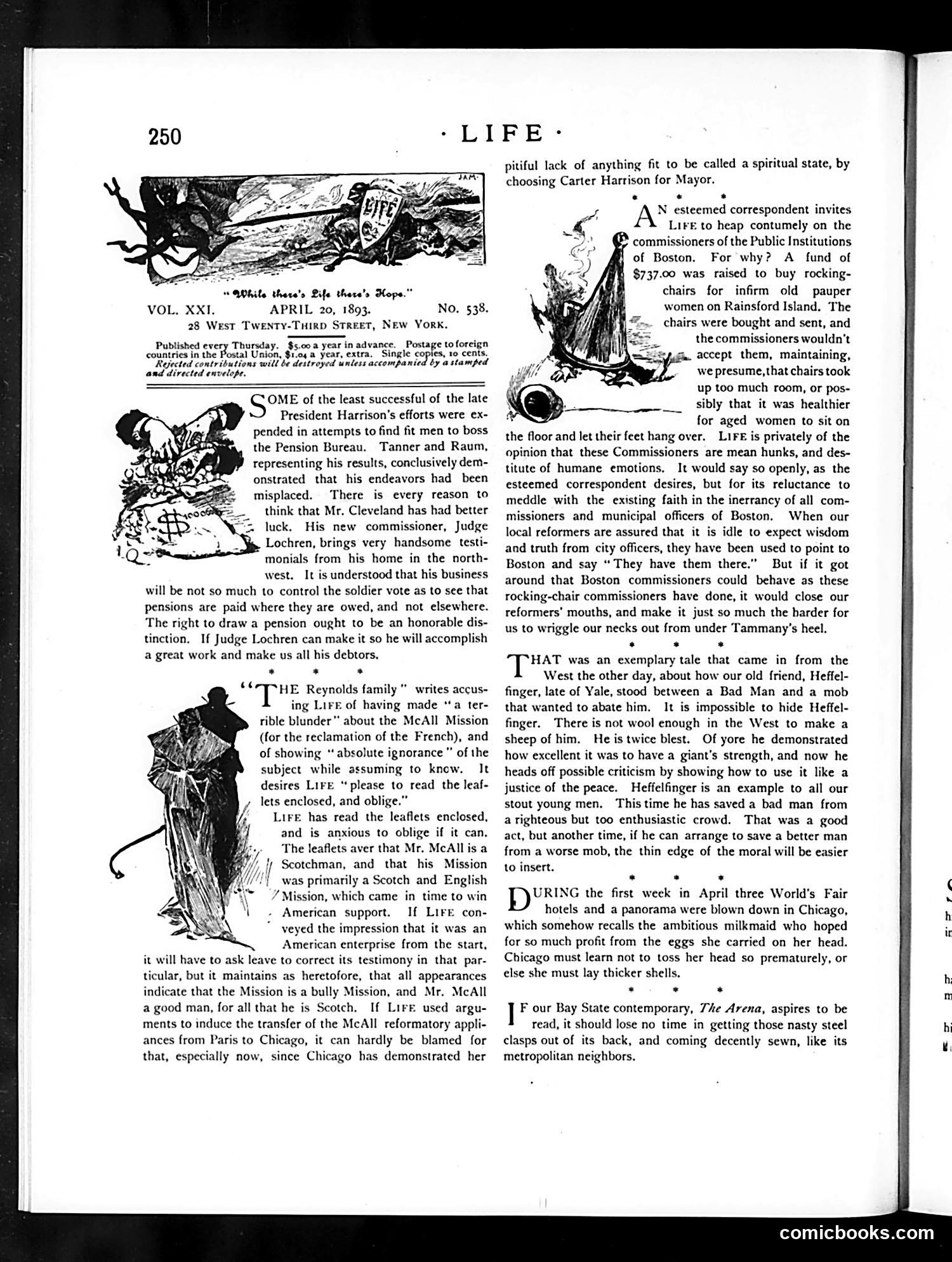
This page contains **three separate satirical pieces** critiquing Boston's municipal leadership: 1. **Top cartoon**: Attacks President Harrison's failed attempt to place allies in the Pension Bureau, criticizing Commissioners Tanner and Raum for incompetence. 2. **Middle section**: Mocks the Reynolds family's accusation that *Life* made "a terrible blunder" about the McCall Mission (a Scottish-English religious mission). *Life* defensively demands the Reynolds family provide corrections. 3. **Bottom piece**: Ridicules Boston's Public Institutions Commissioners as "mean hunks" for refusing rocking chairs donated for elderly poor women on Rainsford Island—arguing comfortable seating was supposedly unhealthy. The satire targets bureaucratic stubbornness and officials' indifference to the poor's welfare, typical *Life* magazine social criticism of the era.
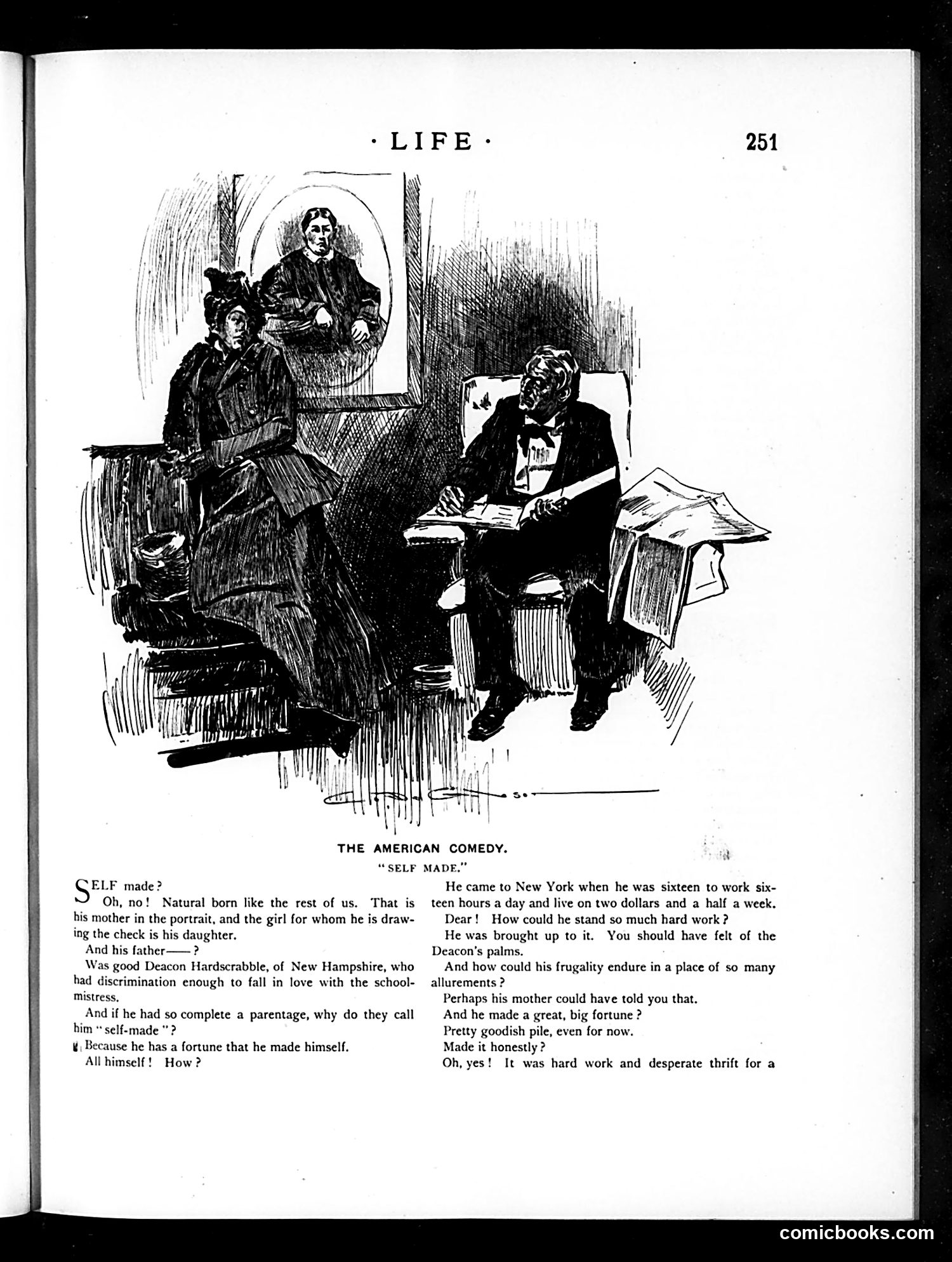
This satirical piece critiques the "self-made man" myth through dialogue about a wealthy businessman. The conversation reveals the hypocrisy: while the man claims to have built his fortune entirely through his own effort—coming to New York at sixteen, working long hours for minimal wages—the speakers suggest his success actually depended on advantages others lacked. References to his father (Deacon Hardscrabble) and the implication that inherited traits or family connections facilitated his rise undermine his claim of purely self-directed success. The sketch mocks the American ideal of the completely self-reliant individual by exposing how circumstance, family background, and luck—not purely personal merit—enable wealth accumulation.
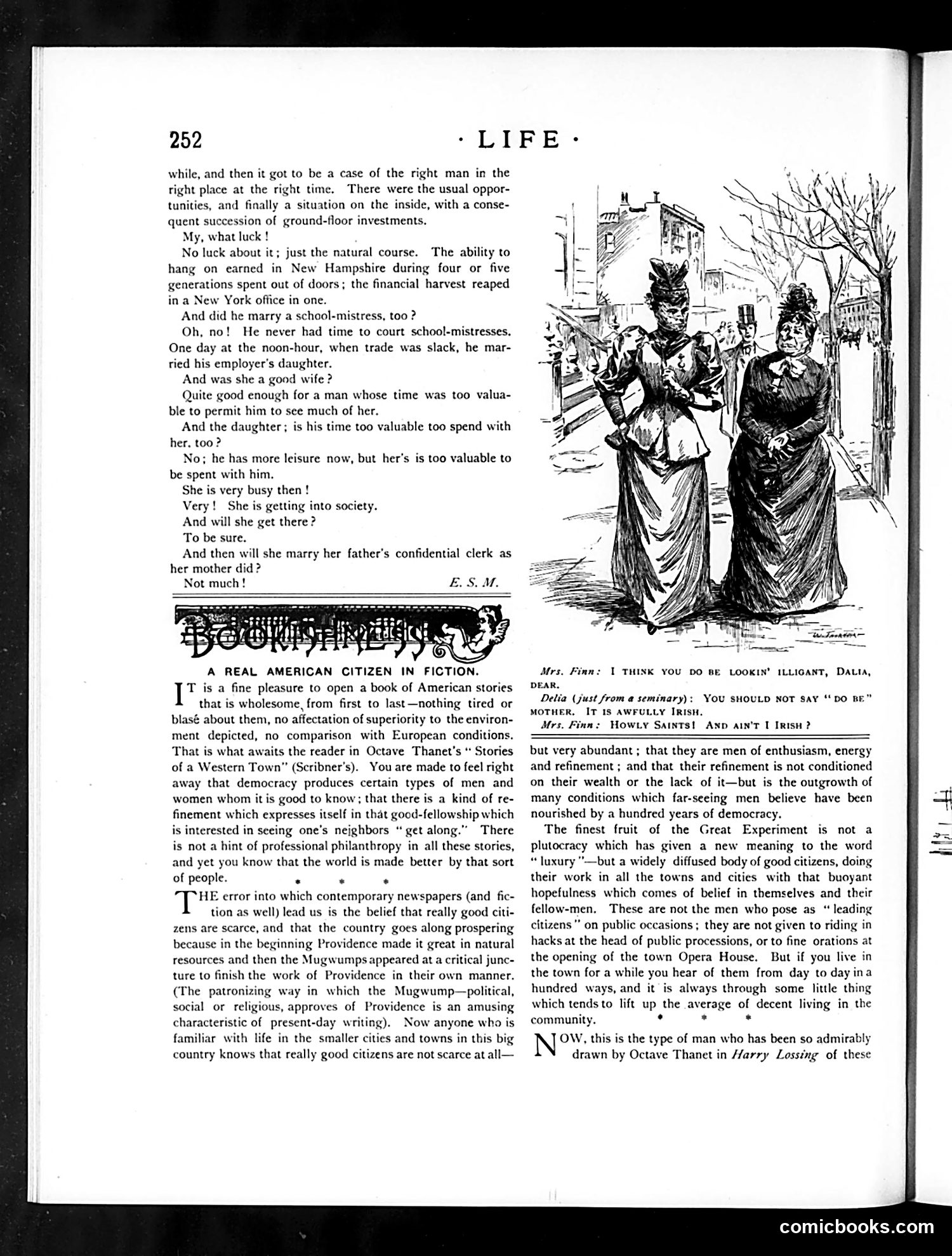
The page contains a literary article praising American fiction writers, particularly Octave Thanet's *Harry Losing*. The accompanying illustration shows two women in Victorian-era dress on a city street—likely depicting characters from the discussed fiction. The text celebrates how American democratic society produces distinctive character types absent in Europe. It critiques newspapers for overlooking "really good citizens" and argues that democracy itself—operating over generations—produces refinement and culture organically, without aristocratic pretense. The satirical point appears to be that genuine American virtue emerges from ordinary democratic life rather than inherited wealth or class. The illustration depicts this "type of man" (or woman) whom Thanet supposedly captures authentically in fiction—representing the dignified, cultured American citizen the article champions.
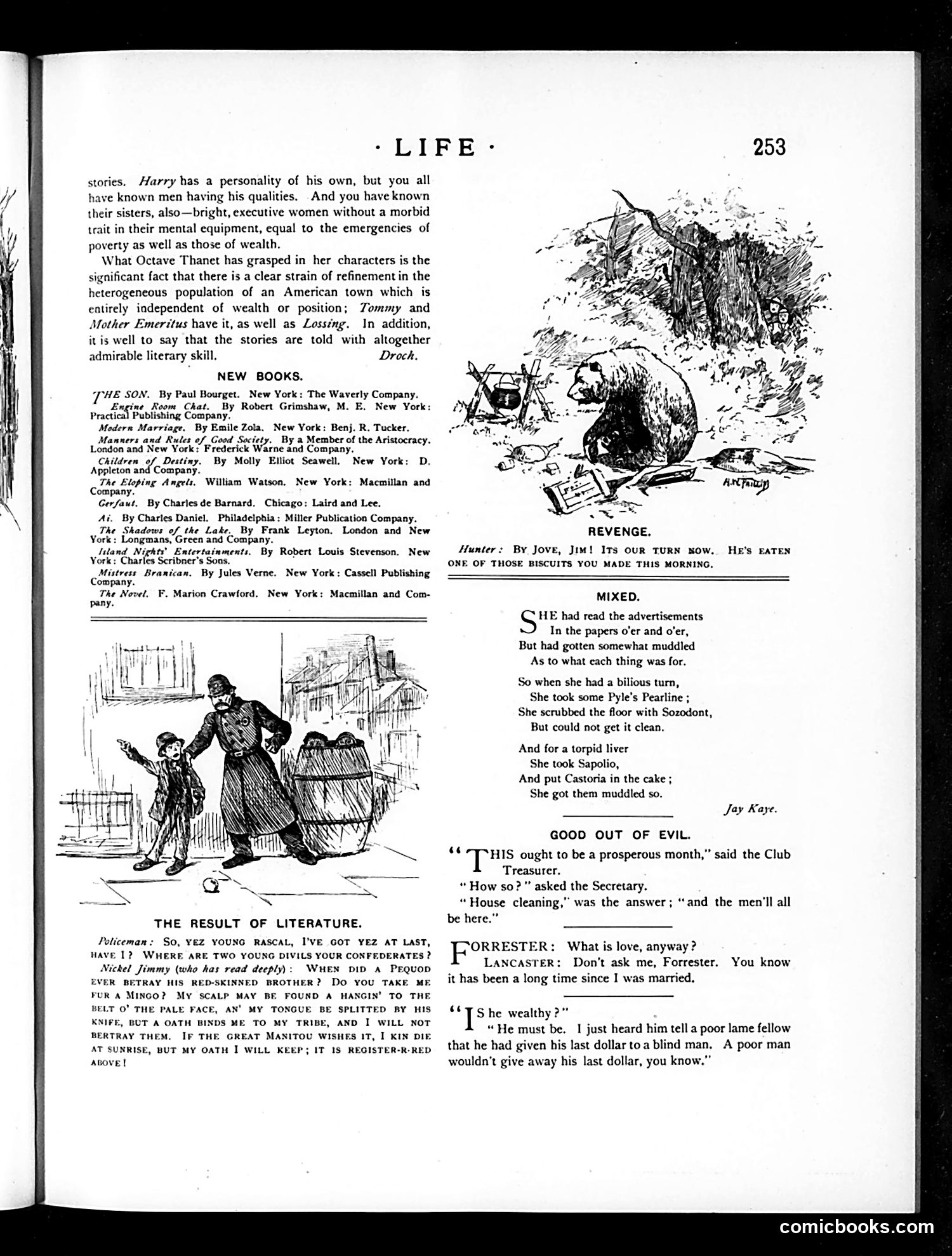
This cartoon satirizes the consequences of reading sensational literature. The caption references a "young rascal" who has read lurid stories ("Where are two young divils your confederates?") and apparently absorbed their criminal lessons. The policeman's confrontation with a ragged street child suggests that cheap popular fiction—dime novels and penny dreadfuls—were blamed for corrupting youth and encouraging crime and mischief. This reflects genuine late-19th-century anxiety about mass-market literature's moral influence on children and working-class readers. The cartoon mocks both the literature's sensationalism and society's fear that reading such material caused delinquency—a common moral panic of the era.
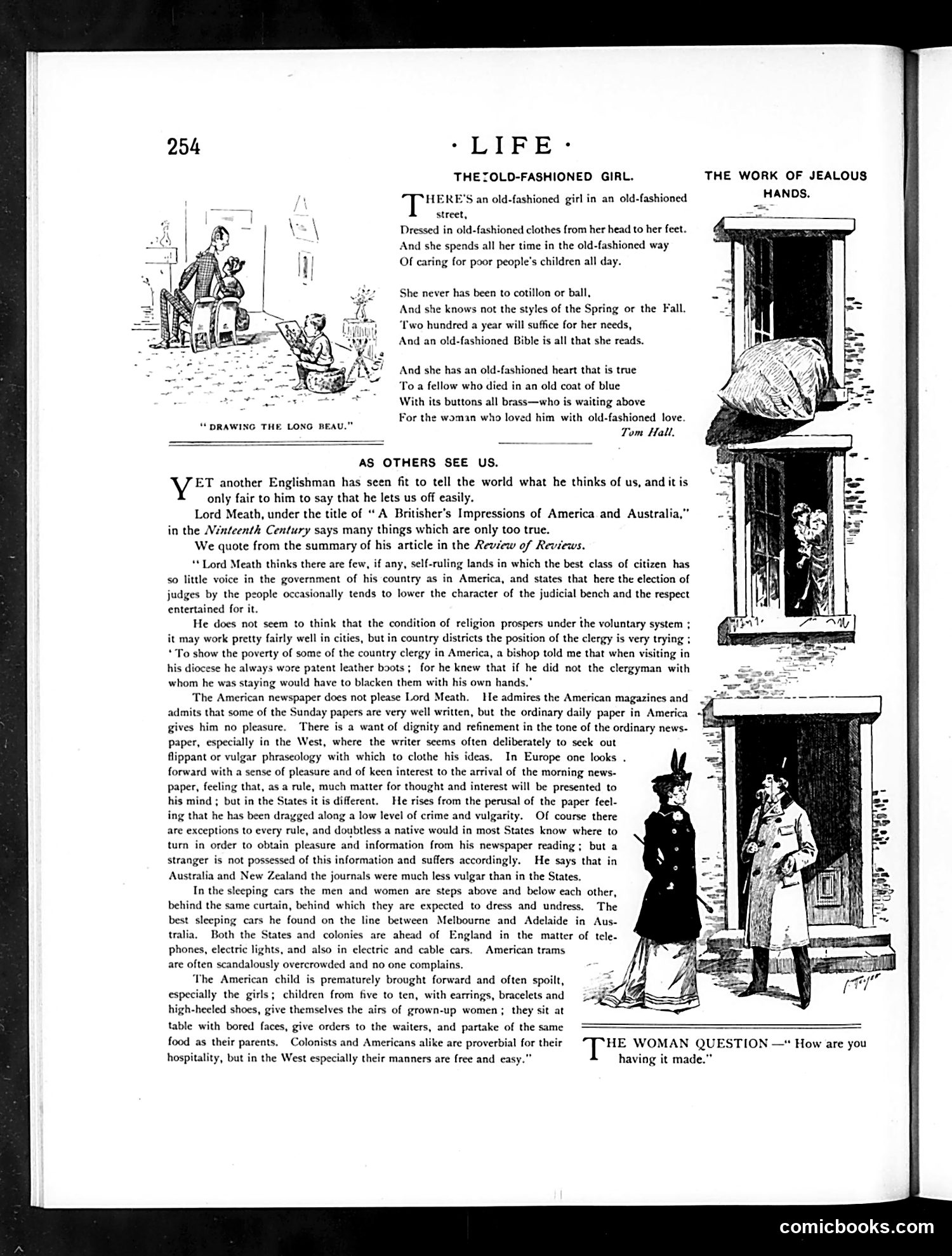
This page contains three distinct satirical pieces: **"The Old-Fashioned Girl"** (left): A poem by Tom Hall mocking an outdated young woman who wears old clothes, hasn't attended social events, reads only the Bible, and maintains romantic devotion to a deceased man. The satire targets women who reject modern fashion and social participation. **"As Others See Us"** (center): Criticism of Lord Meath's article in the *Nineteenth Century* magazine disparaging American character. The text refutes his claims about American religion, journalism standards, and social behavior, defending Americans against British condescension. This reflects 19th-century Anglo-American cultural tensions. **"The Woman Question"** (right): An illustration showing two women at a doorway, captioned "How are you having it made." The meaning remains unclear without additional context.
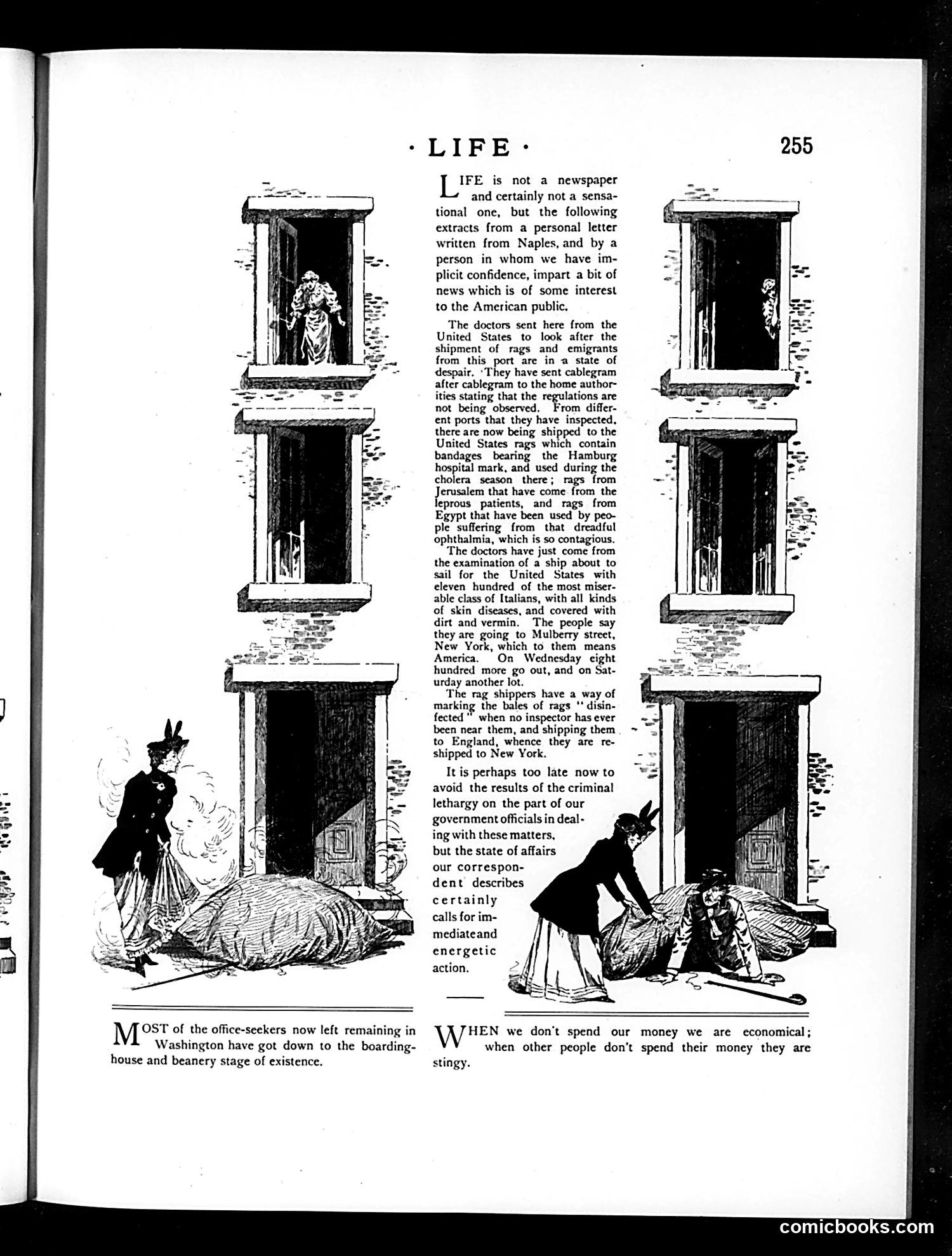
This page satirizes public health concerns about immigration and disease transmission in early 20th-century America. The main article, based on a Naples correspondent's letter, describes U.S. doctors inspecting shipments of rags and emigrant clothing arriving from disease-ridden regions—particularly contaminated bandages from Hamburg hospitals and Egyptian rags allegedly carrying ophthalmia (eye disease). The accompanying illustrations show figures discovering diseased materials in building windows and doorways, suggesting the infection risk posed by imported goods. The satire critiques both government negligence in enforcing health regulations and the fraudulent practices of rag traders who falsely mark contaminated goods as "disinfected" before shipping them to America—highlighting corruption in trade and inadequate immigration/commerce oversight.
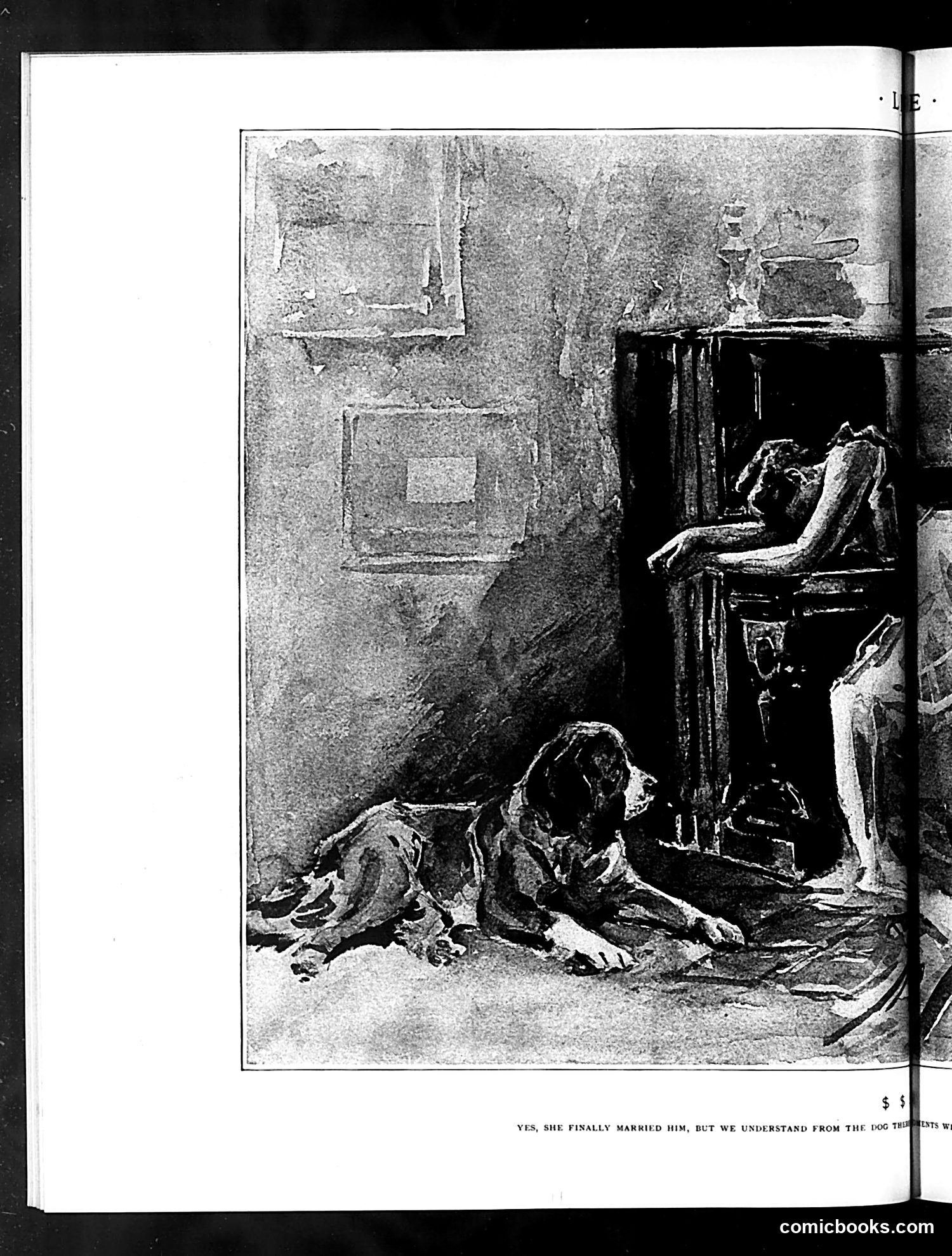
This appears to be an illustration from a satirical story or comic in *Life* magazine. The image shows a domestic interior scene with dogs lying on the floor and a person reclining indoors, viewed from outside through a doorway or window. The caption reads: "YES, SHE FINALLY MARRIED HIM, BUT WE UNDERSTAND FROM THE DOG THAT..." (text cuts off) The satire appears to be about marriage and domestic life—specifically, the joke seems to be that despite the woman finally marrying the man, there are implied problems with the relationship that even "the dog" (a household witness) could attest to. The humor relies on the suggestion that the dogs observe marital discord or dissatisfaction that contradicts the surface appearance of a successful marriage. The specific context of who "he" and "she" are is not provided on this page.
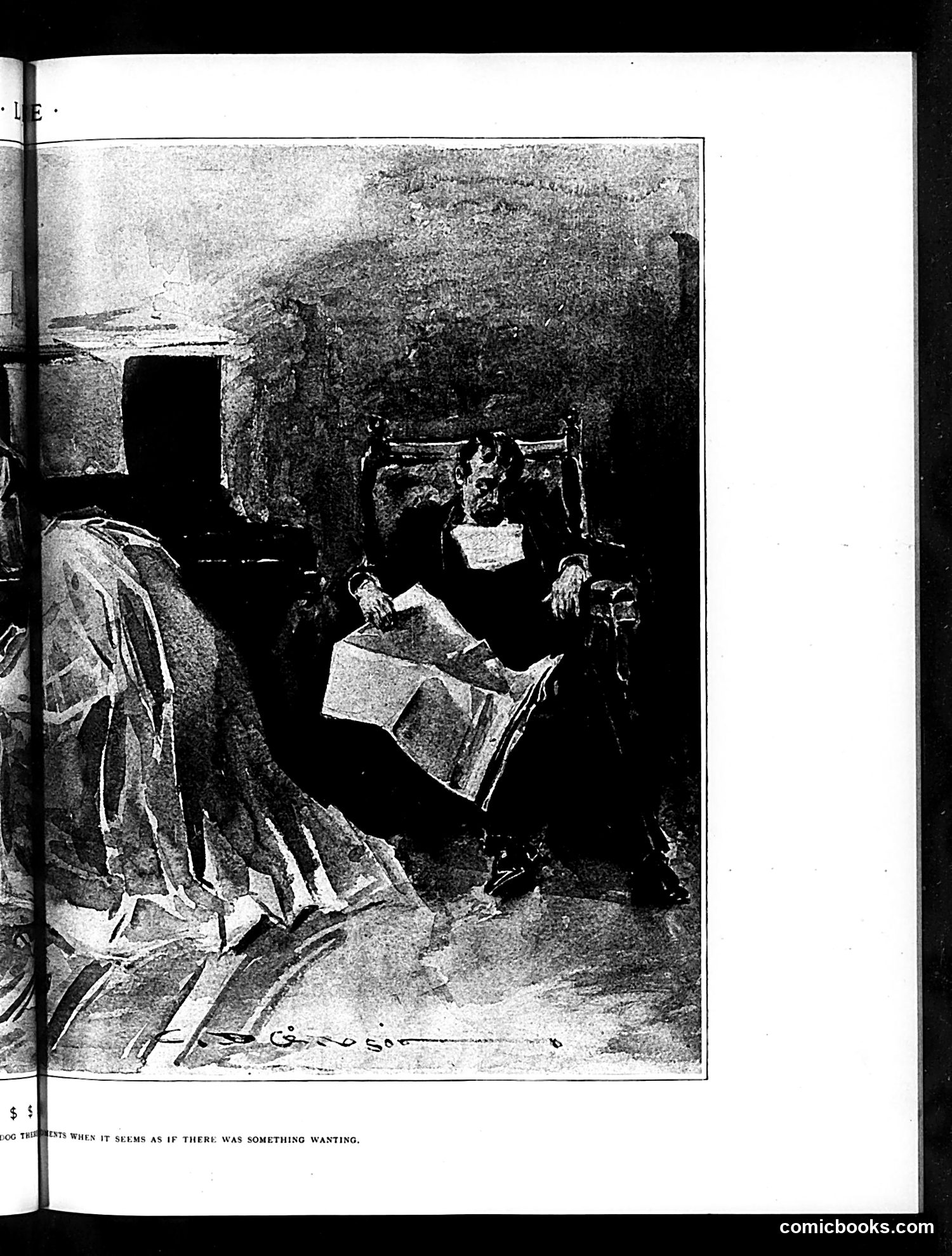
This appears to be an illustration from Life magazine showing what looks like a religious or formal ceremony scene. The image depicts several robed figures in what appears to be an interior space with arched architectural elements. One figure is seated on the left while others stand or sit in the center-right of the composition. The caption at the bottom reads: "...SUGGESTS WHEN IT SEEMS AS IF THERE WAS SOMETHING WANTING." Without additional context from surrounding text or a visible date, I cannot definitively identify the specific figures, event, or satirical target being referenced. The formal dress and ceremonial setting suggest commentary on religious or institutional proceedings, but the exact subject and point of satire remain unclear from this page alone.
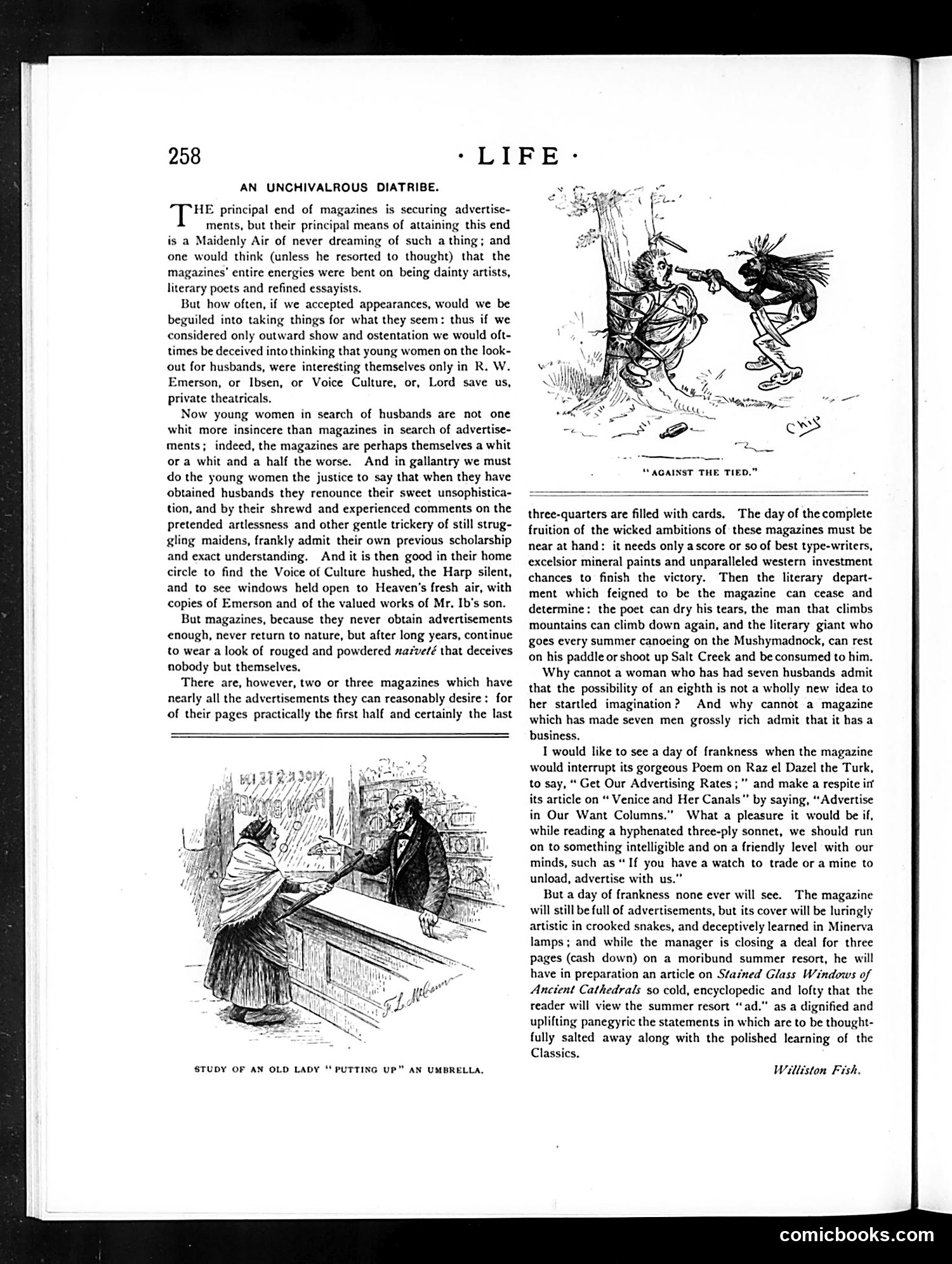
This article by Williston Fish critiques magazines' hypocrisy about advertising. Fish argues that magazines pretend to be refined literary publications while actually chasing advertisements desperately—much like young women pretending interest in Emerson and "Voice Culture" while actually seeking husbands. The satire's central point: magazines adopt fake "naïveté" and artistic pretense to attract advertisers, never dropping the act even after achieving commercial success. Fish contrasts this with married women, who at least honestly admit their previous deception once married. The two accompanying sketches illustrate this theme—one showing figures in conflict (captioned "Against the Tied"), the other depicting an elderly woman with an umbrella, likely representing the false propriety magazines maintain. Fish mockingly suggests magazines should simply interrupt their poetry to advertise rates directly, admitting their true business rather than maintaining transparent dishonesty.
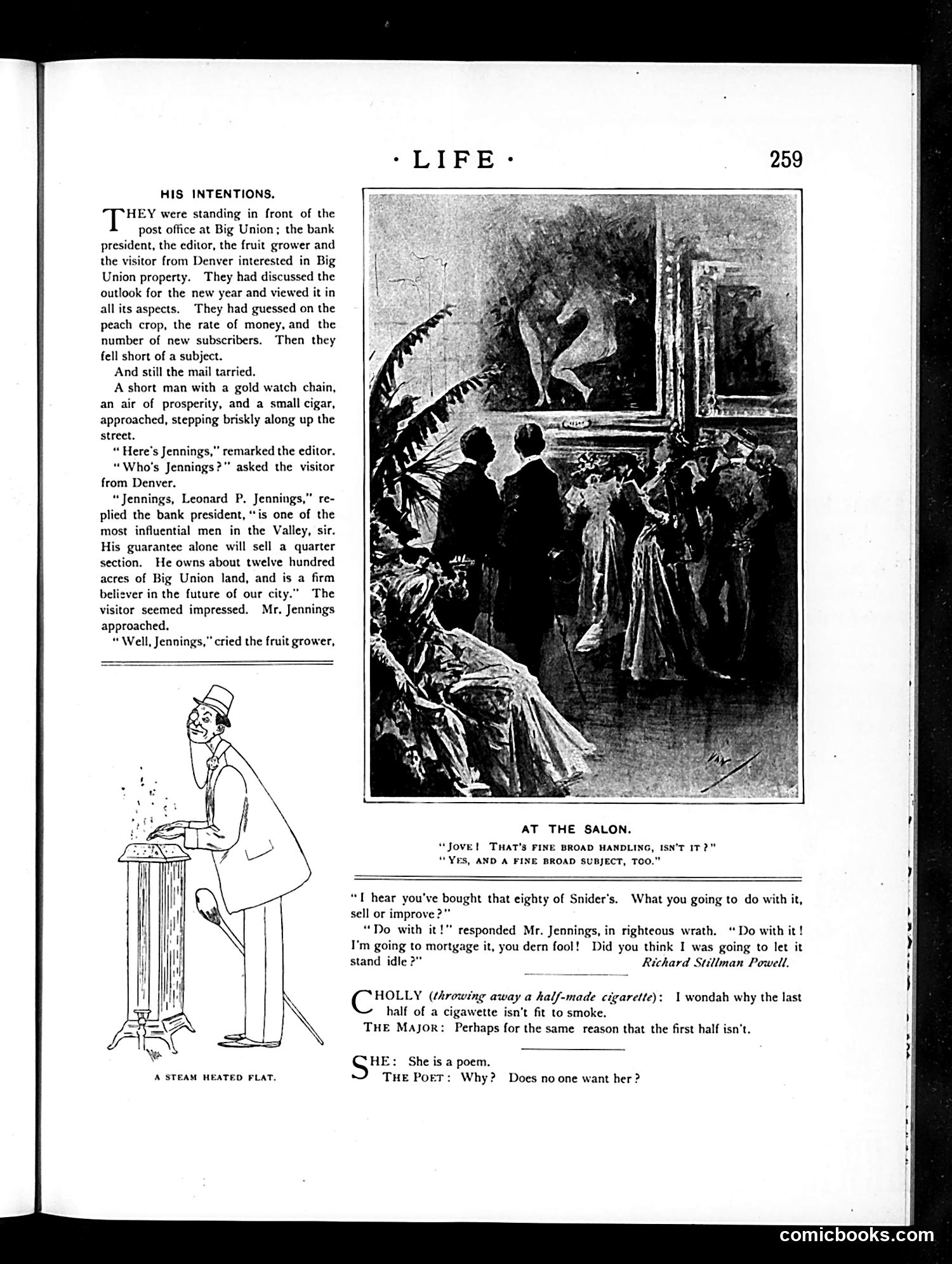
This page contains two separate humorous pieces satirizing American society circa early 1900s. **"His Intentions"** (main story): A visiting Denver investor and local Big Union officials discuss the town's prospects. They're impressed by Leonard P. Jennings, a wealthy landowner with 1,200 acres, presented as the town's most influential figure. The satire's punchline: when asked if he'll improve newly-purchased land, Jennings explodes that he plans to *mortgage* it instead—revealing that even this supposedly shrewd businessman is speculating rather than developing. The joke mocks boom-town land speculation mentality. **"At the Salon"** and accompanying jokes: These are brief quips. One exchanges bon mots about a woman who is "a poem" but nobody wants her—likely satirizing pretentious salon society or artistic circles. Another mocks the pointlessness of smoking the second half of a cigarette. The cartoons and lighter pieces suggest Life's satirical range from economic folly to social affectation.
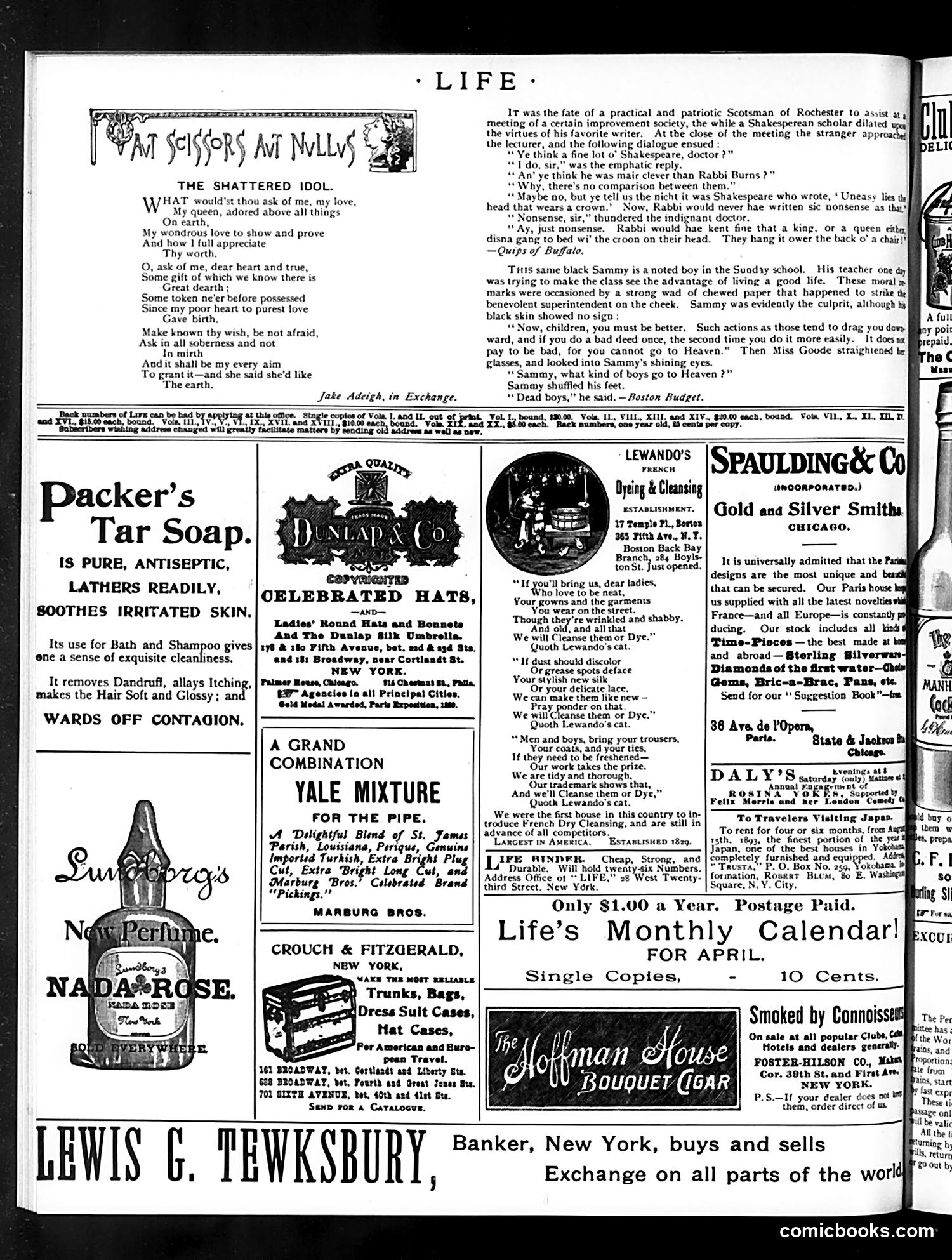
This page is primarily **advertisements and filler content** with minimal satirical cartoons. The main textual humor appears in two brief anecdotes: 1. **"The Shattered Idol"** — A Scottish visitor challenges a Shakespeare scholar by arguing that Robert Burns (the Scottish poet, called "Rabbi Burns") was superior to Shakespeare. The joke: the Scot cites Shakespeare's famous line "Uneasy lies the head that wears a crown" and ridicules it as nonsensical—a king would never sleep wearing his crown; he'd hang it on a chair. This is gentle satire of Scottish pride and the absurdity of using literal logic against poetic license. 2. **The Sunday School anecdote** — A teacher lectures Black children about virtue and avoiding sin; the boy "Sammy" asks what "kind of boys go to Heaven?" The humor relies on period racial stereotypes and dialect humor typical of late-19th-century American publications. The page is otherwise filled with period advertisements for soap, hats, cigars, banking services, and other goods—standard for *Life* magazine content from this era.
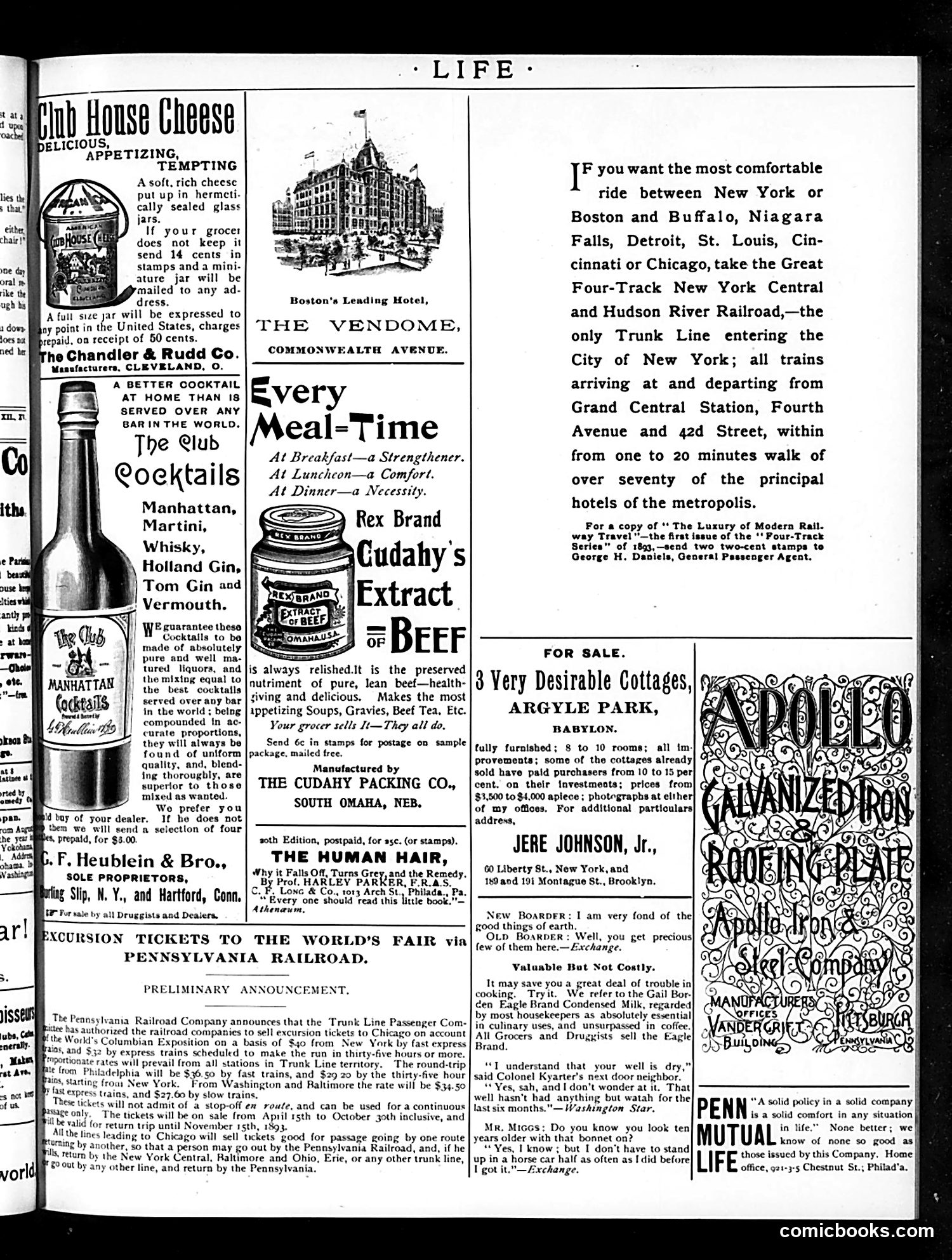
This page is primarily **advertising**, not satire or political commentary. It contains commercial advertisements typical of 1893, including: **Product Ads:** - Club House Cheese (hermetically sealed) - The Club Cocktails (Manhattan, Martini, etc.) - Cudahy's Extract of Beef (a meat extract product) - The Vendome Hotel in Boston - Patent hair remedy by Prof. Harley Parker **Major Content:** The dominant feature is a **Pennsylvania Railroad announcement** promoting excursion tickets to the **1893 World's Columbian Exposition** in Chicago at $40 from New York. This reflects the historical moment—the Chicago World's Fair was a major American event. **Secondary Promotion:** The New York Central and Hudson River Railroad competes for the same travelers, emphasizing comfort and convenient Grand Central Station access. There is **no political cartoon or satire visible** on this page. It represents straightforward commercial messaging from the Gilded Age, targeting middle-class travelers and consumers.
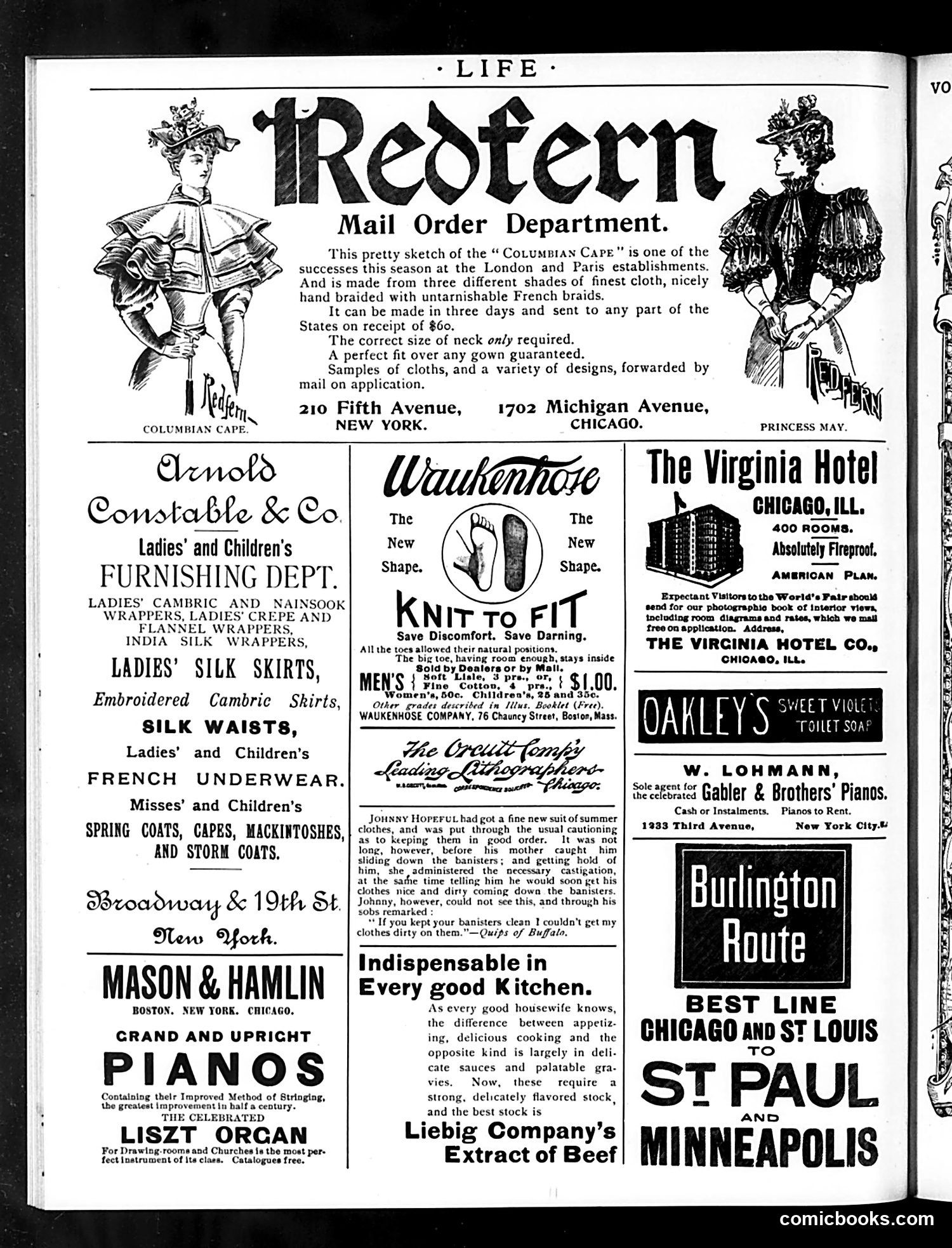
This page is primarily **advertising**, not editorial content or political satire. It's from Life magazine's mail-order section, featuring late 19th/early 20th-century consumer goods. The only non-advertisement content is a brief humorous anecdote about "Johnny Hopeful," a child who slides down banisters and dirties his new clothes. When scolded, he retorts that his mother should keep the banisters clean instead—a simple joke about childhood logic and parental exasperation, with no political meaning. The advertisements showcase period consumer culture: mail-order fashion capes, pianos, knit stockings ("Knit to Fit"), hotels catering to World's Fair visitors, beef extract, and toiletries. The Columbian Cape references the 1893 World's Columbian Exposition in Chicago. These ads reflect the era's emerging mail-order retail economy and industrial manufacturing.