
Life, 1893-04-20 · page 6 of 16
Life — April 20, 1893 — page 6: what you’re looking at
What you’re looking at
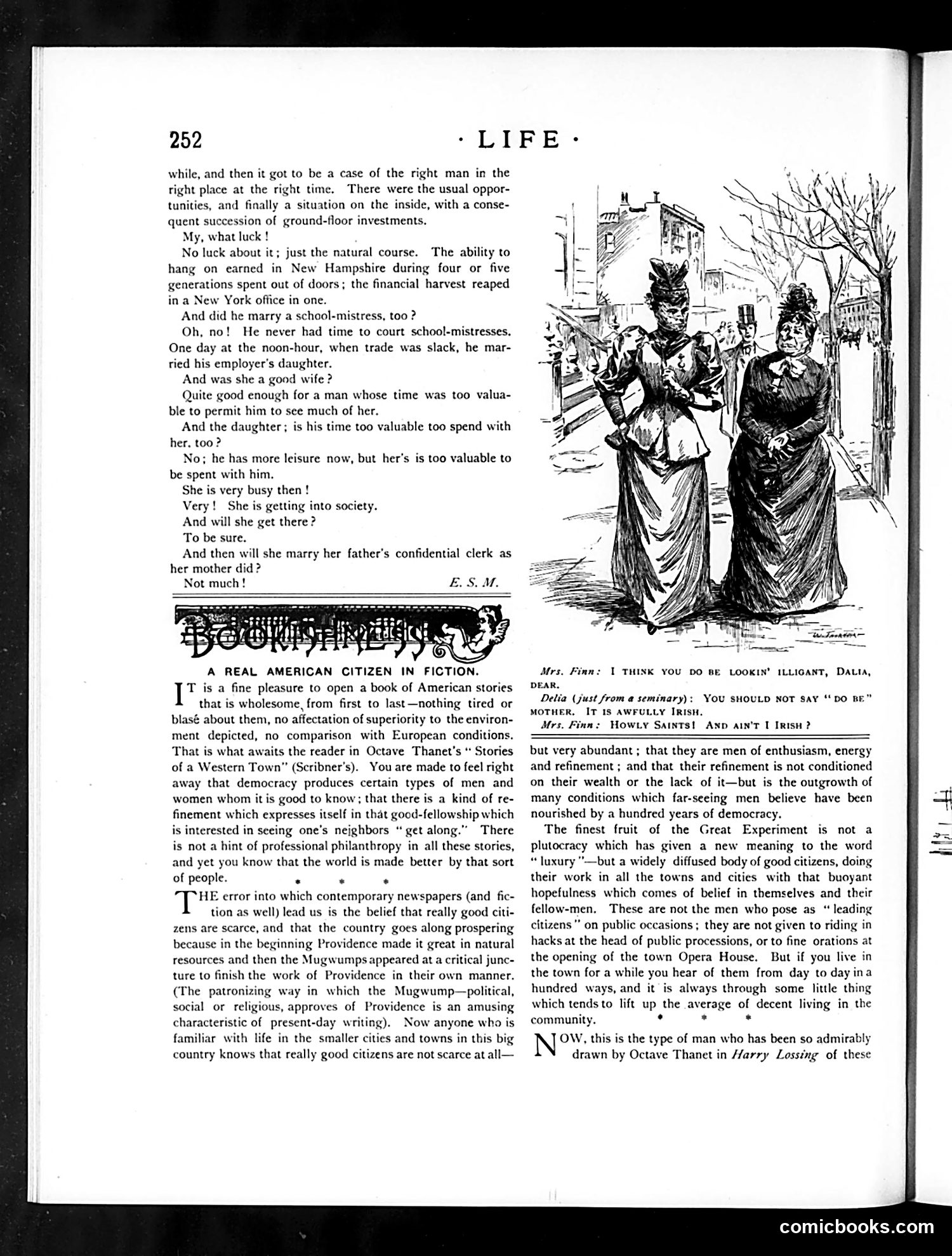
The page contains a literary article praising American fiction writers, particularly Octave Thanet's *Harry Losing*. The accompanying illustration shows two women in Victorian-era dress on a city street—likely depicting characters from the discussed fiction. The text celebrates how American democratic society produces distinctive character types absent in Europe. It critiques newspapers for overlooking "really good citizens" and argues that democracy itself—operating over generations—produces refinement and culture organically, without aristocratic pretense. The satirical point appears to be that genuine American virtue emerges from ordinary democratic life rather than inherited wealth or class. The illustration depicts this "type of man" (or woman) whom Thanet supposedly captures authentically in fiction—representing the dignified, cultured American citizen the article champions.
📄 Transcribed text from this page (OCR, searchable)
Machine-transcribed from the original scan — historical spelling and the odd misread are preserved.
252 ‘LIFE: while, and then it got to be a case of the right man in the right place at the right time. There were the usual oppor- tunities, and finally a situation on the inside, with a conse- quent succession of ground-floor investments. My, what luck ! No luck about it; just the natural course. The ability to hang on earned in New Hampshire during four or five generations spent out of doors; the financial harvest reaped in a New York office in one. And did he marry a school-mistress, too ? Oh, no! He never had time to court school-mistresses, One day at the noon-hour, when trade was slack, he mar- tied his employer's daughter. And was she a good wife ? Quite good enough for a man whose time was too valua- ble to permit him to see much of her. And the daughter; is his time too valuable too spend with her. too ? No; he has more leisure now, but her's is too valuable to be spent with him. She is very busy then! Very! She is getting into society. And will she get there ? To be sure. And then will she marry her father’s confidential clerk as her mother did ? Not much! A REAL AMERICAN CITIZEN IN FICTION. T is a fine pleasure to open a book of American stories that is wholesome, from first to last—nothing tired or blasé about them, no affectation of superiority to the environ- ment depicted, no comparison with European conditions. That is what awaits the reader in Octave Thanet’s * Stories of a Western Town” (Scribner's). You are made to feel right away that democracy produces certain types of men and women whom it is good to know; that there is a kind of re- finement which expresses itself in that good-fellowship which is interested in seeing one’s neighbors “ get along.” There is not a hint of professional philanthropy in all these stories, and yet you know that the world is made better by that sort of people. . * ry HE error into which contemporary newspapers (and fic- tion as well) lead us is the belief that really good citi- zens are scarce, and that the country goes along prospering because in the beginning Providence made it great in natural resources and then the Mugwumps appeared at a critical junc- ture to finish the work of Providence in their own manner. (The patronizing way in which the Mugwump—political, social or religious, approves of Providence is an amusing characteristic of present-day writing). Now anyone who is familiar with life in the smaller cities and towns in this big country knows that really good citizens are not scarce at all— Mrs. Finn: 1 TWINK YOU DO BE LOOKIN’ ILLIGANT, Datta, DEAR. Delia (just from a seminary): YOU SHOULD NOT SAY “DO BE” MOTHER, IT 1S AWFULLY IRISH. Mrs. Finn: HOwLy SAINTS! AND ain't TRisi ? but very abundant; that they are men of enthusiasm, energy and refinement ; and that their refinement is not conditioned on their wealth or the lack of it—but is the outgrowth of many conditions which far-seeing men believe have been nourished by a hundred years of democracy. The finest fruit of the Great Experiment is not a plutocracy which has given a new meaning to the word “luxury "—but a widely diffused body of good citizens, doing their work in all the towns and cities with that buoyant hopefulness which comes of belief in themselves and their fellow-men, These are not the men who pose as “ leading citizens” on public occasions; they are not given to riding in hacks at the head of public processions, or to fine orations at the opening of the town Opera House. But if you live in the town for a while you hear of them from day to day ina hundred ways, and it is always through some little thing which tends to lift up the average of decent living in the community. * * * OW, this is the type of man who has been so admirably drawn by Octave Thanet in Harry Lossing of these ty {y) } comicbooks.com