
Life, 1893-04-20 · page 4 of 16
Life — April 20, 1893 — page 4: what you’re looking at
What you’re looking at
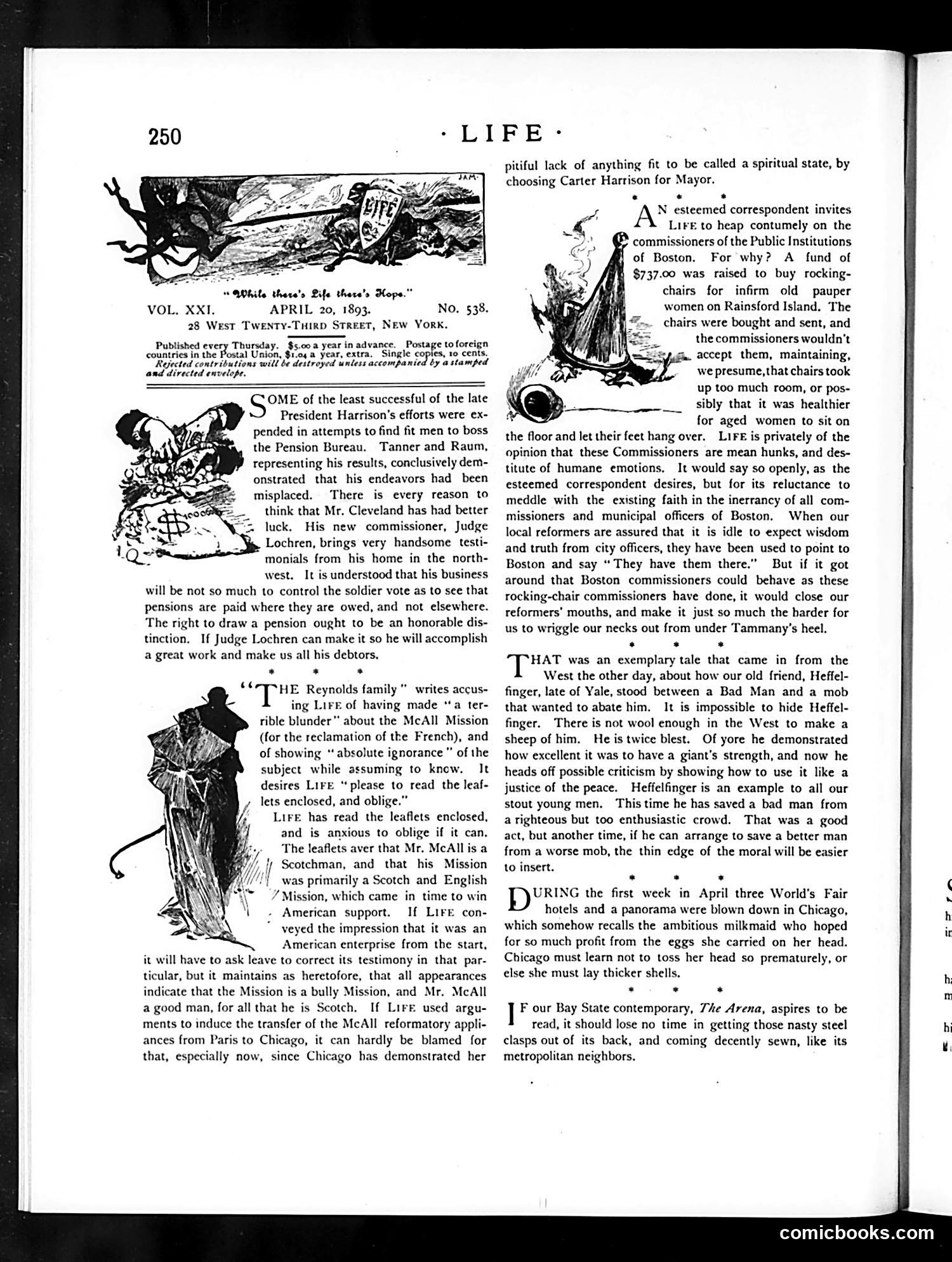
This page contains **three separate satirical pieces** critiquing Boston's municipal leadership: 1. **Top cartoon**: Attacks President Harrison's failed attempt to place allies in the Pension Bureau, criticizing Commissioners Tanner and Raum for incompetence. 2. **Middle section**: Mocks the Reynolds family's accusation that *Life* made "a terrible blunder" about the McCall Mission (a Scottish-English religious mission). *Life* defensively demands the Reynolds family provide corrections. 3. **Bottom piece**: Ridicules Boston's Public Institutions Commissioners as "mean hunks" for refusing rocking chairs donated for elderly poor women on Rainsford Island—arguing comfortable seating was supposedly unhealthy. The satire targets bureaucratic stubbornness and officials' indifference to the poor's welfare, typical *Life* magazine social criticism of the era.
📄 Transcribed text from this page (OCR, searchable)
Machine-transcribed from the original scan — historical spelling and the odd misread are preserved.
LIFE “While there's Life there’s Hope.” VOL, XXI. APRIL 20, 1893. No. 538. 28 West Twenty-THirp STREET, NEw York. Published every Thursday. $5.00 year in advance. Postage to foreign countries in the Postal Union, $1.04 a year, extra. Single copies, ro cents. Rejected contributions will be destroyed unless accompanied by astamped and directed envelope. OME of the least successful of the late President Harrison's efforts were ex- pended in attempts to find fit men to boss the Pension Bureau. Tanner and Raum, representing his results, conclusively dem- onstrated that his endeavors had been misplaced. There is every reason to think that Mr. Cleveland has had better luck. His new commissioner, Judge » Lochren, brings very handsome testi- monials from his home in the north- west. It is understood that his business will be not so much to control the soldier vote as to see that pensions are paid where they are owed, and not elsewhere. The right to draw a pension ought to be an honorable dis- tinction. If Judge Lochren can make it so he will accomplish a great work and make us au his debtors, . pie Seyi family" writes accus- ing Lire of having made “a ter- rible blunder” about the McAll Mission (for the reclamation of the French), and of showing “ absolute ignorance ” of the subject while assuming to know. It desires LiFE “please to read the leaf- lets enclosed, and oblige.” Lire has read the leaflets enclosed, and is anxious to oblige if it can, The leaflets aver that Mr. McAll is a ly Scotchman, and that his Mission was primarily a Scotch and English Mission, which came in time to win American support. If LIFE con- veyed the impression that it was an American enterprise from the start, it will have to ask leave to correct its testimony in that par- ticular, but it maintains as heretofore, that all appearances indicate that the Mission is a bully Mission, and Mr. McAll a good man, for all that he is Scotch, If Lire used argu- ments to induce the transfer of the McAll reformatory appli- ances from Paris to Chicago, it can hardly be blamed for that, especially now, since Chicago has demonstrated her pitiful lack of anything fit to be called a spiritual state, by choosing Carter Harrison for Mayer: "AS sce correspondent invites Lire to heap contumely on the commissioners of the Public Institutions For why? A fund of $737.00 was raised to buy rocking- chairs for infirm old pauper women on Rainsford Island. The chairs were bought and sent, and the commissioners wouldn’t accept them, maintaining, we presume, that chairs took up too much room, or pos- sibly that it was healthier for aged women to sit on the floor and let their feet hang over. LIFE is privately of the opinion that these Commissioners are mean hunks, and des- titute of humane emotions. It would say so openly, as the esteemed correspondent desires, but for its reluctance to meddle with the existing faith in the inerrancy of all com- missioners and municipal officers of Boston. When our local reformers are assured that it is idle to expect wisdom and truth from city officers, they have been used to point to Boston and say “They have them there.” But if it got around that Boston commissioners could behave as these rocking-chair commissioners have done, it would close our reformers’ mouths, and make it just so much the barder for us to wriggle our necks out from under Tammany’s heel. . . . HAT was an exemplary tale that came in from the West the other day, about how our old friend, Heffel- finger, late of Yale, stood between a Bad Man and a mob that wanted to abate him. It is impossible to hide Heffel- finger. There is not wool enough in the West to make a sheep of him. He is twice blest. Of yore he demonstrated how excellent it was to have a giant's strength, and now he heads off possible criticism by showing how to use it like a justice of the peace. Heffelfinger is an example to all our stout young men. This time he has saved a bad man from a righteous but too enthusiastic crowd. That was a good act, but another time, if he can arrange to save a better man from a worse mob, the thin edge of the moral will be easier to insert. * . * URING the first week in April three World’s Fair hotels and a panorama were blown down in Chicago, which somehow recalls the ambitious milkmaid who hoped for so much profit from the eggs she carried on her head. Chicago must learn not to toss her head so prematurely, or else she must lay thicker shells. . * * ] F our Bay State contemporary, Zhe Arena, aspires to be read, it should lose no time in getting those nasty steel clasps out of its back, and coming decently sewn, like its metropolitan neighbors. comicbooks.com