
Life, 1893-04-20 · page 12 of 16
Life — April 20, 1893 — page 12: what you’re looking at
What you’re looking at
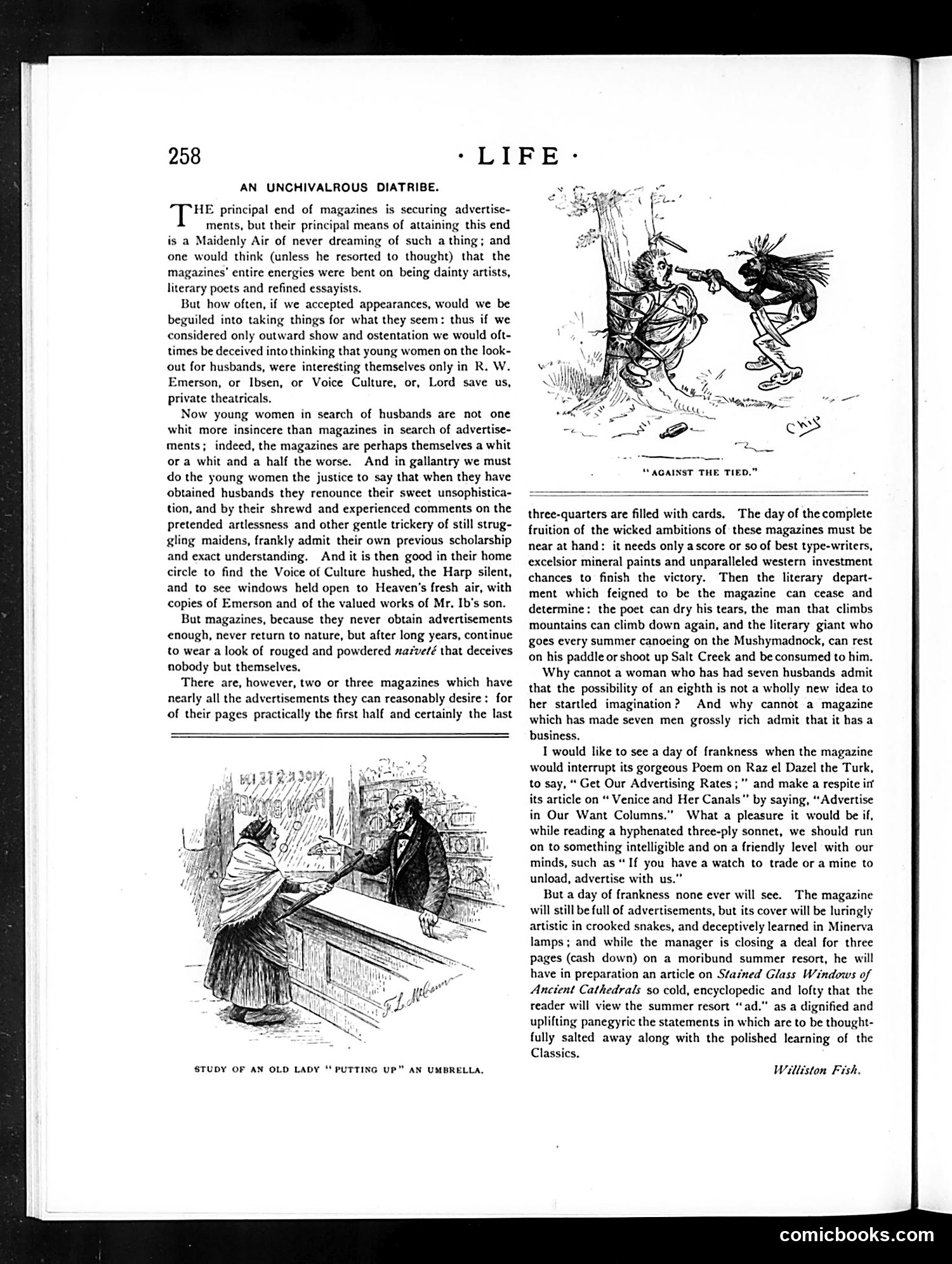
This article by Williston Fish critiques magazines' hypocrisy about advertising. Fish argues that magazines pretend to be refined literary publications while actually chasing advertisements desperately—much like young women pretending interest in Emerson and "Voice Culture" while actually seeking husbands. The satire's central point: magazines adopt fake "naïveté" and artistic pretense to attract advertisers, never dropping the act even after achieving commercial success. Fish contrasts this with married women, who at least honestly admit their previous deception once married. The two accompanying sketches illustrate this theme—one showing figures in conflict (captioned "Against the Tied"), the other depicting an elderly woman with an umbrella, likely representing the false propriety magazines maintain. Fish mockingly suggests magazines should simply interrupt their poetry to advertise rates directly, admitting their true business rather than maintaining transparent dishonesty.
📄 Transcribed text from this page (OCR, searchable)
Machine-transcribed from the original scan — historical spelling and the odd misread are preserved.
258 AN UNCHIVALROUS DIATRIBE. HE principal end of magazines is securing advertise- ments, but their principal means of attaining this end is a Maidenly Air of never dreaming of such a thing; and one would think (unless he resorted to thought) that the magazines’ entire energies were bent on being dainty artists, literary poets and refined essayists. But how often, if we accepted appearances, would we be beguiled into taking things for what they seem: thus if we considered only outward show and ostentation we would oft- times be deceived into thinking that young women on the look- out for husbands, were interesting themselves only in R. W. Emerson, or Ibsen, or Voice Culture, or, Lord save us, private theatricals. Now young women in search of husbands are not one whit more insincere than magazines in search of advertise- ments; indeed, the magazines are perhaps themselves a whit ora whit and a half the worse. And in gallantry we must do the young women the justice to say that when they have obtained husbands they renounce their sweet unsophistica- tion, and by their shrewd and experienced comments on the pretended artlessness and other gentle trickery of still strug- gling maidens, frankly admit their own previous scholarship and exact understanding. And it is then good in their home circle to find the Voice of Culture hushed, the Harp silent, and to see windows held open to Heaven's fresh air, with copies of Emerson and of the valued works of Mr. Ib’s son. But magazines, because they never obtain advertisements enough, never return to nature, but after long years, continue to wear a look of rouged and powdered narveté that deceives nobody but themselves. There are, however, two or three magazines which have nearly all the advertisements they can reasonably desire: for of their pages practically the first half and certainly the last STUDY OF AN OLD LADY “PUTTING UP" AN UMBRELLA, w “AGAINST THE TIED.” three-quarters are filled with cards, The day of the complete fruition of the wicked ambitions of these magazines must be near at hand: it needs only a score or so of best type-writers, excelsior mineral paints and unparalleled western investment chances to finish the victory. Then the literary depart- ment which feigned to be the magazine can cease and determine: the poet can dry his tears, the man that climbs mountains can climb down again, and the literary giant who goes every summer canoeing on the Mushymadnock, can rest on his paddle or shoot up Salt Creek and be consumed to him. Why cannot a woman who has had seven husbands admit that the possibility of an eighth is not a wholly new idea to her startled imagination? And why cannot a magazine which has made seven men grossly rich admit that it has a business. I would like to see a day of frankness when the magazine would interrupt its gorgeous Poem on Raz el Dazel the Turk, to say, “ Get Our Advertising Rates ;"" and make a respite int its article on “ Venice and Her Canals" by saying, “Advertise in Our Want Columns.” What a pleasure it would be if, while reading a hyphenated three-ply sonnet, we should run on to something intelligible and on a friendly level with our minds, such as “If you have a watch to trade or a mine to unload, advertise with us.” But a day of frankness none ever will see. The magazine will still be full of advertisements, but its cover will be luringly artistic in crooked snakes, and deceptively learned in Minerva lamps; and while the manager is closing a deal for three pages (cash down) on a moribund summer resort, he will have in preparation an article on Stained Glass Windows of Ancient Cathedrals so cold, encyclopedic and lofty that the reader will view the summer resort “ad.” as a dignified and uplifting panegyric the statements in which are to be thought- fully salted away along with the polished learning of the Classics. Williston Fish. comicbooks.com