
A complete issue · 18 pages · 1893
Life — April 13, 1893
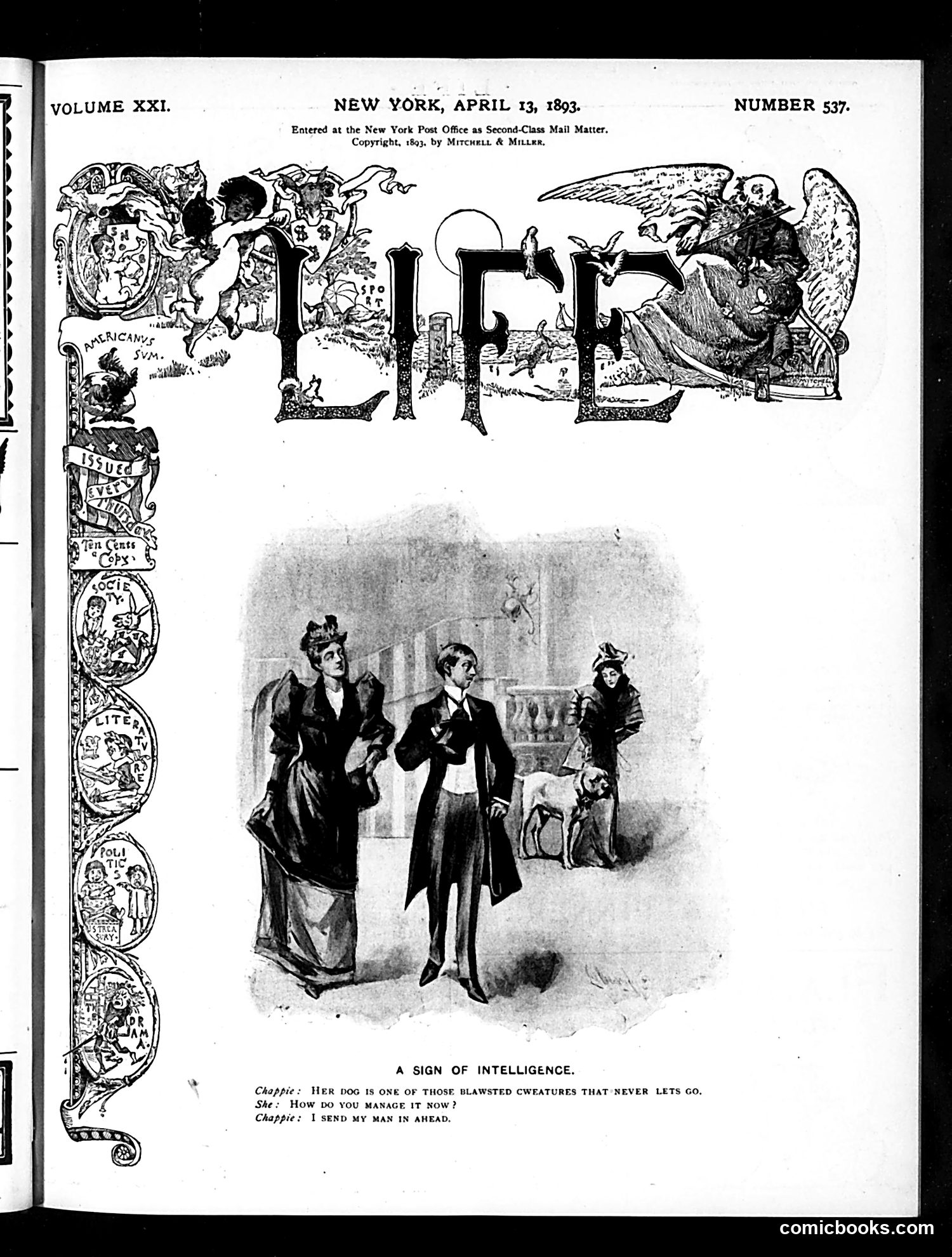
This cartoon satirizes a social interaction about dog ownership. The caption presents a dialogue: when asked how she manages a dog that "never lets go," a woman replies "I send my man in ahead." The joke relies on 1890s gender dynamics and class assumptions. It presents the woman as clever for using a male servant (or husband) as a buffer—sending him ahead to scout and manage the difficult dog, while she follows safely behind. The humor targets both the woman's pragmatism and the assumed hierarchy: she exploits her male companion's presence as a protective measure. The title "A Sign of Intelligence" implies her strategy demonstrates wit, though it simultaneously mocks the social conventions that made such workarounds necessary for women navigating public spaces.
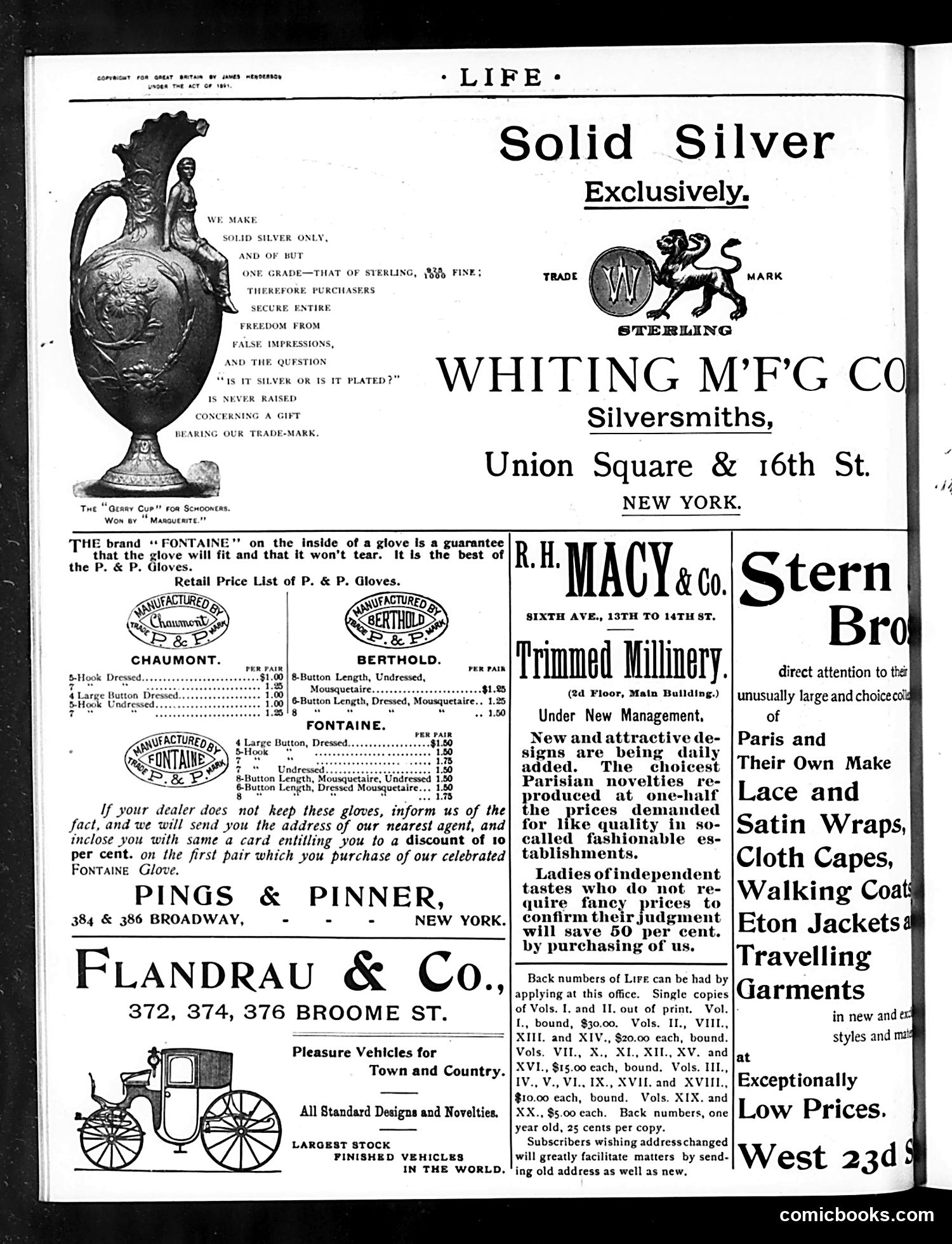
This page is primarily **advertising**, not political satire. It contains multiple commercial notices for late 19th-century New York businesses: - **Whiting M'FG Co** advertises solid silver flatware and hollowware for silversmiths - **P&P Gloves** sells branded gloves with guarantees - **R.H. Macy & Co** promotes trimmed millinery under new management - **Stern Bros** offers Paris-made lace, wraps, capes, and traveling garments - **Flandrau & Co** sells pleasure carriages and vehicles The only illustration is a decorative silver ewer (pitcher) at top left, labeled "The 'Giddy Cup' for Schooners," serving as product imagery for the Whiting silverware advertisement. There is **no political cartoon or satire** on this page—it's a commercial directory typical of Life magazine's revenue model during this era.
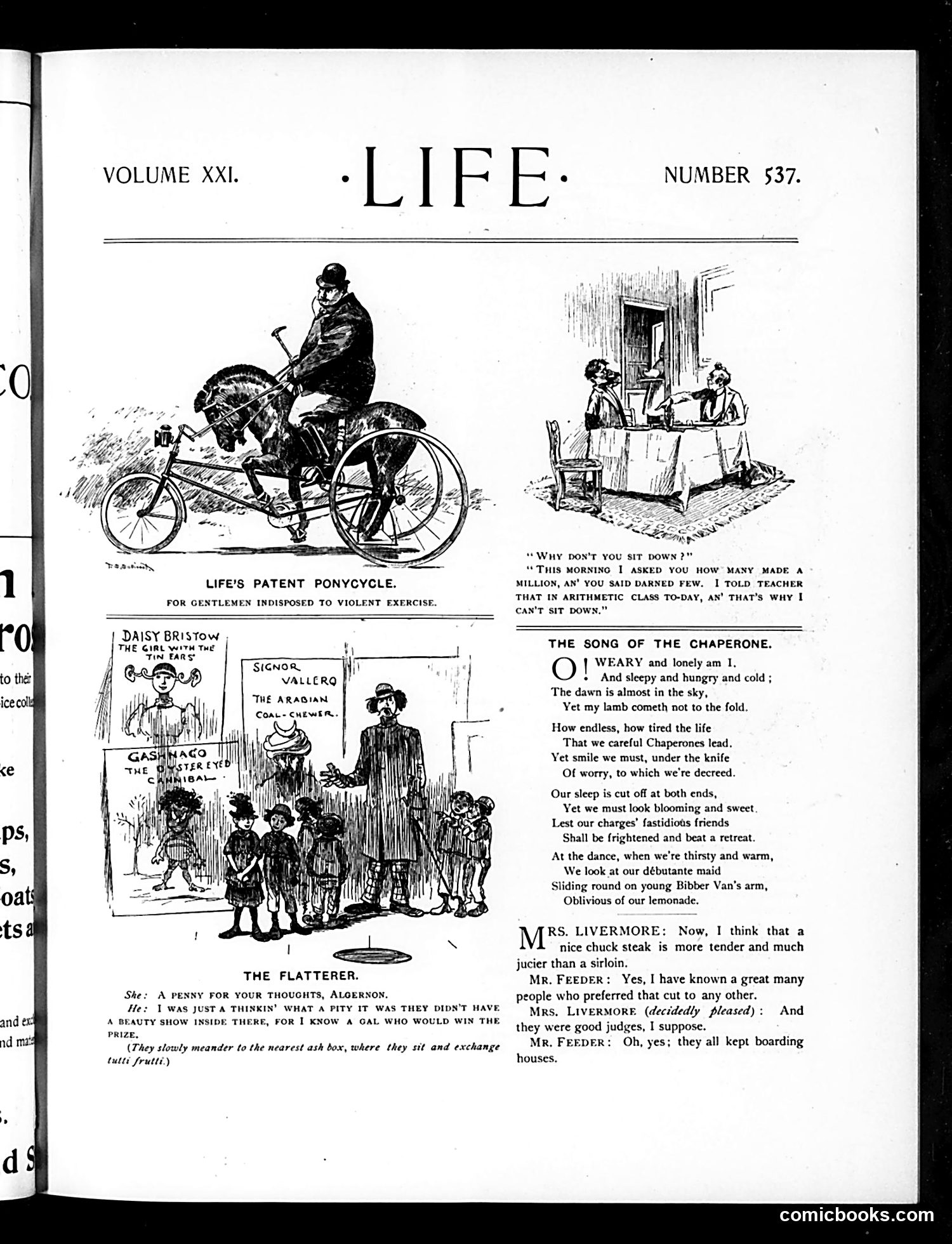
This page contains three satirical cartoons from an early 20th-century Life magazine: 1. **"Life's Patent Ponycycle"** mocks a ridiculous exercise contraption for sedentary gentlemen, satirizing Victorian-era fitness fads and overcomplicated solutions to laziness. 2. **"The Flatterer"** shows a street scene where a man compliments a woman ("A penny for your thoughts"), then admits he'd pay to see her in a beauty show—satirizing insincere flattery and objectification. 3. **Street vendor vignettes** (Daisy Bristow, Signor Vallero, Gashly) depict various street performers and salespeople, likely mocking urban working-class hustles and con artists. **"The Song of the Chaperone"** is a poem about the exhaustion of accompanying young women at social events—satirizing rigid Victorian courtship customs requiring constant supervision. The page ridicules period-specific social conventions and commercialism.
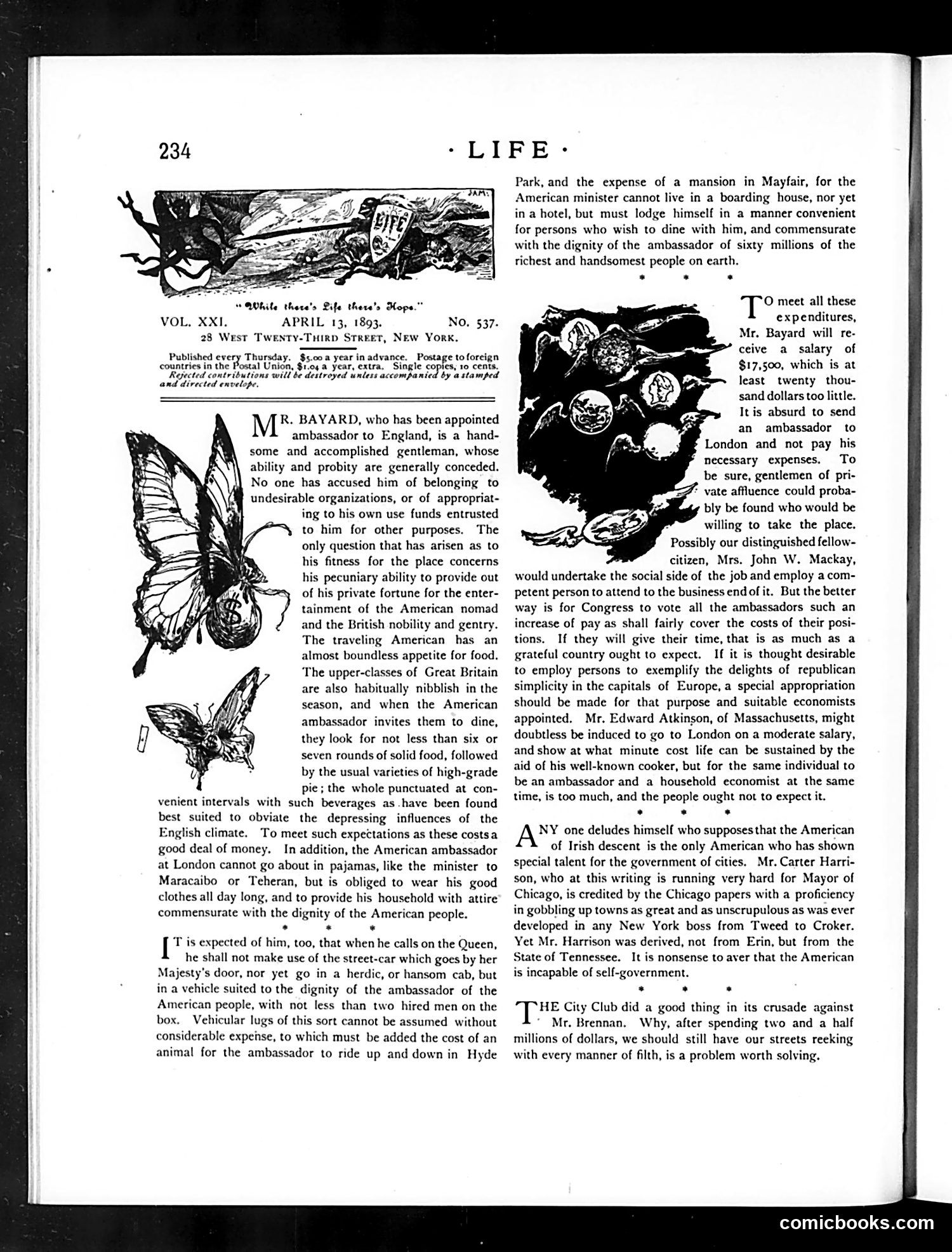
This page satirizes Thomas F. Bayard's appointment as U.S. ambassador to England. The text mocks the expense required to maintain diplomatic dignity—a $17,500 salary (barely adequate for London living) plus mansion costs in Mayfair. The accompanying illustrations are decorative insects/butterflies, not political caricatures. The satire targets the contradiction between America's republican ideals and the lavish lifestyle diplomacy demands. The article questions whether Americans truly must mimic British aristocratic extravagance. It suggests alternatives: perhaps hiring less wealthy diplomats, or having Congress vote salary increases rather than expecting wealthy men to subsidize their own positions. The piece critiques both diplomatic expense and the implicit assumption that only affluent gentlemen could serve as ambassadors.
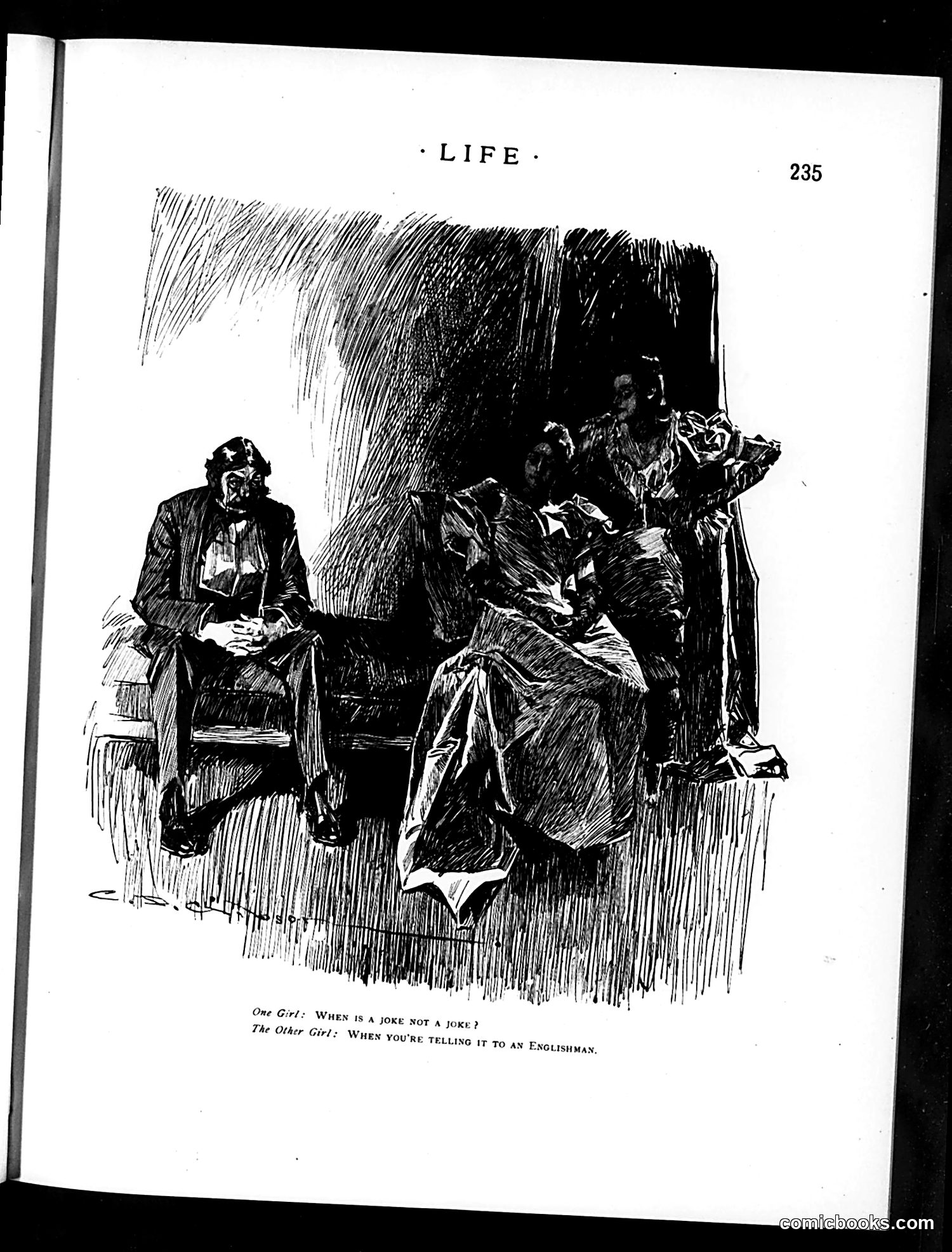
This page from *Life* magazine presents a single cartoon joke about cultural misunderstandings between Americans and the British. The cartoon shows two young women in conversation. One asks the other: "When is a joke not a joke?" The second responds: "When you're telling it to an Englishman." The humor relies on a common early-20th-century American stereotype—that English people, particularly Englishmen, lacked a sense of humor or didn't appreciate American-style wit and comedy. The joke suggests that explaining humor to an Englishman ruins it or makes it fall flat, implying British cultural stuffiness or inability to appreciate jokes. This reflects transatlantic cultural tensions and American attitudes toward British formality during the period.
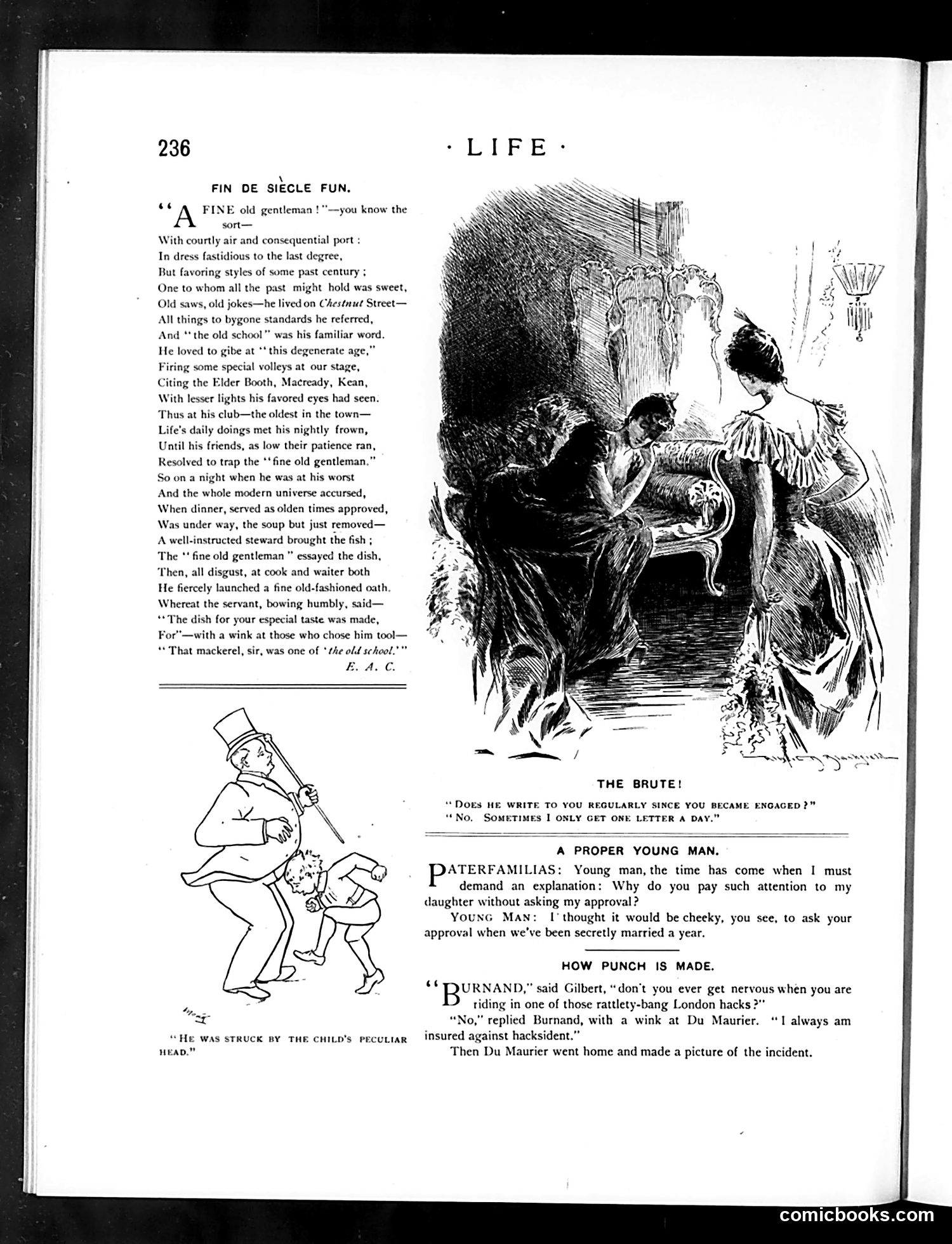
This page contains three distinct satirical pieces: 1. **"Fin de Siècle Fun"** (poem): A nostalgic critique of a gentleman clinging to outdated "old school" values and fashions while the modern world has moved on. The satire mocks his resistance to change and contemporary standards. 2. **"The Brute!"** (cartoon with dialogue): A domestic humor piece where a woman complains her fiancé writes infrequently—only one letter daily. The satire targets the absurdity of her complaint; she's actually receiving substantial correspondence, yet frames it as neglect. 3. **"A Proper Young Man"** and **"How Punch Is Made"**: Brief humorous dialogues about courtship propriety and London cab riding experiences, using light social satire typical of the era's humor magazine format.
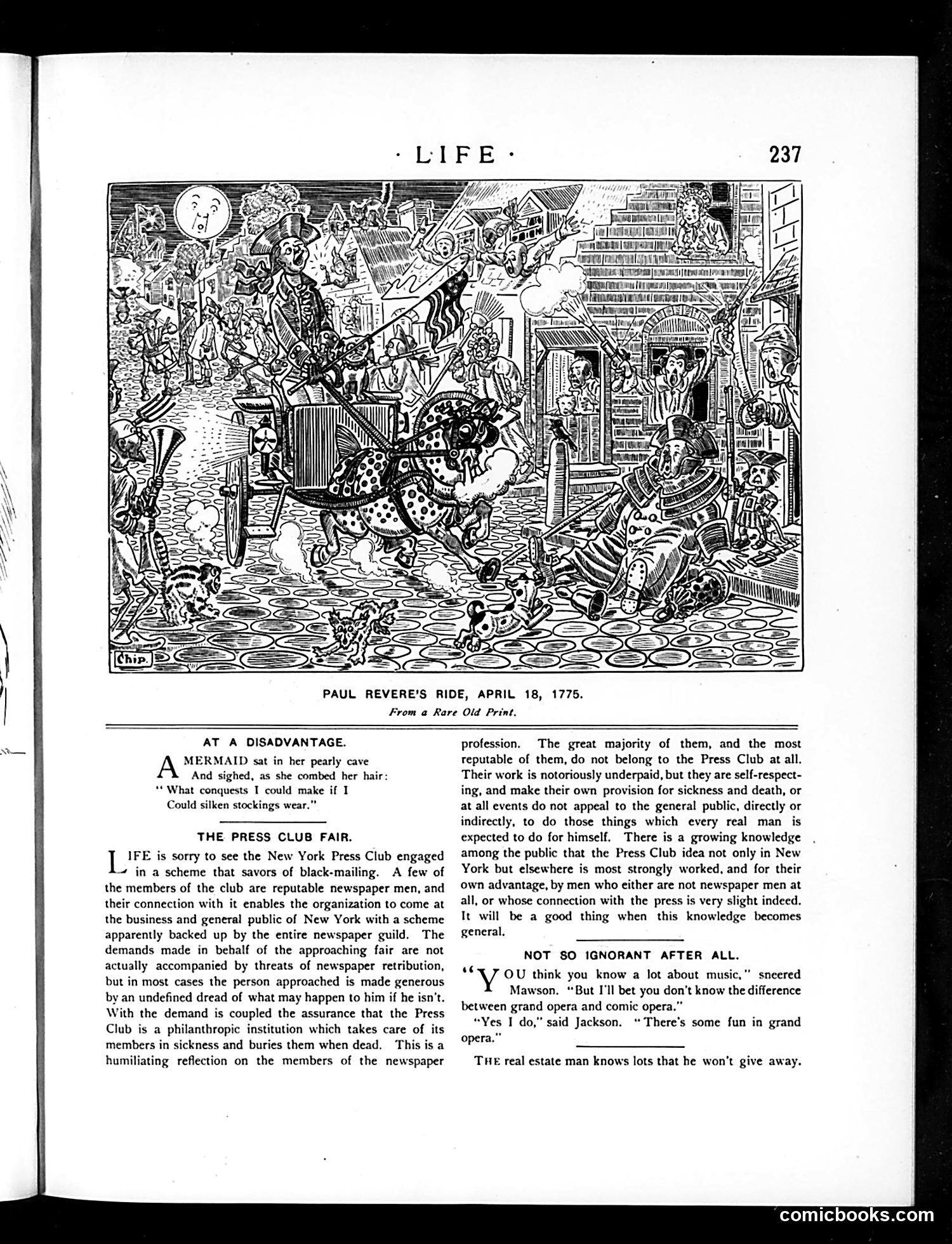
This historical engraving depicts **Paul Revere's famous midnight ride** warning colonists of British troop movements during the American Revolution. The chaotic street scene shows Revere on horseback amid crowds, buildings, and activity—capturing the urgency and confusion of that pivotal night. The text below discusses unrelated contemporary (1900s-era) satirical commentary about **the Press Club Fair** and newspaper industry practices. It criticizes the Press Club for allegedly engaging in "black-mailing" schemes and questions the ethics of newspaper organizations' demands on members. The juxtaposition appears coincidental—a historical illustration paired with modern social commentary, typical of *Life* magazine's mixed editorial format combining historical content with contemporary satire.
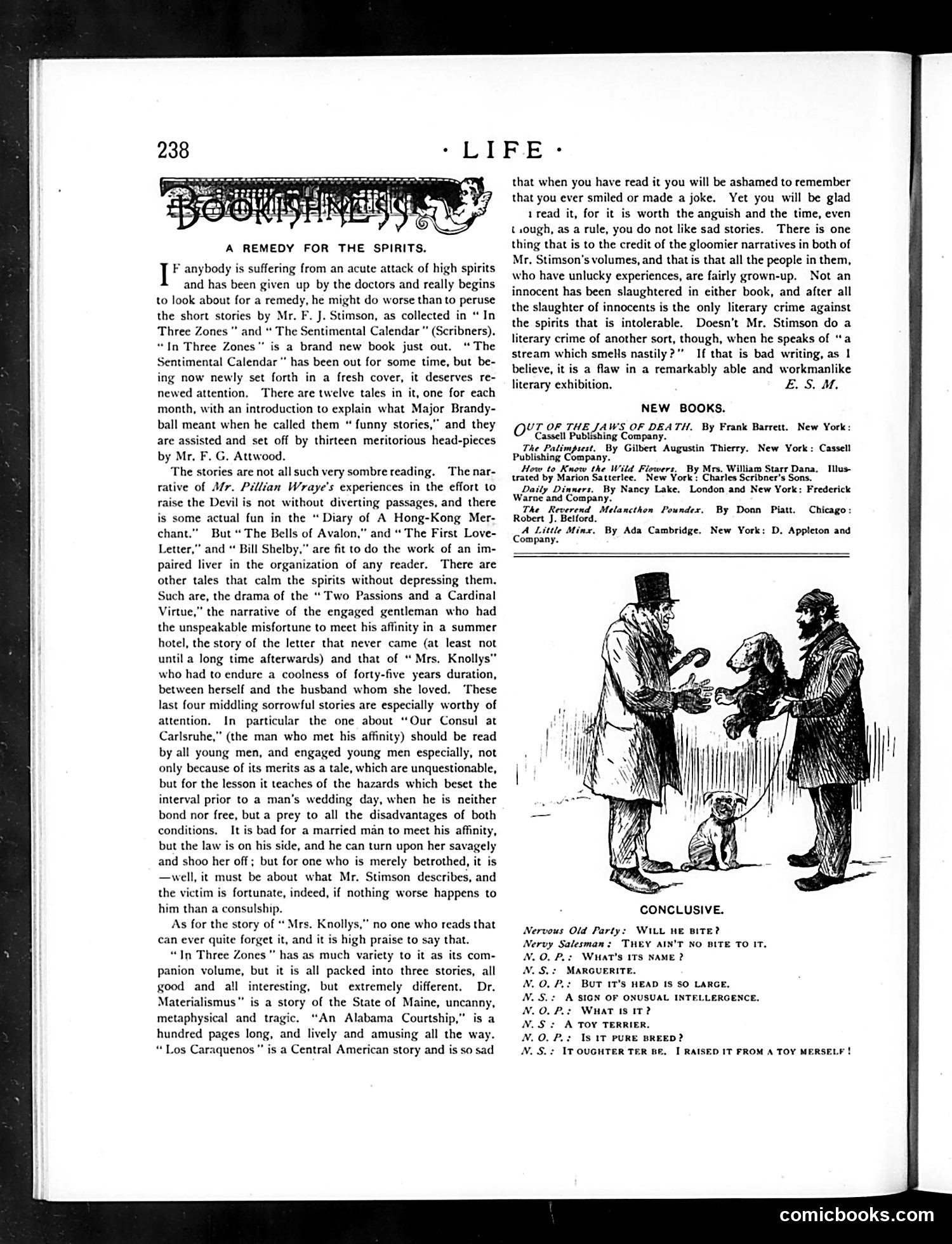
The page contains a book review section titled "BOOKISHNESS" with an accompanying cartoon labeled "CONCLUSIVE." The cartoon depicts a humorous dialogue between what appears to be an elderly gentleman and woman arguing over a small dog's breed. The old party insists the dog will bite, while the Nelly Salesman counters that it won't, claiming it's a toy terrier. The exchange escalates through absurd claims about its size, intelligence, and breeding. The satire mocks pointless domestic arguments and the tendency of people to make confident assertions about subjects they know little about. The "conclusive" ending—where the woman reveals she raised it herself—undercuts the man's expertise entirely, suggesting that personal conviction often trumps actual knowledge in everyday disputes.
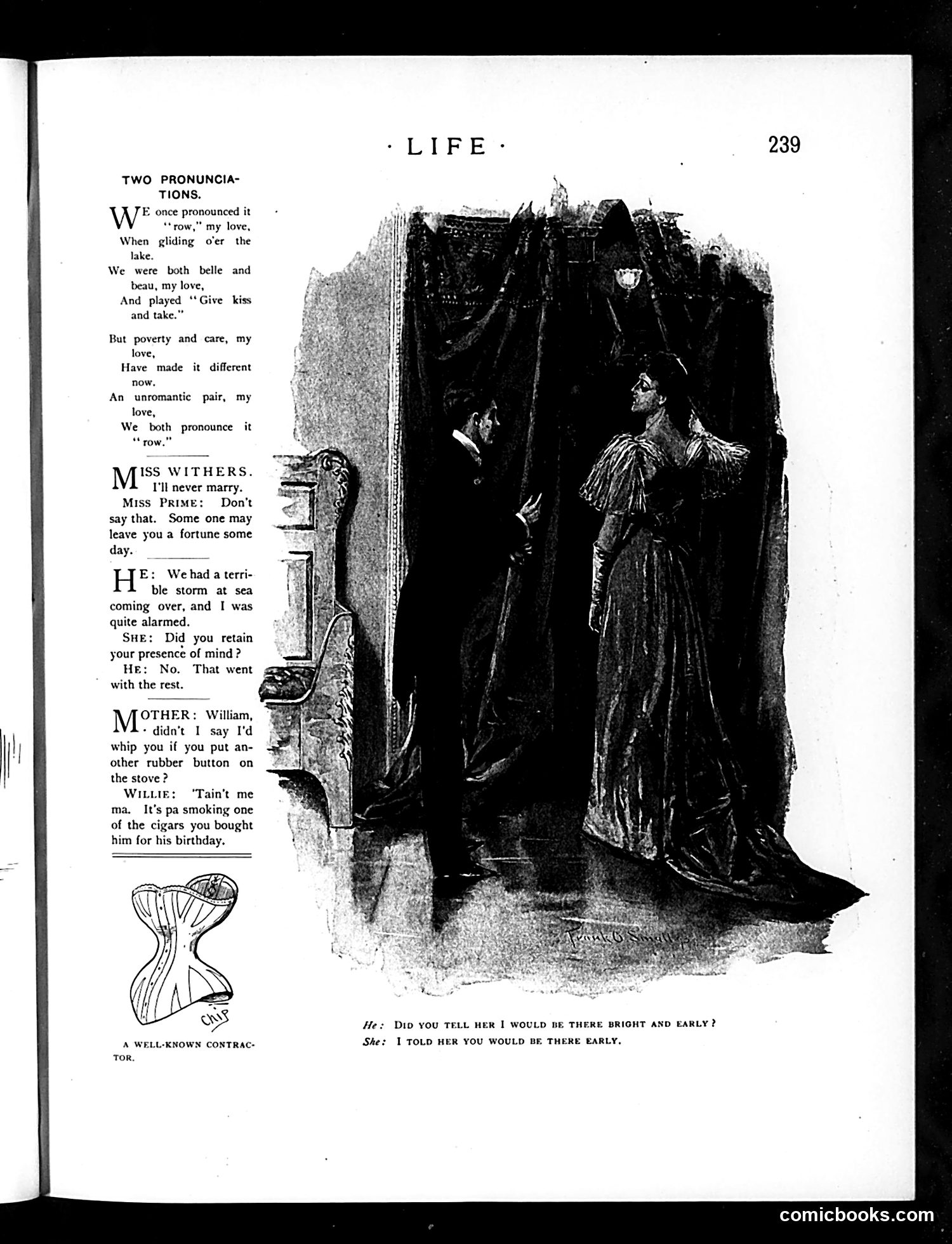
This page contains humorous dialogue snippets and a sketch illustration. The main content includes: **"Two Pronunciations"** - A comedic piece about how a couple pronounces "row" differently based on their changed circumstances (from romantic boat rides to poverty and hardship). **Social commentary dialogues** featuring characters named Miss Withers, Miss Prime, Mother, Willie, and others discussing everyday matters—a storm at sea, marriage prospects, and a cigar purchase. **The illustration** shows two figures in what appears to be a doorway or interior space, with dialogue below: "Did you tell her I would be there bright and early?" / "I told her you would be there early." The page exemplifies *Life* magazine's style: light, domestic humor focusing on class distinctions, courtship conventions, and the gap between expectations and reality in early 20th-century American life. The specific historical references are unclear without additional context.
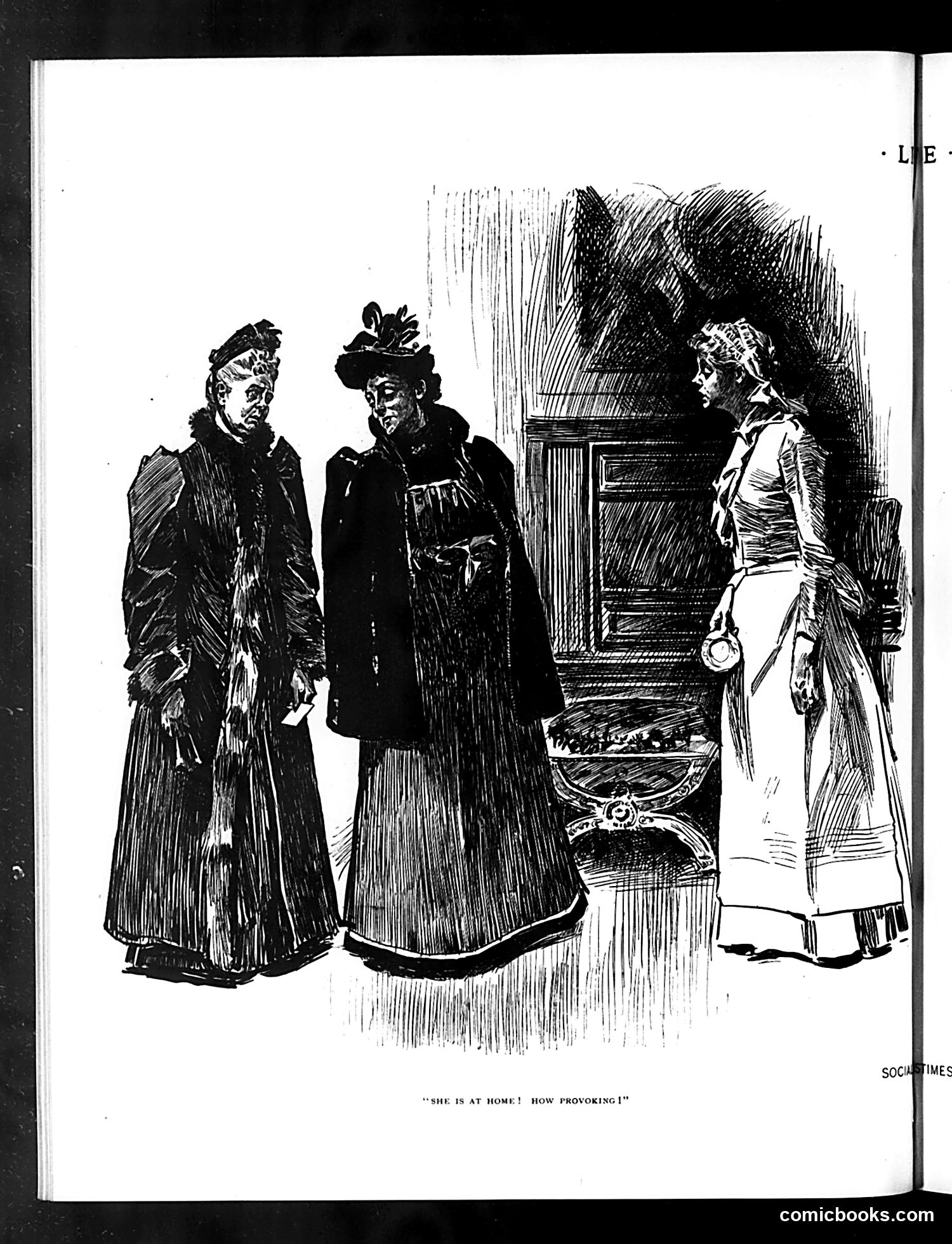
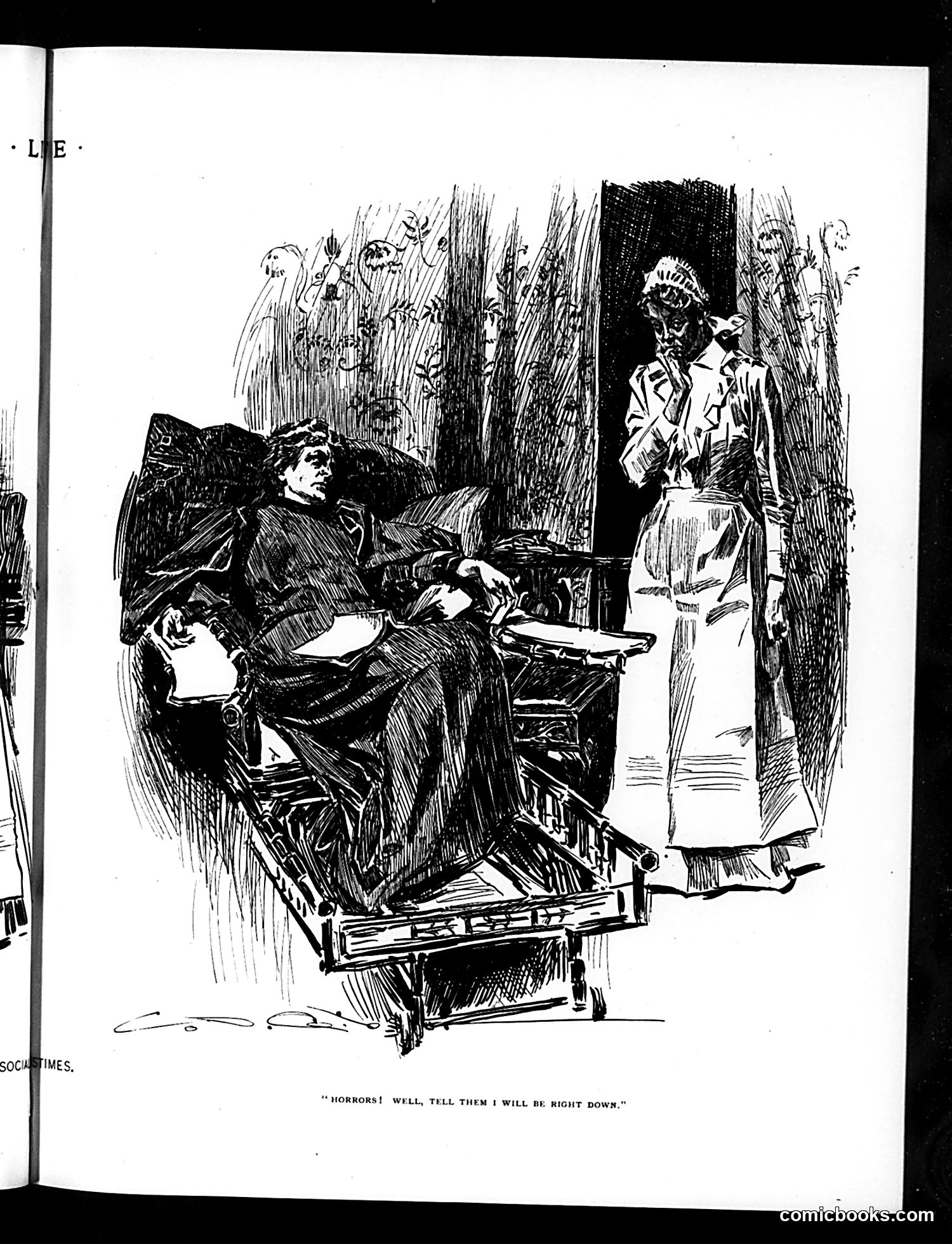
This is a single-panel satirical cartoon showing a man reclining in a chair while a woman stands nearby. The caption reads: "HORRORS! WELL, TELL THEM I WILL BE RIGHT DOWN." The cartoon appears to satirize a domestic or social situation involving procrastination or reluctance to meet visitors. The reclining man's exclamation "Horrors!" suggests he's been interrupted or summoned, and his promise to come "right down" implies he's making excuses or delaying. Without additional context about the specific publication date or surrounding articles, the exact social commentary remains unclear. However, the cartoon likely mocks either male laziness, social obligations, or perhaps class-based pretension about receiving guests—themes common to Life magazine's satirical humor of the early 20th century.
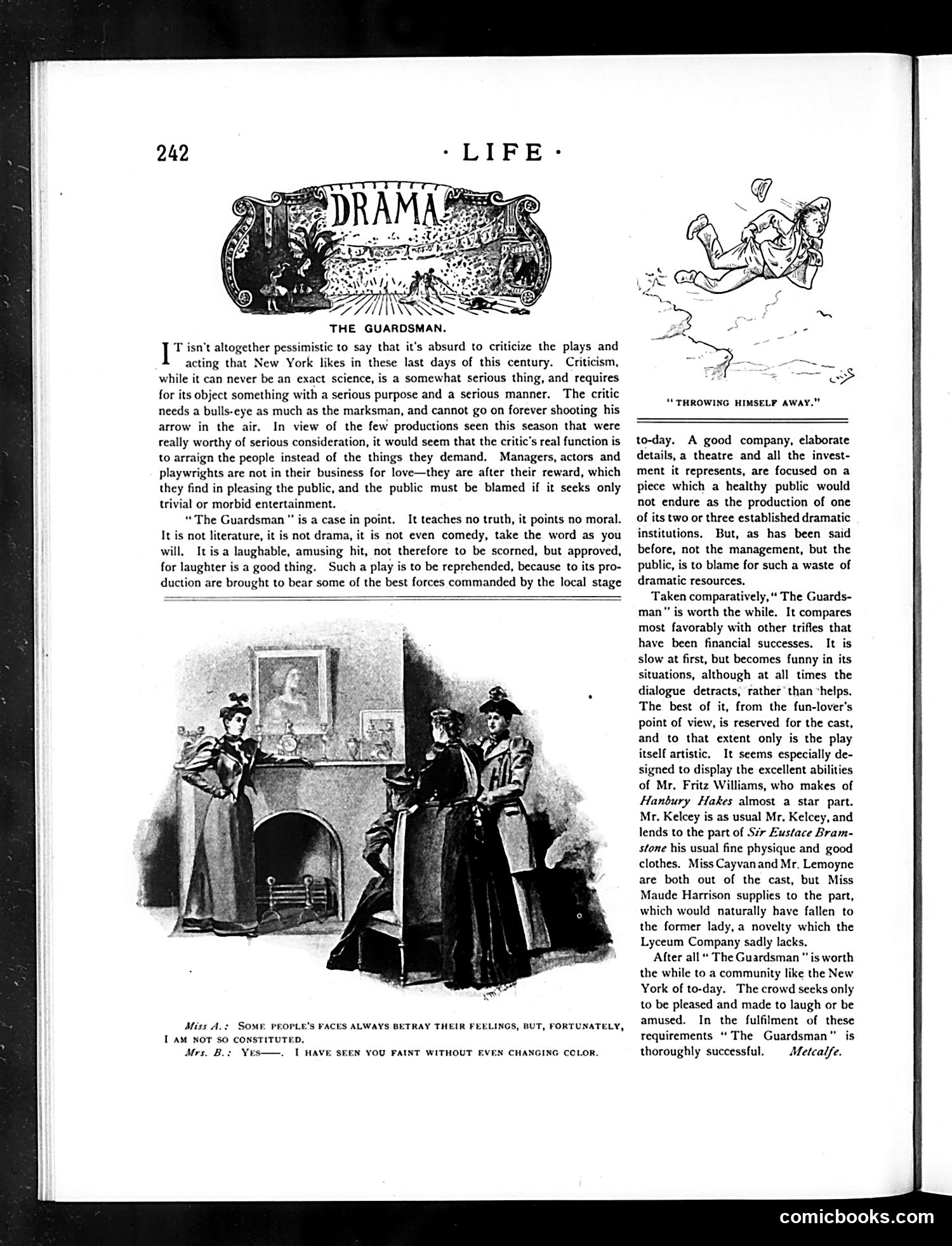
This page reviews a Broadway play called *The Guardsman*. The main illustration shows a scene from the production featuring period-dressed characters in conversation. The critic (signed "Metcalfe") argues that *The Guardsman* is a trivial but entertaining comedy—not serious drama—and that audiences deserve blame for demanding such lightweight fare rather than meaningful theatrical work. The play teaches no moral lesson, but the critic approves of it as "laughable" entertainment. The secondary cartoon depicts two socialite women ("Miss A" and "Mrs. B") discussing how faces reveal feelings. Mrs. B boasts she maintains a blank expression even when fainting—a joke about Victorian-era emotional restraint and aristocratic composure. The review praises the cast's performances, particularly Fritz Williams, while lamenting that substantial resources are wasted on frivolous entertainment. The overall tone is gently satirical toward both audiences who prefer entertainment over substance and the theatrical industry that caters to them.
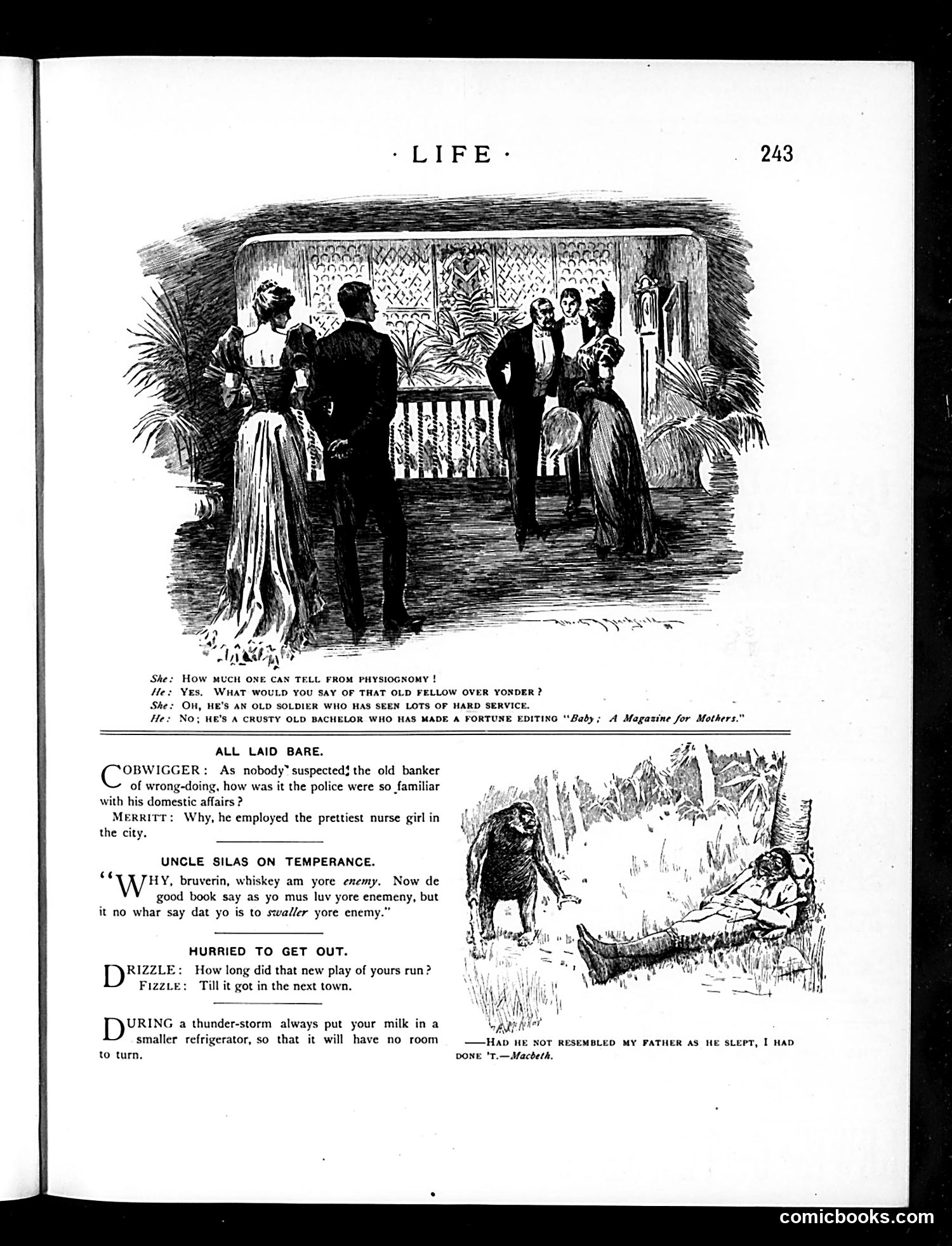
This page contains several short satirical jokes typical of early 20th-century Life magazine: **Top cartoon**: Mocks physiognomy (judging character by appearance). A woman guesses an older man is a decorated soldier, but he's actually a grumpy bachelor who got rich editing "Baby: A Magazine for Mothers"—humor lies in the contrast between his stern appearance and his unlikely, domestically-focused business. **"All Laid Bare"**: A cynical joke about a banker suspected of wrongdoing. Police knew his domestic affairs because he employed "the prettiest nurse girl in the city"—implying scandal or the nurse as an informant. **"Uncle Silas on Temperance"**: Uses dialect humor (likely a rural character) to joke about drinking. He argues whiskey is an enemy, and scripture says love your enemies, so drinking is biblically justified—absurdist reasoning for drinking. **Remaining items**: Brief one-liners about theater and practical advice, typical filler content for the era. The page satirizes social pretense, corruption, and moral hypocrisy common to early 20th-century satirical magazines.
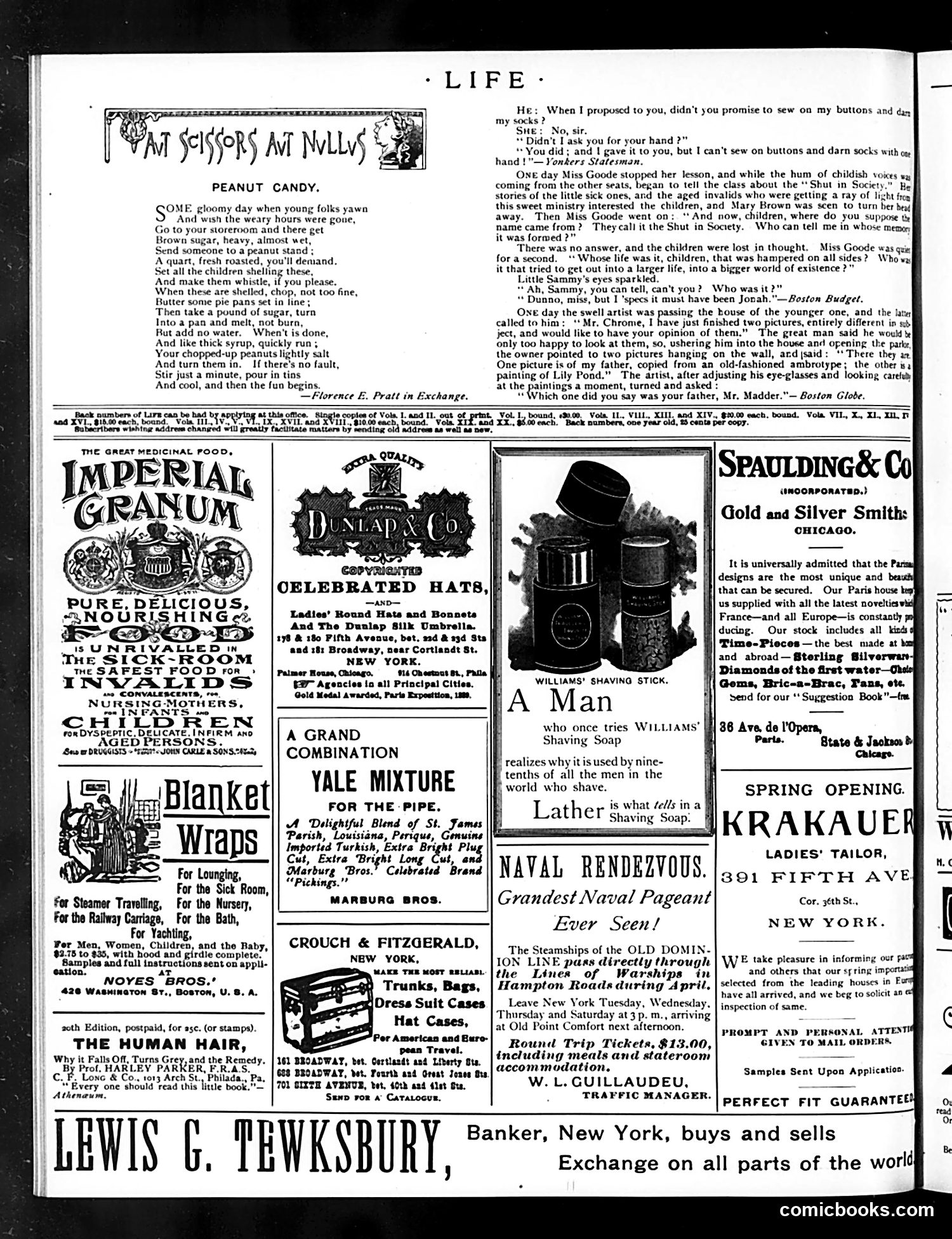
This page from *Life* magazine contains three short humorous anecdotes rather than a single cartoon: 1. **"Peanut Candy"**: A recipe poem by Florence E. Pratt—purely practical content, not satire. 2. **"The Shut in Society"**: A sentimental anecdote about teacher Miss Goode inspiring students by discussing people confined by illness or age. Young Sammy humorously answers that "Jonah" founded it (referencing the biblical figure trapped in a whale). The joke plays on children's literal-mindedness. 3. **"The Art Critic"**: An artist cannot distinguish between an old photograph (ambrotype) of someone's father and a painting of a lily pond—implying the artist lacks genuine critical judgment or that the painting is poorly executed. The humor derives from the artist's embarrassing confusion. The page is primarily **advertising**—Imperial Granum cereal, Blanket Wraps, Dunlap Hats, and other period products dominate the layout. The brief humorous pieces serve as editorial content between ads.
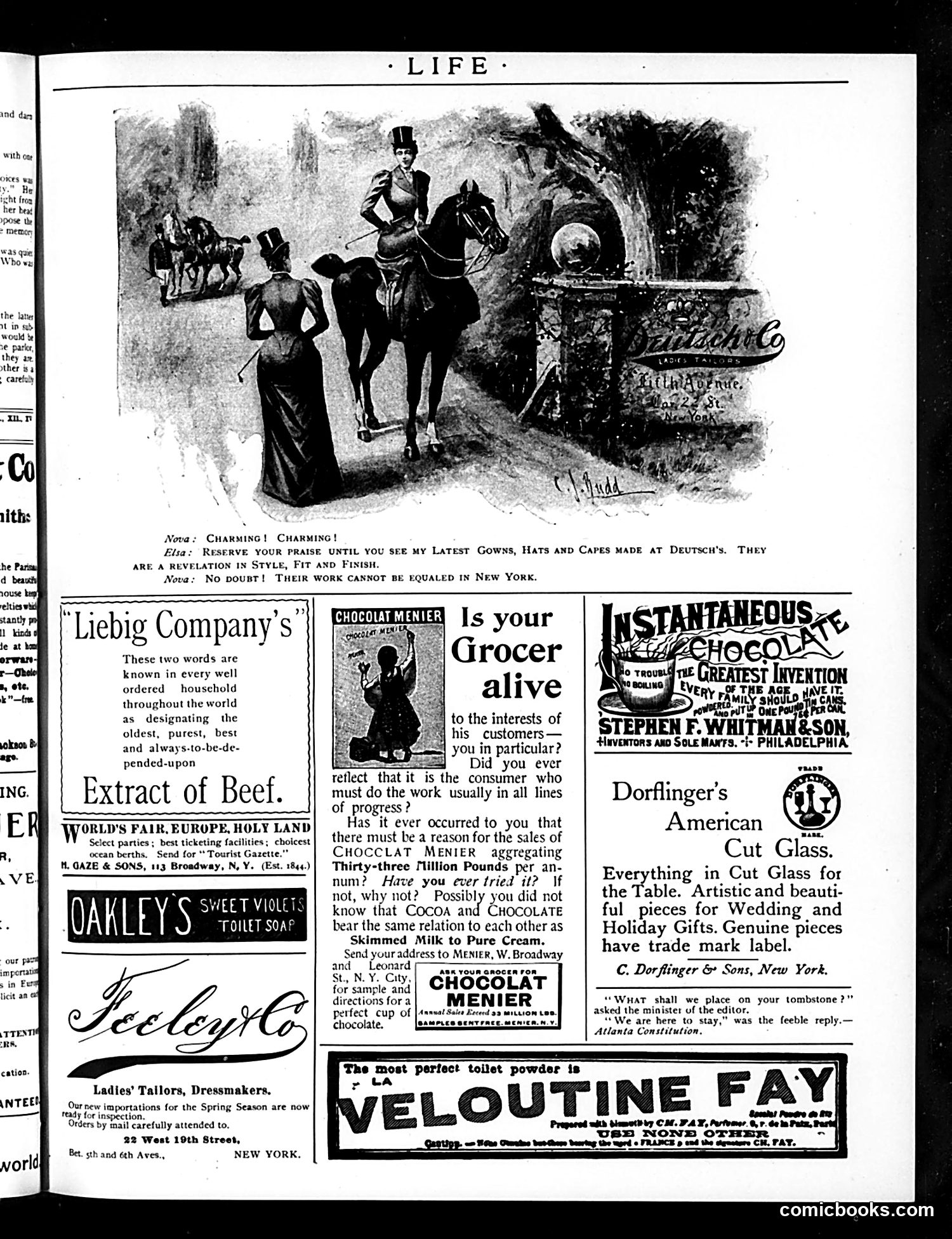
The top cartoon depicts two fashionable women discussing clothing. "Nova" compliments "Elsa" on her gowns, hats, and capes from Deutsch's, calling them "a revelation in style." This appears to be **fashion advertising disguised as editorial content**—a common practice in early Life magazines. The dialogue creates the illusion of genuine society gossip endorsing a clothing manufacturer, making the advertisement seem like authentic high-society commentary rather than paid promotion. The page is primarily **advertising**, featuring various consumer goods: Liebig Company's beef extract, travel services, soap, tailored clothing, Menier chocolate, cut glass, and toilet powder. These ads reflect early 1900s luxury consumer culture targeting affluent readers. The small joke at bottom—a minister asking an editor what epitaph he wants, receiving "We are here to stay"—is unrelated satire about journalistic permanence. The overall page represents Life's function as both satirical commentary and premium advertising vehicle for wealthy consumers.
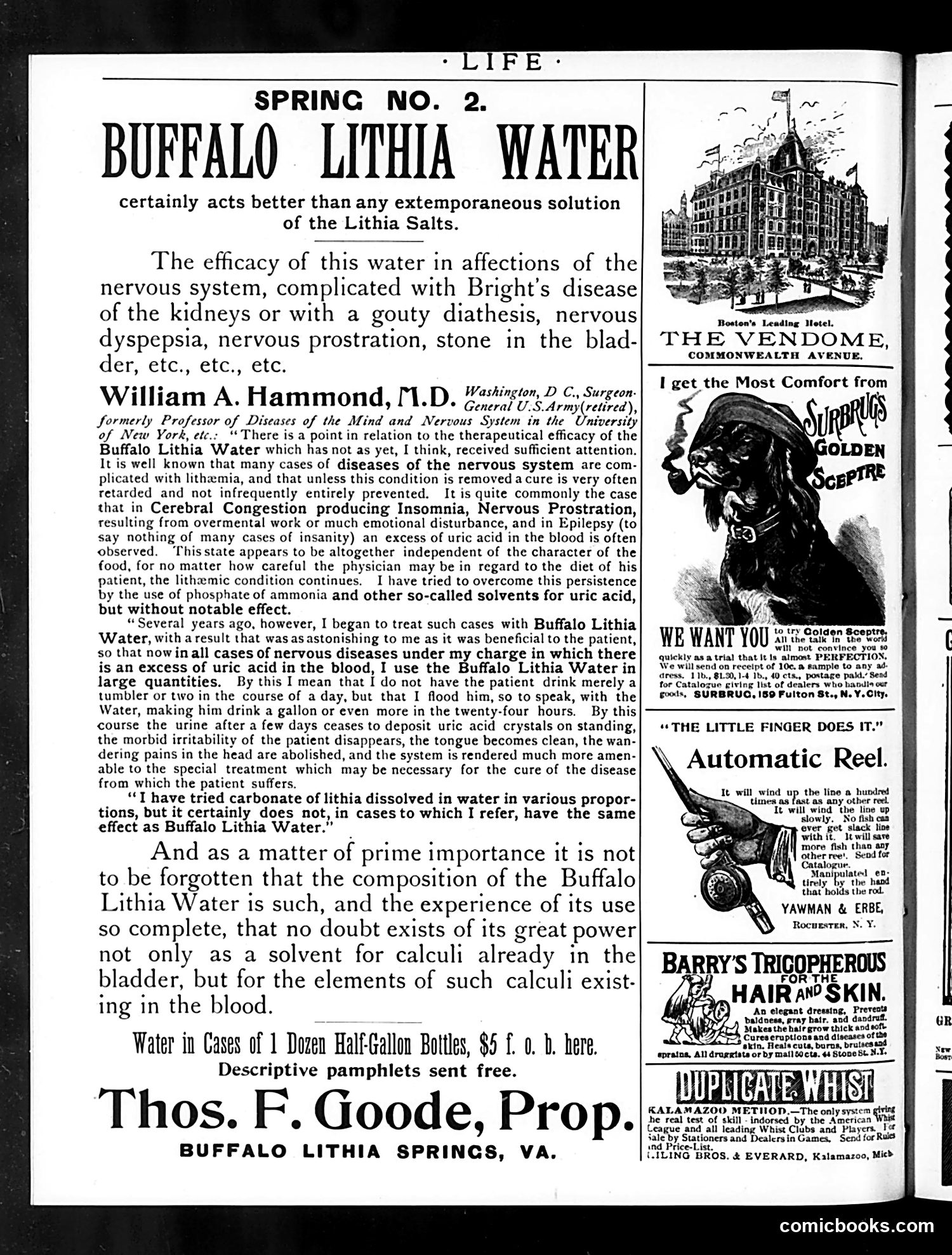
This is primarily a **patent medicine advertisement** rather than a political cartoon. The page promotes Buffalo Lithia Water as a cure for nervous system disorders, kidney disease, and gout—common ailments of the era. The advertisement features a testimonial from **William A. Hammond**, a real Civil War-era physician and neurologist, endorsing the water's efficacy. He describes treating patients by having them consume large quantities daily, claiming it dissolves uric acid crystals and cures conditions like insomnia, nervous prostration, and epilepsy. The surrounding smaller ads (Golden Scepter, Automatic Reel, Barry's Tricopherous) are typical late-19th century patent medicine/product promotions common in Life magazine. This reflects the era's widespread faith in "patent medicines"—largely unregulated tonics marketed with medical authority but containing dubious ingredients. Modern readers would recognize this as quackery, though it appeared credible then.
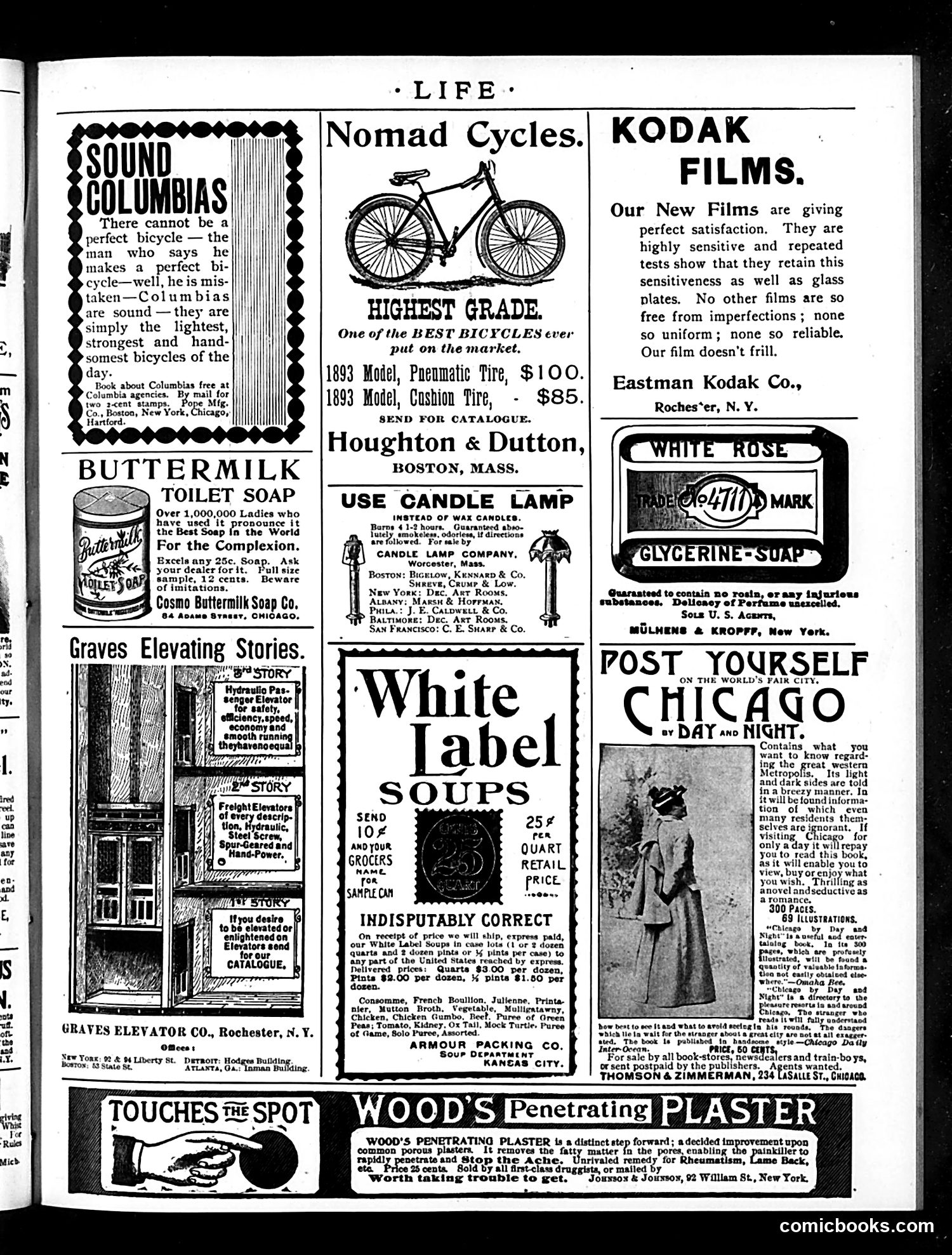
This is primarily an **advertising page** from Life magazine, not a political cartoon. The page contains product advertisements typical of the 1890s era, including bicycles (Columbia and Nomad brands), soap, elevators, film, and soup. The only visual element approaching satire is the "Graves Elevating Stories" advertisement on the left, which uses a clever pun: it shows an elevator shaft with stacked "story" panels, playing on the double meaning of "stories" (narratives and building levels). The copy promises these are "entertaining" stories that will help "elevate" readers—a mild joke combining the elevator product with literary amusement. The rest of the page reflects late-Victorian consumer culture: early photography (Kodak film), bicycling as a leisure activity, and patent medicines. Most notably absent is any political commentary—this appears to be a straightforward commercial publication rather than satirical content.
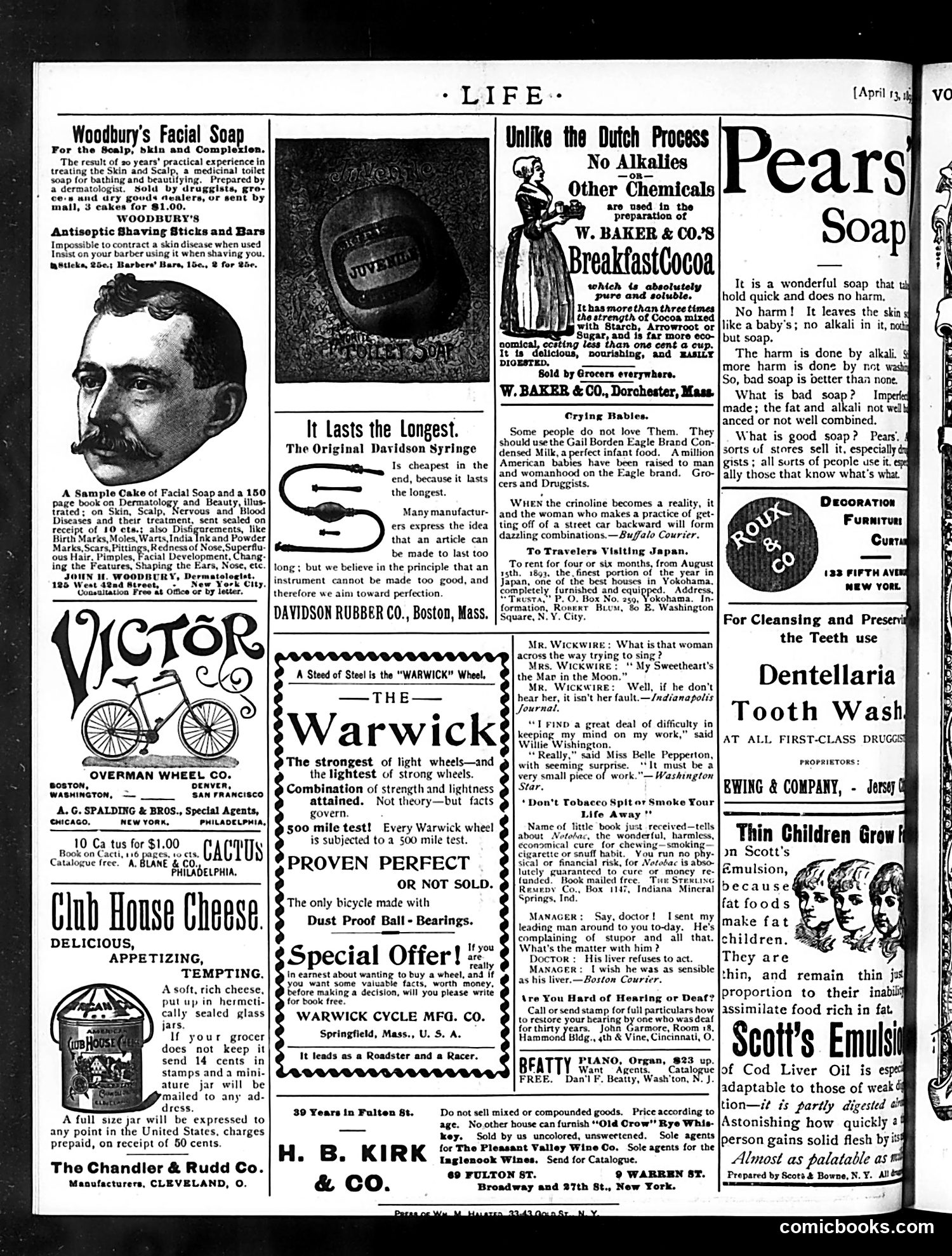
This is primarily an **advertising page** from Life magazine (dated April 13, based on the visible header), featuring vintage product advertisements rather than political cartoons or satire. The main illustrated elements are: - A Victorian-era man's face promoting **Woodbury's Facial Soap** - A bicycle branded **"Victor"** by Overman Wheel Co. - Various product advertisements (cheese, rubber syringes, cocoa, breakfast items, bicycles) **Context for modern readers:** This appears to be late 1890s advertising reflecting Gilded Age consumer culture. The emphasis on skincare ("treating the Skin and Scalp"), bicycles (newly popular), and prepared foods (condensed milk for babies) reveals contemporary concerns. One humorous note: an advertisement addresses "Crying Babies," suggesting modern parenting anxieties existed then too. The page demonstrates Life's business model—the magazine sustained itself largely through advertising revenue rather than editorial content.