
Life, 1893-04-13 · page 7 of 18
Life — April 13, 1893 — page 7: what you’re looking at
What you’re looking at
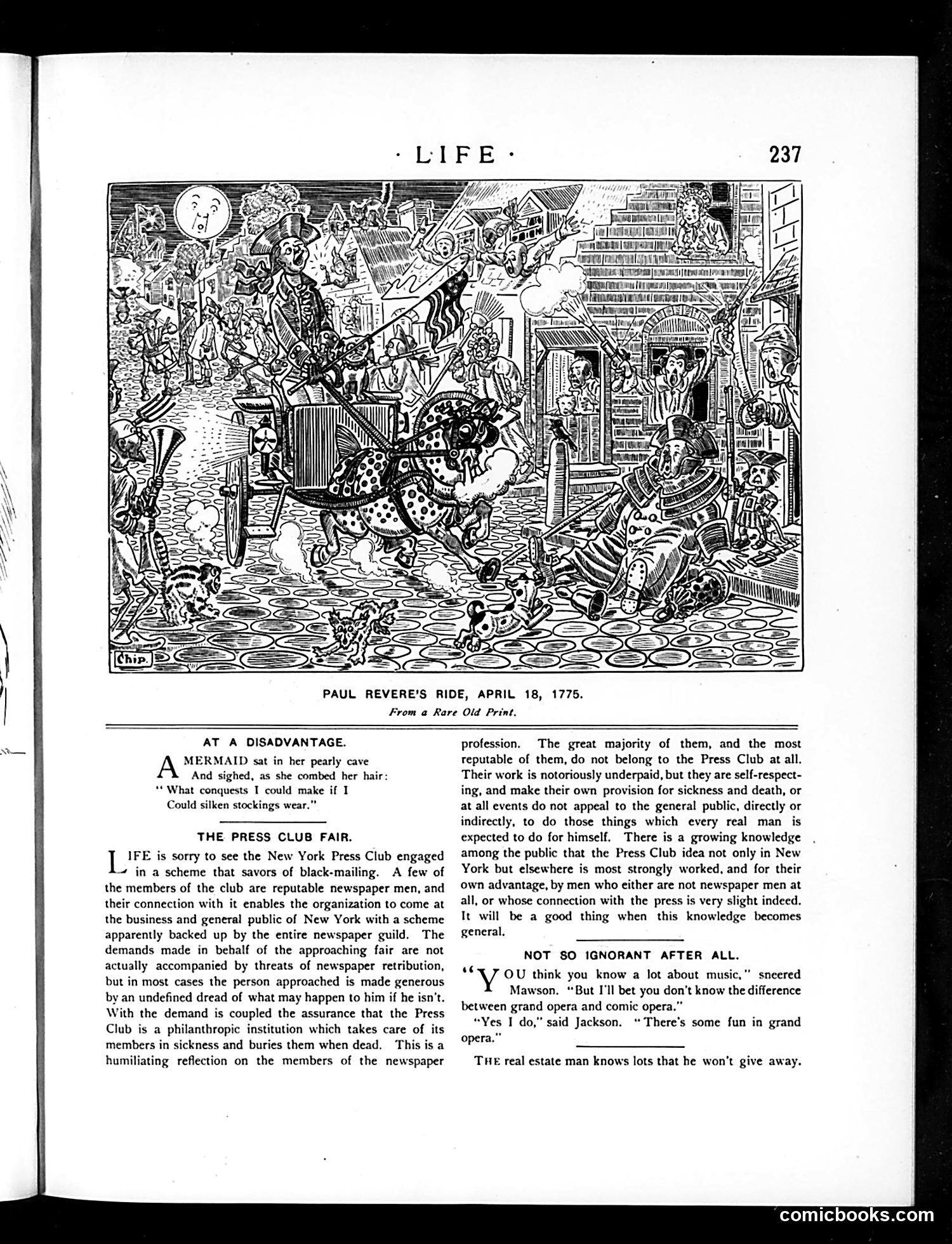
This historical engraving depicts **Paul Revere's famous midnight ride** warning colonists of British troop movements during the American Revolution. The chaotic street scene shows Revere on horseback amid crowds, buildings, and activity—capturing the urgency and confusion of that pivotal night. The text below discusses unrelated contemporary (1900s-era) satirical commentary about **the Press Club Fair** and newspaper industry practices. It criticizes the Press Club for allegedly engaging in "black-mailing" schemes and questions the ethics of newspaper organizations' demands on members. The juxtaposition appears coincidental—a historical illustration paired with modern social commentary, typical of *Life* magazine's mixed editorial format combining historical content with contemporary satire.
📄 Transcribed text from this page (OCR, searchable)
Machine-transcribed from the original scan — historical spelling and the odd misread are preserved.
ae BS i 7 jena mt ij rN MANTA iia “a r so MPA es Hp eR OR, AGS or > =IUIV 6) ER Pomme NEE 7S aie WIN ver PAUL REVERE’S RIDE, APRIL 18, 1775. From a@ Rare Old Print, AT A DISADVANTAGE. MERMAID sat in her pearly cave And sighed, as she combed her hair: “* What conquests I could make if I Could silken stockings wear.” THE PRESS CLUB FAIR. I IFE is sorry to see the New York Press Club engaged — in a scheme that savors of black-mailing. A few of the members of the club are reputable newspaper men, and their connection with it enables the organization to come at the business and general public of New York with a scheme apparently backed up by the entire newspaper guild. The demands made in behalf of the approaching fair are not actually accompanied by threats of newspaper retribution, but in most cases the person approached is made generous by an undefined dread of what may happen to him if he isn’t. With the demand is coupled the assurance that the Press Club is a philanthropic institution which takes care of its members in sickness and buries them when dead. This is a humiliating reflection on the members of the newspaper profession. The great majority of them, and the most reputable of them, do not belong to the Press Club at all. Their work is notoriously underpaid, but they are self-respect- ing, and make their own provision for sickness and death, or at all events do not appeal to the general public, directly or indirectly, to do those things which every real man is expected to do for himself. There is a growing knowledge among the public that the Press Club idea not only in New York but elsewhere is most strongly worked, and for their own advantage, by men who either are not newspaper men at all, or whose connection with the press is very slight indeed. It will be a good thing when this knowledge becomes general, NOT SO IGNORANT AFTER ALL. OU think you know a lot about music," sneered Mawson. “But I'll bet you don’t know the difference between grand opera and comic opera.” “Yes I do,” said Jackson. “ There's some fun in grand opera.” THE real estate man knows lots that he won't give away. “c comicbooks.com