
Life, 1893-04-13 · page 4 of 18
Life — April 13, 1893 — page 4: what you’re looking at
What you’re looking at
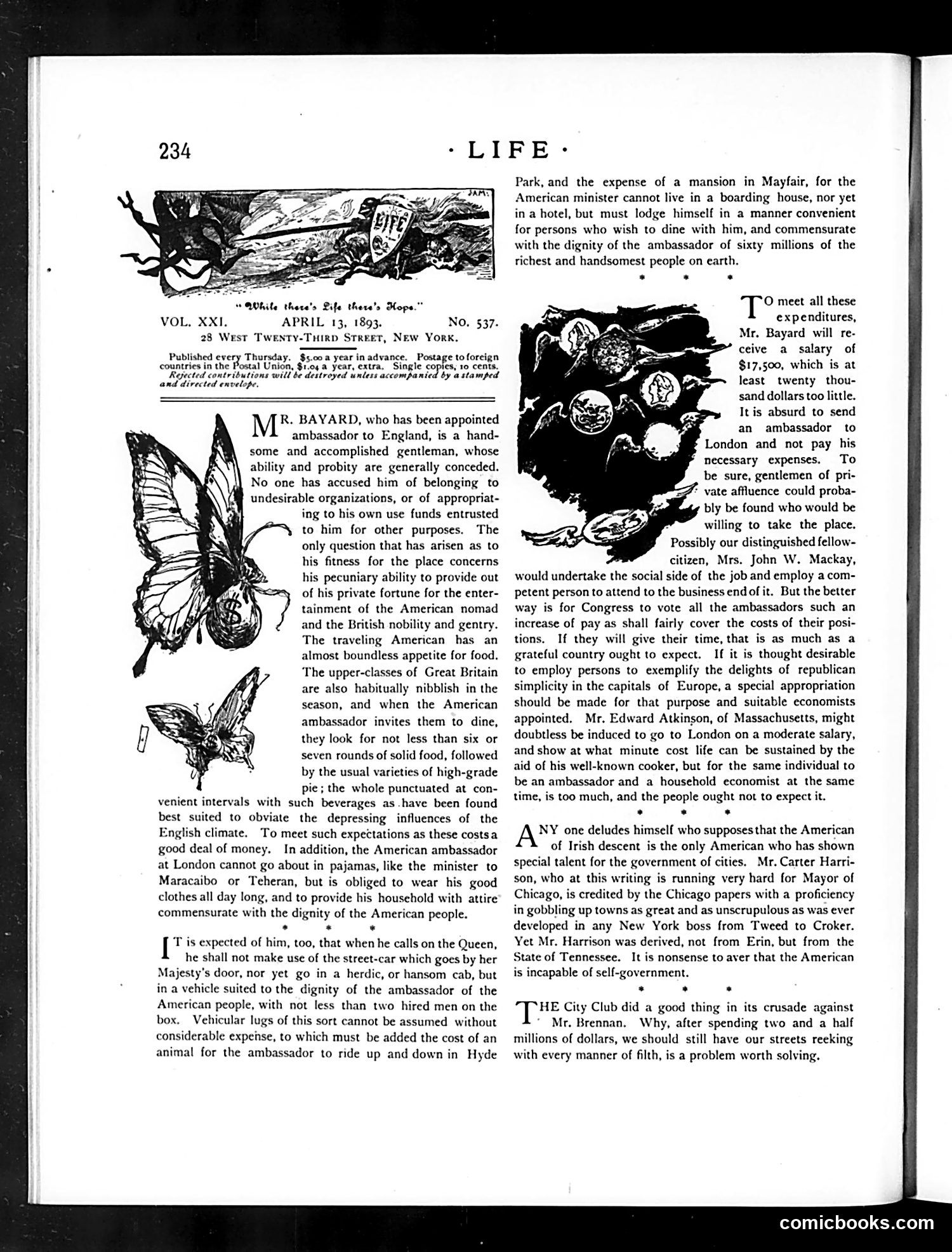
This page satirizes Thomas F. Bayard's appointment as U.S. ambassador to England. The text mocks the expense required to maintain diplomatic dignity—a $17,500 salary (barely adequate for London living) plus mansion costs in Mayfair. The accompanying illustrations are decorative insects/butterflies, not political caricatures. The satire targets the contradiction between America's republican ideals and the lavish lifestyle diplomacy demands. The article questions whether Americans truly must mimic British aristocratic extravagance. It suggests alternatives: perhaps hiring less wealthy diplomats, or having Congress vote salary increases rather than expecting wealthy men to subsidize their own positions. The piece critiques both diplomatic expense and the implicit assumption that only affluent gentlemen could serve as ambassadors.
📄 Transcribed text from this page (OCR, searchable)
Machine-transcribed from the original scan — historical spelling and the odd misread are preserved.
- LIFE: “White there's Life there's Hope.” APRIL 13, 1893. NO. 537- Street, NEw York. VOL. XXI. 28 West Twenty-THirp Published every Thursday. $5.00 a year in advance. Postage to foreign countries in the Postal Union, $1.04 a year, extra, Single copies, 10 cents, Aggected contributions will be destroyed unless accompanied by astamped and directed envelope, R. BAYARD, who has been appointed ambassador to England, is a hand- some and accomplished gentleman, whose ability and probity are generally conceded. No one has accused him of belonging to undesirable organizations, or of appropriat- ing to his own use funds entrusted to him for other purposes. The only question that has arisen as to his fitness for the place concerns his pecuniary ability to provide out of his private fortune for the enter- tainment of the American nomad and the British nobility and gentry. The traveling American has an almost boundless appetite for food. The upper-classes of Great Britain are also habitually nibblish in the season, and when the American ambassador invites them to dine, they look for not less than six or seven rounds of solid food, followed by the usual varieties of high-grade pie; the whole punctuated at con- venient intervals with such beverages as have been found best suited to obviate the depressing influences of the English climate. To meet such expectations as these costsa good deal of money. In addition, the American ambassador at London cannot go about in pajamas, like the minister to Maracaibo or Teheran, but is obliged to wear his good clothes all day long, and to provide his household with attire commensurate with the dignity of the American people. . * * T is expected of him, too, that when he calls on the Queen, he shall not make use of the street-car which goes by her Majesty's door, nor yet go in a herdic, or hansom cab, but in a vehicle suited to the dignity of the ambassador of the American people, with not less than two hired men on the box. Vehicular lugs of this sort cannot be assumed without considerable expense, to which must be added the cost of an animal for the ambassador to ride up and down in Hyde Park, and the expense of a mansion in Mayfair, for the American minister cannot live in a boarding house, nor yet in a hotel, but must lodge himself in a manner convenient for persons who wish to dine with him, and commensurate with the dignity of the ambassador of sixty millions of the richest and handsomest people on earth. * ‘O meet all these expenditures, Mr. Bayard will re- ceive a salary of $17,500, which is at least twenty thou- sand dollars too little. It is absurd to send an ambassador to London and not pay his y necessary expenses. To be sure, gentlemen of pri- f vate affluence could proba- bly be found who would be P willing to take the place. Possibly our distinguished fellow- citizen, Mrs. John W. Mackay, would undertake the social side of the job and employ a com- petent person to attend to the business endof it. But the better way is for Congress to vote all the ambassadors such an increase of pay as shall fairly cover the costs of their posi- tions. If they will give their time, that is as much as a grateful country ought to expect. If it is thought desirable to employ persons to exemplify the delights of republican simplicity in the capitals of Europe, a special appropriation should be made for that purpose and suitable economists appointed. Mr. Edward Atkinson, of Massachusetts, might doubtless be induced to go to London on a moderate salary, and show at what minute cost life can be sustained by the aid of his well-known cooker, but for the same individual to be an ambassador and a household economist at the same time, is too much, and the people ought not to expect it. . . . NY one deludes himself who supposes that the American of Irish descent is the only American who has shown special talent for the government of cities. Mr. Carter Harri- son, who at this writing is running very hard for Mayor of Chicago, is credited by the Chicago papers with a proficiency in gobbling up towns as great and as unscrupulous as was ever developed in any New York boss from Tweed to Croker. Yet Mr. Harrison was derived, not from Erin, but from the State of Tennessee. It is nonsense to aver that the American is incapable of self-government. . . . HE City Club did a good thing in its crusade against Mr. Brennan. Why, after spending two and a half millions of dollars, we should still have our streets reeking with every manner of filth, is a problem worth solving. comicbooks.com