
A complete issue · 16 pages · 1893
Life — March 16, 1893
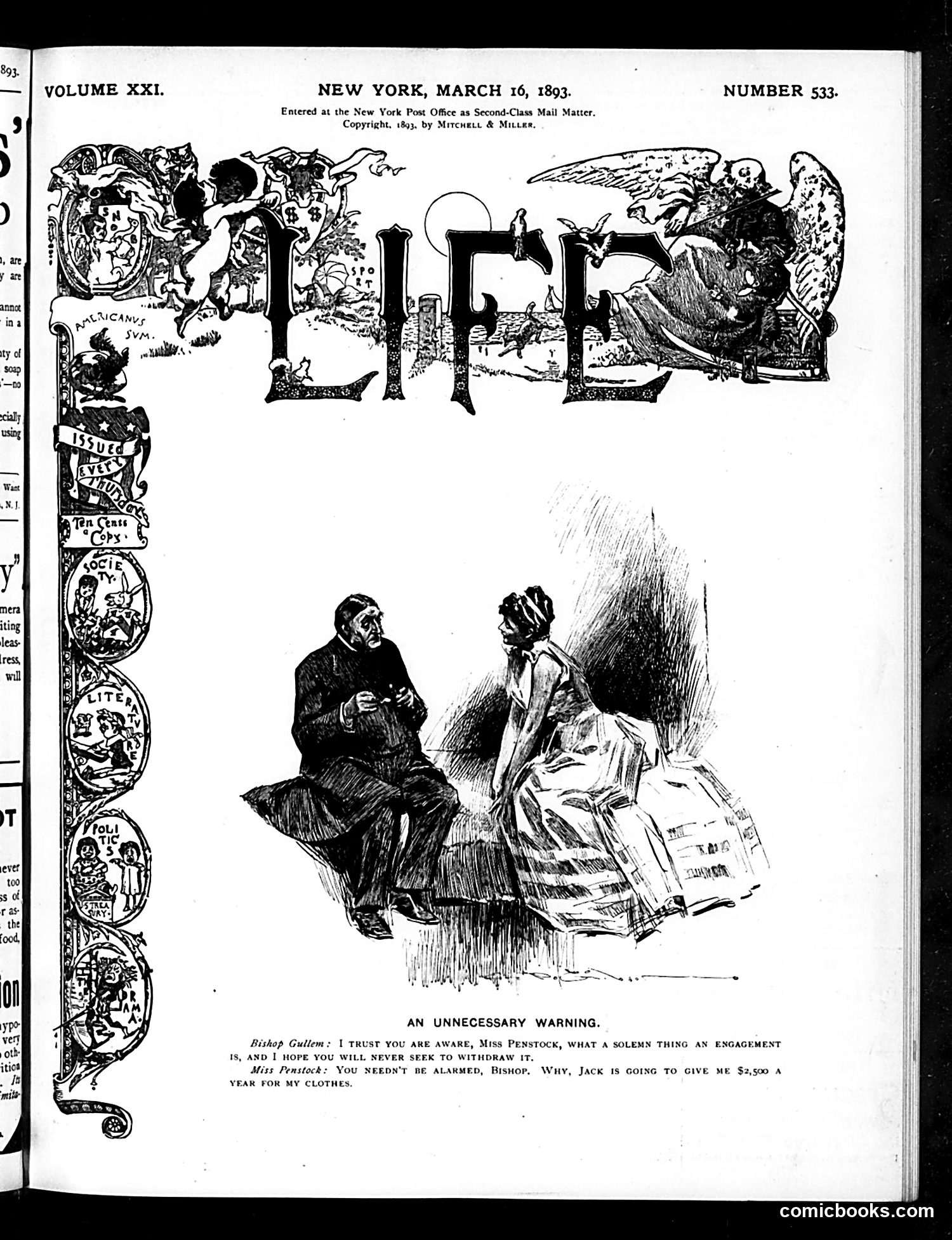
This page contains a single cartoon titled "An Unnecessary Warning," depicting two figures in conversation. Based on the dialogue, Bishop Gallton warns Miss Penstock about the seriousness of an engagement, cautioning against withdrawal. Miss Penstock responds that she needn't worry because "Jack is going to give me $2,500 a year for my clothes." The satire mocks women of the era who prioritized financial security and material goods over genuine romantic commitment in marriage. The bishop's concern about the sanctity of engagement contrasts sharply with the woman's mercenary focus on an annual clothing allowance, satirizing both superficial marriage motivations and the economic dependence of women on their husbands during the Victorian period.
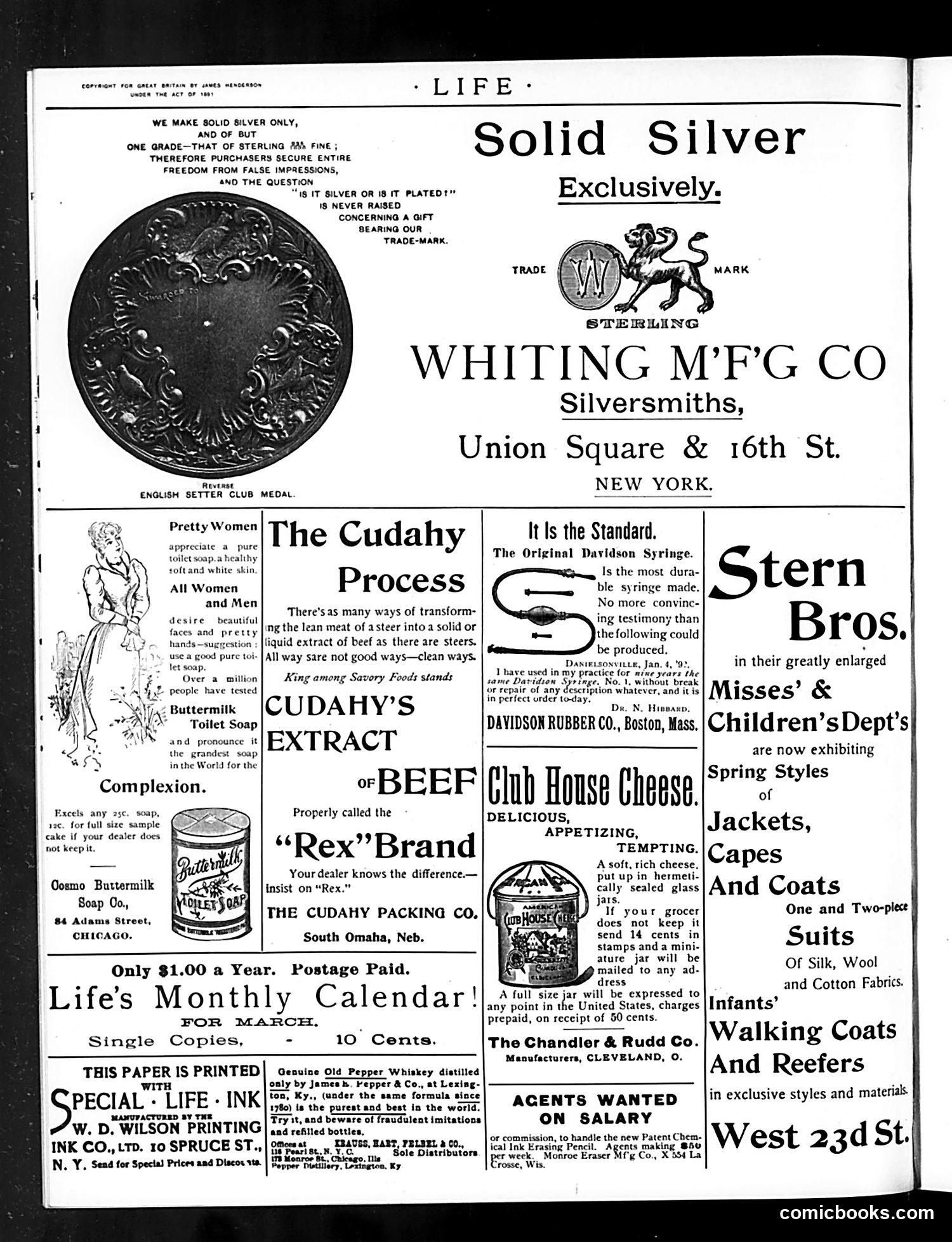
This page is **primarily advertising** with minimal editorial content. The main illustrated advertisement features "Pretty Women" promoting Cudahy's Extract of Beef (the "Rex" Brand) and Buttermilk Toilet Soap. The ad uses a classical female figure to suggest beauty and health benefits. Other advertisements include Davidson Rubber Company's syringe product, Club House Cheese, and Stern Bros. department store clothing. The only non-commercial content is a small notice for "Life's Monthly Calendar for March" (10 cents) and recruitment advertising for agents. There is **no political cartoon or satirical content** visible on this page. It represents typical early 20th-century magazine advertising practices where commercial sponsorships filled most editorial space.
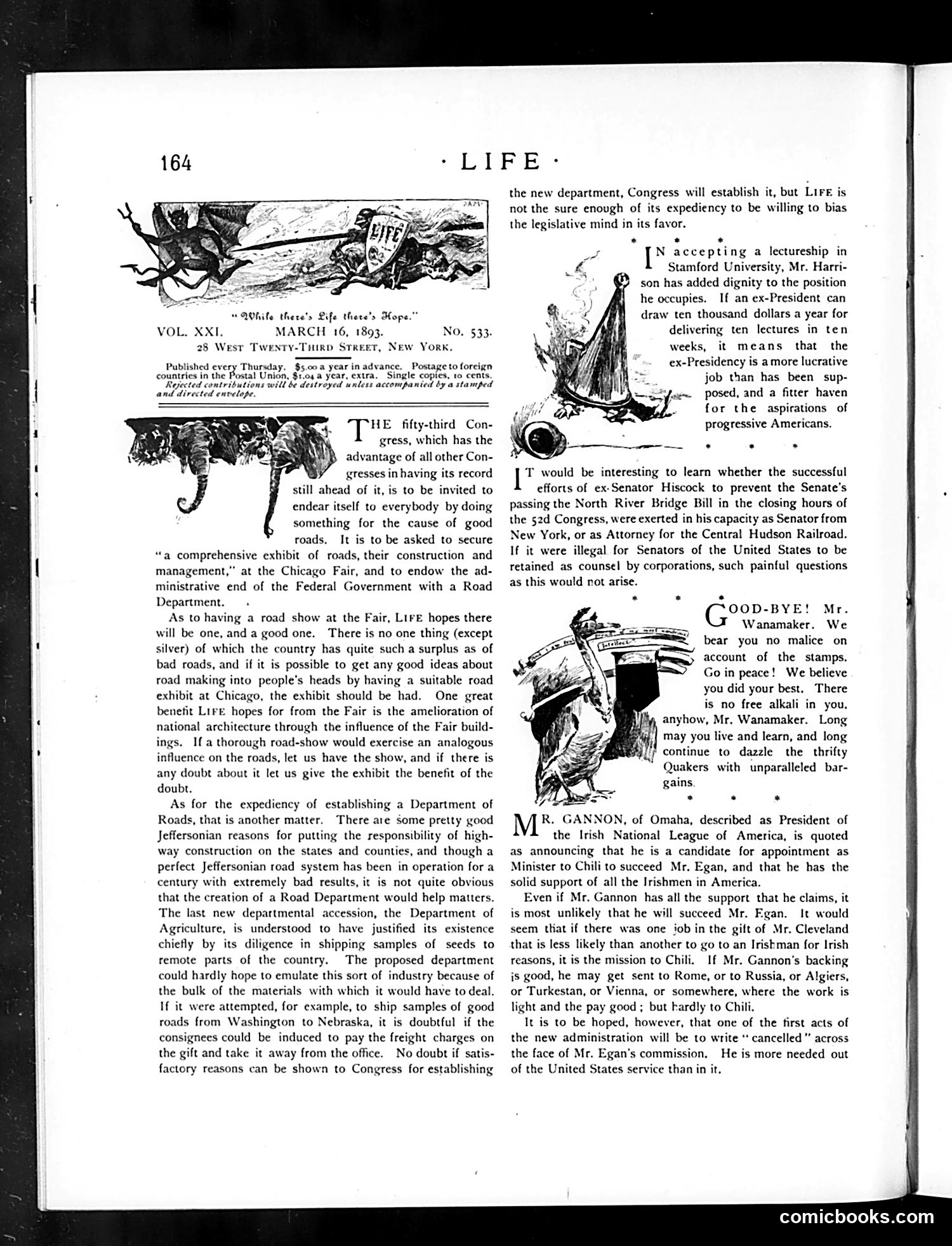
The page contains three editorial cartoons and commentary on contemporary political issues. **Top cartoon**: Shows a figure labeled "Life" pointing at a shield/crest, commenting on the 53rd Congress and road infrastructure. The satire concerns congressional debates over establishing a federal Department of Roads. **Middle cartoon**: Depicts a figure (appears to be a political figure) with sailing/maritime imagery, likely referencing Senator Hiscock's efforts to block the North River Bridge bill in the Senate's final hours—suggesting he was working as counsel for railroad corporations instead of serving the public interest. **Bottom section**: A farewell to "Mr. Wanamaker" and commentary on Mr. Gannon of Omaha, an Irish-American politician seeking appointment as Minister to Chile, satirizing patronage politics and the Irish diaspora's political ambitions in the McKinley administration.
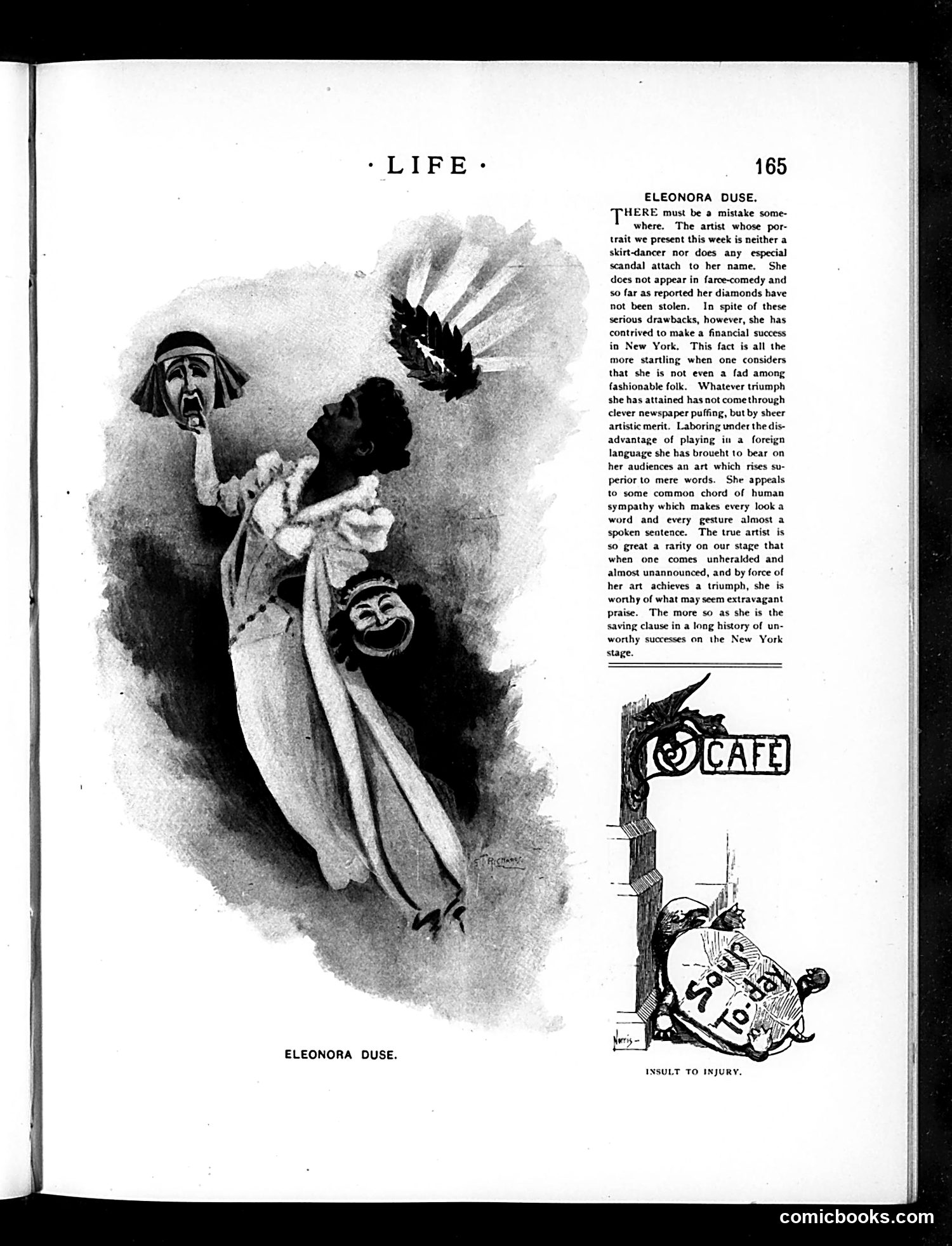
This page features a portrait of **Eleonora Duse**, the renowned Italian actress, with accompanying commentary praising her artistic talent. The text defends her against scandal rumors, noting she lacks the notoriety of a "fad" despite her success on the New York stage. It emphasizes her merit as a serious artist who transcends mere "newspaper puffing," appealing to audiences through genuine artistic skill rather than publicity. The lower cartoon, titled "Insult to Injury," shows a figure at a café being struck or affected by something—likely satirizing the disconnect between Duse's serious reputation and sensationalized media coverage that plagued her public image. This appears to be early 20th-century commentary defending a legitimate artist against tabloid-style character attacks.
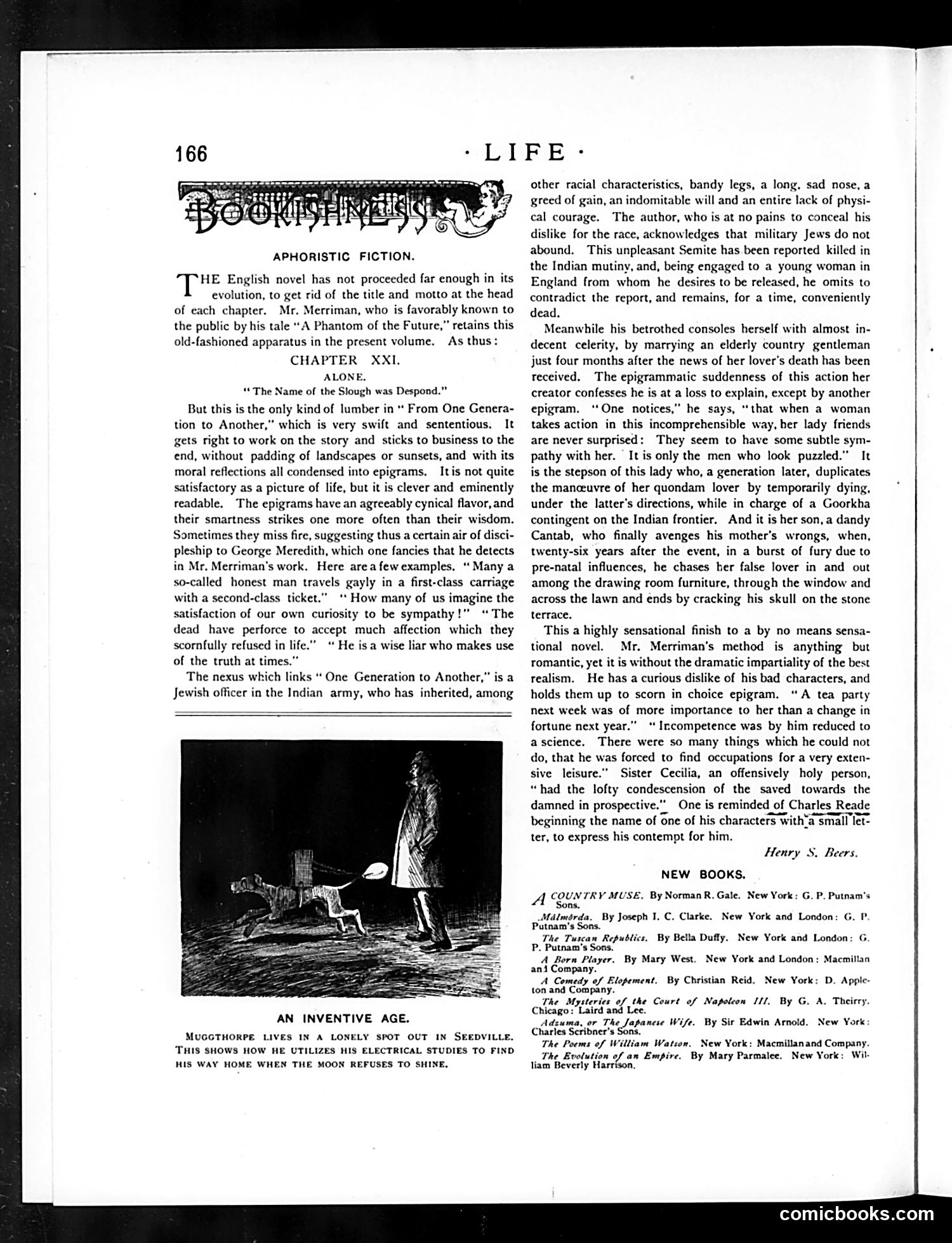
This page combines a book review with a satirical illustration titled "An Inventive Age." The review discusses Mr. Merriman's novel "One Generation to Another," critiquing its portrayal of Indian army officers and characters with contempt. The reviewer, Henry S. Horst, notes Merriman's cynical approach to depicting incompetence and moral failings. The illustration below shows a solitary figure in what appears to be a study or workspace, using electrical equipment by lamplight. The caption indicates this depicts someone utilizing "electrical studies" when moonlight fails to illuminate his home workspace. The cartoon likely satirizes both primitive living conditions and the clever improvisation of modern technology—a comment on innovation in less-developed or resource-limited circumstances during the early 20th century.
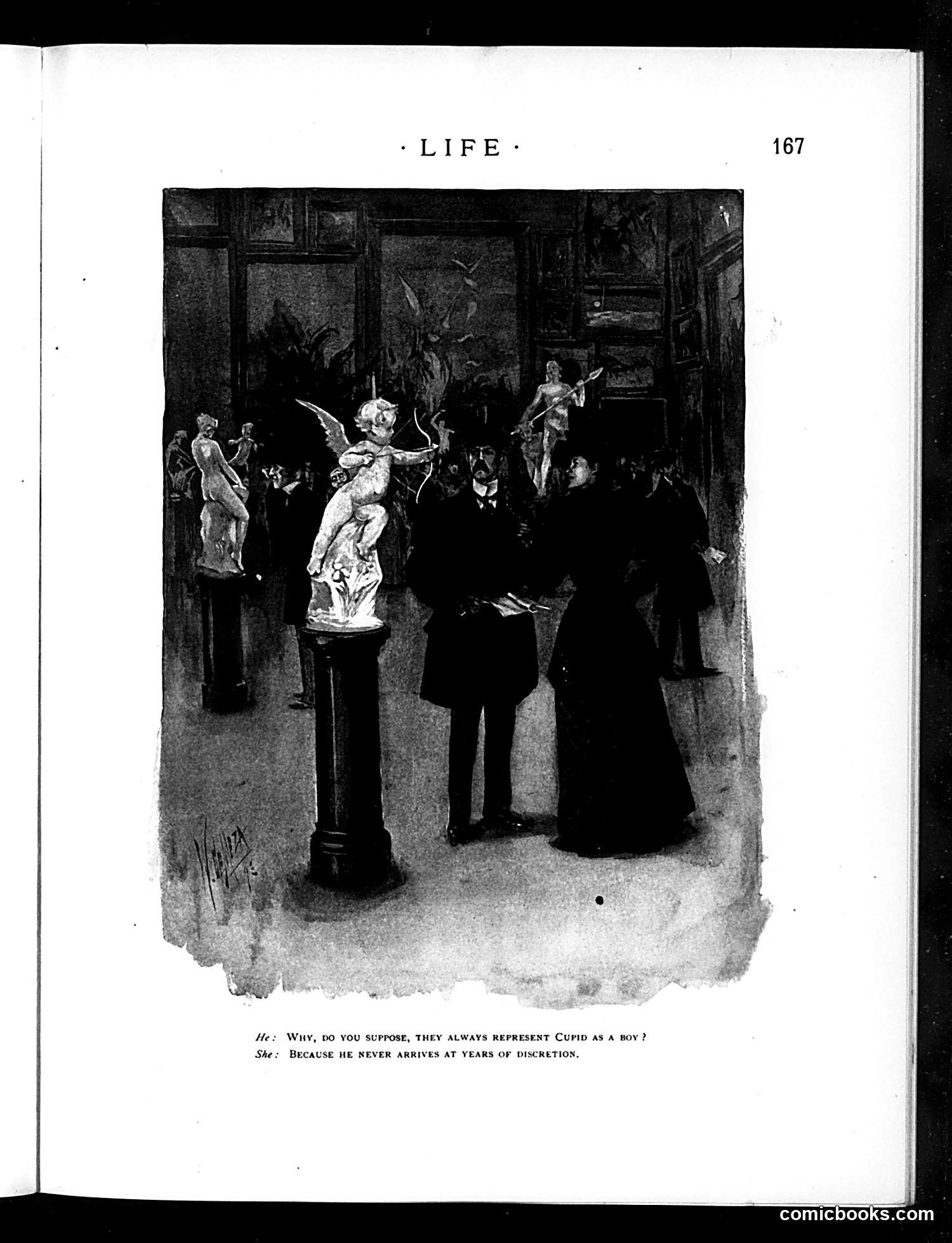
This is a single-panel cartoon showing an art gallery or museum scene. Two elegantly dressed figures stand viewing a classical sculpture of Cupid (a winged cherub) on a pedestal, while other visitors examine artworks in the background. The caption reads as a dialogue: **He:** "Why do you suppose they always represent Cupid as a boy?" **She:** "Because he never arrives at years of discretion." The joke is a play on "years of discretion"—meaning maturity or good judgment. The satire suggests that Cupid (the Roman god of love) remains eternally childish and foolish, never achieving adult wisdom. This mocks romantic love itself as inherently irrational and immature, a common theme in early 20th-century satirical humor about relationships and human nature.
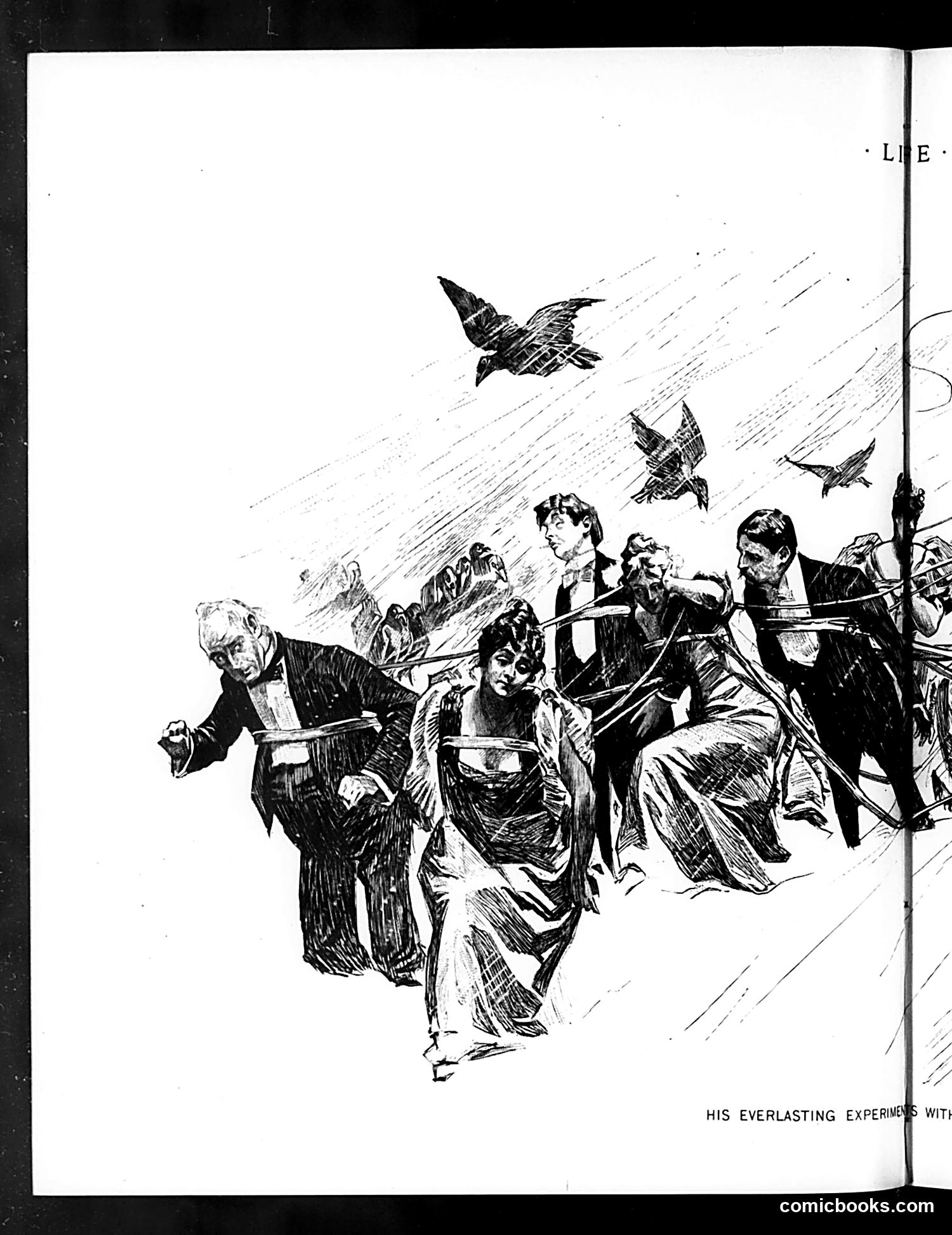
This satirical illustration depicts a group of well-dressed figures being driven upward by diagonal lines suggesting wind or force, with stylized birds flying above them. The caption reads "HIS EVERLASTING EXPERIMENTS WITH" (text cuts off). The image appears to be political satire, likely criticizing someone's chaotic or turbulent policies or leadership style. The figures—appearing to include both men and women in formal attire—seem caught in turmoil or disorder. The birds overhead may symbolize freedom, chaos, or consequences. Without the complete caption or knowing the publication date, I cannot definitively identify the specific political figure or event being mocked. However, the composition suggests criticism of experimental or reckless governance causing disruption to society or political circles.
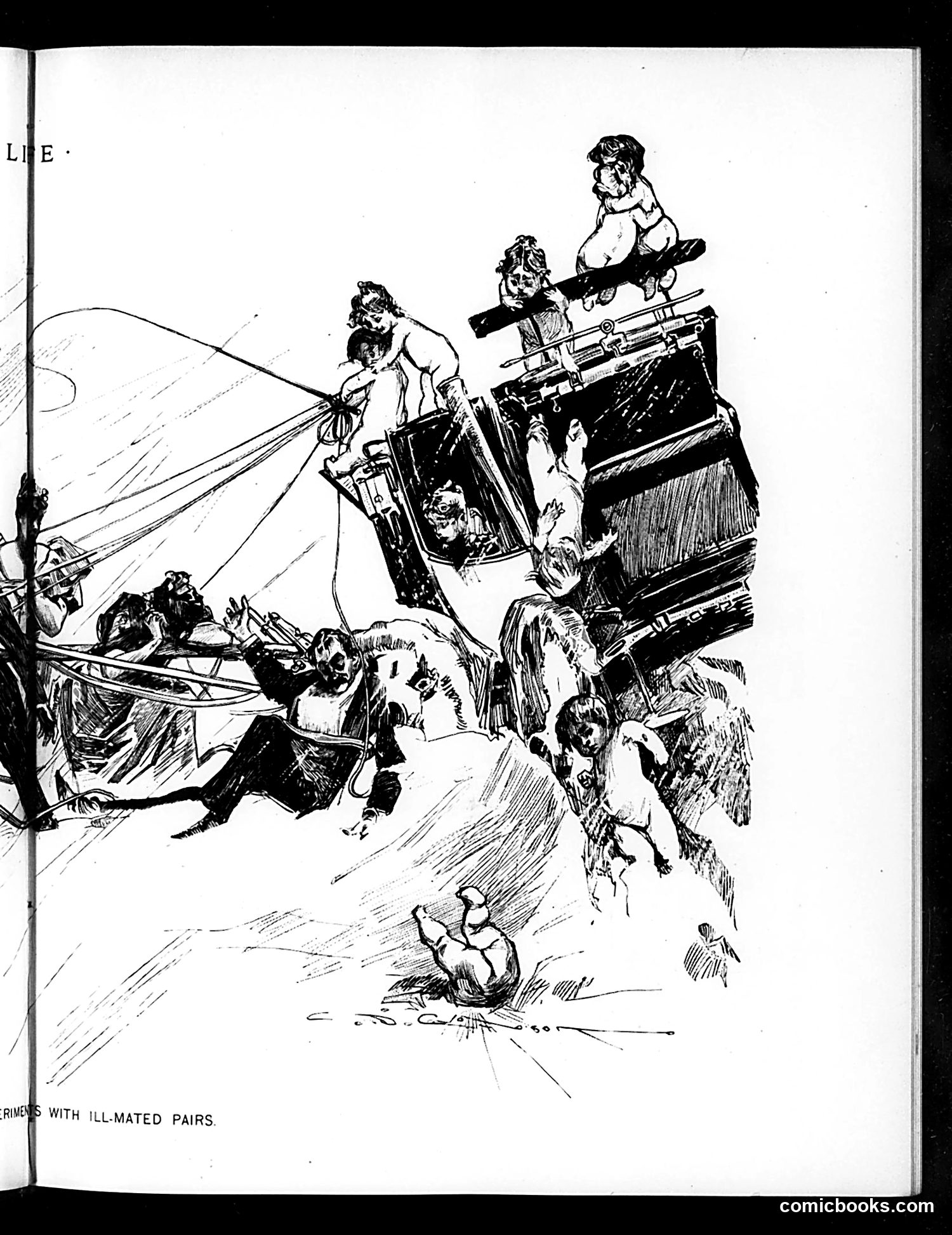
This political cartoon satirizes mismatched or incompatible romantic/marriage pairings. The illustration shows cherubs or cupids operating a large mechanical device—appearing to be a printing press or similar contraption—that's producing couples in various states of chaos and disarray. Bodies and limbs are strewn about haphazardly. The caption at bottom reads "CRIMES WITH ILL-MATED PAIRS," indicating the cartoon's subject: couples poorly suited to each other. The "machinery" metaphor suggests that romantic incompatibility is being mechanically produced or manufactured—perhaps critiquing either matrimonial matchmaking services of the era or simply the randomness/folly of how people end up paired together. The chaotic composition emphasizes the resulting disorder and misery such mismatches create.
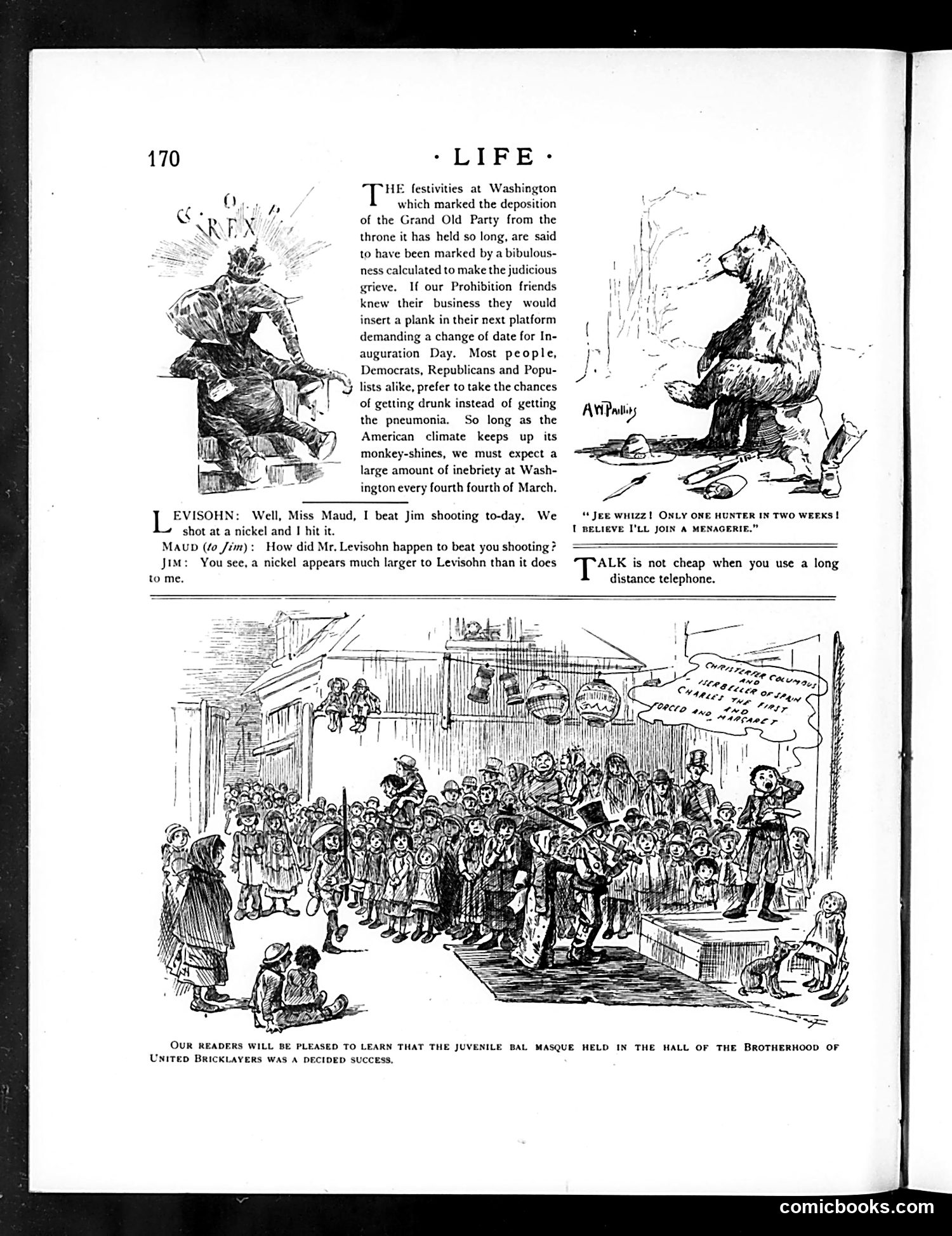
The top editorial cartoon depicts **Prohibition** as a crowned figure sitting on a throne, satirizing how the policy dominates American politics. The accompanying text criticizes Prohibition activists for their "biliousness" and argues that most Americans—regardless of party—prefer the risk of drunkenness to pneumonia, suggesting Prohibition enforcement causes more harm than the drinking it prevents. The lower illustration shows a successful **juvenile masquerade ball** held by the Brotherhood of United Bricklayers, presented as positive community news. The humor between Jim and Levisohn concerns shooting accuracy at targets, while the telephone joke plays on the expense of long-distance calls—both typical period humor unrelated to the political content above.
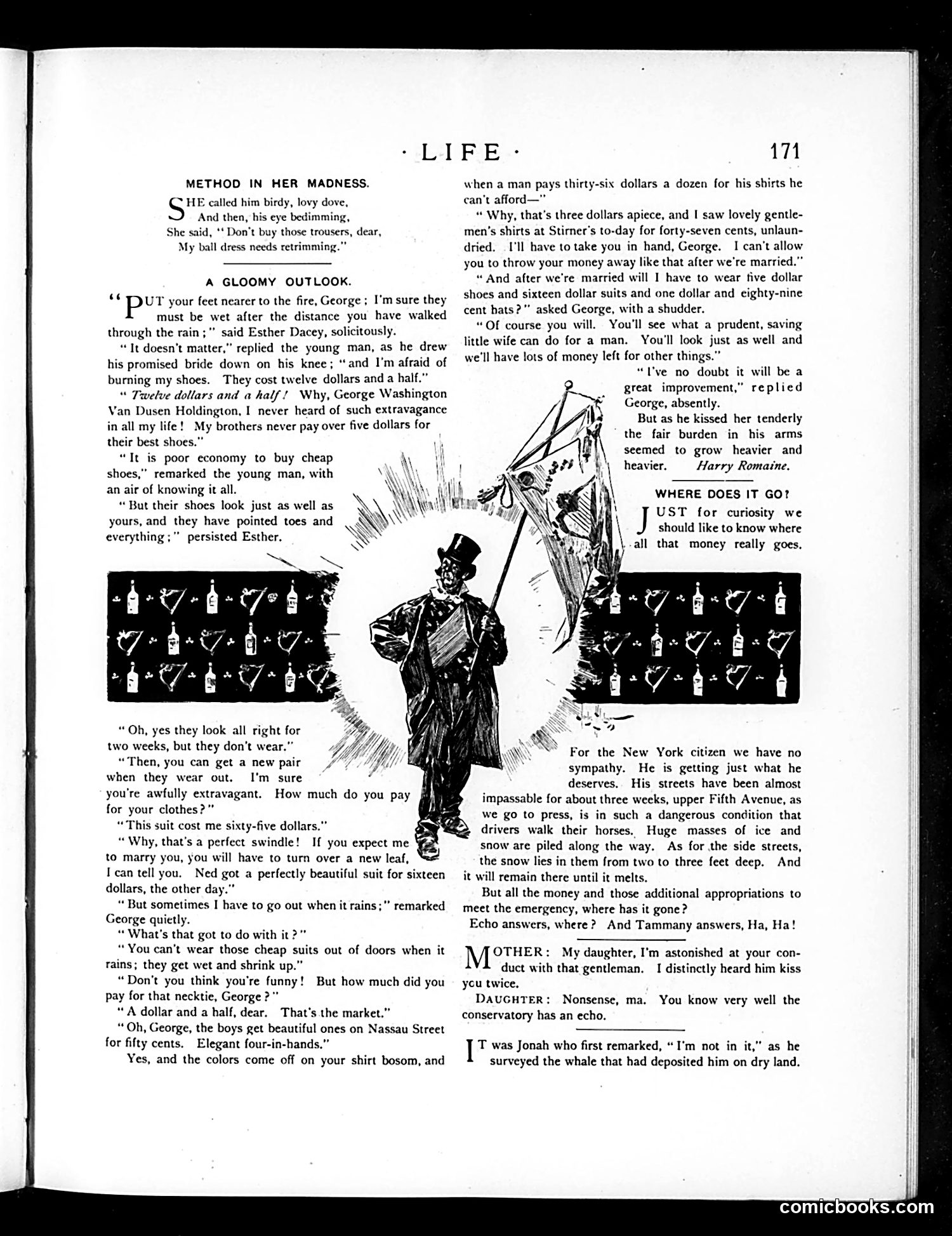
This page satirizes class anxieties and courtship economics in early 20th-century America. The main dialogue features a couple—George and Esther—debating whether George can afford marriage given his meager salary. Esther pressures him about clothing expenses and future costs (five-dollar shoes, sixteen-dollar suits), while George protests the extravagance of middle-class expectations. The central illustration shows a man in a top hat amid mathematical symbols (dollar signs and addition marks), visually representing the financial calculations consuming his thoughts. The satire targets both: **George's anxiety** about meeting the economic demands of respectable married life, and **Esther's materialism**, expecting luxury goods on a modest income. The section "Where Does It Go?" sardonically notes money mysteriously disappears once earned—a commentary on inflation and cost-of-living struggles facing young professionals of the era.
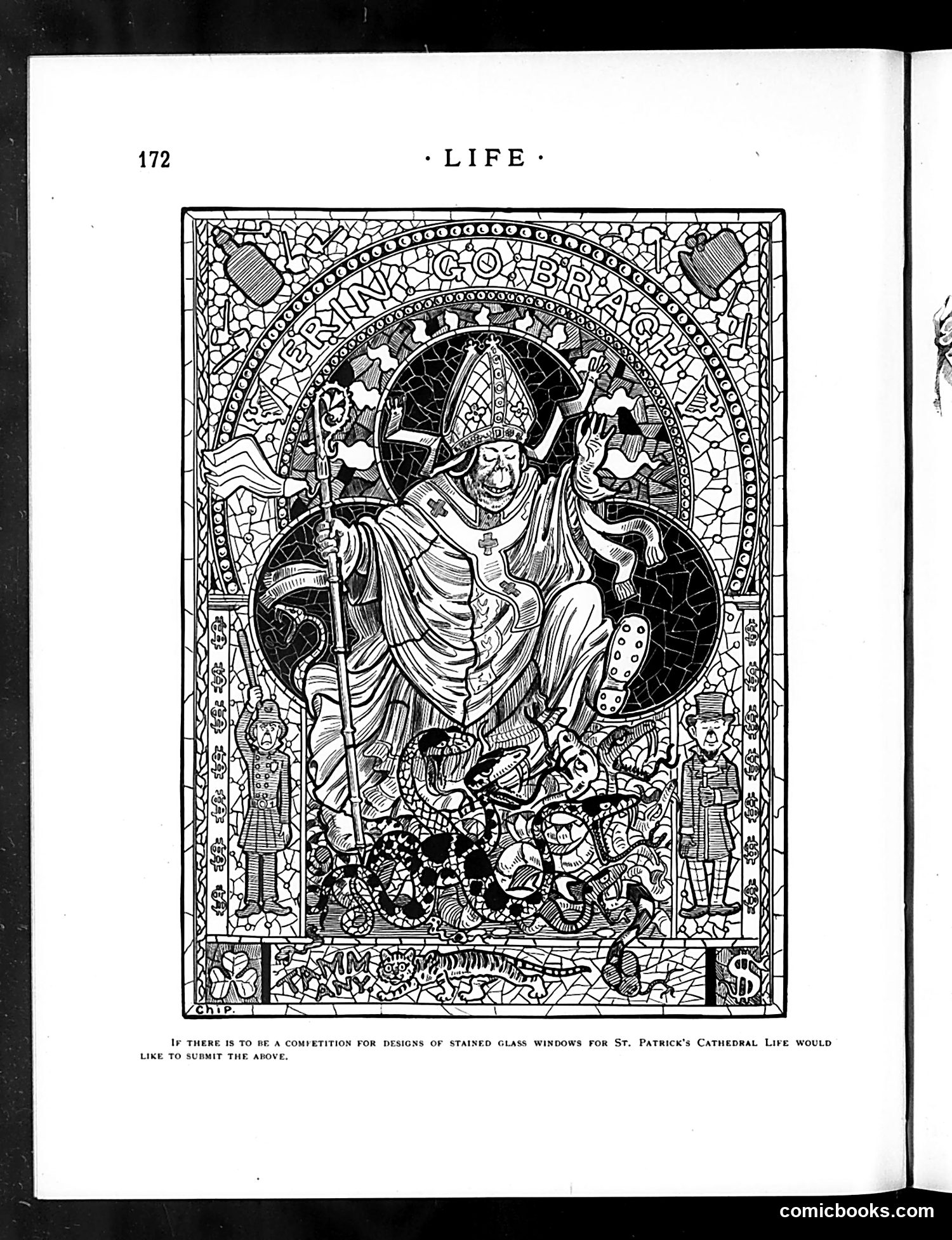
This is a satirical design submission for stained glass windows at St. Patrick's Cathedral in New York. The image shows a religious figure (likely Saint Patrick, given the episcopal vestments and mitre) rendered in ornate medieval stained-glass style, complete with elaborate Gothic framing and decorative elements. The satire's target is unclear from the image alone, but Life's proposal appears to mock either: contemporary stained-glass design aesthetics, the cathedral's artistic choices, or possibly the formality of religious institutional commissions. The elaborate, somewhat overwrought decorative treatment might be satirizing either excessive ornamentation or the gap between grand ecclesiastical ambitions and actual artistic execution. Without additional context about specific 1900s-era architectural debates, the precise satirical point remains somewhat ambiguous.
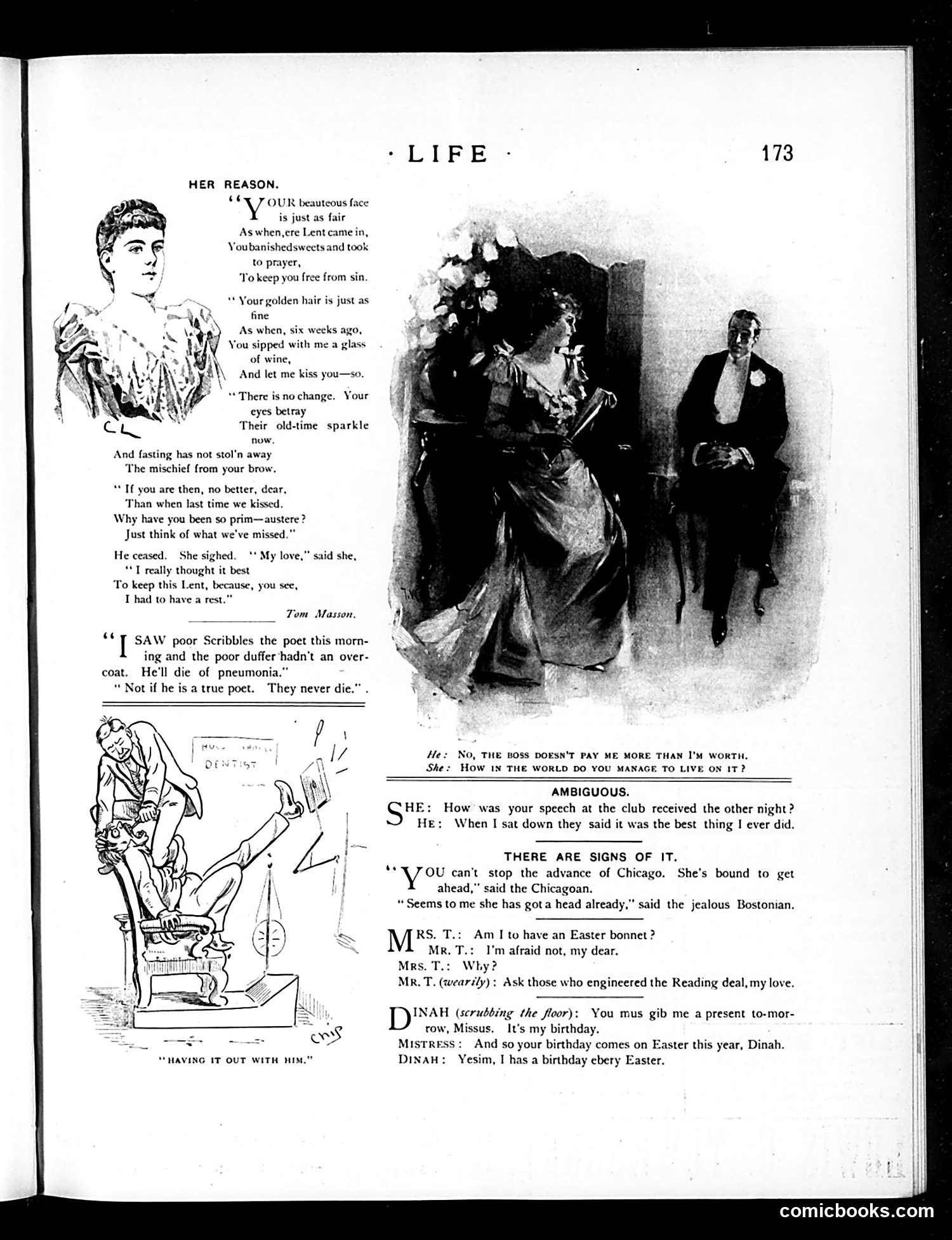
This page collects several short humorous pieces typical of early 20th-century American satire: **"Her Reason"** mocks a woman's Lenten piety as superficial—she maintains her appearance and flirtatiousness while claiming religious observance, then admits she only fasted for "a rest." **The poet joke** plays on the Romantic notion that true poets are immortal through their work, contrasting with economic reality. **"Ambiguous"** uses a wife's pointed question to satirize wage inequality—the husband claims fair pay while struggling financially. **Chicago vs. Boston** reflects regional rivalry, with a Bostonian's jealous quip about Chicago being "ahead" (ambitious/progressive) while she already has "a head" (is headstrong). **The Easter bonnet and Reading deal** reference a contemporary railroad scandal affecting the economy, blaming financial mismanagement for middle-class inability to afford luxuries. **Dinah's birthday** presents racist dialect humor (common for the era), depicting a Black servant's shrewd negotiation for gifts by timing her birthday with Easter.
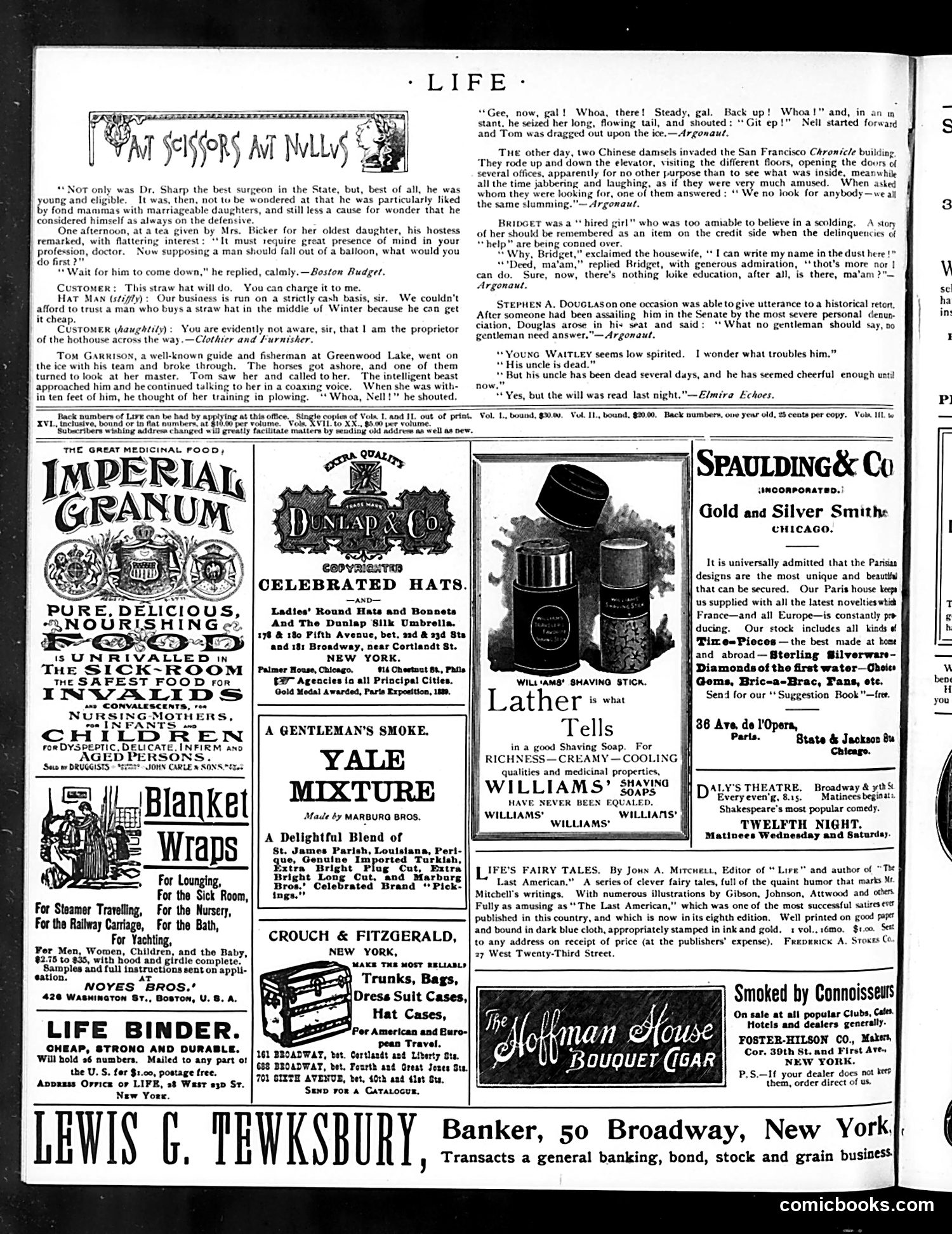
This page contains **short humorous anecdotes** rather than political cartoons. The jokes satirize various social types and situations of the era: 1. **"Dr. Sharp"**: Mocks an eligible young bachelor constantly pursued by mothers seeking matches—a common Victorian social anxiety. 2. **Straw hat customer**: Ridicules a man who buys winter clothing in summer because he owns a hothouse, satirizing absurd logic and pretension. 3. **Tom Garrison/Horse rescue**: A humorous anecdote about a fisherman rescued from icy water by his obedient horse—celebrating animal intelligence. 4. **Chinese visitors to newspaper office**: Depicts Chinese women touring the *Chronicle* building "slumming"—reflecting period attitudes toward Chinese immigrants as curious outsiders engaged in frivolous sightseeing. 5. **Bridget the maid**: A gentle joke about an illiterate Irish housemaid admiring education she cannot access—reflecting class and ethnic stereotypes common to the era. The page is largely **advertisements**, with the anecdotes serving as filler content typical of 19th-century magazines.
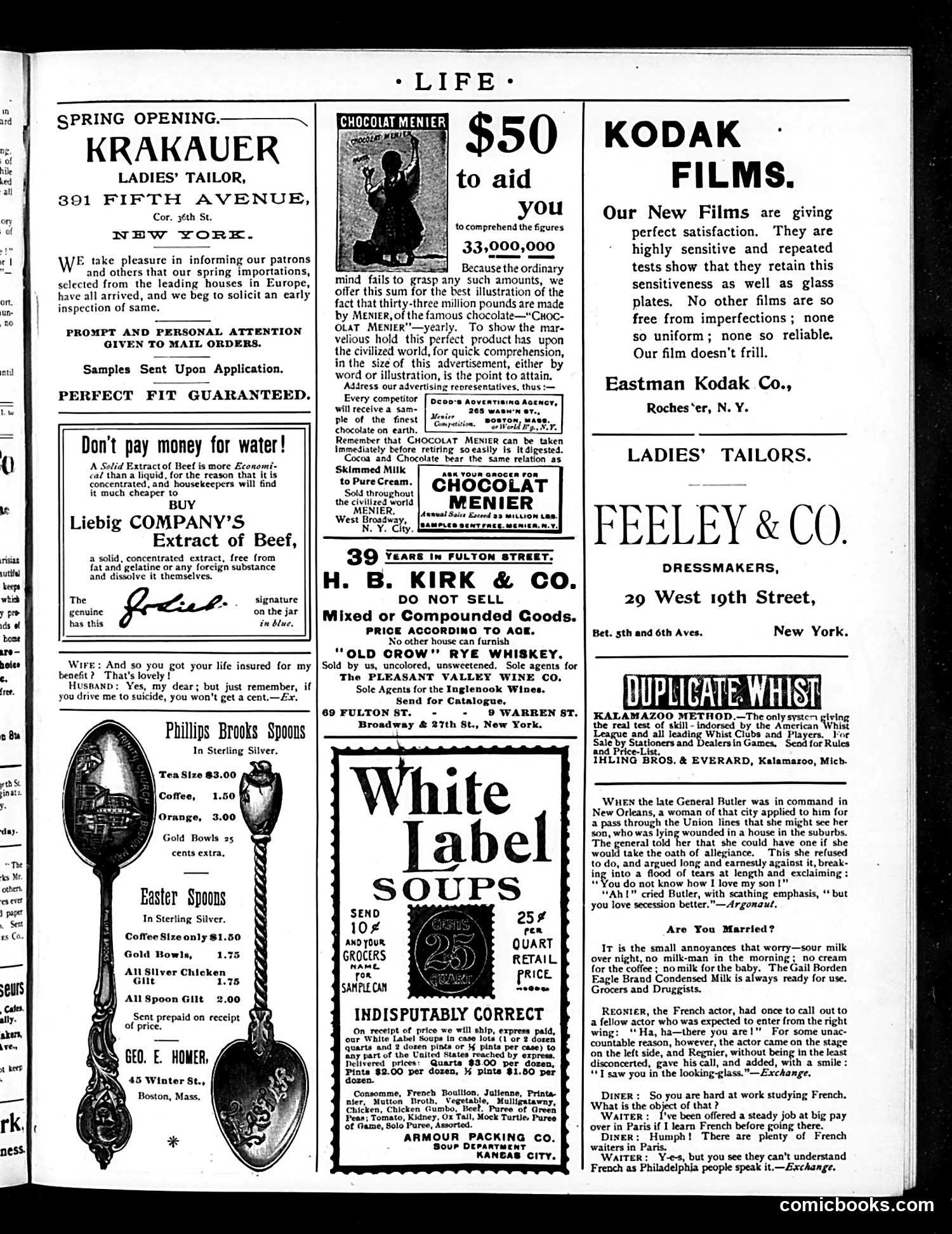
This page is primarily **advertising**, not editorial cartoons or satire. The visible content consists of commercial advertisements for late 19th/early 20th-century products and services: a ladies' tailor, Liebig beef extract, spoons, chocolate, whiskey, soups, and photography film. One brief **humorous item** appears: a short dialogue between "Wire" (husband) and "Husband" about life insurance. The joke is dark marital humor—he's joked that if she drives him to suicide, she won't collect the insurance benefit. This reflects period attitudes about marriage and life insurance as comedic subjects. The page also includes a competition notice: Menier chocolate is offering a prize for the best illustration explaining how 33 million pounds of chocolate are manufactured annually—an early advertising contest. This is a standard magazine page mixing commerce with light humor rather than political satire.
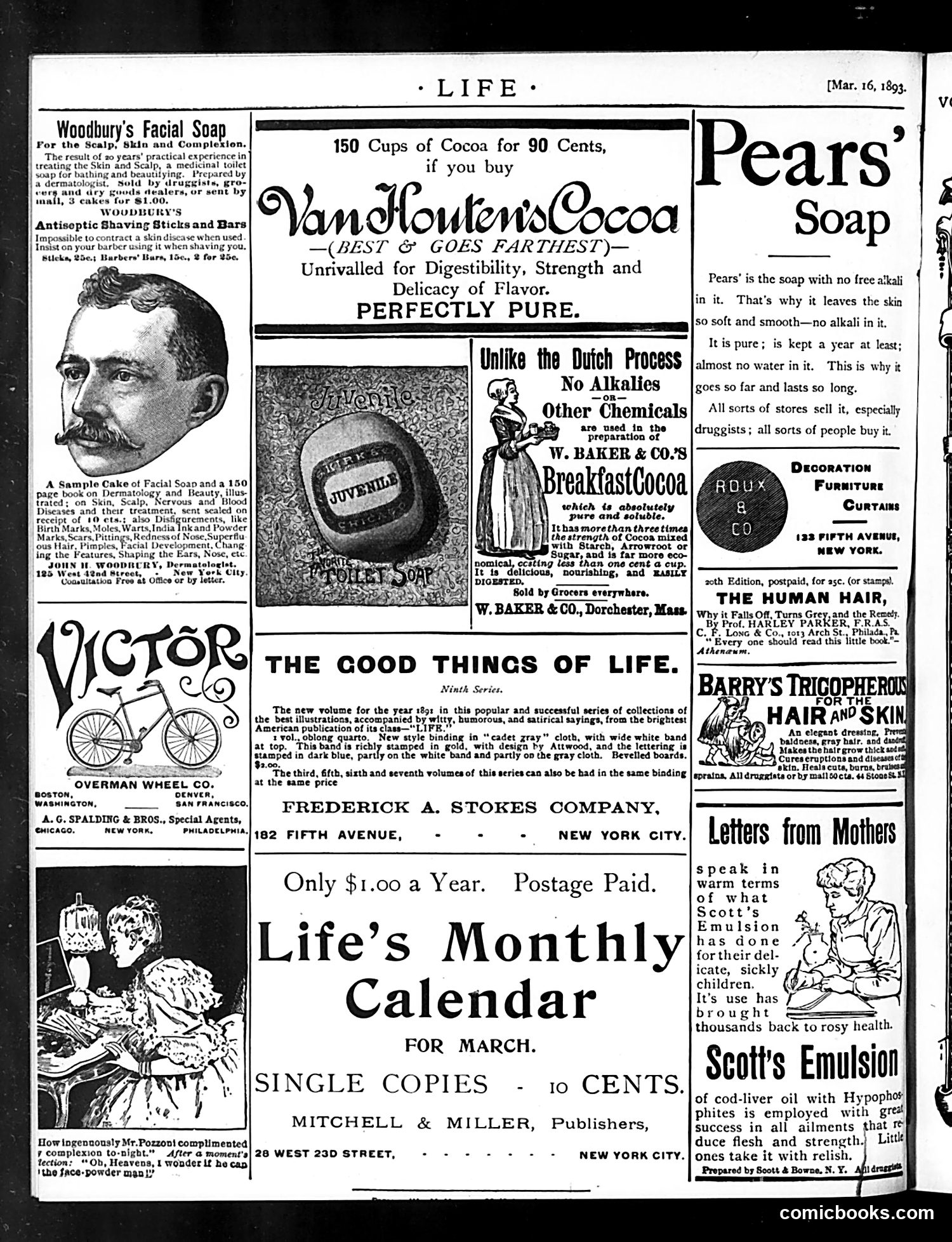
This is primarily a **commercial advertising page** rather than satirical content. The page features multiple product advertisements typical of the 1890s: **Key advertisements include:** - **Woodbury's Facial Soap** and **Pears' Soap** — competing beauty products emphasizing purity and alkali-free formulas - **Van Houten's Cocoa** and **W. Baker & Co.'s Breakfast Cocoa** — chocolate products marketed as pure and economical - **Scott's Emulsion** — a cod-liver oil supplement marketed to mothers for children's health - **Life's Monthly Calendar** — a subscription offer for Life magazine itself The page includes a small joke at bottom left about a man complimenting a woman's complexion, suggesting she used cosmetics. **Context for modern readers:** These ads reflect 1890s consumer culture obsession with "purity" and emerging scientific marketing claims. The competing cocoa brands highlight industrial chemistry debates of the era. Product testimonials and dermatologist endorsements were common advertising strategies. This appears to be filler advertising revenue rather than satirical content.