
Life, 1893-03-16 · page 6 of 16
Life — March 16, 1893 — page 6: what you’re looking at
What you’re looking at
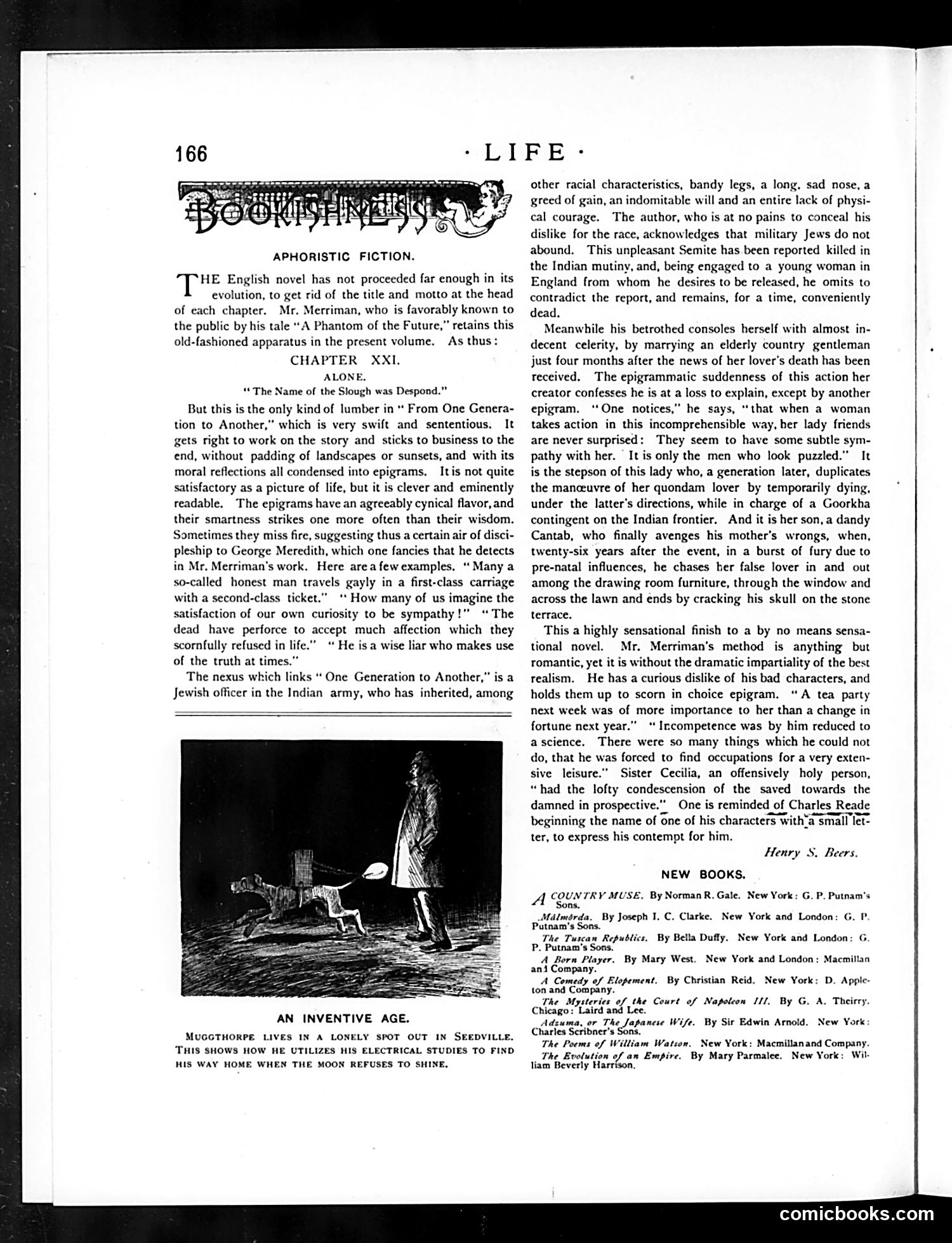
This page combines a book review with a satirical illustration titled "An Inventive Age." The review discusses Mr. Merriman's novel "One Generation to Another," critiquing its portrayal of Indian army officers and characters with contempt. The reviewer, Henry S. Horst, notes Merriman's cynical approach to depicting incompetence and moral failings. The illustration below shows a solitary figure in what appears to be a study or workspace, using electrical equipment by lamplight. The caption indicates this depicts someone utilizing "electrical studies" when moonlight fails to illuminate his home workspace. The cartoon likely satirizes both primitive living conditions and the clever improvisation of modern technology—a comment on innovation in less-developed or resource-limited circumstances during the early 20th century.
📄 Transcribed text from this page (OCR, searchable)
Machine-transcribed from the original scan — historical spelling and the odd misread are preserved.
APHORISTIC FICTION. Tre English novel has not proceeded far enough in its evolution, to get rid of the title and motto at the head of each chapter. Mr. Merriman, who is favorably known to the public by his tale “A Phantom of the Future,” retains this old-fashioned apparatus in the present volume. As thus: CHAPTER XXI. ALONE. “The Name of the Slough was Despond.” But this is the only kind of lumber in “ From One Genera- tion to Another,” which is very swift and sententious. It gets right to work on the story and sticks to business to the end, without padding of landscapes or sunsets, and with its moral reflections all condensed into epigrams. Itis not quite satisfactory as a picture of life, but it is clever and eminently readable. The epigrams have an agreeably cynical flavor,and their smartness strikes one more often than their wisdom. Sometimes they miss fire, suggesting thus a certain air of disci- pleship to George Meredith, which one fancies that he detects in Mr. Merriman’s work. Here area few examples. ‘Many a so-called honest man travels gayly in a first-class carriage with a second-class ticket." ‘* How many of us imagine the satisfaction of our own curiosity to be sympathy!" “ The dead have perforce to accept much affection which they scornfully refused in life.” “ He is a wise liar who makes use of the truth at times.” The nexus which links ‘One Generation to Another,” is a Jewish officer in the Indian army, who has inherited, among AN INVENTIVE AGE. MUGGTHORPE LIVES IN A LONELY SPOT OUT IN SEEDVILLE. THIS SHOWS HOW HE UTILIZES HIS ELECTRICAL STUDIES TO FIND HIS WAY HOME WHEN THE MOON REFUSES TO SHINE. ‘LIFE: other racial characteristics, bandy legs, a long, greed of gain, an indomitable will and an entire | cal courage. The author, who is at no pains to conceal his dislike for the race, acknowledges that military Jews do not abound. This unpleasant Semite has been reported killed in the Indian mutiny, and, being engaged to a young woman in England from whom he desires to be released, he omits to contradict the report, and remains, for a time, conveniently dead. Meanwhile his betrothed consoles herself with almost in- decent celerity, by marrying an elderly country gentleman just four months after the news of her lover's death has been received, The epigrammatic suddenness of this action her creator confesses he is at a loss to explain, except by another epigram. ‘‘One notices,” he says, “that when a woman takes action in this incomprehensible way, her lady friends are never surprised: They seem to have some subtle sym- pathy with her. “It is only the men who look puzzled.” It is the stepson of this lady who, a generation later, duplicates the manceuvre of her quondam lover by temporarily dying, under the latter's directions, while in charge of a Goorkha contingent on the Indian frontier. And it is her son, a dandy Cantab, who finally avenges his mother’s wrongs, when, twenty-six years after the event, in a burst of fury due to pre-natal influences, he chases her false lover in and out among the drawing room furniture, through the window and across the lawn and ends by cracking his skull on the stone terrace. This a highly sensational finish to a by no means sensa- tional novel. Mr. Merriman’s method is anything but romantic, yet it is without the dramatic impartiality of the best realism. He has a curious dislike of his bad characters, and holds them up to scorn in choice epigram. “A tea party next week was of more importance to her than a change in fortune next year.” “Incompetence was by him reduced to ascience. There were so many things which he could not do, that he was forced to find occupations for a very exten- sive leisure.” Sister Cecilia, an offensively holy person, “had the lofty condescension of the saved towards the damned in prospective.” One is reminded of Charles Reade beginning the name of one of his characters with’a small let ter, to express his contempt for him. Henry S. Beers. NEW BOOKS. A COUNTRY MUSE. By Norman R. Gale. New York: G. P. Putnam's Sons. Mdlmirda. By Joseph I, C. Clarke. New York and London: G. P. Putnam's Sons. The Tuscan Republic P. Putnam's Sons, A Born Player. By Mary West. an4 Company. A Comedy of Elopement. ton and Company. The Mysteries of the Court of Napoleon If, By G. A. Theirry. Chicago: Laird and Lee. Adzuma, or The Japancse Wife. Charles Scribner's The Poems of William Watson. The Evolution of an Empire. liam Beverly Harrison, By Bella Duffy. New York and London: New York and London: Macmillan By Christian Reid, New York: D. Apple- By Sir Edwin Arnold, New York: New York: Macmillanand Company. By Mary Parmalee. New York: Wil- comicbooks.com