
Life, 1893-03-16 · page 4 of 16
Life — March 16, 1893 — page 4: what you’re looking at
What you’re looking at
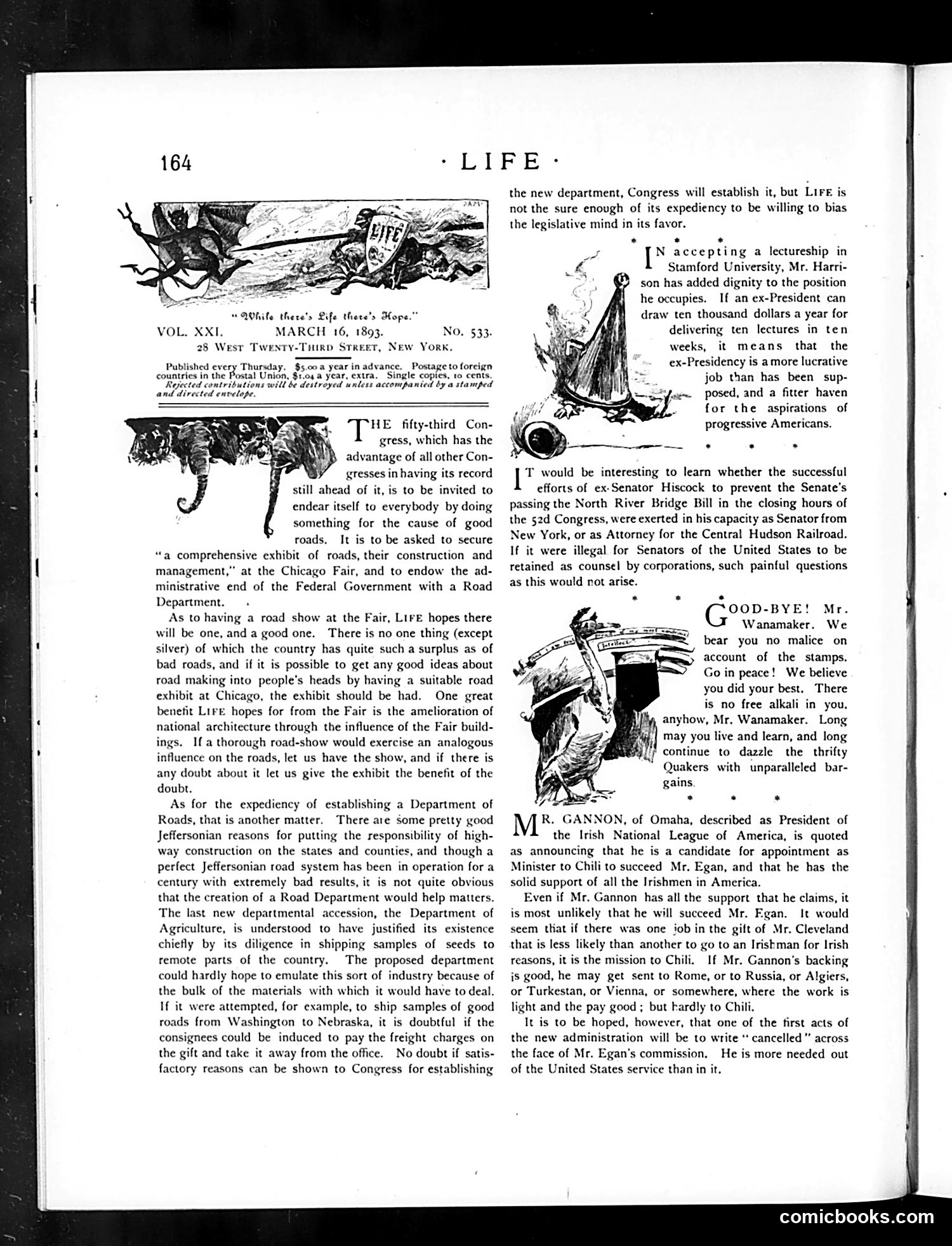
The page contains three editorial cartoons and commentary on contemporary political issues. **Top cartoon**: Shows a figure labeled "Life" pointing at a shield/crest, commenting on the 53rd Congress and road infrastructure. The satire concerns congressional debates over establishing a federal Department of Roads. **Middle cartoon**: Depicts a figure (appears to be a political figure) with sailing/maritime imagery, likely referencing Senator Hiscock's efforts to block the North River Bridge bill in the Senate's final hours—suggesting he was working as counsel for railroad corporations instead of serving the public interest. **Bottom section**: A farewell to "Mr. Wanamaker" and commentary on Mr. Gannon of Omaha, an Irish-American politician seeking appointment as Minister to Chile, satirizing patronage politics and the Irish diaspora's political ambitions in the McKinley administration.
📄 Transcribed text from this page (OCR, searchable)
Machine-transcribed from the original scan — historical spelling and the odd misread are preserved.
- LIFE: “While there's Life there’s Hope.” VOL. XXI. MARCH 16, 1893. No. 533- ew York. 28 Wesr Twenty-THIRD STREET, Published every Thursday. $5.00 year in advance. Postage to foreign countries in the Postal Union, $t.04 a year, extra. Single copies, 10 cents, Rejected contributions will be destroyed untess accompanied by a stamped and directed envelope. . THE fity-third Con- gress, which has the advantage of all other Con- e gresses in having its record still ahead of it, is to be invited to endear itself to everybody by doing something for the cause of good roads. It is to be asked to secure “a comprehensive exhibit of roads, their construction and management,” at the Chicago Fair, and to endow the ad- ministrative end of the Federal Government with a Road Department... As to having a road show at the Fair, Lire hopes there will be one, and a good one. There is no one thing (except silver) of which the country has quite such a surplus as of bad roads, and if it is possible to get any good ideas about road making into people's heads by having a suitable road exhibit at Chicago, the exhibit should be had. One great benefit Lire hopes for from the Fair is the amelioration of national architecture through the influence of the Fair build- ings. If a thorough road-show would exercise an analogous influence on the roads, let us have the show, and if there is any doubt about it let us give the exhibit the benefit of the doubt. As for the expediency of establishing a Department of Roads, that is another matter. There ae Some pretty good Jeffersonian reasons for putting the responsibility of high- way construction on the states and counties, and though a perfect Jeffersonian road system has been in operation for a century with extremely bad results, it is not quite obvious that the creation of a Road Department would help matters. The last new departmental accession, the Department of Agriculture, understood to have justified its existence chiefly by its diligence in shipping samples of seeds to remote parts of the country. The proposed department could hardly hope to emulate this sort of industry because of the bulk of the materials with which it would have to deal. If it were attempted, for example, to ship samples of good roads from Washington to Nebraska, it is doubtful if the consignees could be induced to pay the freight charges on the gift and take it away from the office. No doubt if satis- factory reasons can be shown to Congress for establishing the new department, Congress will establish it, but LIFE is not the sure enough of its expediency to be willing to bias the legislative mind in its favor. * . * N accepting a lectureship in Stamford University, Mr. Harri- son has added dignity to the position he occupies. If an ex-President can draw ten thousand dollars a year for delivering ten lectures in ten weeks, it means that the ex-Presidency is amore lucrative job than has been sup- siyec~ posed, and a fitter haven for the aspirations of progressive Americans. T would be interesting to learn whether the successful efforts of ex-Senator Hiscock to prevent the Senate's passing the North River Bridge Bill in the closing hours of the 52d Congress, were exerted in his capacity as Senator from New York, or as Attorney for the Central Hudson Railroad. If it were illegal for Senators of the United States to be retained as counsel by corporations, such painful questions as this would not arise. . OOD-BYE! Mr. Wanamaker. We bear you no malice on account of the stamps. Go in peace! We believe you did your best. There is no free alkali in you, anyhow, Mr. Wanamaker. Long ,| may you live and learn, and long continue to dazzle the thrifty Quakers with unparalleled bar- gains, . R. GANNON, of Omaha, described as President of the Irish National League of America, is quoted as announcing that he is a candidate for appointment as Minister to Chili to succeed Mr. Egan, and that he has the solid support of all the Irishmen in America. Even if Mr. Gannon has all the support that he claims, it is most unlikely that he will succeed Mr. Egan. It would seem that if there was one iob in the gift of Mr. Cleveland that is less likely than another to go to an Irishman for Irish reasons, it is the mission to Chili. If Mr. Gannon’s backing is good, he may get sent to Rome, or to Russia, or Algiers, or Turkestan, or Vienna, or somewhere, where the work is light and the pay good ; but kardly to Chili. It is to be hoped, however, that one of the first acts of the new administration will be to write ‘ cancelled” across the face of Mr. Egan’s commission. He is more needed out of the United States service than in it. comicbooks.com