
Life, 1893-03-16 · page 11 of 16
Life — March 16, 1893 — page 11: what you’re looking at
What you’re looking at
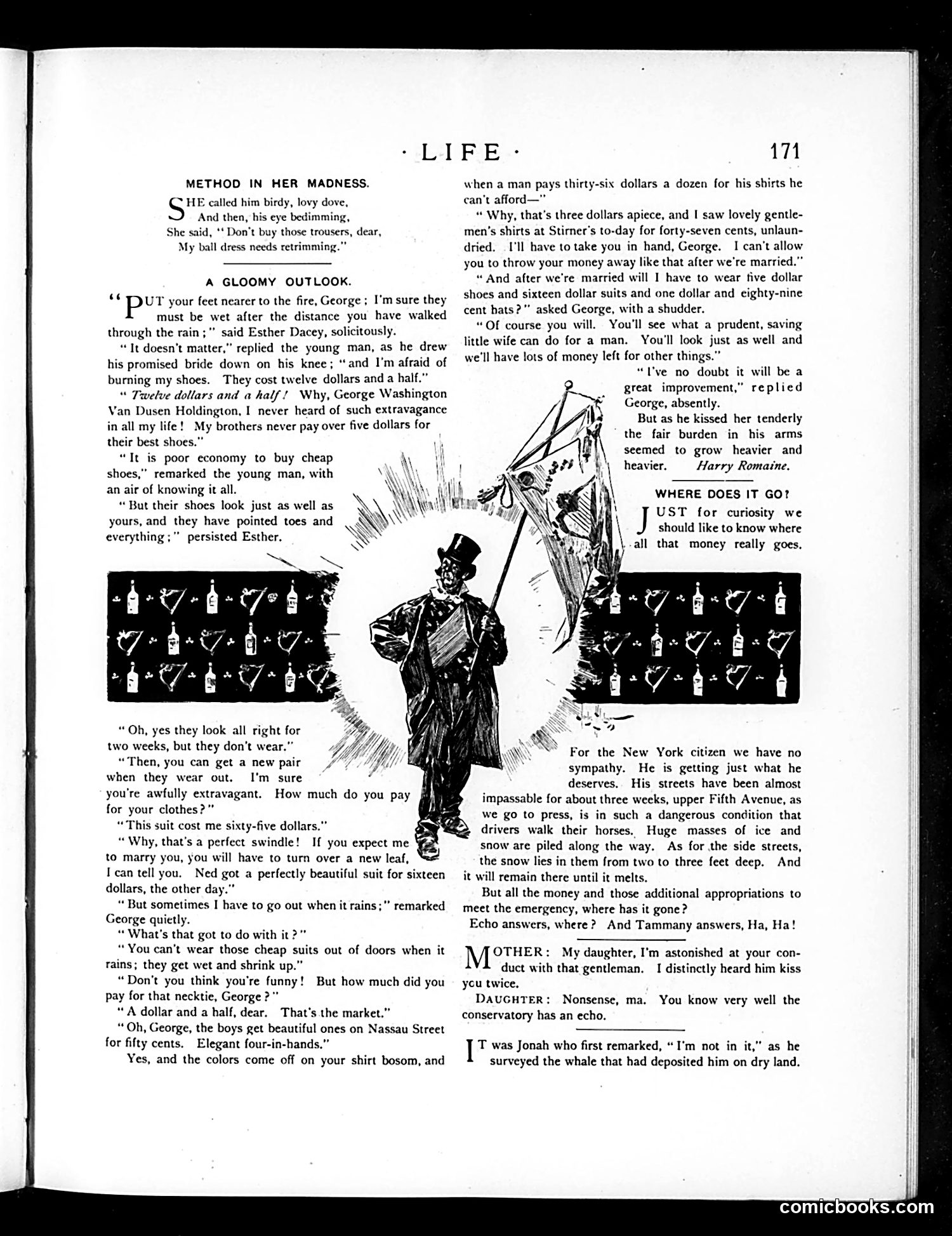
This page satirizes class anxieties and courtship economics in early 20th-century America. The main dialogue features a couple—George and Esther—debating whether George can afford marriage given his meager salary. Esther pressures him about clothing expenses and future costs (five-dollar shoes, sixteen-dollar suits), while George protests the extravagance of middle-class expectations. The central illustration shows a man in a top hat amid mathematical symbols (dollar signs and addition marks), visually representing the financial calculations consuming his thoughts. The satire targets both: **George's anxiety** about meeting the economic demands of respectable married life, and **Esther's materialism**, expecting luxury goods on a modest income. The section "Where Does It Go?" sardonically notes money mysteriously disappears once earned—a commentary on inflation and cost-of-living struggles facing young professionals of the era.
📄 Transcribed text from this page (OCR, searchable)
Machine-transcribed from the original scan — historical spelling and the odd misread are preserved.
-LIFE- METHOD IN HER MADNESS. > HE called him birdy, lovy dove, And then, his eye bedimming, She said, ‘ Don’t buy those trousers, dear, My ball dress needs retrimming A GLOOMY OUTLOOK. *© IQUT your feet nearer to the fire, George ; I'm sure they must be wet after the distance you have walked through the rain ;"” said Esther Dacey, solicitously. “It doesn’t matter,” replied the young man, as he drew his promised bride down on his knee; “and I'm afraid of burning my shoes. They cost twelve dollars and a half.” “ Twelve dollars and a half! Why, George Washington Van Dusen Holdington, I never heard of such extravagance in all my life! My brothers never pay over five dollars for their best shoes.” “It is poor economy to buy cheap shoes,” remarked the young man, with an air of knowing it all. “ But their shoes look just as well as yours, and they have pointed toes and everything ;" persisted Esther. “Oh, yes they look all right for two weeks, but they don’t wear.” “Then, you can get a new pair when they wear out. I'm sure you're awfully extravagant. How much do you pay for your clothes?” “ This suit cost me sixty-five dollars.” “Why, that’s a perfect swindle! If you expect me to marry you, you will have to turn over a new leaf, “= Ican tell you. Ned got a perfectly beautiful suit for sixteen dollars, the other day.” “But sometimes I have to go out when it rains ;" remarked George quietly. “What's that got to do with it?” “You can’t wear those cheap suits out of doors when it rains; they get wet and shrink up.” “Don't you think you're funny! But how much did you pay for that necktie, George ?” “A dollar and a half, dear. That's the market.” “Oh, George, the boys get beautiful ones on Nassau Street for fifty cents. Elegant four-in-hands.” Yes, and the colors come off on your shirt bosom, and 171 when a man pays thirty-six dollars a dozen for his shirts he can't afford—” “ Why, that’s three dollars apiece, and I saw lovely gentle- men’s shirts at Stirner’s to-day for forty-seven cents, unlaun- dried. I'll have to take you in hand, George. I can’t allow you to throw your money away like that after we're married.” “And after we're married will I have to wear five dollar shoes and sixteen dollar suits and one dollar and eighty-nine cent hats?” asked George, with a shudder. “Of course you will. You'll see what a prudent, saving little wife can do for a man. You'll look just as well and we'll have lots of money left for other things.” “I've no doubt it will be a great improvement,” replied George, absently. But as he kissed her tenderly the fair burden in his arms seemed to grow heavier and heavier. Harry Romaine, WHERE DOES IT GO? UST for curiosity we should like to know where all that money really goes. For the New York citizen we have no sympathy. He is getting just what he deserves. His streets have been almost impassable for about three weeks, upper Fifth Avenue, as we go to press, is in such a dangerous condition that drivers walk their horses. Huge masses of ice and snow are piled along the way. As for the side streets, the snow lies in them from two to three feet deep. And it will remain there until it melts. But all the money and those additional appropriations to meet the emergency, where has it gone? Echo answers, where ?. And Tammany answers, Ha, Ha! OTHER: My daughter, I'm astonished at your con- duct with that gentleman. I distinctly heard him kiss you twice, DAUGHTER: Nonsense, ma. conservatory has an echo. You know very well the T was Jonah who first remarked, “I'm not in it,” as he surveyed the whale that had deposited him on dry land. comicbooks.com