
A complete issue · 14 pages · 1893
Life — January 26, 1893
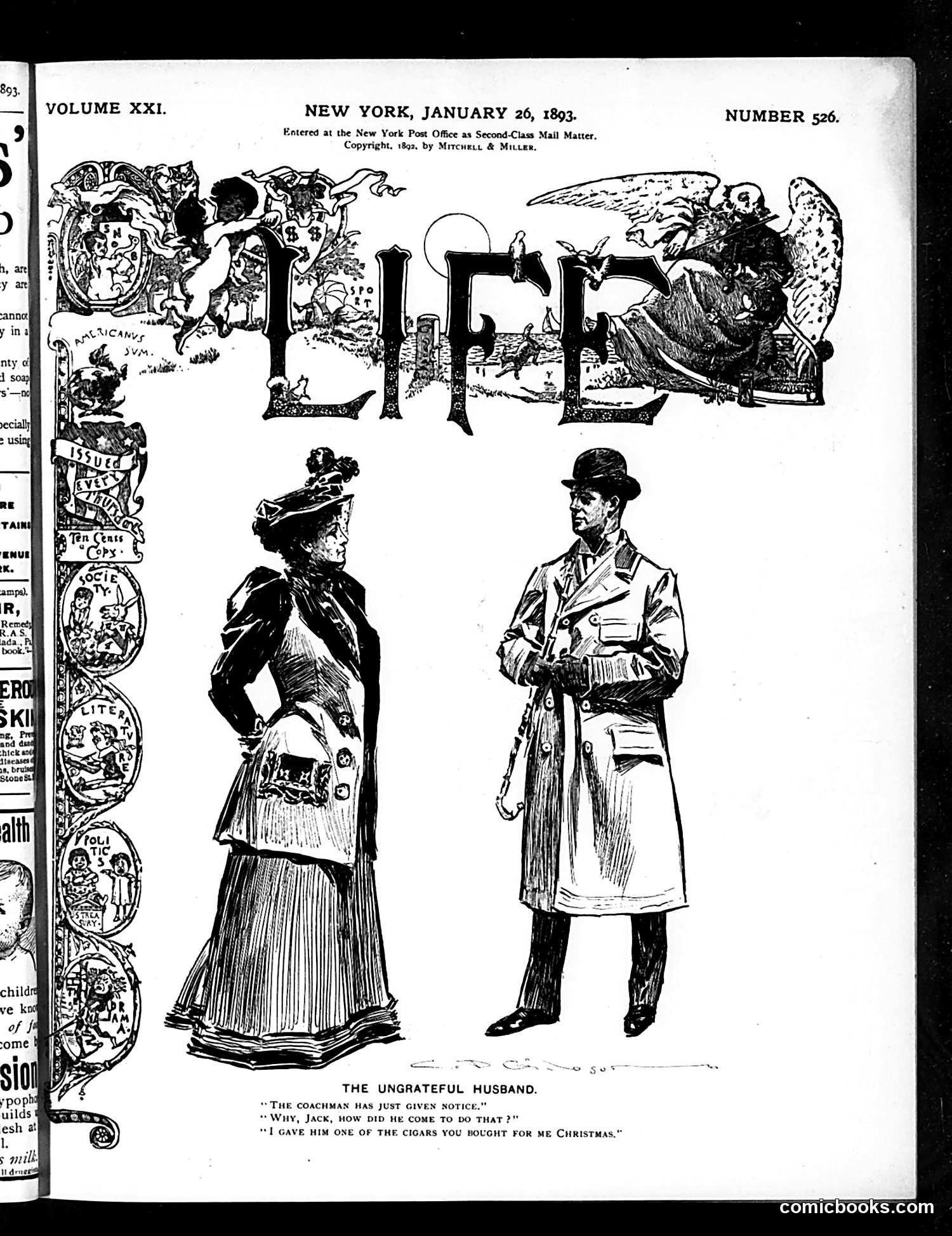
This cartoon satirizes marital discord through a domestic scene. A woman in fashionable 1890s dress confronts a man in a military or official uniform. The caption reads: "The coachman has just given notice. 'Why, Jack, how did he come to do that?' 'I gave him one of the cigars you bought for me Christmas.'" The joke hinges on the woman's gift of poor-quality cigars to her husband, which he then passed to their coachman—an insult so severe it caused the servant to quit. The satire mocks both the wife's terrible gift selection and the husband's ungrateful regifting, suggesting their relationship troubles stem from mutual thoughtlessness rather than serious issues.
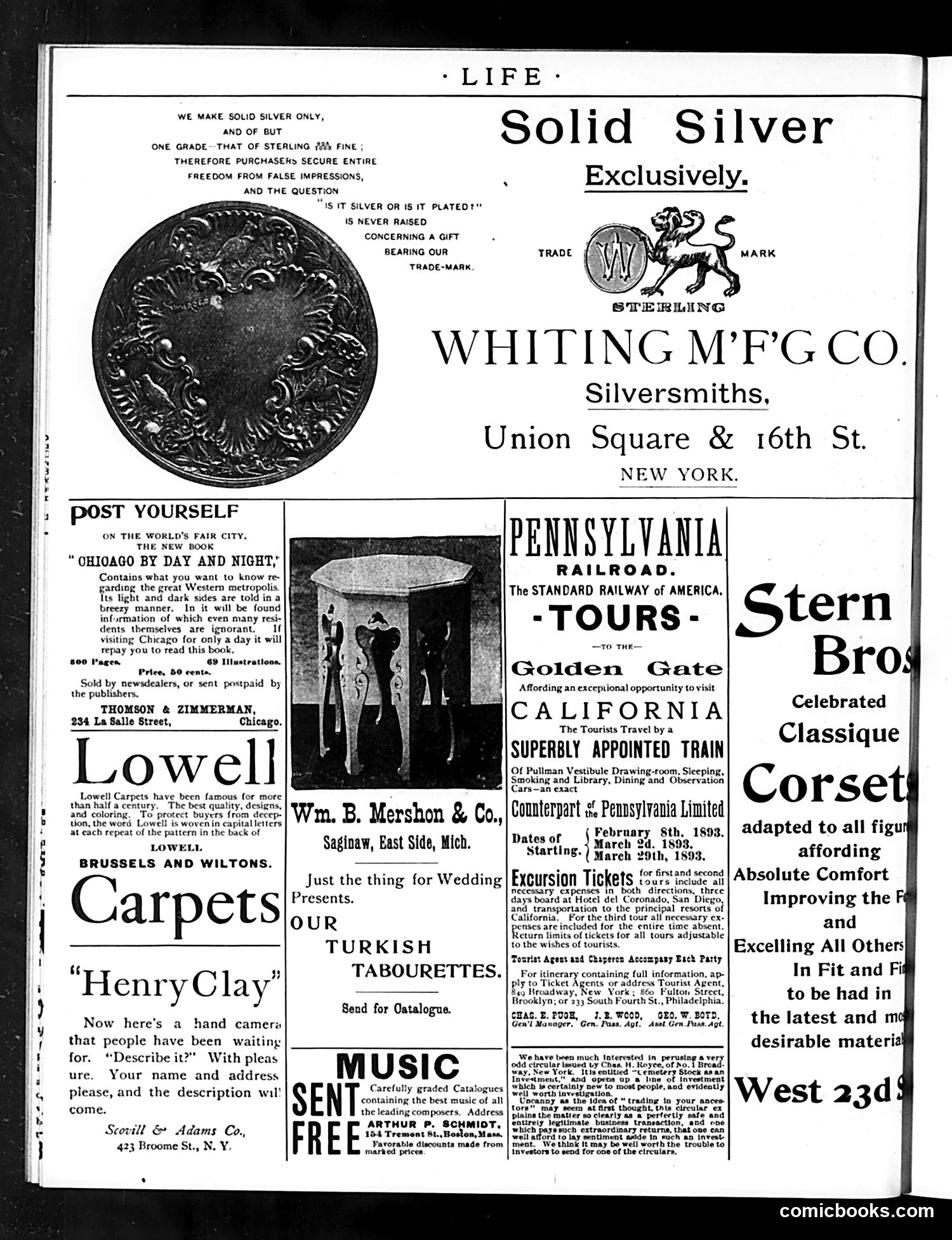
This page is predominantly **advertising** rather than editorial content or political cartoons. It features commercial advertisements for various products and services circa 1893, including: - **Whiting M'fg Co.**: A silversmith promoting solid sterling silver goods - **Lowell Carpets**: Advertising Brussels and Wilton carpet products - **Stern Bros**: Promoting their "Classique Corset" - **Pennsylvania Railroad**: Advertising tours to California's Golden Gate via their "Superb Appointed Train" - **Music**: A free catalogue offer from Arthur P. Schmidt There are no political cartoons or satirical commentary visible on this page. The ornamental circular silver piece at top left appears to be a product illustration. This is simply a commercial advertising page from *Life* magazine's business section.
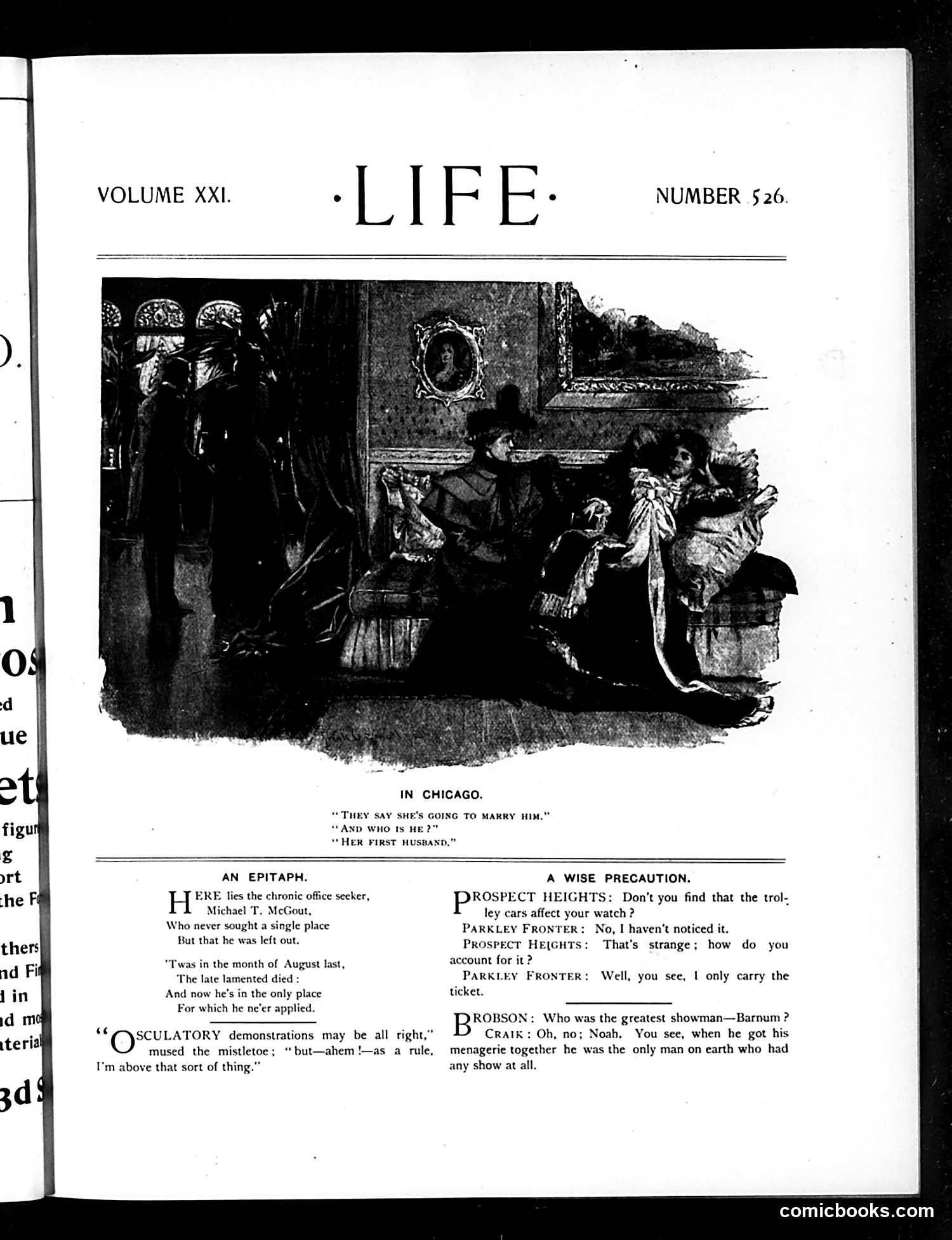
The main illustration depicts a Chicago social scene with the caption "IN CHICAGO" and dialogue: "They say she's going to marry him." / "And who is he?" / "Her first husband." This is satirical commentary on Chicago society, specifically mocking the frequency of remarriage or marital instability among the city's upper classes. The joke hinges on the dark humor that a woman is marrying "her first husband"—implying either she's had multiple husbands already, or there's confusion about which husband is which. It ridicules Chicago's wealthy social circles as frivolous and morally lax. The page also contains brief satirical pieces ("An Epitaph" and "A Wise Precaution") mocking various social types, including office seekers and showmen, typical of Life's general satirical approach to American society and politics.
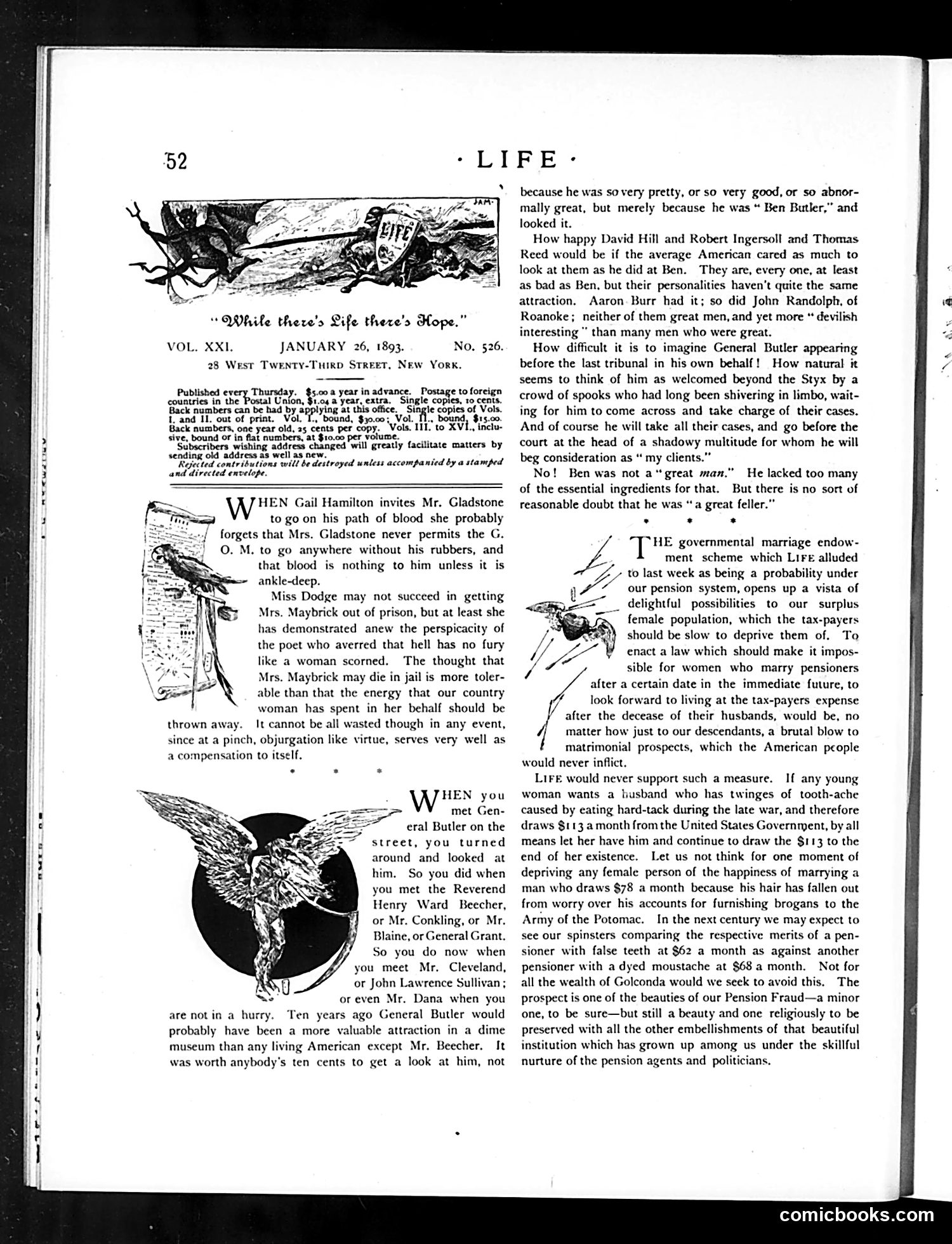
This page contains three editorial cartoons satirizing contemporary figures and issues: 1. **"While there's Life there's Hope"** (top): The masthead illustration, likely a general statement about optimism. 2. **Mrs. Gladstone/Gail Hamilton cartoon** (left): Mocks Mrs. Gladstone for refusing to allow her husband near blood relatives or anywhere without rubbers, suggesting overly controlling behavior. The satire portrays her as unreasonably restrictive. 3. **General Butler cartoon** (large, right): Compares meeting General Butler on the street to seeing famous historical figures (Beecher, Grant, Cleveland, Sullivan, Dana). The point appears to be that Butler was once nationally significant but has faded in prominence—now merely a curiosity rather than a commanding presence. The page combines personal ridicule with political commentary on declining public figures.
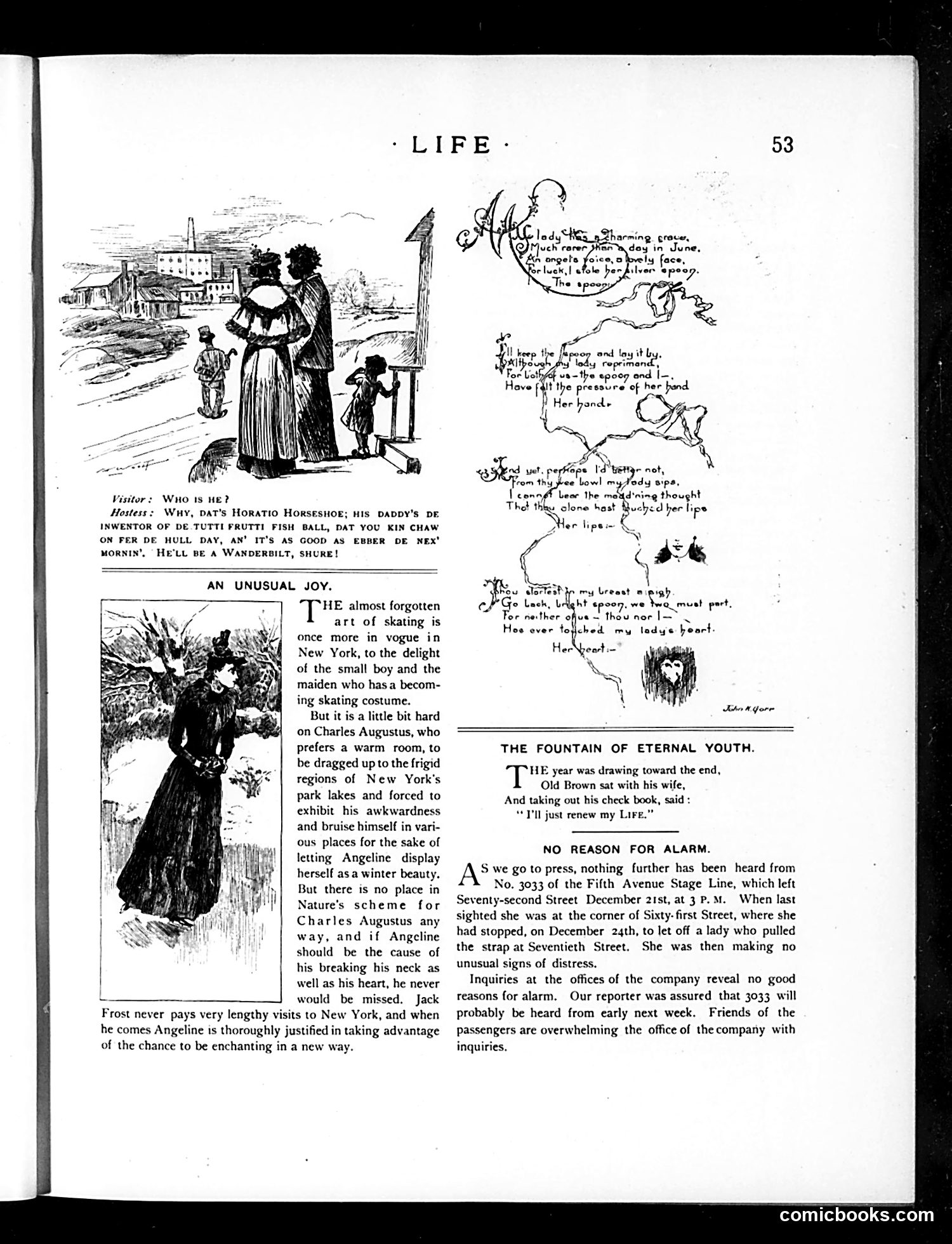
This page contains three distinct items: 1. **Top illustration and dialogue**: A social scene depicting a visitor meeting a hostess. The humor relies on Irish immigrant stereotypes and working-class speech patterns typical of early 20th-century American satire. The hostess mocks the visitor's father as an inventor of trivial items. 2. **"An Unusual Joy"**: A sketch mocking Charles Augustus (likely a contemporary figure) being forced to ice skate in New York parks by his companion Angeline. The satire suggests he's physically awkward and uncomfortable with this "modern" winter activity. 3. **Two news items**: "The Fountain of Eternal Youth" and "No Reason for Alarm"—brief humorous pieces about an elderly man's life renewal claims and a missing Fifth Avenue Stage Line passenger, respectively. The page exemplifies Life's satirical style targeting social pretensions and contemporary urban life.
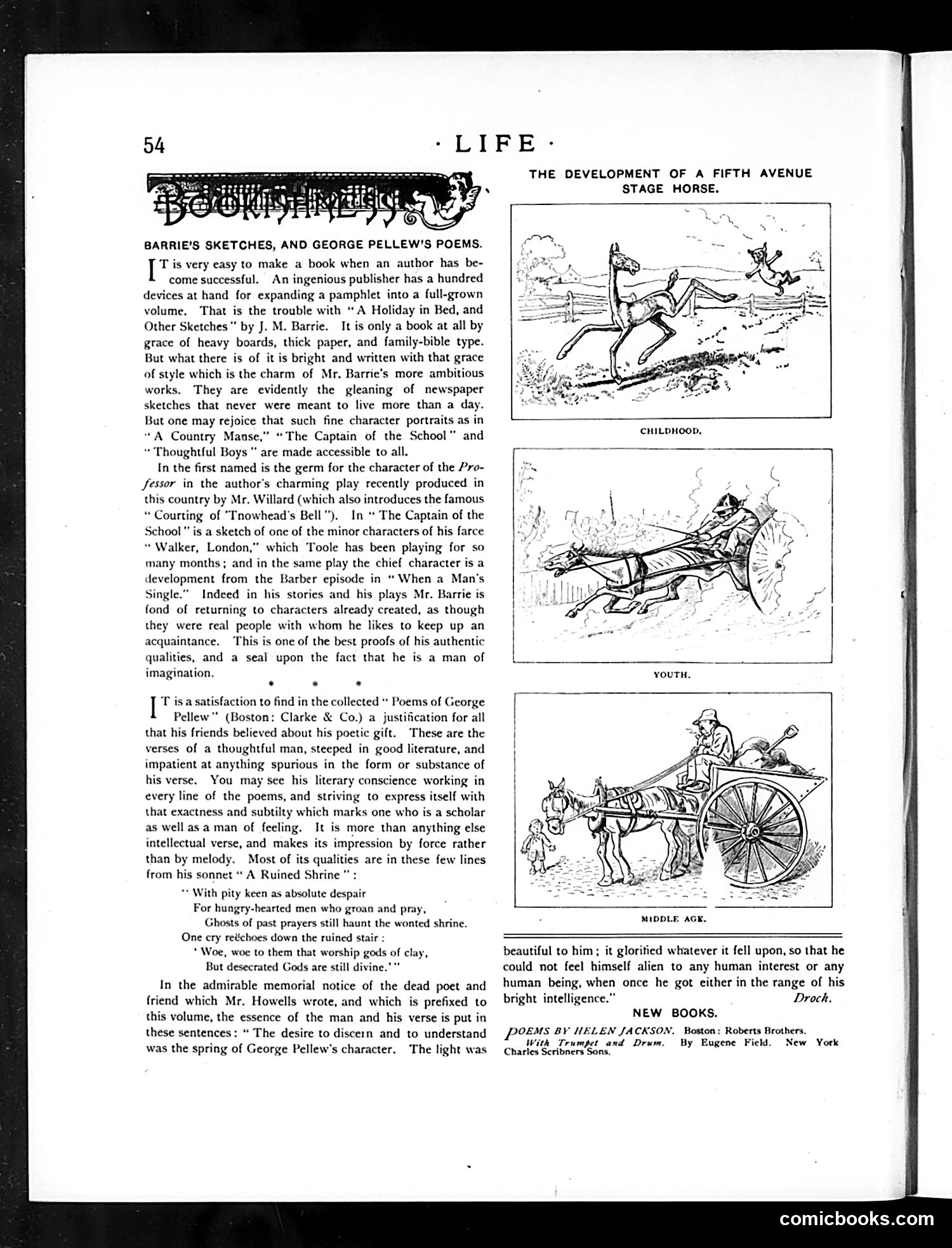
This page primarily contains **literary criticism and book reviews** rather than political cartoons. The left column discusses J.M. Barrie's sketches and George Pellew's poems, praising Barrie's character portraits from his plays, including "The Captain of the School." The right side features **three illustrations** titled "The Development of a Fifth Avenue Stage Horse," showing a horse at different life stages: childhood (bucking), youth (pulling a cart with children), and middle age (pulling a larger wagon). These are humorous, satirical drawings depicting how urban workhorses were worn down through years of labor on New York's Fifth Avenue. This is social satire about animal welfare and urban conditions rather than political commentary.
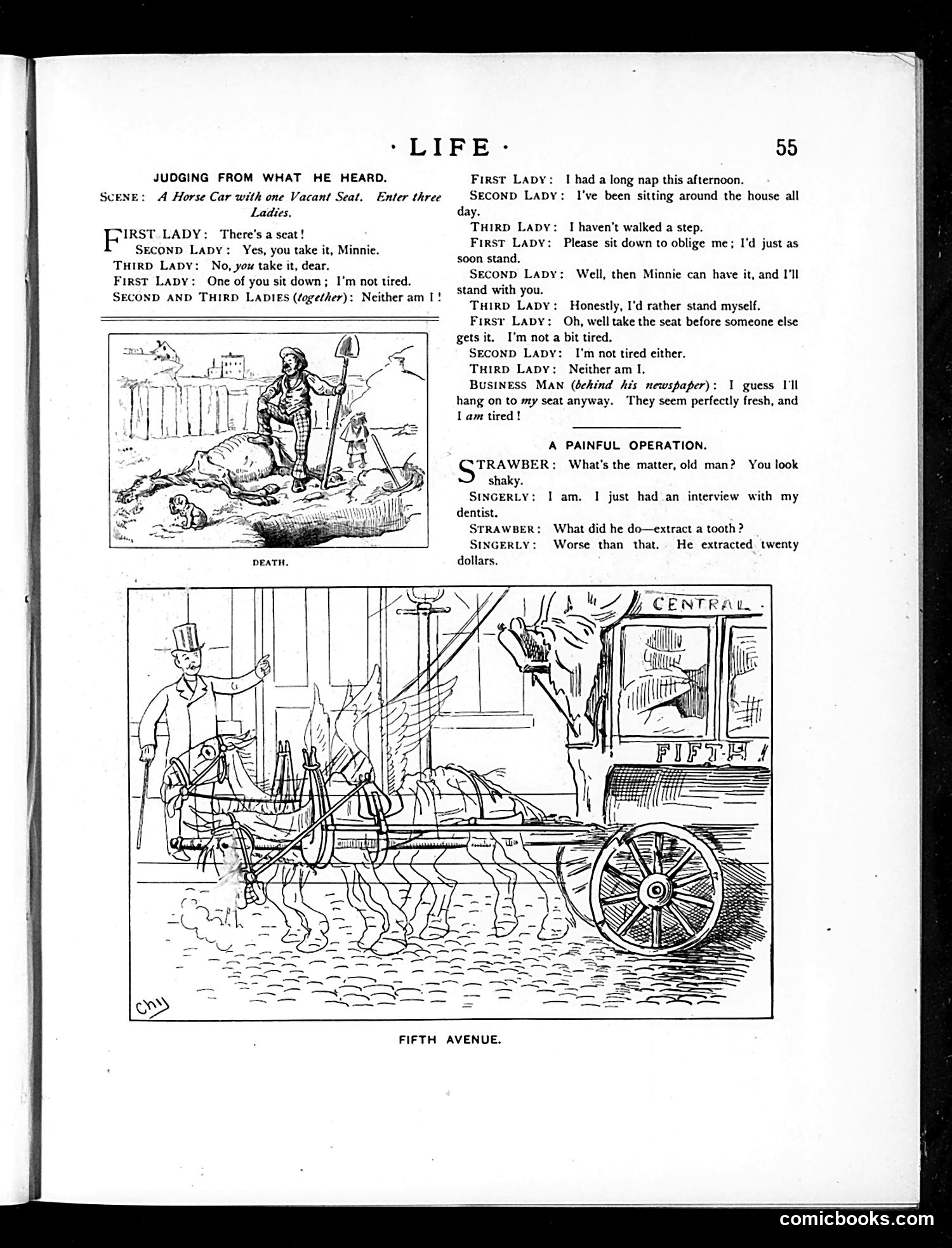
This page contains two humorous sketches with accompanying dialogue. **Top cartoon ("Death")**: Shows a figure with a scythe confronting someone in a horse-drawn carriage. The joke concerns tired commuters on public transit—three ladies debate who should occupy a vacant seat, each claiming exhaustion. A businessman ultimately takes it, prompting the ladies' resigned acceptance. **Bottom cartoon ("Fifth Avenue")**: Depicts a horse-drawn delivery wagon on a crowded street, with the horse appearing distressed or collapsing. The accompanying dialogue shows a strawberry vendor and singer discussing painful dentistry—the singer's dentist extracted twenty teeth rather than one, leaving him unable to perform. Both sketches use visual exaggeration for comedic effect, depicting everyday urban inconveniences and misfortunes common to early 20th-century American city life.
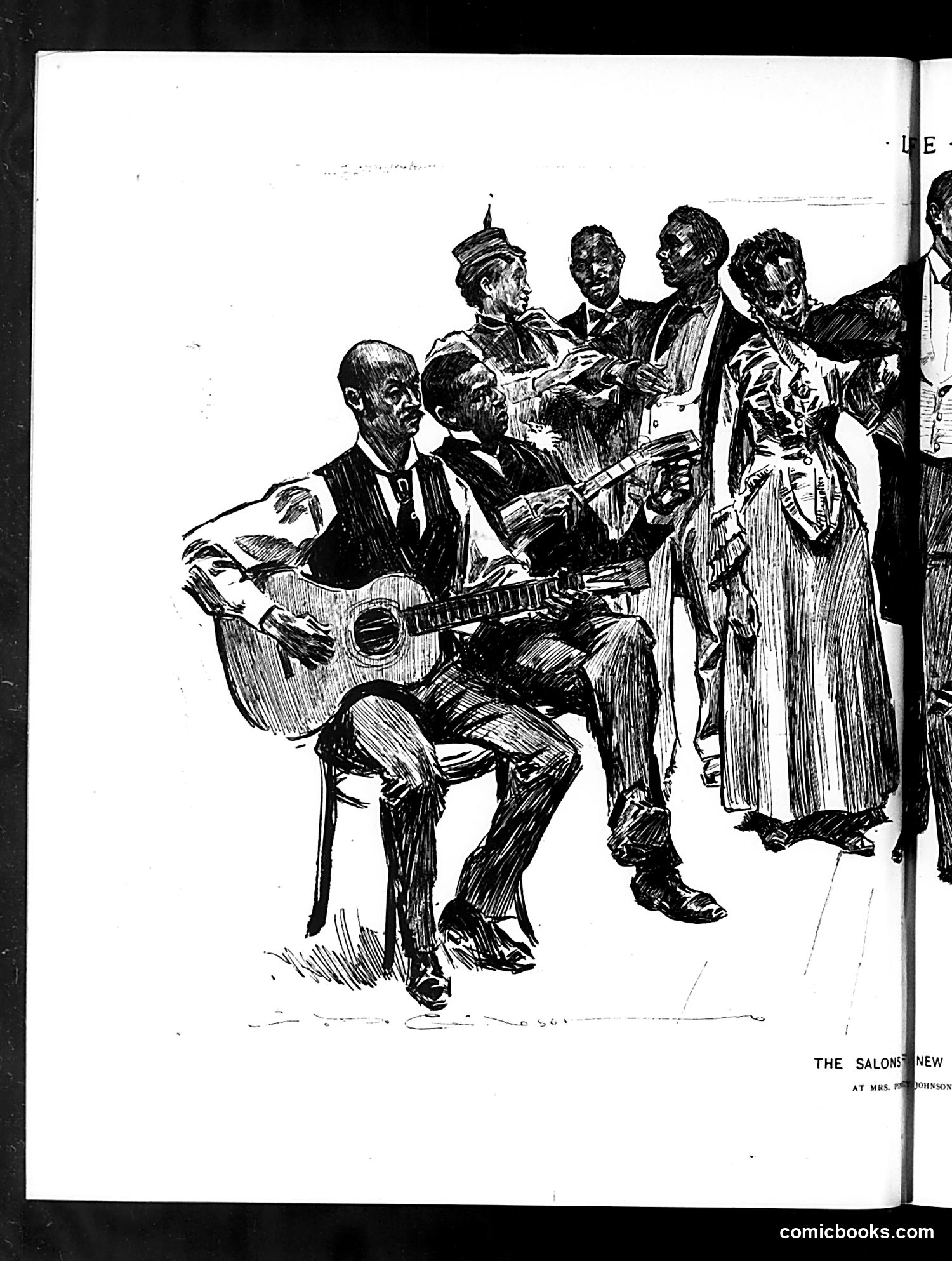
The caption reads "THE SALONS NEW AT MRS. [JOHNSON]" (text partially obscured). This illustration depicts a social gathering—likely at a fashionable salon or home—centered around a man seated with a guitar. He's surrounded by well-dressed figures in formal attire, including women in period dress. The sketch style suggests early 20th-century Life magazine satire. The humor appears to target either pretentious salon culture or an amateur musician being indulged by society. The gathered crowd's formal postures and attentive positioning around the guitarist suggests gentle mockery of either the performer's self-importance or the attendees' affected appreciation of mediocre talent—a common subject for Life's social satire of the era. Without the complete caption, the specific target remains unclear.
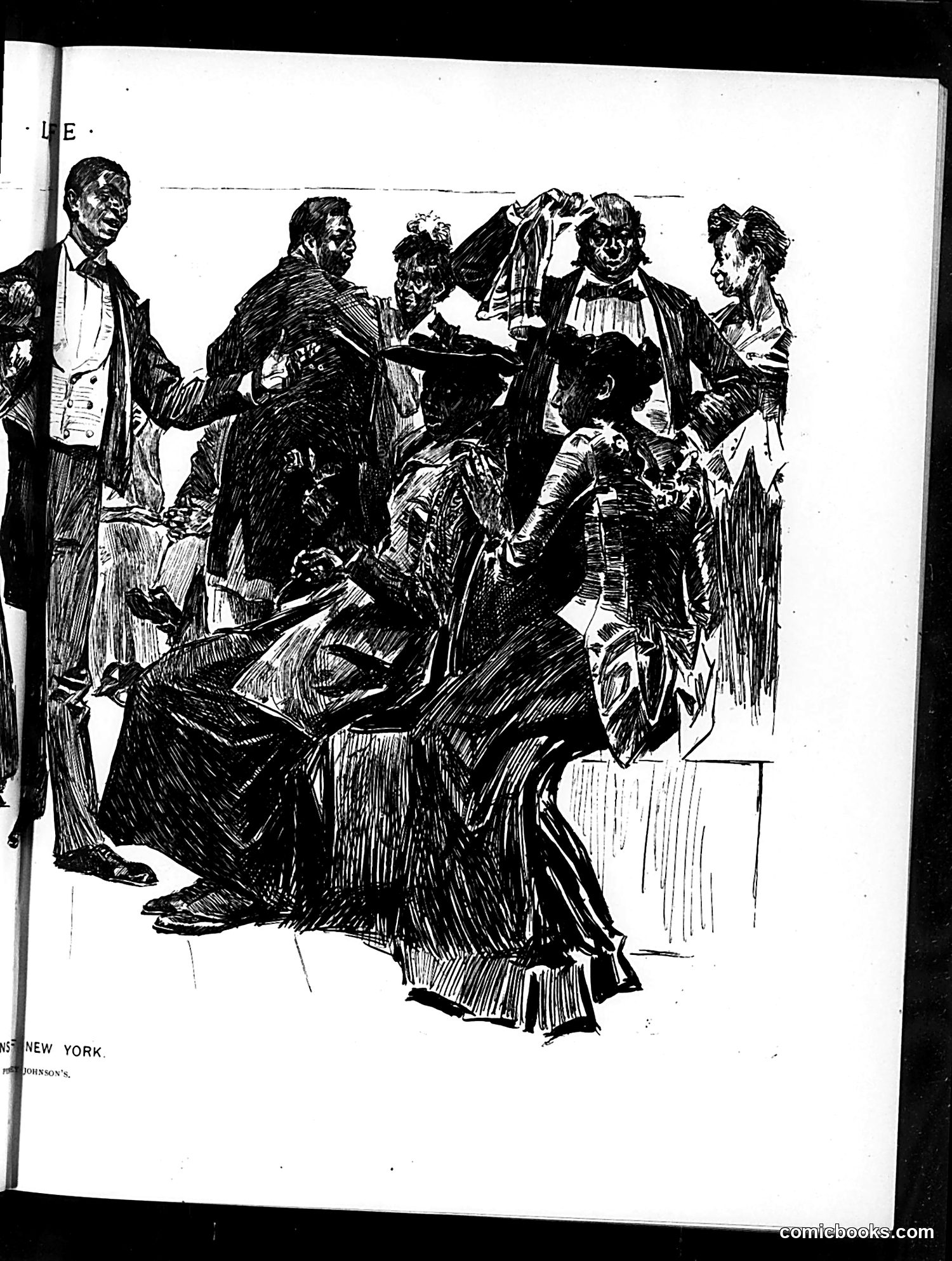
This appears to be a sketch from *Life* magazine (text shows "NEW YORK" and "JOHNSON'S" at bottom) depicting what seems to be a formal social gathering or reception. The illustration shows well-dressed men in formal attire (tuxedos) surrounding seated women in elaborate gowns, rendered in bold black ink with cross-hatching. Without visible text identifying the specific figures or context, I cannot definitively state what political or social satire this addresses. The formal setting and artist's style suggest it may be satirizing high society behavior, social pretension, or a specific contemporary event. However, the lack of clear identifying details in the visible portion prevents me from accurately explaining the specific references or figures to a modern reader. Additional caption or context would be needed for precise interpretation.
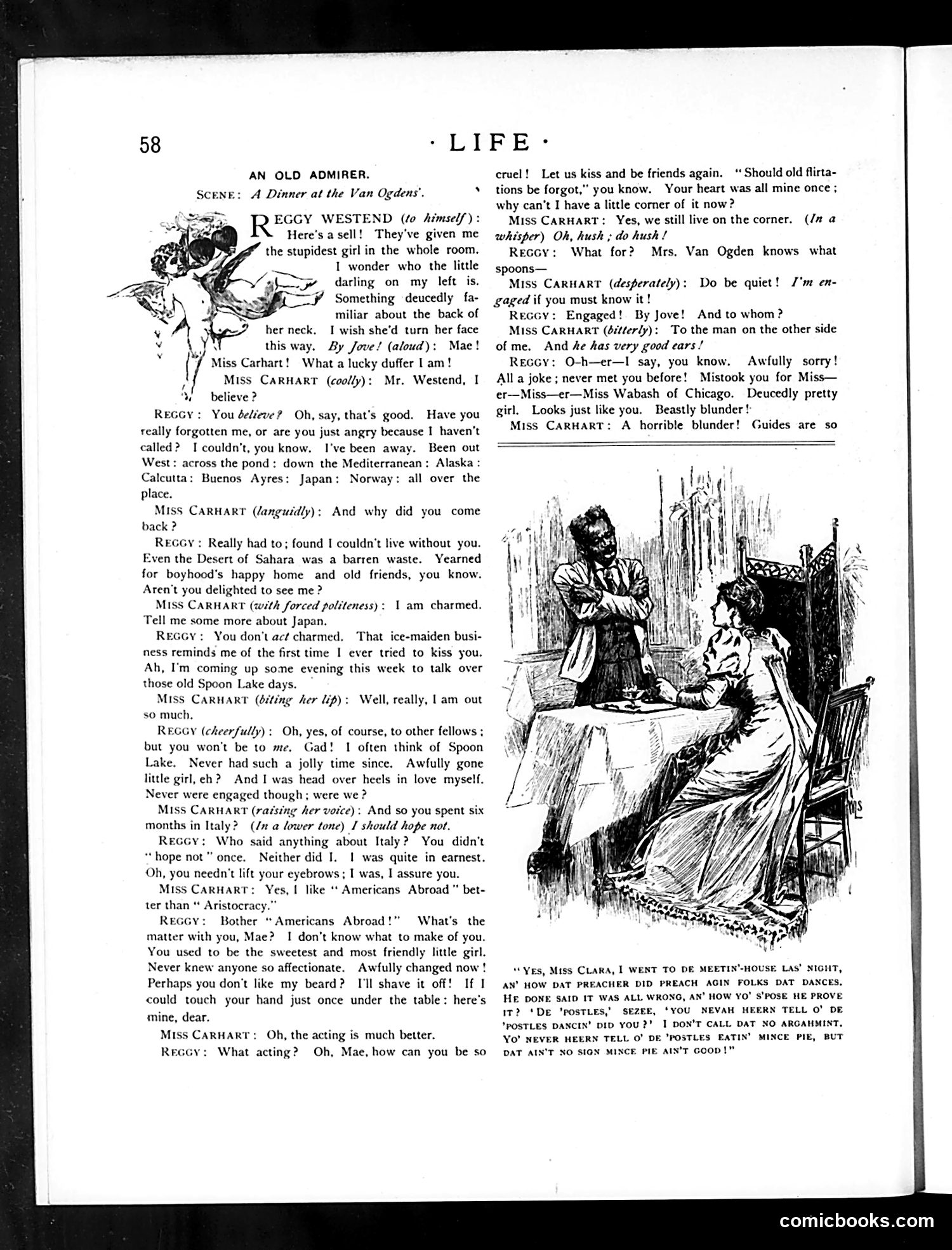
This theatrical sketch depicts a reunion between two former romantic interests. Reggy, a man who has traveled extensively (West, Mediterranean, Alaska, Calcutta, Buenos Aires, Japan, Norway), returns to reconnect with Miss Carhart. She initially appears upset at his long absence, but gradually softens. The humor centers on their romantic banter and Reggy's attempts at reconciliation—claiming he couldn't live without her and was miserable during his travels. Miss Carhart alternates between indignation and affection, while other characters comment on their reconciliation. The accompanying illustration shows two women in period dress having tea, with a caption referencing church dances and preachers—likely satirizing small-town social gossip and morality debates of the era.
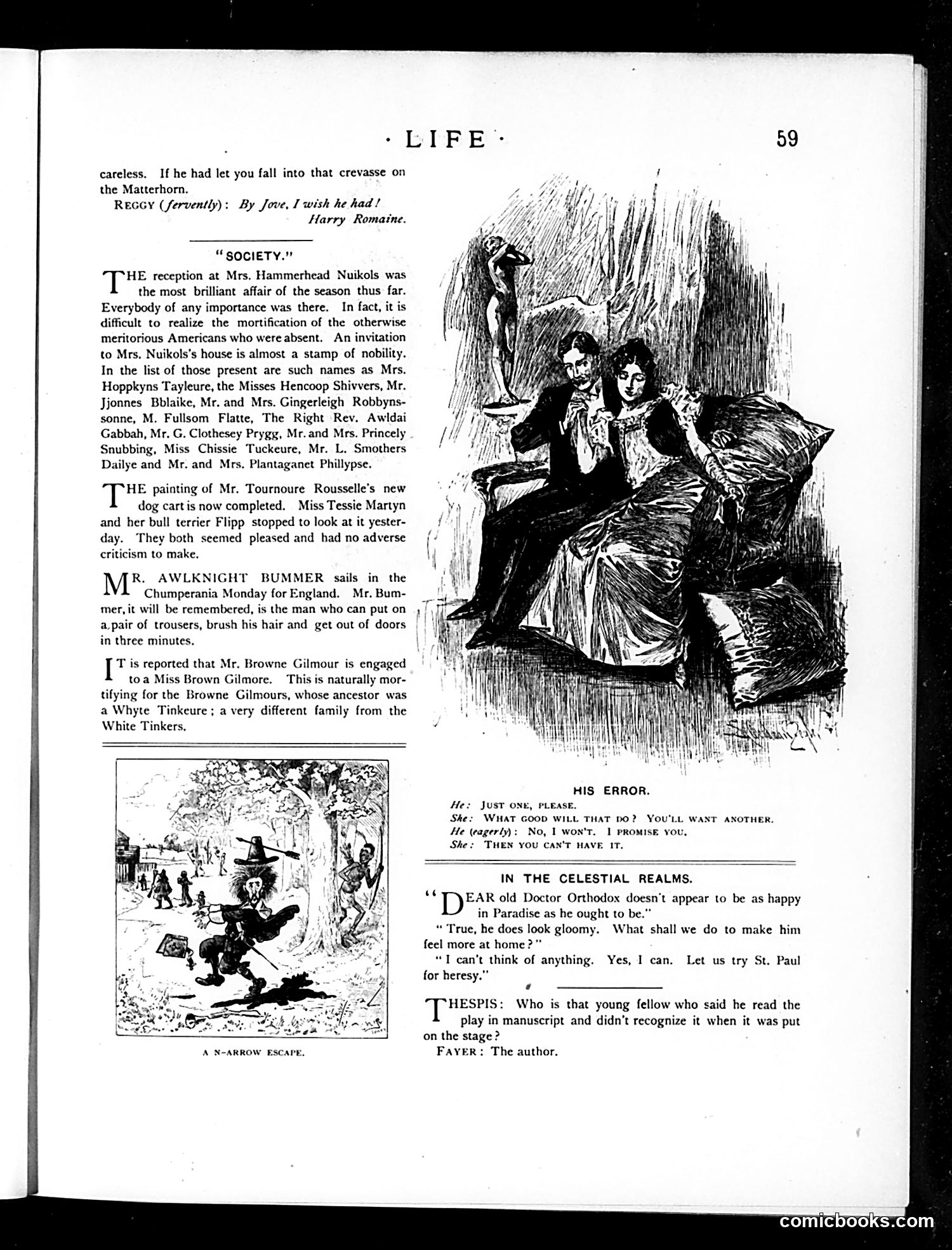
This page contains social gossip and humorous anecdotes rather than political cartoons. The "Society" section reports on Mrs. Hammerhead Nukols's reception, listing prominent attendees—typical upper-class social reporting. **The cartoons:** - "A Narrow Escape" (lower left) depicts a figure in witch attire narrowly avoiding harm, likely satirizing superstition or misfortune. - "His Error" (upper right) shows a domestic dispute about wanting "just one" of something, with the punchline about not being able to have it—a commentary on marital disagreements. - "In the Celestial Realms" is a brief theological joke about Doctor Orthodox and Saint Paul in Paradise. The page reflects turn-of-century upper-class preoccupations and mild domestic humor rather than substantive social critique.
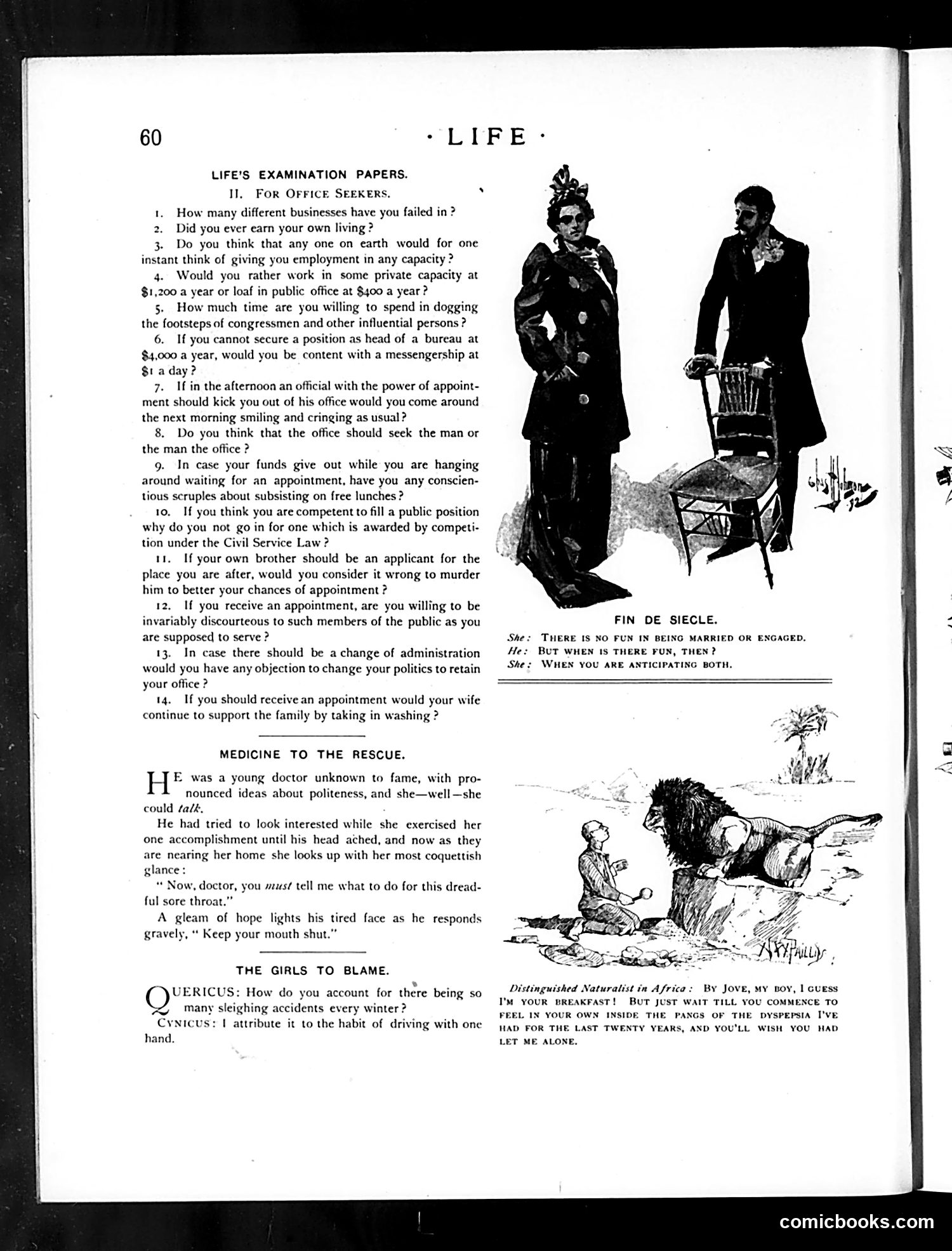
This page satirizes late 19th/early 20th-century American political corruption and social hypocrisy through multiple comic sections: **"Examination Papers for Office Seekers"** mocks the spoils system—the practice of politicians awarding government jobs to unqualified loyalists rather than merit-based candidates. The questions expose the cynicism: applicants are expected to have failed at business, lack self-respect, accept pittance wages, grovel before officials, and abandon principles with each administration change. The satire targets both corrupt politicians who dispense patronage and desperate office-seekers willing to compromise ethics for employment. **"Medicine to the Rescue"** is a brief joke about a talkative woman whose incessant conversation gives a doctor a headache; his "cure" is telling her to shut up. **"Fin de Siècle"** and **"The Girls to Blame"** are lighter social commentary on courtship and winter accidents. **"Distinguished Naturalist"** offers a darkly humorous revenge fantasy where a lion considers eating a man only to reconsider after learning of his chronic dyspepsia. The overall thrust criticizes government corruption and social pretense as endemic American problems.
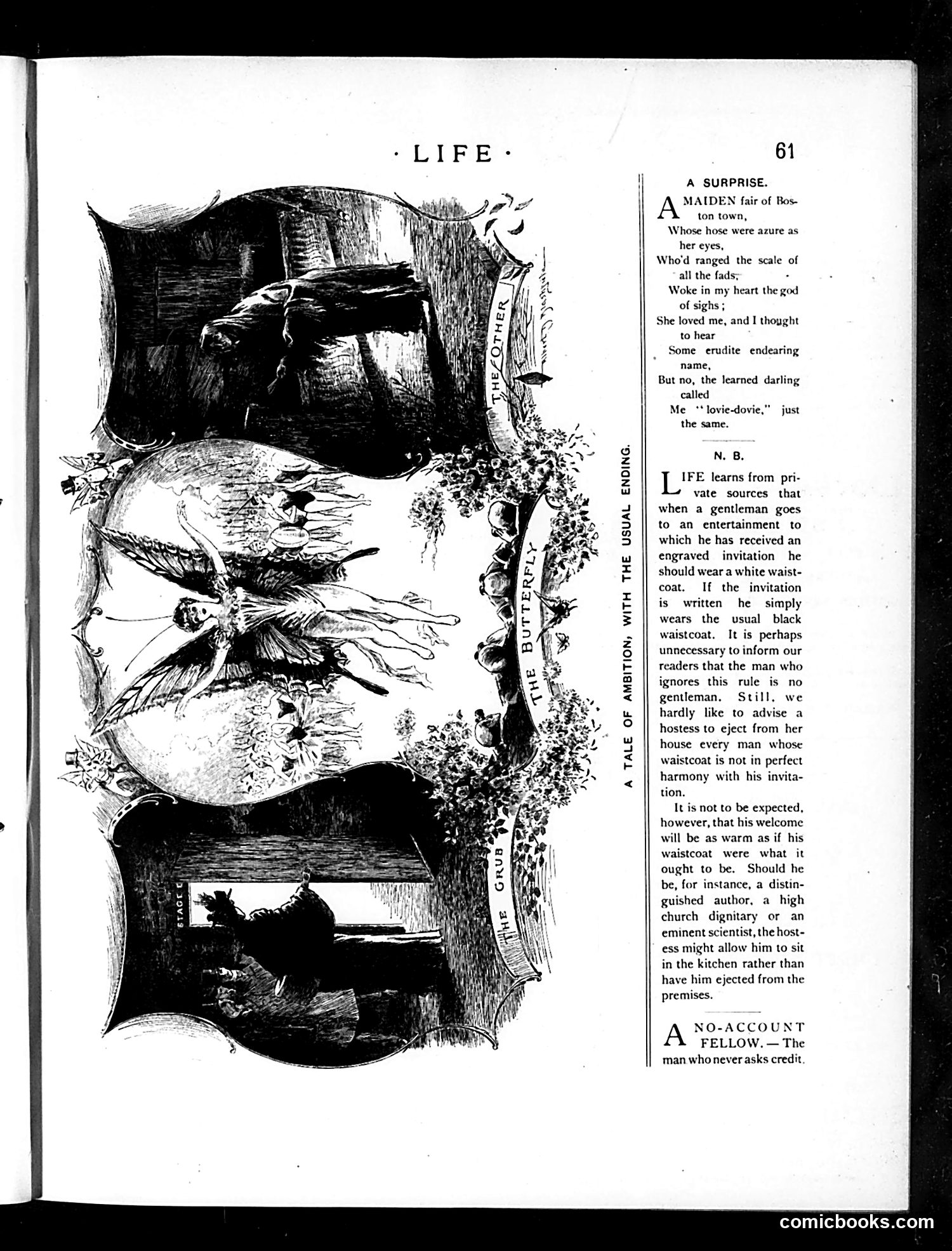
This page contains three short humorous pieces rather than a political cartoon: 1. **"A Surprise"**: A poem about a Boston maiden whose beauty and charm captivated the narrator, until he discovered she was known by the common nickname "Lord-dovie" — deflating the romantic notion. 2. **"N.B."**: Social etiquette advice addressing an "unusual encoding" about white waistcoats at formal entertainments. It argues that hosts should warmly welcome distinguished guests regardless of minor dress code violations, as their status outweighs sartorial concerns. 3. **"A No-Account Fellow"**: A brief definition: "The man who never asks credit." The ornamental illustrations frame these pieces with period-appropriate artistic flourishes. The content reflects typical *Life* magazine humor—romantic disappointment, social propriety debates, and character-type definitions—targeting educated middle-class readers concerned with etiquette and romantic conventions.
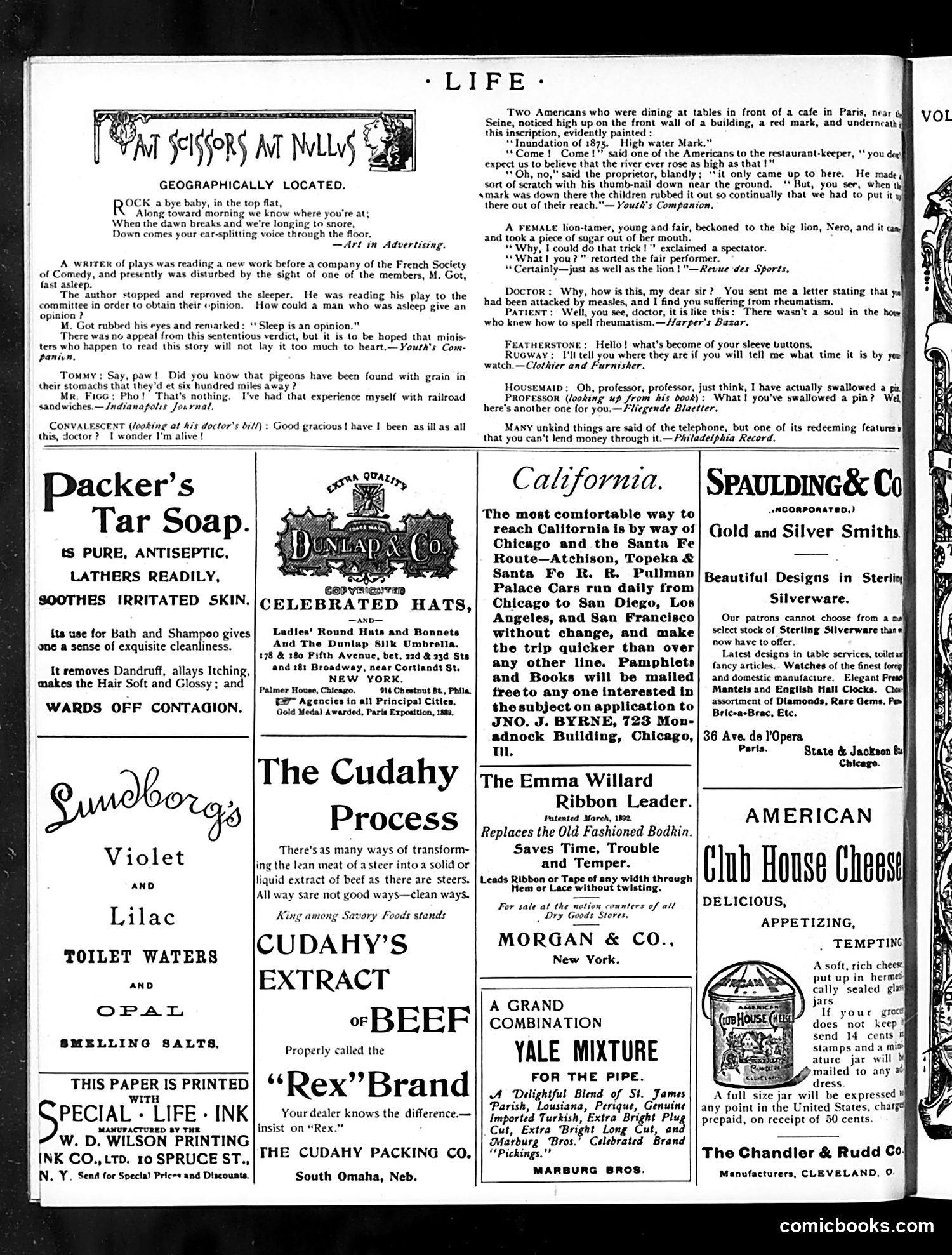
This page is primarily **advertisements and humorous anecdotes** rather than political cartoons. The humor pieces are brief jokes satirizing everyday situations: - **"Rock-a-bye Baby"**: Mock-sympathetic complaint about noisy upstairs neighbors waking sleepers at dawn - **French playwright anecdote**: A sleeping committee member's comeback—"Sleep is an opinion"—defends his inattention to bad theater - **Paris café scene**: Americans mock a "High Water Mark" on a building from 1875 floods, but the proprietor reveals children rubbed it down so often they had to repaint it lower - **Lion tamer**: A spectator boasts he could do her trick; she retorts he couldn't - **Doctor mix-up**: A patient wrote "measles" instead of "rheumatism" because no one knew how to spell the latter - **Telephone joke**: You can't lend money through a telephone (implying people always ask for loans) These are gentle, class-conscious Victorian-era jokes about servants, foreigners, bad theater, and social pretension. The advertisements (Packer's Tar Soap, Dunlap hats, Spaulding silverware) dominate the layout.