
Life, 1893-01-26 · page 4 of 14
Life — January 26, 1893 — page 4: what you’re looking at
What you’re looking at
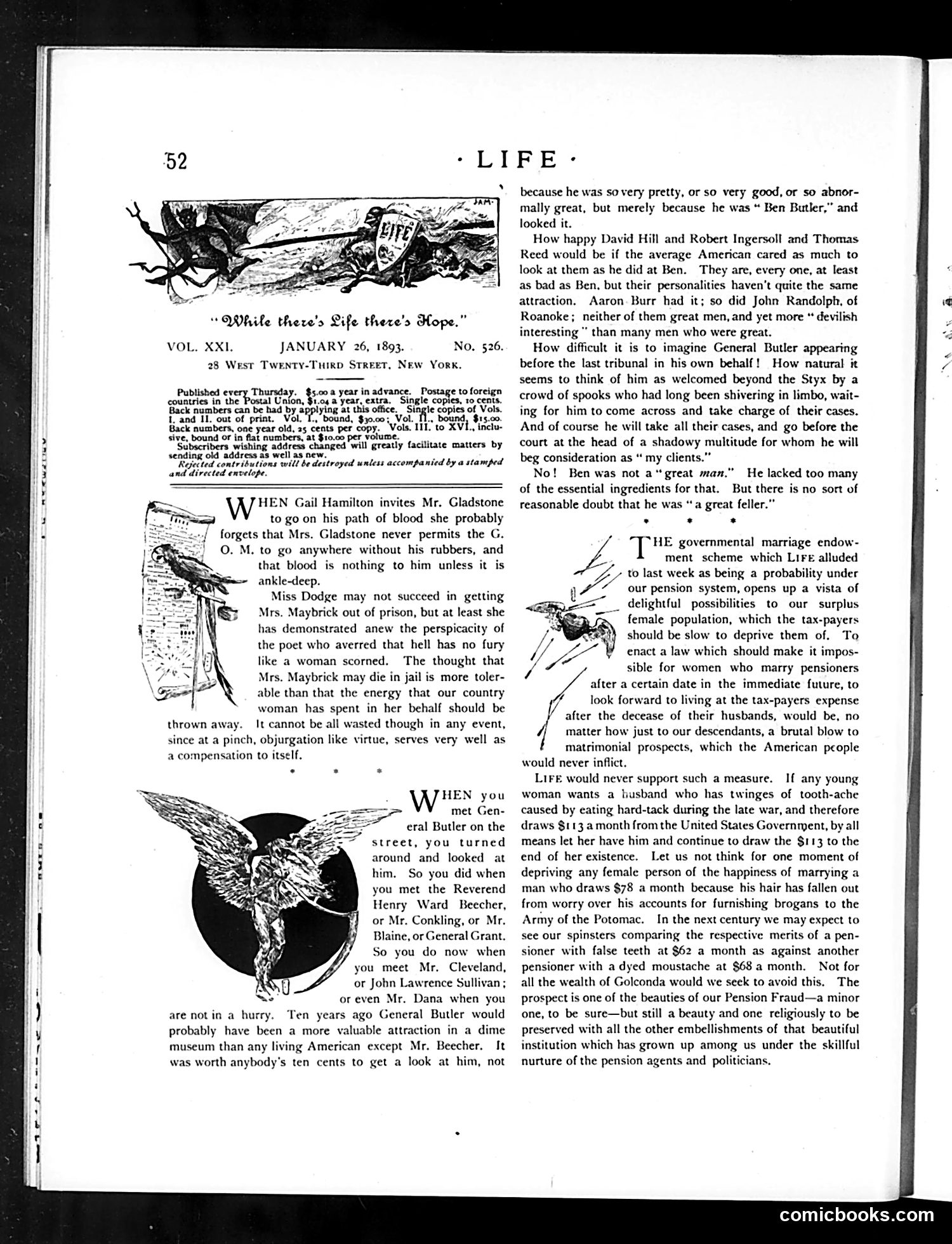
This page contains three editorial cartoons satirizing contemporary figures and issues: 1. **"While there's Life there's Hope"** (top): The masthead illustration, likely a general statement about optimism. 2. **Mrs. Gladstone/Gail Hamilton cartoon** (left): Mocks Mrs. Gladstone for refusing to allow her husband near blood relatives or anywhere without rubbers, suggesting overly controlling behavior. The satire portrays her as unreasonably restrictive. 3. **General Butler cartoon** (large, right): Compares meeting General Butler on the street to seeing famous historical figures (Beecher, Grant, Cleveland, Sullivan, Dana). The point appears to be that Butler was once nationally significant but has faded in prominence—now merely a curiosity rather than a commanding presence. The page combines personal ridicule with political commentary on declining public figures.
📄 Transcribed text from this page (OCR, searchable)
Machine-transcribed from the original scan — historical spelling and the odd misread are preserved.
LIFE , “While there's Life there's Hope.” XX. JANUARY 26, 1893. No. 526. 28 West Twenty-Tuirp Street, New York. Postage to foreign ‘Thursda; a year in advance. countries in the Postal Union, a year, extra. Single copies, ro cents. Pack numbers can be had by y aplying. at this office. Single copies * Me and II. out oft print. Vol, bound, Vol. . bound. baat numbers, one year old, 25 cents per a Wats. IIT. to XV1., iso. sive, bound or in flat numbers, at $10.00 per volu eames, wishing address changed will greatly facilitate matters by ing old address as well as new. “Rejected contributions will be destroyed untess accompanied by a stamped and directed envelope. VOL. Published ev HEN Gail Hamilton invites Mr. Gladstone to goon his path of blood she probably forgets that Mrs. Gladstone never permits the G. O. M. to go anywhere without his rubbers, and that blood is nothing to him unless it is ankle-deep. Miss Dodge may not succeed in getting Mrs. Maybrick out of prison, but at least she has demonstrated anew the perspicacity of the poet who averred that hell has no fury like a woman scorned. The thought that Mrs. Maybrick may die in jail is more toler- able than that the energy that our country woman has spent in her behalf should be thrown away. It cannot be all wasted though in any event, since at a pinch, objurgation like virtue, serves very well as a compensation to itself. HEN you met Gen- eral Butler on the street, you turned around and looked at him. So you did when you met the Reverend Henry Ward Beecher, or Mr. Conkling, or Mr. Blaine, or General Grant. So you do now when you meet Mr. Cleveland, or John Lawrence Sullivan ; oreven Mr. Dana when you are notin a hurry. Ten years ago General Butler would probably have been a more valuable attraction in a dime museum than any living American except Mr. Beecher, It was worth anybody's ten cents to get a look at him, not because he was so very pretty, or so very good, or so abnor- mally great, but merely because he was “ Ben Butler,” and looked it. How happy David Hill and Robert Ingersoll and Thomas Reed would be if the average American cared as much to look at them as he did at Ben. They are, every one, at least as bad as Ben, but their personalities haven't quite the same attraction. Aaron. Burr had it; so did John Randolph, of Roanoke; neither of them great men, and yet more “ devilish interesting ” than many men who were great. How difficult it is to imagine General Butler appearing before the last tribunal in his own behalf! How natural it seems to think of him as welcomed beyond the Styx by a crowd of spooks who had long been shivering in limbo, wait- ing for him to come across and take charge of their cases. And of course he will take all their cases, and go before the court at the head of a shadowy multitude for whom he will beg consideration as “ my clients.” No! Ben was not a“ great man.” of the essential ingredients for that. But there is no sort of reasonable doubt that he was “a great feller.” . . He lacked too many ~HE governmental marriage endow- Lt ment scheme which LiFe alluded ZL to last week as being a probability under TZ our pension system, opens up a vista of <= _ delightful possibilities to our surplus female population, which the tax-payers should be slow to deprive them of. To enact a law which should make it impos- sible for women who marry pensioners after a certain date in the immediate future, to , look forward to living at the tax-payers expense “Y after the decease of their husbands, would be, no matter how just to our descendants, a brutal blow to matrimonial prospects, which the American people would never inflict. LiFe would never support such a measure. If any young woman wants a lusband who has twinges of tooth-ache caused by eating hard-tack during the late war, and therefore draws $113 a month from the United States Government, by all means let her have him and continue to draw the $113 to the end of her existence. Let us not think for one moment of depriving any female person of the happiness of marrying a man who draws $78 a month because his hair has fallen out from worry over his accounts for furnishing brogans to the Army of the Potomac. In the next century we may expect to see our spinsters comparing the respective merits of a pen- sioner with false teeth at $62 a month as against another pensioner with a dyed moustache at $68 a month. Not for all the wealth of Golconda would we seek to avoid this. The prospect is one of the beauties of our Pension Fraud—a minor one, to be sure—but still a beauty and one religiously to be preserved with all the other embellishments of that beautiful institution which has grown up among us under the skillful nurture of the pension agents and politicians. comicbooks.com