
Life, 1893-01-26 · page 6 of 14
Life — January 26, 1893 — page 6: what you’re looking at
What you’re looking at
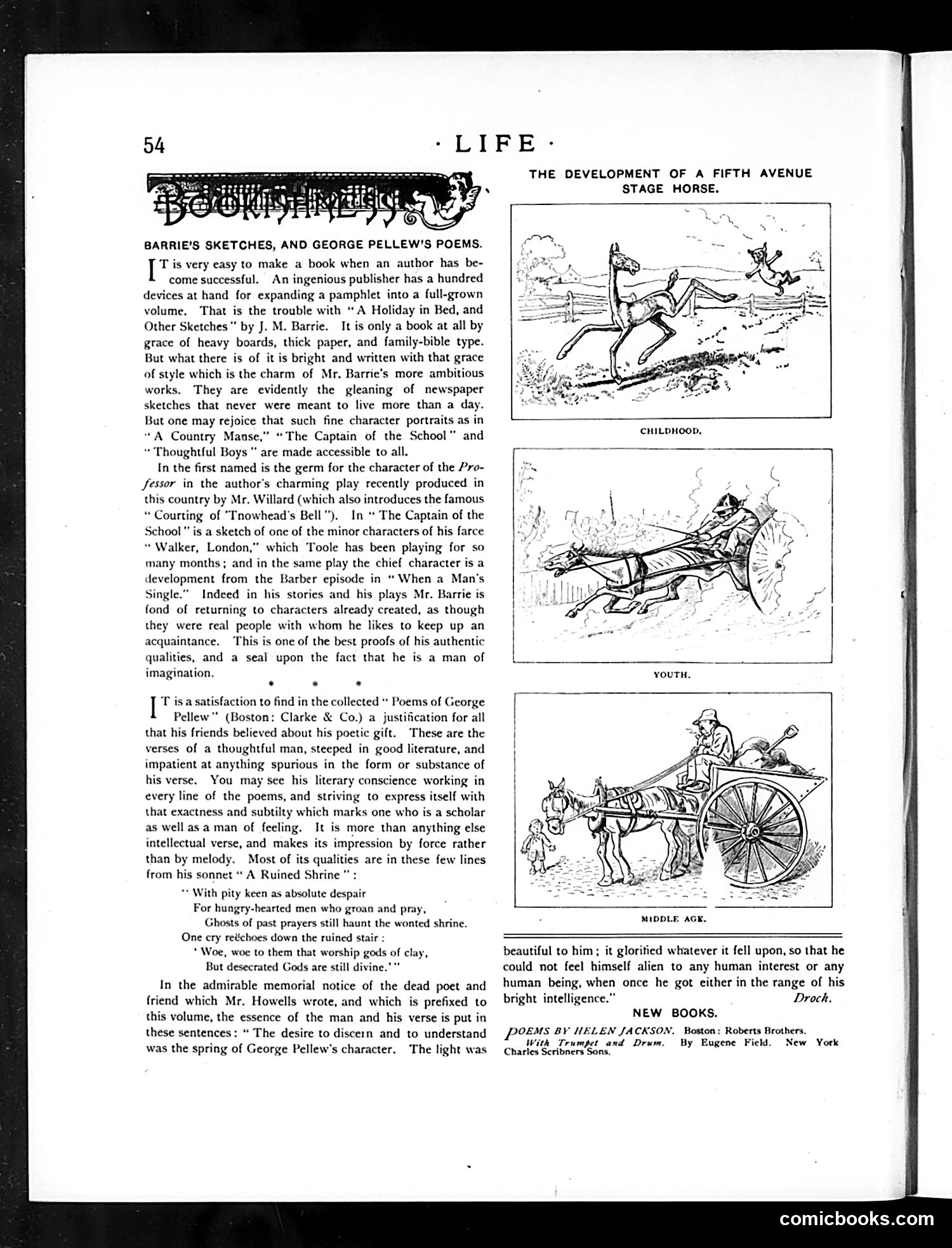
This page primarily contains **literary criticism and book reviews** rather than political cartoons. The left column discusses J.M. Barrie's sketches and George Pellew's poems, praising Barrie's character portraits from his plays, including "The Captain of the School." The right side features **three illustrations** titled "The Development of a Fifth Avenue Stage Horse," showing a horse at different life stages: childhood (bucking), youth (pulling a cart with children), and middle age (pulling a larger wagon). These are humorous, satirical drawings depicting how urban workhorses were worn down through years of labor on New York's Fifth Avenue. This is social satire about animal welfare and urban conditions rather than political commentary.
📄 Transcribed text from this page (OCR, searchable)
Machine-transcribed from the original scan — historical spelling and the odd misread are preserved.
- LIFE: BARRIE’S SKETCHES, AND GEORGE PELLEW’S POEMS. T is very easy to make a book when an author has be- come successful. An ingenious publisher has a hundred devices at hand for expanding a pamphlet into a full-grown volume, That is the trouble with “A Holiday in Bed, and Other Sketches" by J. M. Barrie, It is only a book at all by grace of heavy boards, thick paper, and family-bible type. But what there is of it is bright and written with that grace of style which is the charm of Mr. Barrie’s more ambitious works. They are evidently the gleaning of newspaper sketches that never were meant to live more than a day. But one may rejoice that such fine character portraits as in “A Country Manse,” “The Captain of the School” and * Thoughtful Boys " are made accessible to all, In the first named is the germ for the character of the Pro- fessor in the author's charming play recently produced in this country by Mr. Willard (which also introduces the famous “ Courting of "Tnowhead’s Bell"). In ‘ The Captain of the School” is a sketch of one of the minor characters of his farce “Walker, London,” which Toole has been playing for so many months ; and in the same play the chief character is a development from the Barber episode in “ When a Man's Single.” Indeed in his stories and his plays Mr. Barrie is fond of returning to characters already created, as though they were real people with whom he likes to keep up an acquaintance. This is one of the best proofs of his authentic qualities, and a seal upon the fact that he is a man of imagination. . * . T isa satisfaction to find in the collected * Poems of George Pellew" (Boston: Clarke & Co.) a justification for all that his friends believed about his poetic gift. These are the verses of a thoughtful man, steeped in good literature, and impatient at anything spurious in the form or substance of his verse. You may see his literary conscience working in every line of the poems, and striving to express itself with that exactness and subtilty which marks one who is a scholar as well as a man of feeling. It is more than anything else intellectual verse, and makes its impression by force rather than by melody. Most of its qualities are in these few lines from his sonnet “A Ruined Shrine" ** With pity keen as absolute despair For huagry-hearted men who groan and pray, Ghosts of past prayers still haunt the wonted shrine. One cry reichoes down the ruined stair : * Woe, woe to them that worship gods of clay, But desecrated Gods are still divine.’ In the admirable memorial notice of the dead poet and friend which Mr. Howells wrote, and which is prefixed to this volume, the essence of the man and his verse is put in these sentences: “ The desire to discern and to understand was the spring of George Pellew’s character. The light was THE DEVELOPMENT OF A FIFTH AVENUE STAGE HORSE. YOUTH. MIDDLE AGE. beautiful to him; it gloritied whatever it fell upon, so that he could not feel himself alien to any human interest or any human being, when once he got either in the range of his bright intelligence.” Droch. NEW BOOKS. POEMS BY HELEN JACKSON. Boston: Roberts Brothers. With Trumpet and Drum, By Eugene Field. New York Charles Scribners Sons. comicbooks.com