
A complete issue · 16 pages · 1892
Life — December 8, 1892
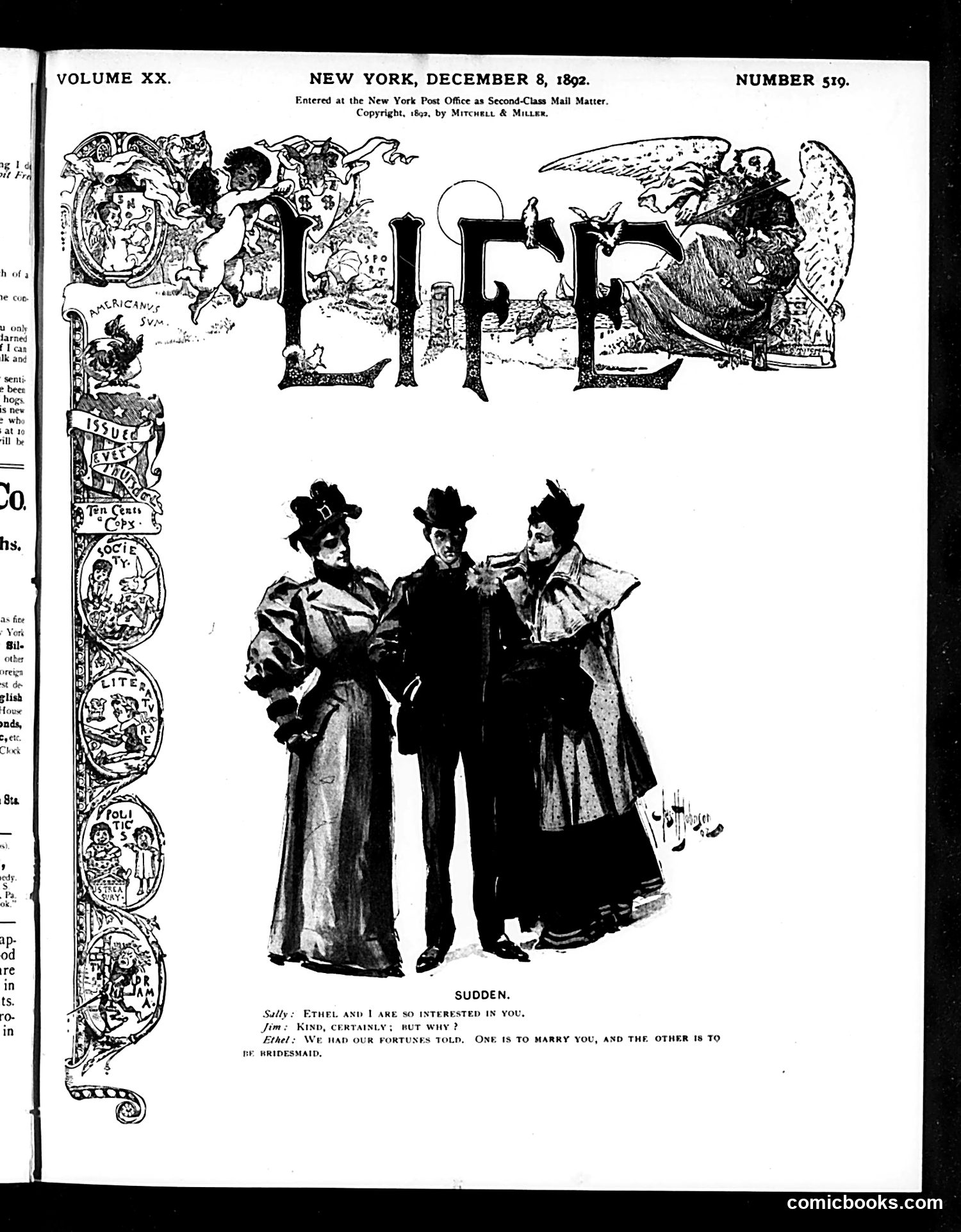
This is a satirical cartoon about marriage prospects for wealthy young women. Three fashionably dressed figures (two women and a man between them) discuss matrimonial fortunes. The caption reveals the joke: a fortune teller has predicted that one woman will marry while the other becomes a bridesmaid—a common anxiety of the period regarding eligible matches. The humor targets Victorian-era marriage anxiety and the social pressure on women to secure advantageous unions. The "sudden" revelation of their fates creates dramatic irony, as the women's fates have apparently been predetermined by fortune-telling rather than romantic choice. This reflects period anxieties about women's limited agency in marriage arrangements and their dependence on luck rather than personal selection.
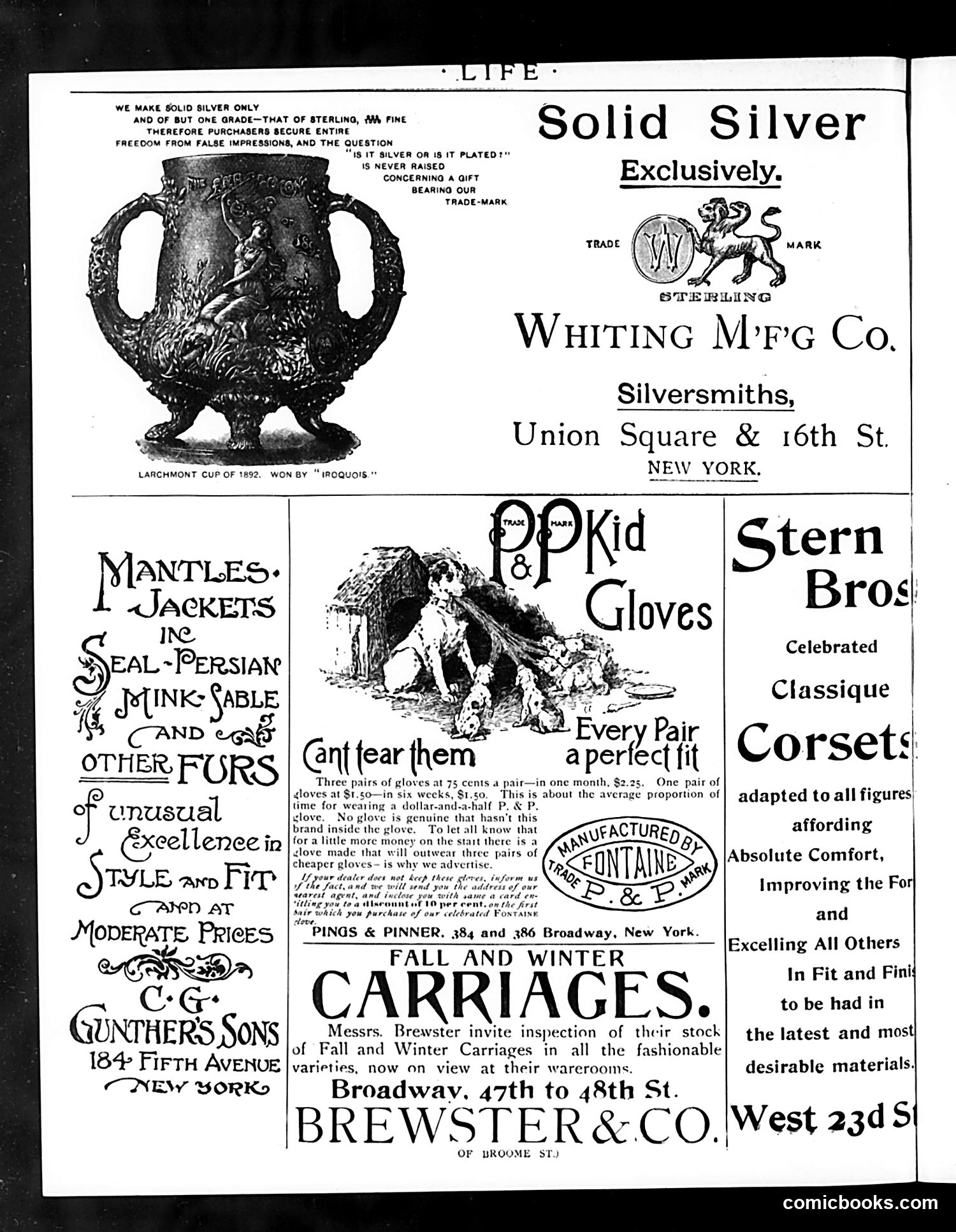
This page is **primarily advertising** with no discernible political cartoon or satirical content. The upper half features an ad for Whiting Mfg Co., silversmiths in New York, promoting sterling silver goods and displaying an ornamental cup from 1892. The lower half contains four separate commercial advertisements: C.G. Günthers Sons (fur jackets), P&P Kid Gloves, Stern Bros (corsets), and Brewster & Co. (carriages). All content reflects late 19th/early 20th-century consumer goods marketed to affluent readers—luxury items like fur coats, fine gloves, fashionable corsets, and custom carriages. There is no apparent satire, social commentary, or political reference on this particular page.
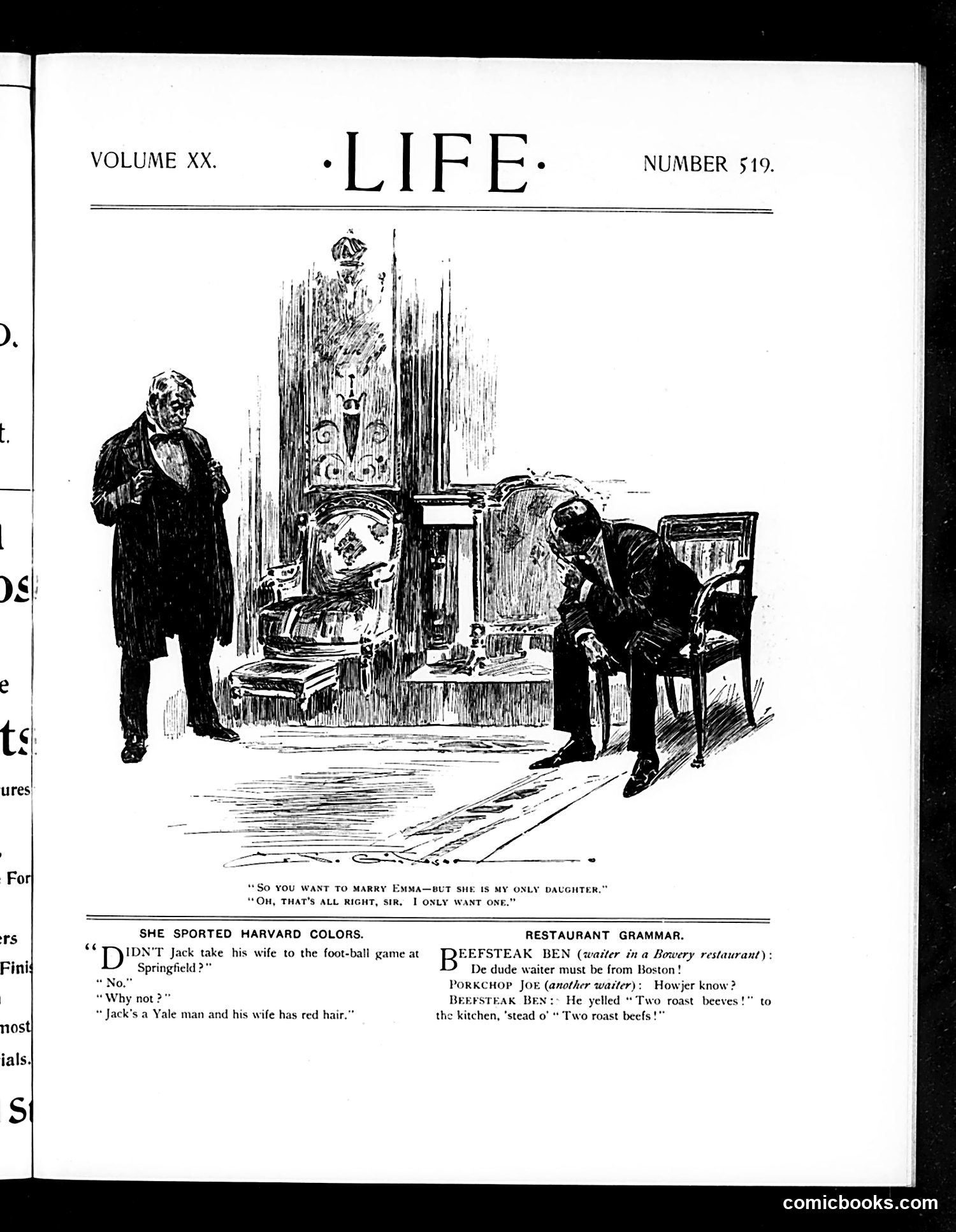
This page contains two separate humor pieces from *Life* magazine (Volume XX, Number 519). **Top cartoon**: Shows a domestic scene where a man seated and a man standing discuss marriage. The caption reads: "So you want to marry Emma—but she is my only daughter" / "Oh, that's all right, sir. I only want one." The joke plays on the father's protective concern being humorously deflated by the suitor's matter-of-fact response. **Bottom section**: Two brief comic anecdotes—"She Sported Harvard Colors" (about a Yale man's wife with red hair) and "Restaurant Grammar" (about a waiter's linguistic confusion between "Boston" and "roast beeves"). These are simple wordplay jokes typical of early 20th-century humor magazines.
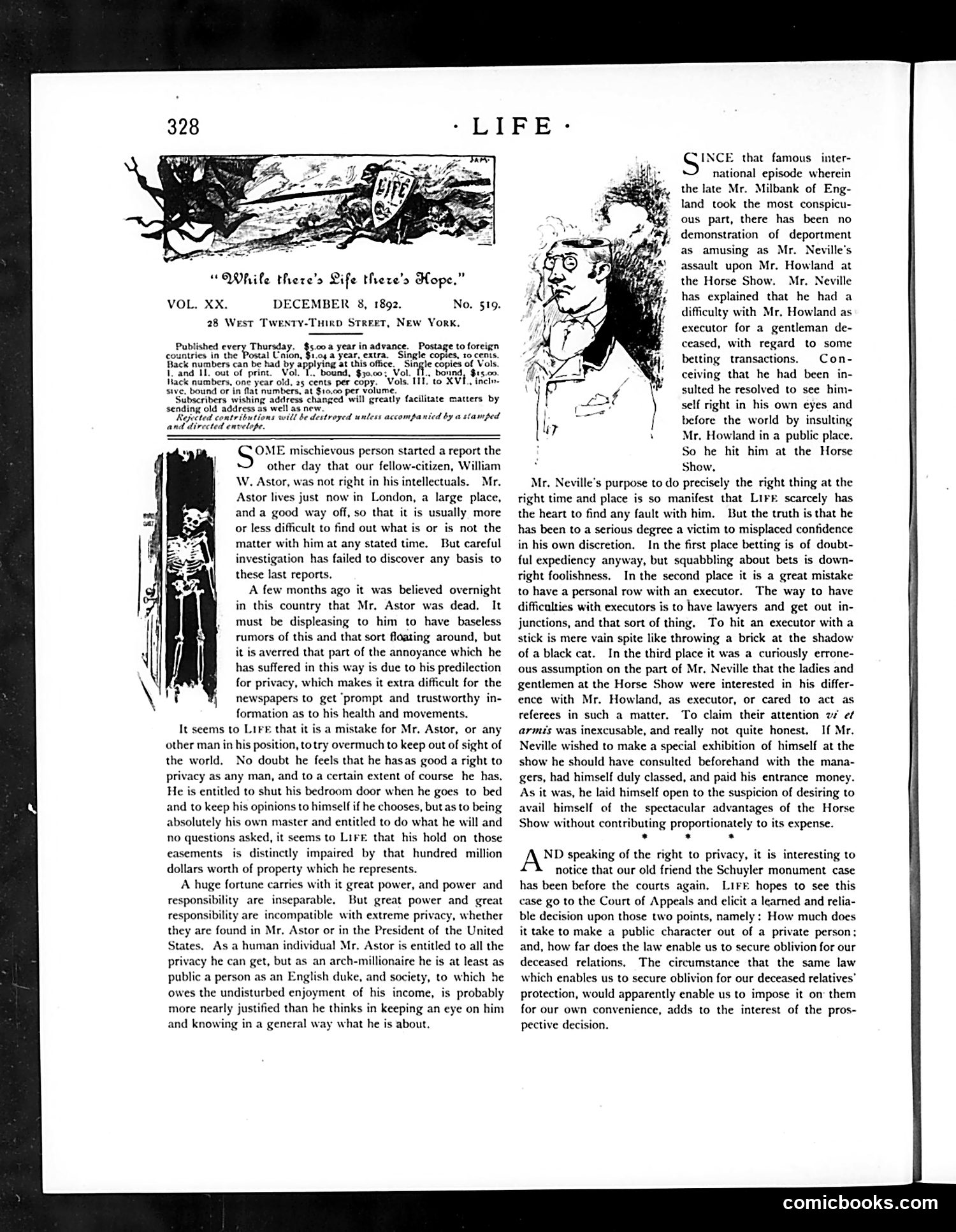
The page features two satirical cartoons about prominent figures of the era: **Top cartoon**: Depicts William W. Astor, a wealthy New York businessman. The text defends Astor against rumors of intellectual inadequacy, arguing he deserves privacy despite his prominence. The satire mocks how newspapers scrutinize the personal lives of the ultra-wealthy while they claim entitlement to privacy. **Bottom cartoon**: Shows Mr. Neville's confrontation with Mr. Howland at a Horse Show, where Neville publicly insulted Howland over disputed betting transactions. The editorial criticizes Neville's poor judgment in creating a spectacle rather than handling the dispute discreetly through lawyers. Both pieces satirize the public behavior and hypocrisies of wealthy New York society figures.
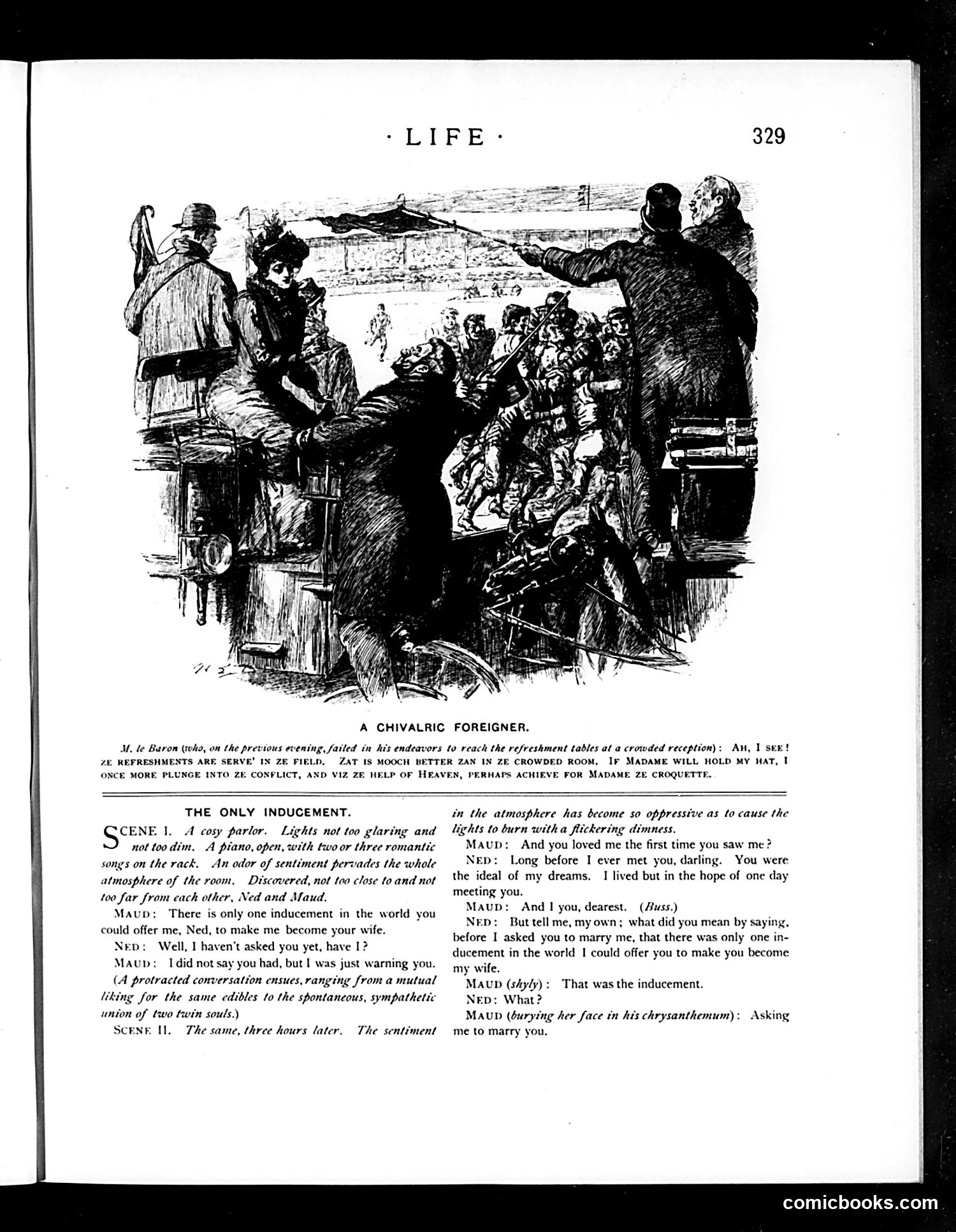
This page contains two theatrical sketches. "A Chivalric Foreigner" depicts a French officer at a crowded reception attempting to seduce an English woman by flattering her with romantic French manners—a satirical jab at French courtship customs and their perceived incompatibility with English propriety. "The Only Inducement" shows a romantic scene between two characters, Ned and Maud, discussing marriage. The satire centers on Maud's mercenary motivation: she agrees to marry only after learning Ned can offer "the inducement in the world"—implying financial security rather than romantic love drives her acceptance. Both sketches mock relationship dynamics: foreign affectation in one, financial pragmatism in the other.
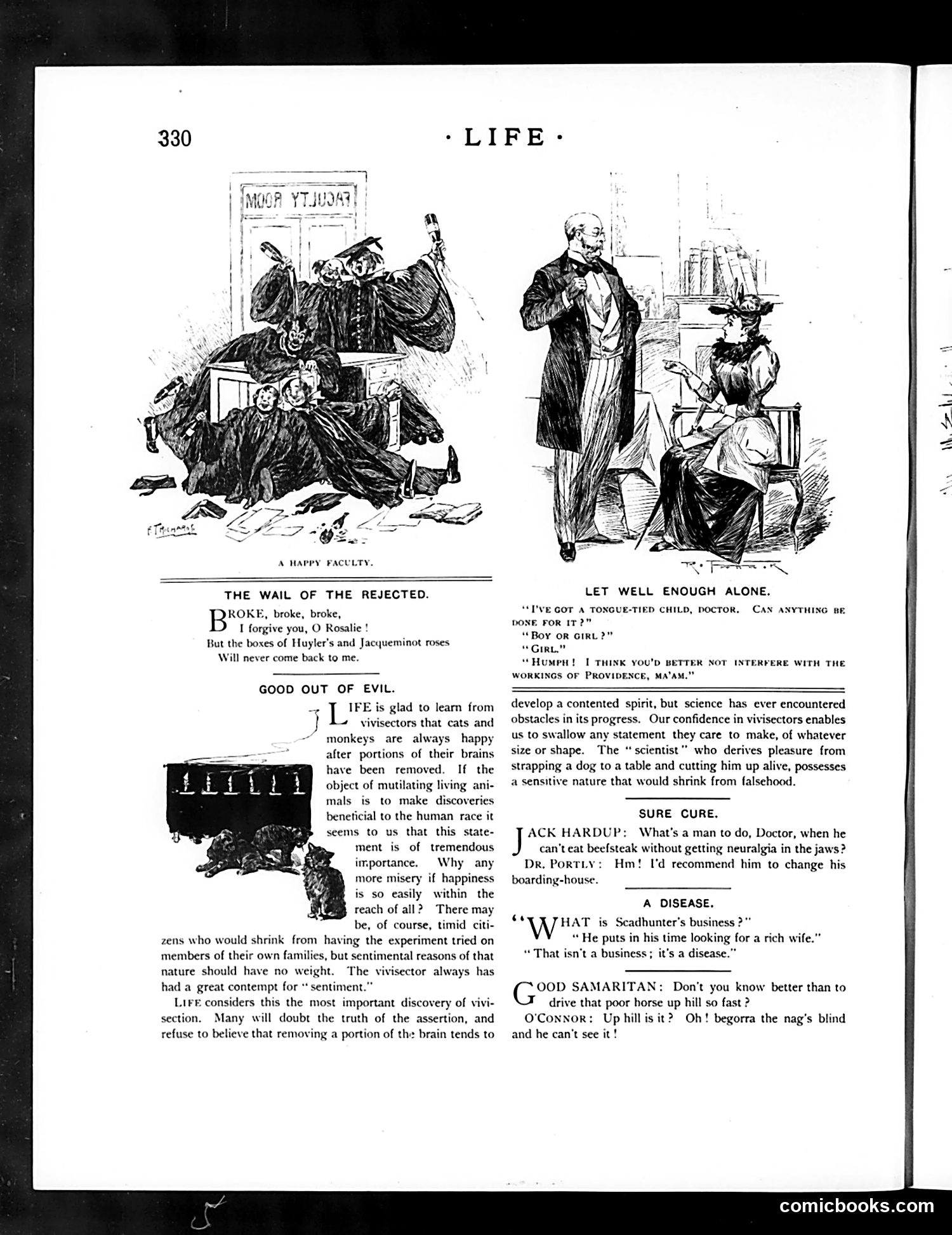
This page contains several Victorian-era satirical pieces. The top cartoon, "A Happy Faculty," shows academics in chaos—likely mocking university incompetence or professorial eccentricity. "The Wail of the Rejected" satirizes rejected lovers using literary references (Huyley's and Jacqueminot roses), suggesting romantic disappointment among the educated classes. The larger section, "Good Out of Evil," defends vivisection (animal experimentation) as scientifically necessary, mocking sentimentalists who oppose it. This reflects genuine 19th-century debates between scientific progress advocates and animal welfare activists. The remaining items are brief humorous dialogues about medical complaints and social situations—typical Life magazine filler humor of the era, without apparent political significance. The overall tone privileges scientific rationalism over sentiment.
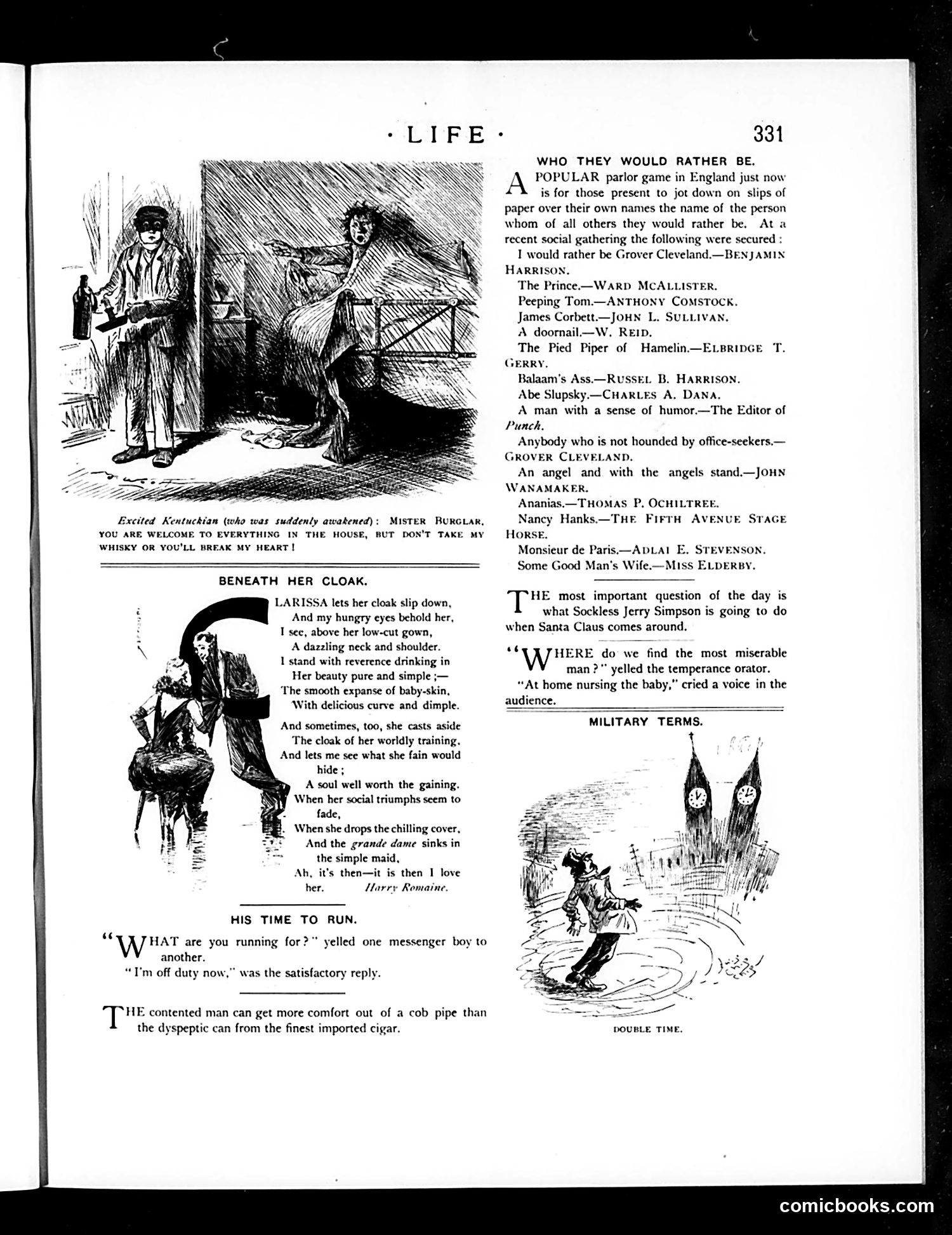
This page contains several satirical pieces rather than a single cartoon: **"Who They Would Rather Be"** lists prominent figures people admire—politicians like Grover Cleveland, entertainers like Ward McAllister, and fictional characters like the Pied Piper. It's social commentary on celebrity and aspiration. **"Beneath Her Cloak"** is a romantic poem about a woman named Larissa, illustrated with a period sketch of a cloaked couple. **"His Time to Run"** and **"The Contented Man"** are brief humorous anecdotes. **"Military Terms"** and **"Double Time"** are illustrated jokes about military life, showing soldiers in comical situations. The page is typical of *Life*'s satirical humor—mixing social observation, romantic poetry, and illustrated jokes rather than focused political commentary.
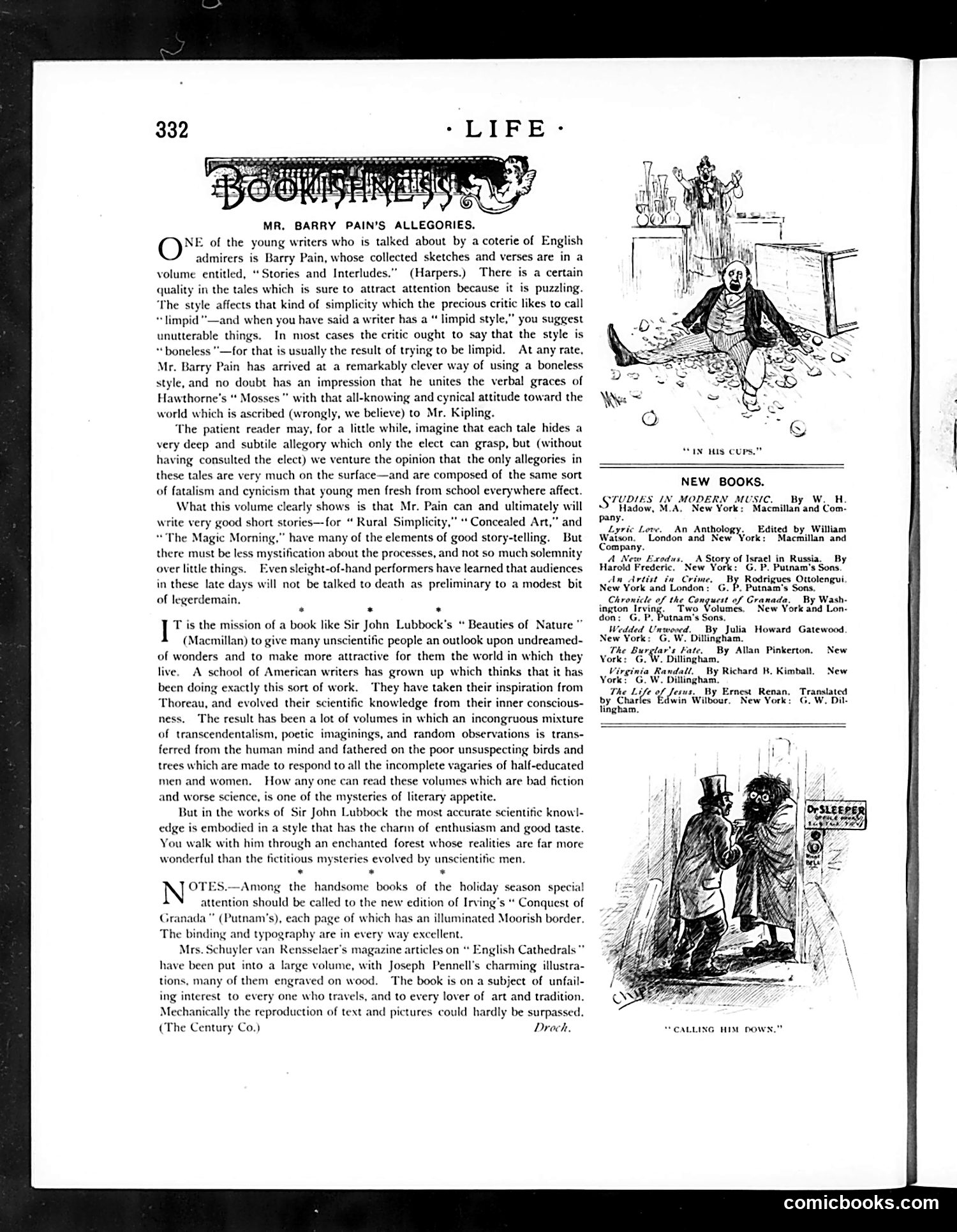
This page contains **book reviews**, not political cartoons. The main content discusses Barry Pain's allegorical sketches and Sir John Lubbock's "Beauties of Nature," praising their literary merit and scientific accuracy. The two illustrations are **humorous literary sketches** accompanying the reviews: 1. **"In his cups"** (top right): depicts a disheveled man surrounded by bottles, illustrating the theme of excess or drunkenness—likely from Pain's work. 2. **"Calling him down"** (bottom right): shows a figure at a doorway, appearing to scold or reprimand someone, suggesting domestic conflict or moral correction. These sketches are **decorative accompaniments** to book discussions rather than satirical commentary on contemporary politics or events.
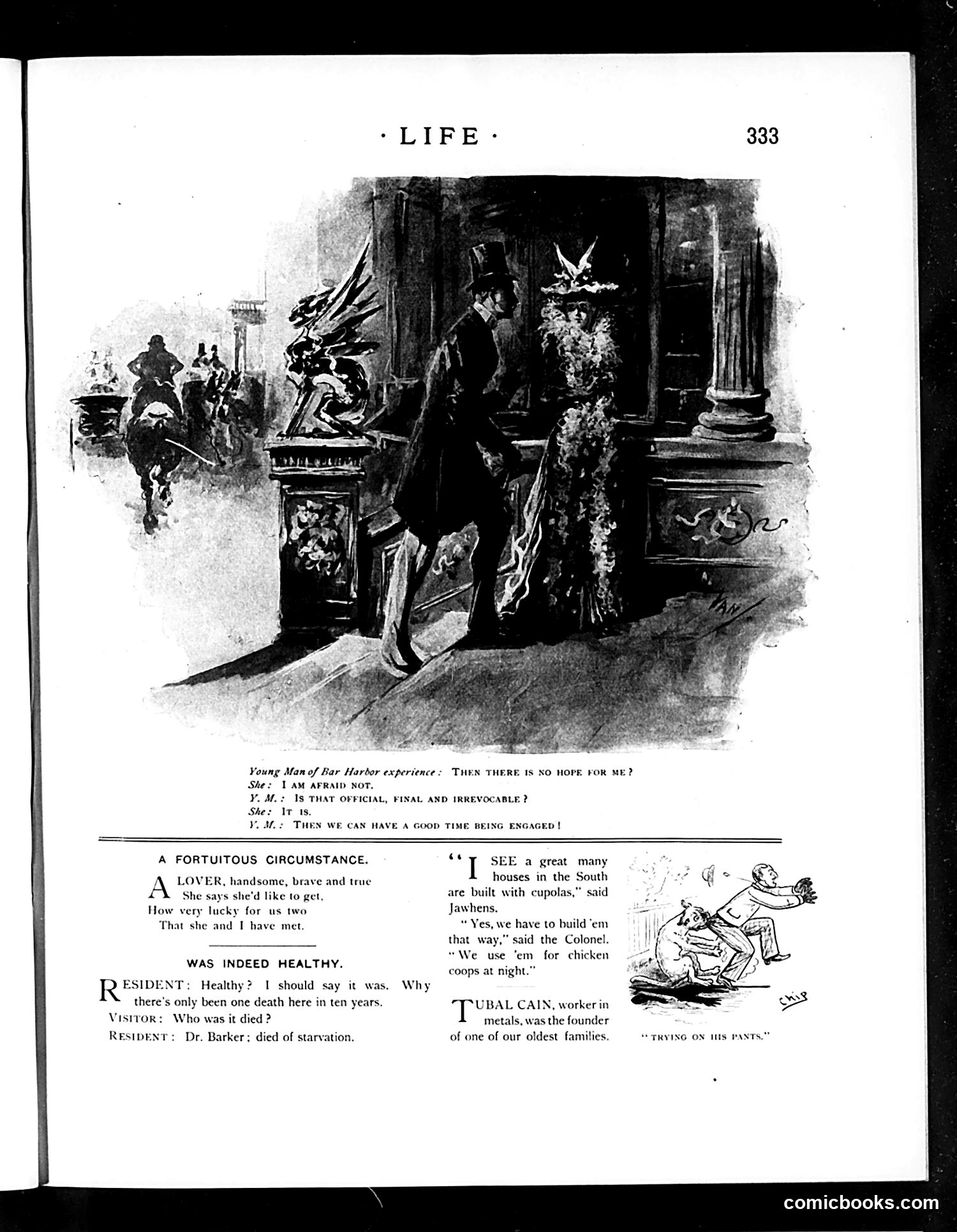
This page contains three separate satirical pieces from *Life* magazine: 1. **Top illustration**: A dialogue about a young man from Bar Harbor (an elite coastal resort) seeking marriage. The joke turns on whether his engagement is "final and irrevocable"—the woman wants to ensure he won't change his mind, suggesting wealthy men were known for romantic fickleness. 2. **"A Fortuitous Circumstance"**: A poem mocking romantic declarations of devotion, suggesting the speaker's love is convenient rather than genuine. 3. **"Was Indeed Healthy"**: A brief comic dialogue where a resident brags that only one death occurred in ten years—until revealing it was from starvation, undercutting the health claim with dark irony. 4. **"Tubal Cain" anecdote**: A brief joke about Southern architecture and class (cupolas used as chicken coops) with an accompanying cartoon of someone slipping on his pants.
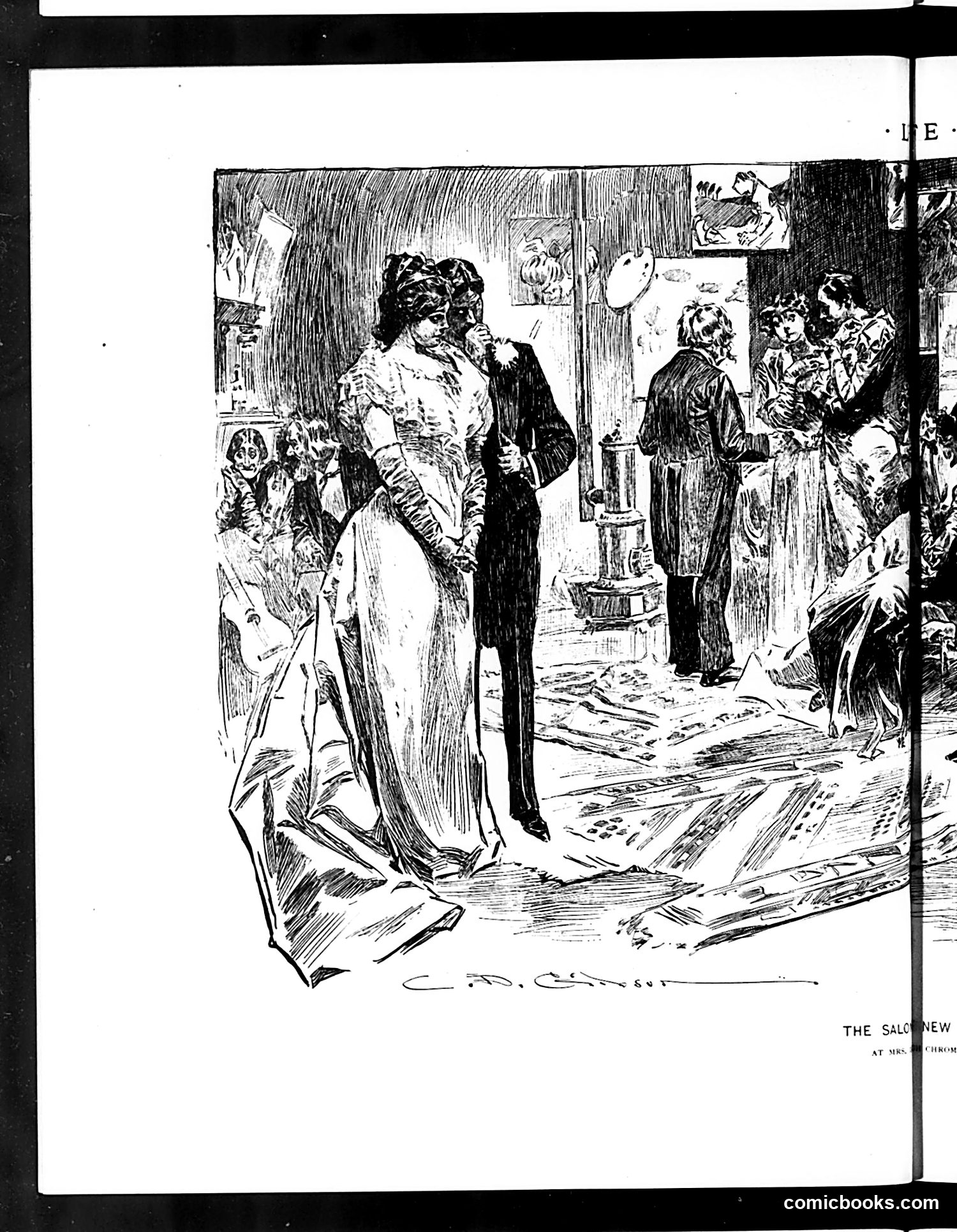
This appears to be an illustration from *Life* magazine depicting an art studio or salon scene. The caption reads "THE SALON NEW" (possibly "THE SALON NEWLY" or similar—OCR unclear). The image shows well-dressed figures in what appears to be an early 20th-century interior space, with artwork visible on the walls. A woman in an elegant white gown is prominently featured in the foreground, conversing with a man in dark clothing. The signature appears to read "C.D. Gibson," suggesting this is by the famous illustrator Charles Dana Gibson, known for depicting high society. Without clearer text, the specific satirical point remains uncertain—it may mock pretentiousness in the art world, fashionable society, or artistic pretense, but I cannot definitively state the joke or reference intended.
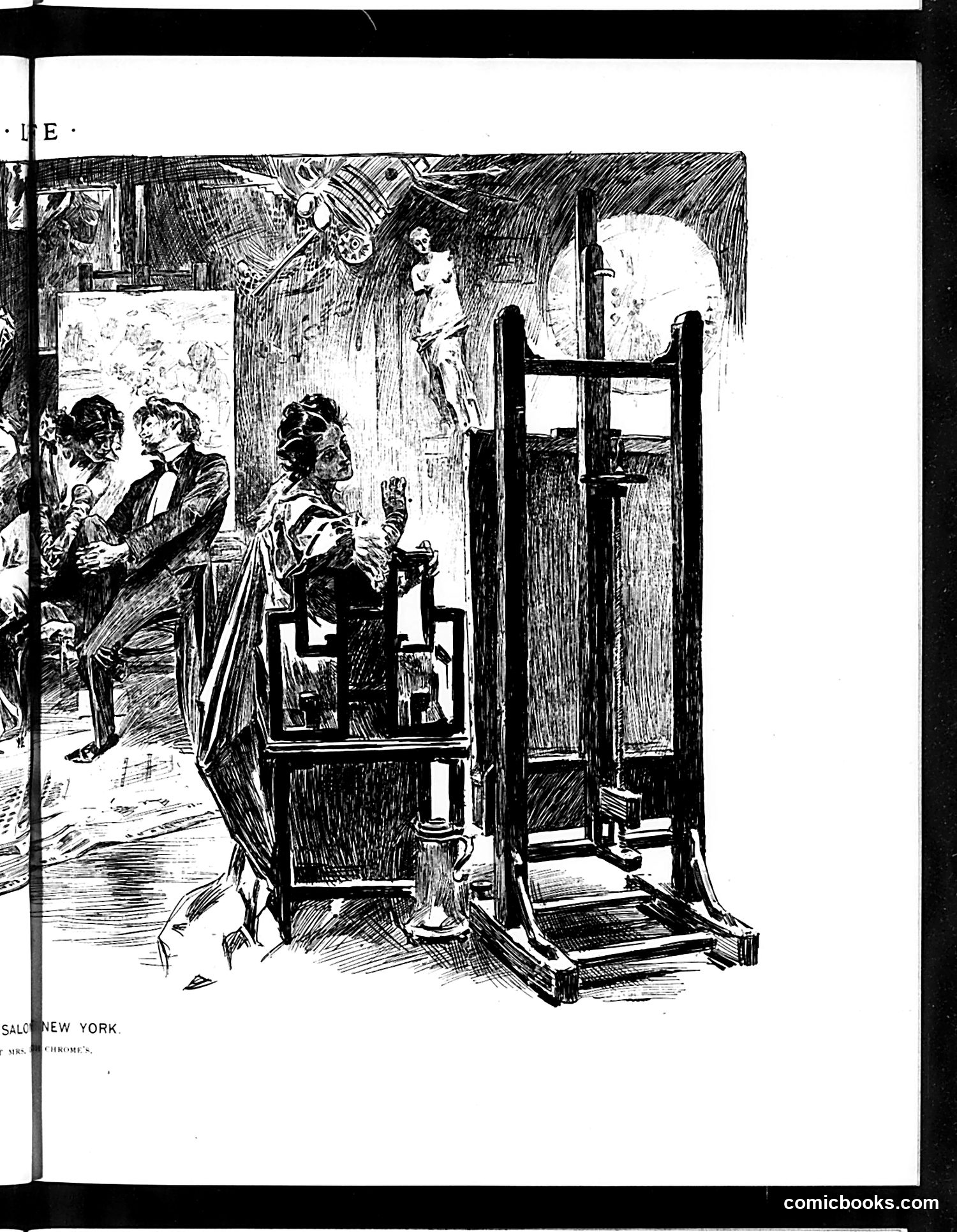
This appears to be a satirical illustration from Life magazine's "Salon: New York" section, depicting an art gallery or salon scene. The image shows well-dressed visitors examining what appears to be an abstract or modern art installation—a large wooden frame structure in the foreground. The satire likely mocks the pretentiousness of New York's art world and high society's reaction to avant-garde or modernist art. The visitors' formal attire and serious expressions contrast with the seemingly incomprehensible wooden apparatus, suggesting the cartoon ridicules both the seriousness with which people regard experimental art and their tendency to admire things they don't understand. The work exemplifies Life magazine's characteristic social commentary on upper-class aesthetics and artistic pretension in early 20th-century Manhattan.
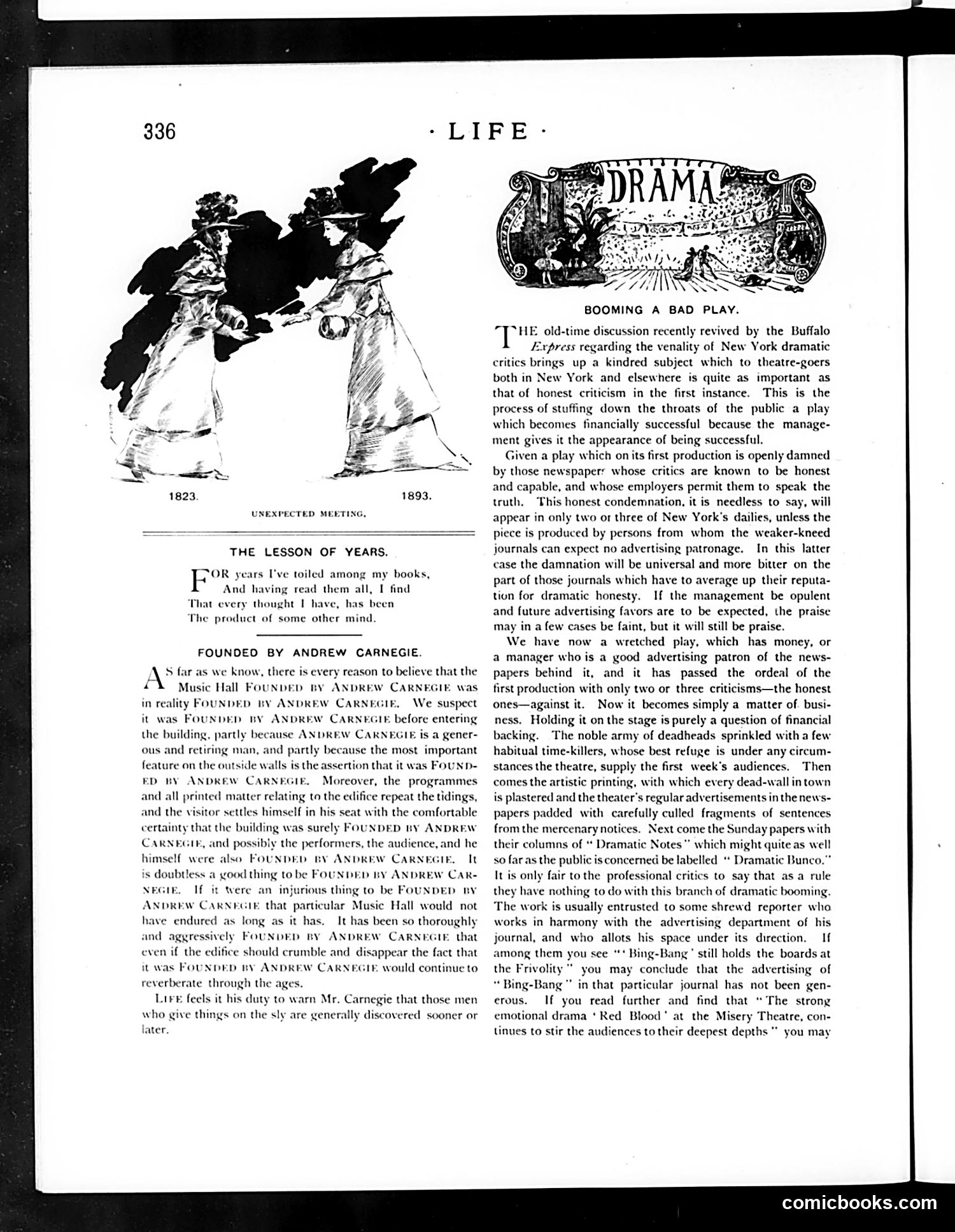
This Life magazine page contains two satirical pieces: **"Unexpected Meeting" (1823-1893):** A visual joke showing two figures meeting across time. The cartoon likely comments on how fashion or social customs recur cyclically, as the dressed figures appear nearly identical despite the 70-year gap. **"Founded by Andrew Carnegie" section:** Satire attacking Carnegie's self-promotion. Life mockingly notes that Carnegie's Music Hall constantly advertises that it was "Founded by Andrew Carnegie"—repeating this claim so obsessively that even the performers, audience, and air seem founded by him. The joke: Carnegie gives philanthropic donations but ensures his name appears everywhere, turning charity into branding. The closing warning—that those who "give things on the sly are generally discovered"—reveals the hypocrisy: Carnegie's supposedly humble giving is actually aggressively publicized. **"Booming a Bad Play":** Editorial criticism of how wealthy theater producers manipulate critics and the public through advertising money. Poor plays get artificially praised and promoted through paid advertising, while honest critics are silenced or ignored. The system corrupts theatrical criticism through financial pressure.
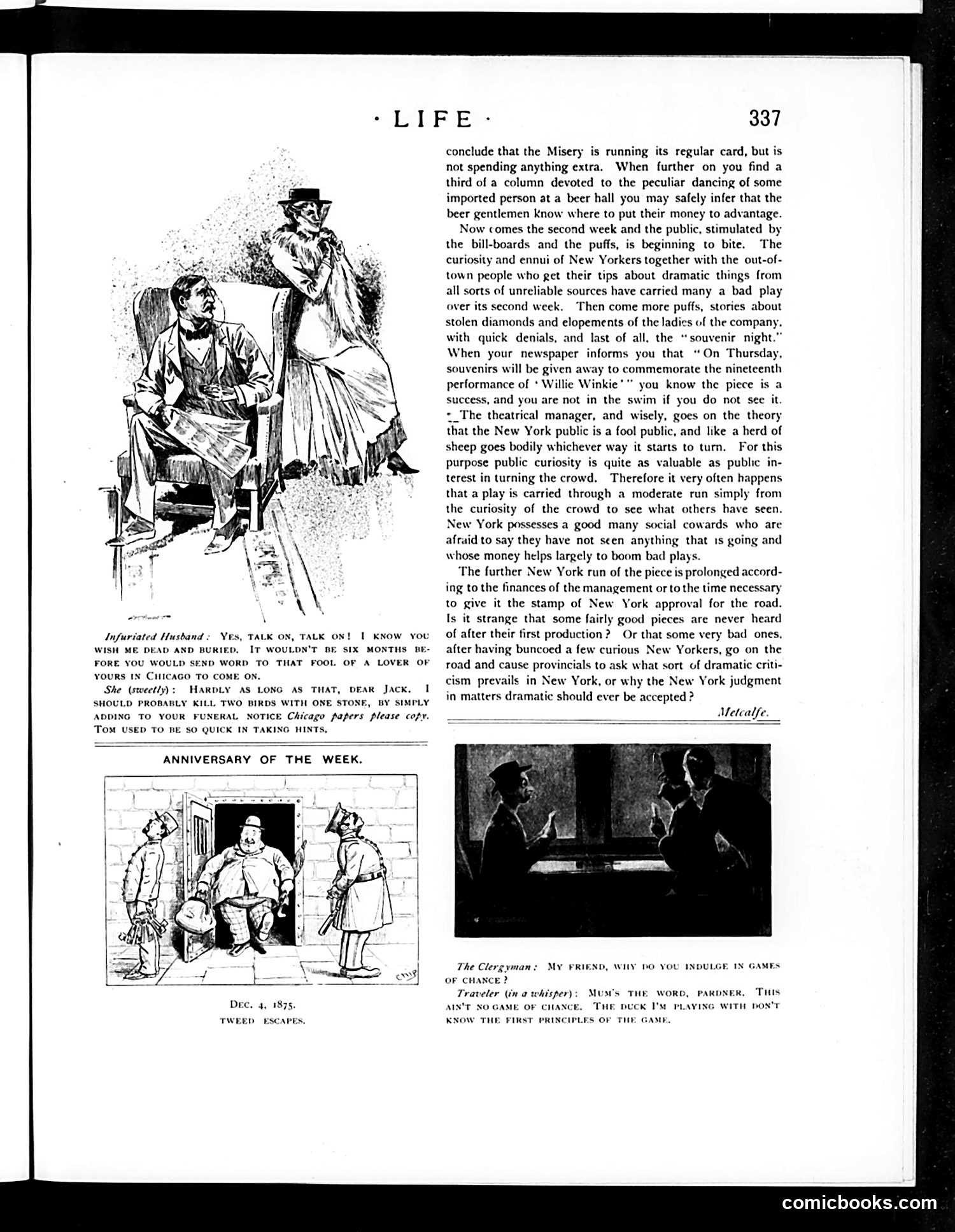
This page contains two satirical pieces mocking American society circa the 1870s-80s. **Top cartoon**: An infuriated husband complains to his wife about her lover in Chicago. She sweetly responds she'd "kill two birds with one stone" by adding the lover's name to his funeral notice in Chicago papers—a cutting jab at both men's expense. The joke satirizes marital infidelity among the wealthy and the casual cruelty upper-class women could deploy. **"Anniversary of the Week" cartoon**: Depicts "Tweed Escapes" (likely referencing Boss Tweed, the corrupt NYC politician). The illustration shows officials or guards, apparently commemorating or discussing a notable jailbreak. **Main article (by Metcalfe)**: Critiques New York theater management and audiences. Metcalfe argues NYC theatrical producers manipulate public curiosity through advertising and scandal-mongering to carry mediocre plays through their runs. He portrays New York audiences as intellectually sheep-like, easily swayed by herd mentality rather than genuine merit—a biting commentary on urban culture and consumer manipulation.
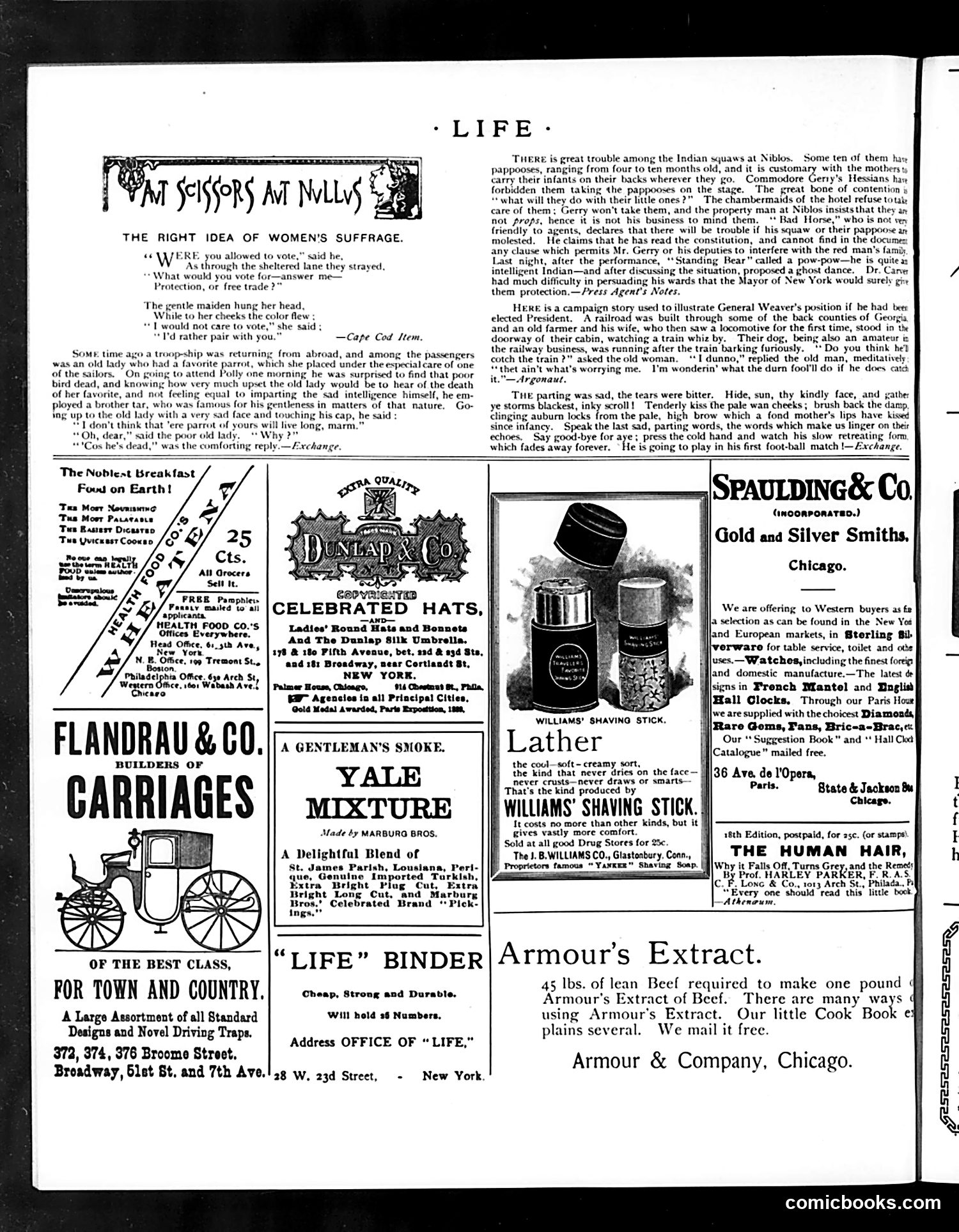
This page contains two main satirical pieces on women's suffrage: **"The Right Idea of Women's Suffrage"** presents a mock-romantic dialogue where a man asks a woman what she'd vote for—protection or free trade (major political issues of the era). The woman replies she'd "rather pair with you," meaning she prefers romantic partnership to political participation. The satire mocks anti-suffrage arguments by suggesting women lack political interest or competence, preferring domestic/romantic roles. **The second anecdote** about a parrot's death uses gentle humor about miscommunication, but serves as filler rather than suffrage commentary. The page ridicules those opposing women's voting rights by exaggerating their position: that women are naturally uninterested in politics and belong in domestic spheres. For modern readers, this reveals early-20th-century anti-suffrage sentiment—the assumption that women couldn't or shouldn't engage in civic matters. The remainder consists of period advertisements for carriages, food products, and consumer goods typical of Life's revenue model.
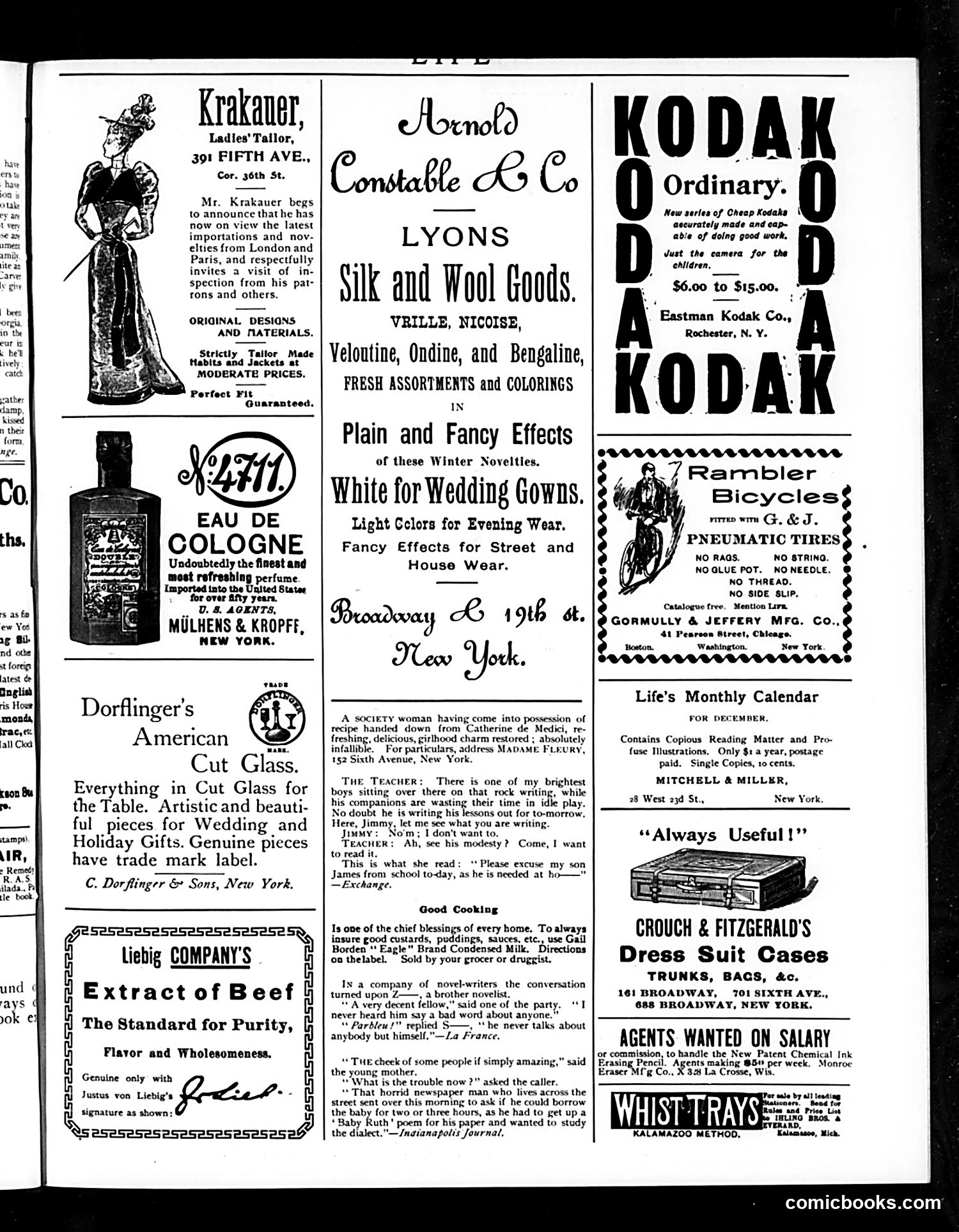
This page is primarily **advertisements** with a few short **humorous anecdotes** rather than political cartoons. The main content includes: **Advertisements** for luxury goods (Kodak cameras, cut glass, tailored clothing, condensed milk) targeting wealthy readers—typical of *Life* magazine's affluent audience. **Three brief jokes**: 1. A teacher discovers a student forging an absence note 2. A novelist who only talks about himself 3. A newspaper reporter asking to borrow a neighbor's baby to study dialect for poetry These are gentle, domestic humor pieces reflecting turn-of-the-century middle-class anxieties: dishonest children, vanity, and the intrusive nature of journalists. One ad references "Catherine de Medici" and a beauty treatment—playing on historical association with luxury and rejuvenation. No clear political satire is evident on this page.
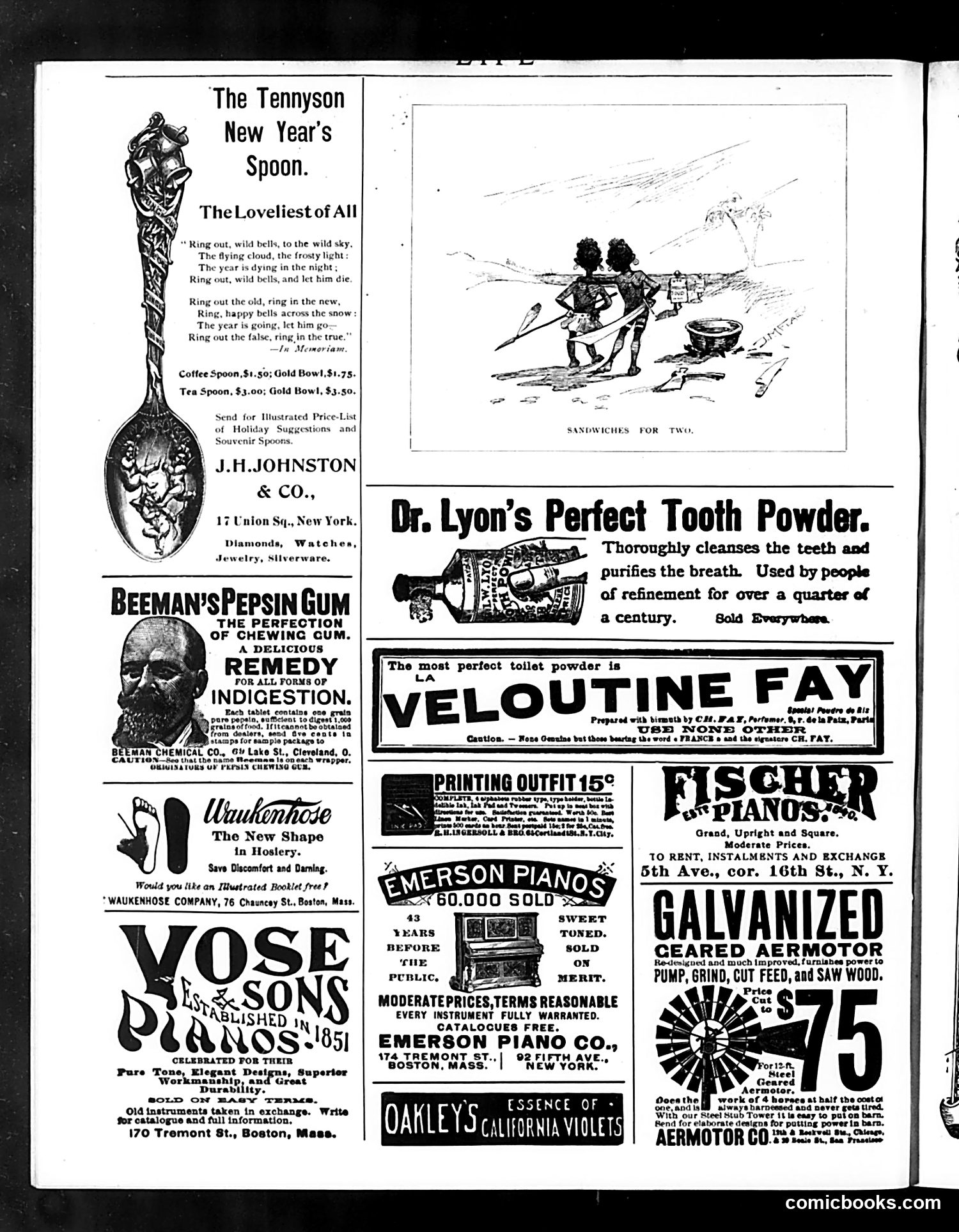
This page is **primarily advertising** with one cartoon illustration. The main illustrated content shows "Sandwiches for Two" — a sketch of two figures sharing a meal outdoors in a winter setting, likely accompanying New Year's themed promotions. The advertisements reflect turn-of-the-century American consumer goods: J.H. Johnston's "Tennyson New Year's Spoon" (quoting Tennyson's poem about ringing in the new year), Beeman's Pepsin Gum for indigestion, piano manufacturers (Vose & Sons, Emerson Piano Co., Fischer Pianos), Dr. Lyon's tooth powder, and the Aermotor windmill pump. The cartoon itself contains no political satire — it's simply a whimsical domestic scene. The page functions as a product-focused publication rather than editorial commentary. The Tennyson literary reference is the closest to intellectual content, used purely as marketing appeal for a luxury spoon product. This reflects Life's dual nature as both satirical magazine and commercial advertising vehicle.