
Life, 1892-12-08 · page 12 of 16
Life — December 8, 1892 — page 12: what you’re looking at
What you’re looking at
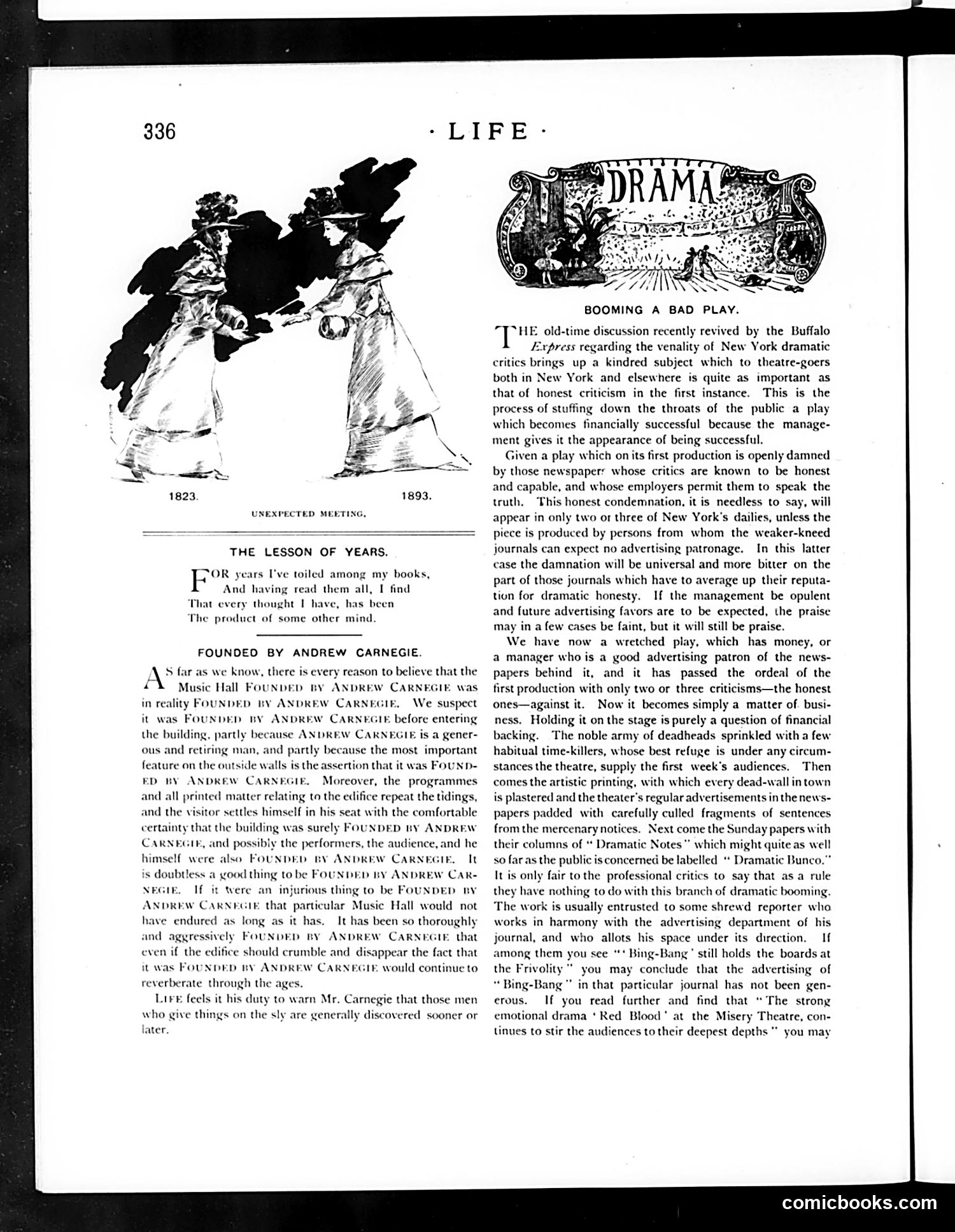
This Life magazine page contains two satirical pieces: **"Unexpected Meeting" (1823-1893):** A visual joke showing two figures meeting across time. The cartoon likely comments on how fashion or social customs recur cyclically, as the dressed figures appear nearly identical despite the 70-year gap. **"Founded by Andrew Carnegie" section:** Satire attacking Carnegie's self-promotion. Life mockingly notes that Carnegie's Music Hall constantly advertises that it was "Founded by Andrew Carnegie"—repeating this claim so obsessively that even the performers, audience, and air seem founded by him. The joke: Carnegie gives philanthropic donations but ensures his name appears everywhere, turning charity into branding. The closing warning—that those who "give things on the sly are generally discovered"—reveals the hypocrisy: Carnegie's supposedly humble giving is actually aggressively publicized. **"Booming a Bad Play":** Editorial criticism of how wealthy theater producers manipulate critics and the public through advertising money. Poor plays get artificially praised and promoted through paid advertising, while honest critics are silenced or ignored. The system corrupts theatrical criticism through financial pressure.
📄 Transcribed text from this page (OCR, searchable)
Machine-transcribed from the original scan — historical spelling and the odd misread are preserved.
UNEXPECTED MEETING, THE LESSON OF YEARS. Fo years I've toiled among my books, And having read them all, [ find That every thought I have, has been The product of some other mind FOUNDED BY ANDREW CARNEGIE. S far as we know, there is eve: Music Hall FouNDED By in reality FOUNDED by ANDREW it was FOUNDED by y reason to believe that the ANDREW CARNEGIE was ARNE We suspect ANDREW CARNEGIE before entering partly because ANDREW CARNEGIE gener- ous and retiring man, and partly because the most important feature on the outside walls is the assertion that it was Foun p- ED BY ANDREW CARNEGIE. and all printed matter relati the buildin Moreover, the programmes x to the edifice repeat the tidings, and the visitor settles himself in his seat with the comfortable certainty that the building was surely FOUNDED by ANDREW CARNEGIE, and possibly the performers, the audience, and he tlso FOUNDED BY ANDREW CARNEGIE, It is doubtless a good thing to be FOUNDED BY ANDREW CaRr- NEGIE, himself were If it Were an injurious thing to be FouNDED ny ANDREW CARNEGIE that particular Music Hall would not have endured as long as it has. It has been so thoroughly vely FOUNDED BY ANDREW CARNEGIE that even if the edifice should crumble and disappear the fact that twas FOUNDED hy ANDREW CARNEGIE would continue to reverberate through the ages. and aggyress Lire feels it his duty to warn Mr. Carnegie that those men who give things on the sly are generally discovered sooner or later. BOOMING A BAD PLAY. “T"HE old-time discussion recently revived by the Buffalo Express regarding the venality of New York dramatic critics brings up a kindred subject which to theatre-goers both in New York and elsewhere is quite as important as that of honest criticism in the first instance. This is the process of stuffing down the throats of the public a play which becomes financially successful because the manage- ment gives it the appearance of being successful. Given a play which on its first production is openly damned by those newspaper: whose critics are known to be honest and capable, and whose employers permit them to speak the truth, This honest condemnation, it is needless to say, will appear in only two or three of New York's dailies, unless the piece is produced by persons from whom the weaker-kneed journals can expect no advertising patronage. In this latter case the damnation will be universal and more bitter on the part of those journals which have to average up their reputa- tion for dramatic honesty. If the management be opulent and future advertising favors are to be expected, the praise may in a few cases be faint, but it will still be praise. We have now a wretched play, which has money, or a manager who is a good advertising patron of the news- papers behind it, and it has passed the ordeal of the first production with only two or three criticisms—the honest ones—against it. Now it becomes simply a matter of. busi- ness. Holding it on the stage is purely a question of financial backing. The noble army of deadheads sprinkled with a few habitual time-killers, whose best refuge is under any circum- stances the theatre, supply the first week's audiences. Then comes the artistic printing, with which every dead-wall intown is plastered and the theater's regular advertisements in the news- papers padded with carefully culled fragments of sentences from the mercenary notices. Next come the Sunday papers with their columns of * Dramatic Notes” which might quite as well so far as the public is concerned be labelled ** Dramatic Bunco.”” It is only fair to the professional critics to say that as a rule they have nothing to do with this branch of dramatic booming. The work is usually entrusted to some shrewd reporter who works in harmony with the advertising department of his journal, and who allots his space under its direction. If among them you see “* Bing-Bang ’ still holds the boards at the Frivolity " you may conclude that the advertising of “ Bing-Bang " in that particular journal has not been gen- erous. If you read further and find that “ The strong emotional drama * Red Blood’ at the Misery Theatre, con- Linues to stir the audiences to their deepest depths " you may comicbooks.com