
Life, 1892-12-08 · page 4 of 16
Life — December 8, 1892 — page 4: what you’re looking at
What you’re looking at
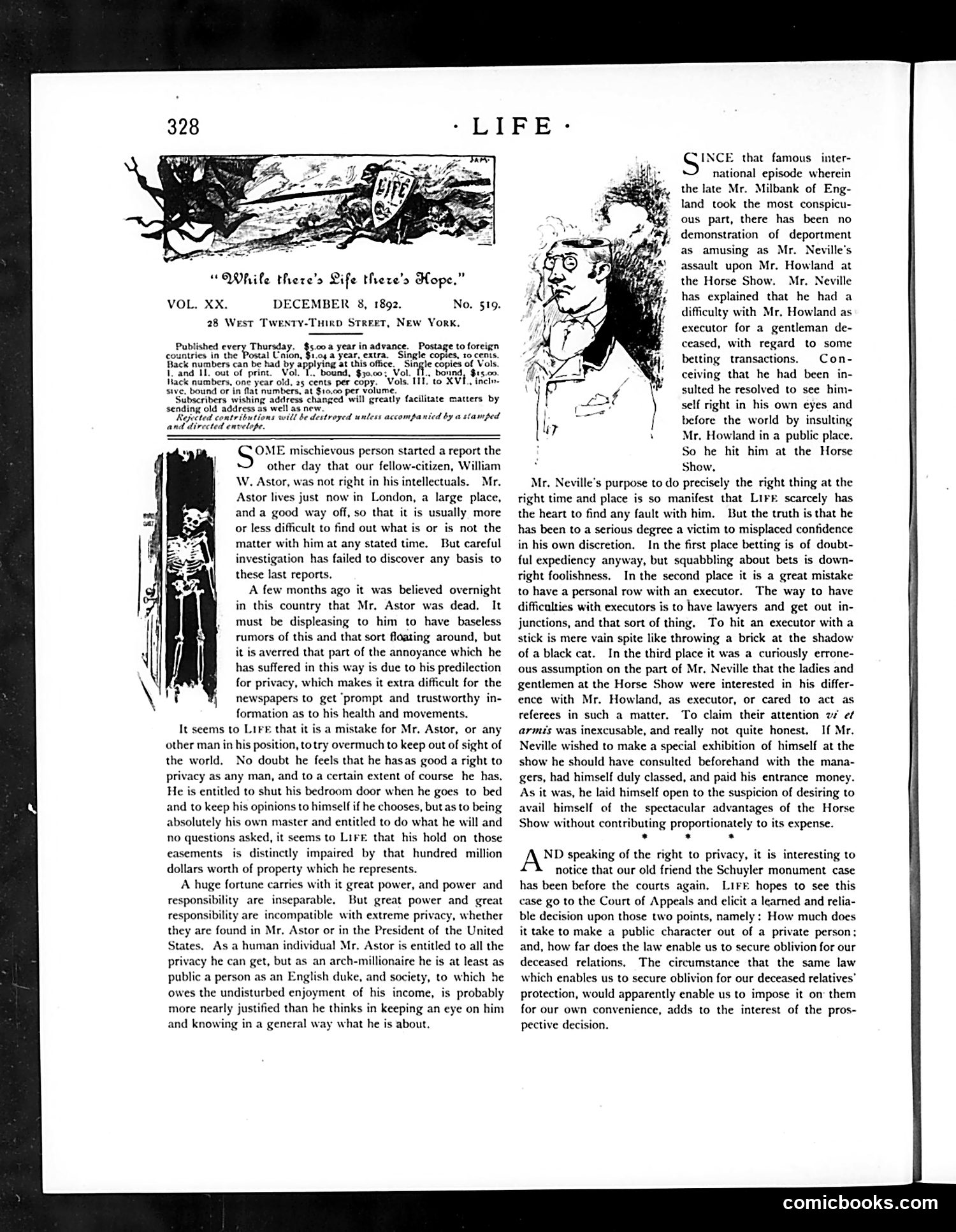
The page features two satirical cartoons about prominent figures of the era: **Top cartoon**: Depicts William W. Astor, a wealthy New York businessman. The text defends Astor against rumors of intellectual inadequacy, arguing he deserves privacy despite his prominence. The satire mocks how newspapers scrutinize the personal lives of the ultra-wealthy while they claim entitlement to privacy. **Bottom cartoon**: Shows Mr. Neville's confrontation with Mr. Howland at a Horse Show, where Neville publicly insulted Howland over disputed betting transactions. The editorial criticizes Neville's poor judgment in creating a spectacle rather than handling the dispute discreetly through lawyers. Both pieces satirize the public behavior and hypocrisies of wealthy New York society figures.
📄 Transcribed text from this page (OCR, searchable)
Machine-transcribed from the original scan — historical spelling and the odd misread are preserved.
“While there's Life there's Hope.” VOL, XX. DECEMBER 8, 1892. 28 West Twenty. No. 519. THIRD. THird STREET, New York, Published every Thurslay. $s.co a year in advance. Postage toforcign countries in the Postal Cain, $1.04 a year, extra. Single copies, ro cents, Back numbers can be had by applying at this ofice, Single copies of Vols. 1. and IL. out of print, Vol. I. 30.005 V $t5.00. Hack numbers, one year old. 25 cents per copy. ‘Vols. IIT. to oxvt, incl sive, bound or in flat numbers, at $10.00 per volume. Subscribers wishing address changed will greatly facilitate matters by sending old address as well as new. Rejected contributions will be destroyed untess accompanied by a stamped rected envelope. ~ OME mischievous person started a report the other day that our fellow-citizen, William W. Astor, was not right in his intellectuals. Mr. Astor lives just now in London, a large place, anda good way off, so that it is usually more or less difficult to find out what is or is not the matter with him at any stated time. But careful investigation has failed to discover any basis to these last reports. A few months ago it was believed overnight in this country that Mr. Astor was dead. It must be displeasing to him to have baseless rumors of this and that sort floating around, but it is averred that part of the annoyance which he has suffered in this way is due to his predilection for privacy, which makes it extra difficult for the newspapers to get ‘prompt and trustworthy in- formation as to his health and movements. It seems to LiFe that it is a mistake for Mr, Astor, or any other man in his position, to try overmuch to keep out of sight of the world. No doubt he feels that he hasas good a right to privacy as any man, and to a certain extent of course he has. He is entitled to shut his bedroom door when he goes to bed and to keep his opinions to himself if he chooses, but as to being absolutely his own master and entitled to do what he will and no questions asked, it seems to Lire that his hold on those easements is distinctly impaired by that hundred million dollars worth of property which he represents. A huge fortune carries with it great power, and power and responsibility are inseparable, But great power and great responsibility are incompatible with extreme privacy, whether they are found in Mr. Astor or in the President of the United States. As a human individual Mr. Astor is entitled to all the privacy he can get, but as an arch-millionaire he is at least as public a person as an English duke, and society, to which he owes the undisturbed enjoyment of his income, is probably more nearly justified than he thinks in keeping an eye on him and knowing in a general way what he is about. CE that famous inter- national episode wherein the late Mr. Milbank of Eng- land took the most conspicu- ous part, there has been no demonstration of deportment as amusing as Mr. Neville’s assault upon Mr. Howland at the Horse Show, Mr. Neville has explained that he had a difficulty with Mr, Howland as executor for a gentleman de- ceased, with regard to some betting transactions. Con- ceiving that he had been in- sulted he resolved to see him- self right in his own eyes and before the world by insulting Mr. Howland in a public place. So he hit him at the Horse Show, Mr. Neville’s purpose to do precisely the right thing at the right time and place is so manifest that LIFE scarcely has the heart to find any fault with him. But the truth is that he has been to a serious degree a victim to misplaced confidence in his own discretion. In the first place betting is of doubt- ful expediency anyway, but squabbling about bets is down- right foolishness. In the second place it is a great mistake to have a personal row with an executor. The way to have difficulties with executors is to have lawyers and get out in- junctions, and that sort of thing. To hit an executor with a stick is mere vain spite like throwing a brick at the shadow of a black cat. In the third place it was a curiously errone- ous assumption on the part of Mr. Neville that the ladies and gentlemen at the Horse Show were interested in his differ- ence with Mr. Howland, as executor, or cared to act as referees in such a matter. To claim their attention vw ef armis was inexcusable, and really not quite honest. If Mr. Neville wished to make a special exhibition of himself at the show he should have consulted beforehand with the mana- gers, had himself duly classed, and paid his entrance money. As it was, he laid himself open to the suspicion of desiring to avail himself of the spectacular advantages of the Horse Show without contributing proportionately to its expense. . * . A™ speaking of the right to privacy, it is interesting to notice that our old friend the Schuyler monument case has been before the courts again, LIFE hopes to see this case go to the Court of Appeals and elicit a learned and relia- ble decision upon those two points, namely : How much does it take to make a public character out of a private person; and, how far does the law enable us to secure oblivion for our deceased relations. The circumstance that the same law which enables us to secure oblivion for our deceased relatives’ protection, would apparently enable us to impose it on them for our own convenience, adds to the interest of the pros- pective decision. comicbooks.com