
Life, 1892-12-08 · page 8 of 16
Life — December 8, 1892 — page 8: what you’re looking at
What you’re looking at
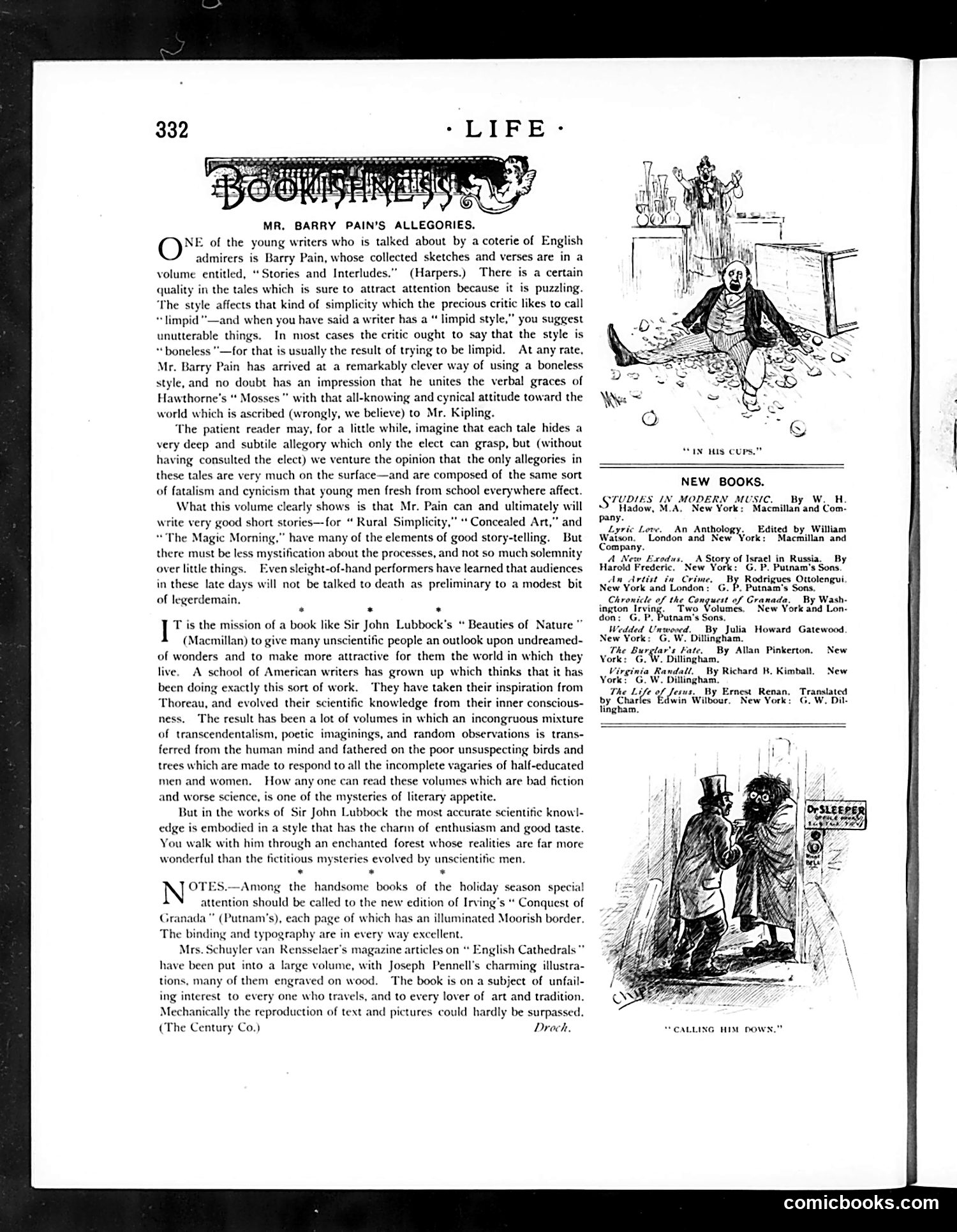
This page contains **book reviews**, not political cartoons. The main content discusses Barry Pain's allegorical sketches and Sir John Lubbock's "Beauties of Nature," praising their literary merit and scientific accuracy. The two illustrations are **humorous literary sketches** accompanying the reviews: 1. **"In his cups"** (top right): depicts a disheveled man surrounded by bottles, illustrating the theme of excess or drunkenness—likely from Pain's work. 2. **"Calling him down"** (bottom right): shows a figure at a doorway, appearing to scold or reprimand someone, suggesting domestic conflict or moral correction. These sketches are **decorative accompaniments** to book discussions rather than satirical commentary on contemporary politics or events.
📄 Transcribed text from this page (OCR, searchable)
Machine-transcribed from the original scan — historical spelling and the odd misread are preserved.
MR. BARRY PAIN’S ALLEGORIES. NE of the young writers who is talked about by a coterie of English admirers is Barry Pain, whose collected sketches and verses are in a volume entitled, “Stories and Interludes.” (Harpers.) There is a certain quality in the tales which is sure to attract attention because it is puzzling. The le affects that kind of simplicity which the precious critic likes to call *limpid "—and when you have said a writer has a“ limpid style,” you suggest unutterable things. In most cases the critic ought to say that the style is “boneless "—for that is usually the result of trying to be limpid. At any rate, Mr. Barry Pain has arrived at a remarkably clever way of using a boneless style, and no doubt has an impression that he unites the verbal graces of Hawthorne Mosses" with that all-knowing and cynical attitude toward the world which is ribed (wrongly, we believe) to Mr. Kipling. ‘The patient reader may, for a little while, imagine that each tale hides a very deep and subtile allegory which only the elect can grasp, but (without aving consulted the elect) we venture the opinion that the only allegories in these tales are very much on the surface—and are composed of the same sort of fatalism and cynicism that young men fresh from school everywhere affect. What this volume clearly shows is that Mr. Pain can and ultimately will write very good short stories—for “ Rural Simplicity,” “ Concealed Art,” and “The Magic Morning,” have many of the elements of good story-telling. But there must be less mystification about the processes, and not so much solemnity over little things. Even sleight-of-hand performers have learned that audiences in these late days will not be talked to death as preliminary to a modest bit of legerdemain, . . . T is the mission of a book like Sir John Lubbock’s “ Beauties of Nature ” (Macmillan) to give many unscientific people an outlook upon undreamed- of wonders and to make more attractive for them the world in which they live. A school of American writers has grown up which thinks that it has been doing exactly this sort of work. They have taken their inspiration from Thoreau, and evolved their scientific knowledge from their inner conscious- ness. The result has been a lot of volumes in which an incongruous mixture of transcendentalism, poetic imaginings, and random observations is trans- ferred from the human mind and fathered on the poor unsuspecting birds and trees which are made to respond to all the incomplete vagari men and women. How any one can read these volumes which are bad fiction and worse science, is one of the mysteries of literary appetite. But in the works of Sir John Lubbock the most accurate scientific knowl- edge is embodied in a style that has the charm of enthusiasm and good taste. You walk with him through an enchanted forest whose realities are far more wonderful than the fictitious mysteries evolved by unscientific men. OTES.—Among the handsome books of the holiday season special attention should be called to the new edition of Irving's * Conquest of Granada” (Putnam's), each page of which has an illuminated Moorish border. The binding and typography cellent. Mrs. Schuyler van Rensselaer’s magazine articles on “ English Cathedrals" have been put into a large volume, with Joseph Pennell’s charming illustra- tions, many of them engraved on wood. The book is on a subject of unfail- ing interest to every one who travels, and to every lover of art and tradition. Mechanically the reproduction of text and pictures could hardly be surpassed, (The Century Co.) Droch, of half-educated ¢ in every way e: “IN Mus CUPS.” NEW BOOKS. STUDIES IN MODERN MUSIC. By WH. Hadow, M.A, New York: Macmillan and Com- pany. Watson, Company. An Anthology, Edited by William London and New York: Macmillan and A New Exodus, A Story of Israel in Russia, By Harold Frederic. New York: G. P, Putnam's Sons. cin artist in Crime, (By Rodrigues Ottolengui New York and London: G. P. Putnam's Sons. Chronicle of the Congucst of Granada. By Wash- ington Irving. Two Golumes. New Vork and Lon. don: G. P. Putnam's Sons. Wedded Unwooed. By Julia Howard Gatewood New York: G. W. Dillingham. The Burglar's Fate, By Allan Pinkerton. York: G. W. Ditlingtiam. cinta Randall, By Richard B, Kimball. G.W. Dillingham. The Life of ferns. By Eenext Renan. by Charles Edwin Wilbour. New Vork: lingham. New New ‘Translated GW. Dil- comicbooks.com