
A complete issue · 14 pages · 1892
Life — December 1, 1892
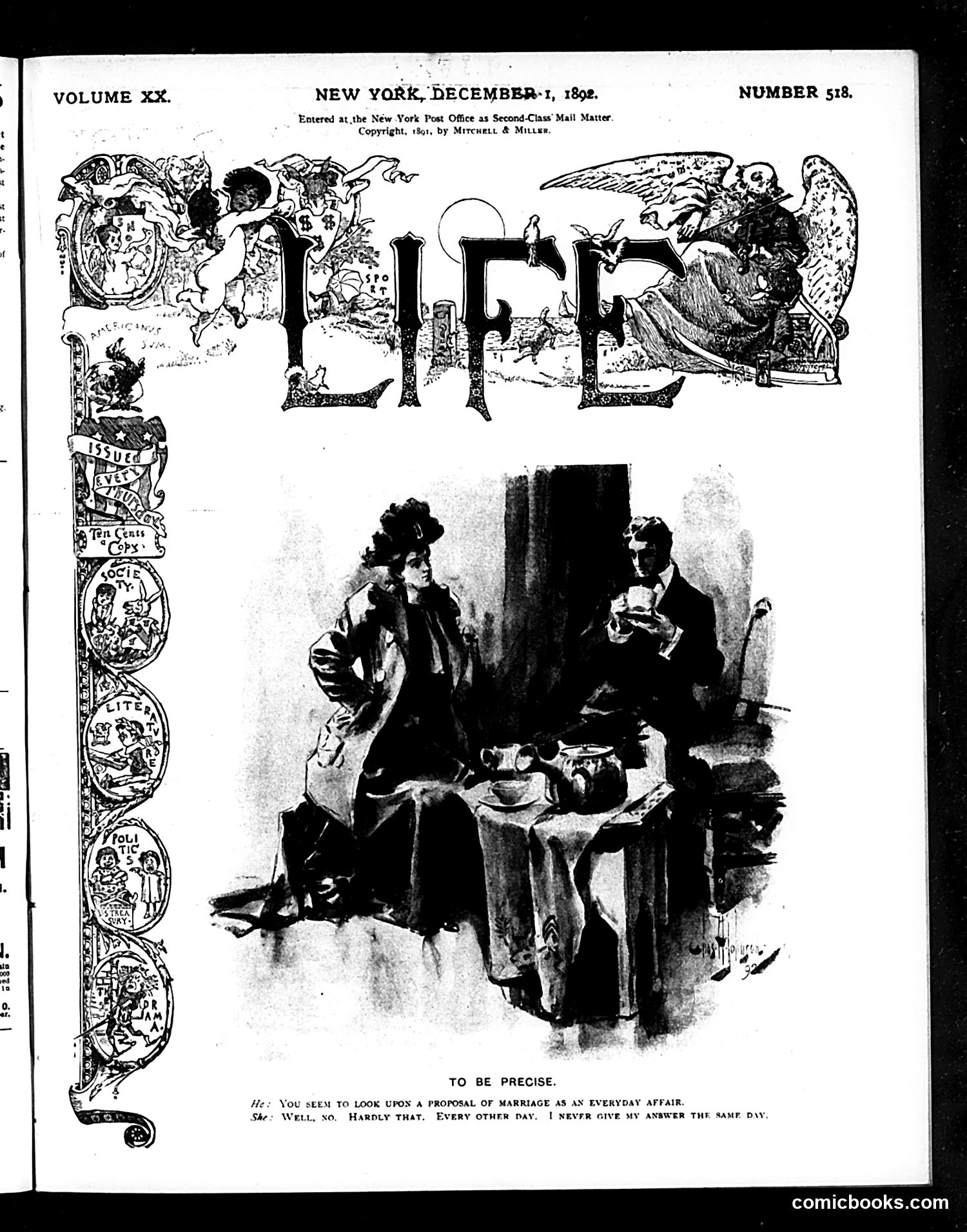
This satirical cartoon depicts a domestic disagreement about marriage proposals. The caption establishes the joke: a man claims he views marriage as an "everyday affair," while the woman insists she "never give[s] [her] answer the same day." The humor targets late-Victorian courtship customs, where formal marriage proposals followed strict social protocols. The woman's position—refusing to answer immediately—reflects period etiquette that required a woman to appear thoughtful and deliberate rather than eager or impulsive. The cartoon satirizes both stuffy romantic conventions and the tension between genders over who controls the pace and formality of courtship. The ornate decorative border and title "LIFE" emphasize this is satirical social commentary on upper-class matrimonial expectations.
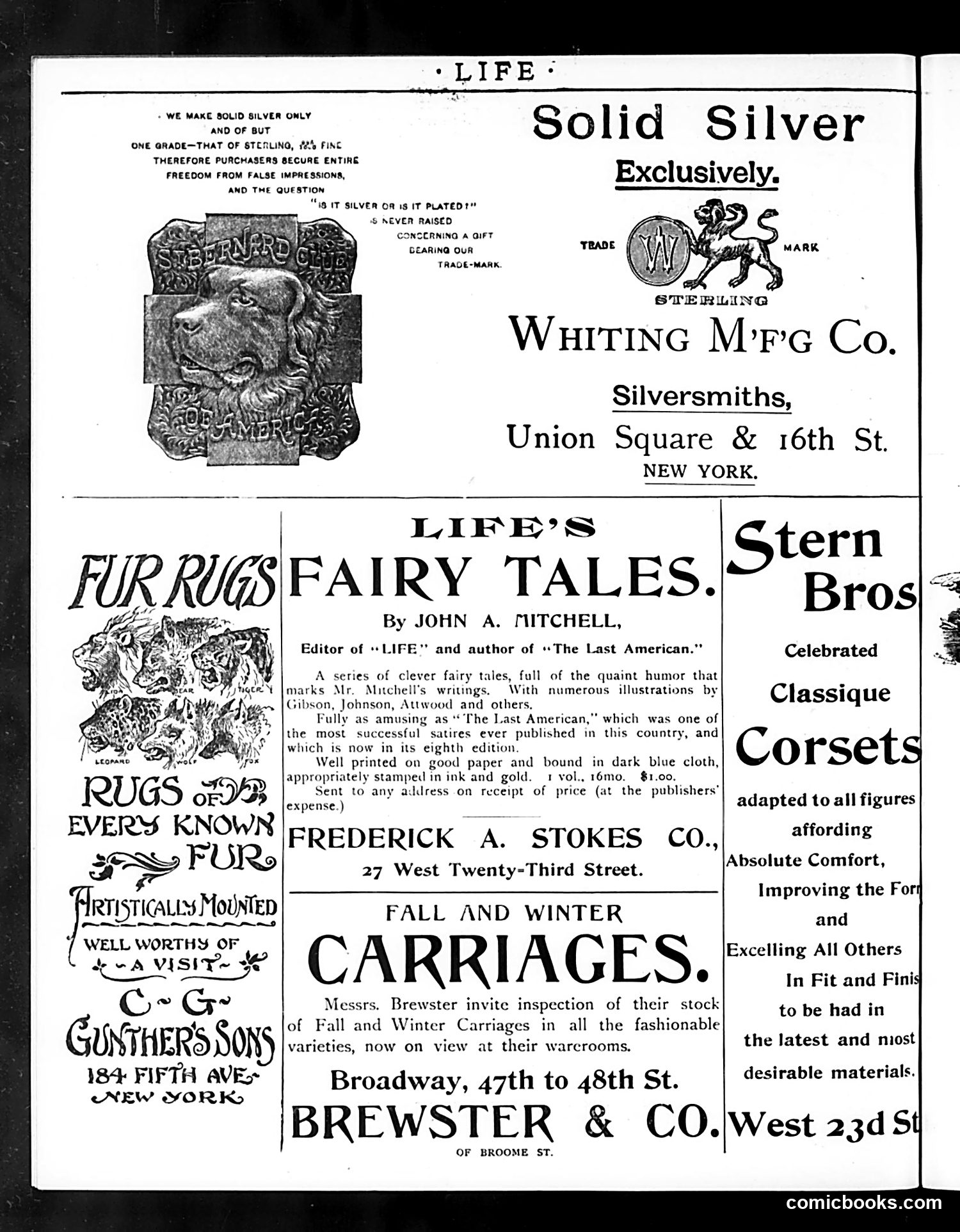
This page is primarily **advertising**, not political satire or comics. The main content promotes luxury goods and services to wealthy New York readers circa the late 1800s: - **Whiting M'fg Co.** advertises solid sterling silver flatware and serving pieces, emphasizing authenticity to counter "false impressions" - **Life's Fairy Tales** by John A. Mitchell (the magazine's editor) announces a forthcoming book - **Stern Bros.** promotes high-end corsets - **Gunthers Sons** advertises artistically-mounted fur rugs - **Frederick A. Stokes Co.** publishes Mitchell's work - **Brewster & Co.** invites inspection of fashionable carriages The ornamental typography and illustrated trade marks reflect the advertising style of the era. There is **no political cartoon or satirical content** visible on this page—it's a straightforward commercial section targeting affluent consumers.
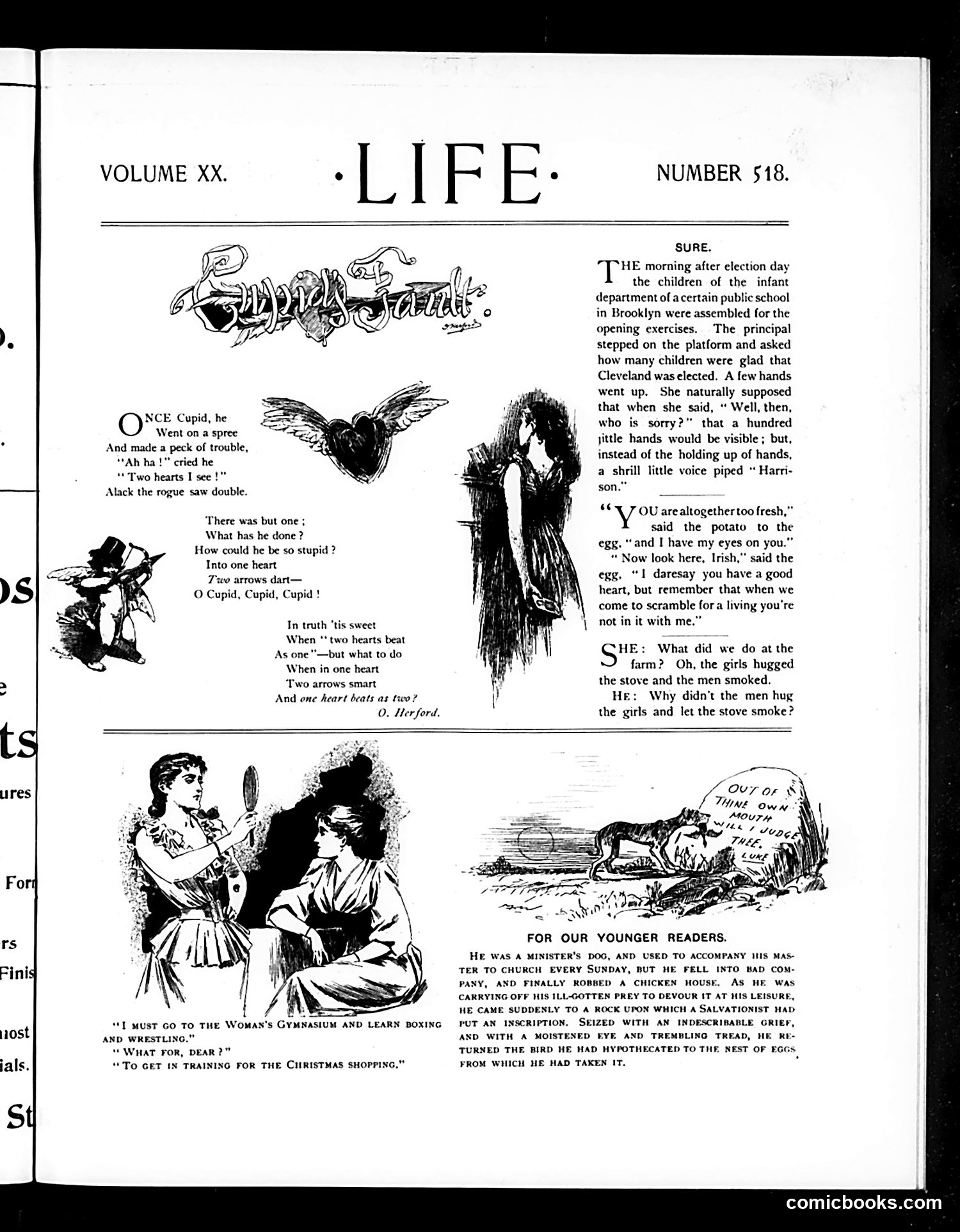
This page contains several satirical pieces unrelated to each other: 1. **"Cupid's Fault"** - A poem mocking romantic complications, illustrated with Cupid imagery. The satire suggests romantic entanglements create problems rather than happiness. 2. **"Sure"** - A dialogue satirizing post-election disappointment. After Cleveland's election, a principal asks children if they're "glad," but one child candidly expresses sorrow, highlighting the political division of the era and children's honest reactions to adult political outcomes. 3. **"For Our Younger Readers"** - A humorous anecdote about a minister's dog who steals a chicken and later feigns innocence, satirizing hypocrisy and deception. The page also includes illustrations of women and dialogue about women's gymnasium activities, suggesting contemporary debates about women's education and athletic participation.
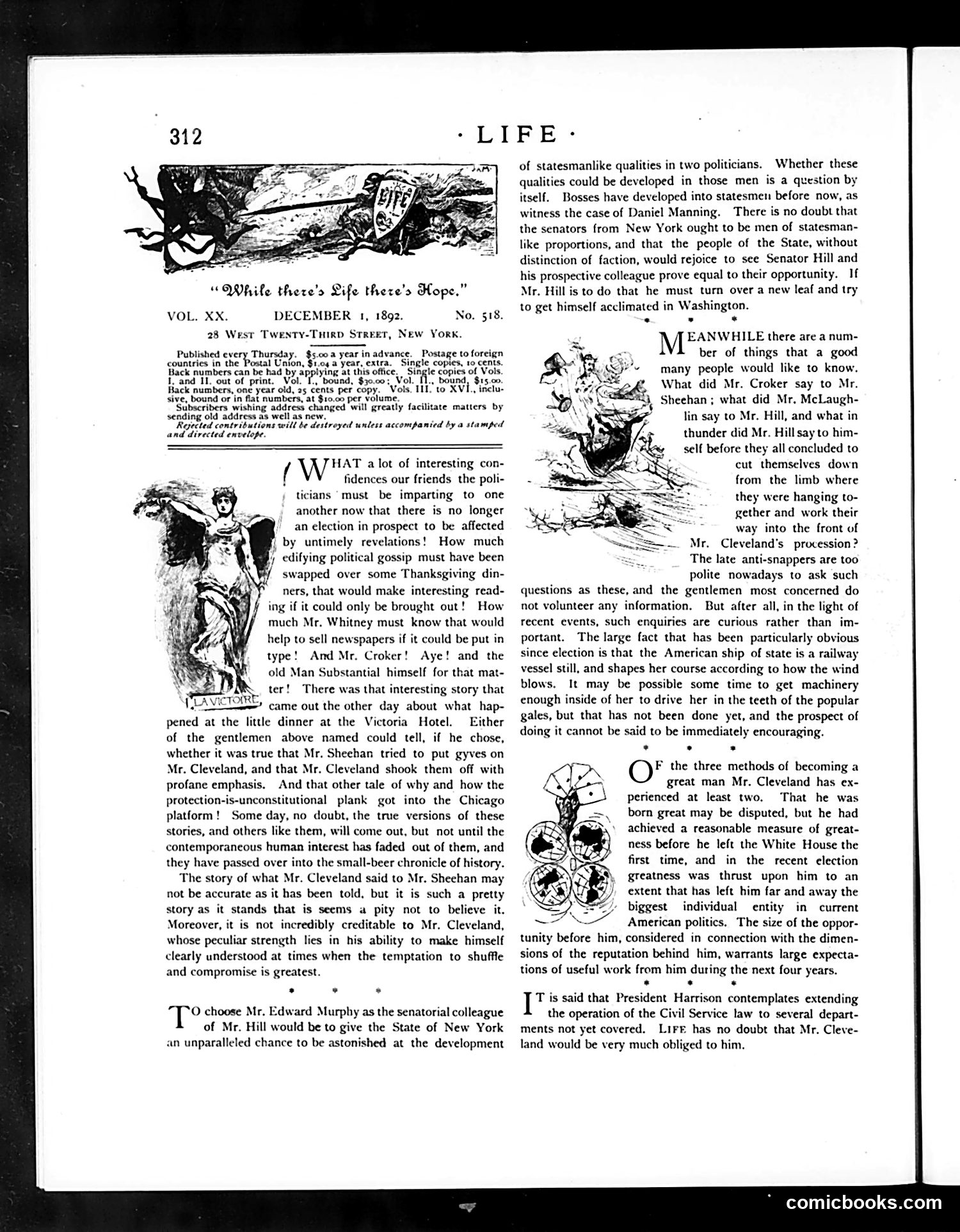
This page discusses recent political gossip involving prominent figures. The text references **Mr. Sheehan**, **Mr. Cleveland**, and **Mr. Hill**—likely New York politicians involved in internal Democratic disputes. The satire mocks the prevalence of political rumors, particularly regarding alleged confrontations at a Victoria Hotel dinner. The writer questions what various politicians actually said to each other, suggesting such gossip dominates political discussion. The page also discusses **President Harrison** and potential Civil Service law extensions, suggesting Life's skepticism about political promises. The decorative illustrations (classical figures and cherubs) are typical period ornamentation rather than specific political caricatures. The overall tone criticizes how politicians engage in behind-the-scenes maneuvering while the public obsesses over unverified rumors rather than substantive policy.
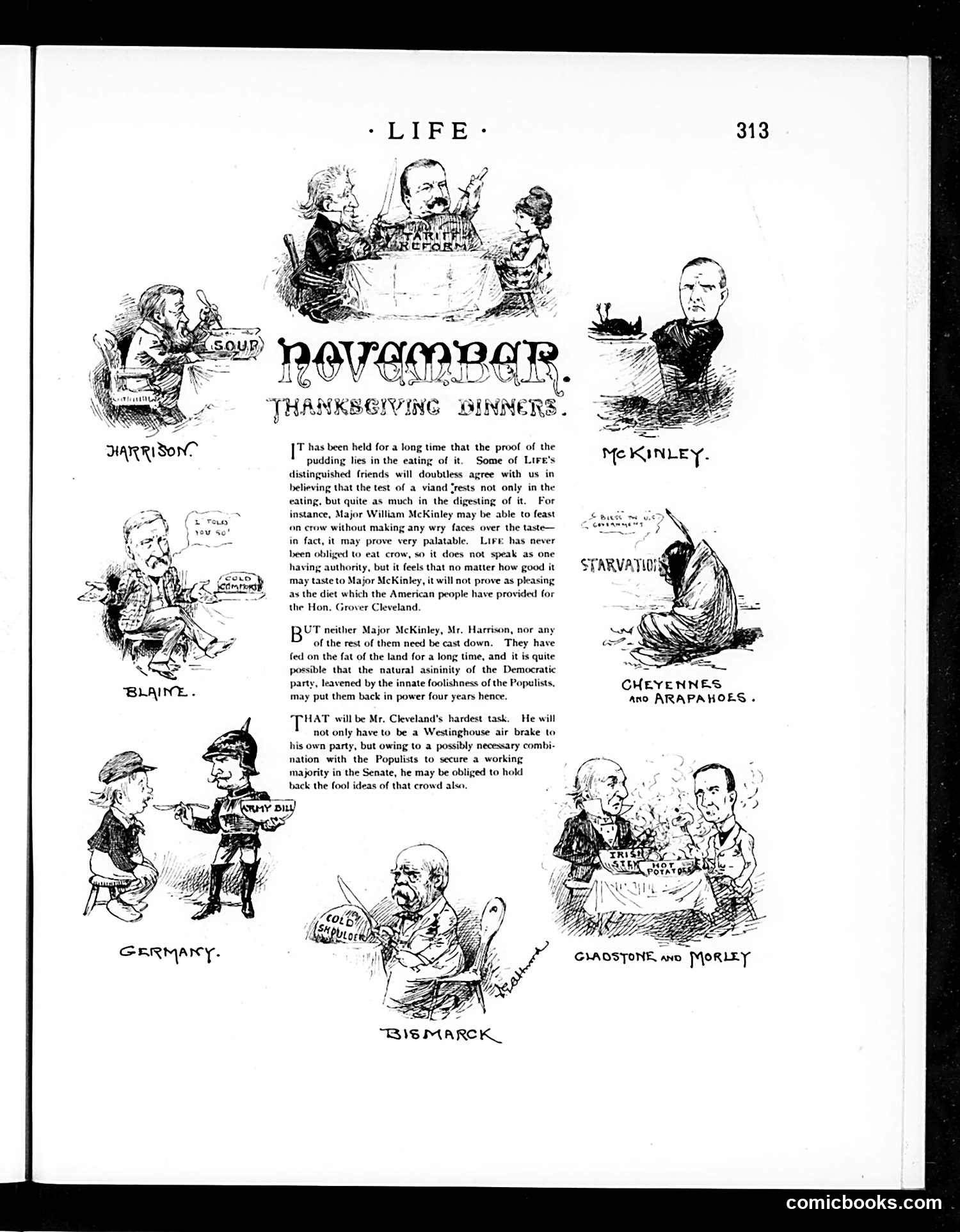
This page satirizes prominent political figures of the 1890s facing difficult circumstances, using "Thanksgiving dinners" as metaphor. The text argues that while Life's friends doubt the "pudding" (policies) works, certain leaders must "eat crow" — accept humiliating defeat. **Identified figures:** - **McKinley**: facing starvation (economic hardship) - **Harrison, Blaine, Cleveland**: similarly struggling - **Bismarck, Gladstone, Morley, Germany**: dealing with political/military challenges - **Cheyennes and Arapahoes**: referenced alongside starvation imagery The satire mocks these leaders' inability to resolve crises—suggesting their "Thanksgiving" will be meager, forcing them to consume their failed policies. The cartoon appears critical of late-19th-century political failures and unpopular decisions.
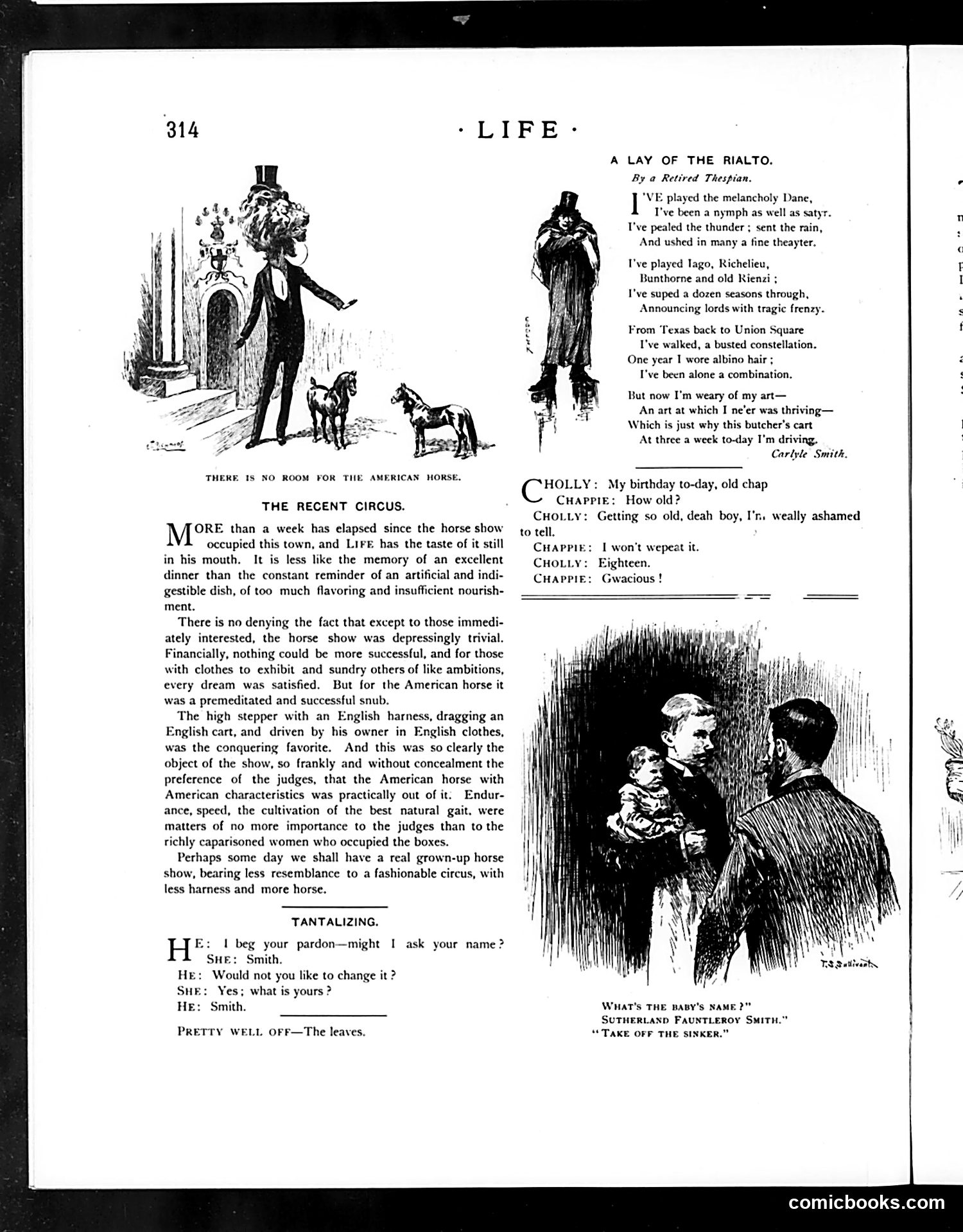
This page from *Life* magazine contains three distinct satirical pieces: **"The Recent Circus"** critiques a horse show where an English horse in English harness was judged superior to American horses. The satire argues that American horses possessed superior "endurance, speed, [and] cultivation of the best natural gait," but judges unfairly favored foreign characteristics. This reflects late-19th/early-20th-century tensions about American versus European standards. **"A Lay of the Rialto"** is a poem by Carlyle Smith lamenting an actor's career decline, performing progressively smaller roles. **"Tantalizing"** and the dialogue with illustration below are light comedic sketches about names and domestic situations, unrelated to political content. The page emphasizes cultural criticism and humor rather than political satire.
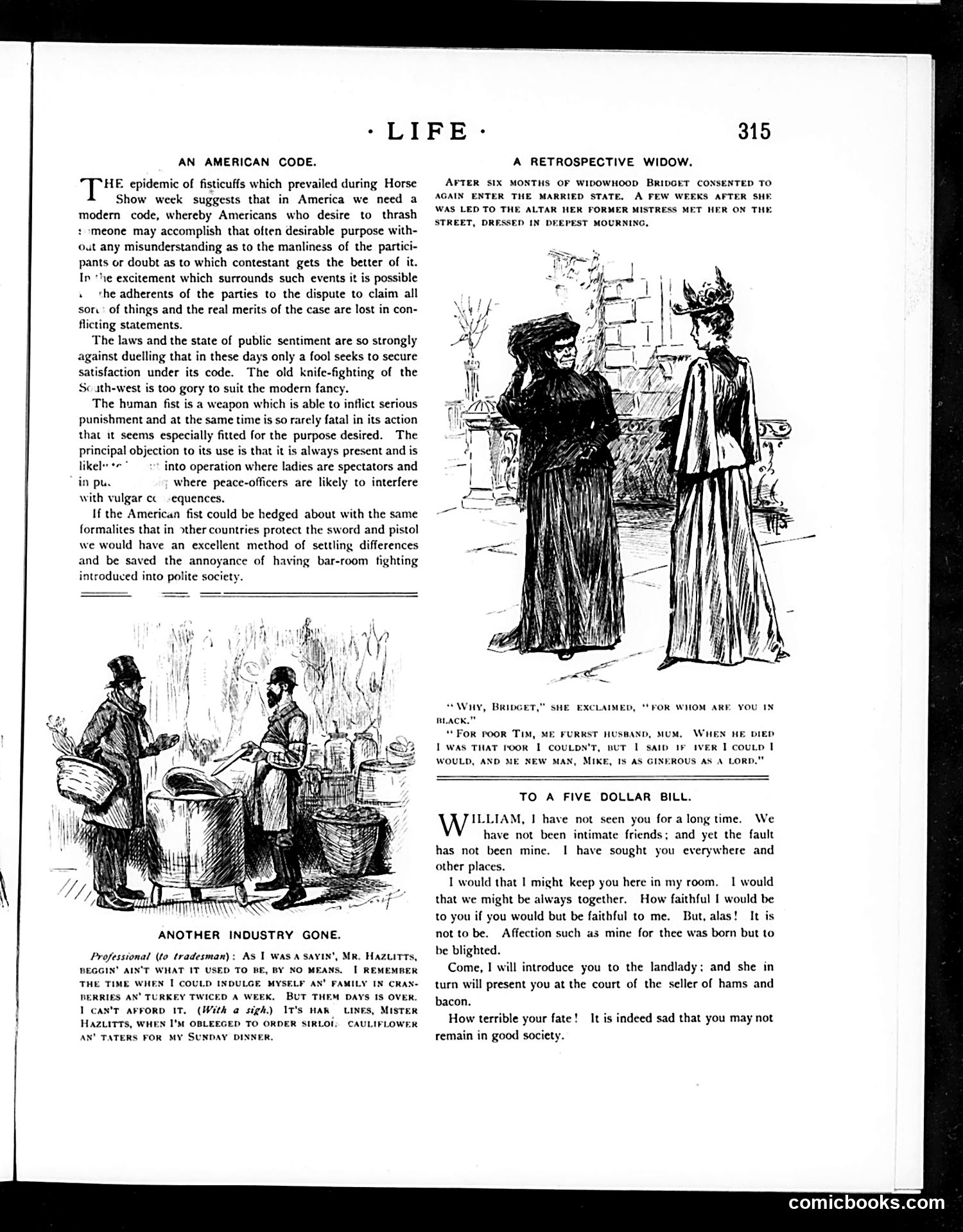
This page contains two distinct pieces: **"An American Code"** (top left): A satirical editorial arguing Americans need formal rules governing fistfighting, similar to codes protecting swords and pistols in other countries. It critiques bare-knuckle boxing as disruptive to public order, suggesting regulated fisticuffs would reduce bar-room violence and police interference. **"Another Industry Gone"** (bottom cartoon): A comic dialogue between working-class men lamenting lost prosperity. One recalls when he could indulge his family with luxuries like cranberries and turkey weekly; now he can only afford sirloin and cauliflower for Sunday dinner. It satirizes economic hardship affecting ordinary workers' living standards. **"A Retrospective Widow"** (right): A narrative illustration showing a widow in mourning encountering another woman, reflecting on her late husband's memory and her remarriage.
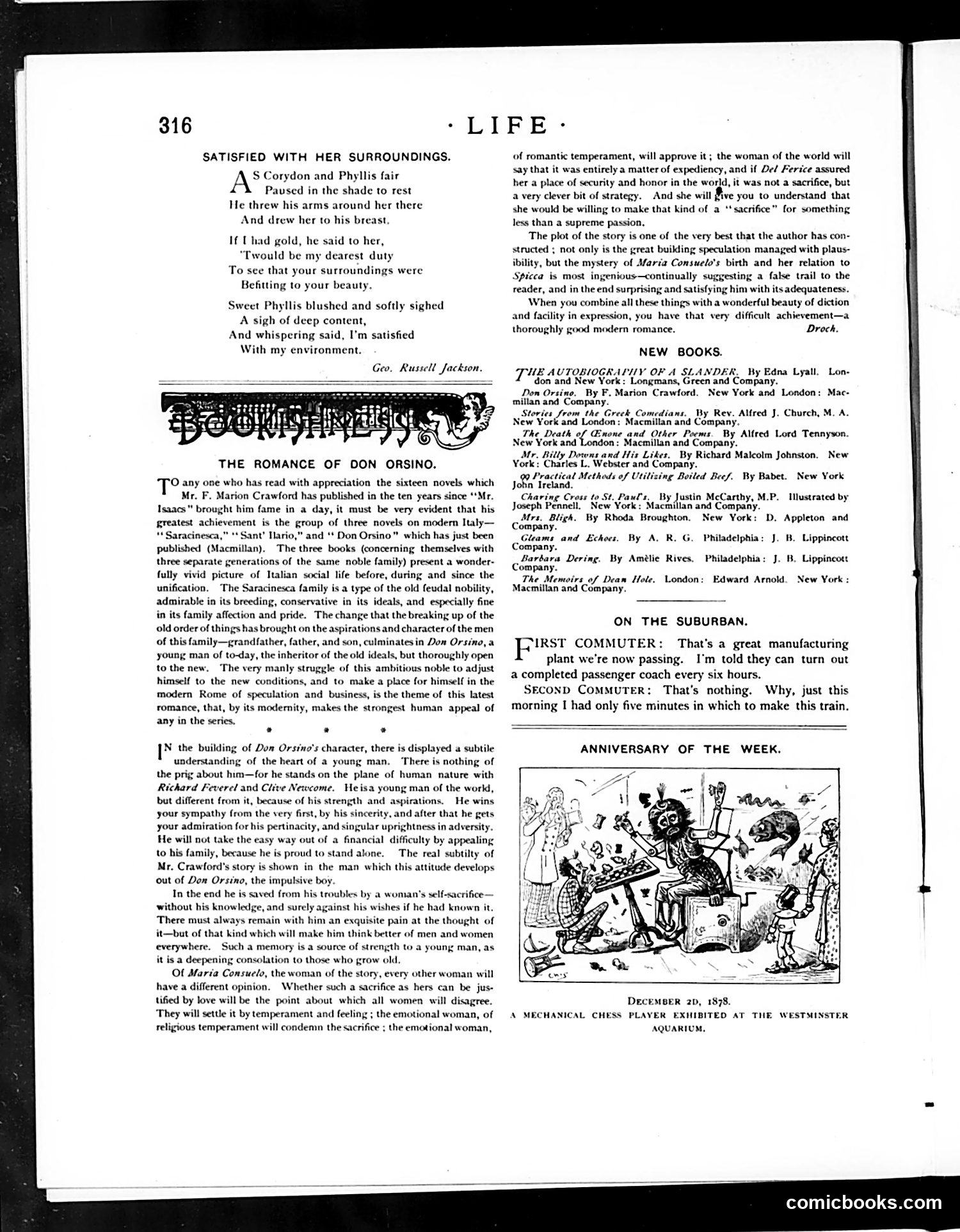
This cartoon, dated December 20, 1898, illustrates "A Mechanical Chess Player Exhibited at the Westminster Aquarium." The image depicts an elaborate contraption with gears, levers, and mechanical components operated by hidden machinery. The satire targets the famous "Turk"—a celebrated 18th-century chess-playing automaton later revealed as a hoax operated by a concealed human player inside. The cartoon mocks public fascination with such mechanical "wonders" and the gap between advertised spectacle and reality. By 1898, the original Turk's deception was well-known, making this exhibit's similar claims suspect. The illustration humorously exposes how audiences were willing to suspend disbelief for entertainment, despite historical precedent for mechanical fraud.
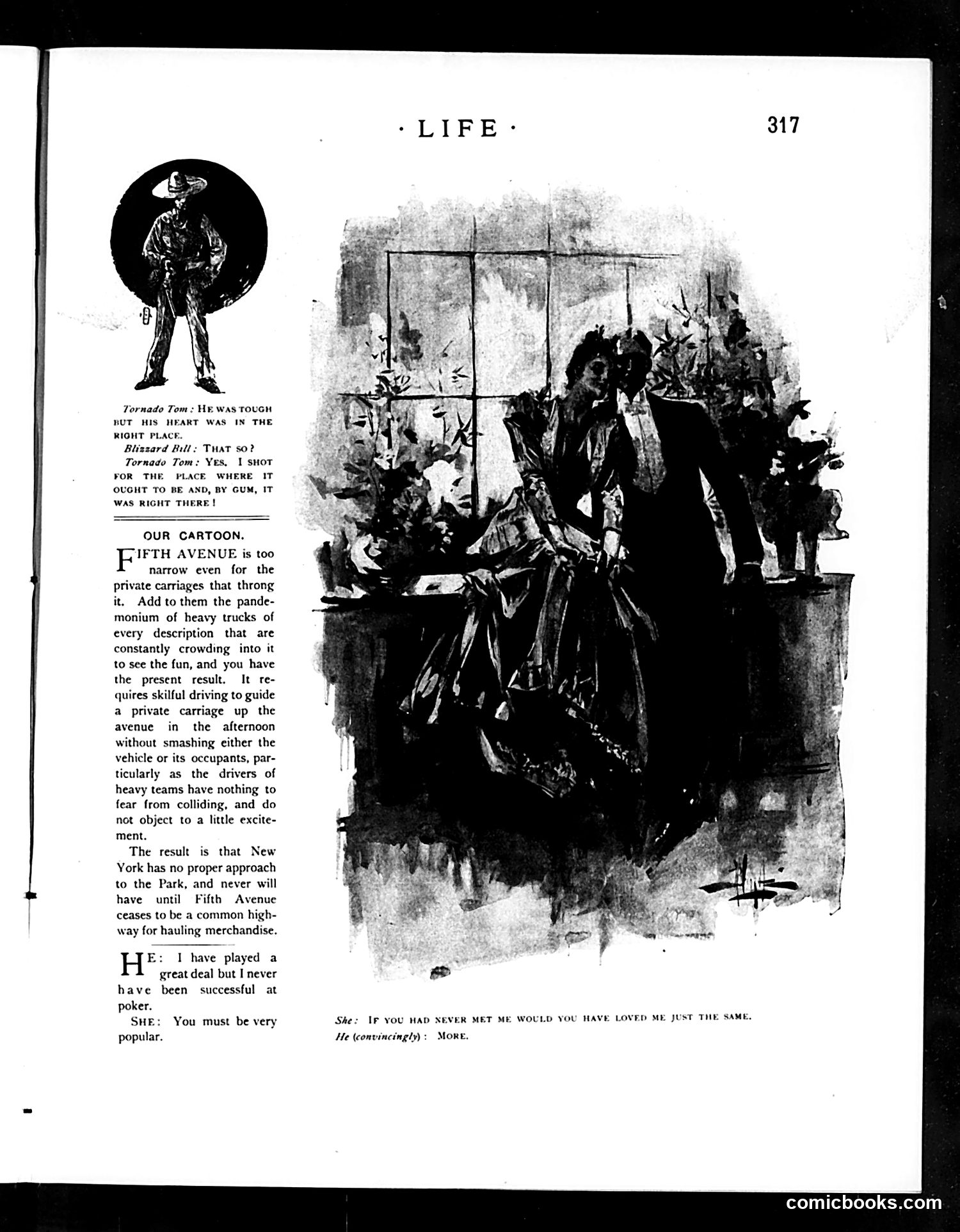
This page satirizes **Fifth Avenue traffic congestion** in New York City. The main cartoon depicts a chaotic street scene with carriages, trucks, and pedestrians dangerously crowded together on Fifth Avenue. The accompanying text argues that Fifth Avenue has become too narrow for the volume of traffic—private carriages, heavy trucks constantly entering to view the park, creating hazardous conditions. The satire criticizes the lack of proper approach to the Park and notes New York won't have adequate access until Fifth Avenue becomes a designated commercial highway. The small vignette at top left featuring "Tornado Tom" and "Blizzard Bill" appears unrelated character dialogue, possibly from another story or comic feature in the magazine.
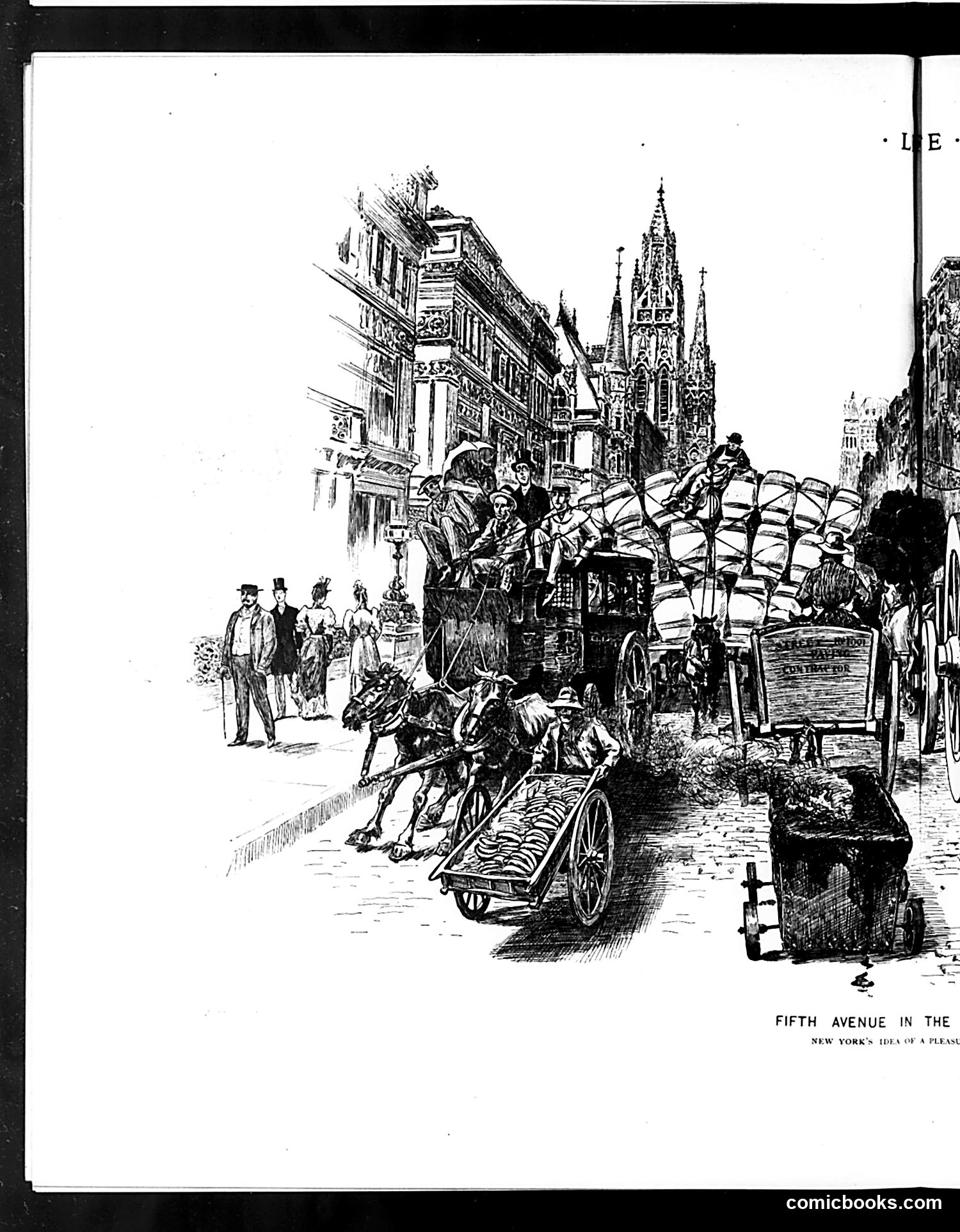
This illustration depicts a satirical vision of Fifth Avenue, Manhattan's famous thoroughfare. The sketch shows a chaotic street scene dominated by various forms of transportation and commerce—hand-pulled carts, loaded wagons, and pedestrians crowded together on the street. The caption's subtitle, "New York's Idea of a Pleasure," suggests the cartoonist is mocking how crowded, congested, and commercialized Fifth Avenue had become. Rather than presenting it as an elegant shopping destination, the drawing emphasizes disorder, manual labor, and traffic congestion. The Gothic spire visible in the background likely references a prominent church or architectural landmark to establish the Fifth Avenue location. The satire critiques urban overcrowding and commercialization in early 20th-century New York.
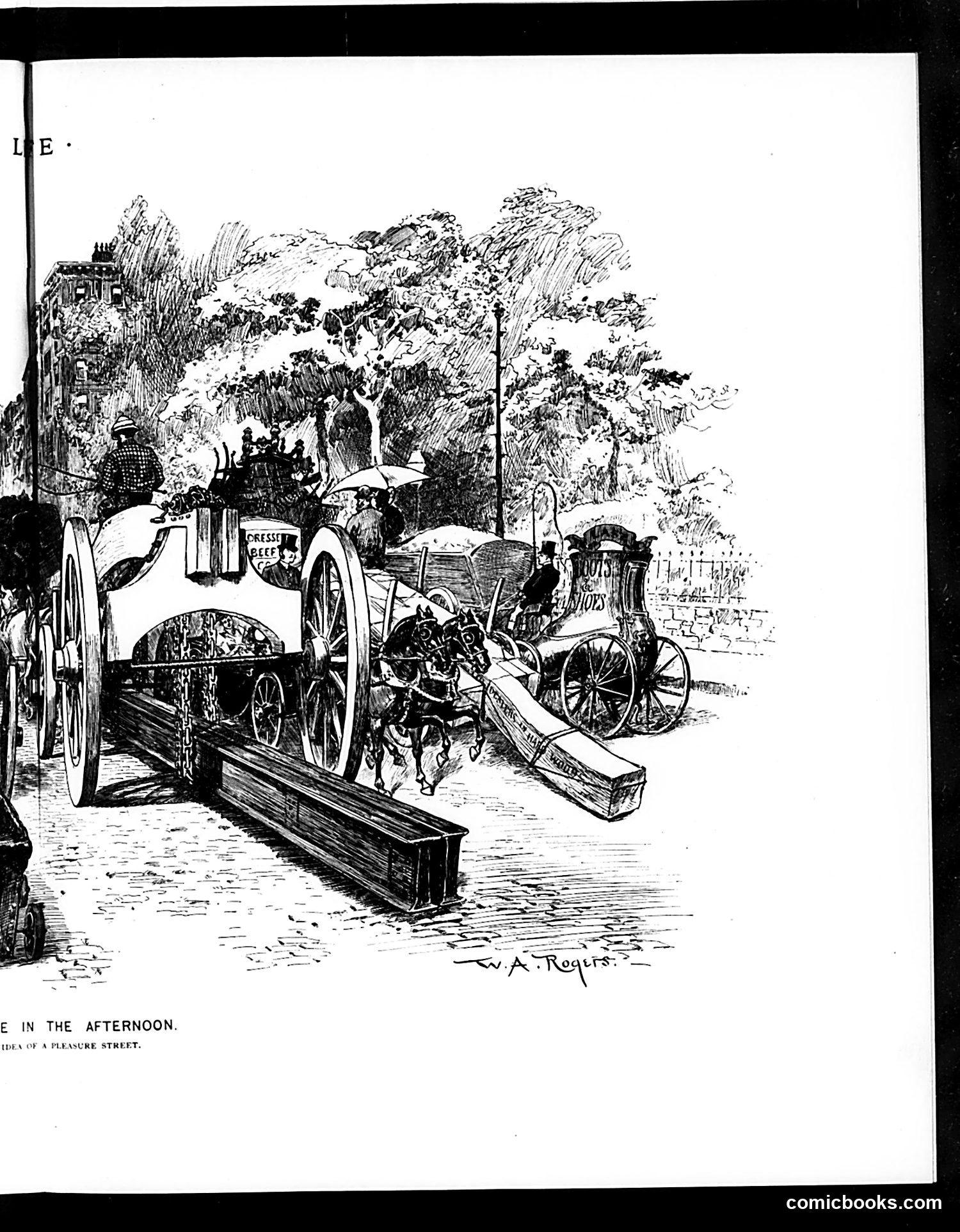
This is an illustration titled "A Pleasure Street" (subtitle: "Idea of a Pleasure Street"), signed by W.A. Rogers. It depicts a street scene with horse-drawn carts and vendors, featuring what appears to be a "Press Beer" advertisement visible on one of the carts. The image illustrates an urban commercial street, likely satirizing the commercialization of public spaces or the mixing of commerce with leisure. The crowded, somewhat chaotic arrangement of carts and pedestrians suggests commentary on how commercial interests have colonized what should be pleasant public areas. Without additional context about the specific historical moment this appeared in Life magazine, the precise satirical target remains unclear, though it appears critical of how marketing and vendors dominate public spaces meant for relaxation.
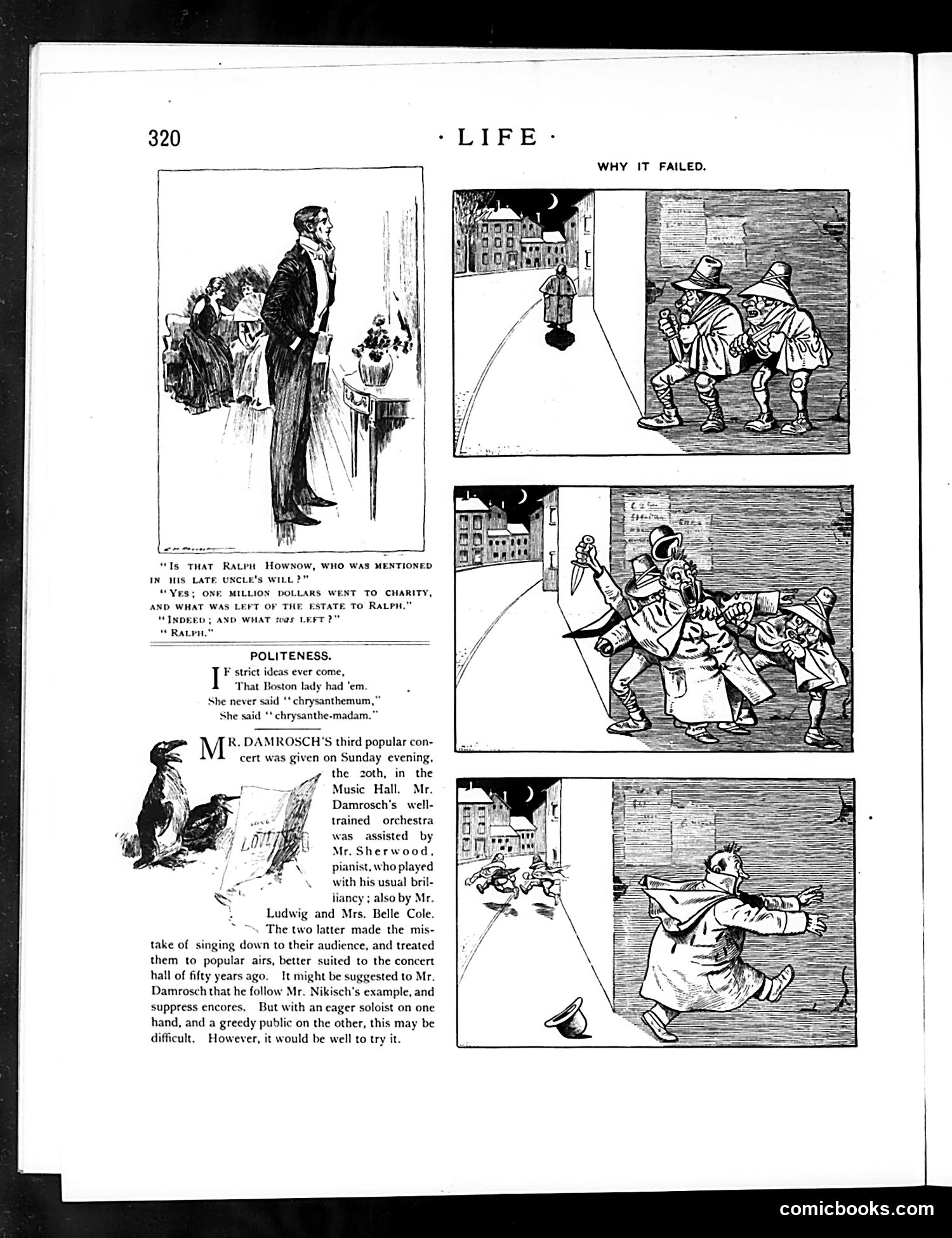
This page contains three separate satirical pieces: 1. **Upper Left Cartoon**: A joke about inheritance. A man asks about "Ralph Hownow" mentioned in his uncle's will. The punchline: one million dollars went to charity, leaving Ralph essentially nothing—a satire on miserly wills and disappointed heirs. 2. **"Politeness" Section**: A brief humorous verse mocking overly formal Boston etiquette. A "Boston lady" pronounces "chrysanthemum" as "chrysanthe-madam" to avoid saying the word directly—satirizing affected propriety. 3. **Music Criticism**: A review of conductor Damrosch's concert criticizing the accompanying singers (Ludwig and Mrs. Belle Cole) for "singing down to their audience" with popular songs instead of serious concert material. The critic suggests suppressing encores and following conductor Nikisch's stricter standards—satirizing both pandering performers and undiscerning audiences who prefer lowbrow entertainment. The page exemplifies *Life*'s satirical approach to American social pretension and cultural standards of the era.
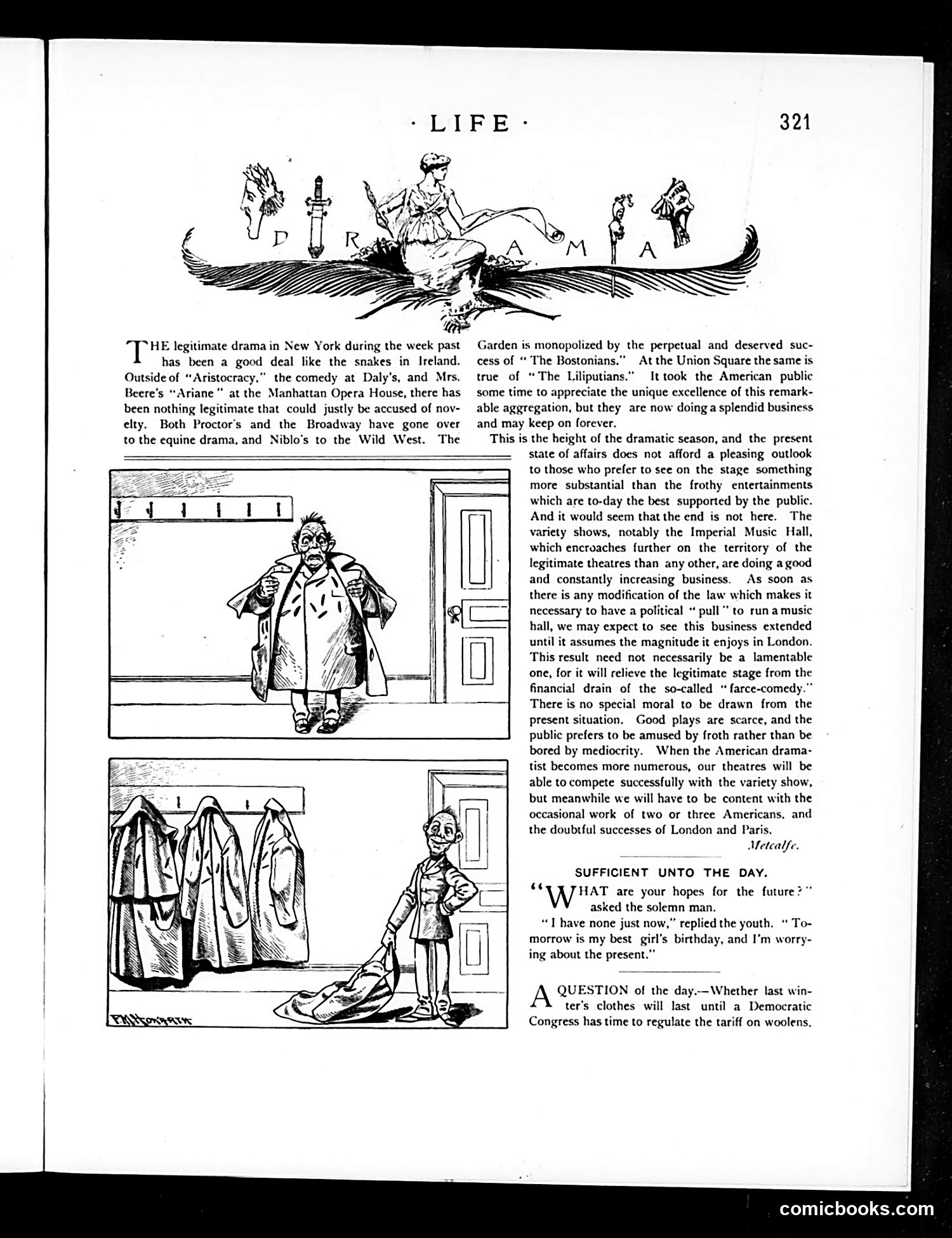
This page contains theater criticism by Metcalfe lamenting New York's dramatic season. The author complains that legitimate drama has been eclipsed by "frothy entertainments"—horse dramas at Proctor's and Broadway theaters, Wild West shows at Niblo's, and variety shows like the Imperial Music Hall. He notes that genuinely good plays are scarce, forcing theaters to rely on imported works from London and Paris. The two illustrated panels appear to depict theatrical scenes, likely supporting the criticism of lower-quality entertainment dominating stages. Below the main article are two brief humor items: a joke about a youth more concerned with his girlfriend's birthday than the future, and a political jab questioning whether winter clothes will survive until a Democratic Congress can regulate wool tariffs—likely referencing contemporary tariff debates affecting textile prices and consumer costs.
This page consists primarily of humorous anecdotal pieces rather than political cartoons. The main content includes: **"The Fad"** - A poem satirizing the Victorian obsession with decorative cushions, where a husband complains his home is so filled with cushions his wife has purchased that there's literally nowhere to sit. **Untitled Anecdotes** - Several brief jokes about everyday life, including: - A father-son story where the son complains about a customer's misspelling, but the father notes the customer "pays cash" (implying practical business sense trumps perfectionism) - A Chicago businessman's impatience with tourist stops at Niagara Falls - A reference to Chicago meat-packing industry wealth and social status The page is primarily filled with period advertisements for soap, hats, whiskey, tobacco, and other products, which was typical of Life magazine's revenue model. There are **no clear political cartoons** visible on this page—the humor is domestic and commercial rather than political satire.